
Middle East and Africa LEO Terminal Market Summary
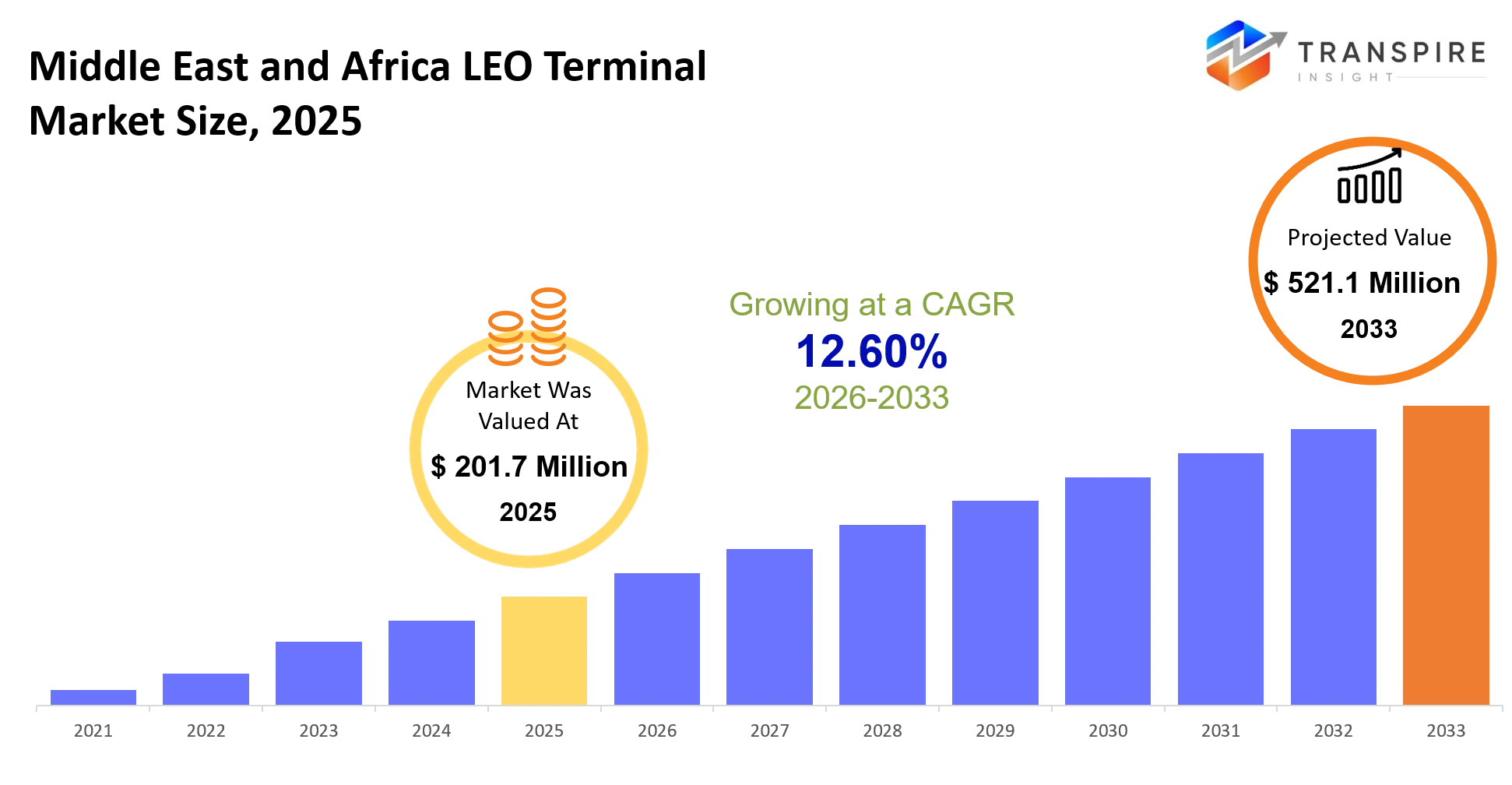
As per Transpire Insight Analysis the Middle East and Africa LEO Terminal Market size is estimated at USD 201.7 Million in 2025 and is anticipated to reach USD 521.1 Million by 2033, growing at a CAGR of 12.60% from 2026 to 2033.
In the Middle East and Africa, the LEO Terminal Market kinda sits at the center of things, it helps deliver ultra fast, low delay satellite connectivity to places where regular , terrestrial communication setups are weak or just not there. These LEO terminals make it possible to get broadband working for maritime vessels, defense activities, oil and gas facilities, mining operations, aviation needs, emergency response teams, and also remote businesses. What really matters is that they can keep the links dependable across deserts, offshore waters, and those hard to reach industrial pockets, so overall they’re becoming a key piece of today’s digital backbone.
During roughly the last 5 years, the market moved away from the older geostationary satellite arrangements and leaned more toward low Earth orbit constellations. Those constellations generally bring much lower latency and noticeably higher throughput. With commercial rollouts such as Starlink and Eutelsat OneWeb, plus geopolitical disruptions that made people pay attention to resilience, more investment flowed into portable and mobile LEO terminals. And since more industries depend on live operational insights, plus cloud based applications, many organizations are upgrading their satellite hardware to make network performance better. That, in turn, supports stronger equipment sales, recurring service income, and wider take-up across the Middle East and Africa, even in pretty challenging environments.
Middle East and Africa LEO Terminal Market Size & Forecast:
- Middle East and Africa LEO Terminal Market Size 2025: USD 201.7 Million
- Expected Market Value 2033: USD 521.1 Million
- Forecast CAGR: 12.60%
- Leading region in 2025:United Arab Emirates (UAE)
- Fastest-growing region:South Africa
- Key Profile: SpaceX (Starlink), Eutelsat OneWeb, SES, Intellian Technologies, Kymeta, Hughes Network Systems, Viasat, Gilat Satellite Networks, Cobham Satcom, Honeywell, Thales, ST Engineering iDirect, Hanwha Phasor, AVL Technologies, Satcube
Key Market Insights
- Regional Analysis: GCC nations are kinda leading the Middle East and Africa LEO Terminal Market, with around 42% market share in 2025, mainly related to defense modernization, offshore energy commitments, and that ongoing digital infrastructure expansion, which still looks like it’s accelerating.
- Fastest-Growing Region: Sub-Saharan Africa should grab the quickest momentum all the way until 2033, pushed by rural broadband deployment, mining connectivity, and enterprise digitization initiatives that honestly are spreading pretty quickly.
- Segment Analysis: Fixed LEO terminals are still in front, getting close to 34% market share in 2025, mainly because enterprises, governments, and energy organizations keep installing them.
- Portable LEO terminals sit in the next tier, fueled by emergency response activities, humanitarian operations, and military field deployments. Meanwhile mobile and maritime LEO terminals are forecasted to grow the quickest across 2026–2033, with connected fleets and autonomous vessel use-cases doing a lot of the heavy lifting.
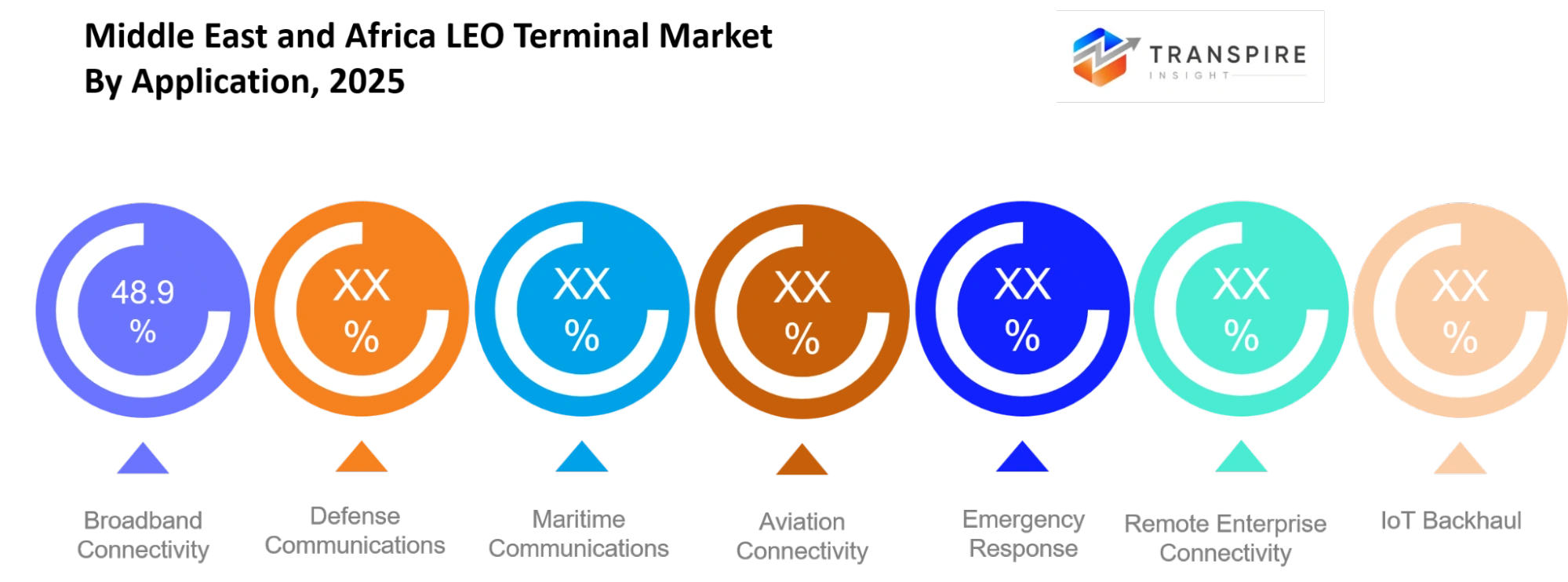
- Application Insights: Broadband connectivity takes the biggest slice, at around 31% of total demand, so it stays the top application area. Defense communications are emerging as the fastest-moving application , because regional security initiatives are pushing investments into resilient satellite networks.
- End-User Insights: Government and defense organizations contribute roughly 36% of market revenue, while commercial maritime and offshore energy companies are ramping up procurement rather aggressively.
- Competitive Landscape: SpaceX (Starlink), Eutelsat OneWeb, SES, Intellian Technologies, Kymeta, and Hughes Network Systems continue to strengthen their positions through electronically steered antennas, multi-orbit terminals, and regional alliances, these strategies look persistent.
What are the Key Drivers, Restraints, and Opportunities in the Middle East and Africa LEO Terminal Market?
The most powerful force driving that market, well expansion i guess, is really the rollout of commercial LEO satellite constellations that can deliver connectivity that feels fiber-like, but with way lower latency compared with older geostationary setups. Governments, offshore energy operators, shipping businesses, and mining companies are now asking for nonstop broadband for cloud workloads, remote observation, and operational analytics. Meanwhile, defense organizations across the Gulf area are putting money into hardened communications that keep working even when infrastructure gets disrupted. Because of this, there’s been a noticeable increase in the purchase of fixed, portable and also mobile LEO terminals ,and that also opens up steady recurring revenue via subscription connectivity services.
Still, the biggest structural snag stays the same, the overall cost to own and operate these systems is high, especially when you consider both the advanced LEO terminals and the supporting network infrastructure. Electronically steered antennae, ruggedized equipment, field installation, ongoing maintenance, and subscription charges together become major capital commitments. This is especially true for groups running operations across several far off sites. On top of that, spectrum licensing differences, regulatory sign-offs, and the fact that local integration is limited, all end up stretching out the timelines. Those constraints make adoption harder for small companies and for developing economies, which in turn limits near term revenue, even though the demand for connectivity keeps growing.
A real opening is in scaling digital connectivity in underserved areas across Sub-Saharan Africa through public-private partnerships and universal broadband programs.
What Has the Impact of Artificial Intelligence Been on the Middle East and Africa LEO Terminal Market?
Artificial intelligence and advanced digital technologies are making the performance, dependability, and day to day operational efficiency better for LEO terminal deployments across the Middle East and Africa. More and more network operators are leaning on AI driven traffic management systems to move bandwidth around dynamically, to choose the most suitable satellite beam, and to sort out terminal settings automatically based on what users need and which satellites are presently available. Overall, these improvements cut down congestion while keeping links steadier especially for ships, distant industrial sites, and defense related missions.
At the same time, machine learning models are helping with predictive maintenance by watching antenna alignment , signal quality, hardware temperatures, and different network performance signals all the while. Instead of waiting for routine checkups, operators can often spot equipment wear ahead of time, before failures happen. That approach lowers downtime and also reduces maintenance spending. AI assisted optimization also tightens energy usage, improves how the spectrum is used, and it allows faster transitions between different satellite constellations. The result is higher network uptime, and more capable communications even when the operating conditions are pretty harsh.
Still, AI rollouts aren’t completely smooth. A lot of remote setups don’t have much historical operational information, so predictive models can be less accurate during the early stages of deployment. Also, inconsistent connectivity, stricter cybersecurity obligations , and the expense of connecting AI software with older satellite systems keep slowing progress. This is especially noticeable for smaller operators that have smaller technology budgets and less room to experiment.
Key Market Trends
- Commercial LEO constellations have been getting more customer mindshare since 2021, mainly because the comms latency is way lower than the old GEO-just approach. Not that people completely ditched GEO, it’s just that the preference kind of swung, sort of noticeably, over time.
- Electronically steered antennas also have seen broader adoption, because makers kept shrinking the size weight and power side of things for moving users, you know, mobile scenarios.
- Multi orbit terminals are now showing up as the “go to” enterprise setup, they blend LEO, GEO, and MEO links so the service is more resilient, which is a nice thing for uptime.
- On the defense side, procurement folks increasingly lean toward secure portable terminals, ones that can handle real time intelligence surveillance, plus tactical communications. That combination matters a lot.
- Offshore oil and gas operators have likewise expanded satellite broadband spending, aimed at digital field monitoring and predictive maintenance platforms. This is becoming normal, not experimental.
- Shipping companies are moving away from older VSAT setups, and switching to hybrid satellite terminals that support cloud based fleet management, and even crew welfare services, which sounds small but it actually counts.
- Regional telecom operators have also expanded partnerships with major global satellite providers since 2022, to speed up broadband coverage in places that were otherwise underserved and slow to get attention.
- Terminal manufacturers are increasingly folding in software defined networking, AI assisted beam management, and remote diagnostics. The idea is to improve operational efficiency without having to babysit the equipment all the time.
- Then there were supply chain disruptions, which pushed manufacturers to spread out production spots and component sourcing, so hardware availability improved after 2023.
- Companies like SpaceX, Eutelsat OneWeb, Intellian Technologies, Kymeta, Hughes Network Systems, and Thales continue growing their product lines, mostly via strategic partnerships and ongoing technology innovation, in case anyone wondered.
Middle East and Africa LEO Terminal Market Segmentation
By Terminal Type
Fixed LEO Terminals help keep permanent links working across industrial facilities, government buildings, mining operations, and even remote energy sites, basically all those places where you need the same connection most of the time. The installation stays put and the connectivity keeps running , so this segment is a good match for long term operations that really need steady network performance. Portable LEO Terminals give a more flexible setup for field teams disaster response units, and temporary work locations. Mobile LEO Terminals are for when you need communication while moving along land routes, supporting transport logistics, and security tasks as you go.
Maritime Terminals provide broadband connectivity for commercial vessels, offshore platforms, and support ships that are far from terrestrial networks. Aviation Terminals allow near uninterrupted communication for aircraft , which helps passenger connectivity and also supports operational data sharing during flights. Rugged Military Terminals are built to handle harsh environments and they support secure communications during defense missions. Enterprise Terminals are for corporate sites that need dependable satellite access , while Others covers specialized terminal designs that get developed for particular commercial or government requirements, so not everything looks the same.
By Frequency Band
Ka-band kind of enables fast broadband services, mainly because it has more bandwidth capacity and tends to move data efficiently, in practice. It also feels like it fits cloud applications, video communication, and enterprise networking really well, so many commercial industries choose it as a kind of preferred option. Ku-band keeps getting broad acceptance too, mostly due to the established satellite infrastructure and because it shows dependable performance across various operating conditions. X-band still matters a lot for defense and government communication, not just in theory, because it offers secure transmission and reliable performance during those critical operations.
S-band supports use cases that need dependable connectivity even when weather conditions change, and it’s used for selected communication services. Multi-band solutions, for the record, improve network flexibility since they can operate over several frequency ranges depending on service availability. Hybrid Band technology goes further by mixing different frequency bands, which helps with communication continuity and overall operational resilience. Then there are other categories, like specialized spectrum allocations that are designed for specific industrial research, and government communication needs, more tailored than generic options.
By Application
Broadband Connectivity is really the biggest application, mostly because dependable internet access helps digital operations keep moving across remote industrial sites, commercial facilities and public services with less friction. With ongoing data exchange, organizations can run cloud platforms remote monitoring systems and digital collaboration tools more efficiently, faster than before or at least that’s how it feels in practice. Defense Communications matters too, since it enables secure information exchange, supports surveillance work, and also mission coordination in harsh or complicated environments where signals can be touchy. Maritime Communications and Aviation Connectivity help with operational safety, navigation assistance, and even passenger communication during travel, so people aren’t left in the dark
Emergency Response kicks in when natural disasters hit, or when infrastructure breaks, because communication still has to work even if terrestrial networks go away. Remote Enterprise Connectivity supports mining, construction and energy activities that sit far from major urban communication infrastructure. IoT Backhaul basically lets connected sensors and industrial equipment send their operational data back for monitoring plus automation. Other services include specialized communication for scientific research, environmental monitoring, and temporary field operations.
By End User
Government and Defense organizations are, you know, a pretty big customer group because secure, and resilient satellite communication really helps national security , also border watch, and even emergency readiness. Telecom Operators often turn to satellite terminals to extend broadband coverage into places where fiber build-out still isn’t that practical cost wise. Maritime Companies use satellite links for fleet management, crew wellbeing, and navigation assistance, more or less every day. Aviation Operators improve how their flights run by keeping continuous aircraft communications going and offering passenger internet.
Oil & Gas firms depend on satellite communication to keep offshore platforms and remote production sites connected back to central teams. Enterprises choose LEO terminals so operations don’t fall apart when sites are spread out, or when projects are only temporary. Disaster Management Agencies set up portable communications gear during emergency response work, especially when land based infrastructure goes offline. Other buyers cover research institutions, utilities, and humanitarian organizations who support activities on the ground across remote areas.
By Deployment
Fixed Installation supports permanent communication links across industrial complexes, government sites, and enterprise campuses needing uninterrupted connection. Vehicle-Mounted deployment gives you mobile comms for emergency services, military platforms, utility work, and field inspection crews working over wide geographic zones, even when routes shift. Portable Deployment helps with quick setup for temporary assignments, humanitarian efforts, and disaster recovery programs, where timing matters. Airborne Deployment makes comms available for aircraft used in commercial aviation, surveillance activities, and emergency responses.
Shipborne Deployment provides lasting broadband access for commercial vessels, offshore energy production, and marine research operations that run well beyond normal terrestrial reach. Hybrid Deployment mixes fixed and vehicle based installation styles, so operations stay adaptable as conditions change. Others are possible too, like tailored deployment formats shaped for specialized industrial tasks, scientific initiatives, and government communication projects.
What are the Key Use Cases Driving the Middle East and Africa LEO Terminal Market?
Broadband connectivity still ends up being the main use case, mostly because remote industries need dependable, low latency communication, and honestly terrestrial networks can’t get there most of the time. Mining operations, oil gas facilities, government sites, and different enterprise locations depend on constant satellite links for cloud workloads, operational monitoring, and day to day business messaging. When the connection stays solid, productivity tends to go up and communication dead spots shrink, even for those isolated areas.
Defense communications and maritime operations keep growing too, as governments tighten border protection and as commercial shipping leans harder into digital fleet management. Offshore energy companies, cargo vessels, and port authorities are using satellite terminals more often for navigation assistance, asset observation, crew coordination, and near real time operational updates. Aviation operators are also bringing LEO connectivity in, to enhance aircraft messaging and even improve passenger services.
Newer, emerging uses start showing up as well, like IoT backhaul in smart mining setups, environmental surveillance, and precision agriculture across far off locations where network infrastructure is thin or just missing. Disaster management agencies are adopting portable satellite terminals for emergency response during floods, earthquakes, and humanitarian efforts, when conventional communication systems suddenly aren’t available. With continued spending on digital infrastructure, adoption should broaden into even more industrial sectors during the forecast time.
|
Report Metrics |
Details |
|
Market size value in 2025 |
USD 201.7 Million |
|
Market size value in 2026 |
USD 227.1 Million |
|
Revenue forecast in 2033 |
USD 521.1 Million |
|
Growth rate |
CAGR of 12.60% from 2026 to 2033 |
|
Base year |
2025 |
|
Historical data |
2021 - 2024 |
|
Forecast period |
2026 - 2033 |
|
Report coverage |
Revenue forecast, competitive landscape, growth factors, and trends |
|
Regional scope |
Middle East and Africa (Saudi Arabia, United Arab Emirates, South Africa, Rest of Middle East and Africa) |
|
Key company profiled |
SpaceX (Starlink), Eutelsat OneWeb, SES, Intellian Technologies, Kymeta, Hughes Network Systems, Viasat, Gilat Satellite Networks, Cobham Satcom, Honeywell, Thales, ST Engineering iDirect, Hanwha Phasor, AVL Technologies, Satcube |
|
Customization scope |
Free report customization (country, regional & segment scope). Avail customized purchase options to meet your exact research needs. |
|
Report Segmentation |
By Terminal Type (Fixed LEO Terminals, Portable LEO Terminals, Mobile LEO Terminals, Maritime Terminals, Aviation Terminals, Rugged Military Terminals, Enterprise Terminals, Others); By Frequency Band (Ka-band, Ku-band, X-band, S-band, Multi-band, Hybrid Band, Others); By Application (Broadband Connectivity, Defense Communications, Maritime Communications, Aviation Connectivity, Emergency Response, Remote Enterprise Connectivity, IoT Backhaul, Others); By End User (Government & Defense, Telecom Operators, Maritime Companies, Aviation Operators, Oil & Gas Companies, Enterprises, Disaster Management Agencies, Others); By Deployment (Fixed Installation, Vehicle-Mounted, Portable Deployment, Airborne Deployment, Shipborne Deployment, Hybrid Deployment, Others) |
Which Regions are Driving the Middle East and Africa LEO Terminal Market Growth?
The Gulf Cooperation Council countries, especially Saudi Arabia and the United Arab Emirates, look like the most leading regional market for LEO terminals. There’s still a lot of government investment going into digital infrastructure, defense modernization, offshore energy work, and smart city programs, and this keeps backing deployment across multiple lines of business. Big seaports like Jebel Ali and King Abdulaziz Port, plus heavy shipping movements around the Arabian Gulf, keep the need for dependable satellite connectivity kinda steady. On top of that, a favorable regulatory atmosphere, more mature telecommunications infrastructure, and close cooperation between satellite operators and local regional service providers help hold the long term market leadership.
South Africa comes in as the next biggest regional contributor, but it’s more driven by a stable industrial base rather than that large scale government spending you see in the Gulf. Mining firms, logistics operators, research organizations, and enterprise clients keep putting money into satellite communications so they can keep working in remote areas. With steady telecom progress and real private sector involvement, demand stays more predictable even when infrastructure expansion is slower. Plus broad uptake across different industries, gives a sort of diversified revenue mix and improves market resilience when economic conditions shift.
Sub Saharan Africa is expected to grow the quickest in the forecast years, since broadband rollout programs and digital inclusion activities are speeding up satellite connectivity projects.
Who are the Key Players in the Middle East and Africa LEO Terminal Market and How Do They Compete?
Competition basically merges older, established satellite communication firms with newer LEO constellation operators , and in practice they push pretty different business models. What matters more and more is tech capability, overall network coverage, how well the terminal actually performs, plus integration services. Hardware pricing alone is no longer the main lever, even if it still shows up in deals. At the same time the traditional satellite providers keep improving multi-orbit offerings, and the newer players tend to emphasize low-latency broadband plus easier setup for both commercial buyers and government organizations. Product innovation and strategic partnerships keep reshuffling who looks stronger across the region.
SpaceX, via Starlink, stands out because it runs a large LEO satellite network that supports low-latency broadband, and it also leans hard on fast deployment and a simpler user installation flow. The ongoing launch cadence helps grow network capacity and broaden geographic coverage, which then supports expansion into enterprise use, maritime operations, aviation connectivity, and government programs. Eutelsat OneWeb leans toward enterprise and government connectivity using managed services, plus collaborations with regional telecom providers. Its multi-orbit strengths, along with secure connectivity options, give customers more choices when they need resilient communication infrastructure
Intellian Technologies takes the route of competing on electronically steered antennas , and it also sells maritime communication equipment built for commercial shipping, offshore energy, and defense. Kymeta specializes in flat-panel antenna solutions that back mobility across land vehicles and emergency response missions, while also shrinking the equipment footprint and lowering the maintenance burden.
Company List
• SpaceX (Starlink)
• Eutelsat OneWeb
• SES
• Intellian Technologies
• Kymeta
• Hughes Network Systems
• Viasat
• Gilat Satellite Networks
• Cobham Satcom
• Honeywell
• Thales
• ST Engineering iDirect
• Hanwha Phasor
• AVL Technologies
• Satcube
Recent Development News
In January 2025, SES announced additional capabilities for its multi-orbit connectivity portfolio through the integration of the O3b mPOWER network with managed enterprise services. The development enhances resilient satellite connectivity for government, maritime, and enterprise customers.
Official Source:https://www.ses.com/news (SES)
What Strategic Insights Define the Future of the Middle East and Africa LEO Terminal Market?
The market seems to be sliding toward integrated multi orbit communication networks where LEO , MEO, and GEO satellites basically work together to give uninterrupted connectivity across maritime, defense, aviation, and also industrial uses. With the continued push of digital transformation, plus the need for resilient communication infrastructure, organizations will likely keep putting money into software defined terminals that can juggle multiple satellite networks.
One not so obvious kind of risk is this growing reliance on just a handful of constellation operators , and that could bring pricing pressure, also supply concentration, especially if network capacity gets tight or when regulatory approvals take longer than expected .
Still, there is a solid opportunity: linking remote mining sites, renewable energy endeavors , and rural digital infrastructure across Sub Saharan Africa using locally integrated satellite solutions. Market players should see value in regional partnerships, on the ground technical support, and multi orbit terminal development. That approach may give more flexibility while trimming deployment headache, and in the end it should help strengthen long term customer relationships.
Middle East and Africa LEO Terminal Market Report Segmentation
By Terminal Type
• Fixed LEO Terminals
• Portable LEO Terminals
• Mobile LEO Terminals
• Maritime Terminals
• Aviation Terminals
• Rugged Military Terminals
• Enterprise Terminals
• Others
By Frequency Band
• Ka-band
• Ku-band
• X-band
• S-band
• Multi-band
• Hybrid Band
• Others
By Application
• Broadband Connectivity
• Defense Communications
• Maritime Communications
• Aviation Connectivity
• Emergency Response
• Remote Enterprise Connectivity
• IoT Backhaul
• Others
By End User
• Government & Defense
• Telecom Operators
• Maritime Companies
• Aviation Operators
• Oil & Gas Companies
• Enterprises
• Disaster Management Agencies
• Others
By Deployment
• Fixed Installation
• Vehicle-Mounted
• Portable Deployment
• Airborne Deployment
• Shipborne Deployment
• Hybrid Deployment
• Others
Frequently Asked Questions
Find quick answers to common questions.
The expected Middle East and Africa LEO Terminal Market size for the market will be USD 521.1 Million in 2033.
Key segments for the Middle East and Africa LEO Terminal Market are By Terminal Type (Fixed LEO Terminals, Portable LEO Terminals, Mobile LEO Terminals, Maritime Terminals, Aviation Terminals, Rugged Military Terminals, Enterprise Terminals, Others); By Frequency Band (Ka-band, Ku-band, X-band, S-band, Multi-band, Hybrid Band, Others); By Application (Broadband Connectivity, Defense Communications, Maritime Communications, Aviation Connectivity, Emergency Response, Remote Enterprise Connectivity, IoT Backhaul, Others); By End User (Government & Defense, Telecom Operators, Maritime Companies, Aviation Operators, Oil & Gas Companies, Enterprises, Disaster Management Agencies, Others); By Deployment (Fixed Installation, Vehicle-Mounted, Portable Deployment, Airborne Deployment, Shipborne Deployment, Hybrid Deployment, Others).
Major Middle East and Africa LEO Terminal Market players are SpaceX (Starlink), Eutelsat OneWeb, SES, Intellian Technologies, Kymeta, Hughes Network Systems, Viasat, Gilat Satellite Networks, Cobham Satcom, Honeywell, Thales, ST Engineering iDirect, Hanwha Phasor, AVL Technologies, Satcube.
The Middle East and Africa LEO Terminal Market size is USD 201.7 Million in 2025.
The Middle East and Africa LEO Terminal Market CAGR is 12.60% from 2026 to 2033.
• SpaceX (Starlink)
• Eutelsat OneWeb
• SES
• Intellian Technologies
• Kymeta
• Hughes Network Systems
• Viasat
• Gilat Satellite Networks
• Cobham Satcom
• Honeywell
• Thales
• ST Engineering iDirect
• Hanwha Phasor
• AVL Technologies
• Satcube
About the Authors

Mayur Shinde
I am Mayur Shinde, a Senior Research Analyst at Transpire Insight, specializing in the Automotive & Transportation and Information & Communication Technology (ICT) Industry. My work focuses on analyzing emerging market trends, technological advancements, competitive landscapes, and industry developments to deliver accurate, data-driven insights. I am passionate about transforming complex market information into clear, actionable content that helps businesses, professionals, and decision-makers stay informed and make confident strategic decisions.

Chakradhar Khansole
Chakradhar serves as the Research Director at Transpire Insight, bringing over 8 years of experience in technology, innovation, and strategic market intelligence. He specializes in transforming complex market data into actionable business insights that enable organizations to make informed, growth-oriented decisions. Recognized for his strategic vision and analytical expertise, Chakradhar leads high-impact research initiatives, delivering comprehensive market assessments, competitive intelligence, and forward-looking industry analysis.
Recently Published Reports
-
Apr 2026
3D Optical Profiler Market
3D Optical Profiler Market Size, Share & Analysis Report By Type (Desktop 3D Optical Profiler, and Portable 3D Optical Profiler), By Technology (Confocal Technology, and White Light Interference), By End-Use Industry (Manufacturing, Research Institutions, Automotive, Aerospace and Defense, Medical Devices, and Other), and Geography (North America, Europe, Asia-Pacific, Middle East and Africa, South and Central America), 2021 - 2031
-
Apr 2026
Depth Sensor Market
Depth Sensor Market Size, Share & Analysis Report By Type (Infrared Depth Sensors, Time-of-Flight (ToF) Sensors, Stereo Vision Sensors, Structured Light Sensors, Ultrasonic Depth Sensors), By Application (Automotive, Robotics, Gaming, Consumer Electronics, Industrial Automation, Healthcare, Security & Surveillance, Others), By End Users (Automotive Manufacturers, Consumer Electronics Companies, Healthcare Providers, Industrial Companies, Security Agencies, Gaming Companies, Robotics Companies, Others), and Geography (North America, Europe, Asia-Pacific, Middle East and Africa, South and Central America), 2021 – 2031
-
Apr 2026
Digital Manufacturing Market
Digital Manufacturing Market Size, Share & Analysis Report By Component (Hardware, Software, and Services), By Technology (Robotics, 3D Printing, Internet of Things (IoT), and Others), By Application (Automotive and Transportation, Aerospace and Defense, Consumer Electronics, Industrial Machinery, and Others), By Process Type (Computer-Based Designing, Computer-Based Simulation, Computer 3D Visualization, Analytics, and Others), and Geography (North America, Europe, Asia-Pacific, Middle East and Africa, South and Central America), 2021 – 2031
-
Apr 2026
Digital Visa Services Market
Digital Visa Services Market Size, Share & Analysis Report By Type (Individual Travelers, Group Travelers), By Application (Tourism, Business Travel, Others), and Geography (North America, Europe, Asia-Pacific, Middle East and Africa, South and Central America), 2021 – 2031