

Asia Pacific Base Oil Market Summary
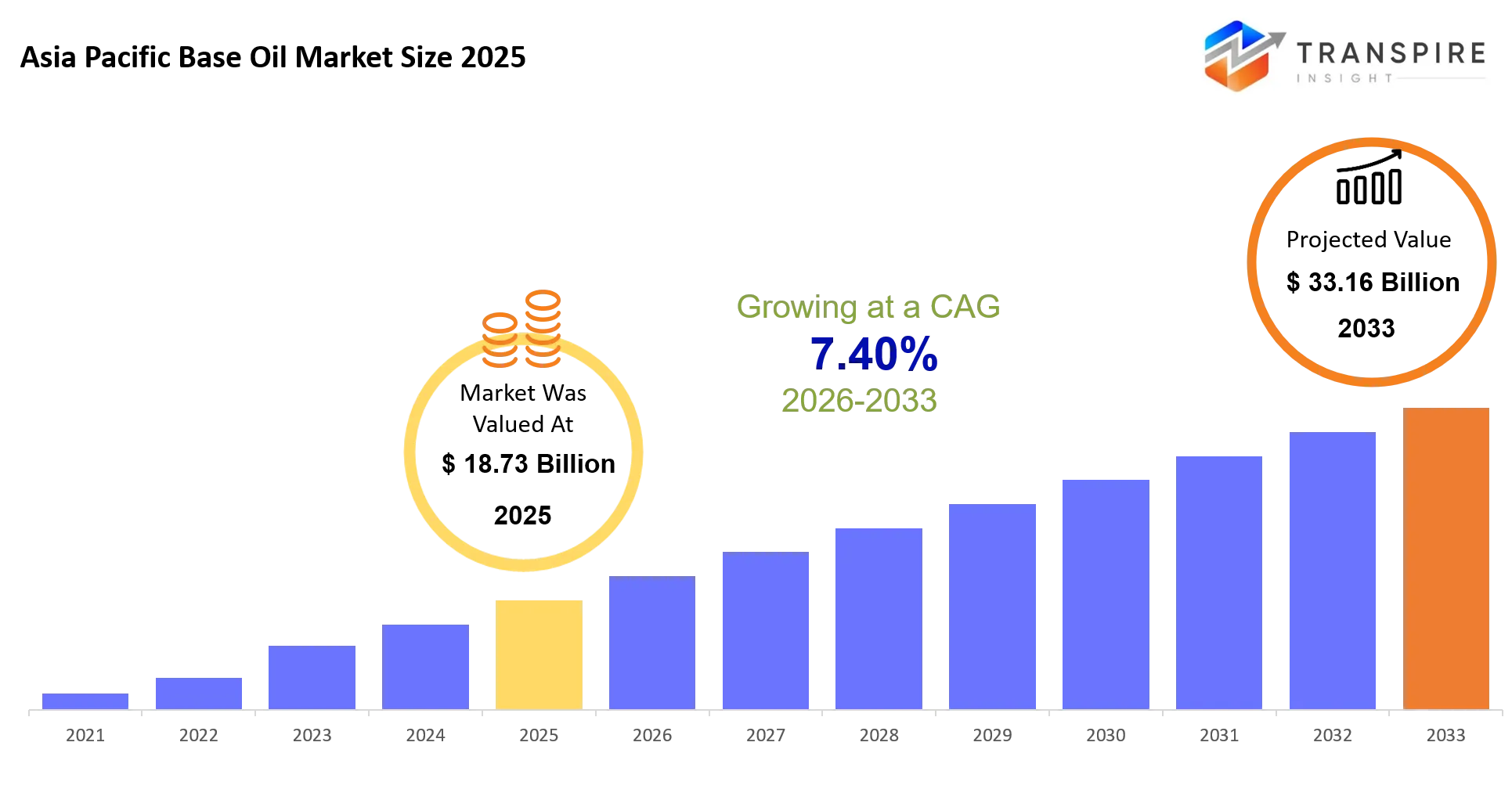
As per Transpire Insight Analysis the Asia Pacific Base Oil Market size is estimated at USD 18.73 Billion in 2025 and is anticipated to reach USD 33.16 Billion by 2033, growing at a CAGR of 7.40% from 2026 to 2033.
The Asia Pacific Base Oil Market provides refined base stocks that basically become the groundwork for many automotive lubricants, industrial oils, hydraulic fluids, greases, and marine lubricants. These materials help keep equipment performing steadily , while also cutting down on engine wear, and they allow longer service intervals in manufacturing, transportation, mining, and power generation. Lately, as industrial equipment gets more sophisticated , lubricant makers seem to ask for higher quality base oils all the time, with improved oxidation stability , plus better viscosity behavior.
In the last five years , the market kind of moved away from solvent refined Group I products , and leaned more toward higher performance Group II and Group III base oils. This shift has been pushed by tougher vehicle emission rules , and by changes in what lubricant specifications want. Then after the COVID-19 pandemic, supply chain disruptions , and a mix of geopolitical uncertainty , changed the way crude is sourced and how refineries decide on new investment. That combination also encouraged more production capacity inside the region. Meanwhile, when refiners modernize and automotive fleets adopt newer engine architectures , premium lubricant formulations are turning into the norm, so the demand keeps building for higher value base oils, and this helps keep revenue growth on track across the regional supply network.
Asia Pacific Base Oil Market Size & Forecast:
- Asia Pacific Base Oil Market Size 2025: USD 18.73 Billion
- Expected Market Value 2033: USD 33.16 Billion
- Forecast CAGR: 7.40%
- Leading region in 2025:
- Fastest Growing region:
- Key Profile: ExxonMobil, Shell, Chevron, BP, SK Enmove, Sinopec, PetroChina, Indian Oil Corporation, GS Caltex, Neste, Phillips 66, ENEOS, Petronas, Repsol, TotalEnergies
Key Market Insights
- The Asia Pacific Base Oil Market is expected to keep expanding from USD 18.73 billion in 2025 up to USD 33.16 billion by 2033, and this seems to show how continued investment in premium lubricant production really keeps rolling. In other words, it is not stopping anytime soon, even if the pace can vary a bit.
- China still holds the strongest position in the region, with an estimated 38–40% market share in 2025. That outcome is largely backed by big refining capacity and a steady push from automotive manufacturing too.
- India looks like it will be the fastest-growing market through 2033, largely because vehicle ownership is rising, industrial output is widening, and refinery capacity additions are coming in more often.
- When it comes to product types, Group II base oil stays on top, holding around 42% market share. It benefits from broader uptake in automotive as well as industrial lubricant formulations, so it kind of fits everywhere.
- Group III base oil is moving the quickest. It is forecast to grow above 8% annually through 2033, mainly because synthetic lubricants are gaining wider acceptance across different applications.
- On the demand side, automotive lubricants take nearly 46% of the market, while industrial lubricants keep growing as manufacturing automation advances, and heavy equipment gets used more frequently.
- Also, industrial machinery, mining, and power generation are all pulling harder on premium lubricants since those products extend equipment life, and they also help cut down maintenance frequency.
- Companies like ExxonMobil, Shell, Chevron, SK Enmove, Sinopec and Indian Oil Corporation are continuing to reinforce their competitive standing by doing refinery upgrades, rolling out product innovation, and expanding regional capacity.
- At the same time, strategic collaborations between refiners and lubricant manufacturers have increased investments in hydrocracking technologies, which in turn help produce higher quality Group II and Group III base oils.
- Finally, the Asia Pacific Base Oil Market is seeing more adoption of digital refinery optimization. This helps producers improve operational efficiency, keep product consistency steadier, and strengthen supply chain resilience maybe even when things get unpredictable.
What are the Key Drivers, Restraints, and Opportunities in the Asia Pacific Base Oil Market?
The strongest kind of growth driver is sort of the move toward premium lubricant formulations that end up needing higher quality Group II and Group III base oils. Meanwhile stricter vehicle emission regs, better fuel economy targets , and the rollout of advanced engine technologies have nudged lubricant makers into reformulating products, with improved oxidation stability and reduced volatility. At the same time refinery investments across China, India, and South Korea keep expanding domestic output of premium base oils. In other words these changes make each lubricant produced feel “worth more”, and they open up additional revenue chances for refiners that can supply high-performance feedstocks.
Crude oil price volatility is still the market’s most major structural snag, because base oil production tracks directly the economics of petroleum refining. Sudden swings in feedstock costs mess with profit margins, they also make long term supply agreements harder to manage, and they can even slow down refinery expansion plans. Also, putting in or upgrading hydrocracking facilities is not quick, it takes big capital spending , plus multi-year execution. So supply cannot pivot fast when conditions shift. That limitation ends up dampening investment momentum and it slows the adoption of premium production technologies, especially during those uncertain market stretches.
The most compelling long term opportunity is the expansion of bio-based and re-refined base oils. Governments all over Asia Pacific are pushing circular economy initiatives harder, while industrial users want lower lifecycle emissions , but without sacrificing lubricant performance. Investments in advanced re-refining technologies in places like Japan and South Korea show how recovered lubricants can actually match premium quality requirements.
What Has the Impact of Artificial Intelligence Been on the Asia Pacific Base Oil Market?
Artificial intelligence and newer digital technologies are, in practice, reshaping base oil production by nudging refinery efficiency upward, keeping product consistency steadier, and making assets more dependable overall. More and more refiners are rolling out AI driven process optimization platforms that sort of continuously watch things like temperature, pressure, catalyst performance, and feedstock quality across hydrocracking as well as catalytic dewaxing units. Then these platforms automatically tweak operating conditions so the refinery can push for better premium base oil yields, while also lowering energy use. On top of that, machine learning models look through past equipment records to estimate maintenance needs for compressors, pumps, heat exchangers, and reactors, before those annoying unexpected failures pop up. That helps facilities keep uptime higher, and cut maintenance expenses.
Digital twins, combined with predictive analytics, let operators project production output ahead of time, refine inventory scheduling, and react in a quicker, more controlled way when crude supply swings or when lubricant demand fluctuates. AI assisted quality control systems add another layer too, improving viscosity uniformity and reducing off specification runs. In the end, that supports profitability across a range of refining activities. There’s also advanced supply chain analytics, which helps with procurement decisions and logistics planning across regional distribution routes.
Still, even with all of that, broad AI deployment is not quite everywhere yet, mainly because integration costs are high, existing refinery infrastructure can be legacy heavy, and standardized operational data is often scarce at older production sites. A lot of refiners run units that were installed decades ago, so big digital rollouts become technically tangled, and financially intense. Because of this, AI adoption tends to cluster among large integrated refiners that have the budget and capital flexibility to handle it.
Key Market Trends
- Group II and Group III base oils really have been steadily swapping out Group I products, so they now make up more than 60% of new refining investments across Asia since 2021, kinda continuously.
- China also expanded its premium refining capacity by roughly 15% during 2021 to 2025, which helps regional supply stability and makes exports more competitive too.
- In India, refiners pushed ahead with hydrocracking capex, as automotive lubricant makers started adopting more high performance formulations, and yes those are designed to meet BS VI engine needs.
- Meanwhile re-refined oils and bio-based base oils have been getting real commercial pull, with sustainability minded lubricant producers growing their procurement programs over the last three years.
- Digital refinery optimization platforms have cut unplanned equipment downtime by around 10–20% across several big integrated sites, and this seems to be repeating in multiple reports.
- Shell, ExxonMobil, SK Enmove, Sinopec, and Chevron have put extra emphasis on refinery modernization to raise premium base oil output and improve operational efficiency.
- On the buying side, customers are increasingly leaning toward long term supply agreements, mostly to reduce procurement exposure caused by geopolitical uncertainty, and also by crude oil price swings.
- At the same time, supply chains across the region are becoming more varied because refiners are dialing down reliance on a single source crude stream, while also expanding domestic production capacity.
- Premium synthetic lubricant businesses continue shifting procurement toward higher purity Group III feedstocks for both passenger vehicle and industrial use cases.
- And honestly, competitive differentiation is now depending more on consistent product quality, stronger refinery performance, digital process governance, and the capability to supply premium lubricant manufacturers in a reliable way.
Asia Pacific Base Oil Market Segmentation
By Group Type
Group I Base Oil keeps getting picked for applications where cost efficiency stays key and conventional lubrication still matters, sort of the usual baseline. Group II Base Oil has a bigger share because stronger oxidation stability and a more tidy performance profile fit today’s automotive plus industrial lubricant needs. Group III Base Oil backs premium and synthetic lubricant formulations, it also helps with better viscosity behavior and improved fuel economy. Group IV Base Oil, made from synthetic polyalphaolefins, brings standout operation during harsh cold and hot conditions. Group V Base Oil covers specialty fluids used for more niche industrial, and high performance jobs where standard approaches don’t quite cut it.
Re-Refined Base Oil is seeing broader trust thanks to upgraded recycling technologies that bring used oil back to commercial quality thresholds. Bio-Based Base Oil draws interest from lubricant makers who want renewable feedstocks for certain use cases. The other specialty base oils handle particular technical demands, when a standard blend can’t provide the exact level of performance. Choosing a product depends on lubricant specifications, equipment operating conditions, regulatory standards, and what performance is expected across different industries, not just one single factor.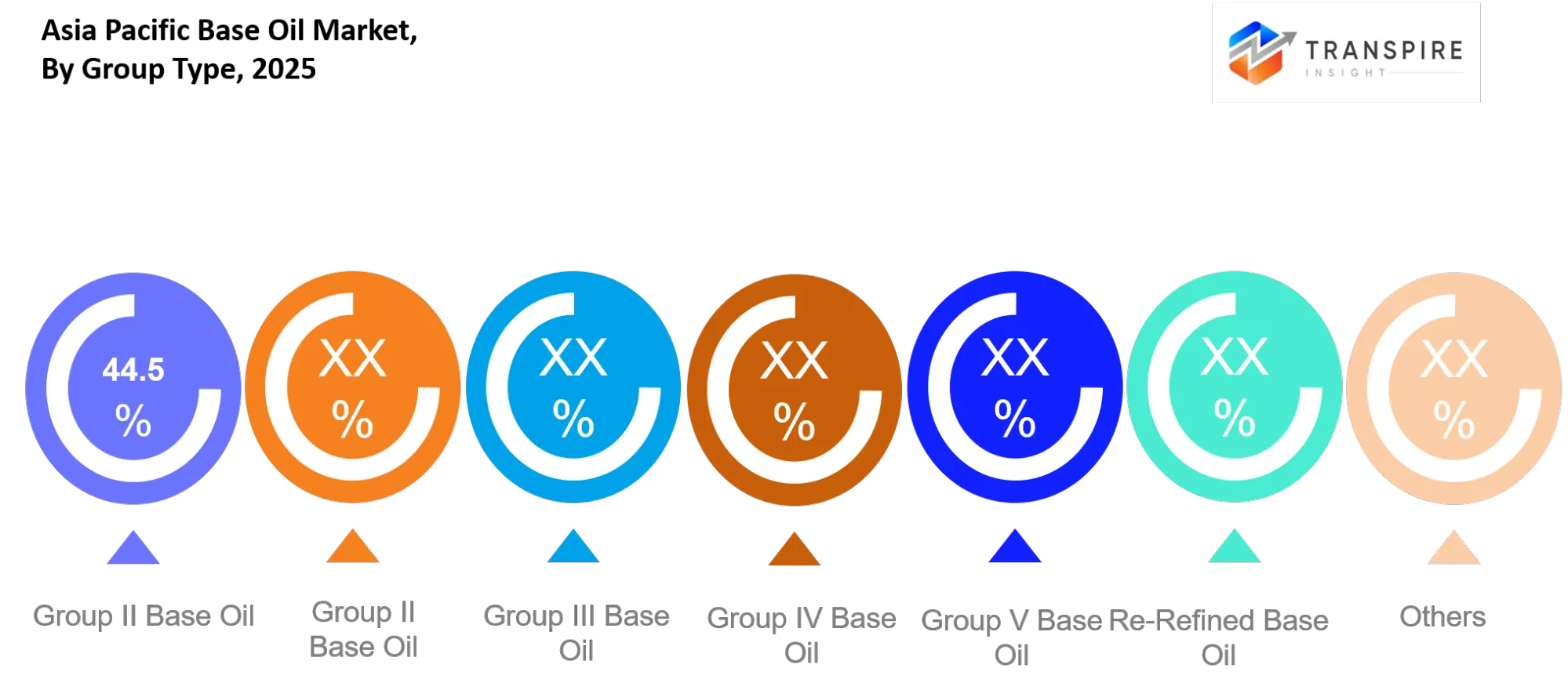
By Application
Automotive Lubricants make up the biggest share, since passenger vehicles, commercial fleets, and motorcycles all still need engine oils, transmission fluids, and gear oils to keep running reliably , day after day. Industrial Lubricants in turn back up manufacturing gear compressors, turbines, and all sorts of production machinery that work with continuous effort, often without stopping. Metalworking Fluids help with machining efficiency and also add a protective barrier for cutting tools, while Marine Oils support engines and auxiliary setups used in shipping trade plus offshore work. Hydraulic Fluids keep things moving cleanly for construction devices , agricultural machines, and various industrial hydraulic systems.
Process Oils matter a lot in rubber, textile, and chemical production, mainly because they help keep production quality up and assist material processing along the way. Greases provide long-lasting lubrication for bearings , heavy equipment, and industrial components that are stuck under tough operating conditions. There are also other uses, like special purpose lubricants created for aviation, railways, food processing equipment, and renewable energy installations. This wide variety of applications helps keep consumption steadier across multiple industrial sectors.
By Production Method
Solvent Refining still stays a well established way of making conventional base oils for the usual lubricant blends, you know. Hydrocracking has more or less become the process people pick, because it helps deliver higher quality Group II and Group III materials with cleaner profiles and stronger oxidation stability , which matters quite a lot. Catalytic Dewaxing then helps with cold weather behavior by cutting down wax content , so the end lubricants work in more climate ranges than before . Put simply , these approaches let refiners satisfy today’s lubricant specs and they also help production stay efficient.
Re-Refining turns spent lubricants into re-usable base oils using more advanced purification steps, and it basically supports circular resource use. Synthetic Production focuses on premium output, made for heavy industry and automotive uses that need very good thermal steadiness. Bio-Based Production is also growing, using renewable feedstocks that align with sustainability objectives. Blended Production meanwhile mixes different base stocks to reach specific performance goals that customers ask for, and yes, it is pretty common. Beyond that , other production methods remain useful too, especially when specialized manufacturing needs unique lubricant properties, rather than something generic.
By Distribution Channel
Direct Sales still feels like the best option for big industrial customers, and lubricant manufacturers who buy huge volumes under longer-term supply agreements, at least in most cases. Distributors help widen the market reach by supplying local and regional customers with flexible inventory, along with technical guidance that matters. Oil Companies keep very extensive supply networks that basically tie together the refining side of things with lubricant blending plants across the main industrial markets. Industrial Suppliers also step in with specialized product lines, aimed at the technical requirements of manufacturing, mining, and heavy equipment operators.
Online Sales are still expanding too, because digital procurement platforms make ordering simpler and the whole inventory tracking becomes less of a hassle for smaller buyers. Wholesalers, in turn, improve product availability across multiple regional markets, by holding broader distribution networks. Dealers support nearby industries through product guidance, customer support, and deliveries that arrive on time. Other distribution channels handle special customer needs—especially in remote areas, or for those niche industrial applications that don’t really fit the usual pattern.
By End User
The Automotive Industry shows up as the biggest end user, mostly because vehicles keep coming off the line , and transportation fleets keep growing so engine oils and transmission lubricants are needed in huge quantities. Manufacturing Industry comes right after that , since factories lean on industrial lubricants to keep machinery performance stable and also to lower those maintenance pauses. Marine Industry takes a different route, it uses specialized lubricants for engines , auxiliary systems, and the various onboard equipment that run in tough conditions every day. Construction Industry also keeps demand steady, powered by heavy machinery used for infrastructure builds and urban development projects.
The Mining Industry depends on high performance lubricants that guard equipment under heavy loads and very rough environments. The Energy Sector needs dependable lubrication for turbines, generators, compressors, and other power generation assets that basically work nonstop. Chemical Industry leans on process oils and specialty lubricants, all aimed at supporting production efficiency while keeping equipment more reliable. Then there are other end users like agriculture, rail transportation, aviation, and renewable energy facilities, who want specialized lubrication solutions tailored to their needs.
What are the Key Use Cases Driving the Asia Pacific Base Oil Market?
Automotive lubricant production is still kind of the main use case, because vehicle manufacturers and lubricant blenders want steady, repeatable base stocks for engine oils transmission fluids and gear oils, that do meet modern emission standards and they also need longer service intervals. Passenger cars, commercial trucks, and motorcycles usually end up driving the biggest consumption across regional transportation routes.
Industrial machinery is another fairly big application too, since factories depend on hydraulic oils, compressor lubricants, and metalworking fluids, to keep day to day production running efficiently. Mining activities and construction equipment also keep buying high grade lubricant blends that lower equipment wear and somehow boost operational reliability when the job is rough, like in demanding working conditions.
Looking ahead, there are emerging opportunities for lubricants tailored to electric vehicle driveline parts, and also bio-based formulations for environmentally sensitive industrial use. Re-refined base oils are still picking up acceptance as recycling technologies keep improving product quality, and this supports sustainability targets set by manufacturers and industrial users throughout the region.
|
Report Metrics |
Details |
|
Market size value in 2025 |
USD 18.73 Billion |
|
Market size value in 2026 |
USD 20.12 Billion |
|
Revenue forecast in 2033 |
USD 33.16 Billion |
|
Growth rate |
CAGR of 7.40% from 2026 to 2033 |
|
Base year |
2025 |
|
Historical data |
2021 - 2024 |
|
Forecast period |
2026 - 2033 |
|
Report coverage |
Revenue forecast, competitive landscape, growth factors, and trends |
|
Regional scope |
United States; Canada; Mexico; United Kingdom; Germany; France; Italy; Spain; Denmark; Sweden; Norway; China; Japan; India; Australia; South Korea; Thailand; Brazil; Argentina; South Africa; Saudi Arabia; United Arab Emirates |
|
Key company profiled |
ExxonMobil, Shell, Chevron, BP, SK Enmove, Sinopec, PetroChina, Indian Oil Corporation, GS Caltex, Neste, Phillips 66, ENEOS, Petronas, Repsol, TotalEnergies |
|
Customization scope |
Free report customization (country, regional & segment scope). Avail customized purchase options to meet your exact research needs. |
|
Report Segmentation |
By Group Type (Group I Base Oil, Group II Base Oil, Group III Base Oil, Group IV Base Oil, Group V Base Oil, Re-Refined Base Oil, Bio-Based Base Oil, Others); By Application (Automotive Lubricants, Industrial Lubricants, Metalworking Fluids, Marine Oils, Hydraulic Fluids, Process Oils, Greases, Others); By Production Method (Solvent Refining, Hydrocracking, Catalytic Dewaxing, Re-Refining, Synthetic Production, Bio-Based Production, Blended Production, Others); By Distribution Channel (Direct Sales, Distributors, Oil Companies, Industrial Suppliers, Online Sales, Wholesalers, Dealers, Others); By End User (Automotive Industry, Manufacturing Industry, Marine Industry, Construction Industry, Mining Industry, Energy Sector, Chemical Industry, Others) |
Which Regions are Driving the Asia Pacific Base Oil Market Growth?
East Asia kind of takes the lead in this regional market, with China, South Korea, and Japan forming a pretty strong refining and lubricant manufacturing hub. Big hydrocracking facilities, integrated petrochemical complexes, and export ports that are already well developed let producers move lubricants to both local demand and international lubricant manufacturers, without too much delay. China backs this up through nonstop refinery upgrades and strict vehicle emission standards which push more adoption of Group II and Group III base oils. Meanwhile South Korea and Japan keep tightening the whole regional ecosystem with advanced refining tech, premium lubricant production, and solid research work that supports long term market dominance.
Southeast Asia shows a different growth rhythm, more like steady industrial expansion rather than just chasing refinery scale. Singapore operates as a major trading and blending center, while Malaysia and Thailand tend to benefit from steady investment in manufacturing, automotive output, and industrial development. Since logistics infrastructure stays reliable, and the energy policies are already set, consumption remains fairly stable across transportation and industrial segments. That kind of balanced environment makes Southeast Asia a dependable contributor to regional revenue, and it also helps cross border lubricant distribution move more smoothly.
South Asia is expected to grow the quickest through 2033, mainly thanks to India. Growth is being driven by refinery modernization efforts, the rollout of tighter vehicle emission standards,and faster industrial development, all of which speed up the shift toward better quality base oils. On top of that, investments in local lubricant manufacturing plus ongoing expansion of automotive production are opening more space for premium base oil suppliers to come in.
Who are the Key Players in the Asia Pacific Base Oil Market and How Do They Compete?
Competition still stays kinda moderately consolidated, mainly because the big integrated refiners hold a sizeable slice of premium base oil output while smaller, regional players sort of fight it out using local supply networks and more specific, curated product selections. Also, technology and refining efficiency, plus the whole thing around product quality and steady, reliable supply these days matter more than price by itself. Because of that, companies keep putting money into hydrocracking capacity, scaling premium Group III production and signing longer term supply agreements with lubricant manufacturers to sort of lock in their market stance.
ExxonMobil is concentrating on premium lubricant performance by tying advanced refining technology to global lubricant brands, the kind that really need consistent base stocks, with the same, repeated quality. Shell instead leans into gas-to-liquids base oil technology and works closely with automotive original equipment manufacturers so its premium formulations can follow the changing engine specifications. SK Enmove keeps a firm edge thanks to its YUBASE product line and big, Group III production volume, which lets it supply premium base oils to lubricant manufacturers across more than 50 countries.
Meanwhile Sinopec and PetroChina push competitiveness through a lot of domestic refining capacity and integrated supply chains that back China’s growing automotive and industrial lubricant demand. Indian Oil Corporation keeps expanding refinery capabilities and lubricant output to handle rising local needs, while also dialing down import dependence. Finally, targeted investments in refinery modernization, regional production expansion, and technology upgrades help them improve operational flow, protect long-term customer relationships, and widen their premium product mix.
Company List
• ExxonMobil
• Shell
• Chevron
• BP
• SK Enmove
• Sinopec
• PetroChina
• Indian Oil Corporation
• GS Caltex
• Neste
• Phillips 66
• ENEOS
• Petronas
• Repsol
• TotalEnergies
Recent Development News
In August 2025, Shell India launched the upgraded Shell Helix Ultra motor oil meeting the 2025 API SQ standard. The launch introduced a premium lubricant formulated with Shell PurePlus Technology, strengthening demand for high-quality base oils across the automotive lubricant segment.https://www.shell.in/about-us
In March 2025, Shell advanced the transformation of the Wesseling hydrocracker at its Rheinland Energy and Chemicals Park to produce Group III base oils. The investment expands production of premium base oils used in high-performance engine oils, transmission fluids, and electric vehicle fluids.https://www.shell.com
In July 2025, Shell India launched the latest Shell Helix Ultra product range engineered to meet the new API SQ specification. The upgraded formulation supports premium lubricant performance and reinforces the company's position in advanced automotive lubricants across India.https://www.shell.in
What Strategic Insights Define the Future of the Asia Pacific Base Oil Market?
Honestly the market is sort of sliding toward higher value base oil production, while refiners put money into premium Group II and Group III setups instead of the older Group I stuff. And this isn’t just a “trend” thing , it keeps going because stricter lubricant specs , more refinery modernization, and better industrial output are all basically demanding cleaner and tougher base stocks.
There’s also this less obvious downside, kind of like a quiet bottleneck. Premium capacity is becoming more concentrated across fewer, bigger integrated refiners, and that concentration could make supply pretty touchy if there are refinery shutdowns or some feedstock disruption.
On the upside, there’s an emerging opening too: the commercialization of re-refined and bio-based base oils. That momentum feels fueled by governments pushing circular economy rules, plus industrial buyers adopting lower-carbon procurement approaches.
For companies trying to enter, the smart bet is to lean on advanced refining technology, build long-term lubricant manufacturing partnerships, and keep regional production networks diversified , so they can stay competitive and not get trapped by future supply risks.
Asia Pacific Base Oil Market Report Segmentation
By Group Type
• Group I Base Oil
• Group II Base Oil
• Group III Base Oil
• Group IV Base Oil
• Group V Base Oil
• Re-Refined Base Oil
• Bio-Based Base Oil
• Others
By Application
• Automotive Lubricants
• Industrial Lubricants
• Metalworking Fluids
• Marine Oils
• Hydraulic Fluids
• Process Oils
• Greases
• Others
By Production Method
• Solvent Refining
• Hydrocracking
• Catalytic Dewaxing
• Re-Refining
• Synthetic Production
• Bio-Based Production
• Blended Production
• Others
By Distribution Channel
• Direct Sales
• Distributors
• Oil Companies
• Industrial Suppliers
• Online Sales
• Wholesalers
• Dealers
• Others
By End User
• Automotive Industry
• Manufacturing Industry
• Marine Industry
• Construction Industry
• Mining Industry
• Energy Sector
• Chemical Industry
• Others
Frequently Asked Questions
Find quick answers to common questions.
The Expected Asia Pacific Base Oil Market size for the Market will be USD 33.16 Billion in 2033.
Key Segments for the Asia Pacific Base Oil Market are By Group Type (Group I Base Oil, Group II Base Oil, Group III Base Oil, Group IV Base Oil, Group V Base Oil, Re-Refined Base Oil, Bio-Based Base Oil, Others); By Application (Automotive Lubricants, Industrial Lubricants, Metalworking Fluids, Marine Oils, Hydraulic Fluids, Process Oils, Greases, Others); By Production Method (Solvent Refining, Hydrocracking, Catalytic Dewaxing, Re-Refining, Synthetic Production, Bio-Based Production, Blended Production, Others); By Distribution Channel (Direct Sales, Distributors, Oil Companies, Industrial Suppliers, Online Sales, Wholesalers, Dealers, Others); By End User (Automotive Industry, Manufacturing Industry,
Major Asia Pacific Base Oil Market Players are ExxonMobil, Shell, Chevron, BP, SK Enmove, Sinopec, PetroChina, Indian Oil Corporation, GS Caltex, Neste, Phillips 66, ENEOS, Petronas, Repsol, TotalEnergies.
The Current Asia Pacific Base Oil Market size is USD 18.73 Billion in 2025.
The Asia Pacific Base Oil Market CAGR is 7.40% from 2026 to 2033.
• ExxonMobil
• Shell
• Chevron
• BP
• SK Enmove
• Sinopec
• PetroChina
• Indian Oil Corporation
• GS Caltex
• Neste
• Phillips 66
• ENEOS
• Petronas
• Repsol
• TotalEnergies
About the Authors

Pankaj Ghogare Patil
I am Pankaj Ghogare Patil, a Senior Research Analyst at Transpire Insight, specializing in the Pharmaceutical, Chemicals & Materials, Healthcare IT, and Biotechnology industry. My expertise lies in conducting comprehensive market research, analyzing industry trends, evaluating competitive landscapes, and translating complex data into actionable insights. At Transpire Insight, I closely follow emerging technologies, regulatory developments, and market innovations to create accurate, well-researched, and informative content that helps businesses and professionals make informed decisions. I am committed to producing credible, evidence-based articles that reflect industry best practices while making technical topics accessible and valuable for a broad audience.

Chakradhar Khansole
Chakradhar serves as the Research Director at Transpire Insight, bringing over 8 years of experience in technology, innovation, and strategic market intelligence. He specializes in transforming complex market data into actionable business insights that enable organizations to make informed, growth-oriented decisions. Recognized for his strategic vision and analytical expertise, Chakradhar leads high-impact research initiatives, delivering comprehensive market assessments, competitive intelligence, and forward-looking industry analysis.
Recently Published Reports
-
May 2026
Healthcare Polymer Packaging Market
Healthcare Polymer Packaging Market Size, Share & Analysis Report By Packaging Type (Syringes, IV Bottles and Pouches, Clamshells, Blisters, Bottles & Jars, Containers, Tubes, IV Parental Packaging, Others), By Type (Regulated, Non-regulated), By Polymer Type (LDPE (Low-Density Polyethylene), HDPE (High-Density Polyethylene), Homo-polymer (Homo), Random Copolymer (Random), Block Copolymer (Block), PET, Polystyrene, Polyvinyl Chloride, Polyamide/EVOH, Others), and Geography (North America, Europe, Asia-Pacific, Middle East and Africa, South and Central America), 2021 - 2031
-
Apr 2026
Hydrophilic Tape (Waterstop) Market
Hydrophilic Tape (Waterstop) Market Size, Share & Analysis Report By Type (Bentonite-Based Hydrophilic Tape, Rubber-Based Hydrophilic Tape), By Application (Residential Buildings, Commercial Buildings, Infrastructure Projects), and Geography (North America, Europe, Asia-Pacific, Middle East and Africa, South and Central America), 2021 - 2031
-
Apr 2026
Metalens Market
Metalens Market Size, Share & Analysis Report By Type (Visible Light Metalens, and Infrared Metalens), By Application (Consumer Electronics, Automotive Electronics, Industrial, Medical, and Others), and Geography (North America, Europe, Asia-Pacific, Middle East and Africa, South and Central America), 2021 - 2031
-
Apr 2026
PBT Resin Market
PBT Resin Market Size, Share & Analysis Report By Type (Reinforced PBT Resin, Unreinforced PBT Resin), By Processing Method (Injection Molding, Extrusion, Blow Molding, Others), By End-User (Automotive, Electrical & Electronics, Consumer Appliances, Industrial Machinery, Medical Devices, Packaging, Others), and Geography (North America, Europe, Asia-Pacific, Middle East and Africa, South and Central America), 2021 - 2031