

Asia Pacific Industrial Lubricants Market Size & Forecast:
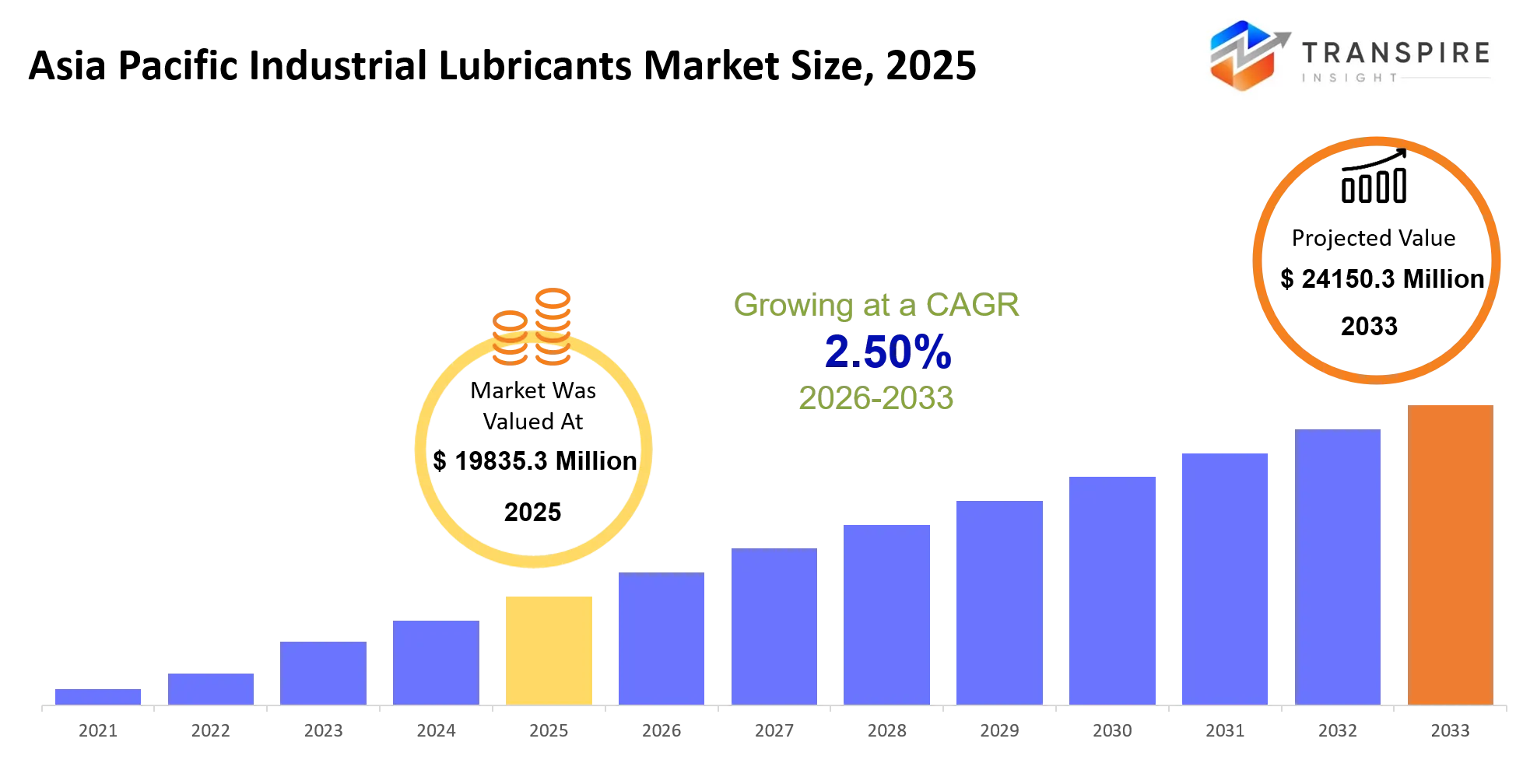
- Asia Pacific Industrial Lubricants Market Size 2025: USD 19835.3 Million
- Asia Pacific Industrial Lubricants Market Size 2033: USD 24150.3 Million
- Asia Pacific Industrial Lubricants Market CAGR: 2.50%
- Asia Pacific Industrial Lubricants Market Segments: By Product Type (Hydraulic Fluids, Metalworking Fluids, Gear Oils, Compressor Oils, Greases, Turbine Oils, Process Oils, Others); By Base Oil (Mineral Oil, Synthetic Oil, Bio-based Oil, Semi-Synthetic Oil, Others); By End User (Manufacturing, Automotive, Construction, Mining, Energy, Marine, Others); By Distribution Channel (Direct Sales, Distributors, Online Sales, Retail, Others)
To learn more about this report,  Download Free Sample Report
Asia Pacific Industrial Lubricants Market Summary
The Asia Pacific Industrial Lubricants Market was valued at USD 19835.3 Million in 2025. It is forecast to reach USD 24150.3 Million by 2033. That is a CAGR of 2.50% over the period.
In the Asia Pacific industrial lubricants market, it kind of matters a lot in keeping machinery, production streams, mining gear, power generation units, and manufacturing systems moving without too many hiccups. These lubricants lower friction , help manage temperature, protect components from abrasion, and really support industrial teams extending equipment life while also trimming that expensive downtime. In everyday terms they let factories and processing sites , plus heavy industry, keep output steady and assets more dependable.
In the last five years, the whole market sort of shifted, leaning more toward synthetic and high-performance lubricants because manufacturers want longer service intervals, reduced maintenance spend , and better energy performance. At the same time global events , especially geopolitical tensions, plus raw material price swings, caused supply chain turbulence. That highlighted weaknesses in how base oils are sourced and priced. So industrial buyers started valuing lubricant quality more , plus local supply stability, and even stronger predictive upkeep programs. Growth is being nudged along by rising manufacturing investments across China, India, Southeast Asia, and other fast-developing industrial areas. And as industrial automation keeps climbing , and equipment turns more advanced, operators look for premium lubrication strategies that boost uptime reliability , which is basically creating lasting revenue chances for lubricant providers.
Key Market Insights
- The Asia Pacific Industrial Lubricants Market is growing steady, as manufacturing output in China, India, and ASEAN countries keeps strengthening, more or less.
- China still leads the region, with an estimated 35%+ share in 2025 backed by huge-scale industrial production, plus infrastructure investments that don’t seem to slow down.
- Meanwhile Southeast Asia is showing the fastest movement through 2033, mainly because of industrial relocation, and new foreign direct investment inflows that are coming in gradually but consistently.
- On the product side, hydraulic oils are about 30% of total industrial lubricant demand, so they stay the top category across manufacturing.
- Gear oils come next, benefiting from the rising use of heavy equipment in mining , construction, and processing.
- Synthetic lubricants are expected to expand by more than 4% each year through 2033, and they’re set to beat conventional mineral based options in performance terms.
- In terms of application, manufacturing use comes in at almost 40% of overall consumption, which keeps it as the largest application group in the region.
- Also power generation and renewable energy facilities are becoming higher value lubricant users, mostly because equipment demands are getting tougher.
- When looking at buyers, big industrial firms make up over half of procurement volumes. At the same time SMEs are increasingly switching to premium formulations, trying to cut downtime and avoid unplanned stops.
- Competitive activity is starting to lean more toward digital maintenance services, predictive lubrication programs, and strategies tied to regional production expansion.
- Shell keeps putting money into premium synthetic lubricant formulations and industrial service programs. ExxonMobil, for its part, is leaning into advanced base stock technologies while also localizing manufacturing across Asia.
What are the Key Drivers, Restraints, and Opportunities in the Asia Pacific Industrial Lubricants Market?
The main push behind market growth is the quick modernization of industrial gear across manufacturing, mining, electricity generation, and processing industries. As plants switch to automated systems, robotics, and fast-moving equipment, lubrication needs get a bit more intense. People on the floor are starting to pick premium formulations too, because unexpected stoppages tend to cost way more than the lubricant budget, basically. That change tends to lift the product mix and helps suppliers that offer performance-led solutions drive stronger revenue.
The biggest drag, though, is the continued shake-up and volatility in crude oil and base oil feedstock costs. Industrial lubricants still lean a lot on petroleum-derived raw materials, so their cost model gets thrown off by geopolitical disruptions, refinery throughput limitations, and supply chain snags. And it’s kind of structural , meaning lubricant makers cannot easily swap out global refining capacity, or fully remove their dependence on petroleum feeds. So pricing uncertainty stays there, which then slows buying decisions and squeezes margins across the whole value chain.
One clear opportunity is tying smart maintenance together with improved lubrication management. More industrial sites are rolling out sensors, condition-monitoring tech, and predictive maintenance software platforms. For instance, lubricant performance signals can now be fed directly into plant maintenance systems, so wear patterns are estimated before a failure even shows up. As digital manufacturing keeps speeding up in India, Vietnam, Indonesia, and other developing industrial hubs, vendors that bundle lubricant products with digital services can open up new, more recurring income streams.
What Has the Impact of Artificial Intelligence Been on the Asia Pacific Industrial Lubricants Market?
Artificial intelligence is reshaping how folks who use industrial lubricants monitor machinery , tune maintenance timing a bit better , and keep operating costs under control. In more and more manufacturing plants, AI-enabled monitoring systems are rolled out that constantly watch vibration traces , temperature shifts , oil condition signals, and basically the equipment’s operating behaviors. Rather than sticking to rigid maintenance intervals, plant teams can figure out the right moment for lubricant change by looking at what the machine is actually doing in real time.
At the same time, machine learning is making predictive maintenance feel a lot more practical. The systems sift through prior operating records and spot early clues connected to bearing wear, gearbox slow-downs, troubles in hydraulic circuits, and lubricant contamination. That means industrial sites often see fewer surprise stop events and they can push equipment operating life further. A lot of operators say they notice real gains in uptime, maintenance efficiency, and overall asset utilization after they introduce predictive lubrication programs.
Then there are advanced analytics platforms, which add another layer by suggesting specific lubricant grades for different operating surroundings and production loads. That helps with energy efficiency and also can reduce lubricant usage over time, in a more steady way.
Even with all that, AI adoption doesn’t move as fast as people expect, mostly due to integration costs and issues with data quality. Many industrial facilities still run older equipment that doesn’t connect nicely to sensors, so it’s hard to gather the big datasets that accurate predictive models need. Until digital infrastructure spreads more widely, AI deployment tends to cluster with larger industrial operators, rather than everyone at once.
Key Market Trends
- Since 2021, the take up of synthetic lubricants has been climbing, manufacturers are really after longer service cycles and also lower maintenance costs for the equipment, or at least that’s what they say.
- In the same span, industrial buyers also adjusted sourcing plans, they leaned more toward regional suppliers after some supply chain disruptions showed how fragile their sourcing can be.
- At the same time China and India kept pushing investments into automated production sites, which made the appetite for high-performance lubrication solutions look even stronger.
- And between 2022 and 2025, industrial condition monitoring rollouts grew by something like 20%+ , which basically helped predictive lubrication practices feel more normal rather than experimental.
- On the spending side, premium lubricant formulations took a bigger chunk of industrial budgets as downtime costs kept trending upward.
- Big producers then responded by expanding local blending and production facilities, mainly to boost supply security and cut down on logistics related exposure, kind of a practical move.
- By 2025, a few industrial segments were already mentioning energy savings in the range of 2%–5% from lubrication management programs that were more optimized.
- Companies like Shell, ExxonMobil, Fuchs, and Petronas increased their investments in technical services as well as asset reliability solutions.
- Plus, tighter environmental compliance rules nudged adoption of lower-emission and longer-life lubricant technologies, not just for PR but because it’s required.
- Finally, digital lubricant monitoring platforms went from small pilots to wider deployment across manufacturing hubs, and that’s where it started feeling scalable.
Asia Pacific Industrial Lubricants Market Segmentation
By Product Type
That product type segment sort of shows the wide spread of lubricant formulations that get used across industrial gearworks, machinery systems, and production sites. Picking the right product really depends on operating conditions, the way the equipment is designed, temperature limits that have to be met, and what the maintenance goals look like. Since industrial activity keeps rolling in manufacturing, construction, mining, and energy, demand stays strong for those more specialized lubricant categories. In the end, performance needs, plus the whole equipment protection angle, still steer purchasing decisions across most end use industries.
Hydraulic Fluids take up a big share, mainly because hydraulic systems run everywhere in industrial machinery and heavy duty equipment. Metalworking Fluids back machining, cutting, grinding and forming by boosting process efficiency, and also helping with surface quality. Gear Oils stay relevant for gearboxes that work under heavy loads, and in harsher conditions. Compressor Oils help keep dependable operation in compressed air setups that are common across industrial facilities. Greases give longer lasting lubrication in parts where liquid lubricants might not work as well. Turbine Oils support steady operation in power generation, and also in industrial turbine applications. Process Oils act like functional ingredients inside different manufacturing activities. Others covers specialized formulations made for some specific industrial needs too.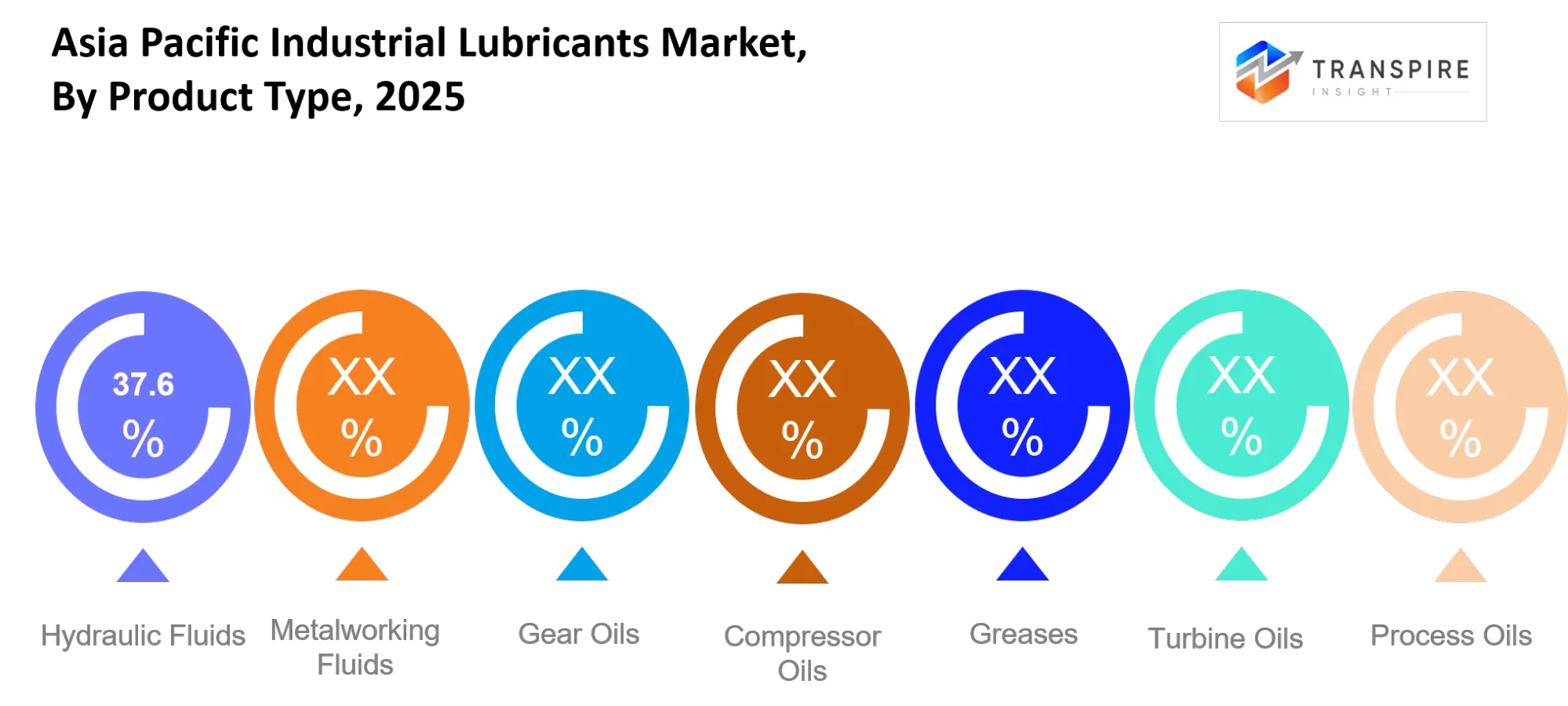
To learn more about this report, Download Free Sample Report
By Base Oil
The base oil segment, kinda mirrors the basic composition of industrial lubricants and really has a direct effect on product performance , durability, and day to day operating efficiency. Most industrial operators look at base oil types in a practical way, considering equipment needs, how often maintenance happens, the actual operating environment, and of course, cost matters. As lubricant technology keeps improving, many industries are being pushed toward more advanced formulations, better performing ones. In general, the different base oil categories cover different operational needs and also environmental expectations.
Mineral Oil still holds a strong role because it is broadly available, cost effective, and it works well for plenty of industrial uses. Synthetic Oil keeps getting more traction, mainly due to longer service intervals and stronger performance, especially when the operating conditions are tough. Bio based Oil is getting noticed for applications where environmental factors matter more in the lubricant selection decision. Semi Synthetic Oil offers that middle ground, a kind of blend between performance upgrades and reasonable cost control, which suits a large mix of industrial users. Other options include specialty base stocks, created for specific operating environments and technical requirements.
By End User
The end user segment kinda shows how lots of different industries lean on industrial lubricants, to keep their gear working right and to also bump up operational efficiency, while reducing maintenance related disruptions. You can see lubricant consumption patterns changing depending on machinery intensity, production timetables and the operating conditions. With industrial infrastructure and manufacturing capacity still expanding, demand keeps getting carried across multiple sectors. Even so, equipment reliability stays a big deal, and it affects how lubricant procurement strategies are set up.
Manufacturing is a major slice here, because production facilities use large volumes of lubricants across machinery, automation systems and processing equipment. The automotive industries then need lubricants for manufacturing processes, assembly setups, and equipment upkeep tasks. Construction pulls demand too, through heavy machinery, earthmoving equipment, and infrastructure development initiatives. Mining operations rely on high performance lubricant solutions so the equipment can handle severe conditions while it’s running. Energy facilities put lubricants into play for turbines, generators, and the supporting systems around them. In marine applications, there are specialized lubrication solutions for engines plus auxiliary equipment, since conditions can be brutal. Then “others” covers industrial sectors that have very specific machinery and operational requirements, where the lubrication role is not exactly the same as elsewhere.
By Distribution Channel
That distribution channel segment basically shows the various pathways where industrial lubricants get to commercial buyers and also to industrial facilities. The market players use multiple channels because it helps with product availability, it also helps build customer relationships, and it supports the technical service side that customers expect. What people prefer when purchasing can really depend on things like order volume , how complex the product is, and how urgent the operations are. Even the expansion of digital capabilities keeps nudging procurement practices across most industrial sectors.
Direct Sales still stay important, because bigger industrial customers usually want customized support, solid technical knowledge, and long term supply agreements, not just a quick product drop. Distributors matter a lot too, mainly by widening the regional market reach and making sure product availability stays consistent across all those different industrial sites. Online Sales are also developing, since digital procurement platforms tend to simplify the ordering flow and improve purchasing efficiency. Retail channels work for smaller industrial buyers who want easy access to lubricant products and also the maintenance supplies that usually come along with them. And then “Others” covers alternative sales networks , designed to handle specialized customer needs and specific industry requirements, kind of tailored to what that segment needs.
What are the Key Use Cases Driving the Asia Pacific Industrial Lubricants Market?
The largest use case still kinda sits in manufacturing equipment lubrication. Like hydraulic systems, compressors, gearboxes, bearings, and production machinery they all need continuous lubrication to minimize friction, reduce wear, and keep operational efficiency in check. This kind of application ends up driving the highest lubricant consumption because most manufacturing facilities run all day and depend on reliable equipment performance without interruptions.
After that, mining and power generation are slowly becoming more important too. Heavy-duty mining equipment works under extreme loads and harsh environmental conditions, so it needs specialized lubricants that can hold up and maintain performance across very long operating cycles. In a similar way power generation facilities lean on turbine oils and hydraulic fluids so operations stay stable and predictable.
More emerging use cases are showing up around lubrication solutions for renewable energy infrastructure, especially wind turbines and modern energy storage systems. Also, high-performance synthetic lubricants are getting more traction in automated factories and smart manufacturing environments, where maintenance optimization and equipment longevity are basically key performance indicators.
|
Report Metrics |
Details |
|
Market size value in 2025 |
USD 19835.3 Million |
|
Market size value in 2026 |
USD 20311.2 Million |
|
Revenue forecast in 2033 |
USD 24150.3 Million |
|
Growth rate |
CAGR of2.50% from 2026 to 2033 |
|
Base year |
2025 |
|
Historical data |
2021 - 2024 |
|
Forecast period |
2026 - 2033 |
|
Report coverage |
Revenue forecast, competitive landscape, growth factors, and trends |
|
Regional scope |
Asia Pacific (India, China, Japan, Australia, South Korea, Rest of Asia Pacific) |
|
Key company profiled |
Shell, ExxonMobil, BP Castrol, Chevron, TotalEnergies, Fuchs, PetroChina, Sinopec, Idemitsu, SK Lubricants, Indian Oil, Valvoline, Phillips 66, Petronas, Gulf Oil |
|
Customization scope |
Free report customization (country, regional & segment scope). Avail customized purchase options to meet your exact research needs. |
|
Report Segmentation |
By Product Type (Hydraulic Fluids, Metalworking Fluids, Gear Oils, Compressor Oils, Greases, Turbine Oils, Process Oils, Others); By Base Oil (Mineral Oil, Synthetic Oil, Bio-based Oil, Semi-Synthetic Oil, Others); By End User (Manufacturing, Automotive, Construction, Mining, Energy, Marine, Others); By Distribution Channel (Direct Sales, Distributors, Online Sales, Retail, Others) |
Which Regions are Driving the Asia Pacific Industrial Lubricants Market Growth?
China is still the biggest market across Asia Pacific, mainly because it has this massive manufacturing base, a huge industrial labor pool , and an already established machinery installed base that keeps growing. It also has this fairly seamless supply chain setup that feeds production for automotive, electronics, chemicals, steel, and other heavy industry work. On top of that, government-backed industrial modernization efforts keep pushing equipment upgrades forward . So overall, you get steady demand not just for conventional industrial lubricants but also for the more premium types, for quite a long time.
India is usually second, and it feels a bit different from China. It leans more into industrial expansion and infrastructure building, so the momentum is shaped by that angle. Manufacturing growth is backed by domestic investment programs, industrial corridor development, and rising private-sector capital spending. You can see the market supported by a wide mix of industries— automotive, cement, steel, pharmaceuticals, and engineering. Because of that range, lubricant demand tends to stay more steady when the economy goes through ups and downs, compared to places that rely on only a few sectors.
Southeast Asia meanwhile is coming in as the fastest grower during the forecast period. Vietnam, Indonesia, Thailand, and Malaysia in particular have pulled in a lot of manufacturing relocation investment in recent years . Their new industrial parks, export-driven production sites, and ongoing infrastructure upgrades have expanded the machinery installed base quite a lot. For companies watching this segment, the situation means real openings for wider distribution , local production investments, and a higher rate of premium lubricant adoption , extending toward 2033 .
Who are the Key Players in the Asia Pacific Industrial Lubricants Market and How Do They Compete?
Competition still looks fairly consolidated, though not totally, with multinational energy firms and specialty lubricant manufacturers holding a big chunk of the regional revenue. Honestly, rivalry is shifting more and more toward technology performance, application know-how, distribution reach and, you know, those value-added industrial services… not just price. On top of that suppliers are putting a lot of money into technical support, condition monitoring and predictive maintenance capabilities, basically to keep and grow customer relationships.
Shell stands out with a wide industrial portfolio, lots of technical service coverage, and a strong footprint across Asian manufacturing areas. ExxonMobil leans into advanced base stock technologies and premium synthetic formulations, built for the kinds of industrial settings that are more demanding. Meanwhile its regional investments help improve supply reliability while also backing more localized customer needs.
Fuchs concentrates on specialty lubrication solutions that are tuned to specific industrial applications. That means it can compete via technical expertise instead of relying only on sheer scale. Petronas is pushing forward using application focused industrial products and also expanding regional distribution. Indian Oil, for its part, uses its domestic infrastructure together with long standing industrial customer ties, to keep strengthening its position across India’s rapidly expanding manufacturing sector.
Company List
- Shell
- ExxonMobil
- BP Castrol
- Chevron
- TotalEnergies
- Fuchs
- PetroChina
- Sinopec
- Idemitsu
- SK Lubricants
- Indian Oil
- Valvoline
- Phillips 66
- Petronas
- Gulf Oil
Recent Development News
"In April 2026, PETRONAS Lubricants International launched the PETRONAS Pro Series industrial lubricant range. The new application-focused portfolio is designed to improve equipment uptime and simplify lubricant selection for industrial operators across Asia Pacific.https://www.hydrocarbonprocessing.com
"In September 2025, ExxonMobil started up a first-of-its-kind technology facility in Singapore. The investment expands production of higher-value lubricant base stocks and strengthens supply capacity for industrial lubricant markets across Asia Pacific.https://corporate.exxonmobil.com
"In February 2025, FUCHS inaugurated an expanded lubricant production facility in Johannesburg following a EUR 26 million investment. The expansion increases manufacturing capacity and strengthens supply support for industrial, mining, and specialty lubricant customers.https://www.fuchs.com
What Strategic Insights Define the Future of the Asia Pacific Industrial Lubricants Market?
Over the next five to seven years, it seems the market may move toward performance based lubrication ecosystems, instead of just standalone lubricant sales. The real engine behind it is how industrial automation is blending with predictive maintenance tech, plus the growing expectation from manufacturers, to boost equipment reliability and also operational efficiency, in a very measurable way. So the suppliers who can bundle lubricant products with digital monitoring and asset management services, will likely grab more of the industrial budget.
There’s also a quieter kind of risk that’s harder to see. It comes from tighter rivalry between regional suppliers, and the possibility of an oversupply in base oil production. If new capacity keeps arriving faster than industrial output growth, then pricing pressure could start eating into margins , even while lubricant volumes keep rising. And when market share is concentrated among only a few big producers, competitive intensity can get even more aggressive.
Still, there is a real opening that’s starting to show up. It’s lubrication solutions that are tuned for renewable energy infrastructure, advanced manufacturing systems, and smart factories. Right now these areas are relatively small, but they are set up for faster adoption through 2033. Market participants should, sort of, prioritize investments in synthetic lubricant technologies, digital service platforms, and regional production capabilities. The goal is to strengthen long term competitiveness, not just chase near term volume.
Asia Pacific Industrial Lubricants Market Report Segmentation
By Product Type
- Hydraulic Fluids
- Metalworking Fluids
- Gear Oils
- Compressor Oils
- Greases
- Turbine Oils
- Process Oils
- Others
By Base Oil
- Mineral Oil
- Synthetic Oil
- Bio-based Oil
- Semi-Synthetic Oil
- Others
By End User
- Manufacturing
- Automotive
- Construction
- Mining
- Energy
- Marine
- Others
By Distribution Channel
- Direct Sales
- Distributors
- Online Sales
- Retail
- Others
Frequently Asked Questions
Find quick answers to common questions.
The Expected Asia Pacific Industrial Lubricants Market size for the Market will be USD 24150.3 Million in 2033.
Key Segments for the Asia Pacific Industrial Lubricants Market are By Product Type (Hydraulic Fluids, Metalworking Fluids, Gear Oils, Compressor Oils, Greases, Turbine Oils, Process Oils, Others); By Base Oil (Mineral Oil, Synthetic Oil, Bio-based Oil, Semi-Synthetic Oil, Others); By End User (Manufacturing, Automotive, Construction, Mining, Energy, Marine, Others); By Distribution Channel (Direct Sales, Distributors, Online Sales, Retail, Others).
Major Asia Pacific Industrial Lubricants Market players are Shell, ExxonMobil, BP Castrol, Chevron, TotalEnergies, Fuchs, PetroChina, Sinopec, Idemitsu, SK Lubricants, Indian Oil, Valvoline, Phillips 66, Petronas, Gulf Oil.
The Current Asia Pacific Industrial Lubricants Market size is USD 19835.3 Million in 2025.
The Asia Pacific Industrial Lubricants Market CAGR is 2.50% from 2026 to 2033.
- Shell
- ExxonMobil
- BP Castrol
- Chevron
- TotalEnergies
- Fuchs
- PetroChina
- Sinopec
- Idemitsu
- SK Lubricants
- Indian Oil
- Valvoline
- Phillips 66
- Petronas
- Gulf Oil
About the Authors

Pankaj Ghogare Patil
I am Pankaj Ghogare Patil, a Senior Research Analyst at Transpire Insight, specializing in the Pharmaceutical, Chemicals & Materials, Healthcare IT, and Biotechnology industry. My expertise lies in conducting comprehensive market research, analyzing industry trends, evaluating competitive landscapes, and translating complex data into actionable insights. At Transpire Insight, I closely follow emerging technologies, regulatory developments, and market innovations to create accurate, well-researched, and informative content that helps businesses and professionals make informed decisions. I am committed to producing credible, evidence-based articles that reflect industry best practices while making technical topics accessible and valuable for a broad audience.

Chakradhar Khansole
Chakradhar serves as the Research Director at Transpire Insight, bringing over 8 years of experience in technology, innovation, and strategic market intelligence. He specializes in transforming complex market data into actionable business insights that enable organizations to make informed, growth-oriented decisions. Recognized for his strategic vision and analytical expertise, Chakradhar leads high-impact research initiatives, delivering comprehensive market assessments, competitive intelligence, and forward-looking industry analysis.
Recently Published Reports
-
May 2026
Healthcare Polymer Packaging Market
Healthcare Polymer Packaging Market Size, Share & Analysis Report By Packaging Type (Syringes, IV Bottles and Pouches, Clamshells, Blisters, Bottles & Jars, Containers, Tubes, IV Parental Packaging, Others), By Type (Regulated, Non-regulated), By Polymer Type (LDPE (Low-Density Polyethylene), HDPE (High-Density Polyethylene), Homo-polymer (Homo), Random Copolymer (Random), Block Copolymer (Block), PET, Polystyrene, Polyvinyl Chloride, Polyamide/EVOH, Others), and Geography (North America, Europe, Asia-Pacific, Middle East and Africa, South and Central America), 2021 - 2031
-
Apr 2026
Hydrophilic Tape (Waterstop) Market
Hydrophilic Tape (Waterstop) Market Size, Share & Analysis Report By Type (Bentonite-Based Hydrophilic Tape, Rubber-Based Hydrophilic Tape), By Application (Residential Buildings, Commercial Buildings, Infrastructure Projects), and Geography (North America, Europe, Asia-Pacific, Middle East and Africa, South and Central America), 2021 - 2031
-
Apr 2026
Metalens Market
Metalens Market Size, Share & Analysis Report By Type (Visible Light Metalens, and Infrared Metalens), By Application (Consumer Electronics, Automotive Electronics, Industrial, Medical, and Others), and Geography (North America, Europe, Asia-Pacific, Middle East and Africa, South and Central America), 2021 - 2031
-
Apr 2026
PBT Resin Market
PBT Resin Market Size, Share & Analysis Report By Type (Reinforced PBT Resin, Unreinforced PBT Resin), By Processing Method (Injection Molding, Extrusion, Blow Molding, Others), By End-User (Automotive, Electrical & Electronics, Consumer Appliances, Industrial Machinery, Medical Devices, Packaging, Others), and Geography (North America, Europe, Asia-Pacific, Middle East and Africa, South and Central America), 2021 - 2031