
United Kingdom Automotive Lubricants Market Size & Forecast:
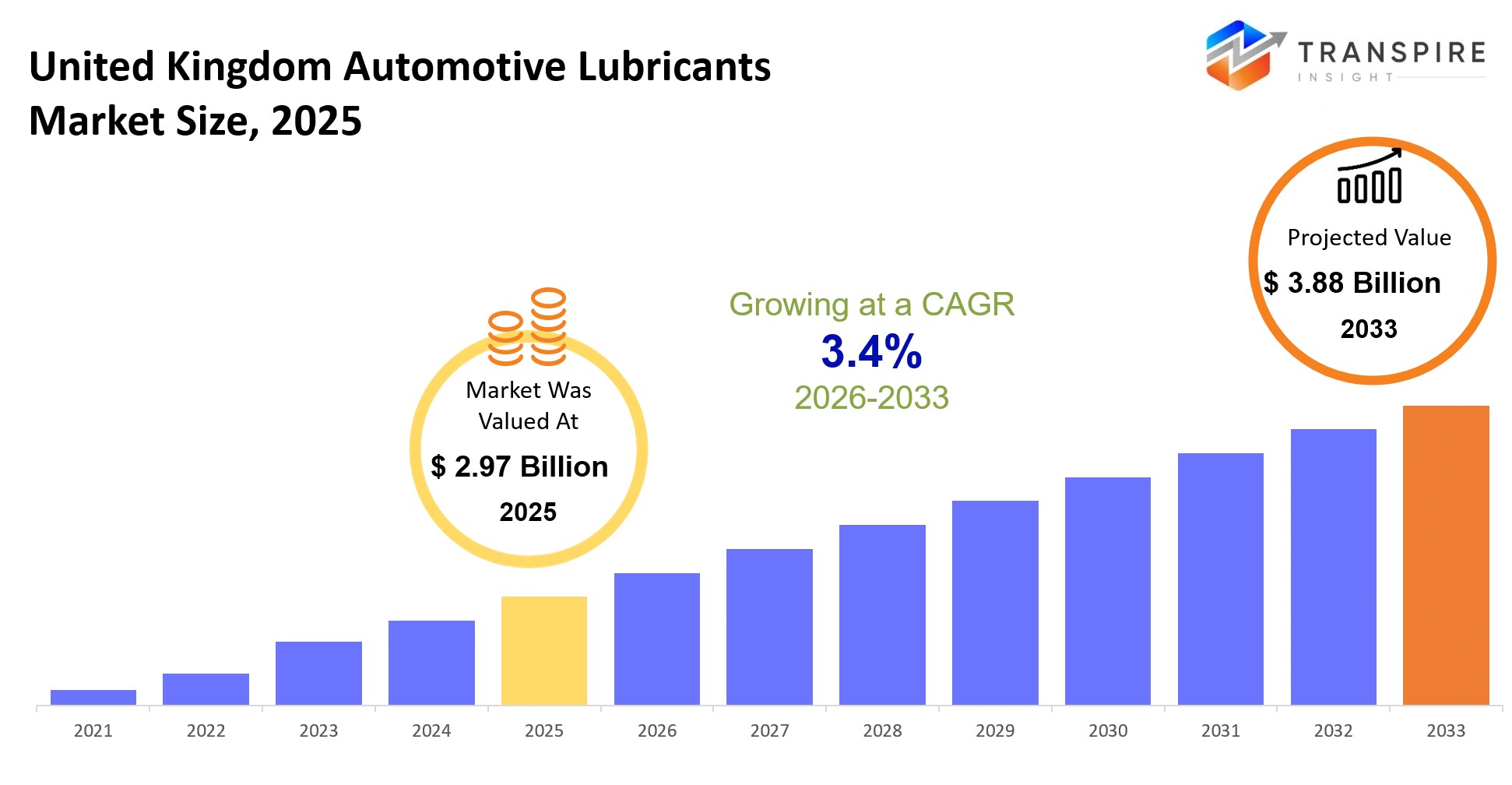
- United Kingdom Automotive Lubricants Market Size 2025: USD 2.97 Billion
- United Kingdom Automotive Lubricants Market Size 2033: USD 3.88 Billion
- United Kingdom Automotive Lubricants Market CAGR: 3.4%
- United Kingdom Automotive Lubricants Market Segments: By Product Type (Engine Oil, Transmission Fluid, Gear Oil, Grease, Coolants, Brake Fluids, Others); By Vehicle Type (Passenger Cars, LCVs, HCVs, Two-Wheelers, Off-Highway, Others)
United Kingdom Automotive Lubricants Market Summary
The United Kingdom Automotive Lubricants Market was valued at USD 2.97 billion in 2025. It is forecast to reach USD 3.88 billion by 2033. That is a CAGR of 3.4% over the period.
The automotive lubricants market in the UK maintains efficient vehicle operation through reduction of friction between engine components, managing the heat generated in engines, protecting against wear, and extending engine and drivetrain life within passenger cars, commercial and transport fleet operations. Effective lubrication helps keep maintenance costs low, improves fuel economy, and enables extended service intervals, thus being an integral aspect of vehicle lifecycle management. Within the last three to five years, the market has been structurally transformed due to the growing demand for low viscosity, synthetic, and electric vehicle compatible lubricants driven by tighter emission regulations and technological development of vehicle fleets. The disruption of global supply chains and volatile pricing of base oils and additives resulting from the Russia-Ukraine conflict have further sped up the reformulation of products and diversification of suppliers. All of these have promoted the usage of premium lubricants offering extended drain intervals and better value creation which helped to grow the revenues even at lower growth rates of lubricants' consumption.
Key Market Insights
- The UK Automotive Lubricants Market share held by England was estimated to be around 68% in 2025, due to the high number of vehicles and good infrastructure facilities available in England.
- Scotland ranked as the second largest regional market owing to its strong activities in the commercial transport, logistics, and industrial vehicle maintenance.
- Wales is expected to be the fastest growing regional market during the forecast period due to modernization and growth in automotive service network.
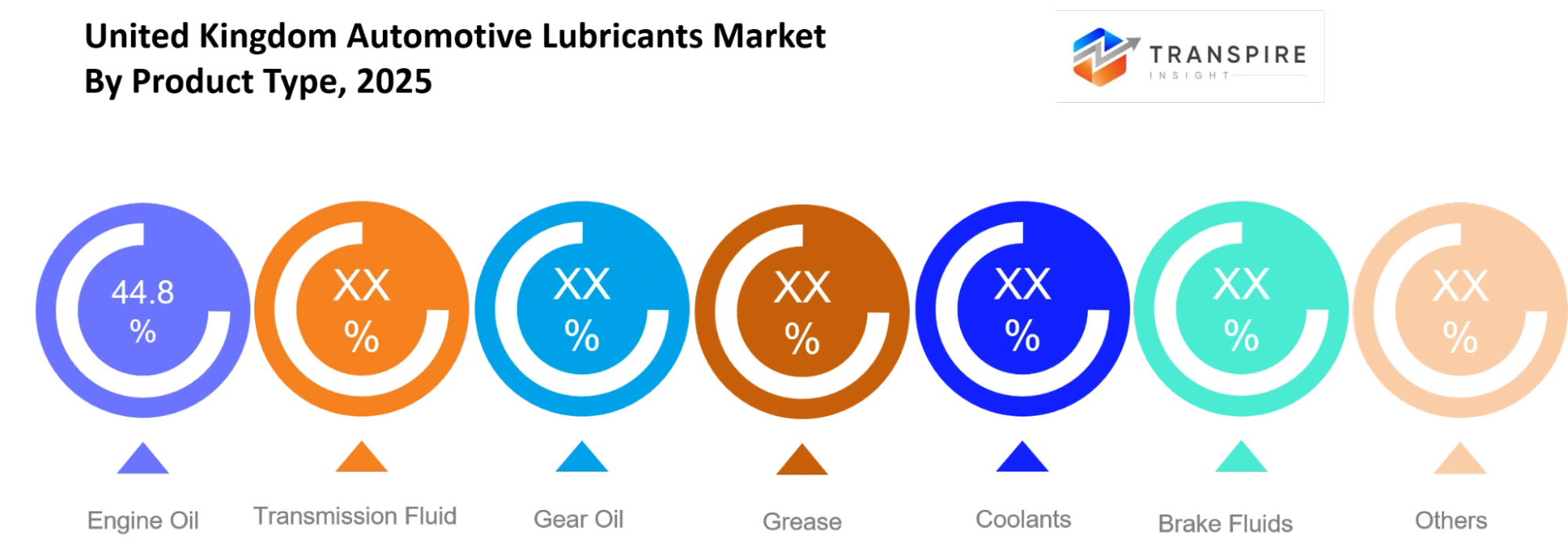
- Engine oils held a dominant share of about 58% in the market in 2025 due to their importance in regular maintenance of both passenger and commercial vehicles.
- Transmission fluids were the second largest product segment owing to increasing use of automatic transmission in vehicles.
- Fluids used in electric vehicles will post the fastest growth in the coming years until 2032 owing to the rising number of electric vehicle sales as well as the need for superior thermal management technologies.
- Passenger cars held around 61% of the market revenue in 2025 due to the presence of many registered vehicles and maintenance schedules for the replacement of lubricants.
- The highest rate of growth is expected from commercial vehicles due to fleet owners' use of premium lubricants to minimize maintenance expenses and increase service periods.
- Automotive aftermarket services have secured about 64% market share in 2025 via maintenance and servicing activities.
- Fleet owners and commercial logistics players will prove to be the fastest growing end-user group due to predictive maintenance and cost optimization.
What are the Key Drivers, Restraints, and Opportunities in the United Kingdom Automotive Lubricants Market?
The key driver behind the UK Automotive Lubricants market is the movement towards moderni-zation of engines and tightening of vehicle emissions regulations. Lower carbon emissions requirement has forced car makers to come up with smaller turbocharged engines, hybrid drive and more fuel-efficient cars that require use of high-performing synthetic and low viscosity lubricants. This trend has enhanced the value of premium quality lubricants enabling the firms to realize higher margins from their sale and the service providers to offer more services that meet the modern car requirements. The fleet owners are increasingly opting for longer life lubricants to minimize downtime.
The biggest structural headwind is the slow but steady expansion of the market for battery electric vehicles that use less conventional lubricants compared to internal combustion engines. Even though the uptake of electric vehicles is growing steadily, there is going to be structural change for some time due to the current vehicle fleet base.
The development of lubricants and thermal management fluid solutions for hybrid and electric vehicles represents an important growth opportunity. Investments being made in the manufacture of electric vehicles, batteries, and associated charging facilities in the United Kingdom have generated opportunities for next generation transmission oils, e-axle oils, and battery coolant products. Companies investing in research and partnering with automobile manufacturers will enjoy premium positions in the market.
What Has the Impact of Artificial Intelligence Been on the United Kingdom Automotive Lubricants Market?
Artificial intelligence and new-age digital technology have revolutionized the way lubricants are formulated, developed and serviced within the UK automotive industry. There is a rapid rise in the use of telematics platforms with AI technology for automating the process of lubricant conditioning monitoring, scheduling of maintenance, and vehicle health monitoring. These systems continuously monitor the engine operation, lubricant condition, temperature, mileage and driving pattern, which allows maintenance staff to change the lubricant if any parameter indicates the need for maintenance.
Moreover, machine learning models have been used to predict engine wear, oil deterioration and component failure in advance so that maintenance can be scheduled before any breakage occurs. Sensor data along with previous maintenance data allows optimization of lubricant choice and drain period in such a way that maximizes vehicle uptime without changing oil unnecessarily. Moreover, digital technology has aided commercial fleets in maximizing their fuel economy, decreasing maintenance cost and complying with the maintenance requirement from the vehicle manufacturers. Lubricant manufacturers have utilized AI technology for accelerating lubricant formulation development and testing of additives.
However, even though there are such benefits, implementation of AI solutions is hindered by high cost of integration and lack of access to good quality operational data. Small workshops and privately owned fleet companies use traditional methods of maintaining equipment which reduces the impact of AI solutions.
Key Market Trends
- From 2021 onward, lubricant producers have launched increased ranges of synthetic and low viscosity lubricants due to increased need for high-performance lubricants to achieve fuel efficiency goals.
- Automakers have started recommending increased oil drain cycles, which has encouraged lubricant manufacturers to produce quality lubricants instead of volume.
- In the wake of the Russia-Ukraine conflict, base oil and additives procurement methods have been diversified to mitigate risks.
- Increasing hybrid vehicles have boosted the need for special transmission fluids and thermal management fluids, which are different from regular passenger car oils.
- There is an increasing trend of AI-based oil condition monitoring by fleet owners since 2022.
- Shell, Castrol, ExxonMobil, and TotalEnergies have made efforts in studying electric vehicle fluids, signaling the companies’ transition from lubricating internal combustion engines.
- Independent repair shops have been stocking their facilities with approved manufacturer lubricants as new vehicles are covered by stricter technical requirements for warranties.
- The goals related to sustainability have pushed the companies to develop lubricants that help reduce emissions, improve fuel consumption, and increase service life in commercial vehicles.
- Online lubricant management systems have been developed as they allow fleet managers to adjust maintenance based on real-time information about the vehicle’s condition.
United Kingdom Automotive Lubricants Market Segmentation
By Product Type:
Engine oil had the largest market share due to its importance in engine protection, temperature regulation, and proper functioning of cars. Synthetic and semi-synthetic oils were increasingly adopted due to the need for better performance and greater fuel efficiency. Transmission fluid was the second largest segment, due to increased adoption of automatic and continuously variable transmissions which required specific type of lubricant for optimal performance. Gear oil was another steadily growing segment because of the demand for protection of gearboxes and axles in heavy-duty conditions.
Lubricants such as grease, coolants, brake fluids, and specialty lubricants ensured reliable operation of vehicles' systems. Products from the grease category offered lasting protection of the gearbox, chassis parts and bearings, coolants offered improved cooling and battery management in both conventional and electric cars, while brake fluids made sure of safe and reliable braking system. Specialty lubricants, used in steering systems, hydraulic pumps, and other parts of a car, also contributed to growth.
By Vehicle Type:
Passenger cars formed the biggest category of vehicles as far as consistent lubricant consumption was concerned as they had a big vehicle fleet and regular maintenance regimes. The light commercial vehicles formed a significant source of demand due to regular logistics services, retail distribution networks, and city transportation that required reliable performance of vehicles. Premium lubricants were necessary for the operation of heavy commercial vehicles as they needed less interruption and good engine reliability. Fleet owners were choosing more high-performance lubricants for minimizing their costs and extending maintenance intervals.
Two-wheelers would also continue forming consistent demand from their regular servicing requirements for commuting purposes. Stable demand could be also expected from off-highway vehicles as their construction, mining, and agricultural operations required special lubricants for reliable performance under heavy load and harsh operational conditions. Manufacturers would keep producing innovative lubricants for all types of vehicles for better wear resistance, thermal stability, and machinery reliability. Product innovations and technological development of vehicles would contribute to increased consumption of premium lubricants.
What are the Key Use Cases Driving the United Kingdom Automotive Lubricants Market?
The most common use of lubricating oils in UK is still routine car maintenance since automobiles need frequent oil changes, transmission fluid changes, and coolant system maintenance to keep their engine running at high efficiency levels. Routine maintenance programs and manufacturer recommended intervals ensure continuous demand for automotive lubricants from independent workshops, franchised centers and dealerships.
Logistics, bus and delivery companies have emerged as a growth market since they have started using premium lubricants to minimize maintenance intervals and increase the availability of their vehicles. Specialized lubricants are used in construction and agricultural equipment due to the harsh conditions under which they operate.
The emerging applications in this industry include the lubricants for electric and hybrid cars as well as predictive maintenance platforms, which help fleet managers to schedule maintenance services using connected vehicle data and condition of lubricants.
|
Report Metrics |
Details |
|
Market size value in 2025 |
USD 2.97 Billion |
|
Market size value in 2026 |
USD 3.07 Billion |
|
Revenue forecast in 2033 |
USD 3.88 Billion |
|
Growth rate |
CAGR of 3.4% from 2026 to 2033 |
|
Base year |
2025 |
|
Historical data |
2021 - 2024 |
|
Forecast period |
2026 - 2033 |
|
Report coverage |
Revenue forecast, competitive landscape, growth factors, and trends |
|
Regional scope |
United Kingdom |
|
Key company profiled |
Shell, BP Castrol, ExxonMobil, TotalEnergies, Valvoline, Fuchs, Chevron, Petronas, Gulf Oil, Motul, Liqui Moly, Repsol, Phillips 66, ENEOS, AMSOIL |
|
Customization scope |
Free report customization (country, regional & segment scope). Avail customized purchase options to meet your exact research needs. |
|
Report Segmentation |
By Product Type (Engine Oil, Transmission Fluid, Gear Oil, Grease, Coolants, Brake Fluids, Others); By Vehicle Type (Passenger Cars, LCVs, HCVs, Two-Wheelers, Off-Highway, Others) |
Which Regions are Driving the United Kingdom Automotive Lubricants Market Growth?
England was the dominant area owing to the greatest number of vehicles registered in the country, automotive service centers, and lubricant supply chains creating a strong client base. Additionally, the region benefits from the presence of manufacturing plants, motorways, and an intensive network of dealers and independent service providers. Strict monitoring of vehicle servicing and emissions standards promotes the use of quality lubricants that match the requirements of modern engines. Stable partnerships with suppliers, warehousing, and logistics ensure further development of regional market dominance.
The second largest regional market was Scotland due to a different set of factors for lubricants demand: transportation and industries. Transport fleets' operations and energy industries provide a steady lubricant consumption year-round. In contrast with England, the growth of the market does not rely much on passenger cars' density and instead on the fleet servicing and operation. Continuous investments in the transport infrastructure and servicing of commercial vehicles help in generating steady income despite fewer vehicles in the country.
Wales is predicted to have the highest growth rate during the period 2026 to 2033 due to investment being made in logistics, industry, and infrastructure in the region. Investment in fleet renewal programs and the use of advanced lubricants in the commercial vehicle segment has led to the increased demand for products in the region. An increase in the presence of distribution centers and service providers has resulted in an increase in supply of the lubricant products and the use of high-end products.
Who are the Key Players in the United Kingdom Automotive Lubricants Market and How Do They Compete?
Competition in the UK automotive lubricants industry is relatively concentrated as major global lubricants producers have taken a large portion of the sales volume, whereas the remaining regional companies and private label brands are competing in the certain customer segments. Competitive edge relies on technology, manufacturer approvals, distribution, and fleet value-added services and not necessarily on pricing. Manufacturers are developing synthetic oils, compatible with electric vehicles, and digital lubricant management system in order to secure their customers' loyalty. Independent garages, dealer chains, and fleets concentrate on performance, longevity and technical advice when choosing lubricants provider.
Shell concentrates on technology development in the form of innovative synthetic oils and electric vehicle fluids based on research and collaboration with automakers. Castrol offers OEM approvals and premium products formulated for modern engines along with an increased customer base via collaboration with automobile servicing organizations. ExxonMobil is concentrating on high-performance lubricants technologies offering engine protection and fuel economy alongside with technical advisory services for commercial fleets.
TotalEnergies is furthering its line of premium lubricants for hybrid and electric cars as well as enhancing its distribution network via strategic alliances in the aftermarket. What makes FUCHS stand out is that it produces lubricant formulas specific to commercial and industrial use, in situations that demand a higher level of performance because of difficult operating conditions. Through consistent investments in research and application-based products, these organizations can maintain good customer relations despite changes in vehicle technology in the UK.
Company List
- Shell
- BP Castrol
- ExxonMobil
- TotalEnergies
- Valvoline
- Fuchs
- Chevron
- Petronas
- Gulf Oil
- Motul
- Liqui Moly
- Repsol
- Phillips 66
- ENEOS
- AMSOIL
Recent Development News
"In December 2025, BP agreed to sell a 65% stake in Castrol to Stonepeak in a transaction valuing the business at approximately US$10.1 billion. The transaction will strengthen BP's balance sheet while enabling Castrol to expand through a new joint venture structure under Stonepeak's majority ownership.https://www.reuters.com
"In December 2025, Stonepeak announced the acquisition of a majority controlling interest in Castrol from BP. The investment, supported by Canada Pension Plan Investment Board, is intended to accelerate Castrol's long-term growth, product innovation, and global lubricants expansion.https://stonepeak.com
"In November 2025, BP entered advanced negotiations with Stonepeak for the sale of the Castrol lubricants business as part of its wider divestment strategy. The proposed transaction reflected BP's portfolio restructuring and attracted significant market attention because of Castrol's strong global lubricants position.https://www.reuters.com
What Strategic Insights Define the Future of the United Kingdom Automotive Lubricants Market?
During the period between the next five to seven years, UK Automotive Lubricants Market will transform into a value-oriented one, where high-quality synthetic lubricants, fluids for hybrid cars, as well as fluids for electric mobility will dominate. The changes will be fueled by increasing vehicle performance standards and the growing complexity of powertrains rather than the growth of traditional lubricant consumption. The second risk factor can be attributed to an increasingly higher popularity of battery electric vehicles which do not need the same amount of traditional lubricants as their competitors and, thus, may decrease the demand for engine oils even at constant car sales. At the same time, there are numerous opportunities in the development of advanced thermal management fluids and e-axle lubricants for hybrid and electric vehicles. The companies willing to invest in researches and digital monitoring services are likely to benefit from these developments.
United Kingdom Automotive Lubricants Market Report Segmentation
By Product Type
- Engine Oil
- Transmission Fluid
- Gear Oil
- Grease
- Coolants
- Brake Fluids
- Others
By Vehicle Type
- Passenger Cars
- LCVs (Light Commercial Vehicles)
- HCVs (Heavy Commercial Vehicles)
- Two-Wheelers
- Off-Highway Vehicles
- Others
Frequently Asked Questions
Find quick answers to common questions.
The expected United Kingdom Automotive Lubricants Market size for the market will be USD 3.88 Billion in 2033.
Key segments for the United Kingdom Automotive Lubricants Market are By Product Type (Engine Oil, Transmission Fluid, Gear Oil, Grease, Coolants, Brake Fluids, Others); By Vehicle Type (Passenger Cars, LCVs, HCVs, Two-Wheelers, Off-Highway, Others).
Major United Kingdom Automotive Lubricants Market players are Shell, BP Castrol, ExxonMobil, TotalEnergies, Valvoline, Fuchs, Chevron, Petronas, Gulf Oil, Motul, Liqui Moly, Repsol, Phillips 66, ENEOS, AMSOIL.
The United Kingdom Automotive Lubricants Market size is USD 2.97 Billion in 2025.
The United Kingdom Automotive Lubricants Market CAGR is 3.4% from 2026 to 2033.
- Shell
- BP Castrol
- ExxonMobil
- TotalEnergies
- Valvoline
- Fuchs
- Chevron
- Petronas
- Gulf Oil
- Motul
- Liqui Moly
- Repsol
- Phillips 66
- ENEOS
- AMSOIL
About the Authors

Mayur Shinde
I am Mayur Shinde, a Senior Research Analyst at Transpire Insight, specializing in the Automotive & Transportation and Information & Communication Technology (ICT) Industry. My work focuses on analyzing emerging market trends, technological advancements, competitive landscapes, and industry developments to deliver accurate, data-driven insights. I am passionate about transforming complex market information into clear, actionable content that helps businesses, professionals, and decision-makers stay informed and make confident strategic decisions.

Chakradhar Khansole
Chakradhar serves as the Research Director at Transpire Insight, bringing over 8 years of experience in technology, innovation, and strategic market intelligence. He specializes in transforming complex market data into actionable business insights that enable organizations to make informed, growth-oriented decisions. Recognized for his strategic vision and analytical expertise, Chakradhar leads high-impact research initiatives, delivering comprehensive market assessments, competitive intelligence, and forward-looking industry analysis.
Recently Published Reports
-
Apr 2026
ATV & UTV Market
ATV & UTV Market Size, Share & Analysis Report By Type (ATV, and UTV), By Variants (Less Than 400 CC, 400 CC To 800 CC, and More Than 800 CC), and Geography (North America, Europe, Asia-Pacific, Middle East and Africa, South and Central America), 2021 - 2031
-
Apr 2026
Automotive Central Gateway Module Market
Automotive Central Gateway Module Market Size, Share & Analysis Report By Type (Ethernet Central Gateway Module, CAN Central Gateway Module, LIN Central Gateway Module, and FlexRay), By Application (Powertrain Control, Body Control, Infotainment System, Advanced Driver Assistance Systems (ADAS), and Others), By End User (Passenger Vehicles, and Commercial Vehicles), and Geography (North America, Europe, Asia-Pacific, Middle East and Africa, South and Central America), 2021 - 2031
-
Apr 2026
Automotive Engine Oil Filter Market
Automotive Engine Oil Filter Market Size, Share & Analysis Report By Filter Type (Fuel Filter, Engine Oil Filter, Hydraulic Oil Filter, and Others), By Filter Media (Cellulose, Synthetic, and Micro), By Sales Channel (OEMs, and Aftermarket), By Vehicle Type (Passenger Cars, Light Commercial Vehicles, Heavy Duty Trucks, Buses and Coaches, and Off-road Vehicles), and Geography (North America, Europe, Asia-Pacific, Middle East and Africa, South and Central America), 2021 - 2031
-
Apr 2026
Automotive Parts Aluminium Die Casting Market
Automotive Parts Aluminium Die Casting Market Size, Share & Analysis Report By Production Process (Pressure Die Casting, Vacuum Die Casting, Squeeze Die Casting, Gravity Die Casting), By Application (Body Parts, Engine Parts, Transmission Parts, Battery And Related Components, Other Application Types), and Geography (North America, Europe, Asia-Pacific, Middle East and Africa, South and Central America), 2021 - 2031
Our Clients



