
Middle East and Africa Immersive Simulation Market Size & Forecast:
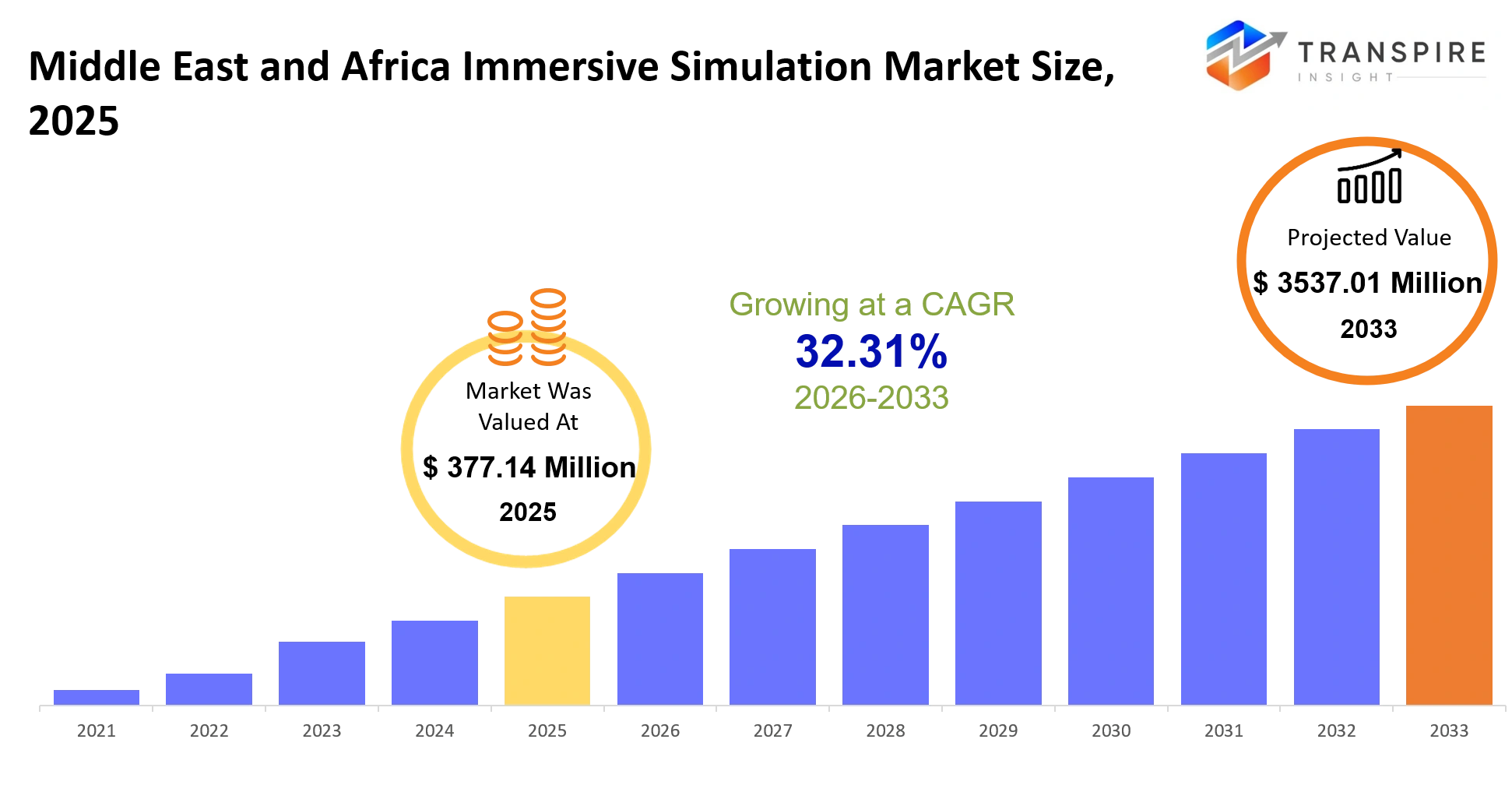
- Middle East and Africa Immersive Simulation Market Size 2025: USD 377.14 Million
- Middle East and Africa Immersive Simulation Market Size 2033: USD 3537.01 Million
- Middle East and Africa Immersive Simulation Market CAGR: 32.31%
- Middle East and Africa Immersive Simulation Market Segments: By Technology (VR, AR, MR, Digital Twins, Haptics, Spatial Computing, 3D Simulation, Others); By Application (Training, Healthcare, Defense, Industrial Training, Gaming, Education, Research, Others); By Component (Hardware, Software, Services, Platforms, Sensors, Displays, Controllers, Others); By End User (Defense, Healthcare, Education, Manufacturing, Government, Enterprises, Research, Others).
Middle East and Africa Immersive Simulation Market Summary
The Middle East and Africa Immersive Simulation Market was valued at USD 377.14 Million in 2025. It is forecast to reach USD 3537.01 Million by 2033. That is a CAGR of 32.31% over the period.
The immersive simulation market kind of supports organizations that need to train personnel, check operational scenarios, build intricate systems, and also make better choices, all without risking people's equipment or facilities in the real world. You can see this in defense, healthcare, manufacturing, education, and energy, where virtual environments are being used more and more , to cut training costs, speed up the learning cycles and lift operational readiness.
Over the past five years the market has moved away from lone virtual reality rollouts, toward more integrated setups, that sort of blend digital twins, artificial intelligence, spatial computing, and real-time teamwork platforms. One big push behind this change was the digital transformation wave that came after pandemic-era disruptions, when it became obvious that classic classroom sessions and on-site simulation programs have gaps. Enterprises then wanted scalable remote learning and operational planning tools, and immersive platforms started to matter more strategically. Also, better hardware affordability, cloud based deployment approaches, and increased funding for smart infrastructure initiatives across Gulf economies have helped commercial adoption really grow. That shift opens up additional income opportunities for technology providers and simulation platform developers across the region.
Key Market Insights
- Gulf Cooperation Council countries, somehow, accounted for approximately 42% market share in 2025 , largely backed by smart city initiatives and defense modernization programs, that kind of thing.
- The Middle East and Africa Immersive Simulation Market shows the strongest momentum in Gulf economies, while African markets still post the fastest adoption rates all the way through 2033 , which is pretty telling.
- VR technology dominated overall with nearly 34% share in 2025, pushed by defense training, industrial safety programs, and workforce development efforts, too.
- Digital twins landed as the second-largest technology segment, benefiting from infrastructure planning, and also industrial asset stewardship applications.
- Spatial computing is projected as the fastest-growing technology segment through 2033, supported by enterprise collaboration and smart facility management operations , more or less.
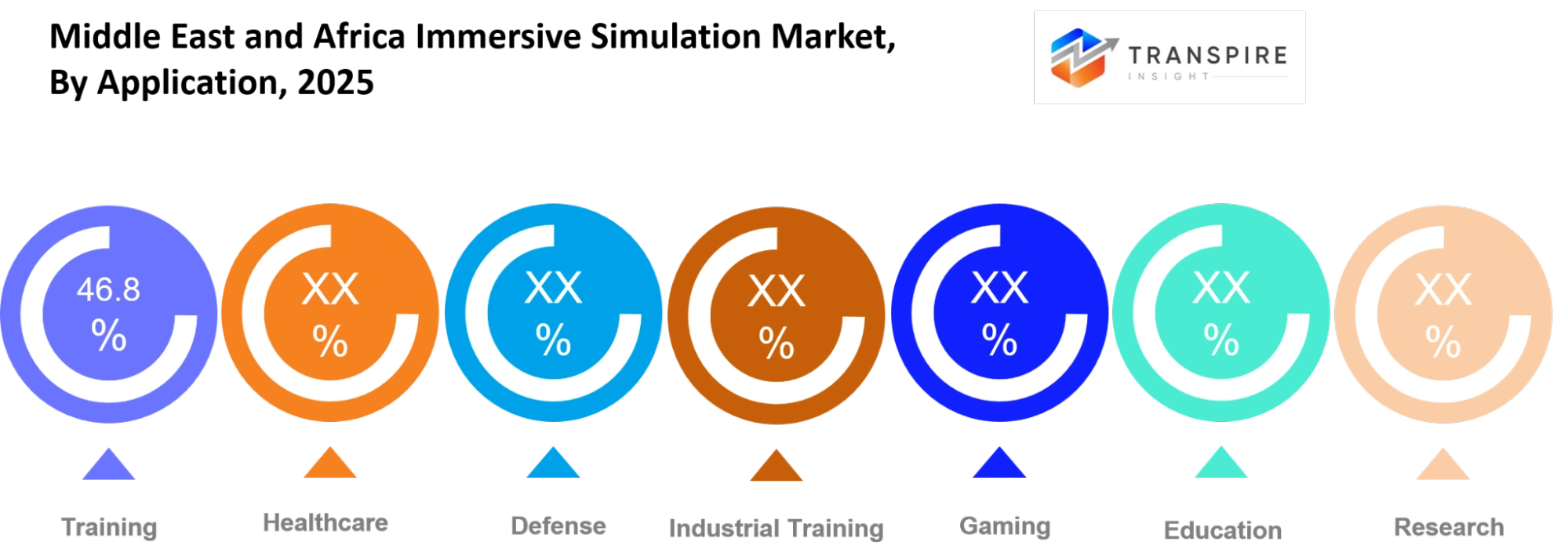
- Training applications held about 31% share in 2025, mirroring widespread deployment across military, industrial, and technical education environments, yes.
- Healthcare simulation is among the fastest-growing applications, as hospitals keep expanding virtual surgical rehearsals , plus patient-care simulations.
- Defense organizations represented roughly 28% of end-user revenue in 2025, staying in the lead through modernization efforts and mission-readiness investments.
- Enterprise and manufacturing users are ramping up adoption fastest via digital factory planning, and operational simulation platforms.
- Companies like Meta, Microsoft, NVIDIA, Siemens, Dassault Systèmes, and Unity compete through AI integration, digital twin innovation, cloud simulation capabilities , and regional partnerships that do not quietly matter.
What are the Key Drivers, Restraints, and Opportunities in the Middle East and Africa Immersive Simulation Market?
The strongest growth driver is kind of where digital transformation programs meet workforce training needs. Governments and companies across the Gulf region are putting a lot of money into smart infrastructure, advanced manufacturing, and defense modernization. Naturally these moves need people with strong skills, however traditional training is often tied to high operational costs and safety risks too. Immersive simulation platforms deliver a more lifelike learning context while also cutting downtime and limiting exposure to the equipment. so then organizations can train a bigger workforce quicker, which helps deployment readiness and keeps recurring software and service revenue streams moving.
The biggest restraint, still, sits in the high cost to implement and integrate everything. Enterprise-grade simulation environments typically need specialized hardware, more capable software platforms, high performance computing capacity, and technical know how. This obstacle feels structural because many organizations don’t yet have enough digital infrastructure or they simply don’t have enough simulation specialists. On top of that, budget constraints across several African economies slow procurement cycles. Because of this, uptake among mid sized enterprises gets delayed, and market revenue potential can shrink even if the interest in the technology looks strong.
Looking ahead, digital twin deployment seems like a major opportunity. Big infrastructure rollouts, industrial facilities, airports, healthcare campuses, and smart city programs increasingly rely on virtual replicas for planning and for day to day operational management. Countries like Saudi Arabia, the UAE, and South Africa are expanding their spending on intelligent infrastructure .
What Has the Impact of Artificial Intelligence Been on the Middle East and Africa Immersive Simulation Market?
Artificial intelligence has, in a pretty noticeable way, strengthened immersive simulation platforms by helping them become more adaptive, predictive, and well… operationally efficient. With AI algorithms in the loop, scenario creation, performance evaluation, and training tailoring are handled with far less manual work across defense, healthcare, and industrial uses. Instead of sticking to static simulations that kinda don’t move much, organizations can build environments that react to what the user does, in real time, without feeling so scripted.
Machine learning models are also boosting predictive能力 , yes that exact idea. In particular, digital twin platforms are using AI to forecast how equipment will behave, spot maintenance needs earlier, and judge potential operational results before anything is physically deployed. In manufacturing and infrastructure efforts, predictive analytics tends to cut down downtime while raising asset utilization, which sounds simple but matters a lot. In healthcare simulation systems, AI powered assessment tools can gauge trainee performance and highlight skill gaps with more precision than older methods.
On the operational side, people usually see faster training cycles, better resource distribution, lower operational hazards, and smoother alignment with safety procedures. As a result, organizations often report improved workforce readiness and more efficient knowledge transfer, thanks to these intelligent simulation platforms that kind of “learn” the training context.
Still, adoption isn’t effortless. AI enabled simulation environments can demand significant computing capacity, plus integration know how, and also high quality datasets to keep outcomes reliable. A lot of organizations, especially in developing markets, run into infrastructure limits, so large scale deployment becomes more complicated and costly compared with traditional simulation approaches, even when the benefits are clear.
Key Market Trends
- Between 2021 and 2025, enterprise adoption shifted away from kind of standalone VR deployments toward integrated digital twin ecosystems, not just a simple upgrade.
- Defense agencies, expanded mixed reality training programs by more than 25% since 2022 (to help mission preparedness) and honestly it feels like that went in waves.
- In healthcare, institutions increasingly adopted simulation-based clinical training after remote learning disruptions, and that pushed the digital transformation more quickly than expected.
- AI-enabled simulation platforms gained traction from 2024 onward through automated scenario generation and performance analytics, with less manual tuning.
- Cloud-based deployment models reduced infrastructure barriers and expanded access for educational plus industrial organizations in general.
- Smart city investments across Gulf countries created new demand for infrastructure visualization and operational planning simulations, which is pretty specific.
- Manufacturers increasingly integrated immersive environments with Industry 4.0 systems to optimize production planning, as well as worker training.
- NVIDIA, Siemens, and Dassault expanded digital twin capabilities, and that helped accelerate enterprise simulation adoption across infrastructure projects, overall.
- Mixed reality solutions gained preference over single-technology deployments, because organizations wanted a more flexible user experience, not a one-track setup.
- Regional partnerships between technology vendors and public institutions increased significantly between 2023 and 2026, kind of a steady climb.
Middle East and Africa Immersive Simulation Market Segmentation
By Technology
VR keeps a big place in the market, as immersive virtual environments kinda support training, operational planning and technical skill growth across all sorts of industries, not only one. Then AR adds layered digital detail onto the real world, so field operations, routine maintenance and workforce guidance become more efficient , overall. With MR, physical and digital interaction kinda get merged together, and that produces a more believable experience which helps teamwork, plus learning results. Digital twins also matter, they back infrastructure planning, operational monitoring and even predictive analysis by using virtual reflections of real assets.
Haptics technology, meanwhile, bumps up realism with tactile feedback, which improves the quality of simulations for healthcare, defense, and industrial uses. Spatial computing makes it easier for people to interact with digital surroundings, helping with high level visualization and collaboration. And the 3D simulation platforms keep being relevant for engineering, education, manufacturing, and design work, especially where visualization accuracy affects decisions. Other related options show up too, like advanced rendering engines, AI-enhanced simulation tools and cloud-based immersive platforms that broaden access , and add extra capabilities for more users.
By Application
Training still kind of stays the biggest use case, since organizations need safe scalable, and repeatable learning spaces. In healthcare, institutions tend to use immersive environments for clinical education, surgical rehearsal and patient-care scenarios, which is pretty crucial. Defense groups then rely on advanced simulation systems for mission rehearsal, operational thinking, and tactical readiness. On the industrial side, training programs leverage virtual environments to boost workforce safety and technical proficiency while cutting down on those everyday operational interruptions.
Gaming keeps moving forward, mostly driving new ideas in graphics, interaction, and immersive content creation. Schools and universities also adopt simulation based learning, not just for engagement but for better hands-on comprehension. Research organizations employ immersive settings for experimentation, visualization, and data analysis activities, sometimes with very specific workflows. Beyond that, you also see it in architecture and urban planning, plus emergency response preparation, and even infrastructure development projects.
By Component
Hardware is a crucial, kinda foundation, built from headsets, processing units , tracking devices, and the computing setup needed for immersive moments. Software solutions handle simulation building, content authoring, analytics, and the everyday user interaction. Services help with rollout, tailoring, upkeep , and also workforce training needs, while Platforms offer a single home base, for distributing content, teamwork, and day to day operational management.
Sensors make motion tracing better, boost environmental awareness and keep interaction accuracy more consistent. Displays keep moving forward, with higher resolutions, broader fields of view ,and cleaner image quality. Controllers enable careful interaction inside the simulated space and they also lift user engagement. Other parts include networking systems, cloud infrastructure tooling, and niche accessories meant for industry specific uses.
By End User
Defense organizations act as a major user group because they have a lot of big needs around mission preparation, operational readiness ,and personnel development, it kind of never really stops. Healthcare institutions often lean on simulation tech for clinical education, hands on procedural practice,and even workforce evaluation. Educational organizations pull immersive learning tools into classrooms, labs ,and technical training programs in a way that helps people actually keep up. Manufacturing companies then put these same simulation environments to work for workforce development, process optimization, and production planning, which is nice since the real line is expensive.
Government agencies also make use of immersive technologies for public service training, emergency readiness, and infrastructure planning, even when budgets are tight. Enterprises deploy simulation platforms for teamwork, product development, and employee learning activities that are consistent across sites. Research institutions use advanced visualization plus modeling capabilities to back innovation and scientific investigation, not just theory. Other end users can include transportation operators, construction companies, energy organizations, and technology development groups, mostly anyone working with complex systems and needing safer practice.
What are the Key Use Cases Driving the Middle East and Africa Immersive Simulation Market?
Workforce training is still the most important use case because organizations really do need practical learning environments that don’t come with operational risks, not even the small ones. Defense agencies, industrial facilities and technical training centers lean on immersive platforms so they can boost skill development, cut training expenses, and improve readiness ahead of real-world deployment.
Healthcare simulation and industrial process optimization are also getting serious traction. Hospitals are moving toward virtual environments for surgical preparation and clinical training, while manufacturers use simulation platforms to trial workflows, tighten safety procedures, and check production changes before they’re actually rolled out.
More emerging stuff shows up too, like digital twin enabled infrastructure management and smart city planning. Big development projects across Gulf economies increasingly adopt immersive environments to help visualize assets, stress test operational scenarios and back long term planning strategies, before construction or deployment even begins.
|
Report Metrics |
Details |
|
Market size value in 2025 |
USD 377.14 Million |
|
Market size value in 2026 |
USD 498.21 Million |
|
Revenue forecast in 2033 |
USD 3537.01 Million |
|
Growth rate |
CAGR of 32.31% from 2026 to 2033 |
|
Base year |
2025 |
|
Historical data |
2021 - 2024 |
|
Forecast period |
2026 - 2033 |
|
Report coverage |
Revenue forecast, competitive landscape, growth factors, and trends |
|
Regional scope |
Middle East and Africa (Saudi Arabia, United Arab Emirates, South Africa, Rest of Middle East and Africa) |
|
Key company profiled |
Meta, Microsoft, HTC, Sony, Varjo, Unity, Epic Games, Siemens, Dassault, PTC, NVIDIA, Qualcomm, Magic Leap, Lenovo, Honeywell. |
|
Customization scope |
Free report customization (country, regional & segment scope). Avail customized purchase options to meet your exact research needs. |
|
Report Segmentation |
By Technology (VR, AR, MR, Digital Twins, Haptics, Spatial Computing, 3D Simulation, Others); By Application (Training, Healthcare, Defense, Industrial Training, Gaming, Education, Research, Others); By Component (Hardware, Software, Services, Platforms, Sensors, Displays, Controllers, Others); By End User (Defense, Healthcare, Education, Manufacturing, Government, Enterprises, Research, Others). |
Which Regions are Driving the Middle East and Africa Immersive Simulation Market Growth?
The Gulf area sort of leads market revenue creation because of solid government investment into digital transition, defense modernization, smart city initiatives, and advanced infrastructure build outs. Saudi Arabia, and also the UAE, keep widening technology adoption not only in public work but private operations too. There is also important funding for innovation programs that helps push advanced simulation platforms out into the real world. When you combine strong tech ecosystems with modern digital foundations it kind of locks in the regional lead.
South Africa ends up as the second-biggest contributor with a somewhat different rhythm, more oriented toward industrial upgrading, healthcare innovation, and educational technology take-up. Enterprise spending stays steady, and the local technology sector is pretty mature, so market activity stays consistent. Universities, research centers, and industrial bodies keep folding simulation platforms into day to day workflows. Because of that balanced adoption style, revenue generation feels dependable across several industries at once.
The remainder of Africa is expected to show the fastest growth rate through 2033. More digital infrastructure is being laid, workforce development programs are rolling forward, and industrial investment initiatives are opening fresh windows for simulation technology providers. A few countries are raising spending on technical education and digital skills training. As adoption rises across developing markets, it should give attractive expansion chances for technology vendors and investors during the whole forecast stretch.
Who are the Key Players in the Middle East and Africa Immersive Simulation Market and How Do They Compete?
Competition stays somewhat moderately concentrated, mostly around global technology providers that have really solid software ecosystems, strong hardware muscles, and lots of enterprise ties. The whole competitive edge is mostly built on innovation, platform unification, content development tools, plus digital twin capabilities , which are kind of the core basis. The biggest tech companies keep piling on ecosystem strengths, mixing immersive hardware, software, cloud services, and artificial intelligence.
Microsoft comes at it by tying together mixed reality solutions with enterprise cloud platforms, and also industrial digital transformation programs. Siemens leans hard into digital twin technology, so infrastructure and manufacturing clients can mesh simulation environments with actual operational data. NVIDIA uses advanced graphics processing, AI acceleration, and Omniverse-style collaboration platforms, to build high-performance simulation setups that feel pretty seamless.
Dassault Systèmes competes via engineering-centered virtual modeling capabilities, supporting product development, and infrastructure planning at the same time. Unity pushes adoption through adaptable development tools used in education, healthcare, industrial training, and also enterprise visualization projects. Meta keeps investing into immersive hardware and software ecosystems, which helps broader enterprise uptake as well as education use.
Overall, strategic partnerships , AI integration, cloud deployment models, and regional expansion attempts remain the main levers for how differentiation plays out across the market.
Company List
- Meta
- Microsoft
- HTC
- Sony
- Varjo
- Unity
- Epic Games
- Siemens
- Dassault Systèmes
- PTC
- NVIDIA
- Qualcomm
- Magic Leap
- Lenovo
- Honeywell
Recent Development News
In May 2026, Microsoft launched new enterprise mixed reality capabilities integrated with Microsoft Mesh. The update strengthened collaborative immersive training and remote simulation applications for enterprise customers.
Source: https://www.microsoft.com/en-us/mesh (Microsoft).
In March 2026, NVIDIA expanded the NVIDIA Omniverse platform with additional AI-powered simulation and digital twin capabilities. The development improved real-time industrial simulation and enterprise-scale virtual collaboration workflows.
Source: https://www.nvidia.com/en-us/omniverse/ (NVIDIA).
What Strategic Insights Define the Future of the Middle East and Africa Immersive Simulation Market?
Market is moving toward fully integrated digital ecosystems where immersive simulation, artificial intelligence, spatial computing, and digital twins sort of operate as one unified operational platform, not separate techs. The strongest force behind this shift is the growing need to train larger workforces, deal with complex infrastructure assets, and tune operational decisions in increasingly digital economies. There is also a quieter concern, market concentration around a small set of software ecosystems and hardware suppliers, which can boost dependency and also narrow the interoperability options for enterprise customers.
At the same time, a rising opening sits in AI powered digital twin environments for smart cities, industrial facilities , healthcare campuses, and big infrastructure developments. Market players should push for open platform architectures and deliberate partnerships that connect simulation surroundings with enterprise data systems. Firms that build scalable ecosystems now will likely be in a better spot to capture long term value as immersive technologies get embedded into day to day operational workflows across the region.
Middle East and Africa Immersive Simulation Market Report Segmentation
By Technology
- VR
- AR
- MR
- Digital Twins
- Haptics
- Spatial Computing
- 3D Simulation
- Others
By Application
- Training
- Healthcare
- Defense
- Industrial Training
- Gaming
- Education
- Research
- Others
By Component
- Hardware
- Software
- Services
- Platforms
- Sensors
- Displays
- Controllers
- Others
By End User
- Defense
- Healthcare
- Education
- Manufacturing
- Government
- Enterprises
- Research
- Others
Frequently Asked Questions
Find quick answers to common questions.
The expected Middle East and Africa Immersive Simulation Market size for the market will be USD 3537.01 Million in 2033.
Key segments for the Middle East and Africa Immersive Simulation Market are By Technology (VR, AR, MR, Digital Twins, Haptics, Spatial Computing, 3D Simulation, Others); By Application (Training, Healthcare, Defense, Industrial Training, Gaming, Education, Research, Others); By Component (Hardware, Software, Services, Platforms, Sensors, Displays, Controllers, Others); By End User (Defense, Healthcare, Education, Manufacturing, Government, Enterprises, Research, Others).
Major Middle East and Africa Immersive Simulation Market players are Meta, Microsoft, HTC, Sony, Varjo, Unity, Epic Games, Siemens, Dassault, PTC, NVIDIA, Qualcomm, Magic Leap, Lenovo, Honeywell.
The Middle East and Africa Immersive Simulation Market size is USD 377.14 Million in 2025.
The Middle East and Africa Immersive Simulation Market CAGR is 32.31% from 2026 to 2033.
- Meta
- Microsoft
- HTC
- Sony
- Varjo
- Unity
- Epic Games
- Siemens
- Dassault Systèmes
- PTC
- NVIDIA
- Qualcomm
- Magic Leap
- Lenovo
- Honeywell
About the Authors

Avinash Kumar
I’m Avinash Kumar, a Senior Research Analyst at Transpire Insight, with expertise in the Electronics and Semiconductor and Energy & Power industry. My work focuses on analyzing emerging technologies, market trends, industry developments, and innovation across these sectors. I specialize in transforming complex technical and market insights into clear, research-backed content that helps professionals, businesses, and decision-makers stay informed. Through continuous industry research and data-driven analysis, I strive to deliver accurate, reliable, and practical perspectives on the latest advancements shaping the semiconductor and energy landscape.

Chakradhar Khansole
Chakradhar serves as the Research Director at Transpire Insight, bringing over 8 years of experience in technology, innovation, and strategic market intelligence. He specializes in transforming complex market data into actionable business insights that enable organizations to make informed, growth-oriented decisions. Recognized for his strategic vision and analytical expertise, Chakradhar leads high-impact research initiatives, delivering comprehensive market assessments, competitive intelligence, and forward-looking industry analysis.
Recently Published Reports
-
Apr 2026
Fiber Optic Faceplates Market
Fiber Optic Faceplates Market Size, Share & Analysis Report By Type (< 300 mm2, 300-350 mm2, and > 350 mm2, By Application (Night Vision, Holographic Imaging, Medical, and Others), and Geography (North America, Europe, Asia-Pacific, Middle East and Africa, South and Central America), 2021 - 2031
-
Apr 2026
High Temperature Superconductors Market
High Temperature Superconductors Market Size, Share & Analysis Report By Type (1G HTS, and 2G HTS), By Application (Power Cable, Fault Current Limiter, and Transformer), and Geography (North America, Europe, Asia-Pacific, Middle East and Africa, South and Central America), 2021 - 2031
-
Apr 2026
Industrial Plugs and Socket Market
Industrial Plugs and Socket Market Size, Share & Analysis Report By Type (Industrial Plugs, Industrial Sockets), By Current (Up to 32 A, 32 to 125 A, Above 125 A), By Protection (Dustproof and Splash Proof, Waterproof, Explosion Proof), By End User (Heavy Industries, Oil and Gas, Chemicals and Pharmaceuticals, Power Generation, Others), and Geography (North America, Europe, Asia-Pacific, Middle East and Africa, South and Central America), 2021 - 2031
-
Apr 2026
InGaAs Avalanche Photodiodes Market
InGaAs Avalanche Photodiodes Market Size, Share & Analysis Report By Type (1100 - 1700 nm, and 1000 - 1600 nm), By Application (Missile Warning System, Muzzle Flash Detection, Wafer Defect Inspection, Laser Rangefinders, and Others), and Geography (North America, Europe, Asia-Pacific, Middle East and Africa, South and Central America), 2021 - 2031