

Asia Pacific Digital Education Market Size & Forecast:
- Asia Pacific Digital Education Market Size 2025: USD 68.49 Billion
- Asia Pacific Digital Education Market Size 2033:USD 200.91 Billion
- Asia Pacific Digital Education Market CAGR:14.40%
- Asia Pacific Digital Education Market Segments:By Learning Type (K-12 Education, Higher Education, Corporate Learning, Vocational Training, Language Learning, Test Preparation, Skill Development, Others); By Technology (E-learning Platforms, Learning Management Systems, Virtual Classrooms, AI Learning Tools, Mobile Learning, Gamification Platforms, AR/VR Learning, Others); By Deployment (Cloud-Based, On-Premise, Hybrid, SaaS Platforms, Mobile Platforms, Web Platforms, Offline Digital Learning, Others); By End User (Students, Educational Institutions, Corporates, Government Organizations, Teachers, Tutors, Training Centers, Others).
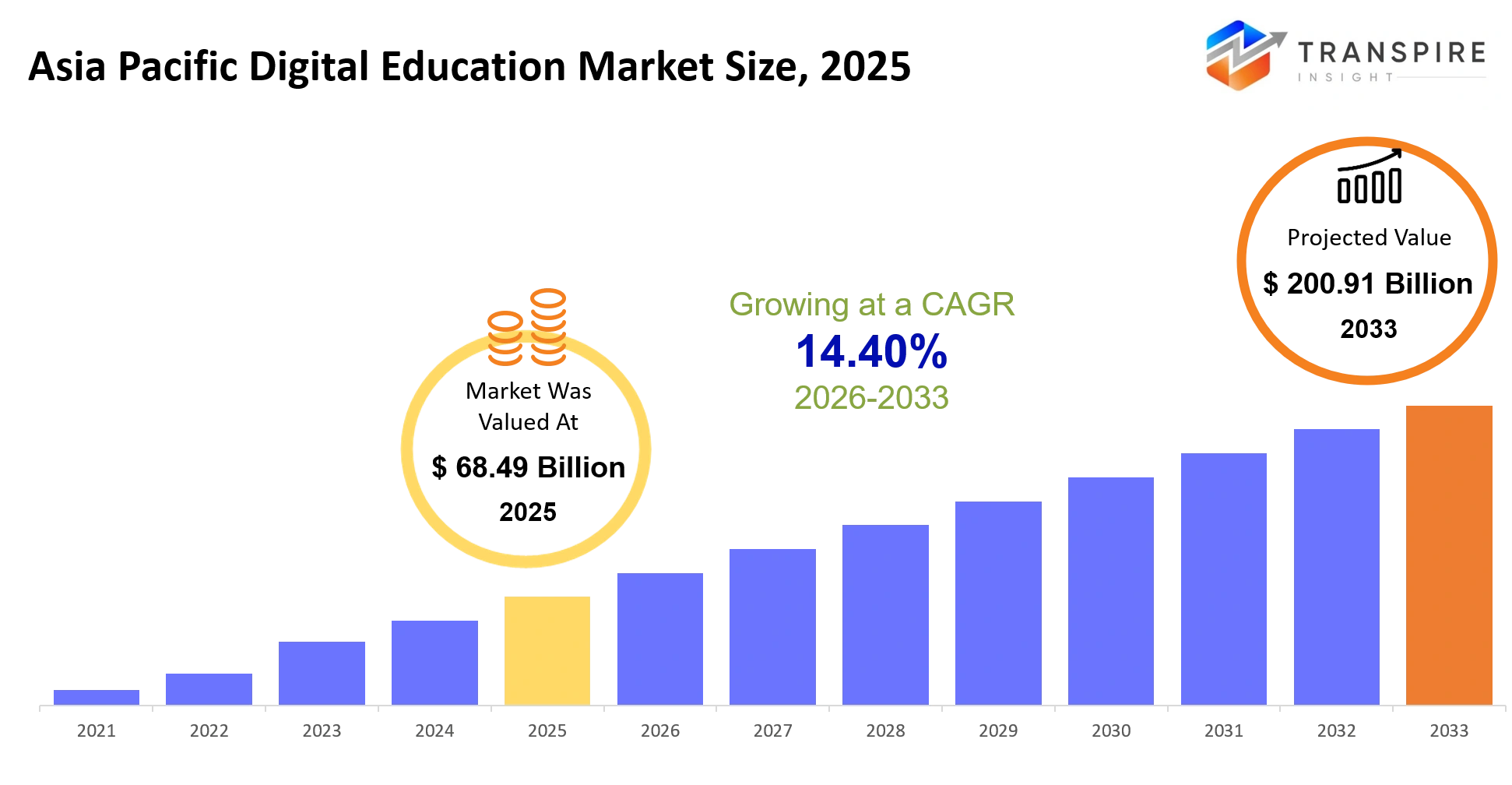
Asia Pacific Digital Education Market Summary
The Asia Pacific Digital Education Market was valued at USD 68.49 Billion in 2025. It is forecast to reach USD 200.91 Billion by 2033. That is a CAGR of 14.40% over the period.
The Asia Pacific Digital Education Market helps people learn skills all the time, get instructions from far away and get access to a lot of knowledge in schools, universities and companies that train their employees. It actually replaces the way of learning in a classroom with a new way of learning that uses platforms. These platforms let teachers give instructions so students can learn at their own pace and everyone can track how well they are doing.Over a few years the way people learn has changed a lot. Now we do not just learn in a classroom we also learn using models that use the internet and special computer programs that help us learn better. The COVID-19 pandemic made a lot of people start using classrooms and learn from far away. This made people get used to learning in a way and it changed the way students and schools think about learning.
At the time governments and companies started to think that it is very important for people to learn new digital skills. So they started to invest money in learning programs for their employees. Now people use education because it helps them get a job, get certified and be more productive. This is making companies that make learning platforms create systems that are connected and help people learn, get assessed and get a job. The Asia Pacific Digital Education Market is making all these changes happen.
Key Market Insights
- The Asia Pacific Digital Education Market is growing fast. This is because schools and universities are moving to a mix of offline learning. They are also using intelligence to make learning personal.. They are using online education platforms. This growth is expected to continue until 2030.
- The Asia Pacific Digital Education Market will keep growing. This is because people need to learn digital skills. Governments are also helping with education technology. Many workers need to learn skills to keep up with changes.
- Asia Pacific has a share of the Asia Pacific Digital Education Market. In 2025 it has around 42% share. This is because there are students and the internet is easily available.
- Southeast Asia is growing fast from 2025 to 2030. This is because people are using their phones to learn. The internet is also easily available in countries.
- Learning Management Systems are a part of the Asia Pacific Digital Education Market. They have 36% share. This is because many schools and universities use them. They are also easy to use. Can be used by many people.
- AI-powered learning platforms are growing fast. This is because schools want to make learning personal. They also want to make sure students are learning what they need to know.
- Higher education is the area of demand. It has a 40% share. This is because many people are getting degrees. Virtual universities are also becoming popular.
- Corporate training is growing fast. This is because companies want their workers to keep learning skills. They want to make sure their workers have the skills they need for their age.
- Educational institutions are the users of digital education. This is because they are using classrooms and a mix of online and offline learning.
- Companies, like Coursera, BYJU'S Udemy, Khan Academy, Pearson and Unacademy are becoming stronger. They are using intelligence and working with other companies. They are also expanding to areas.
What are the Key Drivers, Restraints, and Opportunities in the Asia Pacific Digital Education Market?
Drivers
The main thing that is helping the Asia Pacific Digital Education Market is that schools are quickly changing to use intelligence and cloud-based learning systems. This change happened because a lot of schools started using tools during the pandemic and now the government is investing in helping people learn digital skills and update what they teach. So now schools and universities are using systems to manage learning, tools to assess how well students are doing and platforms that charge a fee for content, which is making money for the companies that make these tools and helping students learn all the time.
Restraints
‘The biggest problem is that some areas do not have digital infrastructure and it is not affordable for everyone. This is an issue because it has been a problem for a long time and it is not just about the technology it is also about how much money schools have and if people have access to the internet and devices. Because of this a lot of people who could be learning are not able to use the education systems, which means the Asia Pacific Digital Education Market is not making as much money as it could be and it is not growing evenly.
Opportunity
There is an opportunity for the Asia Pacific Digital Education Market in using artificial intelligence to make learning platforms that work well in areas with slow internet. This is especially true in India and Southeast Asia. Some companies are making apps that work without the internet and are creating content in local languages, which is starting to be popular. For example Coursera is working with universities and governments to create ways for people to get certified which could help the Asia Pacific Digital Education Market grow in a big way and include more people.
What Has the Impact of Artificial Intelligence Been on the Asia Pacific Digital Education Market?
Artificial intelligence and digital technologies are changing the way scrubber performance systems and marine emission control technologies work. They make it possible to automate things, monitor what is happening in time and manage compliance with the rules based on data. Now systems that use intelligence can control exhaust gas cleaning technology. They do this by adjusting the flow of washwater, pressure levels and how much fuel is used compared to emissions. This is all based on what's happening at the moment.This means that people do not have to get involved much and it helps to make sure that vessels follow the rules set by the International Maritime Organization. Machine learning models are being used more and more to predict when maintenance is needed. They look at data from sensors on scrubber units to figure out when parts might get dirty, corrode or break down before it actually happens. This helps shipping operators plan when to do maintenance, reduces the time that equipment is not working and makes it last longer.
When shipping companies use systems to monitor what is going on they see that their fuel use is more efficient and their emissions are more consistent. This means they save money on complying with the rules and have problems when their vessels are inspected. However there is a problem. There is not enough good data from the real world that these systems can learn from.. When vessels are at sea it can be hard to stay connected. This makes it difficult for the systems to work accurately and make changes in time especially when vessels are in remote areas where internet connections are slow. So even though artificial intelligence is being used more and more in scrubber performance systems it is still hard to make them work completely on their own and optimize them because of problems with the infrastructure and the reliability of the data.
Key Market Trends
- Institutional adoption of cloud-based Learning Management System platforms rose significantly after 2022. They replaced classroom-only learning systems across universities and schools.
- The use of AI-enabled learning tools expanded between 2024 and 2026. These tools improved personalization. Reduced dropout rates in large-scale online education programs. Cloud-based LMS platforms helped to make learning more accessible.
- There was a shift in demand from content access to credential-based learning. Employers prioritized certified skills over informal course completion. They wanted to see proof of skills.
- The use of mobile- learning surged across Southeast Asia. This was because smartphone penetration surpassed 80% in markets between 2023 and 2025. More people had access to smartphones.
- Regulatory frameworks strengthened in 2024. They pushed edtech firms to improve data privacy compliance and standardized assessment systems. This made learning platforms safer.
- Enterprise training adoption accelerated after 2023. Corporations increased investment in reskilling platforms for digital workforce transformation. They wanted their employees to have the skills.
- The competitive strategies of companies like Coursera and Udemy evolved. They expanded certification partnerships with universities. This gave students options.
- Traditional tutoring models declined in markets. Students increasingly migrated to hybrid and online learning ecosystems. They preferred learning.
- Government-led digital education programs expanded in India and China. They accelerated digital inclusion through subsidized connectivity and devices. More people could access education.
- Platform ecosystems consolidated. Leading providers integrated AI tutoring, assessment tools and career pathways into learning solutions. This made learning more complete.
Asia Pacific Digital Education Market Segmentation
By Learning Type:
K-12 education and higher education are moving to modules with skill-based assessments and digital certification. Corporate learning is adopting training modules to reskill workers in tech and service sectors. Training and skill development programs are growing because people want job-ready skills in digital and technical roles. Language learning and test prep are steady because of academic requirements and global mobility.Learning platforms now combine instruction, recorded modules and automated assessments. People want certification pathways in corporate and higher education. Skill development programs use AI to track learner progress and improve completion rates. Education providers invest in content systems to match learner levels.The Asia Pacific Digital Education Market is growing across all learning types because of infrastructure and government programs. Institutions adopt education because of standardized outcomes and measurable performance. Market participants focus on digital content for high-volume learner ecosystems.

By Technology:
Technology is shifting to integrated elearning platforms and learning management systems. Virtual classrooms are adopted for real-time instruction and remote access. Mobile learning platforms grow because of smartphone use and flexible learning. Gamification platforms improve engagement with reward-based learning.
AI learning tools personalize content delivery and assessment improving efficiency and completion. AR and VR learning systems are adopted in vocational education for simulation-based training. Cloud-based education infrastructure supports scalability. Digital transformation initiatives improve platform interoperability.The Asia Pacific Digital Education Market advances with technologies. Technology upgrades improve scalability, content delivery and learner engagement. Investment focuses on platforms with analytics, automation and personalized learning.
By Deployment:
Deployment is shifting to cloud-based platforms for scalability and reduced infrastructure. SaaS platforms support subscription-based education. Web-based platforms are steady for access. Mobile platforms grow because of learning and device penetration.Hybrid deployment models grow in institutions needing offline and online access. On-premise systems are used in organizations requiring data control. Offline digital learning solutions support regions with connectivity. Integration across deployment models improves flexibility and accessibility.The Asia Pacific Digital Education Market benefits from deployment diversification. Digital infrastructure expansion supports adoption rates. Platform interoperability strengthens long-term system sustainability.
By End User:
End user segmentation shows adoption among students in K-12 and higher education. Educational institutions adopt structured learning platforms. Corporate organizations use training platforms for workforce upskilling. Government organizations support scale digital education programs.Teachers and tutors adopt platforms for content delivery and student assessment. Training centers expand offerings for vocational and professional certification. Demand from learner groups increases integration of centralized learning management systems. Adoption patterns reflect a shift toward outcome-based learning evaluation
What are the Key Use Cases Driving the Asia Pacific Digital Education Market?
The Asia Pacific Digital Education Market is really one main thing: using digital classrooms and learning management systems to deliver academic learning in a structured way. This is especially true for universities and colleges which use these platforms to handle a lot of students, make assessments standard and deliver coursework that combines offline learning. This is the popular use of digital education because schools need systems that can grow with them, reduce costs and still provide consistent results.
There are uses for digital education that are becoming more popular. For example companies are using platforms to train their employees in new skills like digital tools, analytics and automation. This helps employees work efficiently. Governments are also using learning systems to support programs that help people develop new skills and to make education more accessible in areas that are not cities. This is especially important for education.Some new and exciting uses for education are starting to appear. For instance some systems use intelligence to help students choose a career path and get certified in a way that is connected to the hiring process. The Asia Pacific Digital Education Market is seeing these new uses become more popular in vocational schools and online universities, where the goal is to help students get jobs after they graduate.
|
Report Metrics |
Details |
|
Market size value in 2025 |
USD 68.49 Billion |
|
Market size value in 2026 |
USD 78.35 Billion |
|
Revenue forecast in 2033 |
USD 200.91 Billion |
|
Growth rate |
CAGR of 14.40% from 2026 to 2033 |
|
Base year |
2025 |
|
Historical data |
2021 - 2024 |
|
Forecast period |
2026 - 2033 |
|
Report coverage |
Revenue forecast, competitive landscape, growth factors, and trends |
|
Regional scope |
Asia Pacific |
|
Key company profiled |
BYJU'S, Coursera, Udemy, Khan Academy, Duolingo, Google Classroom, Blackboard, Moodle, Vedantu, Unacademy, Pearson, Skillsoft, Chegg, edX, FutureLearn. |
|
Customization scope |
Free report customization (country, regional & segment scope). Avail customized purchase options to meet your exact research needs. |
|
Report Segmentation |
By Learning Type (K-12 Education, Higher Education, Corporate Learning, Vocational Training, Language Learning, Test Preparation, Skill Development, Others); By Technology (E-learning Platforms, Learning Management Systems, Virtual Classrooms, AI Learning Tools, Mobile Learning, Gamification Platforms, AR/VR Learning, Others); By Deployment (Cloud-Based, On-Premise, Hybrid, SaaS Platforms, Mobile Platforms, Web Platforms, Offline Digital Learning, Others); By End User (Students, Educational Institutions, Corporates, Government Organizations, Teachers, Tutors, Training Centers, Others). |
Which Regions are Driving the Asia Pacific Digital Education Market Growth?
Asia Pacific leads the Digital Education Market due to strong government policy support, large student populations, and rapid institutional digitization across countries such as China and India. National education frameworks have prioritized digital literacy, leading to large-scale deployment of learning management systems in public universities and school networks. A strong ecosystem of edtech companies, cloud service providers, and telecom operators supports continuous platform expansion. Universities and training institutions benefit from integrated digital infrastructure that enables high-volume remote learning. This structured policy and infrastructure alignment sustains long-term dominance in regional market share.
North America maintains a steady contribution to the global digital education ecosystem, supported by stable enterprise learning investments and mature institutional adoption. Unlike Asia Pacific, growth here is driven less by rapid expansion and more by optimization of existing digital education systems across corporate and higher education sectors. Organizations focus on improving learning efficiency, compliance training, and credential validation within established platforms. Strong regulatory frameworks around data privacy and education standards ensure consistent but controlled adoption. This makes the region a reliable revenue base rather than a high-acceleration growth zone.
Southeast Asia shows the fastest growth momentum due to recent investments in national digital infrastructure, increased smartphone penetration, and education modernization programs launched after 2023. Governments in countries such as Indonesia, Vietnam, and the Philippines expanded broadband access and introduced digital classroom initiatives in public schools. Private sector partnerships with global edtech providers accelerated platform availability in local languages. This shift has opened large untapped learner bases previously excluded from structured digital education systems. For market entrants and investors, this region presents strong expansion potential from 2026 to 2033, especially in mobile-first and low-cost learning solutions.
Who are the Key Players in the Asia Pacific Digital Education Market and How Do They Compete?
The Asia Pacific Digital Education Market remains highly fragmented, with competition shaped by both global platforms and strong regional edtech firms. Established incumbents compete aggressively to retain users, while new entrants continue to disrupt pricing models and delivery formats through mobile-first and AI-based solutions. Competition is mainly driven by technology innovation and content personalization rather than cost alone, as learners and institutions increasingly prioritize measurable outcomes, certification value, and adaptive learning experiences. This shift has pushed platforms to continuously upgrade AI capabilities, user experience, and integration with institutional systems.
Coursera focuses on certification-led growth by partnering with top universities and global enterprises to offer industry-recognized credentials. Its differentiation comes from structured degree programs and professional certificates linked directly to employability outcomes, which strengthens enterprise adoption across Asia Pacific. Expansion continues through university alliances and localized course offerings in emerging markets. BYJU'S builds its advantage through strong K-12 curriculum integration and AI-driven personalized tutoring systems tailored for exam preparation. The company scales through aggressive content localization and hybrid learning models that combine digital and offline coaching centers.
Udemy competes through a marketplace model that enables rapid content diversification across professional skills, supported by instructor-led course creation at scale. This structure allows fast adaptation to changing skill demand in technology and business domains. Khan Academy maintains a differentiation strategy centered on free, high-quality foundational education, strengthening accessibility in underserved regions. Pearson expands through digital transformation of traditional academic publishing into integrated assessment and learning platforms, strengthening institutional contracts across schools and universities.
Company List
- Coursera
- Khan Academy
- Google Classroom
- Moodle
- Vedantu
- Unacademy
- Pearson
- Skillsoft
- Chegg
- edX
- FutureLearn
Recent Development New
In December 2025, Coursera announced its merger with Udemy in a $2.5 billion all-stock deal to build a unified global learning platform focused on AI-driven skill development. The merger strengthens enterprise training capabilities and expands credential-based learning ecosystems across Asia Pacific.
Source: https://www.reuters.com
In May 2026, Coursera and Udemy completed their merger, officially launching an integrated AI-skills education platform designed to support large-scale workforce reskilling. The combined platform is targeting rising demand for AI, data science, and digital transformation skills across global and Asia Pacific learners.
Source: https://www.axios.com
In 2025, India’s edtech ecosystem recorded a significant rebound in AI-focused funding rounds, with investors increasing capital deployment into adaptive learning and workforce upskilling platforms. This shift reflects stronger confidence in outcome-based digital education models across Asia Pacific markets.
Source: https://m.economictimes.com
What Strategic Insights Define the Future of the Asia Pacific Digital Education Market?
The Asia Pacific Digital Education Market is structurally shifting toward integrated, AI-led learning ecosystems where education delivery, assessment, and employment linkage operate within a single digital flow. Over the next 5–7 years, this direction will be driven by sustained enterprise demand for verifiable skills and government pressure to standardize digital credentialing across academic and vocational systems. However, a less visible risk is increasing market concentration among a small set of global platforms, which could reduce pricing flexibility and limit innovation diversity across regional providers. This consolidation may also create dependency risks for institutions relying on single-platform ecosystems.
A key emerging opportunity lies in AI-driven credential interoperability frameworks that allow learners to transfer certifications across platforms and countries, especially within ASEAN education networks. This is gaining traction as governments explore standardized digital qualification systems linked to employment databases. Market participants should prioritize building interoperable APIs and partnerships with universities and workforce agencies rather than focusing solely on content expansion. Firms that align early with credential standardization initiatives and cross-border skill recognition systems will capture disproportionate value as digital education transitions from platform-based learning to ecosystem-based workforce infrastructure.
Asia Pacific Digital Education Market Report Segmentation
By Learning Type
- K-12 Education
- Higher Education
- Corporate Learning
- Vocational Training
- Language Learning
- Test Preparation
- Skill Development
- Others
By Technology
- E-learning Platforms
- Learning Management Systems
- Virtual Classrooms
- AI Learning Tools
- Mobile Learning
- Gamification Platforms
- AR/VR Learning
- Others
By Deployment
- Cloud-Based
- On-Premise
- Hybrid
- SaaS Platforms
- Mobile Platforms
- Web Platforms
- Offline Digital Learning
- Others
By End User
- Students
- Educational Institutions
- Corporates
- Government Organizations
- Teachers
- Tutors
- Training Centers
- Others
Frequently Asked Questions
Find quick answers to common questions.
The expected Asia Pacific Digital Education Market size for the market will be USD 200.91 Billion in 2033.
Key segments for the Asia Pacific Digital Education Market are By Learning Type (K-12 Education, Higher Education, Corporate Learning, Vocational Training, Language Learning, Test Preparation, Skill Development, Others); By Technology (E-learning Platforms, Learning Management Systems, Virtual Classrooms, AI Learning Tools, Mobile Learning, Gamification Platforms, AR/VR Learning, Others); By Deployment (Cloud-Based, On-Premise, Hybrid, SaaS Platforms, Mobile Platforms, Web Platforms, Offline Digital Learning, Others); By End User (Students, Educational Institutions, Corporates, Government Organizations, Teachers, Tutors, Training Centers, Others).
Major Asia Pacific Digital Education Market players are BYJU'S, Coursera, Udemy, Khan Academy, Duolingo, Google Classroom, Blackboard, Moodle, Vedantu, Unacademy, Pearson, Skillsoft, Chegg, edX, FutureLearn.
The Asia Pacific Digital Education Market size is USD 68.49 Billion in 2025.
The Asia Pacific Digital Education Market CAGR is 14.40% from 2026 to 2033.
- BYJU'S
- Coursera
- Udemy
- Khan Academy
- Duolingo
- Google Classroom
- Blackboard
- Moodle
- Vedantu
- Unacademy
- Pearson
- Skillsoft
- Chegg
- edX
- FutureLearn
About the Authors

Mayur Shinde
I am Mayur Shinde, a Senior Research Analyst at Transpire Insight, specializing in the Automotive & Transportation and Information & Communication Technology (ICT) Industry. My work focuses on analyzing emerging market trends, technological advancements, competitive landscapes, and industry developments to deliver accurate, data-driven insights. I am passionate about transforming complex market information into clear, actionable content that helps businesses, professionals, and decision-makers stay informed and make confident strategic decisions.

Chakradhar Khansole
Chakradhar serves as the Research Director at Transpire Insight, bringing over 8 years of experience in technology, innovation, and strategic market intelligence. He specializes in transforming complex market data into actionable business insights that enable organizations to make informed, growth-oriented decisions. Recognized for his strategic vision and analytical expertise, Chakradhar leads high-impact research initiatives, delivering comprehensive market assessments, competitive intelligence, and forward-looking industry analysis.
Recently Published Reports
-
Apr 2026
3D Optical Profiler Market
3D Optical Profiler Market Size, Share & Analysis Report By Type (Desktop 3D Optical Profiler, and Portable 3D Optical Profiler), By Technology (Confocal Technology, and White Light Interference), By End-Use Industry (Manufacturing, Research Institutions, Automotive, Aerospace and Defense, Medical Devices, and Other), and Geography (North America, Europe, Asia-Pacific, Middle East and Africa, South and Central America), 2021 - 2031
-
Apr 2026
Depth Sensor Market
Depth Sensor Market Size, Share & Analysis Report By Type (Infrared Depth Sensors, Time-of-Flight (ToF) Sensors, Stereo Vision Sensors, Structured Light Sensors, Ultrasonic Depth Sensors), By Application (Automotive, Robotics, Gaming, Consumer Electronics, Industrial Automation, Healthcare, Security & Surveillance, Others), By End Users (Automotive Manufacturers, Consumer Electronics Companies, Healthcare Providers, Industrial Companies, Security Agencies, Gaming Companies, Robotics Companies, Others), and Geography (North America, Europe, Asia-Pacific, Middle East and Africa, South and Central America), 2021 – 2031
-
Apr 2026
Digital Manufacturing Market
Digital Manufacturing Market Size, Share & Analysis Report By Component (Hardware, Software, and Services), By Technology (Robotics, 3D Printing, Internet of Things (IoT), and Others), By Application (Automotive and Transportation, Aerospace and Defense, Consumer Electronics, Industrial Machinery, and Others), By Process Type (Computer-Based Designing, Computer-Based Simulation, Computer 3D Visualization, Analytics, and Others), and Geography (North America, Europe, Asia-Pacific, Middle East and Africa, South and Central America), 2021 – 2031
-
Apr 2026
Digital Visa Services Market
Digital Visa Services Market Size, Share & Analysis Report By Type (Individual Travelers, Group Travelers), By Application (Tourism, Business Travel, Others), and Geography (North America, Europe, Asia-Pacific, Middle East and Africa, South and Central America), 2021 – 2031