

Middle East and Africa Higher Education Technology Market Size & Forecast:
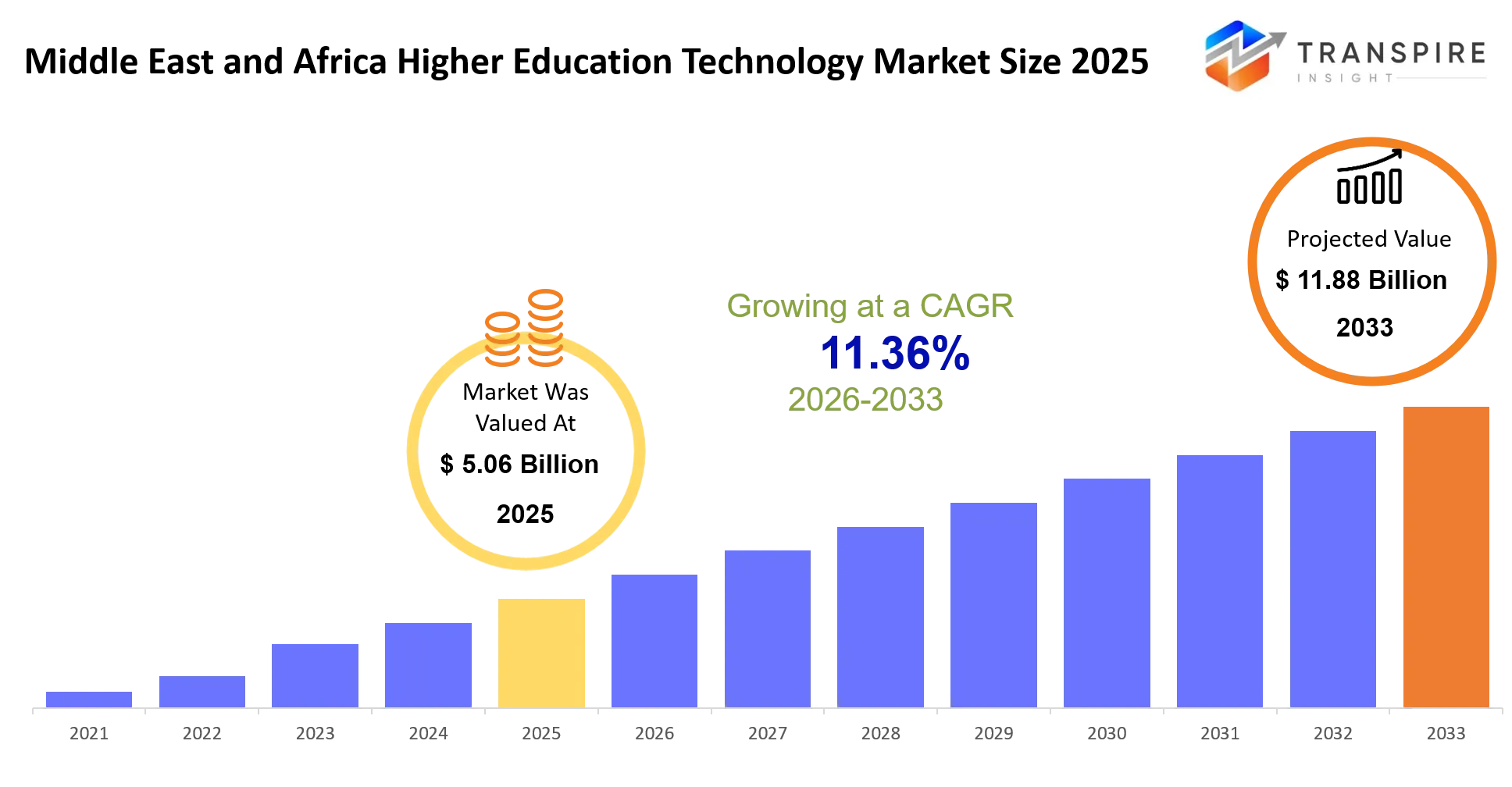
- Middle East and Africa Higher Education Technology Market Size 2025: USD 5.06 Billion
- Middle East and Africa Higher Education Technology Market Size 2033: USD 11.88 Billion
- Middle East and Africa Higher Education Technology Market CAGR: 11.36%
- Middle East and Africa Higher Education Technology Market Segments:By Solution (Learning Management Systems, Student Information Systems, Virtual Classrooms, Assessment Platforms, Others); By Deployment (Cloud, On-premise, Hybrid, Others); By End User (Universities, Colleges, Training Institutes, Others)
Middle East and Africa Higher Education Technology Market Summary
The Middle East and Africa Higher Education Technology Market was valued at USD 5.06billion in 2025. It is forecast to reach USD 11.88 billion by 2033. That is a CAGR of 11.36 % over the period.
In practice, the Middle East and Africa higher education technology market lets universities and training institutes kind of deliver, manage, and verify learning through digital platforms, like learning management systems, virtual classrooms, and assessment tools. This helps swap out the old fragmented paper based administration, and those campus bound teaching routines that just do not scale well. Over the last five years, the whole market kind of moved from simple digitization into a cloud-first, more integrated setup, where schools bring together content delivery, analytics, and student lifecycle management on one unified stack. There’s also been a real structural change, the shift toward hybrid learning models, backed by AI enabled personalization and automated evaluation. The COVID-19 pandemic was basically the main trigger, it pushed big remote learning adoption fast, while the continuing national digital education playbooks in places like the UAE and Saudi Arabia kept the investment energy going. So now, providers are scaling subscription based platforms and data driven services, improving retention results and growing recurring revenue streams across the region, even when budgets are tight.
Key Market Insights
- Learning Management Systems kind of dominate, with about 35% share, mostly because universities and training institutes have been adopting them in a wide spread way. Virtual classroom solutions still sit in the second spot, that happens since hybrid learning keeps pushing demand and remote collaboration needs are rising too, more or less.
- AI-powered analytics platforms are moving the quickest through 2030, they help with more precise student performance tracking and personalization, in that sort of “better insight” direction. Academic delivery applications alone make up nearly 45% share of the Middle East and Africa Higher Education Technology Market, which is pretty significant.
- Student assessment, along with digital examinations is the fastest-growing application area due to exam automation and secure proctoring tools. Administrative automation tools are also getting more traction, lowering operational costs and making institutional processes feel smoother.
- When it comes to end users, universities stay the dominant segment, contributing over 50% share of total platform deployments. Colleges and vocational institutes are growing the fastest, mainly because skill-based education expansion programs keep expanding. Lastly, training institutes are increasingly turning toward cloud-based systems to support short-term certification programs, and that trend is only gaining momentum.
What are the Key Drivers, Restraints, and Opportunities in the Middle East and Africa Higher Education Technology Market?
- The Middle East and Africa Higher Education Technology Market is sort of being reshaped by three strong forces, that are really changing the way institutions deliver and monetize digital learning at scale, kind of all at once.
- One big driver is the fast move toward cloud-based plus AI-enabled learning ecosystems, pushed along by national digital transformation programs in places like Saudi Arabia’s Vision 2030, and the UAE’s Education 2030 strategy. Because of this policy-led modernization universities are being nudged to swap old on-premise systems for more elastic learning management platforms, plus virtual classrooms that can actually scale. So, subscription-based revenue models are broadening too, while schools raise their budgets for integrated analytics, automated grading or assessment, and tools aimed at student participation and retention across the Middle East and Africa Higher Education Technology Market.
- Another restraint is the uneven digital infrastructure across a number of African economies. In some areas broadband reach is limited and connectivity costs stay high, which then makes full-scale adoption of these more advanced platforms difficult. And this kind of structural gap cannot be fixed overnight, it leans on long-term telecom investment and slower public infrastructure funding cycles. Because of that, many institutions in lower-income regions still end up using patchy, or mixed, hybrid setups, which slows enterprise-wide deployment. It also tends to mute recurring software revenues, more than people expect at first.
What Has the Impact of Artificial Intelligence Been on the Middle East and Africa Higher Education Technology Market?
Artificial intelligence and newer digital technologies are, somehow, reshaping scrubber performance systems and marine emission control tech by moving daily operations away from manual monitoring toward more intelligent, data-driven choices. With AI-enabled automation now showing up in exhaust gas cleaning, crews can continuously watch scrubber parameters like SOx concentration, pH balance, and washwater flow. This means less need for hand checks ,and it also supports real-time compliance tracking in a way that feels more consistent. In practice, shipping operators are starting to mix AI based control systems with onboard sensors plus cloud dashboards so regulatory adherence stays steady across different maritime routes, even when conditions get messy.
At the same time, machine learning models are boosting predictive strength by looking at historical engine load, fuel sulfur content, and how the equipment was actually operated. That helps forecast maintenance needs, while also making scrubber efficiency more tunable. These kinds of predictive systems tend to lower the odds of surprise downtime, and they support better planning for dry-dock cycles too, which in turn improves vessel availability and operational reliability. In multiple fleet rollouts, operators describe, directional gains like reduced fuel penalties ,stronger compliance consistency ,and improved energy utilization, basically because exhaust treatment processes get optimized rather than treated as guesswork.
Still though, a major constraint lingers. There is not enough high-quality, standardized training data drawn from real-world maritime conditions. Things like variable sea states, inconsistent sensor calibration, and limited connectivity during long voyages can reduce accuracy and delay broad AI deployment. Even with those obstacles, people keep investing in digital twins and edge computing, and bit by bit this is improving system resilience. So, wider adoption across global marine emission control technology networks is becoming more feasible, even if it’s a slower grind than everyone hoped at first.
Key Market Trends
- In those 2018–2020 years universities sort of moved away from standalone LMS tools, and then in the next phase they drifted toward integrated cloud ecosystems, which then boosted platform consolidation across a lot of higher education institutions.
- From 2020–2024, hybrid learning adoption climbed fast, because many places went from campus-only delivery to blended digital classroom setups, and yeah it was clearly also a post-pandemic disruption thing.
- After 2022, AI-based learning analytics started replacing the older performance tracking methods, so instead of waiting for results later they could do real-time monitoring of students, plus more personalized academic intervention.
- Saudi Arabia and the UAE also increased EdTech funding by over 30% since 2021, which helped speed up the nationwide roll out of digital higher education infrastructure platforms, and not just in one region.
- Blackboard and Instructure Canvas expanded cloud-native deployments, and they basically replaced legacy on-premise systems across several Middle East university networks.
- Across Africa, a lot more universities leaned into mobile-first learning after 2021, partly because smartphone penetration went past 70% in key markets such as Kenya and Nigeria.
- Automated assessment and digital proctoring tools then moved in after 2020, swapping out manual examination systems, and that improved exam integrity too while lowering administrative workload.
- Meanwhile, Microsoft and Google education ecosystems grew their partnerships with institutions after 2022, and that strengthened collaboration tools as well as cloud-based academic workflows.
- By 2023–2025, demand shifted away from just basic digital content delivery, toward AI-driven adaptive learning platforms, and this has been reported as improving retention, engagement, and overall learning outcomes.
Middle East and Africa Higher Education Technology Market Segmentation
By Solution
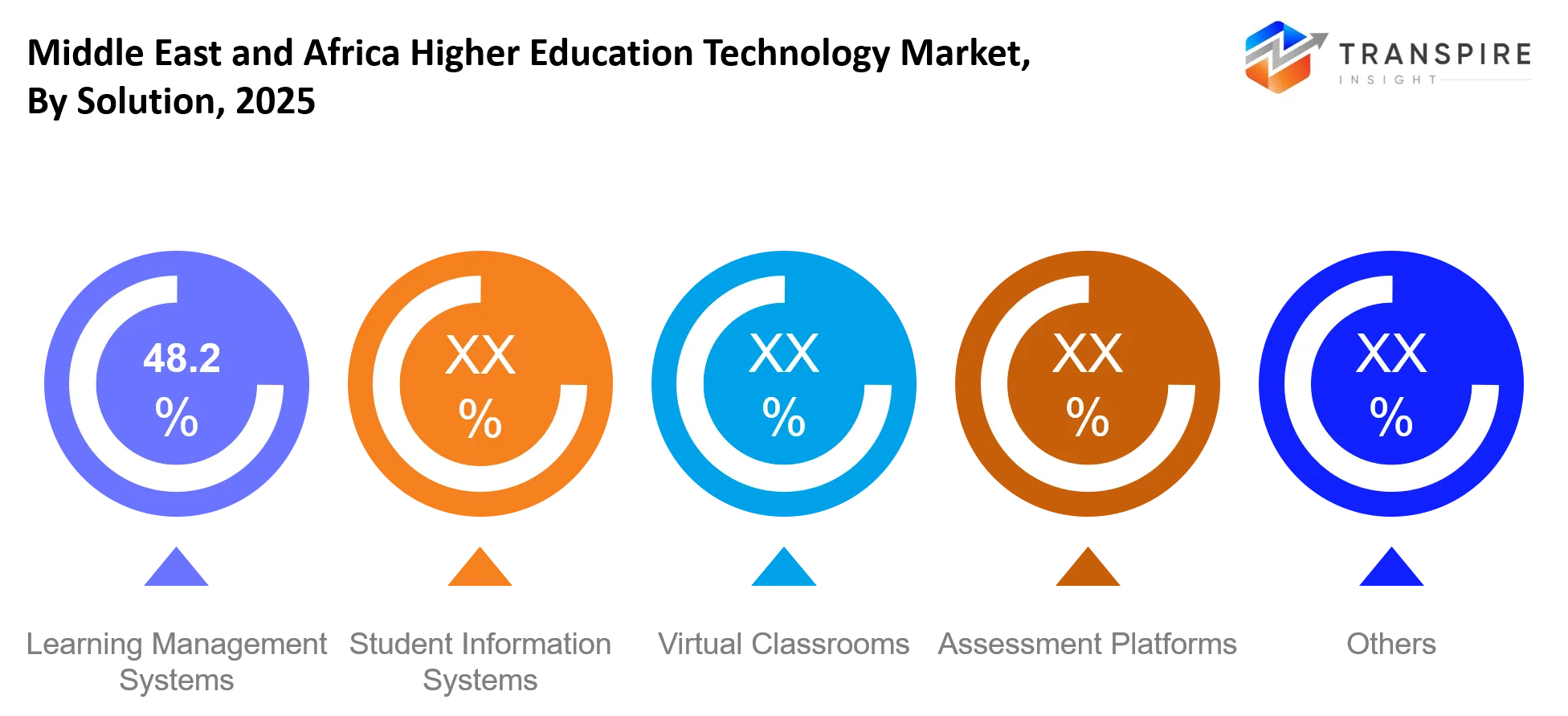
- Learning Management Systems still, kinda, lead adoption across universities and colleges. Most institutions are moving away from hand-delivered materials and toward more structured digital platforms, which help with course creation , monitoring, and evaluation . Student Information Systems get even more attention too, because academic records are sliding into centralized databases for quicker retrieval and reporting. On top of that Assessment Platforms are seeing broader use, especially after the push toward online examinations and automated marking. Overall demand is rising , since schools want to cut down on administrative workload and also make learning progress more visible.
- Virtual Classrooms are expanding as hybrid learning becomes sort of the standard approach in many education centers, including the urban ones. When these virtual spaces are tied into cloud infrastructure, access feels better and scaling gets easier for larger student populations. Providers are putting emphasis on interoperability between platforms, so data can move back and forth without too much friction, or awkward delays. Alongside that, investment in analytics tools supports sharper decision-making for faculty, and for the administration. Adoption keeps growing as institutions prioritize operational efficiency and more organized digital learning environments.
By Deployment
- Cloud deployment becomes the go to option for many higher education institutions because it scales, and it also lowers infrastructure expenses. In practice, universities start shifting workloads from local servers toward cloud platforms that enable real time group work, plus remote access. As hybrid learning keeps expanding, cloud dependence gets stronger, since these systems really need steady uptime, not occasional interruptions. At the same time, data security frameworks keep getting better which makes people more confident about moving to the cloud, whether it is public, or private. In addition, providers keep expanding regional data centers so compliance is easier and latency drops.
- Still, on premise systems don’t disappear entirely, mainly when data control requirements are super strict, for example in older institutions that already have legacy infrastructure. Hybrid deployment keeps growing too, because institutions are trying to manage spending while still keeping flexibility. The full migration is often slower than planned, due to integration complexity and budget limitations, and these kinds of obstacles keep showing up. Service providers respond by emphasizing migration support tools, aiming to reduce operational disruption during the cutover. Over time, gradual modernization continues across both public and private education sectors, like it is happening in layers rather than all at once.
By End User
- Universities are probably the biggest adoption base, because digital transformation programs are modernizing how academic delivery and administration work. Big campuses put money into integrated platforms that blend learning, evaluation, and analytics in one place, or so it seems. At the same time, government initiatives back the digitization of higher education systems across multiple countries. So the demand keeps growing for more centralized solutions, that can serve a large student crowd and also handle multi-campus coordination in a more neat way.
- Meanwhile, colleges and training institutes keep expanding adoption, mostly pushed by skill-based education and short-term certification. Training providers tend to use digital platforms to reach even broader learner groups, with flexible timetables and smoother access. For smaller institutions with tight infrastructure budgets, cost-effective cloud solutions help a lot. Adoption also increases when workforce development programs sync up with digital education platforms across different regions.
What are the Key Use Cases Driving the Middle East and Africa Higher Education Technology Market?
Core adoption in the Middle East and Africa Higher Education Technology market kind of centers on digital learning delivery via learning management systems, where universities move away from classroom only teaching toward more structured online course administration. This use case is what creates the strongest demand, because institutions want centralized platforms for content distribution, attendance tracking, and performance evaluation. Academic organizations use these systems so they can cut down on manual workload, and keep teaching more consistent across different departments.
The expanding applications start to feel broader too, like virtual classrooms and student analytics tools, especially for universities and colleges handling hybrid learning models. Student information systems also pick up momentum for day to day administrative operations, they help streamline enrollment, grading, and academic record management. Training institutes in particular lean into cloud based platforms, to support short certification programs and workforce upskilling efforts, yes.
More emerging use cases show up as well, including AI driven adaptive learning systems that change the learning pathway depending on student performance patterns, which can improve retention outcomes. Digital credentialing, along with blockchain based certification verification, is also getting early adoption in a few universities, to improve qualification authenticity and lower fraud risks.
|
Report Metrics |
Details |
|
Market size value in 2025 |
USD 5.06 Billion |
|
Market size value in 2026 |
USD 5.63 Billion |
|
Revenue forecast in 2033 |
USD 11.88Billion |
|
Growth rate |
CAGR of 11.26% from 2026 to 2033 |
|
Base year |
2025 |
|
Historical data |
2021 - 2024 |
|
Forecast period |
2026 - 2033 |
|
Report coverage |
Revenue forecast, competitive landscape, growth factors, and trends |
|
Regional scope |
Middle East and Africa (Saudi Arabia, United Arab Emirates, South Africa, Rest of Middle East and Africa) |
|
Key company profiled |
Blackboard, Instructure, Moodle, Oracle, SAP, Microsoft, Google, Anthology, D2L, PowerSchool, Ellucian, Adobe, Coursera, Pearson, Canvas |
|
Customization scope |
Free report customization (country, regional & segment scope). Avail customized purchase options to meet your exact research needs. |
|
Report Segmentation |
By Solution (Learning Management Systems, Student Information Systems, Virtual Classrooms, Assessment Platforms, Others); By Deployment (Cloud, On-premise, Hybrid, Others); By End User (Universities, Colleges, Training Institutes, Others) |
Which Regions are Driving the Middle East and Africa Higher Education Technology Market Growth?
Middle East leads the Middle East and Africa Higher Education Technology Market due to strong government-led digital education policies and large-scale funding for smart campus initiatives. Countries such as Saudi Arabia and the United Arab Emirates support nationwide platform adoption across universities through structured modernization programs. Strong internet infrastructure and high cloud readiness allow rapid deployment of integrated learning management and analytics systems. A mature ecosystem of global vendors and local education authorities strengthens long-term platform stability and continuous upgrades.
Africa represents a steady contributing region supported by gradual expansion of digital learning access across universities and colleges. Unlike the Middle East, growth here depends more on affordability and mobile-first education delivery rather than large-scale centralized infrastructure. Institutions adopt hybrid learning tools at a slower pace due to budget limitations and uneven connectivity across regions. However, consistent investments in education digitization and international development funding help maintain stable adoption across public universities and training centers.
Asia-Pacific influenced African corridors within the Middle East and Africa Higher Education Technology Market show the fastest growth momentum due to recent investments in broadband expansion and campus digitization projects. New public-private partnerships since 2023 have improved access to cloud-based education platforms in urban academic hubs. Governments increasingly support digital certification systems and remote learning infrastructure to improve workforce readiness. This rapid shift creates strong opportunities for technology vendors and investors focusing on scalable, low-cost solutions during the 2026–2033 period.
Who are the Key Players in the Middle East and Africa Higher Education Technology Market and How Do They Compete?
Competition in the Middle East and Africa Higher Education Technology Market remains moderately fragmented, with global platform providers competing alongside open-source systems and regional integrators. Incumbents defend share through long-term institutional contracts, while new entrants push cloud-native and mobile-first solutions. Competition primarily revolves around platform flexibility, integration with campus systems, data security standards, and cost efficiency rather than pure pricing. Universities increasingly prioritize vendors that can unify learning, administration, and analytics within a single digital ecosystem.
Instructure Canvas focuses on cloud-first learning management with strong usability and fast deployment cycles, which helps it replace legacy systems in universities transitioning to hybrid education models. Moodle maintains a strong position through its open-source structure, allowing institutions to customize platforms at low cost and adapt features locally without heavy licensing fees. Blackboard, under Anthology, competes through enterprise-grade academic management tools and deep institutional integration across large university networks, supported by long-term service contracts and training support.
Microsoft and Google expand competitive pressure by embedding education tools within broader cloud ecosystems such as Microsoft Teams for Education and Google Classroom. Their advantage comes from bundled productivity, collaboration, and identity management services that reduce switching costs for institutions. Oracle supports competition through back-end student information systems and ERP-style academic management tools, strengthening its position in large public university networks through integrated data and compliance capabilities.
Company List
- Blackboard
- Instructure
- Moodle
- Oracle
- SAP
- Microsoft
- Anthology
- D2L
- PowerSchool
- Ellucian
- Adobe
- Coursera
- Pearson
- Canvas
Recent Development News
In January 2026, Microsoft announced expansion of its education cloud services across multiple Middle East universities, strengthening AI-enabled learning tools and integrated classroom collaboration systems. The initiative improved institutional access to analytics-driven student performance tracking and supported large-scale digital campus modernization efforts.https://news.microsoft.com (Microsoft Newsroom).
In February 2026, Instructure entered a strategic partnership with Gulf-based higher education networks to expand Canvas LMS deployment across public universities in Saudi Arabia and the UAE. The collaboration focused on scaling cloud-native learning infrastructure and improving remote learning accessibility.https://instructure.com
In March 2025, Oracle secured new higher education cloud contracts in Africa to enhance student information systems and administrative automation for large public universities. The deployment strengthened data integration across academic and financial systems, improving operational efficiency and compliance management.https://oracle.com
What Strategic Insights Define the Future of the Middle East and Africa Higher Education Technology Market?
The Middle East and Africa Higher Education Technology Market is structurally moving toward fully integrated, AI-first digital education ecosystems where learning delivery, assessment, and student analytics operate on unified cloud platforms. This direction is driven by sustained government investment in digital education infrastructure and the increasing need for scalable hybrid learning models across universities and training institutes. Over the next five to seven years, institutions will prioritize interoperable platforms that reduce administrative fragmentation and improve measurable learning outcomes.
A less visible risk lies in growing vendor concentration, where a small group of global platform providers increasingly control core learning infrastructure. This creates dependency risks for institutions and exposes the market to pricing rigidity and limited customization flexibility if competition narrows further.
A key emerging opportunity is the rise of mobile-native, AI-adaptive learning platforms tailored for underserved African education systems, especially in Nigeria, Kenya, and parts of North Africa. These solutions align with expanding smartphone penetration and digital skills programs supported by public-private funding initiatives. Market participants should prioritize lightweight, offline-capable platforms with localized content to capture early adoption advantages and long-term institutional contracts.
Middle East and Africa Higher Education Technology Market Report Segmentation
-
By Solution
- Learning Management Systems (LMS)
- Student Information Systems (SIS)
- Virtual Classrooms
- Assessment Platforms
- Others
-
By Deployment
- Cloud
- On-premise
- Hybrid
- Others
-
By End User
- Universities
- Colleges
- Training Institutes
- Others
Frequently Asked Questions
Find quick answers to common questions.
The Expected Middle East and Africa Higher Education Technology Market size for the market will be USD 11.88 Billion in 2033.
Key Segments for the Middle East and Africa Higher Education Technology Market are By Solution (Learning Management Systems, Student Information Systems, Virtual Classrooms, Assessment Platforms, Others); By Deployment (Cloud, On-premise, Hybrid, Others); By End User (Universities, Colleges, Training Institutes, Others).
Major Middle East and Africa Higher Education Technology Market Players are Blackboard, Instructure, Moodle, Oracle, SAP, Microsoft, Google, Anthology, D2L, PowerSchool, Ellucian, Adobe, Coursera, Pearson, Canvas.
The Current Middle East and Africa Higher Education Technology Market size is USD 5.06 Billion in 2025.
The Middle East and Africa Higher Education Technology Market CAGR is 11.26% from 2026 to 2033.
- Blackboard
- Instructure
- Moodle
- Oracle
- SAP
- Microsoft
- Anthology
- D2L
- PowerSchool
- Ellucian
- Adobe
- Coursera
- Pearson
- Canvas
About the Authors

Mayur Shinde
I am Mayur Shinde, a Senior Research Analyst at Transpire Insight, specializing in the Automotive & Transportation and Information & Communication Technology (ICT) Industry. My work focuses on analyzing emerging market trends, technological advancements, competitive landscapes, and industry developments to deliver accurate, data-driven insights. I am passionate about transforming complex market information into clear, actionable content that helps businesses, professionals, and decision-makers stay informed and make confident strategic decisions.

Chakradhar Khansole
Chakradhar serves as the Research Director at Transpire Insight, bringing over 8 years of experience in technology, innovation, and strategic market intelligence. He specializes in transforming complex market data into actionable business insights that enable organizations to make informed, growth-oriented decisions. Recognized for his strategic vision and analytical expertise, Chakradhar leads high-impact research initiatives, delivering comprehensive market assessments, competitive intelligence, and forward-looking industry analysis.
Recently Published Reports
-
Apr 2026
3D Optical Profiler Market
3D Optical Profiler Market Size, Share & Analysis Report By Type (Desktop 3D Optical Profiler, and Portable 3D Optical Profiler), By Technology (Confocal Technology, and White Light Interference), By End-Use Industry (Manufacturing, Research Institutions, Automotive, Aerospace and Defense, Medical Devices, and Other), and Geography (North America, Europe, Asia-Pacific, Middle East and Africa, South and Central America), 2021 - 2031
-
Apr 2026
Depth Sensor Market
Depth Sensor Market Size, Share & Analysis Report By Type (Infrared Depth Sensors, Time-of-Flight (ToF) Sensors, Stereo Vision Sensors, Structured Light Sensors, Ultrasonic Depth Sensors), By Application (Automotive, Robotics, Gaming, Consumer Electronics, Industrial Automation, Healthcare, Security & Surveillance, Others), By End Users (Automotive Manufacturers, Consumer Electronics Companies, Healthcare Providers, Industrial Companies, Security Agencies, Gaming Companies, Robotics Companies, Others), and Geography (North America, Europe, Asia-Pacific, Middle East and Africa, South and Central America), 2021 – 2031
-
Apr 2026
Digital Manufacturing Market
Digital Manufacturing Market Size, Share & Analysis Report By Component (Hardware, Software, and Services), By Technology (Robotics, 3D Printing, Internet of Things (IoT), and Others), By Application (Automotive and Transportation, Aerospace and Defense, Consumer Electronics, Industrial Machinery, and Others), By Process Type (Computer-Based Designing, Computer-Based Simulation, Computer 3D Visualization, Analytics, and Others), and Geography (North America, Europe, Asia-Pacific, Middle East and Africa, South and Central America), 2021 – 2031
-
Apr 2026
Digital Visa Services Market
Digital Visa Services Market Size, Share & Analysis Report By Type (Individual Travelers, Group Travelers), By Application (Tourism, Business Travel, Others), and Geography (North America, Europe, Asia-Pacific, Middle East and Africa, South and Central America), 2021 – 2031