

South Korea Learning Management System Market Size & Forecast:
- South Korea Learning Management System Market Size 2025: USD 640.2 Million
- South Korea Learning Management System Market Size 2033: USD 3670.3 Million
- South Korea Learning Management System Market CAGR: 24.41%
- South Korea Learning Management System Market Segments: By Deployment (Cloud-Based, On-Premise, Hybrid, Others); By End User (K-12, Higher Education, Corporate, Government, Others); By Component (Software, Services, Content, Others)
To learn more about this report,  Download Free Sample Report
South Korea Learning Management System Market Summary
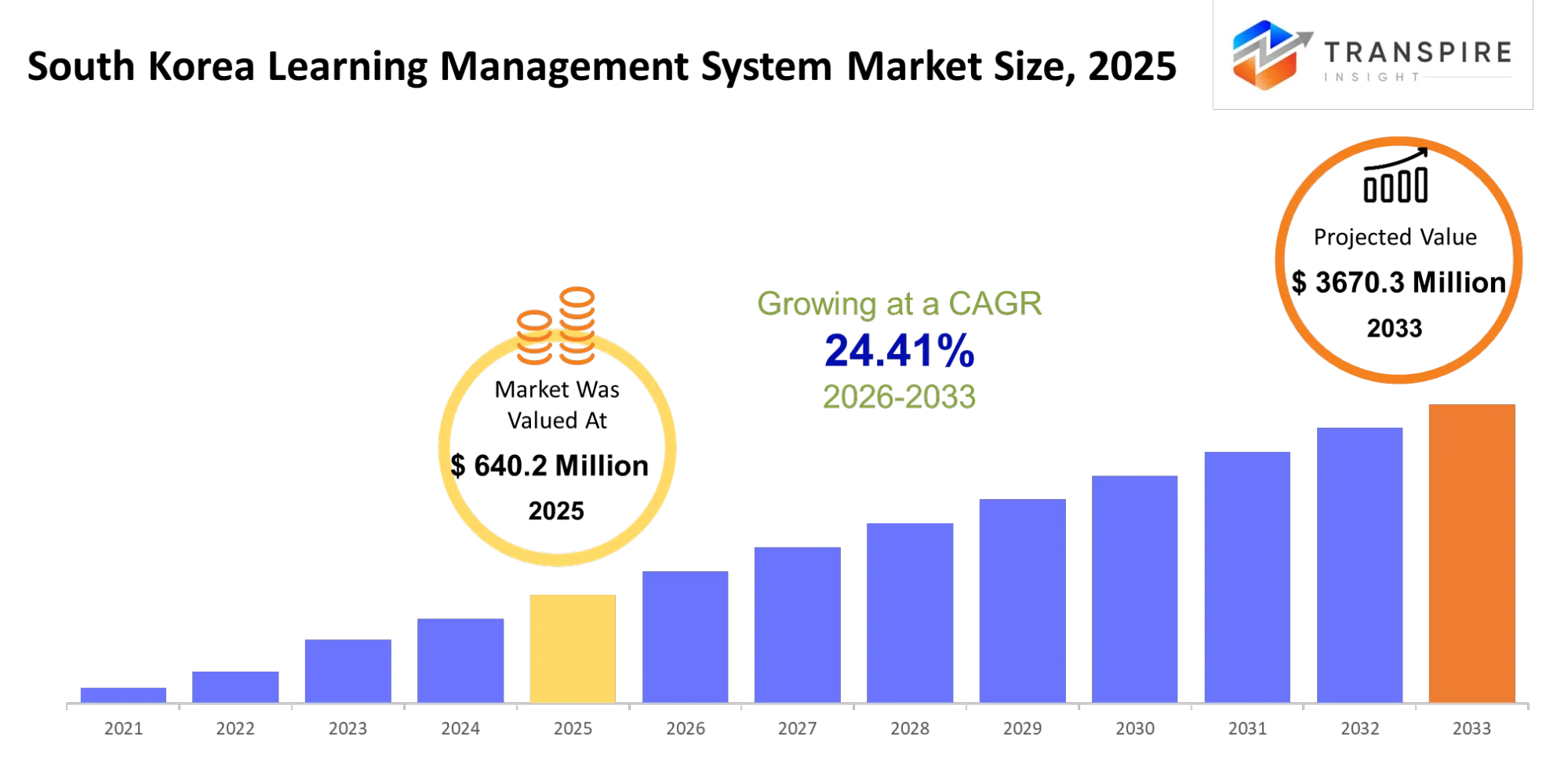
The South Korea Learning Management System Market was valued at USD 640.2 Million in 2025. It is forecast to reach USD 3670.3 Million by 2033. That is a CAGR of 24.41% over the period.
South Korea Learning Management System market, it helps schools, corporations, and government bodies keep track of big scale digital learning, employee training, certification follow up, and performance evaluation using one centralized online platform. In practice these systems address everyday operational problems tied to hybrid learning setups, workforce upskilling, and delivering the same training in a consistent way for people in different locations. For example universities often use a learning platform to run virtual classrooms and organize academic materials, while enterprises tend to use them to handle compliance training more efficiently, streamline onboarding programs,and support technical skill development.
Over the last three to five years, things have moved away from plain content delivery tools toward AI-enabled learning ecosystems, with more individualized learning analytics, stronger cloud connectivity, and mobile-first access. The COVID-19 pandemic sort of became the main trigger, because it sped up digital learning adoption across primary schools, universities, and corporate training teams. That shift pushed organizations to put money into scalable, cloud-based learning infrastructure, able to support remote participation and also real-time performance monitoring without too much friction. And as labor markets became more skill focused, plus digital transformation initiatives expanded across industries, spending on learning platforms increased too, mainly to raise workforce productivity, cut down training administration expenses, and enable continuous professional growth within hybrid work situations.
Key Market Insights
- South Korea Learning Management System Market is kind of expanding, because enterprise digital training keeps getting adopted, and AI learning analytics is becoming a real thing too. Also hybrid education infrastructure modernization is moving faster, like overall. Market analysts are even calling for solid forecast growth through 2032, since organizations are trying to build scalable workforce development, alongside cloud based education platforms that are more adaptable .
- The Seoul metropolitan region kinda dominated the South Korea Learning Management System Market, taking nearly 47% market share in 2025 . this is mostly because enterprise activity and university adoption were concentrated there, it just feels very dense.
- Incheon is projected to be the fastest growing regional market through 2032, mostly because smart education infrastructure and digital workforce programs expanded pretty rapidly after 2023, and during that stretch it really started picking up.
- Cloud based deployment accounted for around 56% share in 2025, since enterprises leaned toward scalable remote learning infrastructure, and frankly lower software upkeep costs made a difference too.
- Hybrid deployment showed up as the second largest segment, with universities and government institutions balancing cloud flexibility with internal data governance needs, so they didn’t have to hand everything fully over.
- AI enabled cloud learning platforms are the fastest growing segment, because there’s strong demand for customized learning analytics and automated course suggestions, people want less generic routes.
- Software solutions generated over 52% revenue share in 2025, as organizations increased spending on integrated learning management and performance tracking platforms.
- Learning services and managed support are seeing faster adoption, since enterprises tend to outsource.
What are the Key Drivers, Restraints, and Opportunities in the South Korea Learning Management System Market?
The strongest force driving the South Korea learning management system industry is this quick pivot toward digital workforce development, and also a bit of hybrid education infrastructure . A bunch of corporate employers across manufacturing, finance, healthcare, and technology started putting more money into cloud based learning systems, especially after remote work setups showed the cracks in the old style classroom training. On top of that, government supported digital education pushes, plus enterprise upskilling programs, kept nudging organizations to choose platforms that are scalable enough to handle standardized training for both distributed employees and learners. And yeah, this change is kind of opening up more recurring subscription revenue opportunities for providers that bring AI enabled analytics, mobile learning access, and features that link learning outcomes to performance management.
The biggest restraint however is still the complexity of tying learning platforms into older enterprise software and institutional IT systems. Universities, public agencies, and larger firms often run on fragmented databases, internal systems that are already a bit dated, and strict data security rules that slow down any platform replacement. These obstacles feel structural because integration work really needs long implementation cycles, cybersecurity reviews, and organizational process redesign. When deployment timelines slip, and the customization costs keep piling up, adoption gets capped particularly for smaller educational institutions and for budget sensitive organizations.
A major opportunity is also forming through AI powered adaptive learning and skill intelligence platforms that connect to workforce automation trends. South Korean companies are investing more and more in systems.
What Has the Impact of Artificial Intelligence Been on the South Korea Learning Management System Market?
Artificial intelligence plus advanced digital technologies are kinda reshaping South Korea’s digital learning ecosystem, by pushing up training automation learner engagement, and performance analysis across both educational and corporate settings. In practice, learning platforms more and more rely on AI-driven automation to handle course enrollment, attendance, certification steps, and grading of assessments with only minimal human effort. At the same time, universities and enterprises also bring in intelligent chatbots and virtual assistants, so users can get support in real time which cuts down administrative burden, and tends to speed up responses for big groups of learners. On top of that, automated content recommendation systems try to tailor the learning journey based on how each person behaves, and how their skill progression looks over time.
Machine learning models are then used for predictive learning analytics, basically spotting students or employees who might be sliding toward poor performance before completion rates start to drop. Training administrators end up reading engagement signals, assessment results, and course interaction details to adjust learning pathways and boost retention. There’s also this idea that AI-supported analytics can help organizations lower training costs by aiming at specific skill gaps, rather than rolling out wide blanket mandatory modules. A few enterprises have even shared that, after switching to adaptive learning systems and mobile learning platforms, they saw better employee certification completion rates and less onboarding time.
Still, AI adoption doesn’t go perfectly, because the integration costs can be high, and the institutional data is often fragmented. Legacy education systems and inconsistent learner data formats can lower algorithm accuracy, and it becomes harder to deploy predictive learning tech at scale, especially when the data isn’t clean or even aligned across different places.
Key Market Trends
- Since 2022, corporations went on upping investment in AI supported learning platforms, to automate employee onboarding, certification tracking, and kind of technical skill development programs.
- Universities also started moving away from separate, standalone e-learning portals, toward more integrated cloud learning ecosystems, that work with hybrid classrooms and real-time student performance analytics, kinda all in one place.
- Meanwhile government digital education policies sped up adoption of remote learning infrastructure across public institutions, after those post pandemic education modernization initiatives, not sure why it took so long though.
- Companies like Moodle and Blackboard kept expanding AI driven engagement and assessment capabilities after 2023, and they did it in a way that felt more iterative.
- Mobile first learning platforms got stronger traction, because distributed workforces needed flexible training access outside the usual office ,or classroom environments.
- Since 2021, enterprises leaned more toward subscription based cloud deployments, to cut down on upfront software infrastructure costs, and also reduce internal IT maintenance dependency.
- AI powered predictive analytics tools helped improve learner retention tracking, by spotting disengagement risks before certification completion rates dipped significantly.
- Corporate training departments increased purchases of microlearning platforms too, since shorter modular content boosted employee participation, and made knowledge retention performance more reliable.
- South Korean technology firms expanded partnerships with global cloud providers, to blend collaboration tools analytics dashboards, and multilingual learning support systems.
- And small and medium-sized enterprises accelerated adoption after low code LMS customization tools reduced implementation complexity, and shortened platform deployment timelines, which really helped them move faster.
South Korea Learning Management System Market Segmentation
By Deployment
Cloud based deployment sort of stayed on top because enterprises and educational institutions needed scalable learning access, for distributed users and remote setups. The subscription style pricing model helped to lower upfront infrastructure spend, and it also made roll out faster across corporate training efforts as well as academic programs. Learning platform providers meanwhile pushed better mobile compatibility, more flexible data storage options, and AI enabled analytics inside cloud ecosystems. And that strong tie-in with collaboration software, plus digital assessment tools, really reinforced the overall business preference for cloud learning environments.
On premise deployment still worked for organizations with strict internal data governance and cybersecurity requirements, especially in government and other regulated sectors. Hybrid deployment got more commercial traction because universities and large enterprises could keep cloud accessibility, but also maintain localized control over data handling. They also put more money into hybrid platforms to make sure operational continuity stayed solid across both physical and virtual learning environments. Other deployment formats basically remained niche, with limited adoption for specific operational needs, or for smaller institutional projects.
By End User
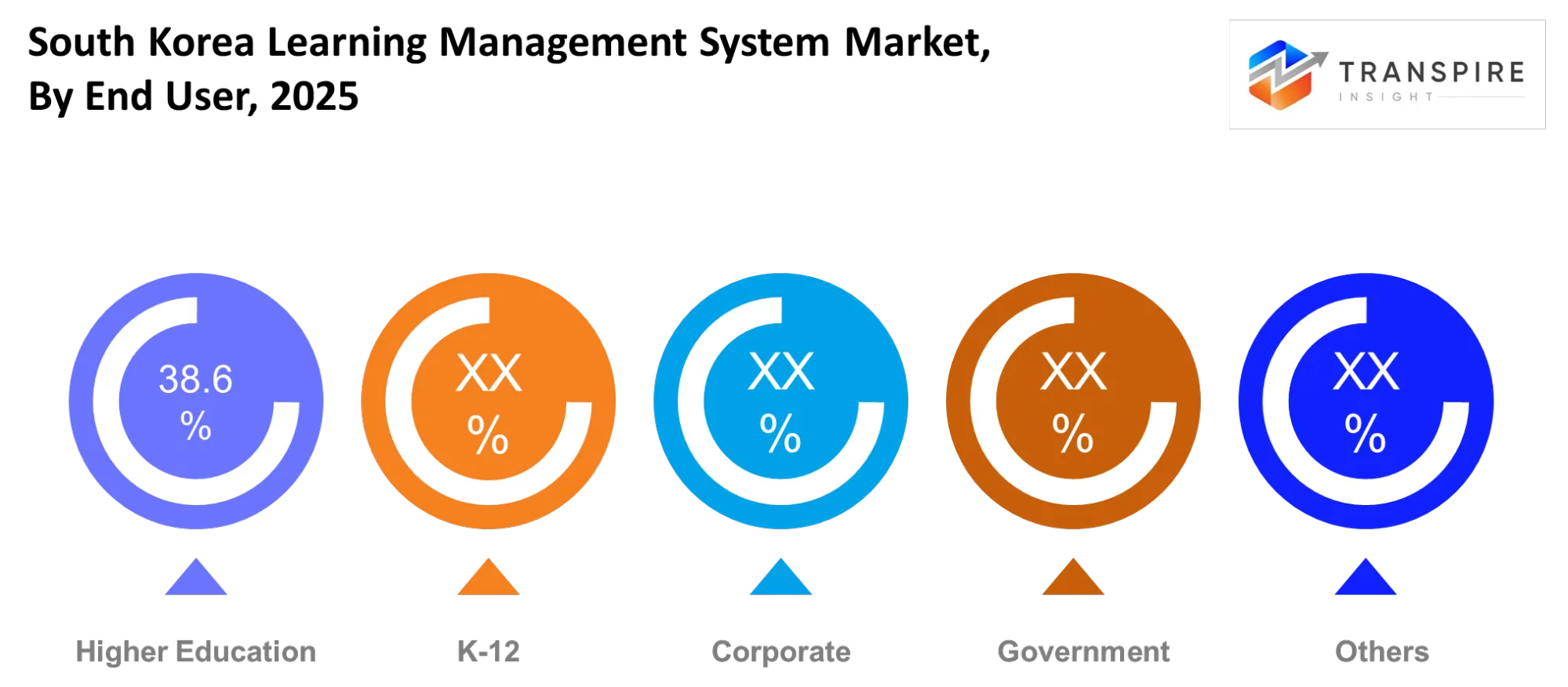
Corporate organizations, sort of created a major platform demand simply because workforce automation and digital transformation programs put more emphasis on continual employee skill growth, not just “one time” learning. In manufacturing companies, technology firms, financial institutions, and healthcare providers, they started expanding their spend on compliance training, plus onboarding systems and technical certification tracks. AI powered learning analytics also helped with employee performance monitoring, and made training more tailored over different enterprise environments. Bigger organizations even began linking their digital learning setups with workforce management, along with productivity measurement platforms, so things felt more connected.
Higher education institutions kept a strong market presence because universities rolled out hybrid classroom models and ramped up online academic content delivery systems. Meanwhile, K-12 institutions sped up digital classroom adoption via smart education initiatives and government backed learning modernization efforts. Government agencies also increased their platform procurement for civil service training, digital literacy programs, and broader workforce development projects. Other end user groups stayed on a moderate platform usage level, depending on what kind of operational training they needed and how large the org was.
To learn more about this report, Download Free Sample Report
By Component
Software solutions, kind of accounted for a lot of industry revenue, because organizations were prioritizing centralized learning administration, automated assessments and integrated performance tracking capabilities, (yes, it mattered). Learning platform developers also expanded AI-driven recommendation systems, virtual classroom tools and multilingual content support, to help keep the platform competitive. Mobile learning functionality and cloud based accessibility also improved software adoption across both enterprise and academic environments. And then there was this strong focus on learner engagement analytics, plus certification management, which basically kept supporting software investment growth.
Services expanded steadily too, since institutions needed technical integration, platform customization, cybersecurity management, and operational support through most deployment cycles. Managed learning services got even more demand among enterprises, especially those wanting outsourced training administration and user management capabilities. Digital learning content development grew as well, across professional certification programs, technical education modules, and interactive workforce training applications. Other component categories still kept a smaller commercial contribution within specialized learning environments and customized institutional programs.
What are the Key Use Cases Driving the South Korea Learning Management System Market?
Corporate workforce training is still kind of the main use case, because enterprises need more centralized systems for compliance certification, employee onboarding, and ongoing technical skill development. Manufacturing companies, financial institutions and IT service providers all lean on digital learning platforms so they can standardize training for staff across distributed operations, and also those hybrid work arrangements that keep moving around.
Higher education and government training programs are growing steadily too, since universities are basically strengthening hybrid classroom delivery, and public agencies are modernizing workforce development systems. At the same time healthcare institutions are adopting digital learning platforms to handle medical certification programs, regulatory training, and continuous professional education across clinical environments, which is pretty important and not always simple.
Lately there are emerging applications like AI-driven adaptive learning systems, and virtual reality training modules meant for technical education and industrial simulation programs. Smart factory operators, plus semiconductor manufacturers, are also testing immersive digital learning environments to make equipment training faster, and to reduce operational mistakes inside advanced production facilities.
|
Report Metrics |
Details |
|
Market size value in 2025 |
USD 640.2 Million |
|
Market size value in 2026 |
USD 795.8 Billion |
|
Revenue forecast in 2033 |
USD 3670.3 Million |
|
Growth rate |
CAGR of 24.41%from 2026 to 2033 |
|
Base year |
2025 |
|
Historical data |
2021 - 2024 |
|
Forecast period |
2026 - 2033 |
|
Report coverage |
Revenue forecast, competitive landscape, growth factors, and trends |
|
Regional scope |
South Korea |
|
Key company profiled |
Moodle, Blackboard, Instructure, D2L, SAP, Oracle, Microsoft, Google, Cornerstone, Docebo, TalentLMS, Absorb Software, Adobe, Pearson, PowerSchool |
|
Customization scope |
Free report customization (country, regional & segment scope). Avail customized purchase options to meet your exact research needs. |
|
Report Segmentation |
By Deployment (Cloud-Based, On-Premise, Hybrid, Others); By End User (K-12, Higher Education, Corporate, Government, Others); By Component (Software, Services, Content, Others) |
Which Regions are Driving the South Korea Learning Management System Market Growth?
Seoul metropolitan region keeps dominating the market, mainly because big universities, corporate headquarters, and government digital education initiatives still stay clustered across the capital area. Strong broadband infrastructure, quicker cloud adoption, and heavy smart education spending helped AI-enabled learning systems roll out faster, compared with other regions. At the same time corporate training providers, and education technology developers, keep a solid day to day presence in Seoul, so you get this kind of mature digital learning ecosystem. Plus the continuous workforce reskilling efforts across finance, manufacturing, and tech, sort of reinforced the long-run platform demand all over the region.
Busan is still the second-largest contributor, but the market activity is not really the same as Seoul because growth leans more on industrial workforce development and vocational learning programs. Shipbuilding firms, logistics operators, and export-oriented manufacturers routinely fund technical training platforms to boost workforce productivity as well as regulatory compliance. With steady industrial output, and longer enterprise learning contracts, platform providers in the region can expect more predictable revenue. On top of that, public education modernization pushes, along with regional university partnerships, contribute to consistent adoption across vocational and professional training settings.
Incheon is emerging as the fastest-growing area, mostly due to the recent expansion of smart city projects, digital education infrastructure, and technology-driven workforce development programs. Regional authorities ramped up investment in cloud learning systems, and AI-supported training efforts after 2023, aiming to strengthen innovation-driven.
Who are the Key Players in the South Korea Learning Management System Market and How Do They Compete?
Competition inside South Korea’s learning management system market stays kind of moderately fragmented, mainly because global cloud software providers education technology firms, and niche enterprise learning platforms all end up competing across several institutional slices. In practice, the technical capability and the strength of platform integration, currently matter more for positioning than pure price rivalry. The bigger established software companies keep defending their market share using AI-driven analytics cloud scalability, and collaboration features that slot into existing systems. Meanwhile smaller developers tend to lean toward customized learning setups and workforce training that fits specific industries. At the same time, pressure keeps rising from demand for multilingual content delivery, mobile access, and data security compliance across both enterprise and academic deployments.
Moodle leans into open-source flexibility and lets organizations choose customizable deployment models, so universities and enterprises can reshape learning environments based on internal requirements. Blackboard differentiates through advanced student engagement analytics, virtual classroom functions, and assessment management tools that are built for higher education workflows. Microsoft keeps its edge by connecting enterprise learning systems with collaboration software, productivity applications, and cloud infrastructure services, which gives corporate users more seamless operational integration. Google, on the other hand, expands its footprint in education using AI-supported classroom management tools and cloud-native learning ecosystems tuned for remote and hybrid modes.
Company List
- Moodle
- Blackboard
- Instructure
- D2L
- SAP
- Oracle
- Microsoft
- Cornerstone
- Docebo
- TalentLMS
- Absorb Software
- Adobe
- Pearson
- PowerSchool
Recent Development News
"In March 2026, Blackboard launched new AI-powered content creation and grading enhancements for Blackboard LMS. The update introduced automated knowledge check generation and expanded instructor workflow automation to improve digital learning efficiency across higher education and enterprise environments.https://www.blackboard.com
"In July 2025, Blackboard announced next-generation AI and immersive learning innovations within Blackboard LMS. The release expanded AI-assisted instructional design, automated administrative workflows, and immersive digital learning capabilities to strengthen institutional learning performance.https://www.blackboard.com
"In April 2026, Google integrated Gemini AI tools with Moodle through a new Gemini LTI update. The integration enabled native AI summarization, assignment support, and NotebookLM functionality within Moodle learning environments, accelerating AI-based education infrastructure adoption.https://productleadersdayindia.org
What Strategic Insights Define the Future of the South Korea Learning Management System Market?
The South Korea learning management system industry is slowly moving toward these more “intelligent learning ecosystems” where AI based personalization, workforce analytics, and real-time skills checking sort of turn into the main deal, not just optional platform nice-to-haves. In the next five to seven years, companies will likely push harder for ongoing workforce re-skilling, and government money for digital education infrastructure will speed up the shift to cloud first, data centered learning environments. At the same time, learning platforms should end up blending with human resource systems, productivity software, and AI collaboration tools, so that automated talent development programs can actually run smoother.
There is also a less obvious risk, kinda like the market getting concentrated around a handful of big global cloud and AI platform vendors. If education institutions and enterprises lean too much on those outside infrastructure ecosystems, it could trigger pricing pressure, make customization less flexible, and even raise long term cybersecurity exposure. On top of that, there’s the growing worry about regulatory scrutiny, especially around learner data privacy, and whether AI generated educational content is accurate enough, or at least responsibly represented.
Still, there’s a pretty clear emerging opportunity too. It’s the development of immersive learning tech for advanced manufacturing, semiconductor production, and industrial automation training programs, especially in places like Incheon,and Busan. Market players should focus on partnerships with enterprise software providers, plus industry specific training organizations, because sector focused digital learning ecosystems will probably improve long term retention, and also support recurring platform revenue.
South Korea Learning Management System Market Report Segmentation
By Deployment
- Cloud-Based
- On-Premise
- Hybrid
- Others
By End User
- K-12
- Higher Education
- Corporate
- Government
- Others
By Component
- Software
- Services
- Content
- Others
Frequently Asked Questions
Find quick answers to common questions.
The expected South Korea Learning Management System Market size for the market will be USD 3670.3 Million in 2033.
By Deployment (Cloud-Based, On-Premise, Hybrid, Others); By End User (K-12, Higher Education, Corporate, Government, Others); By Component (Software, Services, Content, Others).
Major South Korea Learning Management System Market players are Moodle, Blackboard, Instructure, D2L, SAP, Oracle, Microsoft, Google, Cornerstone, Docebo, TalentLMS, Absorb Software, Adobe, Pearson, PowerSchool.
The South Korea Learning Management System Market size is USD 640.2 Million in 2025.
The South Korea Learning Management System Market CAGR is 24.41% from 2026 to 2033.
- Moodle
- Blackboard
- Instructure
- D2L
- SAP
- Oracle
- Microsoft
- Cornerstone
- Docebo
- TalentLMS
- Absorb Software
- Adobe
- Pearson
- PowerSchool
About the Authors

Mayur Shinde
I am Mayur Shinde, a Senior Research Analyst at Transpire Insight, specializing in the Automotive & Transportation and Information & Communication Technology (ICT) Industry. My work focuses on analyzing emerging market trends, technological advancements, competitive landscapes, and industry developments to deliver accurate, data-driven insights. I am passionate about transforming complex market information into clear, actionable content that helps businesses, professionals, and decision-makers stay informed and make confident strategic decisions.

Chakradhar Khansole
Chakradhar serves as the Research Director at Transpire Insight, bringing over 8 years of experience in technology, innovation, and strategic market intelligence. He specializes in transforming complex market data into actionable business insights that enable organizations to make informed, growth-oriented decisions. Recognized for his strategic vision and analytical expertise, Chakradhar leads high-impact research initiatives, delivering comprehensive market assessments, competitive intelligence, and forward-looking industry analysis.
Recently Published Reports
-
Apr 2026
3D Optical Profiler Market
3D Optical Profiler Market Size, Share & Analysis Report By Type (Desktop 3D Optical Profiler, and Portable 3D Optical Profiler), By Technology (Confocal Technology, and White Light Interference), By End-Use Industry (Manufacturing, Research Institutions, Automotive, Aerospace and Defense, Medical Devices, and Other), and Geography (North America, Europe, Asia-Pacific, Middle East and Africa, South and Central America), 2021 - 2031
-
Apr 2026
Depth Sensor Market
Depth Sensor Market Size, Share & Analysis Report By Type (Infrared Depth Sensors, Time-of-Flight (ToF) Sensors, Stereo Vision Sensors, Structured Light Sensors, Ultrasonic Depth Sensors), By Application (Automotive, Robotics, Gaming, Consumer Electronics, Industrial Automation, Healthcare, Security & Surveillance, Others), By End Users (Automotive Manufacturers, Consumer Electronics Companies, Healthcare Providers, Industrial Companies, Security Agencies, Gaming Companies, Robotics Companies, Others), and Geography (North America, Europe, Asia-Pacific, Middle East and Africa, South and Central America), 2021 – 2031
-
Apr 2026
Digital Manufacturing Market
Digital Manufacturing Market Size, Share & Analysis Report By Component (Hardware, Software, and Services), By Technology (Robotics, 3D Printing, Internet of Things (IoT), and Others), By Application (Automotive and Transportation, Aerospace and Defense, Consumer Electronics, Industrial Machinery, and Others), By Process Type (Computer-Based Designing, Computer-Based Simulation, Computer 3D Visualization, Analytics, and Others), and Geography (North America, Europe, Asia-Pacific, Middle East and Africa, South and Central America), 2021 – 2031
-
Apr 2026
Digital Visa Services Market
Digital Visa Services Market Size, Share & Analysis Report By Type (Individual Travelers, Group Travelers), By Application (Tourism, Business Travel, Others), and Geography (North America, Europe, Asia-Pacific, Middle East and Africa, South and Central America), 2021 – 2031