

France Higher Education Market Size & Forecast:
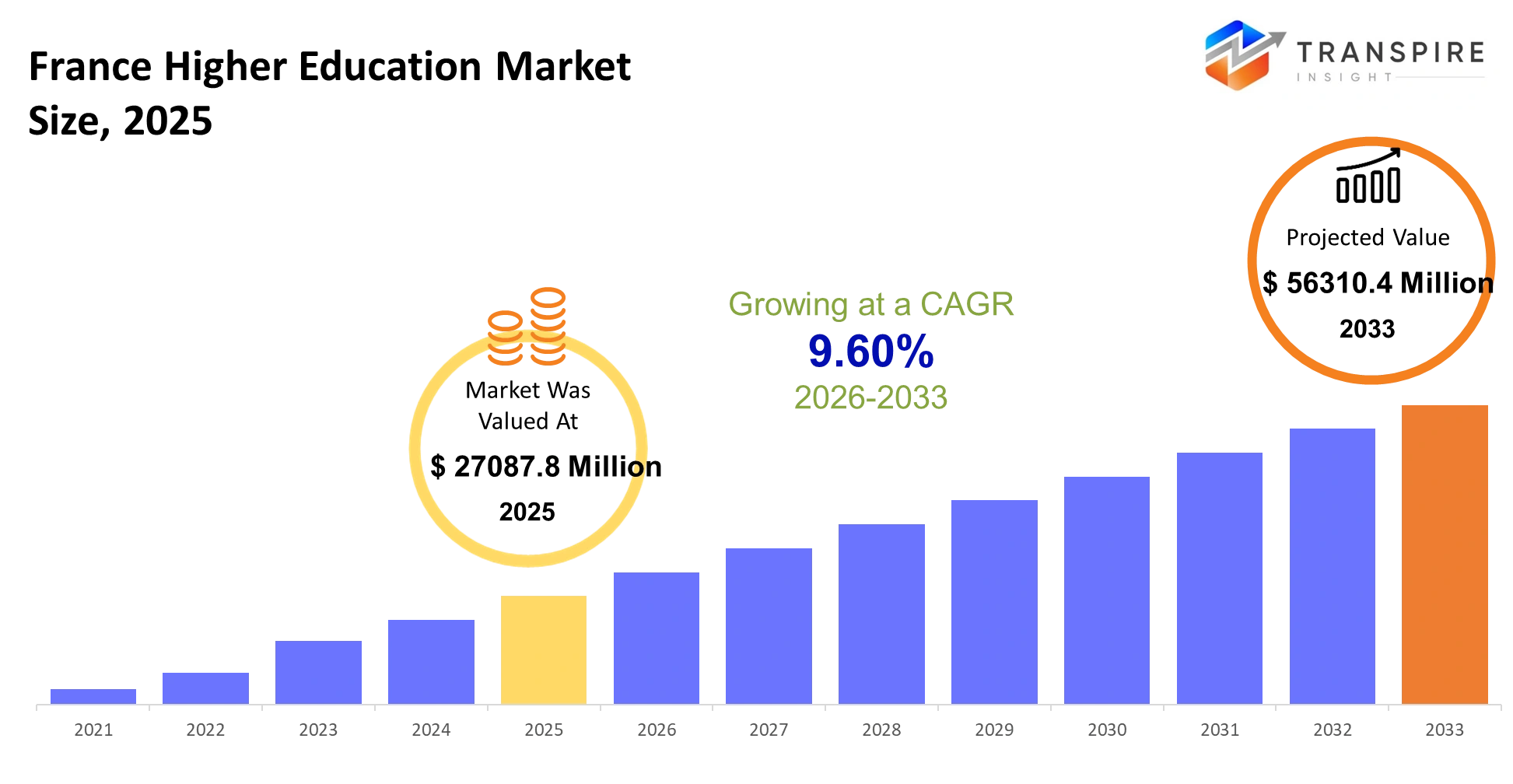
- France Higher Education Market Size 2025: USD 27087.8 Million
- France Higher Education Market Size 2033: USD 56310.4 Million
- France Higher Education Market CAGR: 9.60%
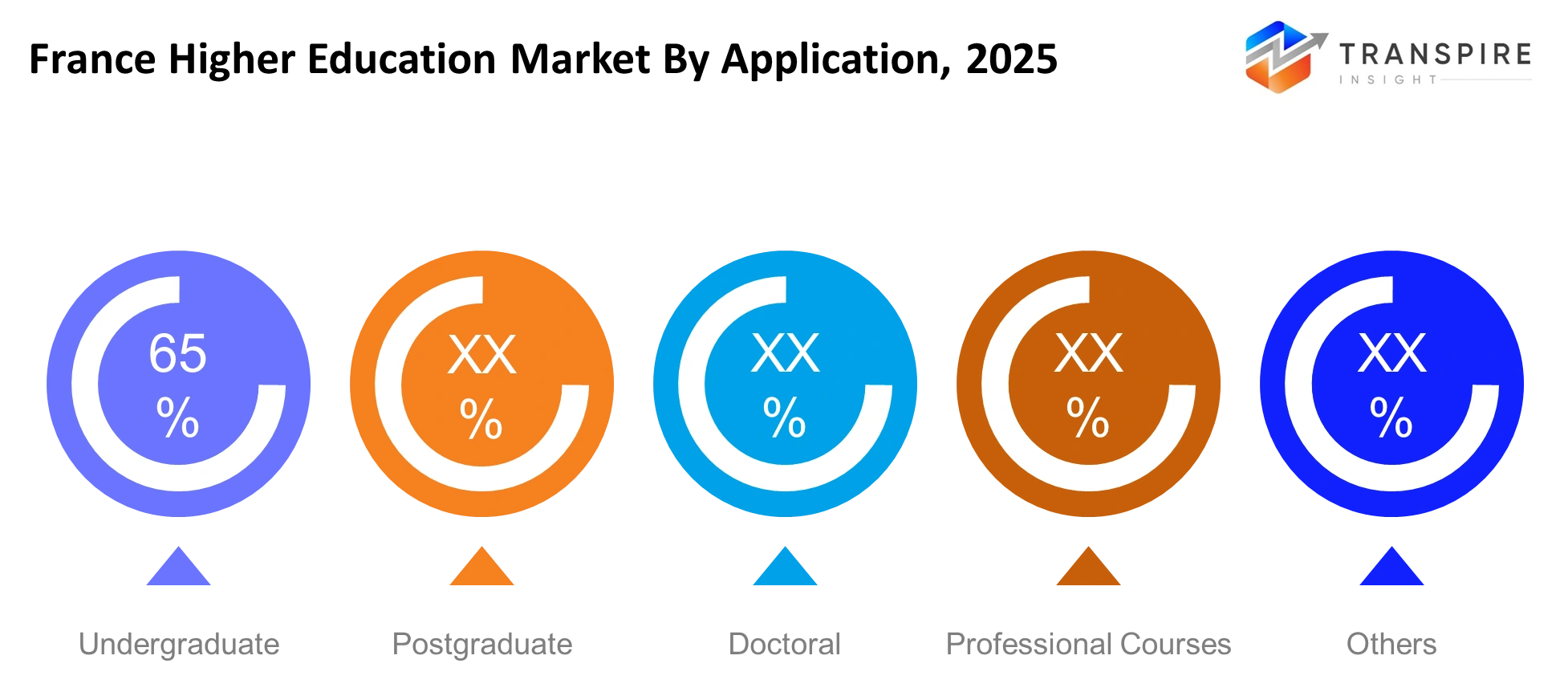
- France Higher Education Market Segments: By Type (Public Universities, Private Universities, Online Universities, Others); By Application (Undergraduate, Postgraduate, Doctoral, Professional Courses, Others); By End-User (Students, Professionals, Researchers, Others); By Mode (Offline, Online, Hybrid, Others)
To learn more about this report,  Download Free Sample Report
France Higher Education Market Summary
The France Higher Education Market was valued at USD 27087.8 Million in 2025. It is forecast to reach USD 56310.4 Million by 2033. That is a CAGR of 9.60%% over the period.
In practice, France's higher education market kinda works as the backbone, for producing skilled graduates, applied research, and workforce-ready talent that then feeds industries like engineering, digital services, healthcare, and public administration. It also knits together universities, Grandes Écoles, and digital learning platforms with employers who are hunting for specific or specialized competencies. Over the last 3–5 years, the whole system moved, sort of structurally, toward hybrid, and digital-first learning models, pushed by the wide scale adoption of learning management systems, and cross-border online programs. One key trigger was the post-pandemic disruption, which basically forced a fast digitalization of lectures, exams, and student services.
That shift changed delivery expectations, for good, or at least for the foreseeable future. At the same time, national skills shortages in STEM and AI related fields have made enrollment pressure in technical programs even stronger, so institutions had to react. Put together, this has reshaped funding flows, and also sped up institutional spending on edtech infrastructure. You can see it in new partnerships with global platforms, and in data-driven academic management systems, which then opens up clearer monetization opportunities across both public and private education providers.
Key Market Insights
- The France Higher Education Market was valued at around USD 38 billion in 2025, and by 2033 it’s expected to be more than USD 60 billion, if things keep going in the same direction.
- Île-de-France holds almost 32% market share in 2025 because it’s packed with universities, plus there are strong corporate academic collaboration networks that keep things moving.
- Auvergne-Rhône-Alpes seems to be on track for the quickest upswing through 2033, with its expansion at engineering schools and also those new campus moves that tie in with emerging technology, more or less like digital craft.
- Southern France, meanwhile, showed roughly 18% growth in international student enrollment between 2023 and 2025 this part is mostly traced to lower living costs , plus multilingual academic programs that feel a bit more approachable to a wide set of learners.
- Public universities still dominate the higher education industry in France, with roughly 57% share, helped by subsidized tuition structures and also a fairly steady domestic enrollment pull.
- Private Grandes Écoles meanwhile make up nearly 26% of the market, backed by close employer partnerships, premium graduate placements, and high employability outcomes after graduation.
- Online and hybrid learning platforms are projected to keep growing at well over 11% by 2033, sort of, because digital adoption is accelerating pretty fast and student preferences are moving toward more adaptable study formats.
- Meanwhile engineering and technology education is taking the lead with roughly 28% share, driven by an increasing need for AI automation, cybersecurity, and data science skills, which also makes sense when you think about it.
- Business and management programs are projected to grow at around 9.5% CAGR through 2033, because global MBA interest keeps increasing, and executives need continuous upskilling.
- Big institutions and providers, like Sorbonne University, Université PSL, HEC Paris, INSEAD, and École Polytechnique are rolling out digital education models, expanding international cooperation, building AI driven learning systems, and offering more courses in English to stay competitive.
What are the Key Drivers, Restraints, and Opportunities in the France Higher Education Market?
The primary driver of the France higher education market is, more or less, the accelerating demand for high-skill labor in digital engineering, artificial intelligence and data science. This shift is triggered by widespread industry automation across manufacturing, finance and services, which has in turn raised the minimum qualification threshold for entry-level roles. So, universities and Grandes Écoles are now expanding specialized programs , with industry-linked curricula as well, directly increasing enrollment in technical disciplines and boosting institutional revenue streams through partnerships, plus executive education programs, even when the pace feels uneven.
The most significant restraint is the structural funding imbalance between public universities and the rising operational demands that come with everything else. While enrollment continues to grow, public institutions depend heavily on state subsidies that do not always scale with digital infrastructure costs or internationalization efforts. That creates delayed modernization of campuses , limited faculty expansion, and a slower curriculum redesign, which together suppresses competitiveness compared to private players and global online providers. And it’s structural because it is tied to long-term public financing frameworks, so it cannot be quickly resolved, no matter how much everyone wants it to.
A major opportunity sits in cross-border hybrid education models supported by European academic alliances and digital learning ecosystems. Programs that mix physical mobility with online modules are gaining traction, especially in engineering and business education. Institutions collaborating with platforms such as Coursera, and cloud providers like Microsoft, are positioned to scale globally recognized micro-credentials , unlocking additional revenue streams and widening access for non-traditional learners, somewhat steadily.
What Has the Impact of Artificial Intelligence Been on the France Higher Education Market?
Artificial intelligence is reshaping the France higher education market , kind of, by changing how institutions deliver, personalize, and overall manage learning experiences . Universities like Université Paris-Saclay are more and more using AI powered learning management systems, to automate various admin routines, for example enrollment processing, exam scheduling , and student performance tracking. This tends to lower operational overhead a bit, and it also lets faculty spend more time on curriculum design and research activities.
Then there’s predictive analytics, which is being used to spot student dropout risks earlier, tune course suggestions , and even estimate enrollment trends. The result is better retention rates since early intervention becomes more practical and students can follow personalized learning pathways . In STEM oriented schools such as École Polytechnique , AI driven simulations and adaptive tutoring mechanisms are boosting learning efficiency , especially in engineering fields and for data science tracks.
On the operational side, AI adoption has improved grading speed and cut administrative processing time by noticeable margins , while also making academic planning more precise. Still, the main downside is the costly integration of AI systems into older university infrastructure, with legacy setups. Many institutions also deal with fragmented data, where mismatched or inconsistent student records reduce how accurate the models end up being. And finally, limited access to high quality training data in multilingual academic contexts can slow down, or cap, full scale rollout of advanced AI tools across all programs.
Key Market Trends
- From 2022–2025 Hybrid learning started to pick up, pretty much sharply and it has reshaped how most universities run classroom based teaching delivery models across many major schools.
- At the same time universities began to lean harder on global edtech platforms like Coursera to grow certified online degree offerings and, sort of, scale them faster than before.
- Meanwhile the share of students in STEM kept rising steadily , because employers seemed to want more and more AI, data science, and engineering know-how.
- International student inflows also moved upward, after reforms to visas and post study work came in during 2023–2025, so the timing mattered.
- On the infrastructure side, Institutions invested heavily in cloud systems so their digital campuses could function smoothly , and so AI driven academic tools could run without constant friction .
- More importantly, competency based education models gained traction, and the attention shifted a bit away from degrees alone toward skills plus micro-credentials, not just simple diplomas.
- Even the Private Grandes Écoles side expanded corporate connections, aiming to improve graduate employability outcomes, which is kind of the real target in practice.
- Research funding collaborations got stronger too between French universities and EU innovation programs, especially after the policy updates that landed post 2024.
- Finally, administrative automation using AI trimmed operational delays in admissions and student services which sounds small but it changes the whole day-to-day rhythm.
- Online assessment systems also expanded quite a lot after remote evaluation technologies became widespread, and then it was basically everywhere.
France Higher Education Market Segmentation
By Type
Active dry yeast holds the leading position in the France Brewer’s Yeast Market, mostly because it stays operationally stable, it delivers a predictable fermentation performance, and it plays nicely with industrial-scale bakery and food processing setups. That dominance is reinforced by standardized manufacturing workflows that keep yeast activity more or less consistent across big production batches, which is a big deal for large volumes. Yeast extract keeps a strong secondary share, mainly since it works as a flavor booster, and especially in savory foods where natural umami substitution is getting more preferred. Inactive yeast has a more niche kind of role, usually in nutrition and feed applications, where protein enrichment plus bioavailability are the main focus, and not so much general fermentation.
Active dry yeast growth is driven mostly by the expansion of industrial bakery operations and also by the rising reliance on standardized fermentation inputs in packaged food manufacturing. Yeast extract benefits from clean-label reformulation efforts, where companies switch out synthetic flavor enhancers with natural alternatives, because regulators and consumers keep pushing that direction. Inactive yeast growth is supported by livestock nutrition systems that emphasize protein efficiency and overall feed optimization. Over the forecast period, yeast extract is expected to contribute more value, while active dry yeast continues to dominate volume, largely due to that scalability advantage, and in practice it tends to fit more easily into high-throughput lines.
By Application
Food and beverages are kind of the main application segment in the France Brewer’s Yeast Market, and they get strong support from really broad use across bakery products, processed foods, plus more savory type formulations. It keeps leading, mostly because yeast is basically required for fermentation control, it helps with flavor building, and it improves texture in many industrial food systems. Then you have animal feed as a solid secondary segment, which is being pushed by the higher adoption of yeast-based additives for digestive efficiency and livestock nutrition that stays antibiotic-free. After that nutraceutical applications are rising pretty fast, since more people want protein-heavy and vitamin-boosted dietary supplements.
For growth, food and beverages are helped by reformulation trends that lean toward natural ingredients rather than artificial additives ,so manufacturers rely more often on yeast-derived solutions. Animal feed is also getting a boost from regulatory pressure, because they want less antibiotic usage while still keeping livestock performance up. Nutraceuticals are expanding faster than the older segments, partly due to growing health awareness and preventive nutrition habits. Over the forecast period, nutraceuticals are expected to move from a kind of niche use into a higher value growth driver, within the wider market setup.
To learn more about this report, Download Free Sample Report
By End-User
In the France Brewer’s Yeast Market, the food industry seems like it takes up the largest share of demand, mostly because large-scale bakery production keeps running, plus processed food manufacturing and even those industrial flavoring applications that never really stop. Meanwhile, feed manufacturers count as a solid secondary end user group, they lean on yeast-derived proteins and other nutrients to boost livestock health and, you know, better feed conversion efficiency. Pharmaceutical and supplement companies are a bit smaller, but they are still kind of strategic, mainly because functional nutrition ingredients are showing up more and more. Direct consumer usage is still limited, but it’s quietly rising, through dietary supplement adoption, people just tend to try those more often lately.
For growth, the food side keeps moving because industrial production cycles are continuous, and demand for fermentation-based inputs stays steady. The feed sector grows too, since there’s pressure for productivity optimization, and there are also regulatory changes trending toward antibiotic-free animal nutrition. On the other hand, the pharmaceutical and nutraceutical segment is growing faster, mainly due to higher demand for immune support and protein supplementation products. Looking ahead, the value split is expected to concentrate more on high-margin pharmaceutical and supplement applications, instead of bulk industrial usage, which is less lucrative.
By Mode
Powder form kinda dominates the France Brewer’s Yeast market, not just because it lasts longer, but also because it’s easier to ship around, and works well with the big, organized food and feed production setups. People keep using it widely because it fits the industrial mixing routines, and it tends to stay stable in storage even when the environment changes a bit. Liquid yeast actually takes a smaller slice of the overall picture but it still matters, especially in controlled fermentation settings, like industrial baking or large-scale output where rapid activation is a must. There are also other specialized forms, but they show up less often and more for high precision uses in biotechnology and research work.
For the powder segment, the growth is mostly pulled along by logistics efficiency and strong uptake in packaged food manufacturing, where product consistency and shelf stability really matter. Liquid yeast is seeing more demand as automated fermentation systems expand, those setups want quicker processing cycles, and they push for better day to day operational efficiency. The niche formulations grow more slowly, mainly through incremental innovation in biotech and specialty nutrition use cases. Across the forecast horizon, powder is expected to keep the biggest volume share, while liquid could gain ground in those high-efficiency industrial fermentation environments.
What are the Key Use Cases Driving the France Higher Education Market?
The main use case behind the France higher education market is formal degree education in engineering, business, and applied sciences, where universities like Sorbonne University and HEC Paris keep drawing solid demand through structured academic programs that match what the workforce actually needs. This chunk still stays dominant, mostly because employers know the names, and the government offers support too.
More ways to use it are now expanding, like executive education and professional upskilling programs, delivered by Grandes Écoles and also digital platforms. These are aimed at mid-career people in tech and management roles, and in practice they’re tightly connected with internal corporate training requirements, plus the whole digital transformation push.
Newer use cases are starting to show up too, such as micro-credentialing, and AI-enabled personalized learning pathways. They’re picking up momentum with international learners and non-traditional students, who want a flexible modular approach that supports ongoing career development instead of one big, fixed stop.
|
Report Metrics |
Details |
|
Market size value in 2025 |
USD 27087.8 Million |
|
Market size value in 2026 |
USD 29633.2 Million |
|
Revenue forecast in 2033 |
USD 56310.4 Million |
|
Growth rate |
CAGR of 9.60%from 2026 to 2033 |
|
Base year |
2025 |
|
Historical data |
2021 - 2024 |
|
Forecast period |
2026 - 2033 |
|
Report coverage |
Revenue forecast, competitive landscape, growth factors, and trends |
|
Regional scope |
United States; Canada; Mexico; United Kingdom; Germany; France; Italy; Spain; Denmark; Sweden; Norway; China; Japan; India; Australia; South Korea; Thailand; Brazil; Argentina; South Africa; Saudi Arabia; United Arab Emirates |
|
Key company profiled |
Coursera, Udemy, edX, Pearson, McGraw Hill, Blackboard, Moodle, Instructure, SAP, Oracle, Google, Microsoft, LinkedIn Learning, Byju’s, Simplilearn |
|
Customization scope |
Free report customization (country, regional & segment scope). Avail customized purchase options to meet your exact research needs. |
|
Report Segmentation |
By Type (Public Universities, Private Universities, Online Universities, Others); By Application (Undergraduate, Postgraduate, Doctoral, Professional Courses, Others); By End-User (Students, Professionals, Researchers, Others); By Mode (Offline, Online, Hybrid, Others) |
Which Regions are Driving the France Higher Education Market Growth?
Île-de-France is still the most dominant region in the France higher education market, mainly because of how densely it packs globally ranked institutions, a few elite Grandes Écoles, and also a lot of major corporate headquarters. Beyond that, there is a clear kind of policy alignment between national education reforms and what employers actually need in terms of skills, so universities can design study paths that feel directly tied to labor market needs, not just theory. It’s also where you find extensive research infrastructure and innovation clusters that link academia to aerospace, finance, and digital industries at the same time. Because of this whole ecosystem it keeps pulling in domestic students as well as international students, and that in turn reinforces leadership through steady enrollments and sustained institutional funding.
Auvergne-Rhône-Alpes is more of a stability-driven player compared to the capital region. It leans on a balanced blend of public universities and technical institutes, and it doesn’t rely as much on global prestige alone. Instead, its momentum is kind of anchored in ongoing regional investment in engineering, manufacturing, and applied sciences education. The region benefits from steady industrial demand in Lyon, and Grenoble too, which helps collaboration stay predictable between universities and mid-sized enterprises. So you end up with an education pipeline that feels resilient, and it keeps enrollment and research activity going even when the wider economy turns a bit rough, or just fluctuates.
Southern France is now emerging as the fastest-growing area due to rising international student inflows and more recent expansion of multilingual academic programs. Toulouse, Montpellier, and Nice in particular have improved their attractiveness through better campus infrastructure, and honestly also through lower living costs compared to northern hubs, which can be a big factor.
Who are the Key Players in the France Higher Education Market and How Do They Compete?
The France higher education market is kinda moderately fragmented, with big rivalry between traditional academic institutions and digital education platforms, yeah. Incumbent universities plus global edtech providers tend to compete on curriculum relevance, digital delivery capability and industry alignment, not only pricing. The disruption mostly comes from online learning platforms and certification providers that are reshaping how people access professional education, and also how quickly they can upskill. Lately, the competition feels more and more centered on hybrid delivery models, credential recognition, and whether employers actually accept digital certifications.
Coursera plays this space using a technology driven certification ecosystem, with university-backed online degrees and professional courses. The key is its scalable partnerships with top global universities, so it can expand content fast across disciplines like data science and business. In France, it grows by collaborating with academic institutions that want a digital reshaping of executive education, basically a smoother transformation of how management programs are delivered.
Microsoft keeps pushing its position by bundling cloud-based education tools together with AI powered learning environments. Its differentiation is mostly ecosystem integration, meaning universities adopt Microsoft’s productivity and cloud platforms for digital campuses. Expansion tends to happen through institutional cloud agreements and AI infrastructure partnerships, where the tech stack is kind of locked in early.
Pearson leans into assessment driven education services and standardized digital learning materials. It stands out due to content ownership strengths and globally recognized academic frameworks. It expands through digital testing platforms and partnerships with universities that are modernizing their evaluation systems, moving away from older processes, you know.
Company List
- Coursera
- Udemy
- edX
- Pearson
- McGraw Hill
- Blackboard
- Moodle
- Instructure
- SAP
- Oracle
- Microsoft
- LinkedIn Learning
- Byju’s
- Simplilearn
Recent Development News
In March 2026, Sorbonne University entered a strengthened international cooperation initiative under the India–France Year of Innovation framework. The university expanded joint AI and health research collaboration with IIT Delhi and AIIMS, accelerating cross-border academic exchange and AI-focused curriculum development in French higher education institutions.https://www.sorbonne-universite.fr
In April 2026, Coursera for Campus expanded its European higher education partnerships through renewed institutional agreements with government education bodies. The initiative strengthened digital learning adoption in universities by integrating online degree pathways and micro-credential systems into formal academic structures, supporting hybrid education models in France and other EU markets.https://blog.coursera.org
What Strategic Insights Define the Future of the France Higher Education Market?
France's higher education market is kinda in motion, it’s moving structurally toward more digitally integrated, skills-first learning ecosystems where universities become hybrid credential providers rather than only academic institutions. The growth story seems to come from deeper integration of AI enabled learning platforms, cross border education delivery, and curricula designed to match what employers actually want. But there is this kind of hidden, not so obvious risk too, because over time universities can get more dependent on a small cluster of global edtech and cloud providers, and that could lead to platform concentration, plus it might reduce institutional autonomy over data and curriculum infrastructure
At the same time there’s an emerging opportunity, micro-credential ecosystems are expanding and they link into EU wide skills recognition frameworks, especially in STEM and digital disciplines. Also, southern and mid tier French regions are getting more attractive as decentralized education hubs, mostly because operating costs are lower and international demand keeps rising. Market participants should really focus on ecosystem partnerships that mix universities, cloud providers, and certification platforms, so they can lock in longer term positioning. Institutions that don’t modernize their digital infrastructure, well they may lose domestic enrollment share, and also weaken their international competitiveness during the 2026–2033 period
France Higher Education Market Report Segmentation
By Type
- Public Universities
- Private Universities
- Online Universities
- Others
By Application
- Undergraduate
- Postgraduate
- Doctoral
- Professional Courses
- Others
By End-User
- Students
- Professionals
- Researchers
- Others
By Mode
- Offline
- Online
- Hybrid
- Others
Frequently Asked Questions
Find quick answers to common questions.
The expected France Higher Education Market size for the market will be USD 56310.4 Million in 2033.
Key segments for the France Higher Education Market are By Type (Public Universities, Private Universities, Online Universities, Others); By Application (Undergraduate, Postgraduate, Doctoral, Professional Courses, Others); By End-User (Students, Professionals, Researchers, Others); By Mode (Offline, Online, Hybrid, Others).
Major France Higher Education Market players are Coursera, Udemy, edX, Pearson, McGraw Hill, Blackboard, Moodle, Instructure, SAP, Oracle, Google, Microsoft, LinkedIn Learning, Byju’s, Simplilearn.
The France Higher Education Market size is USD 27087.8 Million in 2025.
The France Higher Education Market CAGR is 9.60% from 2026 to 2033.
- Coursera
- Udemy
- edX
- Pearson
- McGraw Hill
- Blackboard
- Moodle
- Instructure
- SAP
- Oracle
- Microsoft
- LinkedIn Learning
- Byju’s
- Simplilearn
Recently Published Reports
-
Apr 2026
Bottled Water Market
Bottled Water Market Size, Share & Analysis Report By Product Type (Still Bottled Water, Carbonated Bottled Water, Functional Bottled Water, and Others), By Packaging (PET, Cans, and Others), By Sales Channel (Supermarkets/Hypermarkets, Convenience Stores/Drug Stores, Grocery Stores/Club Stores, Foodservice, and Others) and Geography (North America, Europe, Asia-Pacific, Middle East and Africa, South and Central America), 2021 - 2032
-
Apr 2026
Color Cosmetic Packaging Market
Color Cosmetic Packaging Market Size, Share & Analysis Report By Application (Mascara Packaging, Liquid Packaging, and Liquid Face), By Type (Tubes & Bottles, Pens & Markers, Compacts & Containers, and Droppers & Pumps), and Geography (North America, Europe, Asia-Pacific, Middle East and Africa, South and Central America), 2021 - 2031
-
Apr 2026
External Microphone For Camera Market
External Microphone For Camera Market Size, Share & Analysis Report By Type (Shotgun Microphone, Lavalier Microphone, and Others), By Application (Digital Camera, Professional Video Camera, and Others), and Geography (North America, Europe, Asia-Pacific, Middle East and Africa, South and Central America), 2021 - 2031
-
Apr 2026
Foot Orthotic Insoles Market
Foot Orthotic Insoles Market Size, Share & Analysis Report By Type (Pre-fabricated, and Custom-made), By Material (Thermoplastic, Composite Carbon Fiber, and Others), By Distribution Channel (Drug Stores, Hospitals & Clinics, and Others), and Geography (North America, Europe, Asia-Pacific, Middle East and Africa, South and Central America), 2021 - 2031