
France Packaged Burgers Market Size & Forecast:
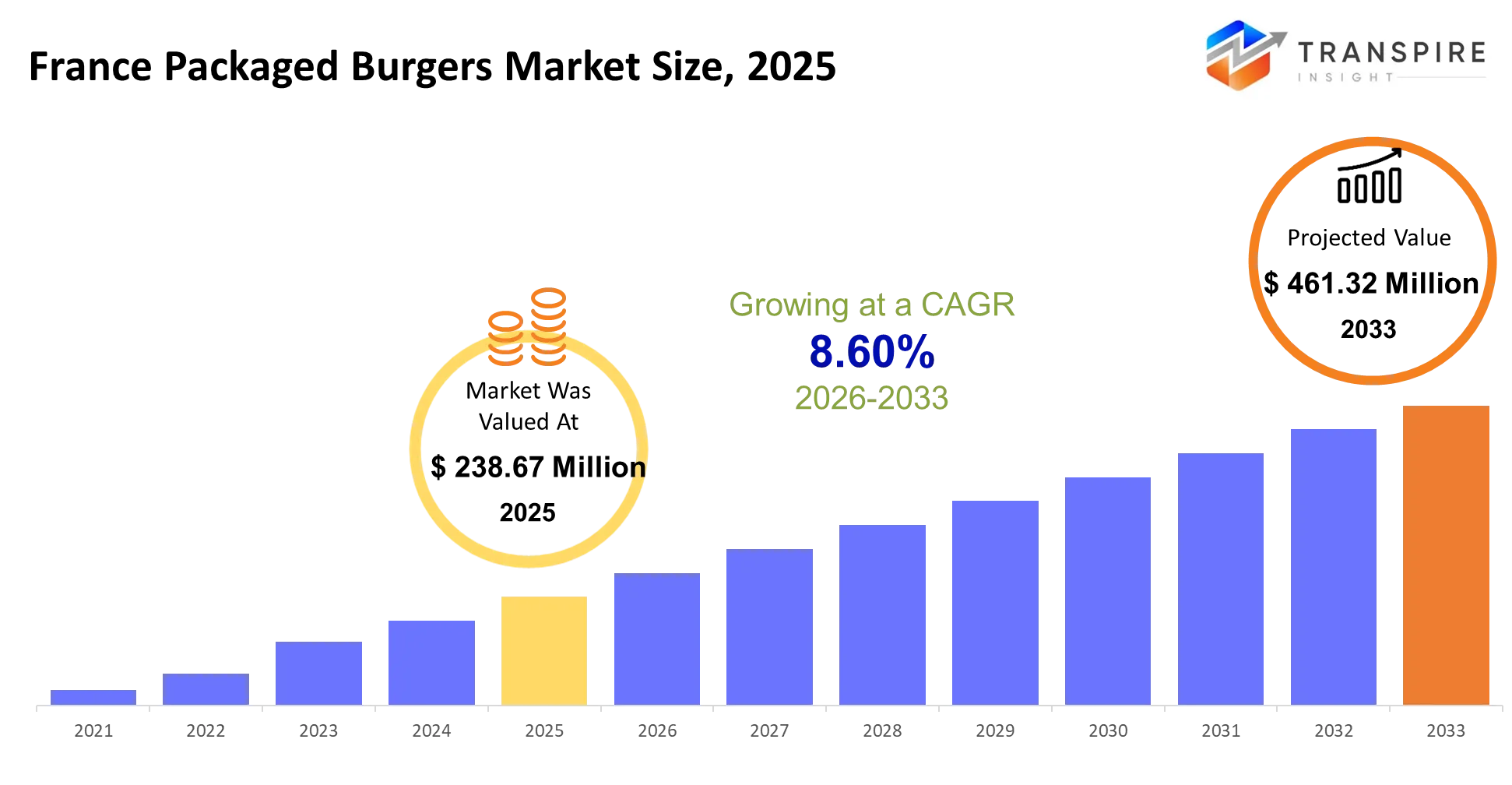
- France Packaged Burgers Market Size 2025: USD 238.67 Million
- France Packaged Burgers Market Size 2033: USD 461.32 Million
- France Packaged Burgers Market CAGR: 8.60%
- France Packaged Burgers Market Segments: By Type (Frozen, Ready-to-eat, Plant-based, Others); By Application (Household, Food Service, Retail, Others); By End-User (Consumers, Restaurants, Retailers, Others); By Distribution (Supermarkets, Online, Convenience Stores, Others)
To learn more about this report,  Download Free Sample Report
France Packaged Burgers Market Summary
The France Packaged Burgers Market was valued at USD 238.67 Million in 2025. It is forecast to reach USD 461.32 Million by 2033. That is a CAGR of 8.60% over the period.
France packaged burger products function as a convenient food option which customers can either eat immediately or heat before consumption within the country's fast-paced food retail ecosystem. The service provides quick meal solutions for urban households which need fast cooking methods because their members work during most of the day. The market has undergone major structural changes during the past three to five years because manufacturers now create cleaner-label frozen foods through processes which use natural ingredients and maintain effective cold-chain control.
Retailers developed stronger domestic sourcing programs and expanded their private-label packaged burger lines because supply chain disruptions from post-pandemic logistics bottlenecks affected their operations. The combination of product reformulation and local sourcing has enhanced product availability while maintaining shelf stability which results in better retail market access. Supermarkets now drive revenue growth through freezer space expansion and ready-to-eat protein products which store in freezers instead of regular fast-food items.
Key Market Insights
- The France Packaged Burgers Market is experiencing growth because supermarkets and convenience stores in urban areas are increasing their chilled meal offerings.
- The France Packaged Burgers Market size development results from frozen ready-meal advancements and the rise of private-label products which retail chains like Carrefour sell.
- Western France will maintain34 percent of market share in 2025 because its retail networks and food processing centers create dependable supply chains.
- The fastest growth in Southern France will continue until 2033 because tourism demand and quick-service restaurant expansion in coastal urban centers drive development.
- The market for frozen packaged burgers remains dominant because their long shelf life combined with efficient cold-chain logistics enables retailers to distribute products more effectively while reducing waste.
- The second-largest market segment for premium chilled burgers exists because people increasingly prefer fresh ready-to-eat foods that offer convenience.
- Supermarket stores control more than 55% of the France Packaged Burgers Market distribution channels which function as the main sales channels.
- The online grocery platforms segment is expanding at the fastest rate because more users started using digital retail after 2022.
- The primary user group for businesses remains households because urban French consumers buy products in large quantities every week.
- Food service and quick-service restaurants represent rapidly growing end-user categories integrating packaged burgers for operational efficiency.
- The companies improve their market position through their development of frozen food products and their expansion into private-label products while forming digital retail partnerships and enhancing their supply chain automation capabilities.
What are the Key Drivers, Restraints, and Opportunities in the France Packaged Burgers Market?
French consumers now prefer ready-to-eat protein meals which require less cooking time as their main preference for food. Supermarkets expanded frozen food infrastructure after supply chain volatility exposed weaknesses in fresh-only sourcing models. The manufacturing process gained capacity because standardized packaged burger production became possible, which resulted in better product shelf availability and improved store distribution, thus boosting customer repurchase rates and generating consistent business income.
The main operational challenge for the business comes from its requirement to use refrigerated transportation and its need for energy-heavy storage facilities, which drive up costs while creating difficulties for developing smaller retail locations. The infrastructure problem exists because cold-chain systems need extended periods before they become profitable while handling food safety regulations, which prevent fast growth for small business operators. Mid-tier consumer segments remain highly price-sensitive, which creates obstacles for businesses to sell their premium products.
The growth of hybrid retail-food service ecosystems creates a significant market opportunity, especially in France's expanding network of urban convenience stores and travel centers. Companies are increasingly testing automated meal vending systems and digitally integrated grocery platforms that combine frozen ready meals with rapid heating solutions. The growth potential from this business model exists for packaged burger producers who want to develop their operations in both impulsive buying and late-night consumption markets.
What Has the Impact of Artificial Intelligence Been on the France Packaged Burgers Market?
Artificial intelligence transforms production efficiency and supply chain management for the France packaged burger industry because it creates better predictions and decreases food waste. Manufacturers in the industry utilize AI-powered demand planning systems which forecast production needs by examining retail sales trends and seasonal demand patterns and promotional activities. The process reduces excess production of frozen burgers while it boosts inventory efficiency throughout supermarket distribution networks.
Machine learning models now serve as the main tool for predicting maintenance needs in food processing facilities because they can detect early indications of freezer breakdowns and packaging faults and contamination dangers. The systems provide better system availability while decreasing unplanned production halts which leads to improved cost performance and consistent production output. The AI-powered logistics systems create better cold-chain delivery routes which result in faster deliveries and decreased energy use during shipping.
The high expenses required to implement AI solutions across different food processing facilities in France create a major obstacle for mid-sized food processors who operate with multiple locations. The absence of unified digital systems at many facilities creates barriers to achieving complete automation. The retail partners provide data with poor quality which creates problems for developing accurate predictive models in smaller regional distribution networks.
Key Market Trends
- Frozen packaged burger sales rose significantly after 2023 as supermarkets expanded ultra-low temperature storage capacity across France retail chains.
- Private-label packaged burgers gained a stronger foothold in 2024, driven by Carrefour and other retailers optimizing cost-sensitive consumer demand.
- Premium chilled burger variants expanded in 2025 as consumers shifted toward restaurant-style convenience meals at home.
- Online grocery penetration increased rapidly between 2022 and 2025, reshaping distribution dynamics for France Packaged Burgers Market players.
- McDonald’s France integrated more localized supply partnerships to stabilize packaged product availability across urban outlets.
- McCain Foods expanded frozen protein innovation pipelines in 2024, focusing on texture retention and extended shelf stability.
- Energy price volatility in 2023 pushed manufacturers to redesign cold-chain systems for improved operational efficiency.
- Urban households increased bulk frozen food purchases by nearly 20% between 2022 and 2025, supporting steady demand growth.
- Automation in food processing plants reduced production downtime and improved consistency across packaged burger manufacturing lines.
France Packaged Burgers Market Segmentation
By Type
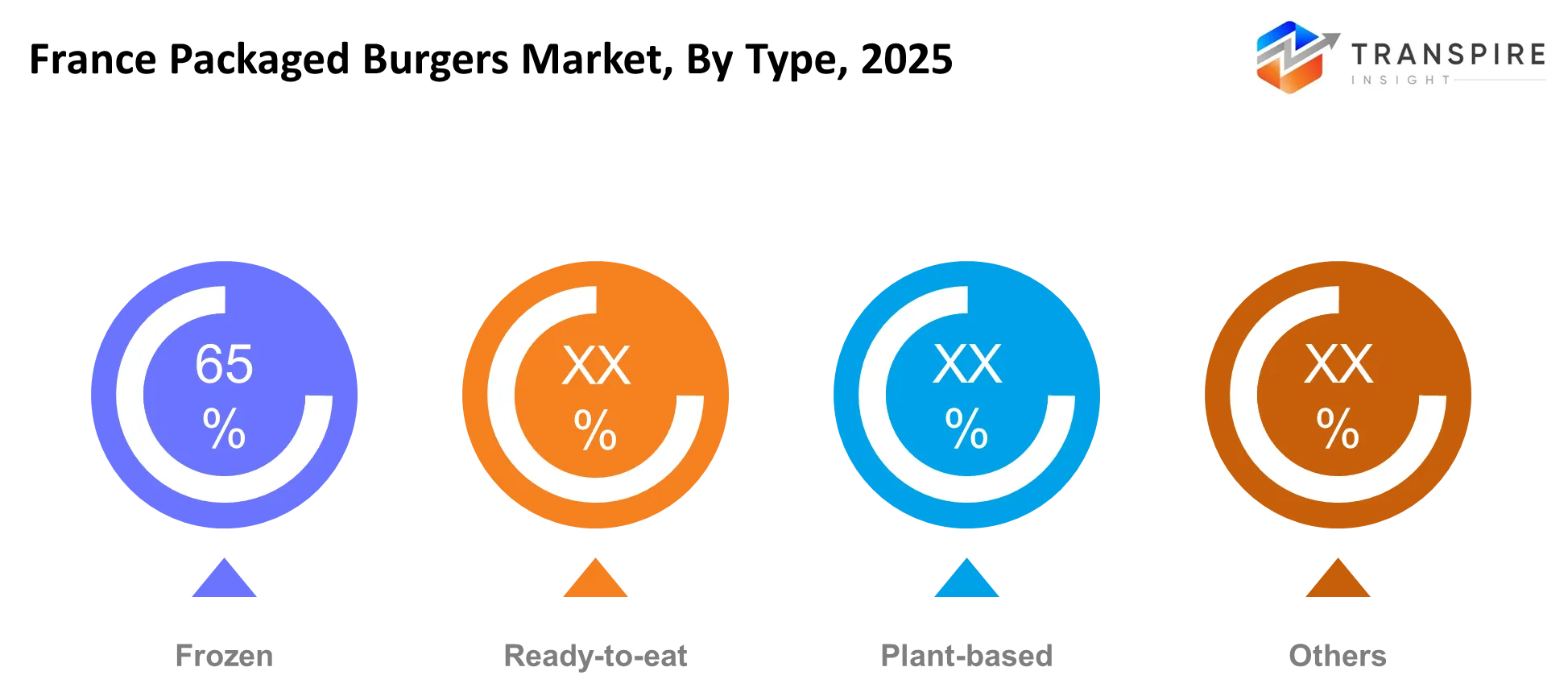
The France packaged burgers market sees frozen packaged burgers as its leading product because they maintain extended shelf life and they match requirements for distribution through major retail channels. Supermarkets choose frozen products because these products maintain consistent inventory levels while generating less waste than their chilled counterparts. Frozen food options provide urban households with meal options that match their irregular dining patterns which they experience throughout their day.
Consumers who seek fast food dining and dining at airports choose ready-to-eat packaged burgers as their second most popular option. People need to travel which creates time constraints during their eating periods that results in lower demand for frozen food products. Young city residents prefer plant-based burgers because they switch to new protein sources and plant-based meat products continue to develop. Frozen food products will stay as the main market force throughout the forecast period while plant-based products will achieve incremental premium market share through retail product developments and menu expansion.
To learn more about this report, Download Free Sample Report
By Application
The convenient meal solution needs of urban French households drive their choice of household application as their most preferred solution. Time limitations together with the need for quick cooking methods which businesses use to prepare their meals create the foundation for how people consume their food. Supermarkets enable customers to buy products in large quantities which leads to households controlling most of the packaged burger market through all sales channels.
The food service industry operates as a major secondary market which cafés and quick-service restaurants and travel food outlets use to deliver standardized meal preparation methods. Supermarket in-store food sections generate consistent customer demand through their retail prepared food counters. The market for institutional catering services maintains a stable presence although its range of applications remains narrow. Food service applications will experience faster growth because operators choose to enhance their operational productivity through better menu management systems which provide constant food item availability.
By End-User
The primary group of end-users consists of consumers who make direct purchases from supermarkets and hypermarkets through their household shopping activities. The demand for packaged burgers remains steady because these products fulfill the requirements of fast meal preparation and provide customers with predefined portion sizes. The availability of retailer private label products enables customers to access various price options which increases their purchasing choices.
Quick-service restaurants depend on standardized frozen and chilled burger products to maintain their operational standards which result in restaurants holding a large market share. Retailers operate as primary end-users because they use their own kitchen facilities to create food products and sell branded pre-packaged meals. The demand from other end-users who include institutional buyers shows a consistent pattern of limited but stable movement. The restaurant industry will see more establishments using standardized supply because it decreases kitchen workload while increasing the speed of service delivery during the forecast period.
By Distribution
Supermarkets maintain their leading market position because they possess extensive cold-chain systems and their frozen food sections display various products. Large retail chains ensure that customers find all products throughout their stores which leads to customers buying products in bulk.
The online distribution channel experiences its fastest growth rate because grocery delivery services keep expanding and urban shopping patterns keep evolving. Convenience stores create consistent demand through their customers who buy products based on their immediate needs and store visits. The remaining channels of distribution maintain small operational capacity. Online retail will experience substantial growth during the forecast period because digital grocery systems will provide faster delivery times and better cold storage facilities.
What are the Key Use Cases Driving the France Packaged Burgers Market?
The primary application in France's packaged burgers market operates through frozen and chilled burgers which deliver quick protein solutions to urban consumers who lack time for cooking. Supermarkets drive this demand because ready-to-heat burgers reduce reliance on restaurant dining while maintaining affordability and portion consistency, especially in single-person and dual-income households.
The operational scope now extends to food service applications which will integrate with cafés and convenience chains and travel retail outlets that include railway stations and motorway stops. The end-users require packaged burgers to achieve uniform cooking times which enable them to maintain their menu standards during busy periods thereby improving their work efficiency.
The development of automated vending processes leads to new use cases in institutional catering environments. Corporate cafeterias and smart vending machines are testing pre-packaged burger solutions to reduce kitchen labor dependency and extend service availability beyond traditional operating hours.
|
Report Metrics |
Details |
|
Market size value in 2025 |
USD 238.67 Million |
|
Market size value in 2026 |
USD 258.98 Million |
|
Revenue forecast in 2033 |
USD 461.32 Million |
|
Growth rate |
CAGR of 8.60% from 2026 to 2033 |
|
Base year |
2025 |
|
Historical data |
2021 - 2024 |
|
Forecast period |
2026 - 2033 |
|
Report coverage |
Revenue forecast, competitive landscape, growth factors, and trends |
|
Regional scope |
France |
|
Key company profiled |
Nestle, Tyson Foods, Beyond Meat, Impossible Foods, McCain, Conagra, Maple Leaf, Kellogg, BRF, Hormel, Unilever, JBS, Kraft Heinz, Perdue, Danone. |
|
Customization scope |
Free report customization (country, regional & segment scope). Avail customized purchase options to meet your exact research needs. |
|
Report Segmentation |
By Type (Frozen, Ready-to-eat, Plant-based, Others); By Application (Household, Food Service, Retail, Others); By End-User (Consumers, Restaurants, Retailers, Others); By Distribution (Supermarkets, Online, Convenience Stores, Others) |
Which Regions are Driving the France Packaged Burgers Market Growth?
The market activity in Western France shows its dominance because the region contains numerous agro-food processing facilities and supermarkets which serve both Nantes and Bordeaux. The area possesses operational cold-chain systems which enable frozen food products to be transported throughout the region. Retailers with high store presence can sell products at a faster rate while their customers choose private-label items more often. Food safety regulations compel manufacturers to create standardized product packages which maintain consistent demand for their goods.
The industrial centers of Northern France and its border trading activities with Belgium and Luxembourg make this area a dependable economic contributor. This region experiences economic growth through its stable economic activities which exist beyond its retail space operations. Large retail chains maintain consistent procurement contracts, ensuring predictable demand. The region’s logistics system which connects to major highways enables effective product distribution yet results in gradual development of its revenue stream.
The most rapidly expanding area in Southern France experiences growth because tourists drive food consumption while urban residents in Marseille and Nice adopt more convenient dining options. The recent investment in retail modernization together with cold storage facility development has enabled better access to products. Retailers expand their packaged ready-meal selection because seasonal population increases make demand more unpredictable. The expansion of this market indicates that new brands will successfully enter based on their ability to meet the needs of customers who prefer quick service and those who visit dining establishments.
Who are the Key Players in the France Packaged Burgers Market and How Do They Compete?
The France packaged burger market shows moderate consolidation because multinational food processors and retail chains control most distribution channels. The existing market players maintain their dominance through their extensive supply chains and retail agreements whereas plant-based competitors create new ways to distinguish their products. The main area where companies compete against each other focuses on developing new products while maintaining low operational costs through standardized frozen proteins and their development of private-label products for supermarkets.
Nestlé competes through its development of high-quality frozen foods which maintain their texture over time while creating clean-label products that match French consumer requirements. The company possesses an advantage because its extensive research and development resources allow fast product development for all European retail markets.
Kraft Heinz promotes cost-efficient packaged burger products which it distributes to mass retail markets. The company achieves competitive advantages through its effective procurement process and its ability to create production systems that handle bulk supermarket contracts.
McCain Foods establishes its market position through its expertise in frozen food products which enables the company to build strong cold-chain systems and extend product availability. The company expands its market reach through partnerships with European retailers which enhance the availability of frozen products in retail spaces.
Beyond Meat and Impossible Foods compete in the premium plant-based segment, using technology-driven protein formulation to capture health-conscious urban consumers. Their expansion strategy depends on running retail pilot programs together with their planned partnerships with food service operators throughout France.
Company List
• Tyson Foods
• Beyond Meat
• Impossible Foods
• McCain
• Conagra
• Maple Leaf
• Kellogg
• BRF
• Hormel
• Unilever
• JBS
• Kraft Heinz
• Perdue
• Danone
Recent Development News
In February 2026, IMARC Group published a revised packaged burgers market outlook report. The report highlighted accelerating demand for frozen and plant-based burger formats across Europe, including France, driven by ready-to-eat consumption patterns and retail expansion.
https://www.imarcgroup.com/global-packaged-burgers-market
In September 2025, Beyond Meat expanded its European retail distribution strategy through new frozen plant-based burger listings across multiple EU supermarket chains. The expansion strengthened its presence in France’s packaged protein segment by improving shelf penetration in mainstream retail channels.
https://www.beyondmeat.com/en-US/
In March 2026, Nestlé advanced its European frozen food portfolio by scaling clean-label burger product lines within its prepared meals division. The move reinforced its competitive position in France’s packaged burger retail ecosystem by aligning with demand for premium frozen convenience foods.
https://www.nestle.com/media/news
What Strategic Insights Define the Future of the France Packaged Burgers Market?
The France packaged burgers market is developing toward a combined system that merges its frozen retail sector with its digital convenience food systems. Urban households will drive growth through their increased need for high-protein standardized meal products and their rising preference for efficient cold-chain systems. The upcoming 5-to-7 year period will see competition evolve toward formulation innovation and distribution control as companies develop their product offerings.
A hidden danger exists because refrigeration-dependent supply chains have become more dependent on energy which will harm profit margins when electricity prices fluctuate and environmental laws increase cold storage requirements. This situation will harm mid-sized processors who lack complete system capabilities for their operations.
Automated retail systems which include smart vending machines and hybrid convenience stores that use heating systems to sell packaged food create new business opportunities. Companies that combine product development with immediate cooking solutions will achieve first market advantage. Market participants should prioritize retail-tech partnerships to secure long-term shelf access and consumer visibility.
France Packaged Burgers Market Report Segmentation
By Type
- Frozen
- Ready-to-eat
- Plant-based
- Others
By Application
- Household
- Food Service
- Retail
- Others
By End-User
- Consumers
- Restaurants
- Retailers
- Others
By Distribution
- Supermarkets
- Online
- Convenience Stores
- Others
Frequently Asked Questions
Find quick answers to common questions.
The estimated 2033 market size figure is USD 461.32 Million.
Key segments for the France Packaged Burgers Market are By Type (Frozen, Ready-to-eat, Plant-based, Others); By Application (Household, Food Service, Retail, Others); By End-User (Consumers, Restaurants, Retailers, Others); By Distribution (Supermarkets, Online, Convenience Stores, Others).
Major France Packaged Burgers Market players are Nestle, Tyson Foods, Beyond Meat, Impossible Foods, McCain, Conagra, Maple Leaf, Kellogg, BRF, Hormel, Unilever, JBS, Kraft Heinz, Perdue, Danone.
The France Packaged Burgers Market size is USD 238.67 Million in 2025.
The France Packaged Burgers Market CAGR is 8.60% from 2026 to 2033.
• Tyson Foods
• Beyond Meat
• Impossible Foods
• McCain
• Conagra
• Maple Leaf
• Kellogg
• BRF
• Hormel
• Unilever
• JBS
• Kraft Heinz
• Perdue
• Danone
Recently Published Reports
-
Apr 2026
Baby Infant Formula Market
Baby Infant Formula Market Size, Share & Analysis Report By ype (Infant Milk, Follow On Milk, Specialty Baby Milk, Growing-Up Milk), By Ingredient (Carbohydrate, Fat, Protein, Minerals, Vitamins, and Others), By Product Form (Powder, Liquid, and Ready-to-feed), By Distribution Channels (Supermarket/Hypermarket, Specialty Store, Pharmacies, Online Retail, and Others), and Geography (North America, Europe, Asia-Pacific, Middle East and Africa, South and Central America), 2021 - 2031
-
Apr 2026
Edible Insects for Animal Feed Market
Edible Insects for Animal Feed Market Size, Share & Analysis Report By Type (Insect Powder, Insect Meal, Insect Bar, Insect Paste, Insect Oil, and Others), By Insect Type (Beetles, Cricket, Caterpillar, Hymenoptera, Orthoptera, Tree Bugs, and Others), By Application (Livestock, Pet Food, and Aquaculture), By Livestock Type (Poultry, Swine, and Others), and Geography (North America, Europe, Asia-Pacific, Middle East and Africa, South and Central America), 2021 - 2031
-
Apr 2026
Food Industry Disinfection and Bacterial Control Market
Food Industry Disinfection and Bacterial Control Market Size, Share & Analysis Report By Type (Chemical Disinfectants, Physical Disinfectants, and Biocides and Antimicrobials), By Application (Food Processing Equipment Surface Disinfection, Food Preparation Areas Surface Disinfection, Storage Areas Surface Disinfection, Anti-microbial Coatings Food Preservation, and Preservative Solutions Food Preservation), By End User (Meat and Poultry Processing, Dairy Processing, Seafood Processing, Bakery and Confectionery, Restaurants and Commercial Kitchens, and Food Service Providers), By Sales Channel (Online, Offline), and Geography (North America, Europe, Asia-Pacific, Middle East and Africa, South and Central America), 2021 - 2031
-
Apr 2026
Freeze Dried Food Market
Freeze Dried Food Market Size, Share & Analysis Report By Product Type (Fruits, Vegetables, Freeze-Dried Dairy Products, Freeze-Dried Meat and Seafood, Freeze-Dried Pet Food, and Prepared Meal), By Nature (Organic, and Conventional), By Form (Powdered, Granules, and Diced), By End Use (Breakfast Cereals, Dairy Products, Bakery & Confectionery, Nutritional Bars & Supplements, Powdered Beverages, Snacks, and Retail (Household)), and Geography (North America, Europe, Asia-Pacific, Middle East and Africa, South and Central America), 2021 - 2031