

North America Learning Management (LMS) System Market Size & Forecast:
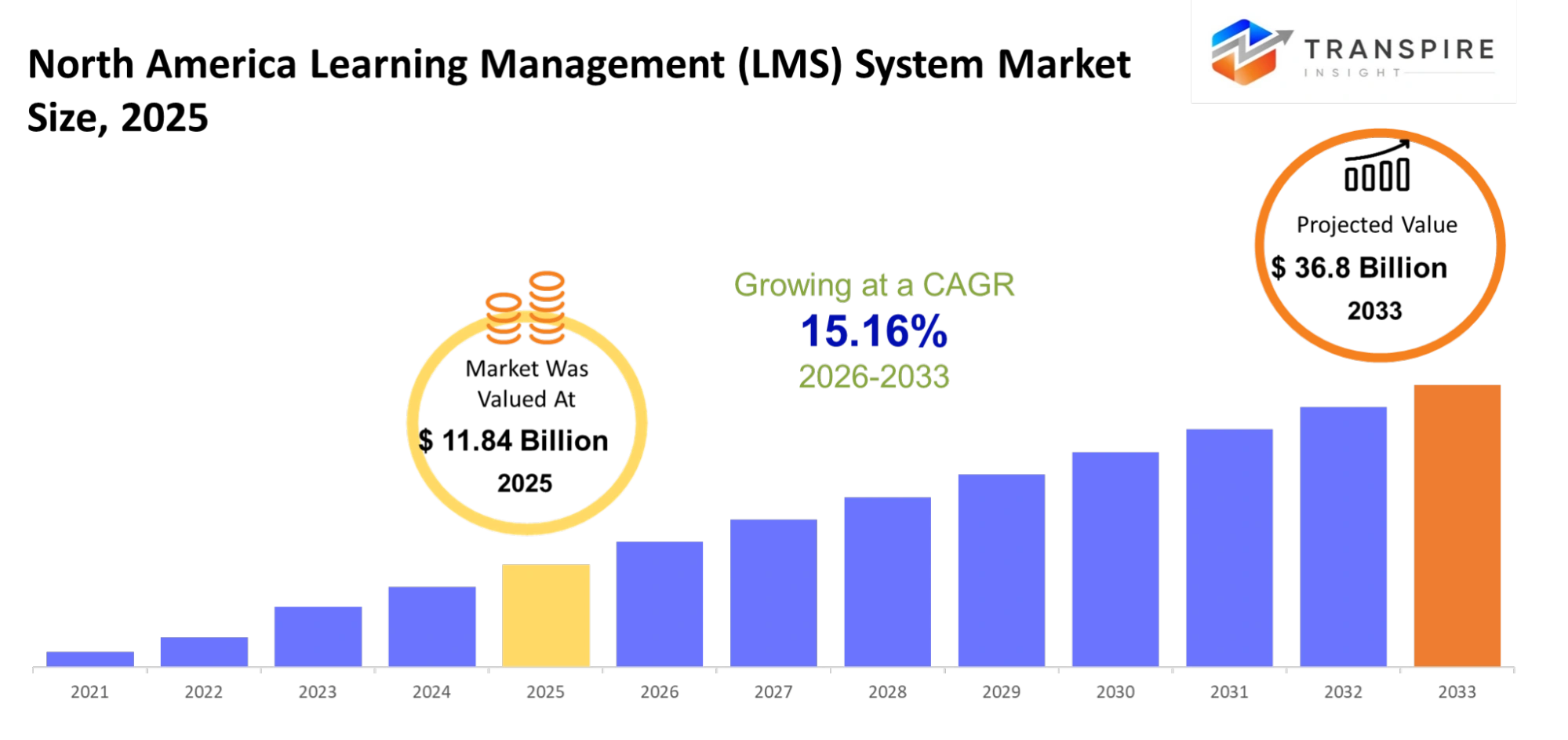
- North America Learning Management (LMS) System Market Size 2025: USD 11.84 Billion
- North America Learning Management (LMS) System Market Size 2033: USD 36.8 Billion
- North America Learning Management (LMS) System Market CAGR: 15.16%
- North America Learning Management (LMS) System Market Segments: By Component (Software, Services), By Deployment (Cloud, On-Premise), By End-User (K-12, Higher Education, Corporate).
To learn more about this report,  Download Free Sample Report
North America Learning Management (LMS) System Market Summary:
The North America Learning Management (LMS) System Market size is estimated at USD 11.84 Billion in 2025 and is anticipated to reach USD 36.8 Billion by 2033, growing at a CAGR of 15.16% from 2026 to 2033. The North America learning management system market which includes Canada, The United States and Mexico forms a part of the education technology sector which will experience transformation through digital infrastructure developments that change knowledge delivery and assessment methods. Institutions and enterprises will increasingly expect platforms that feel intuitive mobile-first and deeply personalized. Buyers will choose systems which provide analytics and AI-driven recommendations and collaboration tools that work together without problems. Vendors will need to improve their compliance standards because regulatory requirements for data privacy and accessibility have become more demanding. The market will transform through hybrid learning which creates a demand for digital environments that support flexible learning and achievement-based measurement instead of traditional course delivery methods.
Key Market Trends & Insights:
The learning management system market in North America which includes Canada and the United States and Mexico is currently experiencing a transformation that leads to the development of highly customized educational settings. The platforms will start to modify their content delivery based on the assessment of user actions and their existing knowledge and their advancement throughout the learning process. The evolution will show increasing demands which both corporate learners and students who need customized learning paths will show. The vendors will develop adaptive learning systems which organizations can use to replace standard training programs with customized online learning experiences.
The next developing trend will see companies use artificial intelligence to create integrated systems across their entire operational activities. The AI system will automate administrative work while improving both assessment precision and predictive capabilities. Organizations will use these systems to forecast how learners will perform and decide on suitable support methods. Institutions will change their assessment practices to implement continuous performance assessment which uses data to track student development and their preparedness for professional work.
Mobile-first design will become a defining standard as users increasingly access content through smartphones and tablets. Learning platforms must deliver continuous access to all functions through their products which users can access from various devices. The shift will demonstrate how people consume media content today, which has changed especially among younger audiences and those who work from home. Providers will create lightweight user interfaces which enable users to access learning materials through offline access and short learning sessions in environments where traditional desktop learning solutions are not suitable.
Platform architecture will receive more influence from organizations which understand regulatory requirements and data management procedures. Vendors will focus on secure data processing and clear data disclosure and compliance features as privacy regulations develop throughout the region. Institutions will favor systems that align with regional standards while maintaining user trust. The need for advanced security solutions will determine which products are purchased because institutional and governmental needs require providers to implement strong encryption systems and detailed audit capabilities and user approval tracking mechanisms.
North America Learning Management (LMS) System Market Segmentation
By Component
Software- The North american learning management system market will depend on software which will establish the fundamental structure of its operation throughout Canada, the United States, and Mexico. The systems will develop advanced features which enable users to create courses through user-friendly tools while tracking student progress. Buyers will expect seamless integrations with HR tools, content libraries, and communication systems, which will require vendors to develop software systems that allow extensive customization and operate across different platforms.
Services- The complete value extraction from platforms by organizations depends on the vital importance of services. Organizations require tailored solutions which will make implementation support and system customization and ongoing maintenance essential for their operations. Organizations will receive consulting services which enable them to create learning strategies that support their business objectives while training services will assist administrators and instructors in learning new system functions. The segment will demonstrate the growing requirement for organizations to continuously improve their operations instead of using one-time solutions.

To learn more about this report, Download Free Sample Report
By Deployment
Cloud- Organizations will choose cloud-based deployment solutions because these systems offer better flexibility and scalability and enable remote access. The solutions will let users study materials from any place while they simplify infrastructure management tasks. The vendors will keep improving their cloud security systems together with system uptime performance and their automatic update features which keep their systems updated without creating downtime. Organizations that need to control their expenses while establishing their distributed educational environment will find this model valuable.
On-Premise- Organizations that need to maintain tight control over their data will choose on-premise deployment because it enables them to manage their data in accordance with their internal policies. Government bodies and regulated industries that need to protect sensitive information will select hosting solutions that operate on their own data centers. The system requires organizations to invest more money at first and to handle ongoing support tasks yet it provides them with complete control over their system because they can customize it according to their needs. The segment will keep satisfying specialized requirements because their security and compliance requirements take precedence over operational flexibility.
By End-User
K-12- The K-12 educational sector will see learning platforms shift their attention toward three main areas which include student engagement and platform ease of use and parental participation. The system will enable students to access interactive materials while participating in gamified educational activities and their academic development will be monitored through real-time progress assessments. Educators will use these tools to handle classroom operations while delivering individualized student support. Digital education solutions will become more common in early learning settings which will create a demand for platforms that provide easy use and attractive visual designs.
Higher Education- Higher education institutions will adopt advanced systems that support hybrid learning models research collaboration and large-scale course management. Universities will seek platforms capable of handling diverse academic programs while offering detailed performance analytics. Virtual classrooms and digital libraries and assessment tools need to be integrated together with their system. The segment will demonstrate an evolution towards degree programs that allow students to study from anywhere in the world while providing institutions the ability to extend their educational services beyond traditional campus boundaries.
Corporate- The corporate sector will develop programs that train employees on necessary skills and conduct compliance training and track employee performance. Organizations will use these systems to deliver continuous learning aligned with business objectives. The industry will adopt microlearning modules together with certification tracking and real-time reporting capabilities as their standard features. The companies will allocate their resources to create platforms which enable employees to develop their careers while the platforms support remote onboarding and upskilling programs which help staff members maintain their competitive edge in the changing job market. The text uses artificial intelligence writing technology.
Regional Insights
The development of digital learning ecosystems in the United States will continue as institutions and businesses need systems that cater to their evolving workforce needs. Universities and businesses need systems that offer hybrid delivery, credentialing, and outcomes. The traditional vendors driving product development for these systems. Data privacy regulations will influence the management of user data for these systems.
Canada’s trend will be balanced, with education policies and accessibility driving system adoption. Education institutions will design systems that are inclusive to cater to diverse learner needs. For instance, they will ensure that systems are effective for students in remote areas. Government initiatives driving digital systems in Canada will ensure standardization and system interoperability. Education institutions in Canada will design systems that are bilingual to cater to the country’s cultural diversity.
The digital learning development process in Mexico will take place through structured adoption methods which will be implemented across all educational and business environments. Organizations will invest in scalable platforms which will provide solutions for skill development and workforce readiness needs. The combination of infrastructure upgrades and improved internet access will enable wider internet use especially in urban areas. Users will continue to need cost-effective mobile solutions which allow them to learn anywhere because their learning needs change based on their economic situation and access to technology.
North America will experience regional dynamics which result from the combination of existing technological capabilities and changing user requirements. Institutions and businesses from different countries will work together to promote cross-border collaboration which will lead to the creation of systems that can work together. Vendors will customize their products to comply with multiple regulatory standards while users will experience the same interface across different platforms. The regional trend will develop towards platforms which provide security and adaptability through user-centered designs that fulfill institutional needs and personal learning styles.
Recent Development News
United States: AI Expansion and Corporate Learning Integration
Recent developments across the United States highlight a strong push toward AI-enabled learning platforms and enterprise-focused solutions. Companies are upgrading systems to include predictive analytics, skill mapping, and automated assessments. Corporate training demand is rising as organizations invest in continuous workforce development. The country continues to dominate regional adoption, supported by advanced infrastructure and large-scale enterprise usage, with businesses prioritizing digital learning as a core operational tool.
Canada: Platform Innovation and Global Expansion Moves
Canada has seen notable activity from homegrown providers expanding both product capabilities and international reach. Firms are enhancing cloud-based platforms with personalization features and multilingual support, reflecting the country’s diverse user base. Canadian companies are also entering new global markets, strengthening their competitive position. This progress is supported by strong public education systems and a growing emphasis on accessible, inclusive digital learning environments across institutions.
Mexico: Rising Adoption with Mobile-First Learning Solutions
Mexico is experiencing increasing momentum as organizations adopt cost-effective and mobile-friendly platforms. Recent developments show a shift toward scalable cloud systems that support workforce training and academic use. Expanding internet access and smartphone usage are enabling broader participation in digital learning. The country is expected to record faster expansion compared to its regional peers, driven by demand for flexible, accessible solutions tailored to diverse economic conditions.
|
Report Metrics |
Details |
|
Market size value in 2025 |
USD 11.84 Billion |
|
Market size value in 2026 |
USD 13.7 Billion |
|
Revenue forecast in 2033 |
USD 36.8 Billion |
|
Growth rate |
CAGR of 15.16% from 2026 to 2033 |
|
Base year |
2025 |
|
Historical data |
2021 – 2024 |
|
Forecast period |
2026 – 2033 |
|
Report coverage |
Revenue forecast, competitive landscape, growth factors, and trends |
|
Country scope |
North America (Canada, The United States, and Mexico) |
|
Key company profiled |
Blackboard Inc., Moodle Pty Ltd., Instructure Inc. (Canvas), D2L Corporation, SAP SE, Oracle Corporation, Cornerstone OnDemand Inc., Docebo Inc., TalentLMS (Epignosis), Absorb LMS, Adobe Inc., Google LLC, Microsoft Corporation, IBM Corporation, Skillsoft Corporation. |
|
Customization scope |
Free report customization (country, regional & segment scope). Avail customized purchase options to meet your exact research needs. |
|
Report Segmentation |
By Component (Software, Services), By Deployment (Cloud, On-Premise), By End-User (K-12, Higher Education, Corporate). |
Key North America Learning Management (LMS) System Market Company Insights
The north america (canada, the united states, and mexico) learning management system (lms) market will experience ongoing competition through innovations and scalability and integration capabilities which all key players will implement. Cornerstone OnDemand and D2L Corporation and Anthology (Blackboard) and Docebo will develop enterprise-grade solutions while Adobe and SAP Litmos and TalentLMS will enhance their cloud-based products. The vendors will develop unique market positions through their use of AI-driven personalization and analytics and HR integration systems which organizations require to operate their academic and corporate educational programs.
Company List
- Blackboard Inc.
- Moodle Pty Ltd.
- Instructure Inc. (Canvas)
- D2L Corporation
- SAP SE
- Oracle Corporation
- Cornerstone OnDemand Inc.
- Docebo Inc.
- TalentLMS (Epignosis)
- Absorb LMS
- Adobe Inc.
- Google LLC
- Microsoft Corporation
- IBM Corporation
- Skillsoft Corporation
North America Learning Management (LMS) System Market Report Segmentation
By Component
- Software
- Services
By Deployment
- Cloud
- On-Premise
By End-User
- K-12
- Higher Education
- Corporate
Frequently Asked Questions
Find quick answers to common questions.
The approximate North America Learning Management (LMS) System Market size for the market will be USD 36.8 Billion in 2033.
Key segments for the North America Learning Management (LMS) System Market By Component (Software, Services), By Deployment (Cloud, On-Premise), By End-User (K-12, Higher Education, Corporate).
Major players in the North America Learning Management (LMS) System Market are Blackboard Inc., Moodle Pty Ltd., Instructure Inc. (Canvas), D2L Corporation, SAP SE, Oracle Corporation, Cornerstone OnDemand Inc., Docebo Inc., TalentLMS (Epignosis), Absorb LMS, Adobe Inc., Google LLC, Microsoft Corporation, IBM Corporation, Skillsoft Corporation.
The North America Learning Management (LMS) System Market size is USD 11.84 Billion in 2025.
The North America Learning Management (LMS) System Market CAGR is 15.16%.
- Blackboard Inc.
- Moodle Pty Ltd.
- Instructure Inc. (Canvas)
- D2L Corporation
- SAP SE
- Oracle Corporation
- Cornerstone OnDemand Inc.
- Docebo Inc.
- TalentLMS (Epignosis)
- Absorb LMS
- Adobe Inc.
- Google LLC
- Microsoft Corporation
- IBM Corporation
- Skillsoft Corporation
Recently Published Reports
-
Apr 2026
3D Optical Profiler Market
3D Optical Profiler Market Size, Share & Analysis Report By Type (Desktop 3D Optical Profiler, and Portable 3D Optical Profiler), By Technology (Confocal Technology, and White Light Interference), By End-Use Industry (Manufacturing, Research Institutions, Automotive, Aerospace and Defense, Medical Devices, and Other), and Geography (North America, Europe, Asia-Pacific, Middle East and Africa, South and Central America), 2021 - 2031
-
Apr 2026
Depth Sensor Market
Depth Sensor Market Size, Share & Analysis Report By Type (Infrared Depth Sensors, Time-of-Flight (ToF) Sensors, Stereo Vision Sensors, Structured Light Sensors, Ultrasonic Depth Sensors), By Application (Automotive, Robotics, Gaming, Consumer Electronics, Industrial Automation, Healthcare, Security & Surveillance, Others), By End Users (Automotive Manufacturers, Consumer Electronics Companies, Healthcare Providers, Industrial Companies, Security Agencies, Gaming Companies, Robotics Companies, Others), and Geography (North America, Europe, Asia-Pacific, Middle East and Africa, South and Central America), 2021 – 2031
-
Apr 2026
Digital Manufacturing Market
Digital Manufacturing Market Size, Share & Analysis Report By Component (Hardware, Software, and Services), By Technology (Robotics, 3D Printing, Internet of Things (IoT), and Others), By Application (Automotive and Transportation, Aerospace and Defense, Consumer Electronics, Industrial Machinery, and Others), By Process Type (Computer-Based Designing, Computer-Based Simulation, Computer 3D Visualization, Analytics, and Others), and Geography (North America, Europe, Asia-Pacific, Middle East and Africa, South and Central America), 2021 – 2031
-
Apr 2026
Digital Visa Services Market
Digital Visa Services Market Size, Share & Analysis Report By Type (Individual Travelers, Group Travelers), By Application (Tourism, Business Travel, Others), and Geography (North America, Europe, Asia-Pacific, Middle East and Africa, South and Central America), 2021 – 2031