

Asia Pacific Online Gaming Market Size & Forecast:
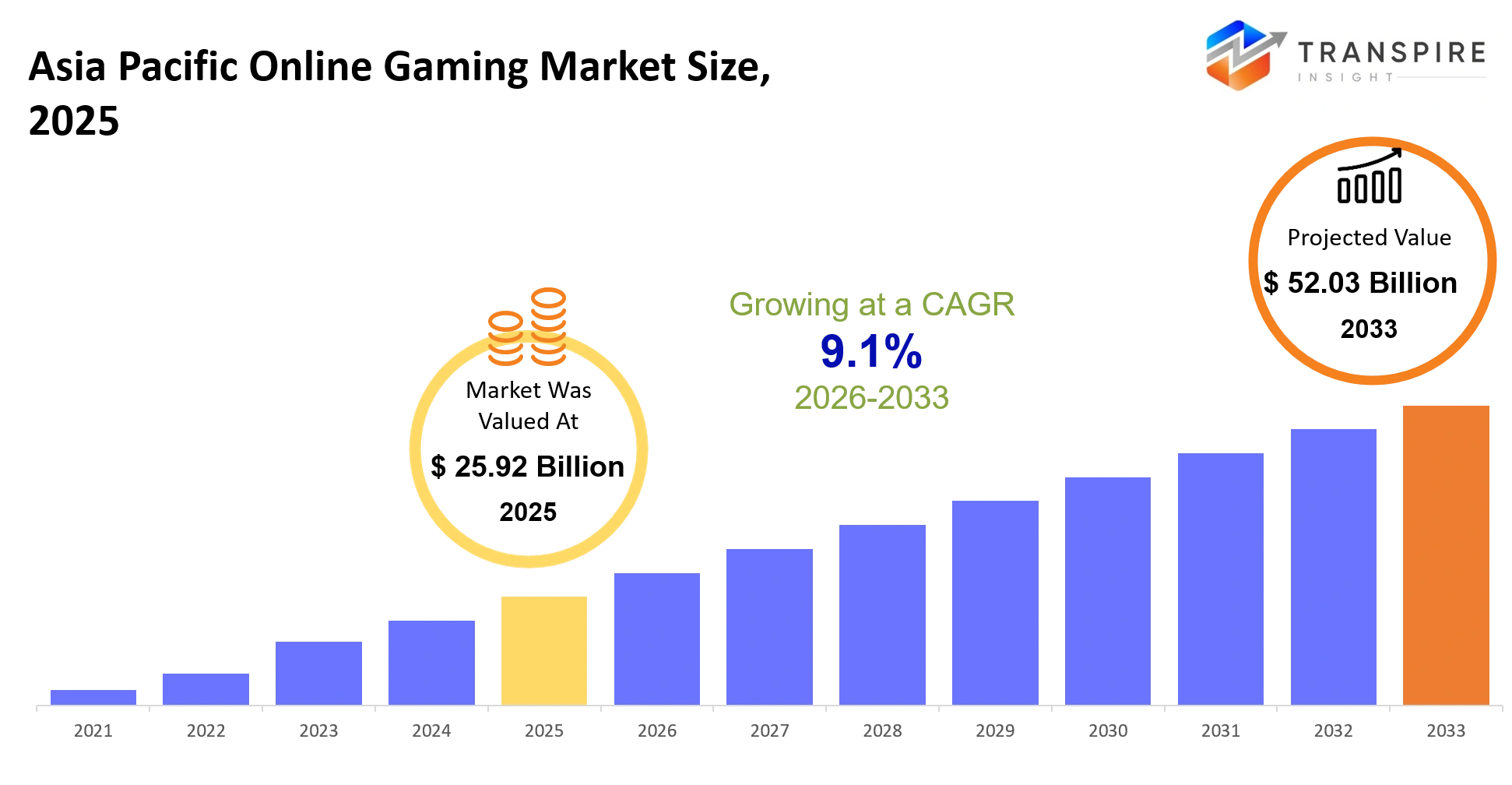
- Asia Pacific Online Gaming Market Size 2025: USD 25.92 billion
- Asia Pacific Online Gaming Market Size 2033: USD 52.03 billion
- Asia Pacific Online Gaming Market CAGR: 9.1%
- Asia Pacific Online Gaming Market Segments: By Game Type (Action, Strategy, RPG, Sports, Casual, Simulation, Others); By Platform (PC, Mobile, Console, Cloud Gaming, Others); By Revenue Model (Free-to-Play, Subscription, In-Game Purchases, Ads, Others); By End User (Teenagers, Adults, Professional Gamers, Others)
Asia Pacific Online Gaming Market Summary
The Asia Pacific Online Gaming Market was valued at USD 25.92 billion in 2025. It is forecast to reach USD 52.03 billion by 2033. That is a CAGR of 9.1% over the period.
Asia Pacific Online Gaming Market refers to a digital entertainment industry through which the consumers can indulge in multi-player games, interact socially, compete against each other, and consume contents while playing from their smartphones, PCs, and gaming consoles. Apart from serving as a form of entertainment, online gaming serves as a means of building communities and engaging in various activities, and earning money through live gaming and economic activities.
There has been a complete change in structure in the Asia Pacific Online Gaming Market over the past five years as the market is evolving through the adoption of a free-to-play model through microtransactions and live content, amongst others. A very important reason for such change has been the coronavirus pandemic, where people were using online gaming as a means of entertainment due to lockdowns and quarantines. The rising use of smartphones, digital transactions, and cloud computing technologies have enabled publishers to target larger audiences online.
Key Market Insights
- China is a player in the Asia Pacific Online Gaming Market making up around 35 to 40 percent of the regions revenue. This is because China has a number of gamers.
- Japan also has a share of the market. People in Japan spend a lot of money on high-end gaming content and mobile games.
- India is growing fast. More people are getting smartphones internet is getting cheaper. Esports is becoming more popular.
- In Southeast Asia more and more people are getting into gaming. This is because its becoming easier to pay for games
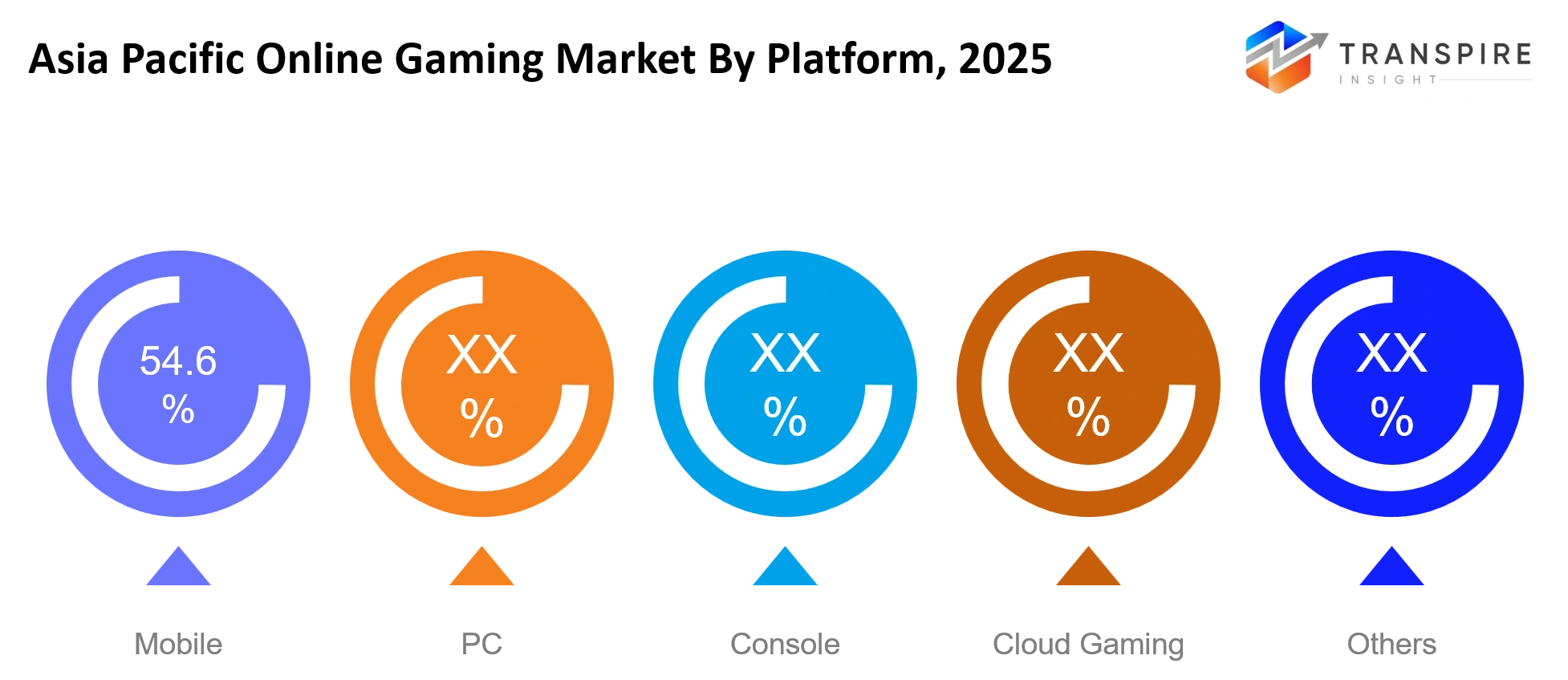
- Mobile games are the popular making up over half of the market. This is because many people have smartphones.
- PC gaming is the biggest segment. Its helped by esports and games that you can play with lots of people online.
- Cloud gaming is growing fast. This is because of 5G. Because you don't need such powerful hardware to play.
- Games that you can play on devices are becoming more popular. This is helping to keep players engaged and interested.
- Free games that you can play for free but buy things inside the game are very popular. They make money from people buying things inside the game.
- Some people are also getting into subscription-based gaming services. These are popular with people who're really, into gaming.
What are the Key Drivers, Restraints, and Opportunities in the Asia Pacific Online Gaming Market?
The foremost driver fueling the Asia Pacific Online Gaming Market is the fast growth in mobile-based online games driven by cheap mobile internet and advanced payments infrastructure. The increasing adoption of 4G and 5G networks along with decreasing prices of smartphones has reduced barriers to entry for thousands of gamers in India, Indonesia, Vietnam, and the Philippines. It has made gaming not only accessible but also an everyday digital necessity. As increasing numbers of gamers begin to access online multiplayer games, the revenue generation process of game makers has become recurrent through in-game payments, subscription fees, advertisements, and other live-service methods and no longer depend on the sales of games alone.
Regulatory challenges are the primary structural barrier in the way of development of the industry. Several Asia Pacific nations are constantly changing their laws regarding online gaming, personal data safety, monetization practices, and participation of children. These problems will take time to solve since they pertain to law, culture, and the protection of consumers. Inconsistency of regulations leads to increased costs of compliance, delayed launch of games, restricted investment, and reduced revenues.
Cloud Gaming is a promising frontier in terms of future expansion opportunities. The construction of edge computing and 5G infrastructures allows high-end gaming to be experienced by consumers without the need for costly equipment. Countries like India and Southeast Asia, in particular, hold great potential since their huge user bases on mobile phones have the ability to experience premium games via cloud services.
What Has the Impact of Artificial Intelligence Been on the Asia Pacific Online Gaming Market?
The use of AI in the Asia Pacific Online Gaming Market is associated with automation of the processes involved in the game. The development teams employ machine learning systems to analyze and manage gamers' actions and behavior. In particular, the artificial intelligence is applied to detect cheaters, monitor offensive messages, manage user behavior, and ensure compliance with community rules. Moreover, the platform administrators employ automated tools for analyzing gamers' activities and automating the process of assigning servers, making match-making, and managing other aspects of gameplay.
Nowadays, predictive analytics become increasingly common practice among game developers due to using machine learning algorithms by game development companies. Predictive models can estimate whether the gamer is going to leave the gaming site; therefore, the developer receives an opportunity to prevent such events. In particular, the model can predict the spending patterns of the gamer, the possibility of leaving the platform, and other essential characteristics which allow personalizing content or scheduling marketing campaigns. This approach allows keeping gamers engaged, boosting average revenue per user and reducing marketing costs.
However, despite all these advantages, there exist several limitations associated with AI implementation in gaming. Incorporation of sophisticated AI into older gaming systems calls for substantial costs and expertise. Moreover, inaccuracies may arise from prediction algorithms in cases where data available for training is small, and gamer behavior changes quickly.
Key Market Trends
- Since 2020 game publishers have changed the way they sell games. They now focus on battle passes, seasonal content. Making money from games on a regular basis.
- Mobile gaming is very popular in areas. This is because smartphones are affordable and data plans are cheap in places like India and Southeast Asia.
- After 2021 cloud gaming started to be available to everyone not for testing. This happened because 5G internet is now available in big cities.
- Esports is now a deal. Many companies want to be a part of it. They include companies that make things people use every day phone companies and online payment companies.
- In 2022 game publishers started using intelligence to make the games more personal for each player. This helps keep players in the games.
- Now people can play games with others no matter what device they use. This is because game developers made it possible for people to play together on devices like phones, computers and gaming consoles.
- The government is watching game publishers closely. This means publishers have to make sure they are protecting players information and making sure they are old enough to play.
- Big companies like Tencent, NetEase and Krafton are investing in game studios. They want to make games that people in areas will like.
- It is easier for people to buy things in games now. This is because online payments are easy to use. More people are playing games that're free because it is easy to buy things in the game.
- People like to play games, with others and be part of a community. Game publishers know this so they are making games that let people interact with each other.
- Game publishers are making games that have features. This is what players want. They want to be able to play with others and talk to them while they play.
Asia Pacific Online Gaming Market Segmentation
By Game Type:
Action games are still dominating the market since the combination of exciting action, competition, and regular updates make them very popular and attract a lot of players. Multiplayer games are engaging their users through live events, seasonal rewards, and socialization opportunities. Esports development and integration have helped many action games gain popularity in a number of countries within the region.
Role-playing games remain popular due to captivating stories and character development features, which keep users loyal for long periods of time. Strategy and simulation games are also appealing to a certain audience that enjoys tactical game-play. The increasing popularity of casual games lies in their easy-to-play nature and ability to be enjoyed on-the-go.
By Platform:
Games played using mobile devices have a larger market share because most people own smartphones that provide access to games and reliable internet connections. The availability of games through app stores makes them easily available to billions of users, both in cities and rural areas. The constant development of mobile hardware has further improved the gaming experience.
Another segment of gaming is that involving PCs which is mostly popular with gamers who participate in competitions or esports events. Games played using consoles remain relevant since they provide premium gaming experience and exclusive content. Cloud gaming has recently gained popularity since better internet and 5G connectivity allow playing games online without requiring powerful hardware.
By Revenue Model:
Free-to-play models have become dominant revenue models due to the lower costs for entering the market. Game publishers earn money from in-app purchases, cosmetics, battle passes, and other virtual items. This helps create a continuous cycle of playing along with generating regular revenues aside from game sales.
Subscriptions are increasingly being adopted by gamers who need access to large numbers of games and extra features. Ad-based models remain applicable, especially when it comes to casual and mobile games since player acquisition is very important in this area. The hybrid approach, which combines subscription-based, ad-based, and pay-per-use models, becomes more popular now than ever before.
By End User:
The young adults make the highest users of the platform, thanks to their involvement in gaming experiences, esports events, and community gaming sessions. Digital payments have enhanced expenditure on virtual products, premium services, and tailored gaming sessions. The competitive gaming culture has also helped increase participation from this category.
Casual gamers play an important role in the overall user base because of mobile gaming's availability to them during normal routines. Female involvement has been on the rise, making it necessary to develop diversified content and new types of games. Young consumers have been driving the market's future trends.
What are the Key Use Cases Driving the Asia Pacific Online Gaming Market?
The key application that is responsible for the market's growth is multiplayer online gaming, especially those played on mobile devices. Competitive aspects, social interactions, and the presence of live services will increase user engagement. The application segment has the largest demand as it allows publishers to monetize players regularly via virtual goods and live content updates.
Other applications include esports and interactive gaming. Esports tournaments can bring in sponsorships and media partnerships along with additional revenue from advertisements, whereas interactive gaming is growing among general mobile gamers. Education games and skill-based games can be found popular among the next generation of digital users.
Upcoming applications include cloud gaming and artificial intelligence for personalization of gaming. Cloud gaming will cut down hardware costs as well as bring high-end games to many devices. Artificial intelligence applications for game recommendation, adaptation of game play and community development can prove effective over the projected period.
|
Report Metrics |
Details |
|
Market size value in 2025 |
USD 25.92 Billion |
|
Market size value in 2026 |
USD 28.28 Billion |
|
Revenue forecast in 2033 |
USD 52.03 Billion |
|
Growth rate |
CAGR of 9.1% from 2026 to 2033 |
|
Base year |
2025 |
|
Historical data |
2021 - 2024 |
|
Forecast period |
2026 - 2033 |
|
Report coverage |
Revenue forecast, competitive landscape, growth factors, and trends |
|
Regional scope |
Asia Pacific (India, China, Japan, Australia, South Korea, Rest of Asia Pacific) |
|
Key company profiled |
Tencent, NetEase, Krafton, Sony, Nintendo, Microsoft Xbox, Garena, miHoYo, Nexon, Bandai Namco, Sega, Ubisoft, Electronic Arts, Activision Blizzard, Riot Games |
|
Customization scope |
Free report customization (country, regional & segment scope). Avail customized purchase options to meet your exact research needs. |
|
Report Segmentation |
By Game Type (Action, Strategy, RPG, Sports, Casual, Simulation, Others); By Platform (PC, Mobile, Console, Cloud Gaming, Others); By Revenue Model (Free-to-Play, Subscription, In-Game Purchases, Ads, Others); By End User (Teenagers, Adults, Professional Gamers, Others) |
Which Regions are Driving the Asia Pacific Online Gaming Market Growth?
The first reason for the leadership of East Asia is attributed to its massive community of gamers, well-developed digital ecosystem and involvement of major game publishers. Such countries like China, Japan, and South Korea have created a highly evolved system connecting all participants – developers, platform providers, esports teams, payment platforms, content providers. Support of governments to digital economy, alongside a high percentage of internet users and advanced mobile connections, contributes to further market development. Persistent development of game design, cloud services, and competitive gaming platforms enables sustaining their leading position in providing long-term revenues.
The next place is taken by Southeast Asia. This region differs significantly from East Asia by its growth factors. The key aspects driving the market performance are the young population, the expansion of middle-class households, and regular use of digital payments. Such countries as Thailand, Malaysia, Singapore, and Vietnam have created a reliable gaming ecosystem without the presence of significant game publishers. Stable involvement of consumers and regular investments into the development of mobile technology make this region an efficient source of income for the industry.
This region has the highest growth rate as the region’s growth can be largely attributed to the rise of smartphones and enhanced internet access in the region. In this case, India is a vital player because of the reduced costs associated with owning a smartphone and accessing data, which has made gaming on the internet possible for many users. The continued growth of esports, games development, and gaming platforms will drive growth and opportunities in this industry in the coming years between 2026 and 2033.
Who are the Key Players in the Asia Pacific Online Gaming Market and How Do They Compete?
The Asia Pacific Online Gaming Industry features consolidation as a result of a limited number of publishers that capture much of the market revenues through ownership of intellectual property. In addition, smaller regional firms engage in competition by specializing in their niches. The main driver of competition has moved from being game possession and ownership to ensuring player retention and effective content ecosystems. Existing firms are trying to retain market share using proprietary intellectual property, live services, and integrations with platforms. On the other hand, startups take advantage of localized game content and mobile game development along with serving niche markets.
Tencent relies on expanding its game ecosystem by making investments into developers and partnering with firms involved in game publishing. Such an approach allows Tencent to access various intellectual properties without reliance on one single franchise. NetEase, in contrast, benefits from high-quality internal development and regular content updating that ensures sustained player engagement. Efforts to expand include partnerships with foreign firms and development of internationally competitive game titles.
Competitive strategies employed by Sony Interactive Entertainment include exclusivity of its content and tight integration of software, hardware, and online aspects of gaming. The strategy helps to build customer loyalty and poses challenges to companies that concentrate exclusively on software delivery channels. The focus of Krafton is on delivering highly engaging multiplayer and esport-focused gaming platforms especially in battle royale games. Competitive strategy used by Microsoft Xbox involves development of cloud gaming services and subscriptions.
Company List
- Tencent
- NetEase
- Krafton
- Sony
- Nintendo
- Microsoft Xbox
- Garena
- miHoYo
- Nexon
- Bandai Namco
- Sega
- Ubisoft
- Electronic Arts
- Activision Blizzard
- Riot Games
Recent Development News
In May 2026, Tencent entered strategic partnerships with the Services Export Promotion Council (SEPC) and the Game Developers Association of India (GDAI). The company committed more than ₹100 billion to support gaming talent development, startup growth, and ecosystem expansion in India, strengthening long-term industry capacity in one of Asia Pacific's fastest-growing gaming markets. Source:https://timesofindia.indiatimes.com
In May 2026, Tencent Games unveiled 45 major updates and new cross-platform initiatives during its SPARK 2026 conference. The announcements included new intellectual property collaborations, publishing initiatives, and technology-driven gaming experiences designed to strengthen player engagement across global and Asia Pacific markets. Source:https://www.tencent.com
In April 2026, NetEase Games announced the Qinchuan update for Where Winds Meet, released on April 30, 2026. The expansion formed part of NetEase's content-driven growth strategy, helping extend player retention and strengthen the company's competitive position in the regional online gaming industry. Source:https://www.neteasegames.com
What Strategic Insights Define the Future of the Asia Pacific Online Gaming Market?
It is expected that over the next five to seven years, the Asia Pacific Online Gaming Market would progress towards digital entertainment ecosystems that integrate gaming, socializing, creating content, and conducting transactions within one platform. The reason why this happens is because the power of publishers in terms of profit has shifted from selling games to monetizing their engagement. With advancements in cloud computing technology, artificial intelligence, and cross-platform integration, competitive advantage lies in having a robust ecosystem and retention capability instead of content generation.
There is also an underlying danger in market concentration wherein more and more engagement and revenue generated by players are in the hands of just a few publishers and platform operators.
An opportunity for the future could be the development of adaptive gaming using artificial intelligence, especially for high-growth markets like India and Southeast Asia. Customized game experiences and community management technologies will emerge as critical differentiators. The industry must adopt these early on so that sustainable communities can be developed before increased competition becomes an issue.
Asia Pacific Online Gaming Market Report Segmentation
By Game Type
- Action
- Strategy
- RPG
- Sports
- Casual
- Simulation
- Others
By Platform
- PC
- Mobile
- Console
- Cloud Gaming
- Others
By Revenue Model
- Free-to-Play
- Subscription
- In-Game Purchases
- Ads
- Others
By End User
- Teenagers
- Adults
- Professional Gamers
- Others
Frequently Asked Questions
Find quick answers to common questions.
The expected Asia Pacific Online Gaming Market size for the market will be USD 52.03 Billion in 2033.
Key segments for the Asia Pacific Online Gaming Market are By Game Type (Action, Strategy, RPG, Sports, Casual, Simulation, Others); By Platform (PC, Mobile, Console, Cloud Gaming, Others); By Revenue Model (Free-to-Play, Subscription, In-Game Purchases, Ads, Others); By End User (Teenagers, Adults, Professional Gamers, Others).
Major Asia Pacific Online Gaming Market players are Tencent, NetEase, Krafton, Sony, Nintendo, Microsoft Xbox, Garena, miHoYo, Nexon, Bandai Namco, Sega, Ubisoft, Electronic Arts, Activision Blizzard, Riot Games.
The Asia Pacific Online Gaming Market size is USD 25.92 billion in 2025.
The Asia Pacific Online Gaming Market CAGR is 9.1% from 2026 to 2033.
- Tencent
- NetEase
- Krafton
- Sony
- Nintendo
- Microsoft Xbox
- Garena
- miHoYo
- Nexon
- Bandai Namco
- Sega
- Ubisoft
- Electronic Arts
- Activision Blizzard
- Riot Games
About the Authors

Mayur Shinde
I am Mayur Shinde, a Senior Research Analyst at Transpire Insight, specializing in the Automotive & Transportation and Information & Communication Technology (ICT) Industry. My work focuses on analyzing emerging market trends, technological advancements, competitive landscapes, and industry developments to deliver accurate, data-driven insights. I am passionate about transforming complex market information into clear, actionable content that helps businesses, professionals, and decision-makers stay informed and make confident strategic decisions.

Chakradhar Khansole
Chakradhar serves as the Research Director at Transpire Insight, bringing over 8 years of experience in technology, innovation, and strategic market intelligence. He specializes in transforming complex market data into actionable business insights that enable organizations to make informed, growth-oriented decisions. Recognized for his strategic vision and analytical expertise, Chakradhar leads high-impact research initiatives, delivering comprehensive market assessments, competitive intelligence, and forward-looking industry analysis.
Recently Published Reports
-
Apr 2026
3D Optical Profiler Market
3D Optical Profiler Market Size, Share & Analysis Report By Type (Desktop 3D Optical Profiler, and Portable 3D Optical Profiler), By Technology (Confocal Technology, and White Light Interference), By End-Use Industry (Manufacturing, Research Institutions, Automotive, Aerospace and Defense, Medical Devices, and Other), and Geography (North America, Europe, Asia-Pacific, Middle East and Africa, South and Central America), 2021 - 2031
-
Apr 2026
Depth Sensor Market
Depth Sensor Market Size, Share & Analysis Report By Type (Infrared Depth Sensors, Time-of-Flight (ToF) Sensors, Stereo Vision Sensors, Structured Light Sensors, Ultrasonic Depth Sensors), By Application (Automotive, Robotics, Gaming, Consumer Electronics, Industrial Automation, Healthcare, Security & Surveillance, Others), By End Users (Automotive Manufacturers, Consumer Electronics Companies, Healthcare Providers, Industrial Companies, Security Agencies, Gaming Companies, Robotics Companies, Others), and Geography (North America, Europe, Asia-Pacific, Middle East and Africa, South and Central America), 2021 – 2031
-
Apr 2026
Digital Manufacturing Market
Digital Manufacturing Market Size, Share & Analysis Report By Component (Hardware, Software, and Services), By Technology (Robotics, 3D Printing, Internet of Things (IoT), and Others), By Application (Automotive and Transportation, Aerospace and Defense, Consumer Electronics, Industrial Machinery, and Others), By Process Type (Computer-Based Designing, Computer-Based Simulation, Computer 3D Visualization, Analytics, and Others), and Geography (North America, Europe, Asia-Pacific, Middle East and Africa, South and Central America), 2021 – 2031
-
Apr 2026
Digital Visa Services Market
Digital Visa Services Market Size, Share & Analysis Report By Type (Individual Travelers, Group Travelers), By Application (Tourism, Business Travel, Others), and Geography (North America, Europe, Asia-Pacific, Middle East and Africa, South and Central America), 2021 – 2031