

Asia Pacific Mobile Gaming Market Size & Forecast:
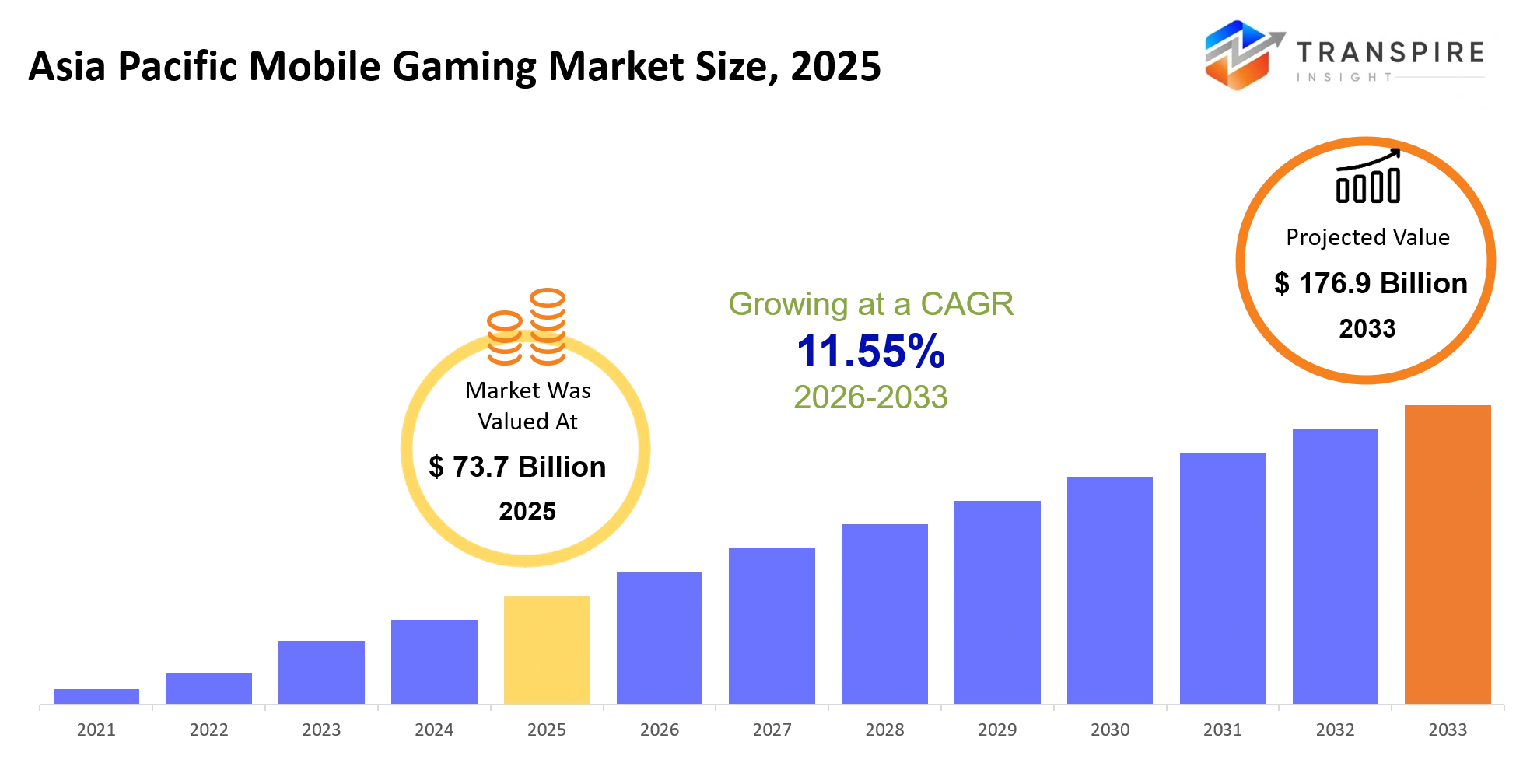
- Asia Pacific Mobile Gaming Market Size 2025: USD 73.7 Billion
- Asia Pacific Mobile Gaming Market Size 2033: USD 176.9 Billion
- Asia Pacific Mobile Gaming Market CAGR: 11.55%
- Asia Pacific Mobile Gaming Market Segments: By Game Type (Action Games, Strategy Games, Casual Games, Sports Games, Multiplayer Online Games, Others); By Revenue Model (Free-to-play, Subscription-based, In-game Purchases, Advertisements, Others); By Platform (Android Gaming, iOS Gaming, Cloud Mobile Gaming, Others); By End User (Teenagers, Adults, Professional Gamers, Others).
To learn more about this report,  Download Free Sample Report
Asia Pacific Mobile Gaming Market Summary
The Asia Pacific Mobile Gaming Market was valued at USD 73.7 Billion in 2025. It is forecast to reach USD 176.9 Billion by 2033. That is a CAGR of 11.55% over the period.
The Asia Pacific mobile gaming market kinda works like a primary digital pastime route, letting people jump into interactive games immediately via smartphones and tablets, without any real need for dedicated gaming gear. In real practice, it plays out as this big content distribution and monetization setup that stitches together game publishers, advertisers, payment providers, and hundreds of millions of users across very different income brackets.
Over the last 3 to 5 years, you can see more of a structural shift, like moving away from premium and casual downloads toward live-service, free-to-play games that count on in-app purchases, subscriptions and even ad income. Plus, the broader rollout of 5G networks, along with improved mobile processors, really widened the range of high-fidelity experiences people can actually run on handheld devices. And during the pandemic, those mobility restrictions… you know, in a kind of strange way, made people rely on mobile more often, and it also pushed up digital spending. So the whole installed base of active players ended up growing, which is kinda wild.
At the same time, developers are increasingly leaning on data analytics, localized content, and cross platform ecosystems just to extend the lifespan, and keep monetization protected. So revenue growth is starting to depend less on piling more players in, and more on how far user engagement actually goes.
Key Market Insights
- East Asia was kind of dominating the Asia Pacific Mobile Gaming Market, with around 55% market share in 2025, mainly led by China, Japan and South Korea.
- Meanwhile Southeast Asia is seeing the fastest growth trend through 2030, helped by affordable handsets and mobile internet penetration that keeps expanding, and more and more people getting connected.
- India is still driving plenty of industry growth, mostly because data costs are lower, and the gamer population is growing quickly, steadily, and honestly.
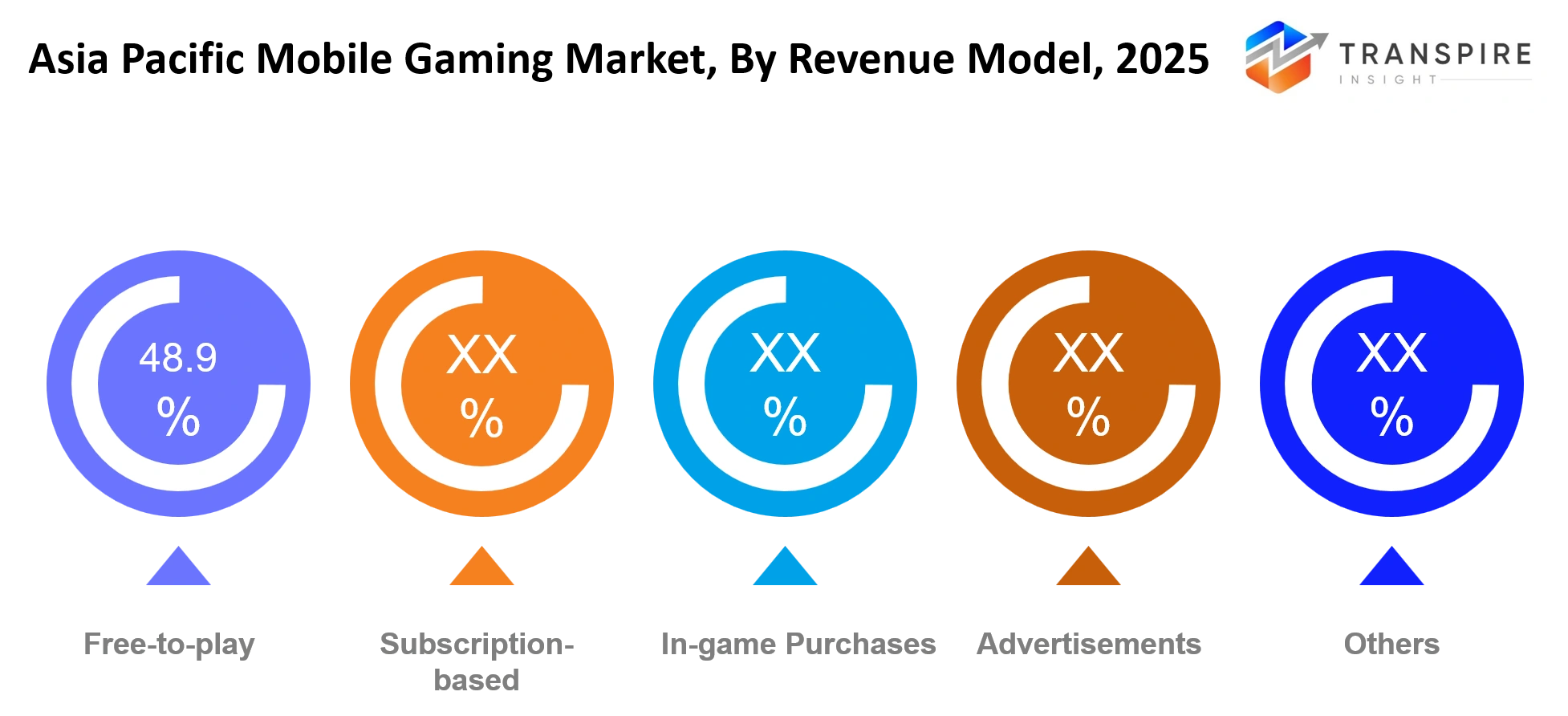
- In terms of model and revenue, free-to-play games took the lead with more than 65% market share in 2025, largely tied to in-app purchase monetization setups that work really well.
- Cloud-based mobile gaming is expected to be one of the fastest-growing segment during 2025–2030, and the 5G network expansion is acting as the backbone for that change.
- Also, multiplayer and live-service titles keep picking up speed too, mainly because of frequent content updates and community-driven engagement plans that tend to keep players around longer.
- From the revenue angle, entertainment-focused gaming made up more than 70% of the Asia Pacific Mobile Gaming Market in 2025, so yeah its a huge share overall.
- Esports-integrated mobile gaming is starting to look like the fastest-growing application segment across major regional markets too, not just one place.
- And social gaming experiences are pushing higher user retention rates through interactive features plus real-time competition, so players feel more involved.
What are the Key Drivers, Restraints, and Opportunities in the Asia Pacific Mobile Gaming Market?
The strongest force pushing growth in the Asia Pacific Mobile Gaming Market is basically a blend of affordable smartphones, faster mobile connectivity, and more advanced free to play monetization approaches. In the last ten years, cheaper handsets and the broader rollout of 4G and 5G have reduced the entry hurdles in big areas like China, India, Indonesia, and Vietnam. That tech change has helped publishers connect to hundreds of millions of players via app stores, while still pulling in repeat income from in app purchases, “battle passes”, and advertising placements. So over time, revenue growth often shifts toward deeper player involvement and spending, not just adding more people.
The most meaningful structural problem is the fragmented situation around regulation plus digital payments across the whole region. Authorities keep adding different rules touching gaming content, data privacy, online payments, and limits on youth gaming. For publishers, this means they have to reshape games, compliance processes, and monetization methods for each market, which drives up operational cost, and also stretches the time needed to launch. And since regulatory systems, as well as consumer payment habits, tend to move slowly, these issues can’t really be fixed overnight. What happens then is later market entry, weaker monetization performance, and missed income chances in a few high potential markets.
Cloud gaming is showing like a big chance for the next phase of market expansion. The investments in 5G infrastructure, edge computing, and cloud platforms are putting things in place for high quality gameplay experiences without needing expensive hardware. In particular, Southeast Asia looks really attractive, because network performance is getting better there, and digital spending is going up. That’s helping publishers to reach new audiences with premium mobile gaming content.
What Has the Impact of Artificial Intelligence Been on the Asia Pacific Mobile Gaming Market?
Artificial intelligence plus advanced digital technologies are really reshaping the Asia Pacific mobile gaming market, sort of like, everywhere at once, and mostly by making game creation faster, keeping players a lot more engaged, and lifting monetization results. Also, there is that feeling that everything is moving at the same time, just faster than before.More and more publishers are leaning into AI-powered automation, kinda to accelerate the whole workflow, and this ends up covering things like content moderation, customer service, fraud detection, and even live operations management.With automated systems in place, cheating patterns can be spotted, in-game economies can be watched, and events can be tweaked on the fly, so overall workloads shrink a bit while player retention tends to get better.
On another front, machine learning models are also boosting prediction abilities all across the mobile gaming ecosystem. Developers look at player habits, spending trends and session data, then they estimate churn risk and adjust user acquisition campaigns. After that, in-game offers can sort of get personalized a bit, in a way that tends to lift how often free-to-play players actually convert, like it is more tuned than before. These predictive systems also make it easier for publishers to zero in on higher value users with less waste, and the AI recommendation engines help keep engagement up too. They deliver content that feels more tailored, along with timely events and rewards, and it ends up feeling more relevant or kinda personal, depending on the player.
From an operational angle, these tools are backing higher retention rates, better ad efficiency, and stronger lifetime value figures. A lot of publishers claim they’re seeing clear improvements in campaign performance, mainly due to AI-based audience segmentation and dynamic pricing strategies that change as needed. Cloud gaming platforms, advanced analytics, and real-time data processing are in ways that allow studios to deliver more responsive gaming experiences across the region, which also helps the whole cycle keep staying smoother and quicker. Sometimes it feels like everything sort of clicks together, even when it’s a bit complex.
Yet, AI uptake still has some limits. When you try to weave in the newer AI infrastructure it takes serious spending, and many smaller developers just don’t have those big, large-scale datasets required for building reliable models. On top of that, data privacy rules across various Asia Pacific markets can get messy quickly, making it harder to roll everything out, and even harder to use data across borders, in other contexts.
Key Market Trends
- From 2020 to 2025, free-to-play monetization kind of blew up, like publishers were really pushing battle passes, subscriptions, and in-app purchases instead of just relying on premium downloads .
- After 2021, 5G deployment sped up, which helped unlock higher-quality multiplayer experiences, and it also nudged people toward mobile games that look more demanding across big markets.
- Cloud gaming went from small pilot deployments into proper commercial rollout, so the whole “need expensive hardware” problem eased, and more players could reach premium gaming content without much hassle.
- Since 2022, publishers have been putting more money into AI-driven personalization, boosting player retention by using customized rewards, events, and content recommendations.
- At the same time, regional expansion plans started leaning harder toward Southeast Asia, where Indonesia, Vietnam, and the Philippines showed up as priority growth markets.
- Mobile esports sort of moved past those smaller, kinda niche tournaments, and it turned into more mainstream entertainment. This whole shift pulled in larger sponsorship budgets, and it also reinforced user engagement systems, like the whole ecosystem thing.
- After 2021, regulatory attention got a lot stricter in several places, so developers had to tweak monetization approaches, tighten up data handling policies, and even add youth safeguards. Sometimes it was more about compliance than just product design, you know.
- When the big names Tencent, NetEase, Krafton, and Garena—pushed harder into localized publishing efforts, trying to get deeper market reach and make player acquisition more efficient, not just bigger.
- From 2022 through 2025 cross platform gaming really picked up momentum, because publishers started connecting mobile, PC, and console worlds together, basically stretching the player lifetime value longer, in a way that felt more consistent.
- Advertising technology got sharper too, with real-time analytics and machine learning improving campaign targeting, and making monetization across gaming platforms work better overall.
Asia Pacific Mobile Gaming Market Segmentation
By Game Type :
Action games tend to lean on reflex, brawl, motion, and yeah, getting the mission done. Strategy games kind of push you into planning, resource management, plus tactical calls that feel a bit more deliberate. Casual games offer brief and pretty easy sessions, so they can reach a wider crowd without too much friction. Sports games are basically built around athletic rivalry, meanwhile multiplayer online games bring folks together in shared real-time arenas. The “Others” label is like puzzle, simulation, role-playing, educational, and some niche stuff that doesn’t really match the main buckets.
Game type ends up shaping session duration, monetization approach, social interaction, and what the team thinks is most important to build. Action and multiplayer titles often need regular patches and competitive components, whereas casual games usually chase accessibility and retention. Strategy games can really shine with deeper progression loops, and sports titles rely on licensing too, plus seasonal drops and live events to keep players engaged.
By Revenue Model :
Free-to-play games let you jump in without an upfront fee and then make money from optional spending, kind of like, you can ignore it if you want. Subscription models charge a repeated cost to keep access, or to get premium perks that stay behind a paywall. For in-game purchases, you’ll typically see cosmetics, virtual goods, progression related items, plus battle passes. There are also ad-driven setups where income comes from banners, rewarded videos, and other ad formats that pop up at different times. The “Others” bucket, includes things like paid downloads, hybrid monetization, licensing deals,and promotional partnerships too, sort of.
Overall the way revenue works affects how people are brought in, how they stick around, and how they end up spending. Free-to-play releases often aim for a huge crowd and they watch engagement metrics very closely, while subscription services lean into steady income and better quality content, more or less. Ads tend to perform best when there’s heavy daily activity, and in-game purchases lean on strong progression loops, personalization, and community driven participation, yeah.
To learn more about this report, Download Free Sample Report
By Platform :
Android gaming is basically all those games that end up in Android app stores and maybe in partner ecosystems too. iOS gaming is more about games made for Apple devices, along with the whole Apple distribution environment. Then there is cloud mobile gaming, which is when the game is processed on distant servers, so the phone itself needs less brute performance. The “Others” bucket is like the leftover stuff, including alternative operating systems, web based play, and platform specific distribution lanes.
Choosing a platform really steers how far the games can go, how money comes in, what hardware is needed, and how well everything gets tuned technically. Android usually has wide coverage across different price levels, while iOS more often leans into premium device capabilities and spending efficiency. Cloud gaming can open the door to demanding titles on lower spec devices, yet it mostly rides on network quality, latency handling, and whether the backend infrastructure gets serious investment.
By End User :
Teenagers usually lean toward social hangouts, competitive play, creator culture, and things that feel affordable or easy to reach. Adults show up as a broader crowd with mixed tastes from simple fun to more intricate multiplayer modes, really depends on the person. Professional gamers, well they take part in esports events, tournaments, streaming, and other kinds of performance driven tasks. The “Others” bucket covers children, older adults, educational users, and niche communities that show very different ways of engaging, and yeah that matters.
How end users get grouped also nudges content design, safety rules, spending patterns, and the way communities are run. Teen focused products often need tighter supervision and parent controls, not just “some” moderation. Meanwhile adult audiences may accept a wider mix of genres, and transactions that are higher value. Professional gaming pushes expectations for low latency, plus spectator options, ranking systems, and safeguards aimed at keeping competition fair, not just hype.
What are the Key Use Cases Driving the Asia Pacific Mobile Gaming Market?
The main situation pushing people to adopt in the Asia Pacific mobile gaming market is kinda, well entertainment via free-to-play multiplayer and casual play moments. These games draw big user groups because there is instant access, steady content drops, and some social back-and-forth features. When players stay engaged at a strong level, that usually turns straight into better in-app purchase income and also more advertising revenue
A secondary direction is slowly broadening too, especially around mobile esports and creator-led gaming ecosystems. Pro gamers and other competitive players are now showing up more in tournaments, live streaming, and these community happenings. Meanwhile adult players are spending extra time in strategy and multiplayer titles, with a focus on teamwork, progression mechanics, and longer-term staying power.
Then there are the newer use cases like cloud-based mobile gaming and cross-platform experiences, linking smartphones to PCs and consoles. AI based personalization is also getting more attention, so publishers can share customized content, tailored rewards, and recommendations. This whole part is still early, but it is expected to improve how long players stick around and expand monetization chances across the forecast period.
|
Report Metrics |
Details |
|
Market size value in 2025 |
USD 73.7 Billion |
|
Market size value in 2026 |
USD 82.3 Billion |
|
Revenue forecast in 2033 |
USD 176.9 Billion |
|
Growth rate |
CAGR of 11.55% from 2026 to 2033 |
|
Base year |
2025 |
|
Historical data |
2021 - 2024 |
|
Forecast period |
2026 - 2033 |
|
Report coverage |
Revenue forecast, competitive landscape, growth factors, and trends |
|
Regional scope |
Asia Pacific (India, China, Japan, Australia,South Korea, Rest of Asia Pacific) |
|
Key company profiled |
Tencent, NetEase, Krafton, Garena, Activision Blizzard, Electronic Arts, Supercell, Riot Games, Nintendo, Ubisoft, Bandai Namco, Sony Interactive Entertainment, Epic Games, Sega, miHoYo. |
|
Customization scope |
Free report customization (country, regional & segment scope). Avail customized purchase options to meet your exact research needs. |
|
Report Segmentation |
By Game Type (Action Games, Strategy Games, Casual Games, Sports Games, Multiplayer Online Games, Others); By Revenue Model (Free-to-play, Subscription-based, In-game Purchases, Advertisements, Others); By Platform (Android Gaming, iOS Gaming, Cloud Mobile Gaming, Others); By End User (Teenagers, Adults, Professional Gamers, Others). |
Which Regions are Driving the Asia Pacific Mobile Gaming Market Growth?
East Asia still feels like the main driver in the Asia Pacific Mobile Gaming Market, mostly pushed by China, Japan, and South Korea. The whole region kind of has these strong digital foundations, with advanced infrastructure, broad 5G rollouts, and app store ecosystems that are already built for large-scale game distribution. Because players spend heavily on in-game purchases and the gaming culture is pretty established, the revenue numbers tend to beat most of the nearby markets. There is also this ongoing web of publishers, esports organizations, payment providers, and technology firms that keeps the leadership position pretty solid.
South Asia shows up as the second biggest contributor, but the way it grows isn’t like East Asia at all. Performance depends more on mass reach, user acquisition, and constant discovery, rather than on very high average spending per player. India holds the region together through lower-cost mobile data, a huge smartphone base, and continued investment from both domestic and international publishers. At the same time, steadier digital payments plus better mobile connectivity make it easier to build a reliable base for long-term income.
Southeast Asia, though, is the fastest-moving region and it has picked up serious momentum. This is tied to quick smartphone adoption and the internet coverage expanding bit by bit. Places like Indonesia, Vietnam, and the Philippines have pulled in more publisher focus, helped by improved digital infrastructure, and by rising consumer spending on entertainment. Localized content, mobile esports and creator-led gaming communities have also sped up how engaged players stay over the past few years. Looking at 2026 through 2033, this trend is expected to open interesting doors for new entrants who want fresh audiences, and for investors who are watching high-potential gaming ecosystems.
Who are the Key Players in the Asia Pacific Mobile Gaming Market and How Do They Compete?
The Asia Pacific Mobile Gaming Market looks like it has a moderately concentrated competitive setup, where a small group of big publishers grabs a lot of the revenue, and meanwhile regional studios push in on certain genres, and also on local audiences. Most of the rivalry seems to be about content quality, player retention, live-service know-how, and monetization efficiency, not just pricing. Bigger publishers keep trying to guard their position by leaning on hefty development budgets, strong intellectual property collections, and wide distribution channels. Yet at the same time, newer studios are kind of shaking things up in parts of the market using locally fitted narratives and more inventive gameplay styles.
Tencent goes for ecosystem led momentum by blending game publishing with social platforms, esports resources, and payment services. That combined model gives them real user acquisition lift and retention benefits that competitors find hard to replicate, even with significant effort. NetEase, on the other hand, differentiates through franchise building from within, plus pretty advanced multiplayer infrastructure. This helps them keep players engaged via frequent content drops, and also long running live operations. Both firms keep stretching their reach through strategic publishing collaborations, and by investing in outside development studios across Asia.
Krafton kind of emphasizes competitive multiplayer stuff, and honestly it benefits a lot from being well recognized in battle royale gaming. Meanwhile, the company is expanding, through regional publishing programs, plus it keeps investing in newer emerging studios, which gives it more room to move. Garena leans on deep market awareness in Southeast Asia. In that space, localized content, community involvement, and esports integration all seem to reinforce player loyalty pretty strongly. miHoYo is a different case entirely, it stands apart with high production value games and a cross platform ecosystem. Also, the narrative led approach in the content helps pull in global audiences. Overall, continued investment in original intellectual property and international expansion is what keeps these companies in a long term competitive position.
Company List
- Tencent
- NetEase
- Krafton
- Garena
- Activision Blizzard
- Electronic Arts
- Supercell
- Riot Games
- Nintendo
- Ubisoft
- Bandai Namco
- Sony Interactive Entertainment
- Epic Games
- Sega
- miHoYo
Recent Development News
In April 2026, LightFury Games secured funding of USD 11 million. The investment round, backed by institutional investors and leading Indian cricketers, will support the development and late-2026 launch of its mobile title eCricket, strengthening India’s position as a growing hub for mobile game development in the Asia Pacific region.
Source: https://respawn.outlookindia.com/
In February 2026, Century Entertainment International Holdings entered a strategic operating partnership with World Platinum Technologies (WPT). The agreement gives Century access to WPT’s platform, technology, and regulatory infrastructure to develop and monetize up to ten mobile gaming applications across Asia Pacific markets, accelerating regional mobile gaming expansion through a joint-venture model.
Source: https://agbrief.com/
What Strategic Insights Define the Future of the Asia Pacific Mobile Gaming Market?
The Asia Pacific Mobile Gaming Market is slowly moving toward a more engagement-focused, ecosystem driven model over the next five to seven years. In the future, growth is gonna rely less on bringing in first time players and more on lifting lifetime value via personalized experiences, cross platform connectivity, cloud gaming, and AI-powered content delivery. With digital infrastructure getting better across emerging economies, publishers will probably compete on retention, community building, and service quality more than on straightforward user acquisition
There is also a less visible risk, it kinda sits in market concentration and platform dependence. A big chunk of the revenue is effectively steered by a small group of publishers, app stores, and digital distribution channels. If platform rules change, or content regulations shift, or even revenue splitting models get revised, developers could feel the impact more strongly, and monetization flexibility might shrink across multiple markets at once
An emerging opportunity is the rollout of cloud-native gaming ecosystems in Southeast Asia, where improving 5G reach and growing edge computing infrastructure are lowering hardware barriers. Market participants should aim for localized live service plays, plus they should invest in data analytics, since regional content fit and player stickiness will matter a lot for long-term competitive results
Asia Pacific Mobile Gaming Market Report Segmentation
By Game Type
- Action Games
- Strategy Games
- Casual Games
- Sports Games
- Multiplayer Online Games
By Revenue Model
- Free-to-play
- Subscription-based
- In-game Purchases
- Advertisements
By Platform
- Android Gaming
- iOS Gaming
- Cloud Mobile Gaming
By End User
- Teenagers
- Adults
- Professional Gamers
Frequently Asked Questions
Find quick answers to common questions.
The expected Asia Pacific Mobile Gaming Market size is USD 176.9 Billion in 2033.
Key segments for the Asia Pacific Mobile Gaming Market are By Game Type (Action Games, Strategy Games, Casual Games, Sports Games, Multiplayer Online Games, Others); By Revenue Model (Free-to-play, Subscription-based, In-game Purchases, Advertisements, Others); By Platform (Android Gaming, iOS Gaming, Cloud Mobile Gaming, Others); By End User (Teenagers, Adults, Professional Gamers, Others).
Major Asia Pacific Mobile Gaming Market players are Tencent, NetEase, Krafton, Garena, Activision Blizzard, Electronic Arts, Supercell, Riot Games, Nintendo, Ubisoft, Bandai Namco, Sony Interactive Entertainment, Epic Games, Sega, miHoYo.
The Asia Pacific Mobile Gaming Market size is USD 73.7 Billion in 2025.
The Asia Pacific Mobile Gaming Market CAGR is 11.55% from 2026 to 2033.
- Tencent
- NetEase
- Krafton
- Garena
- Activision Blizzard
- Electronic Arts
- Supercell
- Riot Games
- Nintendo
- Ubisoft
- Bandai Namco
- Sony Interactive Entertainment
- Epic Games
- Sega
- miHoYo
About the Authors

Chetan Dhatrak
I’m Chetan Dhatrak, a Senior Research Analyst at Transpire Insight, specializing in the Consumer Goods, Foods and Beverages industry. I focus on analyzing market trends, consumer behavior, competitive landscapes, and industry developments to deliver accurate, data-driven insights. My research at Transpire Insight is built on credible sources and in-depth analysis, helping businesses and readers better understand market dynamics, emerging opportunities, and evolving consumer preferences. I’m committed to creating reliable, well-researched content that supports informed decision-making and reflects the latest developments in the consumer goods and food & beverage sectors.

Chakradhar Khansole
Chakradhar serves as the Research Director at Transpire Insight, bringing over 8 years of experience in technology, innovation, and strategic market intelligence. He specializes in transforming complex market data into actionable business insights that enable organizations to make informed, growth-oriented decisions. Recognized for his strategic vision and analytical expertise, Chakradhar leads high-impact research initiatives, delivering comprehensive market assessments, competitive intelligence, and forward-looking industry analysis.
Recently Published Reports
-
Apr 2026
Bottled Water Market
Bottled Water Market Size, Share & Analysis Report By Product Type (Still Bottled Water, Carbonated Bottled Water, Functional Bottled Water, and Others), By Packaging (PET, Cans, and Others), By Sales Channel (Supermarkets/Hypermarkets, Convenience Stores/Drug Stores, Grocery Stores/Club Stores, Foodservice, and Others) and Geography (North America, Europe, Asia-Pacific, Middle East and Africa, South and Central America), 2021 - 2032
-
Apr 2026
Color Cosmetic Packaging Market
Color Cosmetic Packaging Market Size, Share & Analysis Report By Application (Mascara Packaging, Liquid Packaging, and Liquid Face), By Type (Tubes & Bottles, Pens & Markers, Compacts & Containers, and Droppers & Pumps), and Geography (North America, Europe, Asia-Pacific, Middle East and Africa, South and Central America), 2021 - 2031
-
Apr 2026
External Microphone For Camera Market
External Microphone For Camera Market Size, Share & Analysis Report By Type (Shotgun Microphone, Lavalier Microphone, and Others), By Application (Digital Camera, Professional Video Camera, and Others), and Geography (North America, Europe, Asia-Pacific, Middle East and Africa, South and Central America), 2021 - 2031
-
Apr 2026
Foot Orthotic Insoles Market
Foot Orthotic Insoles Market Size, Share & Analysis Report By Type (Pre-fabricated, and Custom-made), By Material (Thermoplastic, Composite Carbon Fiber, and Others), By Distribution Channel (Drug Stores, Hospitals & Clinics, and Others), and Geography (North America, Europe, Asia-Pacific, Middle East and Africa, South and Central America), 2021 - 2031