
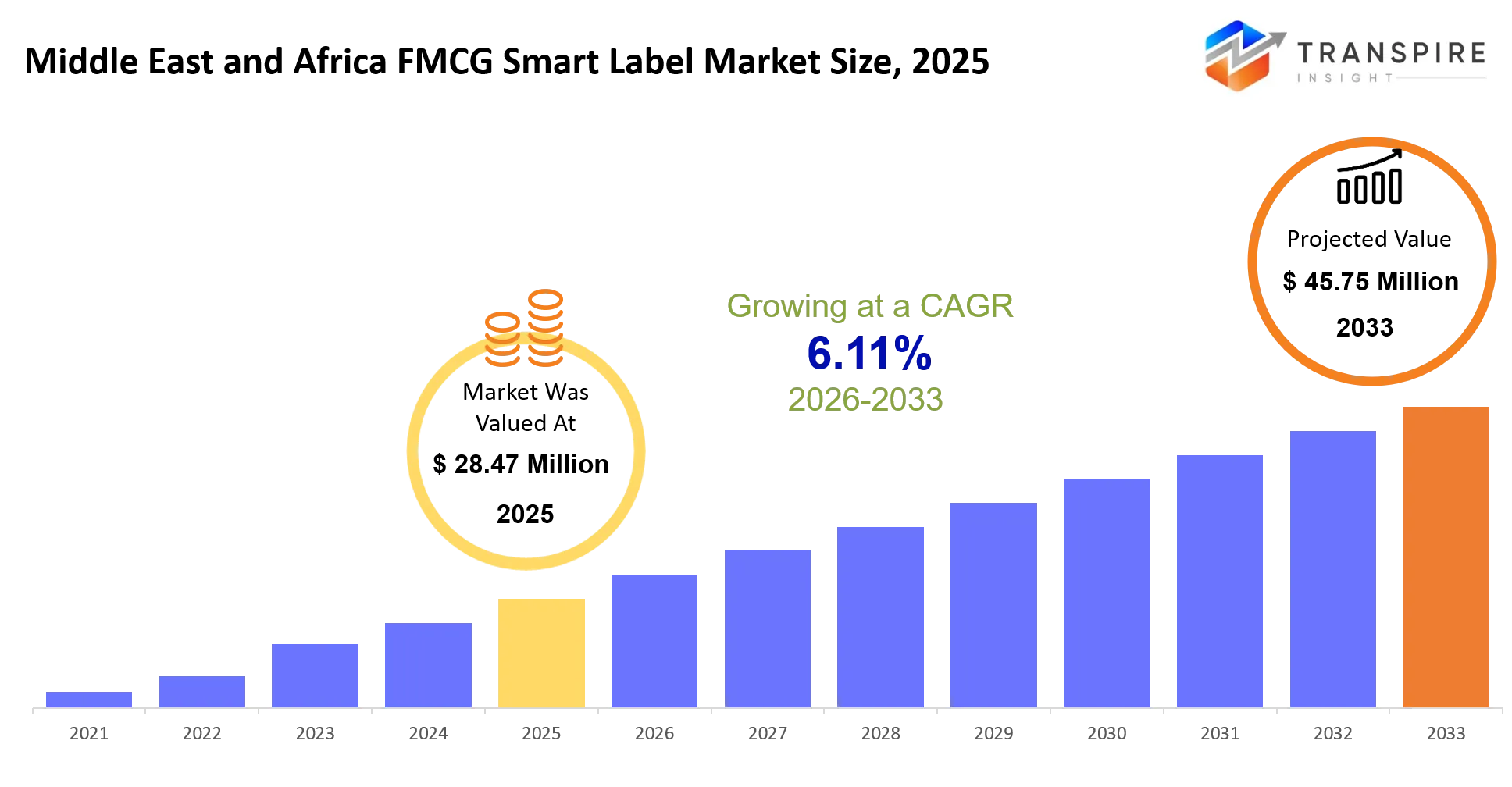
Middle East and Africa FMCG Smart Label Market Size & Forecast:
- Middle East and Africa FMCG Smart Label Market Size 2025: USD 28.47 Million
- Middle East and Africa FMCG Smart Label Market Size 2033: USD 45.75 Million
- Middle East and Africa FMCG Smart Label Market CAGR: 6.11%
- Middle East and Africa FMCG Smart Label Market Segments: By Label Type (RFID Labels, NFC Labels, QR Code Labels, EAS Labels, Others); By Application (Food & Beverages, Personal Care, Household Products, Pharmaceuticals, Others); By Technology (Printed Electronics, RFID, NFC, Others); By End User (FMCG Manufacturers, Retailers, Logistics Providers, Others)
To learn more about this report,  Download Free Sample Report
Middle East and Africa FMCG Smart Label Market Summary
The Middle East and Africa FMCG Smart Label Market was valued at USD 28.47 Million in 2025. It is forecast to reach USD 45.75 Million by 2033. That is a CAGR of 6.11% over the period.
The Middle East and Africa FMCG Smart Label Market ends up playing a practical role, in the sense that brands, retailers and logistics people can actually track products in a more orderly way, verify authenticity, lower shrinkage, and get better inventory visibility across those complicated supply chains. Smart labels, by using things like RFID, NFC, QR codes, plus a few electronic monitoring technologies, make it possible to identify items in real time. Then businesses can keep an eye on how stock is moving, and also give consumers digital product information without the usual friction.
In the last five years, the whole market vibe has moved away from plain barcode identification, and more toward connected labeling platforms that bundle together inventory management, traceability, and consumer engagement, in one routine. One big reason for this shift was the supply chain disruption during and after the pandemic, it showed serious weak spots in inventory visibility and product traceability. Retailers and FMCG manufacturers then pushed harder on RFID and NFC enabled labeling systems. And as organized retail networks grow across Gulf countries, plus across African urban centers, smart labels support fewer stock mistakes, better replenishment efficiency, and they strengthen anti-counterfeiting actions too. All those operational gains end up mattering for revenue capture, reduced losses, and faster rollouts across FMCG distribution routes.
Key Market Insights
- In 2025, GCC countries sort of dominated regional revenue with around 42% market share, and this was likely propped up by more advanced retail infrastructure plus digital commerce growth and stuff.
- Sub-Saharan Africa should show the fastest expansion through 2033, mostly because retail is getting modernized, and supply chain digitization investments are moving forward, faster than before .
- By 2025, RFID labels grabbed nearly 38% market share, so they basically stayed as the top label type thanks to better inventory visibility features and the like.
- NFC labels were also clearly the second-largest segment, benefiting from smartphone penetration and consumer authentication use cases.
- QR code labels are projected to be the fastest-growing label category between 2026 and 2033, helped by their low setup costs, and easier adoption in many areas.
- Food and beverages made up more than 34% of total market demand in 2025, which ties back to traceability needs across packaged goods .
- FMCG manufacturers generated roughly 46% of market revenue in 2025, largely because serialization programs and supply chain efficiency initiatives kept rolling.
- Retailers keep pushing ahead with RFID-enabled inventory systems, and in some deployments they’ve reported stock accuracy gains above 90% .
- Firms such as Avery Dennison, CCL Industries, Zebra Technologies, Honeywell, and Impinj are putting money into connected labeling ecosystems, basically to keep their edge.
- Overall, strategic partnerships, RFID innovation, cloud based analytics, and expanded regional manufacturing are reinforcing competitive positioning across the smart packaging landscape.
What are the Key Drivers, Restraints, and Opportunities in the Middle East and Africa FMCG Smart Label Market?
The strongest growth driver is the rapid adoption of RFID enabled inventory management across retail and FMCG supply chains. Big retailers and manufacturers are increasingly asking for real time visibility into stock movement, in order to cut down on out of stock incidents and also to better replenishment efficiency. The movement toward omnichannel retailing has basically pushed the need for reliable inventory data across stores, warehouses, and distribution centers. Smart labels help with automated product identification and inventory tracing, trimming labor spend while boosting stock accuracy . These measurable operational wins make it easier for firms to roll things out more broadly, which then generates ongoing demand for label hardware, software, and those integration services too.
The most important barrier still feels like the hefty upfront investment for infrastructure deployment. RFID readers, software integration, data management platforms, and process redesign all require serious capital spend. A lot of regional manufacturers and retailers run on tight margins, so they keep leaning on conventional barcode systems. This limitation is kind of structural, because to do it properly you need participation across the whole ecosystem, meaning suppliers, distributors, and retailers all involved. Because of that, adoption timelines end up stretching, slower than people expect, and this can cap revenue expansion in markets that are very cost sensitive.
A big opportunity sits in the convergence of smart packaging and consumer engagement technologies. NFC based labels can deliver product authentication, promotional materials, loyalty programs, and sustainability information via smartphone interaction. Investments are rising in digital commerce across Gulf countries, so the environment is getting more favorable for connected packaging solutions, especially ones tied to engagement.
What Has the Impact of Artificial Intelligence Been on the Middle East and Africa FMCG Smart Label Market?
Artificial intelligence is changing smart labeling systems, like from mere identification devices into something more like an intelligent supply chain management stage, kind of. AI-powered analytics can take the data gathered through RFID, NFC, and those connected label networks and then use it to automate inventory watching, replenishment planning, and even day-to-day warehouse tasks. Retailers, for example, lean on machine learning models to read product movement routines, catch stock oddities early, and lower inventory losses across the distribution web.
The predictive side is becoming more and more useful. Machine learning algorithms review past sales information, inventory turnover rates, seasonal signals, and logistics execution metrics to estimate future stock needs with better precision. With those views, manufacturers and retailers can fine-tune inventory distribution, which reduces surplus inventory while also keeping product shortages to a minimum, more or less.
On the operational front, companies often see audits happen quicker, warehouse productivity rise, less manual scanning work, and broader supply chain visibility. At the same time, AI-enabled analytics can also support anti-counterfeiting measures by spotting strange movement behavior and authentication mismatches, before they spread too far.
Still, despite all that, adoption is not fully smooth because integration costs remain high and data quality can be messy. A lot of regional supply chains run on fragmented information systems, so the performance of advanced analytics gets capped. Also, when high-grade historical tracking data is scarce, predictive accuracy drops in some markets, which ends up slowing down big-scale AI rollout across the smart labeling ecosystem.
Key Market Trends
- RFID deployment kind of ramped up a lot between 2021 and 2025, as retailers started valuing inventory accuracy more than the old, manual stock counting habits.
- After 2023, NFC-enabled packaging adoption really took off, letting consumers engage straight from smartphones, plus digital product verification became a normal thing.
- In the Gulf region, retailers pushed RFID investments up by more than 20% during the latest modernization push across organized retail channels.
- Anti-counterfeiting efforts gained real momentum between 2024 and 2026, especially in premium personal care and pharmaceutical categories.
- Avery Dennison rolled out new RFID food retail solutions in 2026, which strengthened inventory visibility across fresh supply chain flows.
- Flexible NFC technologies also appeared in 2026, and they helped reduce the whole implementation hassle, while opening the door for more smart packaging use cases.
- Sustainability requirements have nudged manufacturers toward recyclable RFID labeling solutions in the past two years, which feels pretty important.
- Retailers have increasingly paired smart labels with cloud analytics platforms, to back predictive inventory management choices.
- Logistics providers expanded item-level tracking as well, so shipment visibility improved across regional distribution networks.
- And strategic collaborations between label manufacturers and technology providers pushed commercialization of connected packaging innovations, fairly quickly.
Middle East and Africa FMCG Smart Label Market Segmentation
By Label Type
RFID labels still hold a strong standing, because inventory visibility and supply chain tracing have turned into something really necessary across FMCG operations. There is also this item-level marking, automated shelf counting, and warehouse management capabilities that help adoption happen with manufacturers, retailers, and logistics providers. Big retail chains often stick with RFID labels to get better stock accuracy and cut down on product losses during distribution, more or less.
Meanwhile NFC labels keep growing through consumer interaction apps that link real products with digital context . QR code labels are still very common, since the cost to deploy stays pretty low, yet they still share product details and promotional messaging. EAS labels back loss-prevention initiatives across retail spaces, and other smart label types handle narrower needs like sensing, verification, and specialized tracking functions in specific workflows.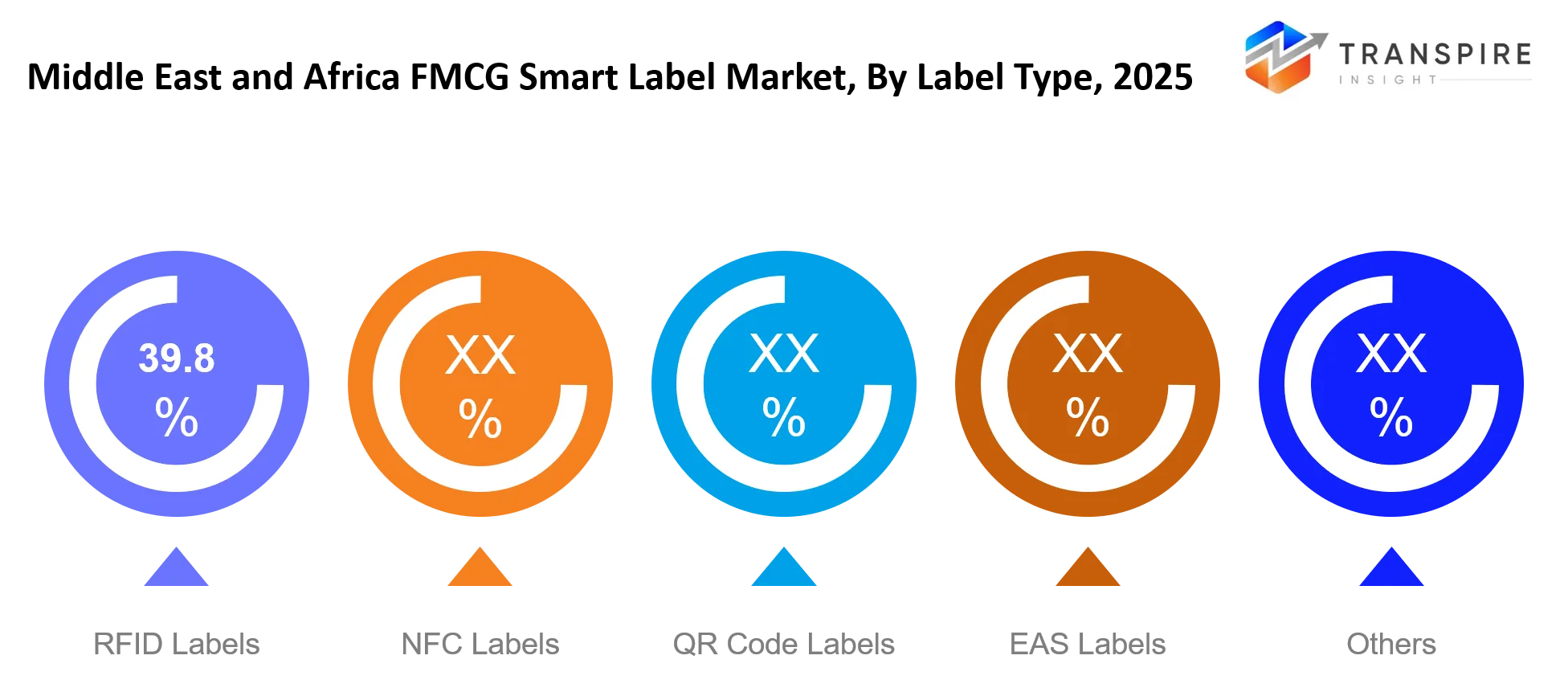
To learn more about this report, Download Free Sample Report
By Application
Food and beverage use cases make up a huge chunk of adoption, mostly because freshness monitoring, stock control and product traceability are still top operational concerns. Smart labels do help with better shelf presence and, in practice, they speed up replenishment across supermarkets and small convenience stores. Also, having product movement visibility is useful for cutting down waste and tuning stock levels.
Personal care items are starting to bring in smart labels for authentication plus customer engagement. Household goods, meanwhile, tend to benefit from stronger inventory oversight through wider retail channels. In pharmaceuticals, advanced labeling matters for product verification and traceability, while other fields adopt smart labeling approaches for niche packaging and delivery needs.
By Technology
RFID tech is the biggest chunk of the tech market because it basically allows automated recognition and almost real time inventory tracking across huge quantities of products. In distribution centers as well as retail venues they rely on RFID infrastructure to boost operational efficiency, and to gain better supply chain visibility. Ongoing advancements in this technology keeps it on track for wider rollout, covering more FMCG product categories.
NFC technology leans toward people facing uses like verification, marketing involvement and access to product details using smartphones. Printed electronics open up a real chance for bendy, very light smart label designs. Then there are other options that handle specialized needs, such as sensing, environmental observation and more advanced product traceability features.
By End User
FMCG manufacturers account for a sizable chunk of the implementation work, mostly because product traceability, inventory command, and brand defense are still strategic priorities. Smart labels help with production watchfulness and supply chain visibility, from manufacturing sites through distribution routes and yeah, all along. Operational efficiency gains also make it easier for adoption across packaged goods, in a broader sense.
Retailers, in turn, lean on intelligent labeling systems to make inventory numbers more exact, to cut down on stock mismatches, and to improve the overall customer journey. Logistics providers then deploy smart labels so shipment movement can be watched more precisely, and so warehouse management performance gets a nudge upward. Some other end users roll out these solutions for asset stewardship, authentication, and those more specialized operational needs where details really matter.
What are the Key Use Cases Driving the Middle East and Africa FMCG Smart Label Market?
The biggest use case is really about inventory visibility and product tracking across food and beverage supply chains; smart labels let retailers and manufacturers keep an eye on where products go in real time. That means better stock accuracy, less shrinkage, and quicker replenishment decisions, so operationally it becomes kind of the main driver. These benefits end up pulling the strongest demand across organized retail networks.
More extra things are popping up too, especially in personal care and pharmaceutical spaces. Product authentication is used to fight counterfeit products, while connected packaging solutions support digital consumer engagement. Retailers are increasingly leaning on NFC and QR-enabled packaging, to share product details, promo material and even fold in loyalty program integration, all in one.
Also, newer use cases are showing up around sustainability reporting and digital product passport efforts. Smart labels are starting to help with packaging lifecycle tracking, recycling verification, and environmental reporting obligations. Right now it’s still pretty early but these ideas are expected to build momentum as traceability standards get more and more sophisticated .
|
Report Metrics |
Details |
|
Market size value in 2025 |
USD 28.47 Million |
|
Market size value in 2026 |
USD 30.21 Million |
|
Revenue forecast in 2033 |
USD 45.75 Million |
|
Growth rate |
CAGR of 6.11% from 2026 to 2033 |
|
Base year |
2025 |
|
Historical data |
2021 - 2024 |
|
Forecast period |
2026 - 2033 |
|
Report coverage |
Revenue forecast, competitive landscape, growth factors, and trends |
|
Regional scope |
Middle East and Africa (Saudi Arabia, United Arab Emirates, South Africa, Rest of Middle East and Africa) |
|
Key company profiled |
Avery Dennison, CCL Industries, Zebra Technologies, SATO, Checkpoint Systems, Alien Technology, Smartrac, Identiv, Honeywell, Brady, Thinfilm, Impinj, HID Global, UPM Raflatac, GAO RFID |
|
Customization scope |
Free report customization (country, regional & segment scope). Avail customized purchase options to meet your exact research needs. |
|
Report Segmentation |
By Label Type (RFID Labels, NFC Labels, QR Code Labels, EAS Labels, Others); By Application (Food & Beverages, Personal Care, Household Products, Pharmaceuticals, Others); By Technology (Printed Electronics, RFID, NFC, Others); By End User (FMCG Manufacturers, Retailers, Logistics Providers, Others) |
Which Regions are Driving the Middle East and Africa FMCG Smart Label Market Growth?
In the Gulf Cooperation Council area, market revenue keeps coming out on top, mostly because retail infrastructure is already quite mature, the digital transformation programs are moving fast, and there’s also a lot of money going into supply chain modernization. Saudi Arabia and the United Arab Emirates in particular keep pushing ahead with organized retail networks, and warehouse automation projects too. High technology adoption rates help make it easier to roll out RFID and NFC labeling solutions. Then, logistics connectivity is a further boost that keeps the region in a strong leadership position.
South Africa is still the second biggest contributor but the story there is a bit more gradual, it leans toward retail stability, plus well-established distribution networks. Big supermarket chains continue putting resources into inventory optimization and loss prevention technologies. Overall modernization efforts stay steady, which helps long term adoption across several FMCG categories. For most major retail groups, supply chain efficiency stays near the top of the investment list.
Growth is expected to move the quickest across newer African markets like Kenya, Nigeria, and Egypt. In these places, recent spending on retail infrastructure, e-commerce expansion, and logistics modernization has opened up room for intelligent labeling technologies. Growth in digital commerce also nudges businesses to tighten product visibility and improve inventory control. Companies that enter these markets during 2026–2033 might find a bit lower penetration already exists and, at the same time, modernization programs are still ramping up.
Who are the Key Players in the Middle East and Africa FMCG Smart Label Market and How Do They Compete?
Competition still looks a bit moderately fragmented, with global labeling players, RFID firms, and enterprise technology providers all going at it across tech performance, integration ability, and that regional service coverage angle. In the last while, technology innovation has basically become the main way to stand out, because customers now want an integrated platform, not just a standalone label sitting there alone. In practice, competitive momentum comes down to blending hardware plus software, analytics, and supply chain know-how together, rather than focusing on one piece.
Avery Dennison is putting a strong emphasis on intelligent labeling innovation, building out RFID infrastructure, and pushing connected packaging technologies. More recently, their spending is leaning into flexible NFC solutions and also advanced RFID use cases, which is meant to tighten differentiation for inventory visibility and even consumer engagement. CCL Industries, on the other hand, keeps expanding through acquisitions, and by leveraging specialty packaging expertise, which also helps them broaden product offerings while extending geographic reach.
Impinj tends to differentiate via RAIN RFID semiconductor technology and the reader ecosystem development. They keep moving forward on Gen2X capabilities, and that helps improve item-level tracking performance across retail and logistics environments. Zebra Technologies leans hard on enterprise mobility and data capture integration, so they can support end to end visibility across retail operations. Honeywell mixes automation technologies with identification solutions, with the goal of backing warehouse optimization and logistics efficiency. Overall, these companies continue to grow using partnerships, tech upgrades, and regional market development initiatives, though the emphasis can shift depending on the company.
Company List
- Avery Dennison
- CCL Industries
- Zebra Technologies
- SATO
- Checkpoint Systems
- Alien Technology
- Smartrac
- Identiv
- Honeywell
- Brady
- Thinfilm
- Impinj
- HID Global
- UPM Raflatac
- GAO RFID
Recent Development News
"In April 2026, Avery Dennison announced a strategic investment of USD 75 million in Wiliot. The investment strengthens physical AI and connected supply chain capabilities that support next-generation smart label ecosystems.https://rfid.averydennison.com
"In March 2026, CCL Industries announced the acquisition of Sleever International. The transaction expands specialty labeling and smart packaging capabilities across consumer goods and healthcare markets.https://ccllabel.com
What Strategic Insights Define the Future of the Middle East and Africa FMCG Smart Label Market?
The market seems like it is moving, toward a connected packaging ecosystem where labels act more like little data capture points than just plain identification tools. What’s pushing that shift is sort of the coming together of inventory visibility, consumer interaction, product authentication, and analytics into one shared digital setup. More and more businesses are starting to treat smart labels as operational assets, not as just another packaging item sitting on the shelf.
There’s also a less obvious risk, and it’s kinda about technology concentration inside the RFID semiconductor and infrastructure world. If companies lean too hard on a small group of chip suppliers and a handful of technology providers then supply might get tight, and pricing could swing a lot when adoption accelerates too quickly.
On the flip side, there’s a real opportunity in NFC-enabled digital product passports and traceability platforms. The regulatory talk lately, on product transparency, sustainability reporting, and authentication is basically setting the stage for wider rollout across different consumer goods categories.
Market participants should focus on interoperable platforms that bring RFID, NFC, analytics, and cloud-based visibility tools into one framework. The groups that build scalable data ecosystems rather than doing isolated labeling initiatives should end up in a stronger spot to grab the long-term value as intelligent packaging becomes, more or less a core part of FMCG supply chain strategy.
Middle East and Africa FMCG Smart Label Market Report Segmentation
By Label Type
- RFID Labels
- NFC Labels
- QR Code Labels
- EAS Labels
- Others
By Application
- Food & Beverages
- Personal Care
- Household Products
- Pharmaceuticals
- Others
By Technology
- Printed Electronics
- RFID
- NFC
- Others
By End User
- FMCG Manufacturers
- Retailers
- Logistics Providers
- Others
Frequently Asked Questions
Find quick answers to common questions.
The Expected Middle East and Africa FMCG Smart Label Market size for the Market will be USD 45.75 Million in 2033.
Key Segments for the Middle East and Africa FMCG Smart Label Market are By Label Type (RFID Labels, NFC Labels, QR Code Labels, EAS Labels, Others); By Application (Food & Beverages, Personal Care, Household Products, Pharmaceuticals, Others); By Technology (Printed Electronics, RFID, NFC, Others); By End User (FMCG Manufacturers, Retailers, Logistics Providers, Others).
Major Middle East and Africa FMCG Smart Label Market Players are Avery Dennison, CCL Industries, Zebra Technologies, SATO, Checkpoint Systems, Alien Technology, Smartrac, Identiv, Honeywell, Brady, Thinfilm, Impinj, HID Global, UPM Raflatac, GAO RFID.
The Current Middle East and Africa FMCG Smart Label Market size is USD 28.47 Million in 2025.
The Middle East and Africa FMCG Smart Label Market CAGR is 6.11% from 2026 to 2033.
- Avery Dennison
- CCL Industries
- Zebra Technologies
- SATO
- Checkpoint Systems
- Alien Technology
- Smartrac
- Identiv
- Honeywell
- Brady
- Thinfilm
- Impinj
- HID Global
- UPM Raflatac
- GAO RFID
About the Authors

Avinash Kumar
I’m Avinash Kumar, a Senior Research Analyst at Transpire Insight, with expertise in the Electronics and Semiconductor and Energy & Power industry. My work focuses on analyzing emerging technologies, market trends, industry developments, and innovation across these sectors. I specialize in transforming complex technical and market insights into clear, research-backed content that helps professionals, businesses, and decision-makers stay informed. Through continuous industry research and data-driven analysis, I strive to deliver accurate, reliable, and practical perspectives on the latest advancements shaping the semiconductor and energy landscape.

Chakradhar Khansole
Chakradhar serves as the Research Director at Transpire Insight, bringing over 8 years of experience in technology, innovation, and strategic market intelligence. He specializes in transforming complex market data into actionable business insights that enable organizations to make informed, growth-oriented decisions. Recognized for his strategic vision and analytical expertise, Chakradhar leads high-impact research initiatives, delivering comprehensive market assessments, competitive intelligence, and forward-looking industry analysis.
Recently Published Reports
-
Apr 2026
Fiber Optic Faceplates Market
Fiber Optic Faceplates Market Size, Share & Analysis Report By Type (< 300 mm2, 300-350 mm2, and > 350 mm2, By Application (Night Vision, Holographic Imaging, Medical, and Others), and Geography (North America, Europe, Asia-Pacific, Middle East and Africa, South and Central America), 2021 - 2031
-
Apr 2026
High Temperature Superconductors Market
High Temperature Superconductors Market Size, Share & Analysis Report By Type (1G HTS, and 2G HTS), By Application (Power Cable, Fault Current Limiter, and Transformer), and Geography (North America, Europe, Asia-Pacific, Middle East and Africa, South and Central America), 2021 - 2031
-
Apr 2026
Industrial Plugs and Socket Market
Industrial Plugs and Socket Market Size, Share & Analysis Report By Type (Industrial Plugs, Industrial Sockets), By Current (Up to 32 A, 32 to 125 A, Above 125 A), By Protection (Dustproof and Splash Proof, Waterproof, Explosion Proof), By End User (Heavy Industries, Oil and Gas, Chemicals and Pharmaceuticals, Power Generation, Others), and Geography (North America, Europe, Asia-Pacific, Middle East and Africa, South and Central America), 2021 - 2031
-
Apr 2026
InGaAs Avalanche Photodiodes Market
InGaAs Avalanche Photodiodes Market Size, Share & Analysis Report By Type (1100 - 1700 nm, and 1000 - 1600 nm), By Application (Missile Warning System, Muzzle Flash Detection, Wafer Defect Inspection, Laser Rangefinders, and Others), and Geography (North America, Europe, Asia-Pacific, Middle East and Africa, South and Central America), 2021 - 2031