

United States Retail Media Networks Market Size & Forecast:
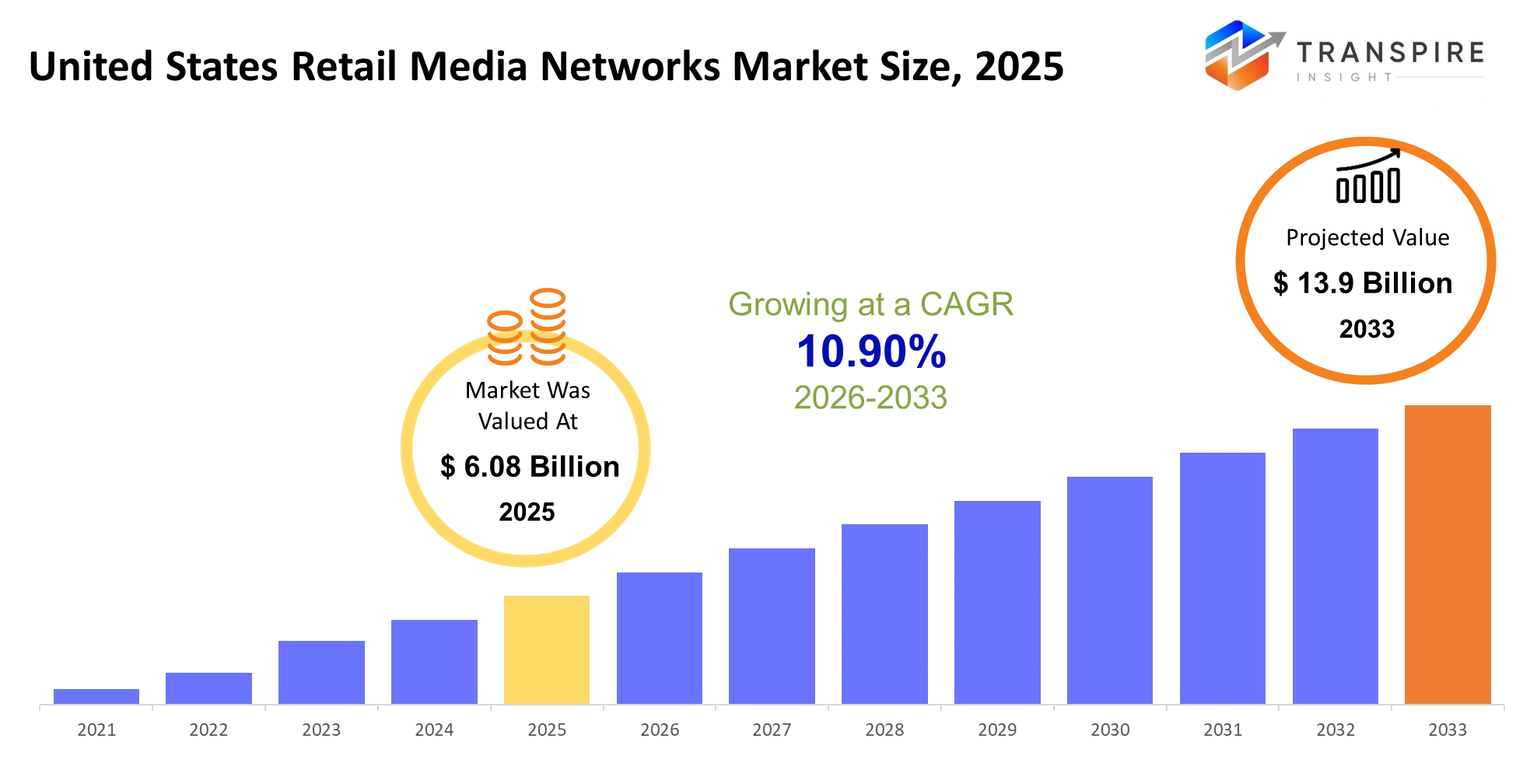
- United States Retail Media Networks Market Size 2025: USD 6.08 Billion
- United States Retail Media Networks Market Size 2033: USD 13.9 Billion
- United States Retail Media Networks Market CAGR: 10.90%
- United States Retail Media Networks Market Segments: By Platform (E-commerce Platforms, Mobile Apps, In-store Media, Digital Signage, Social Commerce, Marketplace Platforms, Others); By Advertisement Type (Display Ads, Sponsored Products, Video Ads, Search Ads, Native Advertising, Programmatic Ads, Others); By End User (Retailers, Consumer Brands, FMCG Companies, E-commerce Companies, Advertising Agencies, Others); By Deployment (Cloud-based, On-premise, Hybrid Systems, AI-powered Platforms, Self-service Platforms, Others).
To learn more about this report,  Download Free Sample Report
United States Retail Media Networks Market Summary
The United States Retail Media Networks Market was valued at USD 6.08 Billion in 2025. It is forecast to reach USD 13.9 Billion by 2033. That is a CAGR of 10.90% over the period.
Retail media networks let retailers kind of turn their digital storefronts, apps, and even those in-store screens into ad platforms where brands can find shoppers right at the moment of purchase, using first-party transactions and browsing data. Basically, they help close that annoying long-standing gap between seeing an ad and actually getting sales credit, because ad impressions get tied directly to checkout behavior. Over the last 3–5 years, the whole thing has changed in a more structural way, moving away from third-party cookie driven targeting and moving toward first-party data ecosystems and closed-loop measurement, so advertisers end up rethinking where their budgets go and shifting more spend into channels the retailer controls.
One of the big sparks was Apple’s App Tracking Transparency update, it reduced cross-app tracking efficiency, and it kinda pushed ad spend to migrate into retail-owned environments faster than before. Because of that, many brands now treat retail media as a priority, since it can show verifiable returns on ad spend, and retailers in turn unlock higher-margin media revenue streams that sort of sit alongside— not replace— their main commerce operations.
Key Market Insights
- Northeast is showing pretty strong adoption, sitting around 28–32% share in 2025, largely because there are dense retail networks and also a pretty premium CPG advertising demand.
- Southern and Midwest regions look like the fastest-growing adoption path through 2030, it’s mainly pushed by omnichannel retail digitization, and in-store media expansion that keeps getting deeper.
- Onsite retail media advertising has the lead share, near about 45% in the United States Retail Media Networks Market, mostly due to high purchase proximity.
- Offsite retail media is basically the second-largest slice, it’s expanding quickly as programmatic targeting improves, plus data-driven audience extension strategies keep getting more traction.
- Also, in-store digital advertising is the fastest-growing segment through 2026–2030, supported by smart shelf adoption and connected display installs, which is kind of the main enabler right now.
- E-commerce platforms pretty much take over application share at around 50% , because conversion focused advertising keeps pushing the United States Retail Media Networks Market forward or so it seems.
- Brick-and-mortar digital integration is showing up as the fastest-growing app segment, largely steered by QR based engagement and real-time promotional customization technologies that feel almost seamless.
- Consumer packaged goods brands, or CPGs as people say it , hold the leading end user share at close to 40% , using sharper shopper intent signals and sales attribution tracking.
- Amazon Ads is the one that dominates, with AI powered ad placement and a complete funnel commerce link between retail and cloud ecosystems.
- Walmart Connect keeps expanding omnichannel retail media via in store digitization, plus data rich shopper insights across U.S. retail stores.
What are the Key Drivers, Restraints, and Opportunities in the United States Retail Media Networks Market?
The main push is basically a structural shift toward monetizing first-party data now that third-party cookies got deprecated, plus privacy controls got tighter too, like Apple’s App Tracking Transparency framework. In practice it kind of nudge s advertisers into retail-owned spaces where purchase behavior, loyalty cues and browsing intent can be linked directly to sales outcomes. So retailers like Amazon Ads and Walmart Connect scaled their ad inventories pretty quick, turning shopper traffic into those higher-margin media revenue streams, and that makes platform adoption ramp up across CPG plus e-commerce brands too.
The key restraint is that measurement standardization is fragmented across competing retail media platforms. Each network uses different attribution models, different reporting windows, and different identity resolution methods, which limits cross-platform comparability. And this kind of structural inconsistency makes campaign planning more annoying for advertisers, while also slowing budget migration away from traditional digital channels, so full revenue optimization across the United States Retail Media Networks Market gets suppressed.
The most promising opportunity comes from AI-driven omnichannel attribution systems that unify both online and offline shopping signals. Retailers that are investing in integrated data clean rooms, like Kroger Precision Marketing’s collaboration with data analytics providers, are starting to enable real-time cross-channel measurement. This is expected to unlock incremental ad spend from brands that really want verifiable, full-funnel performance visibility.
What Has the Impact of Artificial Intelligence Been on the United States Retail Media Networks Market?
Artificial intelligence is basically reshaping the United States Retail Media Networks Market by making retail platforms feel like fully automated, data-driven advertising ecosystems, and honestly it kind of moves everything faster. Retailers are now leaning on AI-powered automation, to tune ad bidding , audience segmentation, and even campaign pacing on the fly. That means less hands-on campaign management, and ads get more relevant across onsite and offsite channels. Platforms like Amazon Ads and Walmart Connect use machine learning models to tweak placements dynamically, based on conversion probability, which tends to push return on ad spend up and boosts monetization efficiency across retail inventory.
At the same time the predictive part is growing too, because machine learning models are checking purchase history, search behavior, and basket composition to forecast buying intent and improve media targeting. These setups help with demand prediction, revenue attribution modeling, and inventory-linked advertising strategies that try to line up marketing spend with expected sales outcomes. So in practice, brands see better conversion efficiency , healthier customer acquisition costs, and quicker campaign deployment cycles across the United States Retail Media Networks Market.
That said, adoption is still kinda slowed down by stubborn data fragmentation across these retail ecosystems. The walled-garden architectures make cross platform identity resolution difficult, and privacy regulations plus the integration costs keep advertisers and retailers from sharing data smoothly. Even if performance gains are strong, inconsistent data interoperability still limits how far AI-driven retail media optimization can scale through the market.
Key Market Trends
- After Apple’s ATT in 2021 kind of pushed first-party data, advertisers ended up leaning into retail owned ecosystems i guess, which in turn boosted attribution accuracy and made conversion tracking feel more streamlined, honestly.
- Amazon Ads and Walmart Connect kept growing their ad revenue streams quite a bit from 2023 to 2025 , mostly by squeezing tighter retail inventory monetization strategies out of the supply they already had.
- Offsite retail media started picking up steam too, because programmatic integration made it simpler for brands to reach retail audiences beyond just their own digital storefronts from around 2022.
- After that, in store digital advertising began expanding fast, post 2022, with things like smart shelves and connected displays offering better near real time promotional targeting, and yeah that part mattered.
- Then in 2024 , the absence of standardized measurement frameworks across retail media networks got pretty intense, so IAB led efforts moved in to align attribution metrics across the whole set.
- Meanwhile CPG advertisers shifted about 30% of their digital ad budgets toward retail media channels between 2022 and 2026, largely to gain clearer conversion visibility.
- On top of that, AI driven bidding and audience segmentation tools improved campaign results across retail platforms starting in 2023, and it also cut down the manual optimization grind.
- Retailers also started adopting data clean rooms between 2023 and 2025, which allowed privacy compliant collaboration between advertisers and retail platforms without all the usual drama.
United States Retail Media Networks Market Segmentation
By Platform:
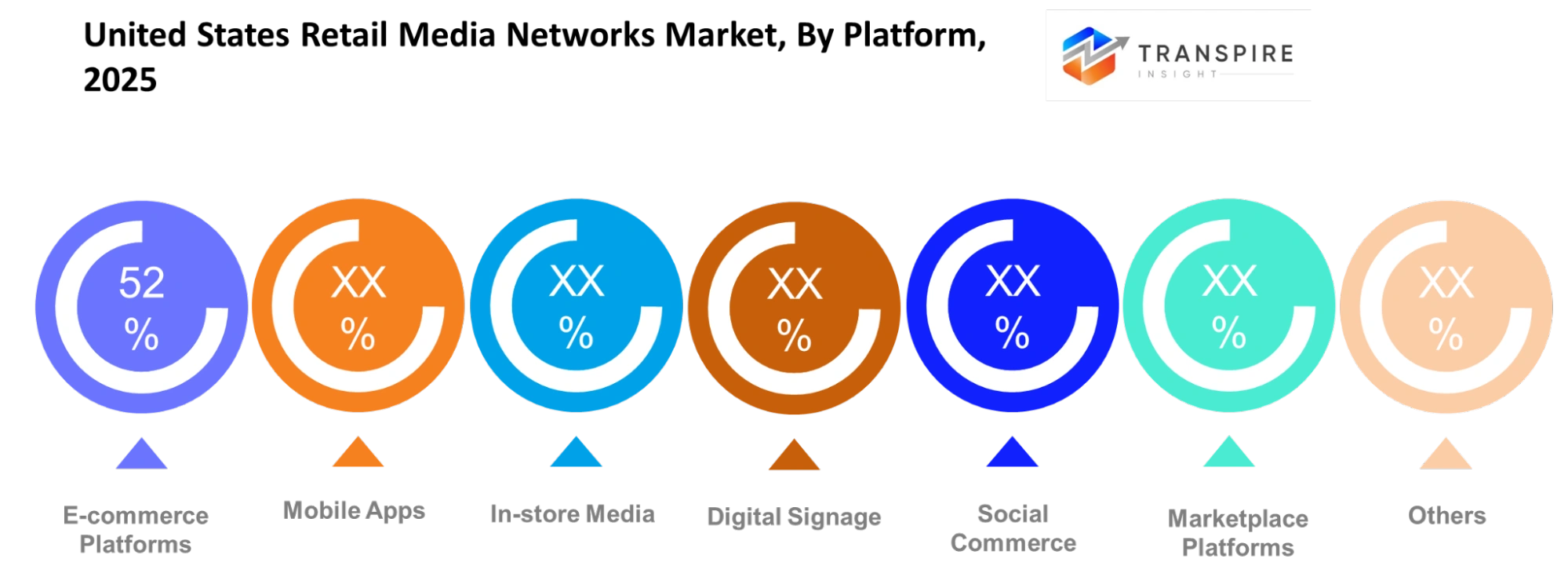
E-commerce platforms, mobile apps, in-store media, digital signage, social commerce, marketplace platforms, and a few other channels kind of form the base of retail media networks in the United States. These platforms support targeted ads using shopper data, purchase history, and browsing patterns, which helps make ad reach and relevance better, more like it actually fits the intent.
Retailers and brands use these kinds of platforms to place ads across online and offline touchpoints. Mobile apps and marketplace platforms will keep growing because customer engagement stays higher and tracking of user actions gets better, though. Meanwhile in-store media and digital signage back up the physical shopping environment, in a way that feels more immediate.
To learn more about this report, Download Free Sample Report
By Advertisement Type:
Display ads, sponsored products, video ads, search ads, native advertising, programmatic ads, and other formats make up most of the ad types you see in retail media networks. They help brands stay visible and they push direct product promotion across retail platforms and digital channels.
Sponsored products and search ads help boost product visibility right at the moment of purchase. Video ads and display ads help build stronger brand awareness. On the other hand programmatic and native advertising tend to improve targeting efficiency and user engagement across multiple digital touchpoints, overall.
By End User:
In the United States, retailers, consumer brands, FMCG companies, e-commerce companies, advertising agencies, and several other users make up the main demand base for retail media networks, kind of like this whole ecosystem depends on them. Each one relies on retail data to boost ad results and tighten customer targeting across different platforms, sometimes quickly sometimes not.
Retailers and e-commerce companies usually try to monetize their digital traffic.Meanwhile FMCG and consumer brands tend to care more about raising product visibility, while advertising agencies on their end deal with campaigns for multiple clients, so they’re usually pushing for greater reach and more precise performance tracking, but also a kind of smarter spending across retail media channels, in a way that feels more or less efficient.
By Deployment:
As for how these networks get deployed, cloud-based systems, on-premise setups, hybrid systems, AI-powered platforms, and self-service platforms are the common categories. They enable more adaptable ad delivery, smoother data handling, and campaign management across retail environments in the U.S. Cloud-based and AI-powered platforms are expected to help with scalability and real-time optimization.
Hybrid systems try to balance control with flexibility, and self-service platforms let brands manage campaigns themselves which can improve speed, efficiency, and day to day control over advertising operations.
What are the Key Use Cases Driving the United States Retail Media Networks Market?
Core use case is onsite retail search and product listing ads on ecommerce platforms, where brands are aiming at shoppers right at the purchase moment, using first-party behavioral data. Basically this pushes demand because it gets direct conversion attribution, and you can actually see measurable sales lift.
If we broaden it, there are also offsite retail media things, plus in-store digital screens that CPG brands and grocery retailers deploy , to stitch together omnichannel efforts. Pharmacy and grocery chains typically lean on loyalty-driven targeting, so they can nudge repeat purchases and improve basket size across physical and digital touchpoints. Kinda like, same intent, different stage.
Then the newer use cases start showing up, like shoppable connected tv ads,and retail data clean rooms that support privacy safe collaboration between advertisers and retailers. These are slowly gaining traction, because brands are trying to nail down cross platform measurement and more AI-driven audience activation, even when it gets a bit messy across channels.
|
Report Metrics |
Details |
|
Market size value in 2025 |
USD 6.08 Billion |
|
Market size value in 2026 |
USD 6.7 Billion |
|
Revenue forecast in 2033 |
USD 13.9 Billion |
|
Growth rate |
CAGR of 10.90% from 2026 to 2033 |
|
Base year |
2025 |
|
Historical data |
2021 - 2024 |
|
Forecast period |
2026 - 2033 |
|
Report coverage |
Revenue forecast, competitive landscape, growth factors, and trends |
|
Geographic scope |
United States of America |
|
Key company profiled |
Amazon Ads, Walmart Connect, Kroger Precision Marketing, Target Roundel, Criteo, Instacart Ads, CitrusAd, PromoteIQ, Albertsons Media Collective, eBay Ads, Best Buy Ads, Walgreens Advertising Group, Home Depot Retail Media, Macy’s Media Network, DoorDash Ads. |
|
Customization scope |
Free report customization (country, regional & segment scope). Avail customized purchase options to meet your exact research needs. |
|
Report Segmentation |
By Platform (E-commerce Platforms, Mobile Apps, In-store Media, Digital Signage, Social Commerce, Marketplace Platforms, Others); By Advertisement Type (Display Ads, Sponsored Products, Video Ads, Search Ads, Native Advertising, Programmatic Ads, Others); By End User (Retailers, Consumer Brands, FMCG Companies, E-commerce Companies, Advertising Agencies, Others); By Deployment (Cloud-based, On-premise, Hybrid Systems, AI-powered Platforms, Self-service Platforms, Others). |
Which Regions are Driving the United States Retail Media Networks Market Growth?
West Coast still kind of leads the United States Retail Media Networks Market , mainly because there’s a really dense cluster of tech platforms, digital advertisers , and an advanced commerce build-out that people keep leaning on. In particular, California and Washington get a lot out of how well cloud ecosystems plug in with adtech developers and major retail media players like Amazon Ads (which is headquartered in Seattle). The region also has a bunch of CPG innovation hubs that are always trying retail-first advertising methods , you know, testing new angles, tweaking formats. And that whole setup helps teams spin up AI based targeting fast, plus closed-loop attribution systems across online retail touchpoints.
The Northeast , on the other hand, shows up as a stable and mature contributor. That’s largely due to its strong foundation of advertising agencies, financial institutions , and older CPG headquarters in New York and Boston. Compared with the West Coast, it’s a bit less “innovation push” and more agency orchestrated , with more structured media planning cycles and longer term brand agreements. Retail media adoption is reinforced through steady enterprise advertising budgets, and also disciplined procurement routines among big FMCG buyers. So overall, this stability supports predictable revenue streams even when the wider digital advertising environment in the United States Retail Media Networks Market feels a little wobbly .
The South and Midwest are like the fastest-growing regions, mostly because grocery retail networks keep expanding, plus omnichannel infrastructure spending that keeps rolling out across Texas, Florida and Ohio. Companies such as Kroger and Walmart are pushing store digitization harder, adding in-store media too, and building loyalty-based data capture systems since 2023, so it all feels more connected. Also, new investments in distribution centers and connected retail ecosystems have basically boosted how much data is available for targeted advertising. This whole momentum means there are real entry opportunities for adtech firms as well as retailers who want scalable growth from 2026 to 2033.
Who are the Key Players in the United States Retail Media Networks Market and How Do They Compete?
Competition is getting more and more clumped up inside these kind of walled garden retail media ecosystems in the United States Retail Media Networks Market. The incumbents kind of hold their ground by leaning on first-party data scale, closed-loop attribution, and those integrated commerce platforms that connect everything together. So, instead of it being only about pricing , the real fight is about data quality, how well AI targeting actually works, and measurement transparency , like who can prove what. Because the entry barriers are high , smaller adtech firms have a hard time causing meaningful disruption and the dominant platforms keep their position.
Amazon Ads ties retail signals into AWS cloud infrastructure plus its DSP features, so it can back full-funnel targeting while automating optimization at a big scale and in practice it feels pretty seamless. Walmart Connect uses its broad store footprint with pickup and delivery operations, then it maps that in-store activity to digital shopper behavior for CPG marketers. Kroger Precision Marketing, in the meantime, leans on loyalty based targeting through partnerships with data clean room providers, and that tends to lift attribution accuracy and also gives purchase level insights that feel more grounded and less hand wavy.
Target Roundel keeps a narrow but deliberate attention on carefully picked brand collaborations and premium first party audience segments, while pushing its offsite retail media options outward for lifestyle and CPG advertisers, mostly in a way that's easy to activate. Instacart monetizes grocery basket intelligence by teaming up with several retailers and scaling advertising across delivery-driven transactions. CVS Health builds its pharmacy-led retail media capabilities by using compliant healthcare-adjacent consumer data, and that supports targeted advertising in regulated environments where the rules are, well, more strict than usual.
Company List
- Amazon Ads
- Walmart Connect
- Kroger Precision Marketing
- Target Roundel
- Criteo
- Instacart Ads
- CitrusAd
- PromoteIQ
- Albertsons Media Collective
- eBay Ads
- Best Buy Ads
- Walgreens Advertising Group
- Home Depot Retail Media
- Macy’s Media Network
- DoorDash Ads
Recent Development News
In April 2026, Best Buy expanded its retail media and marketplace ecosystem through its evolving third-party marketplace and in-store digital partnership strategy. The retailer continued scaling its advertising-supported ecosystem alongside new vendor integrations and AI-enabled shopping experiences to strengthen its position in the U.S. retail media network landscape.
Source: https://www.the-sun.com/
In January 2025, Amazon announced the expansion of its “Retail Ad Service” beta to third-party retailers. The service allows external ecommerce platforms to integrate Amazon’s advertising technology, enabling contextual ads powered by Amazon’s machine-learning-driven retail media infrastructure.
Source: https://www.theverge.com/
What Strategic Insights Define the Future of the United States Retail Media Networks Market?
The United States Retail Media Networks market is sort of moving, structurally, toward fully integrated commerce advertising ecosystems where retail platforms basically act as end-to-end media plus data, and transaction layers. This direction is pushed by the ongoing shift of marketing budgets into first-party data environments and also that growing need for verifiable sales attribution across both digital and physical retail channels. In the next 5–7 years, you’ll likely see competition focus less on ad inventory only, and more on who controls the shopper identity graphs, and who has real-time purchase intelligence at hand.
There’s also a risk that is not super obvious at first. It’s about ad spend over concentrating inside a handful of dominant retail ecosystems, which makes advertisers dependent and, in turn, leaves them exposed to pricing power imbalances. And if regulatory attention gets aimed at data usage, or anti-competitive bundling, it could mess with current monetization models faster than people think.
On the opportunity side, there is something that’s quietly emerging: interoperable data clean room standards. These things help enable cross-retailer campaign measurement without direct data sharing, especially when brands are asking for more unified attribution across Amazon Walmart and Kroger ecosystems. Market participants should also put in a bit more effort into privacy-preserving identity resolution tech, and build multi-retailer analytics partnerships, so they can reduce platform lock-in, and at the same time they can capture additional enterprise ad budgets.
United States Retail Media Networks Market Report Segmentation
By Platform
- E-commerce Platforms
- Mobile Apps
- In-store Media
- Digital Signage
- Social Commerce
- Marketplace Platforms
By Advertisement Type
- Display Ads
- Sponsored Products
- Video Ads
- Search Ads
- Native Advertising
- Programmatic Ads
By End User
- Retailers
- Consumer Brands
- FMCG Companies
- E-commerce Companies
- Advertising Agencies
By Deployment
- Cloud-based
- On-premise
- Hybrid Systems
- AI-powered Platforms
- Self-service Platforms
Frequently Asked Questions
Find quick answers to common questions.
The estimated United States Retail Media Networks Market size is USD 13.9 Billion in 2033.
Key segments for the United States Retail Media Networks Market are By Platform (E-commerce Platforms, Mobile Apps, In-store Media, Digital Signage, Social Commerce, Marketplace Platforms, Others); By Advertisement Type (Display Ads, Sponsored Products, Video Ads, Search Ads, Native Advertising, Programmatic Ads, Others); By End User (Retailers, Consumer Brands, FMCG Companies, E-commerce Companies, Advertising Agencies, Others); By Deployment (Cloud-based, On-premise, Hybrid Systems, AI-powered Platforms, Self-service Platforms, Others).
Major United States Retail Media Networks Market players are Amazon Ads, Walmart Connect, Kroger Precision Marketing, Target Roundel, Criteo, Instacart Ads, CitrusAd, PromoteIQ, Albertsons Media Collective, eBay Ads, Best Buy Ads, Walgreens Advertising Group, Home Depot Retail Media, Macy’s Media Network, DoorDash Ads.
The United States Retail Media Networks Market size is USD 6.08 Billion in 2025.
The United States Retail Media Networks Market CAGR is 10.90% from 2026 to 2033.
- Amazon Ads
- Walmart Connect
- Kroger Precision Marketing
- Target Roundel
- Criteo
- Instacart Ads
- CitrusAd
- PromoteIQ
- Albertsons Media Collective
- eBay Ads
- Best Buy Ads
- Walgreens Advertising Group
- Home Depot Retail Media
- Macy’s Media Network
- DoorDash Ads
Recently Published Reports
-
Apr 2026
3D Optical Profiler Market
3D Optical Profiler Market Size, Share & Analysis Report By Type (Desktop 3D Optical Profiler, and Portable 3D Optical Profiler), By Technology (Confocal Technology, and White Light Interference), By End-Use Industry (Manufacturing, Research Institutions, Automotive, Aerospace and Defense, Medical Devices, and Other), and Geography (North America, Europe, Asia-Pacific, Middle East and Africa, South and Central America), 2021 - 2031
-
Apr 2026
Depth Sensor Market
Depth Sensor Market Size, Share & Analysis Report By Type (Infrared Depth Sensors, Time-of-Flight (ToF) Sensors, Stereo Vision Sensors, Structured Light Sensors, Ultrasonic Depth Sensors), By Application (Automotive, Robotics, Gaming, Consumer Electronics, Industrial Automation, Healthcare, Security & Surveillance, Others), By End Users (Automotive Manufacturers, Consumer Electronics Companies, Healthcare Providers, Industrial Companies, Security Agencies, Gaming Companies, Robotics Companies, Others), and Geography (North America, Europe, Asia-Pacific, Middle East and Africa, South and Central America), 2021 – 2031
-
Apr 2026
Digital Manufacturing Market
Digital Manufacturing Market Size, Share & Analysis Report By Component (Hardware, Software, and Services), By Technology (Robotics, 3D Printing, Internet of Things (IoT), and Others), By Application (Automotive and Transportation, Aerospace and Defense, Consumer Electronics, Industrial Machinery, and Others), By Process Type (Computer-Based Designing, Computer-Based Simulation, Computer 3D Visualization, Analytics, and Others), and Geography (North America, Europe, Asia-Pacific, Middle East and Africa, South and Central America), 2021 – 2031
-
Apr 2026
Digital Visa Services Market
Digital Visa Services Market Size, Share & Analysis Report By Type (Individual Travelers, Group Travelers), By Application (Tourism, Business Travel, Others), and Geography (North America, Europe, Asia-Pacific, Middle East and Africa, South and Central America), 2021 – 2031