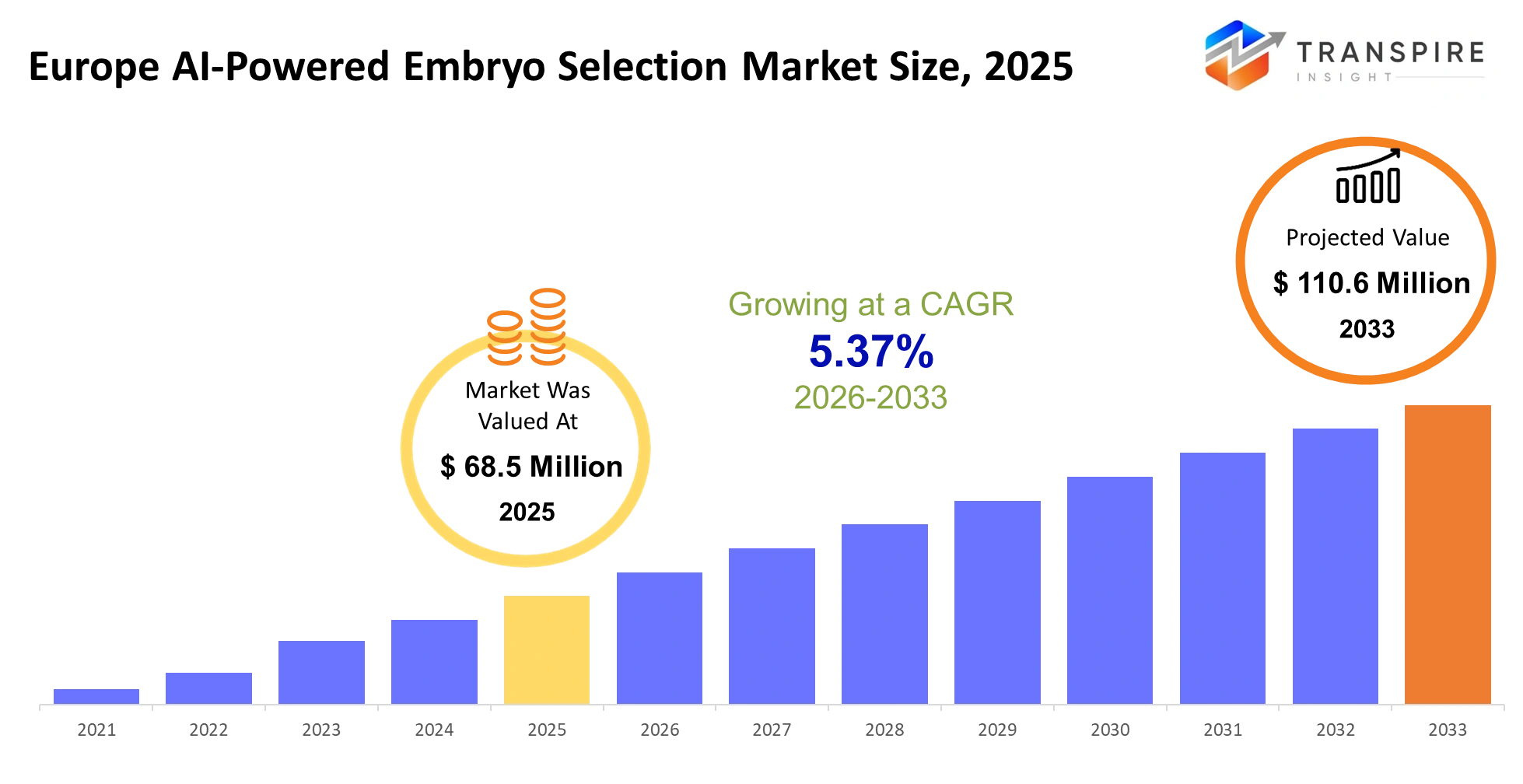
Europe AI-Powered Embryo Selection Market Size & Forecast:
- Europe AI-Powered Embryo Selection Market Size 2025: USD 68.5 Million
- Europe AI-Powered Embryo Selection Market Size 2033: USD 110.6 Million
- Europe AI-Powered Embryo Selection Market CAGR: 5.37%
- Europe AI-Powered Embryo Selection Market Segments: By Type (Software Solutions, Imaging Systems, AI Platforms, Analytics Tools, Others), By Application (IVF Procedures, Fertility Clinics, Research, Others), By End-User (Fertility Clinics, Hospitals, Research Institutes, Others), By Technology (Machine Learning, Deep Learning, Computer Vision, Others).
To learn more about this report,  Download Free Sample Report
Europe AI-Powered Embryo Selection Market Summary:
The Europe AI-Powered Embryo Selection Market size is estimated at USD 68.5 Million in 2025 and is anticipated to reach USD 110.6 Million by 2033, growing at a CAGR of 5.37% from 2026 to 2033. The Europe AI powered Embryo Selection Market is sort of reshaping how fertility clinics decide which embryos have the best probability , or rather the highest chance of turning into a successful pregnancy during IVF procedures. Instead of depending on manual visual review only, more and more clinics are leaning on AI models that assess embryo images, developmental timing, and morphology based patterns, sort of like a computed way to interpret subtle signs. In that way, they can help reduce failed implantation cycles, speed up the treatment sequence , and lift pregnancy outcomes for patients who often feel both medical pressure and financial pressure at the same time.
Over the past 3–5 years, the market moved away from experimental pilot trials and more toward clinically integrated decision support systems that actually sit inside IVF lab workflows. this shift picked up especially after the COVID 19 period, because it disrupted fertility appointment schedules, and then also increased the need for higher first cycle success rates, to cope with patient backlogs and to keep clinic efficiency steady. at the same time, Europe’s declining birth rates, plus trends toward delayed parenthood, pushed fertility providers to invest in technologies that support clearer measurable outcomes. As clinics compete using success metrics and treatment transparency, AI driven embryo selection is slowly going from a nice premium extra, to a more commercially important operational norm.
Key Market Insights
- Western Europe, more or less, dominated the Europe AI-Powered Embryo Selection Market with roughly 42% market share in 2025 , driven by advanced IVF infrastructure and reimbursement backing, you know, the usual support framework.
- Germany was the main contributor to regional revenue, helped by strong fertility clinic networks and quick uptake of AI-assisted embryo grading platforms.
- Southern Europe surfaced as the fastest-moving regional market through 2032 , mostly because private fertility investments are expanding and medical tourism demand keeps rising, it’s kind of connected.
- In the U.K. and Spain, clinics logged major procedure volumes , especially after integrating time-lapse imaging alongside AI-powered embryo viability assessment systems.
- On the software side, AI-based embryo imaging technology led the market, holding over 48% share in 2025, mainly because clinics focus on automated embryo ranking precision.
- Time-lapse incubator systems held the second-largest place in the segments , since they work well with machine-learning embryo monitoring technologies, fairly seamlessly.
- Cloud-based fertility analytics platforms are expected to be the fastest-growing segment during the forecast window, as clinics centralize IVF data administration into one place.
- Predictive embryo scoring tools gained solid momentum, because they lower embryologist workload, and also help keep implantation results more consistent.
- IVF treatment optimization alone represented nearly 55% of Europe AI-Powered Embryo Selection Market revenue in 2025 , tied to the rising number of assisted reproduction cycles.
- Genetic screening support applications posted the quickest growth , as clinics blend AI algorithms with preimplantation genetic testing workflows.
- Single embryo transfer optimization became a big pull factor, because European regulators tend to push for safer fertility treatment results , overall.
What are the Key Drivers, Restraints, and Opportunities in the Europe AI-Powered Embryo Selection Market?
The strongest force driving the Europe AI Powered Embryo Selection Market is this clinical shift toward models that are really outcome based for IVF. Fertility clinics in Germany, Spain and the U.K. are dealing with more and more pressure to raise first cycle pregnancy success rates while still managing the lab workload and also treatment expenses. That pressure got even heavier during the COVID-19 period, when fertility treatment backlogs started showing up, and clinics needed faster yet dependable embryo assessment methods. Nowadays AI powered imaging systems look at embryo development patterns with a steadier level of consistency than manual grading alone , so clinics can tune their embryo transfer choices. When those higher success rates strengthen clinic reputation, and also push better patient conversion, providers tend to fund bigger technology budgets toward AI assisted reproductive platforms.
Still, regulatory fragmentation plus ongoing ethical scrutiny is the market’s biggest structural stumbling block. Europe does not have one single, unified approval and clinical validation pathway for AI-assisted embryo decision systems, so vendors have to maneuver through each country’s medical device rules, and also reproductive health regulations. Clinics are also not fully comfortable depending on algorithmic suggestions for something as sensitive as fertility decisions, especially without long-term outcome data . That hesitation slows procurement, stretches cross-border commercialization, and makes it harder for smaller fertility centers to adopt advanced AI platforms, mainly because compliance expenses and legal uncertainty keep building up.
Expansion into data-tethered fertility ecosystems, it is becoming the next major growth window. Companies are increasingly mixing AI embryo selection with genetic testing and cloud based IVF workflow software, plus predictive patient analytics, somehow all together. Spain and Denmark are showing up as attractive innovation hubs , not only because private fertility investment keeps flowing, but also because medical tourism continues to feed demand for technology heavy IVF centers.
What Has the Impact of Artificial Intelligence Been on the Europe AI-Powered Embryo Selection Market?
Artificial intelligence and advanced digital technologies are, in a way, quietly changing how European fertility clinics look at embryo viability during IVF procedures. AI powered embryo assessment platforms now automate image analysis by reviewing thousands of time lapse microscopy images. They try to spot developmental patterns that embryologists may not always notice with manual grading, not exactly every time. Clinics increasingly plug these tools into digital IVF laboratory management software, so they can automate embryo ranking , keep patient records synced and track real time workflow across multi site fertility networks.
Machine learning models are also getting better at prediction in reproductive medicine. Newer algorithms analyze embryo morphology, cell division timing, maternal age, and even past IVF results. Then they estimate implantation probability and aim to reduce unsuccessful transfer cycles. Several fertility centers in the U.K., Spain, and Denmark report more steady embryo selection and faster evaluation times after they deploy AI assisted scoring tools. In practice these systems help labs manage resources better, reduce repeat IVF procedures, and improve first cycle pregnancy outcomes, which then supports clinic revenue growth as well as patient retention, and it can feel like a win all around.
Still, AI adoption has a key snag. A lot of predictive models rely on huge , very standardized IVF datasets. But embryo imaging protocols and clinical practices differ a lot between European clinics. That means data uniformity is often limited. As a result, algorithm reliability can drop when systems are used beyond their original training settings, and this slows down wider clinical adoption.
Key Market Trends
- Since 2022, fertility clinics across Germany and Spain kind of shifted from manual embryo grading , toward AI supported time-lapse imaging platforms for more standardized assessments, though the roll out has been a bit uneven.
- Multi site IVF providers increasingly adopted centralized cloud based embryo analytics systems after COVID-19 made laboratory staffing and workflow inefficiencies show up, across Europe in a very direct way.
- By 2025, more than 60% of premium fertility centers integrated predictive embryo scoring software alongside preimplantation genetic testing workflows , to improve transfer precision in practice.
- Between 2023 and 2025, European regulators got more intensive with scrutiny for AI assisted reproductive technologies, which boosted the demand for clinically validated algorithm transparency and auditability , especially when questions came up in clinical audits.
- Fertility chains increasingly partnered with companies like Vitrolife and AIVF, to standardize embryo selection quality across regional laboratories even when procedures differed slightly.
- Clinics also started marketing measurable IVF success metrics, after patient comparison behavior changed around 2021 toward more data driven selection of treatment providers , rather than only reputation.
- Denmark and Spain emerged as AI fertility innovation hubs, partly because private equity funding pushed faster investment into digitally integrated IVF laboratory infrastructure.
- AI platforms were also increasingly doing a mix, combining embryo morphology analysis with maternal health data and historical IVF outcomes, to raise implantation probability forecasting accuracy, not just for one dataset.
- Smaller fertility clinics delayed adoption between 2022 and 2025, because AI integration costs, compliance requirements, and training demands stayed operationally restrictive , and this wasn’t easy to absorb.
- Competition then shifted from standalone imaging hardware toward subscription based fertility analytics ecosystems , where embryo scoring is bundled with workflow automation and patient outcome benchmarking , in a single recurring model.
Europe AI-Powered Embryo Selection Market Segmentation
By Type
Software solutions currently kinda have the strongest position in the type segment because fertility clinics, are increasingly leaning toward scalable platforms that blend embryo imaging grading, and patient workflow management into one kind of unified digital environment. AI driven embryo assessment software shows a higher recurring revenue upside than standalone imaging hardware. That’s because subscription based deployment models let vendors keep pushing continuous algorithm updates along with data analytics services, and yeah it keeps generating recurring spend. Imaging systems still sit as the second largest category, partly due to ongoing demand for time lapse incubators and those high resolution embryo monitoring tools that get used during IVF procedures.
Meanwhile AI platforms and predictive analytics tools keep getting more attention as fertility providers chase measurable gains in implantation success rates and laboratory efficiency. Adoption patterns are starting to, favor interoperable systems that connect with electronic medical records and genetic testing workflows without too much friction. Looking ahead, growth within this segment will likely move toward cloud enabled fertility ecosystems, which opens chances for vendors that can deliver integrated software, data security, and clinical decision support, all inside a single platform.
By Application
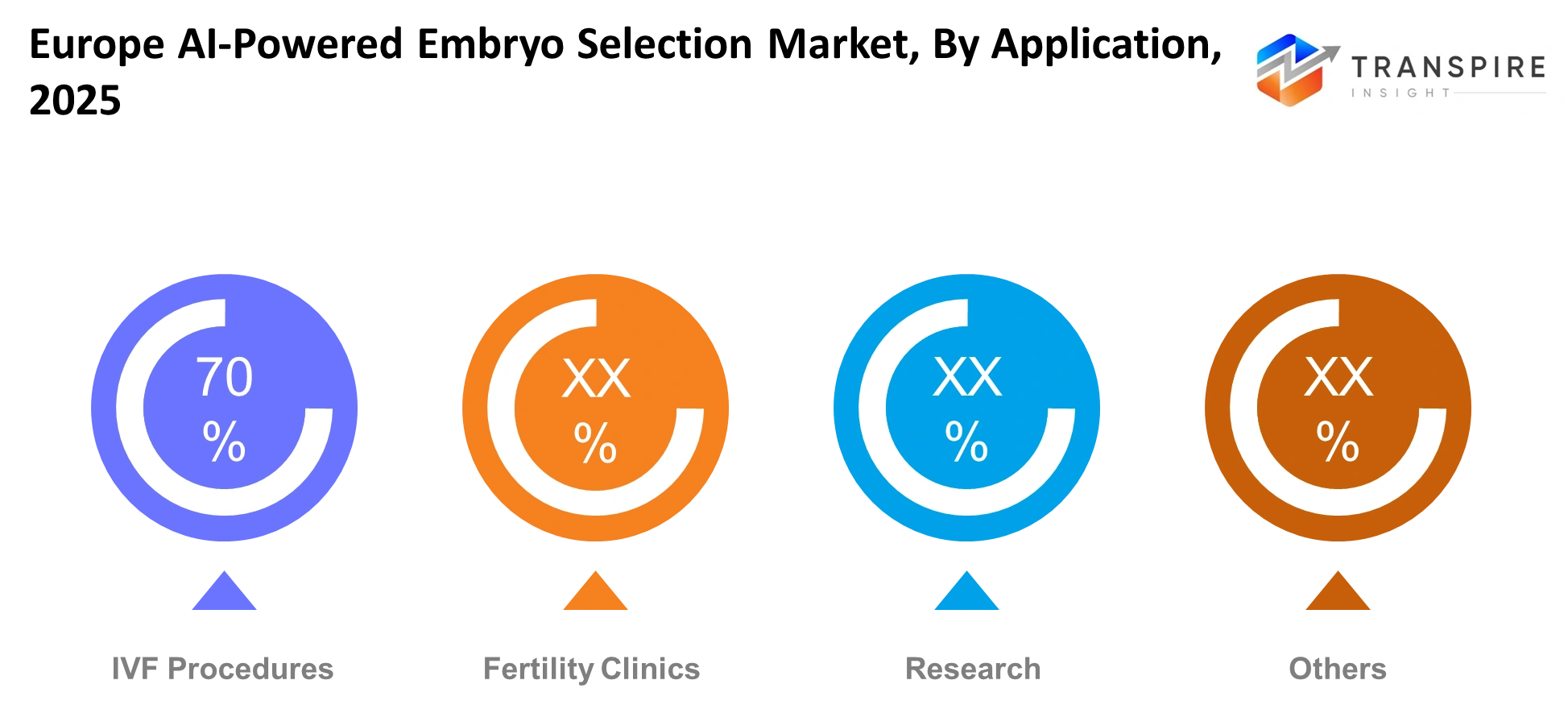
IVF procedures pretty much sit as the leading application segment because embryo selection technologies, they have a direct say in implantation outcomes , treatment efficiency and honestly patient satisfaction. Fertility clinics are increasingly rolling out AI assisted systems to cut down variability in embryo grading, and to help single embryo transfer strategies that are basically encouraged by European reproductive health guidelines. Research applications are also moving fast, you know as academic institutions and biotech firms widen their studies on embryo viability prediction, genetic screening integration, and reproductive data modeling.
In research settings, demand is still strongly tied to whether people can access big clinical datasets and whether they can collaborate with fertility centers that actually generate high quality imaging records. There are smaller areas too, like fertility preservation and donor embryo assessment, but they’re developing at a slower rhythm since clinical validation standards stay pretty strict. Going forward, application growth will likely track personalized reproductive medicine , where predictive algorithms blend embryo development information with maternal health indicators to fine tune treatment planning and keep procedural consistency steadier across laboratories.
To learn more about this report, Download Free Sample Report
By End-User
Fertility clinics keep the biggest share within the end-user segment, kind of because the specialized IVF centers run most embryo assessment tasks across Europe, so it tends to stack up there. Meanwhile, big clinic networks are still pouring in money for AI-supported lab infrastructure , aiming to make treatments feel more differentiated and to speed up operational throughput, at least in practice. Hospitals show up as the second-largest end-user category especially in nations where public healthcare frameworks back assisted reproductive treatments. But hospital uptake seems to move slower, since procurement cycles often stay linked to budget approvals and to wider healthcare digitization priorities.
Research institutes are also pushing forward as a notable growth track, driven by rising public and private funding toward reproductive health innovation and artificial intelligence development. In parallel, academic partnerships with technology providers are helping clinical validation speed up, and they also support algorithm training efforts , which is kind of the point. Going forward, market momentum will likely favor end users who can pair large patient caseloads with advanced digital infrastructure. That combo should create stronger competitive benefits for multi-location fertility providers and for healthcare systems that are research-led.
By Technology
Machine learning tech right now kind of dominates the technology segment, mostly because predictive embryo scoring models really depend on pattern recognition across huge IVF datasets. Clinics more and more use machine learning systems to judge embryo morphology, developmental timing and past therapy results with what feels like more steady consistency than manual evaluation. Deep learning platforms are also expanding fast , since convolutional neural networks help the image interpretation become more accurate during time lapse embryo monitoring. Computer vision solutions keep gaining traction as fertility labs automate image capture, embryo tracking, and the detection of developmental oddities in their day to day workflows.
The growth in these smaller sub segments leans on access to standardized clinical data, and on regulatory approval routes that can actually back algorithm transparency. Some smaller tech lanes , like hybrid analytics models and explainable AI frameworks, are now appearing because clinics want a clearer rationale for automated embryo recommendations. Looking ahead, future investment trends will probably concentrate on explainable and clinically validated AI systems , those that boost confidence with embryologists, regulators and fertility patients, while still helping larger commercial scaling across different markets.
What are the Key Use Cases Driving the Europe AI-Powered Embryo Selection Market?
The main use case that is driving adoption is embryo viability assessment during IVF procedures, specifically inside specialized fertility clinics, and yeah, a big part of the day to day work. AI based imaging platforms help embryologists spot embryos that seem to have better implantation odds, which can cut down on those failed transfer cycles and also help raise first cycle pregnancy outcomes. Because patient volumes are going up , many clinics are leaning on these systems so they can keep laboratory results more uniform and stable across the board.
A secondary track is now broadening into genetic screening support and a kind of fertility workflow optimization, mostly across hospital based reproductive centers and larger IVF lab networks. Here the AI tools support clinicians by linking embryo morphology with preimplantation genetic testing data, so treatment planning can be more precise, not guessy. On top of that, multi location fertility providers use predictive analytics software in order to standardize embryo grading across different regional laboratories, even when the teams are not in the same building.
And then there are emerging use cases that look like personalized reproductive treatment modeling and even remote IVF laboratory collaboration. Research institutes are testing AI systems that mix maternal health data, hormone response patterns, and embryo development metrics, to forecast treatment success with more detail than before. There are also cloud based embryo analytics platforms, which are showing longer term promise for cross border fertility consultations and joint reproductive research efforts, so the same kind of insights don’t stay trapped in one place only.
|
Report Metrics |
Details |
|
Market size value in 2025 |
USD 68.5 Million |
|
Market size value in 2026 |
USD 76.7 Million |
|
Revenue forecast in 2033 |
USD 110.6 Million |
|
Growth rate |
CAGR of 5.37% from 2026 to 2033 |
|
Base year |
2025 |
|
Historical data |
2021 - 2024 |
|
Forecast period |
2026 - 2033 |
|
Report coverage |
Revenue forecast, competitive landscape, growth factors, and trends |
|
Regional scope |
Europe (Germany, United Kingdom, France, Italy, Spain and Rest of Europe) |
|
Key company profiled |
Vitrolife, CooperSurgical, Hamilton Thorne, Genea Biomedx, Merck KGaA, Esco Medical, FUJIFILM Irvine Scientific, Oxford Gene Technology, Thermo Fisher, Illumina, Agilent, Labcorp, Ferring Pharmaceuticals, Progyny, OvaScience. |
|
Customization scope |
Free report customization (country, regional & segment scope). Avail customized purchase options to meet your exact research needs. |
|
Report Segmentation |
By Type (Software Solutions, Imaging Systems, AI Platforms, Analytics Tools, Others), By Application (IVF Procedures, Fertility Clinics, Research, Others), By End-User (Fertility Clinics, Hospitals, Research Institutes, Others), By Technology (Machine Learning, Deep Learning, Computer Vision, Others). |
Which Regions are Driving the Europe AI-Powered Embryo Selection Market Growth?
Western Europe stays out front a bit, since nations like Germany, the United Kingdom, and Spain hold very developed fertility treatment infrastructure, plus supportive reproductive healthcare frameworks. There is also this regulatory clarity around IVF steps, and the way medical AI is being adopted, it kinda helped fertility clinics move toward embryo selection platforms and then fold them into regular lab routines. On top of that, the region gets a lot from strong private healthcare spend, plenty of advanced imaging technology around, and big networks of specialized fertility centers that can actually pay for digital lab upgrades. Academic hospitals , reproductive research institutes, and biotech collaborations make the innovation web stronger too, because they back clinical validation efforts and help build AI training data set development.
Northern Europe comes next as the second-largest regional contributor, but the growth feel is different than Western Europe. Here the market leans more on publicly supported healthcare systems , plus long-term clinical standardization. Denmark, Sweden, and Finland keep investing steadily in reproductive health digitization, while they also keep tight clinical quality control, and clear, treatment reporting requirements. Fertility providers across the area, they seem to care more about treatment consistency , patient protection, and evidence based embryo selection, not so much on aggressive commercial expansion. With steady healthcare funding models and cooperative research setups, Northern Europe looks like a dependable place for ongoing technology adoption, and long term clinical collaborations for AI fertility solution vendors.
Southern and Eastern Europe right now seems to have the quickest growth momentum. It is driven by a kind of ongoing expansion in fertility clinics, plus fertility medical tourism activity that keeps rising, and also more private money going into IVF infrastructure. In Spain, Greece, and some areas of Eastern Europe, international fertility patients have been coming in after local clinics sped up their use of advanced embryo imaging, and even AI-assisted treatment systems during 2022 to 2025, kinda back to back. Treatment costs there are lower than in Western Europe. When you mix that with the private fertility networks that keep widening, it basically creates strong incentives for modernization of the technology stack, and for competitive differentiation. Overall, this regional lift should open big chances for software vendors, imaging system manufacturers, and reproductive analytics providers who are hunting for fresh business partnerships and scalable rollouts through 2033.
Who are the Key Players in the Europe AI-Powered Embryo Selection Market and How Do They Compete?
The competitive landscape still seems moderately consolidated because a limited number of fertility technology providers actually control the access to clinically validated embryo imaging systems , IVF laboratory software, and also large reproductive datasets needed for AI model training. In a way competition is shifting more and more toward tech accuracy, workflow integration ability, and clinical outcome validation , more than price alone. The established IVF technology suppliers keep defending their market share by embedding AI features into the existing lab ecosystems, while newer companies tend to push more specialized predictive analytics, and cloud-based embryo scoring platforms. Even cross-border fertility clinic partnerships, plus the ability to access large-scale IVF treatment data, have turned into a really important competitive advantage. This is because algorithm performance depends heavily on continuous clinical learning.
Vitrolife kind of differentiates itself with integrated time-lapse incubators and AI-enabled embryo assessment systems that connect directly with the IVF laboratory workflows. The firm improves customer retention by giving clinics an integrated ecosystem that includes imaging, culture media and analytics, instead of selling standalone software products. AIVF leans toward predictive embryo selection algorithms, and cloud-based decision support tools meant to reduce subjectivity in embryo grading. Their expansion now seems focused on partnerships with European fertility clinic networks, looking for scalable digital laboratory infrastructure.
CooperSurgical is kind of competing via broad reproductive healthcare portfolios that blend genetic testing, IVF consumables and embryo assessment technologies, all within one procurement channel. With that integrated service approach it lets fertility centers , keep supplier relationships more simple and also standardize their treatment workflows across several locations. On the other side Merck KGaA leans on solid pharmaceutical plus reproductive medicine know-how, to back AI assisted fertility research collaborations and digital treatment optimization programs across Europe. More recently strategic investments seem to tip toward data driven reproductive medicine platforms, that can connect embryo analytics with personalized fertility treatment planning .
Company List
- Vitrolife
- CooperSurgical
- Hamilton Thorne
- Genea Biomedx
- Merck KGaA
- Esco Medical
- FUJIFILM Irvine Scientific
- Oxford Gene Technology
- Thermo Fisher
- Illumina
- Agilent
- Labcorp
- Ferring Pharmaceuticals
- Progyny
- OvaScience
Recent Development News
In May 2026, FutureLife Group Partners with Alife Health for Europe-Wide AI Fertility Rollout: Europe-based fertility network FutureLife announced a strategic partnership with Alife Health to deploy AI-driven IVF decision-support tools across its clinics in 16 European countries. The rollout includes the CE-marked “Embryo Predict” platform designed to improve embryo transfer decisions using deep-learning analytics.
Source: https://www.prnewswire.com
In May 2026, FutureLife expands AI-based embryo selection across 60 European clinics: Industry coverage in 2026 highlighted FutureLife’s large-scale AI integration initiative across more than 60 clinics in Europe. The move positions the company among the first major European fertility providers standardising AI-assisted embryo scoring and IVF workflow automation at network scale.
Source: https://briefglance.com
What Strategic Insights Define the Future of the Europe AI-Powered Embryo Selection Market?
Over the next 5–7 years, the Europe AI-Powered Embryo Selection Market is expected to shift away from just standalone embryo grading tools toward more fully integrated reproductive intelligence platforms, sort of combining imaging genetic testing, patient biomarkers and predictive treatment analytics. The main thing pushing this move is the rising commercial pressure on fertility providers to show measurable treatment results while also keeping procedural costs in check and reducing laboratory variability. In practice, AI systems will likely show up inside the wider IVF workflow infrastructure, rather than staying as separate software solutions that work on their own.
There’s also a quieter risk that doesn’t get as much attention , which is data concentration and algorithm dependency. Right now, a limited number of fertility technology providers are already controlling access to the larger IVF datasets that are needed for model training. That can, in turn, shrink competition and potentially trigger regulatory concerns around clinical bias, transparency, and cross-border reproductive data governance. At the same time , personalized fertility modeling based on multimodal patient data is becoming a real chance, especially in Northern and Western Europe where digital healthcare integration is moving fast. Market players should therefore prioritize strategic alliances with fertility networks, as well as research institutions, so they can secure ongoing access to clinically diverse reproductive datasets, long term.
Europe AI-Powered Embryo Selection Market Report Segmentation
By Type
- Software Solutions
- Imaging Systems
- AI Platforms
- Analytics Tools
- Others
By Application
- IVF Procedures
- Fertility Clinics
- Research
- Others
By End-User
- Fertility Clinics
- Hospitals
- Research Institutes
- Others
By Technology
- Machine Learning
- Deep Learning
- Computer Vision
- Others
Frequently Asked Questions
Find quick answers to common questions.
The approximate Europe AI-Powered Embryo Selection Market size for the market will be USD 110.6 Million in 2033.
The key segments of the Europe AI-Powered Embryo Selection Market are By Type (Software Solutions, Imaging Systems, AI Platforms, Analytics Tools, Others), By Application (IVF Procedures, Fertility Clinics, Research, Others), By End-User (Fertility Clinics, Hospitals, Research Institutes, Others), By Technology (Machine Learning, Deep Learning, Computer Vision, Others).
Major players in the Europe AI-Powered Embryo Selection Market are Vitrolife, CooperSurgical, Hamilton Thorne, Genea Biomedx, Merck KGaA, Esco Medical, FUJIFILM Irvine Scientific, Oxford Gene Technology, Thermo Fisher, Illumina, Agilent, Labcorp, Ferring Pharmaceuticals, Progyny, OvaScience.
The current market size of the Europe AI-Powered Embryo Selection Market is USD 68.5 Million in 2025.
The Europe AI-Powered Embryo Selection Market CAGR is 5.37%.
- Vitrolife
- CooperSurgical
- Hamilton Thorne
- Genea Biomedx
- Merck KGaA
- Esco Medical
- FUJIFILM Irvine Scientific
- Oxford Gene Technology
- Thermo Fisher
- Illumina
- Agilent
- Labcorp
- Ferring Pharmaceuticals
- Progyny
- OvaScience
Recently Published Reports
-
Apr 2026
AI in Diabetic Retinopathy Market
AI in Diabetic Retinopathy Market Size, Share & Analysis Report By Type (Screening AI Systems, Diagnostic AI Systems, and Predictive AI Models), By Application Segment (Hospitals, Ophthalmology Clinics, Diagnostic Centers, and Research and Development), and Geography (North America, Europe, Asia-Pacific, Middle East and Africa, South and Central America), 2021 - 2031
-
Apr 2026
Psychometric Tests Market
Psychometric Tests Market Size, Share & Analysis Report By Type (Personality Tests, Ability/Aptitude Tests, Skill/Knowledge Tests, and Others), By Application (Talent Acquisition and Talent Management), and Geography (North America, Europe, Asia-Pacific, Middle East and Africa, South and Central America), 2021 – 2031
-
Apr 2026
Rare Biological Sample Collection Market
Rare Biological Sample Collection Market Size, Share & Analysis Report By Type (Isolation Kits & Reagent, Blood Collection Tubes, and Others), By Application (Oncology, Transcriptomics, Pharmacogenomics, and Others), and Geography (North America, Europe, Asia-Pacific, Middle East and Africa, South and Central America), 2021 – 2031
-
Apr 2026
Patient Lift Pendant Market
Patient Lift Pendant Market By Product Type (Wired Pendants, Wireless, Programmable), By Operation Type(Manual, Electric), By End-Users (Healthcare Professionals, Patients), By Application (Hospitals, Homecare, Rehabilitation Centers, Others), By Industry Analysis, Size, Share, Growth, Trends, and Forecasts 2021-2033
Our Clients
.jpg)