

Middle East and Africa Electronic Toll Collection Market Size & Forecast:
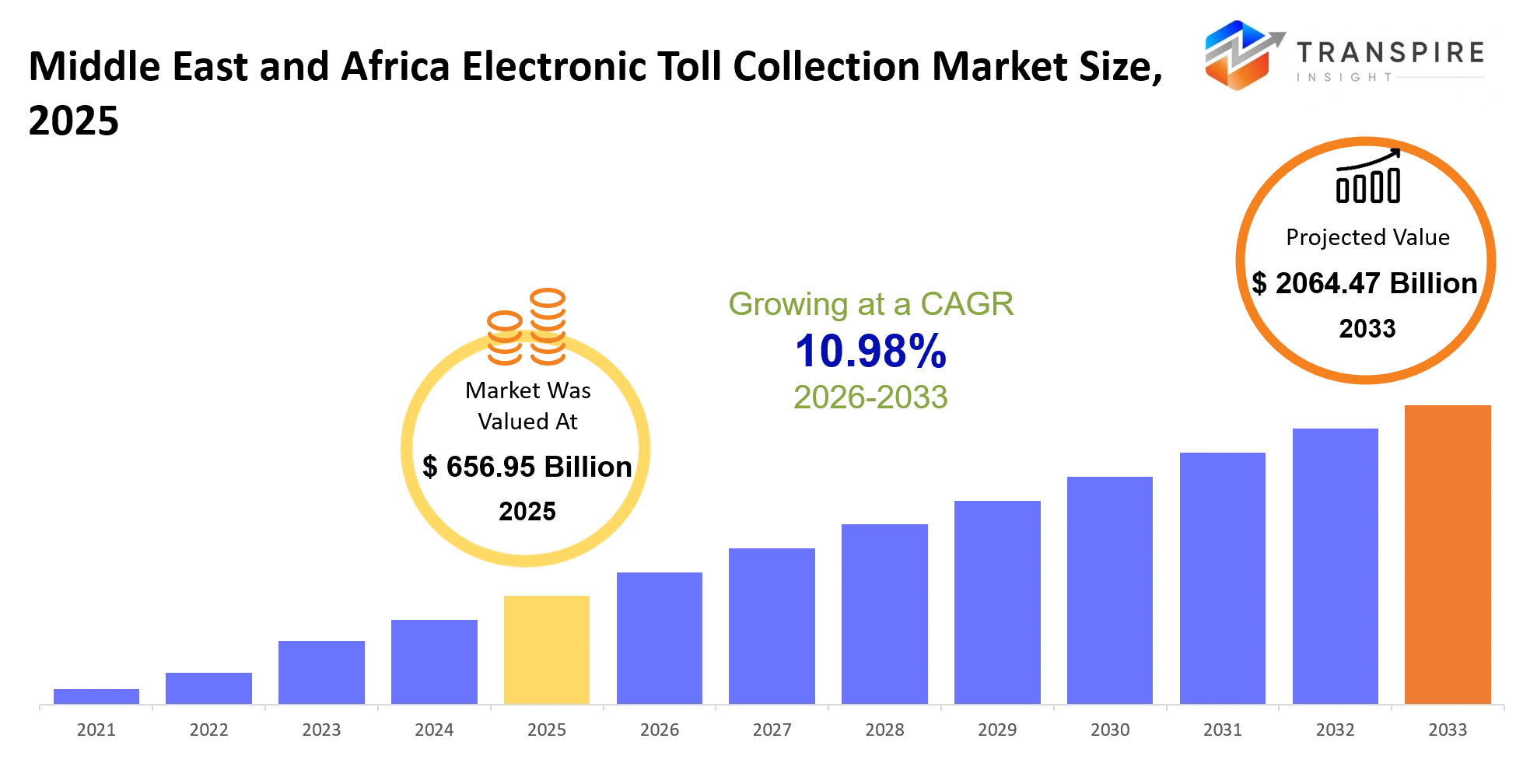
- Middle East and Africa Electronic Toll Collection Market Size 2025: USD 656.95 Billion
- Middle East and Africa Electronic Toll Collection Market Size 2033: USD 2064.47 Billion
- Middle East and Africa Electronic Toll Collection Market CAGR: 10.98%
- Middle East and Africa Electronic Toll Collection Market Segments: By Technology (RFID, DSRC, GNSS, ANPR, Others); By Application (Highways, Urban Roads, Bridges & Tunnels, Others); By End User (Government Agencies, Toll Operators, Others).
To learn more about this report,  Download Free Sample Report
Middle East and Africa Electronic Toll Collection Market Summary
The Middle East and Africa Electronic Toll Collection Market was valued at USD 656.95 Billion in 2025. It is forecast to reach USD 2064.47 Billion by 2033. That is a CAGR of 10.98% over the period.
The Middle East and Africa Electronic Toll Collection (ETC) market kinda supports the movement of vehicles across highways, urban expressways, and even cross border transport corridors by letting toll payments happen without stopping at the booths. In real use, ETC setups cut down on congestion, help shorten travel times, support better fuel efficiency, and also allow road authorities to capture revenue in a more precise way, while at the same time lowering operational costs.
Over the past five years, the market has shifted away from standalone RFID based tolling infrastructure , toward integrated digital mobility platforms that bring together RFID, automatic number plate recognition, and centralized traffic management. One of the big drivers for this transition was the faster push for contactless transport services after the COVID 19 pandemic, this made governments and road operators lean toward fewer cash transactions and less manual toll collection.
Right now, market growth is very tied to big scale transportation infrastructure spending across Gulf countries, and also in selected African economies. As new highways and smart city projects roll out, authorities are embedding electronic tolling systems into the road network from day one. That approach boosts toll compliance, improves revenue capture, and it leaves longer term openings for technology providers, system integrators, and infrastructure operators as well.
Key Market Insights
- In 2025, the Middle East seems to really dominate the Middle East and Africa Electronic Toll Collection Market , hitting about 68% market share, more or less.
- The UAE and Saudi Arabia kind of lead regional deployment, with smart city initiatives, better road network s and digital mobility programs. It’s like they push it forward via more tech oriented plans, so travel and services stay smoother.
- Africa is seen as the fastest growing regional market during the forecast period, largely pushed by the modernization of highway routes and added transportation infrastructure funding. It’s kind of like everything is getting upgraded, so demand keeps moving, forward.
- Public-private partnership projects across South Africa, Kenya and Egypt are speeding up ETC system roll out and getting deeper market take up, kind of like that, you know.
- In 2025, RFID based toll collection systems are basically holding the largest share , it’s about 55% of market revenue, mainly because the infrastructure is already in place and kinda established.
- Automatic Number Plate Recognition, or ANPR for short, solutions kind of make up the second-largest segment. It’s backed mainly by enforcement and congestion management stuff, even though the wording can be a bit fuzzy.
- Multi-lane free flow tolling systems are, kind of the fastest growing segment through 2030 , as operators try to keep uninterrupted traffic movement, and you know, not really stop things.
- Cloud based toll management platforms are getting more traction lately , mostly because they help with scalability, plus analytics from the data , and they also make day to day operations more efficient .
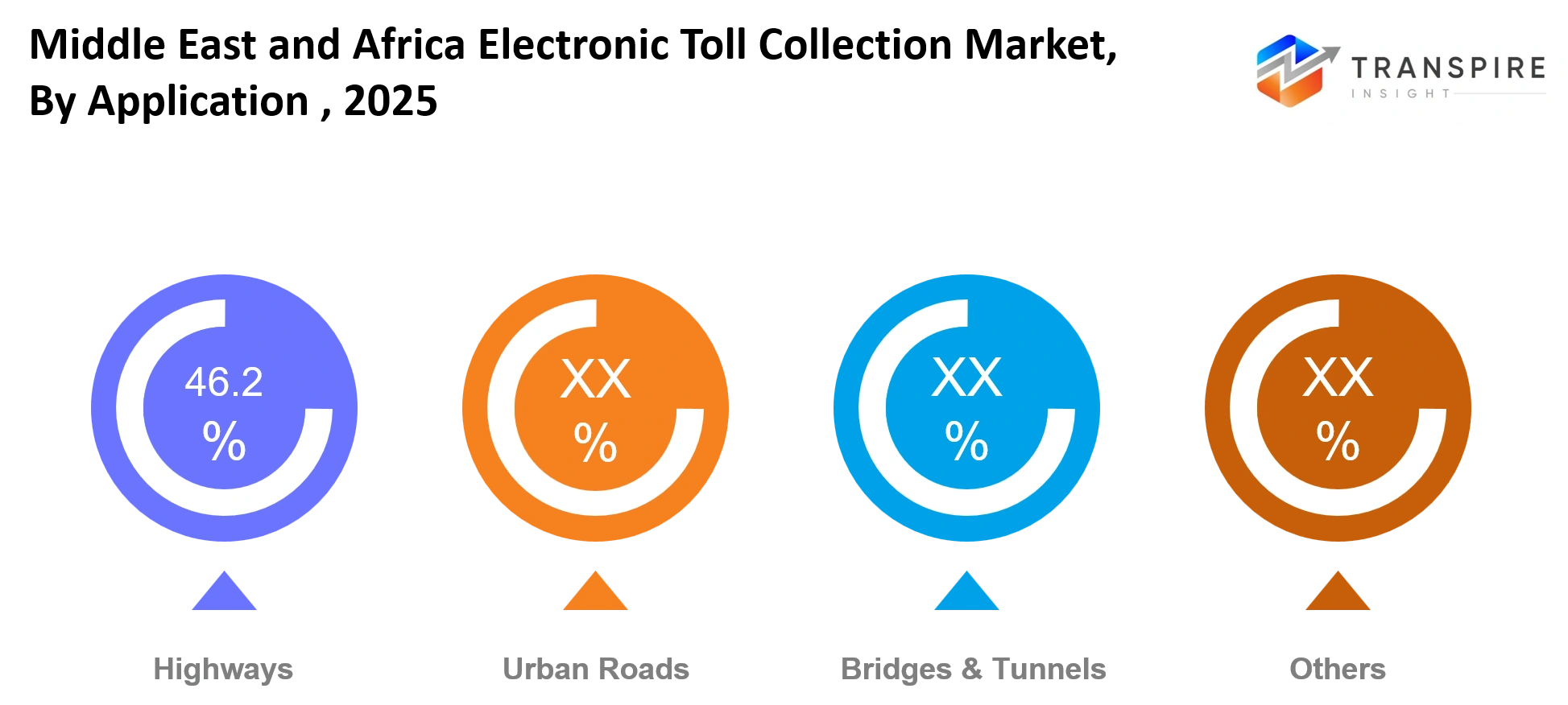
- Highway toll collection still seems to be the big one, capturing about 62% market share in 2025 across regional transport networks, more or less.
- Urban expressways ,and those congestion pricing programs are kinda popping up as high-growth uses inside the whole electronic tolling ecosystem, and honestly they seem to be growing fast.
What are the Key Drivers, Restraints, and Opportunities in the Middle East and Africa Electronic Toll Collection Market?
The strongest force pushing the Middle East and Africa Electronic Toll Collection Market along is mostly the expansion of smart transportation infrastructure programs across the Gulf states. Governments in the UAE and Saudi Arabia have put a lot of money into intelligent mobility systems, as part of wider economic diversification and city development strategies. In turn, transport authorities are increasingly swapping manual toll collection, for RFID based plus free-flow tolling approaches which handle vehicles without requiring them to stop. The outcome is typically quicker traffic movement, less day-to-day operating expense, and better toll collection efficiency. These improvements really do nudge larger technology adoption and they open up repeating revenue chances for system providers, software vendors, and infrastructure operators.
Still, the biggest hurdle remains that inconsistent transport infrastructure quality across many African markets. Electronic toll collection depends on dependable road networks, communications infrastructure, data centers, and practical enforcement mechanisms. To get these foundations in place it takes heavy capital spending and long implementation timelines. Since these issues are linked to national infrastructure development, not just individual technology rollouts, they can’t be fixed quickly. This kind of structural challenge postpones deployments, narrows the geographic reach, and slows down how fast market revenue can grow in emerging economies.
A major future opportunity is the rollout of multi-lane free-flow tolling, integrated with artificial intelligence plus vehicle recognition capabilities. Countries like Saudi Arabia are expanding smart highway spending that helps enable fully digital tolling setups. As governments chase connected mobility ecosystems, tolling becomes less of a standalone task and more like an integrated, data driven service layer. That direction could help operators improve accuracy, optimize lane management, and support dynamic pricing models while also reducing operational frictions.
What Has the Impact of Artificial Intelligence Been on the Middle East and Africa Electronic Toll Collection Market?
Artificial intelligence and advanced digital technologies are, kind of, reshaping electronic toll collection operations across the Middle East and Africa—mostly by tightening traffic management, strengthening revenue assurance, and boosting infrastructure performance overall. AI-based Automatic Number Plate Recognition (ANPR) systems are now used to automate vehicle identification and toll checking, which lowers how much manual work is needed ,and it also improves transaction accuracy in a consistent way. At the same time, transport authorities rely on intelligent control platforms to watch over toll lanes, flag noncompliance, and steer traffic movements in near real time. this helps operators move more vehicles through the system without automatically adding extra physical toll infrastructure, which is usually expensive.
Also, machine learning is being applied more often for predictive maintenance of cameras, sensors, RFID readers, and the communication networks. once these systems analyze equipment performance signals, they can spot likely issues before they actually interrupt service. that translates into less unplanned downtime and lower maintenance costs. on top of that, AI models help with traffic forecasting too, by anticipating congestion behaviors. Operators can then fine tune lane availability and improve throughput during high-demand travel windows.
In practice, these solutions bring measurable operational advantages. Quicker transaction handling cuts vehicle queues, improves road network efficiency, and increases toll collection accuracy. Digital analytics platforms additionally reinforce compliance visibility and revenue recovery, because they can pinpoint missed toll transactions and spot unusual system patterns that might otherwise slip through.
Still, there’s a big obstacle to AI adoption. Many toll operators have to connect new AI capabilities with legacy infrastructure. that typically means substantial spending, along with complicated upgrades to existing systems, and the integration part can be rough. Data quality inconsistencies, plus limited interoperability between older tolling platforms, can also.
Key Market Trends
- Since 2020, Gulf transport authorities have sped up the migration away from cash based tolling and toward fully digital payment ecosystems across the major highway networks , a kind of steady shift that’s been happening more and more .
- Between 2021 and 2025, Saudi Arabia along with the UAE expanded their smart mobility programs, ramping up the deployment of AI enabled road surveillance technologies. In that span, the traffic monitoring moved faster, like a more attentive eye on movement, and it kept growing in scale, probably because of those advanced sensing systems, also traffic analytics.
- Toll operators are more and more combining RFID along with ANPR tech, so they reduce reliance on just one platform system , and this also helps in verifying transactions more accurately, in the process it feels like the system is a bit more robust and responsive.
- Multi lane free-flow tolling kind of gained momentum after 2022, as regulators focused on cutting congestion and keeping cars moving without a stop. It’s like uninterrupted vehicle movement became the main point , and that push had more and more traction in the following period.
- More and more Public private partnership initiatives showed up along African transport corridors, kind of shifting infrastructure funding models away from just government-only investment, and not really in a straight line, you know. This trend made the whole thing feel a bit more common overall, where previously it was mostly the state, and only the state.
- Transport agencies are increasingly moving toward cloud-based toll management platforms, replacing these fragmented on-premise systems that were kinda stuck, with limited operational visibility and scaling. In practice, the shift to cloud helps with more clear oversight, and lets everything grow without so much friction , like earlier setups did.
- Kapsch TrafficCom, Q-Free, and Conduent somehow strengthened their regional footing via long term service agreements, not just one-time infrastructure deployments, which is kinda how it went in practice.
- Cross border freight traffic growth pushed governments to chase more interoperable tolling frameworks, so that payments stay simpler across multiple jurisdictions and not get stuck in the middle, like it sort of does when systems don’t line up.
- Enforcement strategies kind of evolved when AI based license plate recognition got better at spotting violations , and that improved detection rates while also cutting down that revenue leakage for unpaid tolls.
- After 2021, it seems like data analytics adoption really went up quite a bit, which let operators forecast traffic volumes and somehow better optimize maintenance scheduling, more effectively too.
Middle East and Africa Electronic Toll Collection Market Segmentation
By Technology:
RFID technology still seems to be in the lead across tolling networks, mainly because it can identify vehicles reliably, process transactions quickly, and the infrastructure is already in place. A lot of road authorities put RFID systems into action during the earlier digital tolling efforts, so you now get this fairly solid installed base on many important highways. What helps is consistent performance and fewer operational delays, so the tech keeps getting used along both urban and intercity transport corridors. On top of that, when it integrates with payment platforms, the whole process feels more convenient for road users, and frankly for toll operators too.
Automatic Number Plate Recognition keeps growing too, transport agencies go for it when they want stricter enforcement, plus more operational flexibility, which makes sense. The camera based setup helps detect vehicles without needing physical tags and it also supports the different parts of violation management. Meanwhile, multi lane free-flow tolling solutions are starting to show more momentum, highway operators care about keeping traffic moving smoothly and cutting down congestion. Cloud based toll management platforms add another layer, with centralized monitoring, analytics and yes, easier network management , so system performance tends to improve overall..
By Application:
Highway toll collection still feels like the main application slot, simply because there’s been so much road infrastructure investment across the Gulf states, plus a few chosen African economies. Electronic tolling systems usually cut down on the standing around, they make traffic flow calmer, and they raise revenue collection efficiency too. A lot of the bigger highway projects are now quietly folding in digital tolling tech right from the planning and build phase, not just after the fact. Meanwhile, transport authorities keep touching up older routes , aiming to get automated toll collection running smoothly.
Urban expressways are also getting more attention, that growth part is pretty real as cities wrestle with congestion and try to run mobility management better. Congestion-pricing programs and smart traffic initiatives nudge things forward , so you see more advanced tolling solutions getting rolled out. Then there are cross-border freight corridors, which basically help with further adoption since logistics providers want quicker transit across the wider transport grid. When integrated traffic management and toll collection platforms come together, it opens up extra chances for day-to-day operational efficiency and better road utilization , overall.
To learn more about this report, Download Free Sample Report
By End User:
Government transportation authorities are still, like, the biggest end-user group since public agencies typically manage most of the toll road infrastructure through the entire region. National road development plans continue to allocate funding for digital tolling systems and traffic management technologies. Getting revenue collection right, maintaining operational visibility , and minimizing cash handling are still the big concerns for public-sector operators. On top of that, long-term infrastructure modernization efforts keep pushing new tech rollouts along the major transport corridors.
Private toll road operators also show up in a meaningful way, mainly via concession agreements and public-private partnership projects. For them, day-to-day operational efficiency, plus customer experience, continues to steer where they place technology investments. Infrastructure concessionaires are gradually moving toward more advanced tolling platforms, aiming to raise throughput and at the same time reduce maintenance demands. The expansion of privately administered transportation projects is expected to open even more doors for technology providers and the service companies that support them.
What are the Key Use Cases Driving the Middle East and Africa Electronic Toll Collection Market?
Electronic toll collection systems are being used most extensively on major highways and expressways, where huge numbers of passenger and commercial vehicles show up every day. Road authorities lean on these setups to tamp down congestion at toll plazas, smooth the traffic stream, and raise the overall efficiency of collecting payments. Because vehicle density stays high along key transport corridors, this becomes the biggest wellspring of demand, in practice.
Adoption is also spreading into urban mobility efforts and even cross border freight corridors. Municipal transport agencies are starting to lean on digital tolling platforms to back congestion control initiatives, while logistics operators can move with more speed across regional trade routes. These kinds of applications matter more each year as governments modernize transportation infrastructure, sort of.
Newer use cases involve tying into connected mobility ecosystems and smart city platforms. More advanced tolling networks are starting to enable real-time traffic optimization, flexible road pricing, and a single unified digital payment experience. And as intelligent transportation investments keep ramping up across the Gulf countries, these applications are expected to see broader commercial take up during the forecast window.
|
Report Metrics |
Details |
|
Market size value in 2025 |
USD 656.95 Billion |
|
Market size value in 2026 |
USD 728.56 Billion |
|
Revenue forecast in 2033 |
USD 2064.47 Billion |
|
Growth rate |
CAGR of 10.98% from 2026 to 2033 |
|
Base year |
2025 |
|
Historical data |
2021 - 2024 |
|
Forecast period |
2026 - 2033 |
|
Report coverage |
Revenue forecast, competitive landscape, growth factors, and trends |
|
Regional scope |
Middle East and Africa |
|
Key company profiled |
Kapsch TrafficCom, Conduent, Thales, Siemens Mobility, TransCore, Q-Free, Cubic, Efkon, Toshiba, Hitachi, NEC, Huawei, Cisco, Jenoptik, Swarco. |
|
Customization scope |
Free report customization (country, regional & segment scope). Avail customized purchase options to meet your exact research needs. |
|
Report Segmentation |
By Technology (RFID, DSRC, GNSS, ANPR, Others); By Application (Highways, Urban Roads, Bridges & Tunnels, Others); By End User (Government Agencies, Toll Operators, Others). |
Which Regions are Driving the Middle East and Africa Electronic Toll Collection Market Growth?
The Middle East is still the region that seems to lead the market, mostly because governments keep pouring money into transportation infrastructure plus digital mobility programs. Countries like the UAE and Saudi Arabia have already put in place sophisticated tolling systems, kind of tied to broader smart city planning and economic diversification, even if the overall logic is not always identical across the board. With solid highway networks already in place , plus lots of people using digital payments, and strong institutional backing, it becomes easier to roll out these solutions at scale. Also there’s a fairly mature mix of technology providers, infrastructure operators, and transport authorities, and that keeps boosting regional momentum.
Southern Africa is the next biggest contributor, but the way growth happens there feels a bit different than what you see in the Gulf states. Instead of jumping straight into major smart city initiatives, the market leans more on long-range transport planning, toll road frameworks that are already there , and incremental upgrades to the technology. South Africa matters a lot here since it has a wide road footprint and prior know-how with electronic tolling. Ongoing spending on road upkeep and transport efficiency supports consistent revenue , which helps smooth out the expansion over time.
North and East Africa, though, are showing the strongest growth momentum as the forecast period approaches. New highway build-outs, logistics corridor efforts, and higher levels of public-private infrastructure funding have opened up fresh chances for electronic toll collection. Governments are concentrating on moving freight better, easing congestion, and making revenue collection more reliable with digital systems. Overall, this change should translate into compelling openings for technology vendors, system integrators, and investors who want exposure to transportation modernization sometime between 2026 and 2033.
Who are the Key Players in the Middle East and Africa Electronic Toll Collection Market and How Do They Compete?
The competitive landscape of the Middle East and Africa Electronic Toll Collection Market is kinda moderately consolidated, with a small set of worldwide transportation tech providers competing for major infrastructure contracts, while local specialists still handle more country specific needs. In practice, competition feels way less about pure equipment pricing and more about system dependability , interoperability, data analytics skills, and sustained service backing over time. More governments and toll operators now lean toward integrated platforms that bundle toll collection, traffic management, enforcement activities, and payment processing into one single ecosystem. Because of that, technology know-how and the capacity to steer complicated rollouts have turned into the real differentiators.
Kapsch TrafficCom leans into end to end intelligent transportation solutions, mixing tolling with traffic monitoring and mobility management. That unified approach makes it easier for road authorities to cut down operational clutter while boosting overall network awareness. The firm keeps growing via long term infrastructure partnerships and smart mobility initiatives across Gulf markets. Q-Free sets itself apart using adaptable tolling platforms, supporting RFID, Automatic Number Plate Recognition, and multi lane free-flow operations inside one architecture. With this, operators can upgrade their current setup without having to chuck the whole network.
Conduent Transportation focuses on advanced transaction handling and back-office management services that raise revenue collection precision and improve enforcement effectiveness. Their strong know-how in large scale toll operations backs expansion into new transportation modernization programs. Siemens Mobility, meanwhile, leans on wider transportation technology capabilities by tying toll
Company List
- Kapsch TrafficCom
- Conduent
- Thales
- Siemens Mobility
- TransCore
- Q-Free
- Cubic
- Efkon
- Toshiba
- Hitachi
- NEC
- Huawei
- Cisco
- Jenoptik
- Swarco
Recent Development News
"In September 2025, Salik Company PJSC joined the International Bridge, Tunnel & Turnpike Association (IBTTA). The strategic membership expanded Salik’s international collaboration network in tolling and smart-mobility technologies, strengthening the electronic toll collection ecosystem in the Middle East.
Source: https://timesofindia.indiatimes.com
"In October 2025, government transportation authorities and tolling stakeholders from the UAE, Saudi Arabia, and Kenya announced participation in the Road User Charging Conference Middle East & Africa in Abu Dhabi, focusing on electronic tolling expansion, interoperability, and next-generation payment technologies. The initiative supports regional collaboration and future electronic toll collection deployments across the Middle East and Africa.
Source: https://www.roaduserchargingconferenceasiapacific.com
What Strategic Insights Define the Future of the Middle East and Africa Electronic Toll Collection Market?
Over the next five to seven years, the Middle East and Africa Electronic Toll Collection Market is expected to move beyond just standalone tolling infrastructure, sort of towards more integrated mobility ecosystems where toll collection, traffic management, digital payments, and real-time transportation analytics all sit together. This seems to be happening because governments are pushing smart transportation networks , and there is also this growing need to handle urban congestion plus freight movement in a more efficient way. And when transportation authorities try to get better operational visibility, data-driven platforms will keep becoming more important in procurement decisions, even if nobody talks about it that much.
One less visible risk is the growing reliance on a small number of big technology providers that can actually deliver complex, end-to-end tolling solutions. If the market gets too concentrated, it could bump up implementation costs , lower the usual competitive pressure , and then create long-run vendor lock-in headaches for operators. In other words, less choice, more friction later.
A promising opportunity is the rise of interoperable regional tolling networks, especially along cross-border freight corridors in Africa. As trade connectivity initiatives expand, the need for smooth multi-jurisdiction payment systems will likely climb. Market participants should focus on open, interoperable platforms, so they can plug into future mobility services too. That approach should help their offerings stay useful for the long term as transportation ecosystems keep becoming more connected over time.
Middle East and Africa Electronic Toll Collection Market Report Segmentation
By Technology
- RFID
- DSRC
- GNSS
- ANPR
- Others
By Application
- Highways
- Urban Roads
- Bridges & Tunnels
- Others
By End User
- Government Agencies
- Toll Operators
- Others
Frequently Asked Questions
Find quick answers to common questions.
The expected Middle East and Africa Electronic Toll Collection Market size for the market will be USD 2064.47 Billion in 2033.
Key segments for the Middle East and Africa Electronic Toll Collection Market are By Technology (RFID, DSRC, GNSS, ANPR, Others); By Application (Highways, Urban Roads, Bridges & Tunnels, Others); By End User (Government Agencies, Toll Operators, Others).
Major Middle East and Africa Electronic Toll Collection Market players are Kapsch TrafficCom, Conduent, Thales, Siemens Mobility, TransCore, Q-Free, Cubic, Efkon, Toshiba, Hitachi, NEC, Huawei, Cisco, Jenoptik, Swarco.
The Middle East and Africa Electronic Toll Collection Market size is USD 656.95 Billion in 2025.
The Middle East and Africa Electronic Toll Collection Market CAGR is 10.98% from 2026 to 2033.
- Kapsch TrafficCom
- Conduent
- Thales
- Siemens Mobility
- TransCore
- Q-Free
- Cubic
- Efkon
- Toshiba
- Hitachi
- NEC
- Huawei
- Cisco
- Jenoptik
- Swarco
About the Authors

Avinash Kumar
I’m Avinash Kumar, a Senior Research Analyst at Transpire Insight, with expertise in the Electronics and Semiconductor and Energy & Power industry. My work focuses on analyzing emerging technologies, market trends, industry developments, and innovation across these sectors. I specialize in transforming complex technical and market insights into clear, research-backed content that helps professionals, businesses, and decision-makers stay informed. Through continuous industry research and data-driven analysis, I strive to deliver accurate, reliable, and practical perspectives on the latest advancements shaping the semiconductor and energy landscape.

Chakradhar Khansole
Chakradhar serves as the Research Director at Transpire Insight, bringing over 8 years of experience in technology, innovation, and strategic market intelligence. He specializes in transforming complex market data into actionable business insights that enable organizations to make informed, growth-oriented decisions. Recognized for his strategic vision and analytical expertise, Chakradhar leads high-impact research initiatives, delivering comprehensive market assessments, competitive intelligence, and forward-looking industry analysis.
Recently Published Reports
-
Apr 2026
Fiber Optic Faceplates Market
Fiber Optic Faceplates Market Size, Share & Analysis Report By Type (< 300 mm2, 300-350 mm2, and > 350 mm2, By Application (Night Vision, Holographic Imaging, Medical, and Others), and Geography (North America, Europe, Asia-Pacific, Middle East and Africa, South and Central America), 2021 - 2031
-
Apr 2026
High Temperature Superconductors Market
High Temperature Superconductors Market Size, Share & Analysis Report By Type (1G HTS, and 2G HTS), By Application (Power Cable, Fault Current Limiter, and Transformer), and Geography (North America, Europe, Asia-Pacific, Middle East and Africa, South and Central America), 2021 - 2031
-
Apr 2026
Industrial Plugs and Socket Market
Industrial Plugs and Socket Market Size, Share & Analysis Report By Type (Industrial Plugs, Industrial Sockets), By Current (Up to 32 A, 32 to 125 A, Above 125 A), By Protection (Dustproof and Splash Proof, Waterproof, Explosion Proof), By End User (Heavy Industries, Oil and Gas, Chemicals and Pharmaceuticals, Power Generation, Others), and Geography (North America, Europe, Asia-Pacific, Middle East and Africa, South and Central America), 2021 - 2031
-
Apr 2026
InGaAs Avalanche Photodiodes Market
InGaAs Avalanche Photodiodes Market Size, Share & Analysis Report By Type (1100 - 1700 nm, and 1000 - 1600 nm), By Application (Missile Warning System, Muzzle Flash Detection, Wafer Defect Inspection, Laser Rangefinders, and Others), and Geography (North America, Europe, Asia-Pacific, Middle East and Africa, South and Central America), 2021 - 2031