
United Kingdom Automotive Camera Market Size & Forecast:
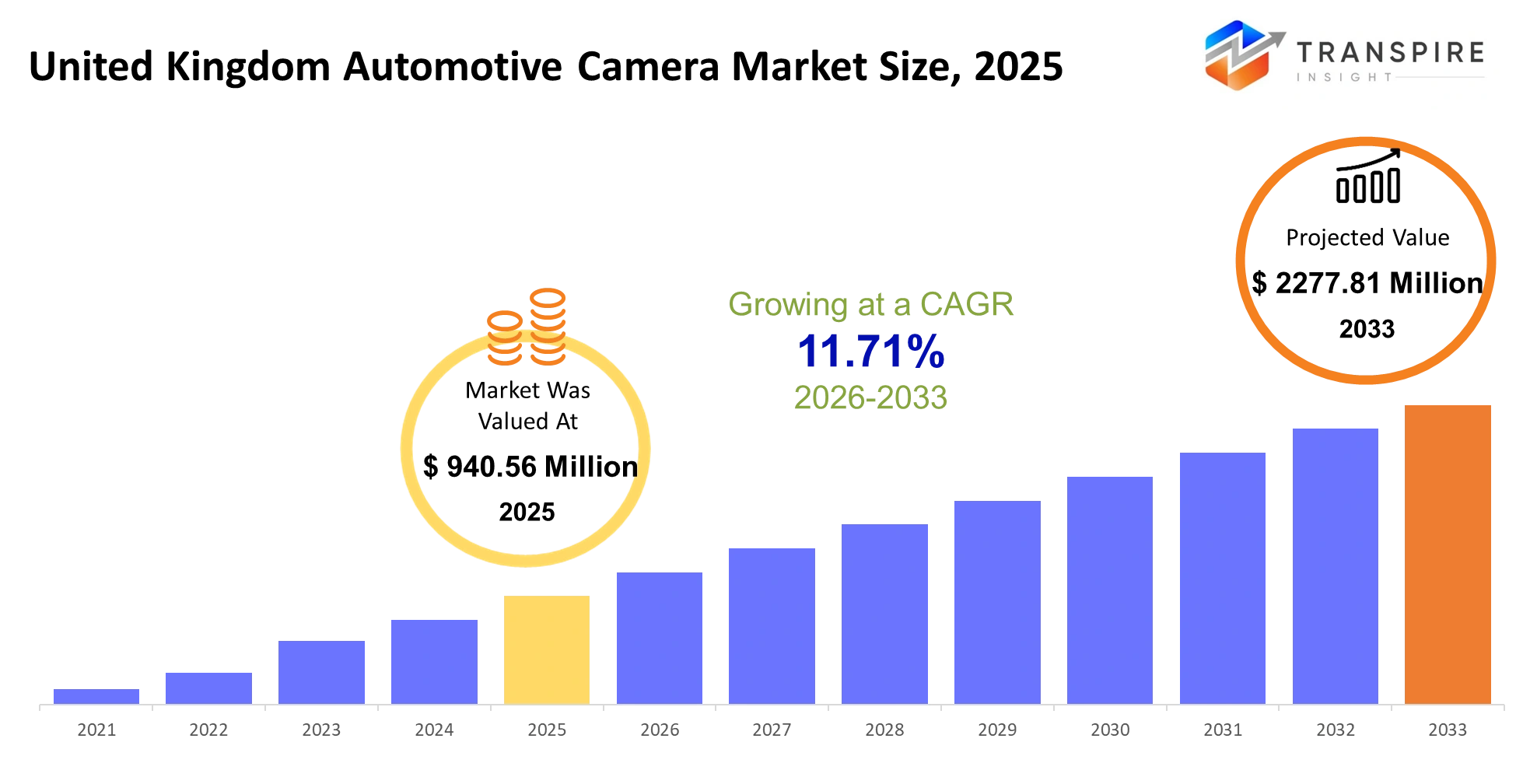
- United Kingdom Automotive Camera Market Size 2025: USD 940.56 Million
- United Kingdom Automotive Camera Market Size 2033: USD 2277.81 Million
- United Kingdom Automotive Camera Market CAGR: 11.71%
- United Kingdom Automotive Camera Market Segments: By Camera Type (Rear-view Cameras, Surround-view Cameras, Driver Monitoring Cameras, ADAS Cameras, Night Vision Cameras, Others); By Vehicle Type (Passenger Cars, SUVs, Commercial Vehicles, Electric Vehicles, Others); By Technology (Digital Cameras, Infrared Cameras, AI-enabled Cameras, Thermal Cameras, Others); By Application (Parking Assistance, Lane Departure Warning, Collision Avoidance, Driver Monitoring, Others).
To learn more about this report,  Download Free Sample Report
United Kingdom Automotive Camera Market Summary
The United Kingdom Automotive Camera Market was valued at USD 940.56 Million in 2025. It is forecast to reach USD 2277.81 Million by 2033. That is a CAGR of 11.71% over the period.
The United Kingdom automotive camera market kinda lets vehicles perceive what’s around them using digital imaging systems, which then help with safe driving, automated parking, lane management, and driver behavior monitoring. Usually, these kinds of camera systems lower the chance of collisions, make it easier to read the road in busy city traffic, and also back up compliance with tighter vehicle safety rules for both passenger cars and commercial fleets.
Over the last 3 to 5 years the market has changed in a more structural way , moving away from simple standalone rear-view cameras toward integrated multi-camera ADAS platforms that are embedded inside centralized vehicle computing units. One big driver behind this shift is the growth of Euro NCAP safety testing , which has pushed OEMs to standardize things like automatic emergency braking and driver monitoring across newer vehicle models. And at the same time, disruptions in the semiconductor supply chain between 2021 and 2023, kinda forced suppliers to diversify faster , and that encouraged OEMs to lock in longer term arrangements with Tier 1 providers such as Bosch and Continental AG. Put together , regulatory pressure plus supply constraints have increased the amount of camera hardware per vehicle, improved software linkages, and expanded revenue possibilities across the whole ecosystem, not just one segment.
Key Market Insights
- Europe sort of dominates the United Kingdom Automotive Camera Market with something like 38% regional influence, mostly because of Euro NCAP safety enforcement and also because OEM integration density remains really high in 2025.
- Asia Pacific is maybe the fastest-growing influence area for UK supply chains too, climbing at about a 9–11% CAGR through 2030, driven by EV platform scaling and sensor cost reductions.
- Rear-view cameras, together with ADAS cameras pretty much take the biggest portion, and in 2025, they reach over 55% combined adoption across passenger vehicles.
- Driver monitoring systems are the fastest-moving segment by far, expected to expand significantly between 2025 and 2030, as fatigue-detection rules tighten and fleet safety mandates grow stronger.
- Parking assistance still looks like the dominant application with nearly 40% usage share, helped along by urban gridlock and the growing appetite for semi-automated maneuvering solutions.
- Collision avoidance meanwhile is showing up as the fastest-expanding application segment, backed by insurance incentives and the slow shift toward mandatory safety feature integration.
- For end users, passenger cars lead the United Kingdom Automotive Camera Market pretty clearly, taking around 60% share because mass-market ADAS deployment keeps rolling.
- And electric vehicles are the fastest-growing end-user category too, with camera integration accelerating due to software-defined vehicle architectures and centralized computing systems, which are kind of becoming the norm.
- Sony kind of gains a competitive edge with advanced CMOS sensor tech , tuned for low-light but also high-dynamic-range automotive sight use cases, not just one thing.
- ZF Friedrichshafen and Continental expand by tying in vehicle motion integration and also a software-defined driving approach, which helps lock in longer-term OEM agreements and pushes more growth regionally too.
What are the Key Drivers, Restraints, and Opportunities in the United Kingdom Automotive Camera Market?
The main driver behind the United Kingdom automotive camera market is basically the tougher enforcement of advanced safety rules, brought in alongside Euro NCAP style protocols and wider European vehicle safety frameworks. Because of that, OEMs get pushed to add lane departure warning, automatic emergency braking, and driver monitoring, almost as a default. So they end up embedding multi-camera architectures across most new passenger cars and commercial vehicles, even though it was previously considered optional. This kind of regulatory nudge has, in practice, accelerated revenue growth for Tier 1 suppliers. They benefit because features that used to be optional become baseline, per vehicle camera content is worth more, and long term procurement agreements get calmer, more stable.
The biggest restraint is the system integration messiness, especially when you look across different vehicle platforms. Modern camera setups still need to sync with radar, lidar, and a central computing unit, but older vehicle architectures often don’t have the needed processing bandwidth, or the wiring flexibility for smooth installation. Then you get longer development timelines, and OEMs face higher certification spend. It hits harder in mid tier vehicle segments, where profit is already thin. So even if the regulatory pull stays strong, adoption tends to slow down outside premium models, and it also gets uneven across platforms, which limits broader revenue scalability. Newly designed electric vehicle platforms might move faster, but the overall rollout pace can still be constrained.
A real opportunity is emerging from software-defined vehicle platforms being built by manufacturers like Jaguar Land Rover and several global EV entrants operating in the UK ecosystem. With these designs, the computing gets centralized, and over-the-air updates can tune camera based perception systems after the cars are already on the road. That means camera performance can be improved later without repeating full hardware changes, and manufacturers can iterate more quickly over time, rather than waiting for the next major refresh.As these platforms scale through 2026 onward , suppliers who mix AI enabled imaging with modular hardware design , will get more say in recurring software-linked revenue streams, not just the usual one time component sales.
What Has the Impact of Artificial Intelligence Been on the United Kingdom Automotive Camera Market?
Artificial intelligence is, basically, reshaping vehicle vision systems by turning camera hardware into real time decision engines, inside these advanced driver assistance ecosystems. In automotive camera deployments, AI enabled perception software now automates object detection, lane recognition and even driver behavior tracking, so operators rely less on manual calibration and the whole setup feels more responsive, especially in dense urban traffic situations where everything is moving at once. Fleet operators are also leaning more on camera linked telematics platforms to automate compliance monitoring, covering fatigue detection alerts plus incident documentation , and that lowers the administrative workload while helping safety enforcement stay more consistent across commercial fleets.
Machine learning models further boost predictive abilities by examining camera derived data streams to estimate component degradation, sensor misalignment, and the thermal stress happening inside imaging modules. That, in turn, supports predictive maintenance scheduling, which cuts down on unexpected downtime across vehicle fleets and improves the lifecycle performance of ADAS hardware. In premium automotive programs, AI driven optimization has pushed parking accuracy higher and sped up collision avoidance response times, which leads to clear reductions in low speed accident rates and also reduces insurance related repair costs.
Still, there’s a catch to current adoption: the high integration complexity between AI software stacks and multi sensor camera architectures, particularly when older vehicle platforms need retrofit compatibility. That specific limitation slows deployment cycles and raises upfront costs for OEMs and fleet operators, and it tends to hit mid market vehicle segments the hardest.
Key Market Trends
- Rear-view camera adoption kindof got close to universal once enforcement actually kicked in, and that moved the demand toward higher value ADAS plus surround-view setups across passenger cars.
- OEMs started leaning harder on AI enabled camera stacks after 2024, which sorta cut back on standalone sensor pull and it also sped up the development of integrated perception platforms.
- Continental AG, and Bosch expanded modular camera architectures too, so the whole thing shifted from just selling parts to signing full system integration agreements with European automakers.
- Driver monitoring cameras took off pretty fast after 2025 fatigue rules, especially in commercial fleets, and in ride-hailing vehicles that spend time in dense city traffic.
- Mobileye partnerships with several major automakers helped push multi camera ADAS standardization, so from 2025 onward there was less fragmentation inside perception software ecosystems.
- Surround-view systems gained more share in SUVs as street congestion kept increasing, and that basically drove install rates that were higher than what you usually see on traditional passenger car platforms.
- Sony CMOS sensor demand jumped quite a lot as low light imaging requirements expanded, so supplier competition started focusing more on real sensor performance, rather than only on unit cost.
- Electric vehicle platforms began putting multi camera arrays in at the design stage after 2024, replacing the retrofit integration model that was more common with legacy combustion vehicles.
- Collision avoidance systems became a must under the new safety frameworks, so suppliers got pushed toward integrated braking and vision fusion technologies across multiple OEM lines.
United Kingdom Automotive Camera Market Segmentation
By Camera Type
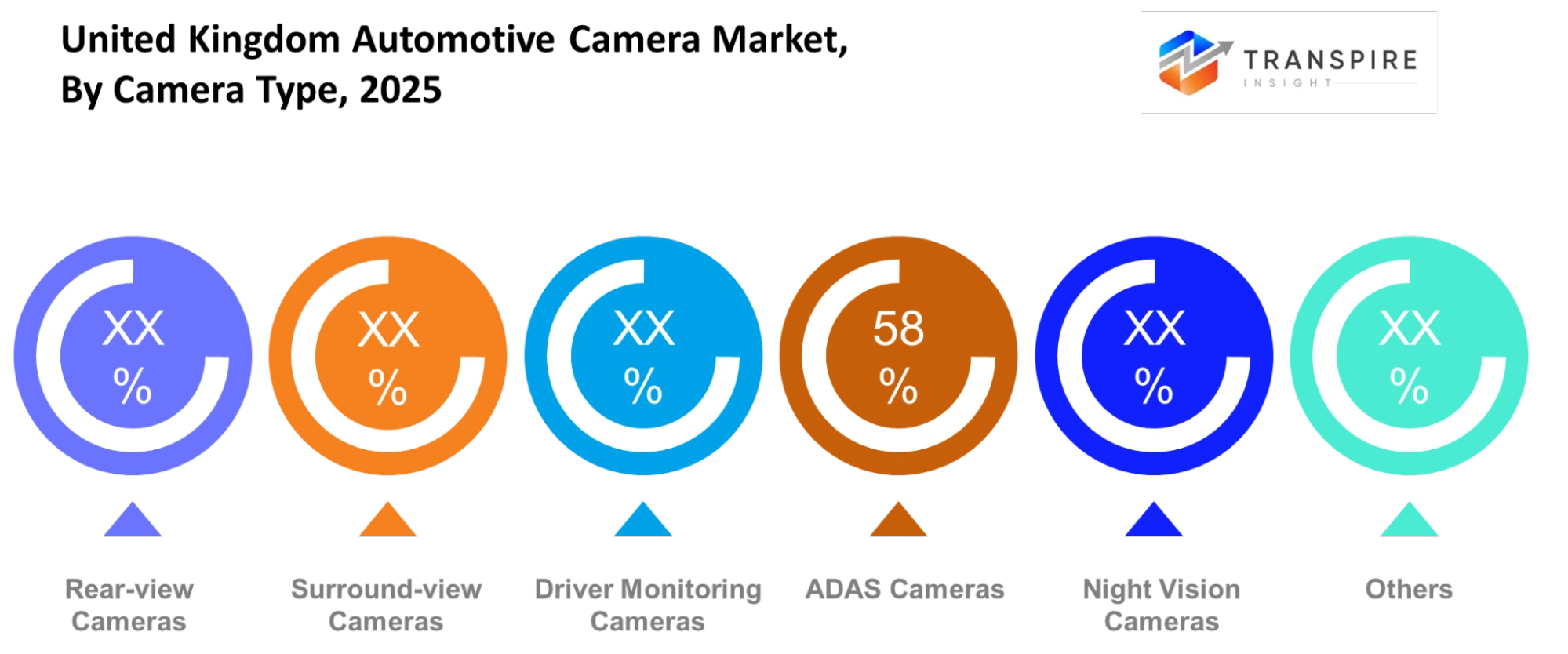
Rear-view cameras still hold the dominant position in this camera-type segment, mostly because safety regulations are kind of mandatory and because they’re near-universal in new passenger vehicles, so yeah. Surround-view systems are close behind, helped by the growing demand in SUVs and premium cars where parking assistance really matters, plus urban maneuverability is not negotiable. ADAS cameras are expanding pretty fast too as safety requirements keep tightening across European vehicle rules, while driver monitoring cameras get more and more attention due to fatigue detection expectations in commercial fleets. Night vision, and a few other specialized options, stay somewhat niche, mainly since costs are higher and mass-market integration is limited, not great, you know.
Rear-view systems grow primarily due to regulatory enforcement not exactly technological differentiation, and that creates a fairly stable baseline demand across all OEM categories. Surround-view and ADAS cameras grow because consumers like convenience, plus they want automated safety functions, especially during dense city driving. Driver monitoring systems move forward because fleet liability worries are rising and insurance-linked safety incentives start to show up more often. These main drivers are a bit different, with regulation anchoring rear-view demand, while intelligence-led features push growth in the premium tiers.
Looking ahead, growth will lean toward ADAS and AI-enhanced camera modules as vehicle architectures become more software-defined. Rear-view cameras should stabilize in total volume, but they’ll likely lose relative share of value. Surround-view and driver monitoring systems will be pulled into unified perception platforms, so system complexity increases and supplier consolidation follows. Product developers will need to prioritize multi-function camera modules rather than treating them like standalone units only, and that changes the whole development approach, a lot.
To learn more about this report, Download Free Sample Report
By Vehicle Type
Passenger cars take the largest share of the vehicle-type segment, largely because production volumes remain high and safety systems are already kind of everywhere across both mass-market and premium models. SUVs add a solid second-place share, helped by tighter uptake of surround-view and parking-assistance features, mostly because the cars are bigger and the urban routine makes detection harder. Commercial vehicles are smaller, though still kind of strategically crucial, since fleet safety rules and logistics-efficiency demands keep pulling on budgets. Electric vehicles are moving fast too, since newer platforms slot in sensor architectures early on, like before anything else really.
The passenger car rise happens from regulatory compliance and the very broad consumer move toward driver assistance features. SUVs show stronger pull for multi camera setups , mainly because visibility issues build up as vehicle size increases, which creates a pretty natural demand for improved perception systems. Commercial vehicles grow through operational safety obligations and insurance-tied fleet monitoring programs . Electric vehicles are expanding because redesign cycles allow OEMs to integrate electronic and camera-based systems much deeper than older combustion-oriented architectures.
In the future , the real momentum should mostly gather around electric vehicles as OEMs build centralized computing and sensor heavy setups. Passenger cars will stay the volume anchor, but expect margin stress due to commoditization. SUVs will keep feeding premium camera system demand especially in city mobility situations. Commercial vehicles will shift toward telematics linked camera ecosystems that blend safety with operational analytics, kind of in one package.
By Technology
In the technology segment, digital cameras dominate, mostly because they’re cost efficient, easy to scale, and they match well with mainstream ADAS deployments. AI-enabled cameras are growing the quickest, too, as perception starts moving away from just raw image capture, toward real-time object finding and basically decision support. Infrared and thermal cameras are still kind of stuck in high end and specialized arenas, like night driving and defense-adjacent scenarios, so they don’t spread everywhere. Other older imaging approaches keep slipping back, especially as software-defined imaging becomes the new norm.
Digital systems lead because they plug into existing vehicle architectures without much drama, and they also help standardized production across multiple OEM lineups. AI-enabled systems expand as demand for autonomous capability rises, and teams need less dependence on separate external processing units. Infrared and thermal solutions keep growing in tight environments, where visibility constraints drive stronger sensing, but pricing remains high, which naturally limits scale. Taken together, these forces show a move away from hardware-first imaging toward a more computation driven perception workflow.
Going forward, development will likely tilt toward AI-enabled cameras that are paired with edge computing chips inside vehicles. Digital cameras will remain important, but they’ll serve more as supporting components in multi-sensor setups. Thermal and infrared options should grow selectively, mainly in premium packages and safety-critical segments. Investors, meanwhile, will tend to favor companies that blend sensor hardware with embedded AI software capability , rather than treating them as separate worlds.
By Application
Parking assistance seems to lead this segment, largely because it’s been picked up pretty widely across mass market and premium vehicles, and also because dense city driving is kind of everywhere now, plus people just want convenience, so the adoption snowballs. Then lane departure warning plus collision avoidance sits in a strong second tier, driven by regulatory safety needs and insurance nudges. Driver monitoring apps are coming along fairly steadily, too, since fatigue detection is being treated as a compliance requirement in commercial transport and ride-hailing fleets as well. Everything else is more scattered, less standardized across OEM platforms, and it doesn’t really gel the same way.
Parking assistance is growing mainly because it delivers immediate user value and reduces the likelihood of minor incidents, making it an easy sell for a quick OEM rollout. Lane departure and collision avoidance are expanding because mandatory safety rules basically compel integration across almost all new vehicle categories. Driver monitoring is being pulled more by regulation and fleet safety math than by straight-up consumer preference. Also, each app kind of follows its own driver, from pure convenience to compliance duty to liability reduction, depending on the use case.
Going forward, adoption should tilt toward integrated multi function safety systems that merge parking, collision handling, and driver monitoring into one unified software platform. Standalone applications will likely shrink as software consolidation keeps increasing. Commercial fleet operators should add extra momentum, especially for monitoring linked analytics systems. In practice, developers will need to move away from single use applications toward integrated perception ecosystems if they want to stay competitive.
What are the Key Use Cases Driving the United Kingdom Automotive Camera Market?
Advanced driver assistance systems sort of form the core use case in the United Kingdom automotive camera market, and honestly it feels like that’s the point everybody keeps coming back to. Automakers usually bring in forward-facing cameras and surround-view cameras, to help with lane keeping and automatic emergency braking ,plus pedestrian detection. A lot of this is pushed along by Euro NCAP safety expectations and insurer pressure, which is pretty consistent year to year. This application also drives the highest demand because it’s now built into nearly all new passenger vehicles, both mass-market and premium, so it’s no longer a niche.
Nearby demand is also climbing, especially for driver-monitoring systems and parking-assistance solutions. You can see it most clearly in premium passenger cars and in shared mobility fleets. On top of that commercial vehicle operators are adopting multi-camera arrangements for blind spot detection and even cargo monitoring, with the goal to boost operational safety and reduce liability risk. These uses tend to keep growing because fleet owners want compliance, and they want fewer accidents, like pretty straightforward.
There are also some emerging use cases that sound a bit more future-leaning. For example autonomous valet parking in controlled environments, and camera-based predictive maintenance where the system spots external vehicle damage. There’s also increasing interest in AI enabled cabin monitoring for ride-hailing services, to raise passenger safety and make compliance easier. These items are still early-stage, but they’re expected to pick up once software-defined vehicles scale across the UK market.
|
Report Metrics |
Details |
|
Market size value in 2025 |
USD 940.56 Million |
|
Market size value in 2026 |
USD 1049.12 Million |
|
Revenue forecast in 2033 |
USD 2277.81 Million |
|
Growth rate |
CAGR of 11.71% from 2026 to 2033 |
|
Base year |
2025 |
|
Historical data |
2021 - 2024 |
|
Forecast period |
2026 - 2033 |
|
Report coverage |
Revenue forecast, competitive landscape, growth factors, and trends |
|
Regional scope |
United Kingdom |
|
Key company profiled |
Bosch, Continental AG, Valeo, Denso, Magna International, Aptiv, Mobileye, Hyundai Mobis, ZF Friedrichshafen, Veoneer, Panasonic Automotive, Garmin, Sony, Hitachi Astemo, HELLA. |
|
Customization scope |
Free report customization (country, regional & segment scope). Avail customized purchase options to meet your exact research needs. |
|
Report Segmentation |
By Camera Type (Rear-view Cameras, Surround-view Cameras, Driver Monitoring Cameras, ADAS Cameras, Night Vision Cameras, Others); By Vehicle Type (Passenger Cars, SUVs, Commercial Vehicles, Electric Vehicles, Others); By Technology (Digital Cameras, Infrared Cameras, AI-enabled Cameras, Thermal Cameras, Others); By Application (Parking Assistance, Lane Departure Warning, Collision Avoidance, Driver Monitoring, Others). |
Which Regions are Driving the United Kingdom Automotive Camera Market Growth?
Europe still holds the top spot in the automotive camera market, with the United Kingdom playing a rather strong “second fiddle” role, partly because of how quickly ADAS is adopted and how well safety rules align with Euro NCAP standards. In other words the region kind of enjoys this dense network of Tier 1 suppliers, automotive research and development hubs, and also a high level of premium vehicle production. OEMs in Germany, France and the UK tend to push sooner integration of multi-camera systems for lane keeping, driver monitoring, and sort of “autonomous readiness”. So, the regulatory push plus those solid engineering clusters keeps Europe ahead in high-value camera system deployments , not really in the “churn out more units” kind of expansion.
North America comes next as a fairly steady contributor, and it’s mainly supported by consistent fleet renewal schedules and continued OEM spending from Detroit based manufacturers. Instead of being led mostly by regulation like Europe, this region is more driven by what consumers want—advanced safety bundles—and by the need to do large scale software integration across many vehicle lines. Also, vertically integrated automakers help keep demand stable for standardized camera modules across pickup trucks, SUVs, and commercial fleets. On top of that, investments in autonomy testing corridors, plus long term supplier agreements, create predictable revenue streams for camera system suppliers even if there isn’t aggressive regulatory acceleration.
Asia Pacific is growing the fastest, with China’s rapid EV uptake, India moving toward higher ADAS requirements, and Southeast Asia investing heavily in smart mobility infrastructure. More recently, there’s been a noticeable lift in local semiconductor production, and government backed intelligent transport programs, which has lowered the entry barrier for deploying camera modules.This shift is also driven by aggressive domestic OEM competition, which forces rapid innovation cycles in perception systems. For entrants and investors, Asia Pacific offers the strongest volume upside through 2026 to 2033, but it also demands high localization capability and cost-optimized camera architectures to remain competitive.
Who are the Key Players in the United Kingdom Automotive Camera Market and How Do They Compete?
The UK auto camera market is kind of moderately consolidated at the Tier 1 supplier level, but it keeps getting more scrambled by software-driven new players. You mostly see fighting over system integration, AI-enabled image processing, and meeting Euro NCAP safety requirements. Even if the older companies still try to hold tight to platform roles using long term OEM contracts, the “what actually matters” part is sliding away from hardware cost and toward better perception accuracy and cross-platform scalability across different vehicle architectures, not just one type.
Bosch leans into vertically integrated camera-and-radar fusion systems, so it backs this with deeper OEM involvement and ADAS architectures that can scale across European programs. Continental AG meanwhile pushes modular camera setups combined with domain control units, and then leans on software defined driving capabilities to secure long-term OEM commitments. Valeo differentiates by going for high-resolution imaging plus automated parking, and they keep expanding through co-development partnerships with European automakers, while also reinforcing their speciality in advanced optical sensing performance.
Mobileye takes the software first route, with EyeQ processors and perception algorithms as the core, and they’re expanding via multi OEM deployment of standardized ADAS stacks. ZF Friedrichshafen takes camera inputs and folds them into full vehicle motion control, basically tying perception together with braking and steering domains, so they can win platform wide agreements. Sony stays in an upstream strong spot by supplying CMOS sensors tuned for low light automotive vision, and these get reused across several Tier 1 integrators.
Company List
- Bosch
- Continental AG
- Valeo
- Denso
- Magna International
- Aptiv
- Mobileye
- Hyundai Mobis
- ZF Friedrichshafen
- Veoneer
- Panasonic Automotive
- Garmin
- Sony
- Hitachi Astemo
- HELLA
Recent Development News
“In January 2026, Mobileye announced that a US-based automaker selected its EyeQ6H-based Surround ADAS platform.” The system, which relies heavily on multi-camera sensor fusion, is expected to scale across millions of vehicles globally, indirectly strengthening demand for camera modules and validation ecosystems used by UK-linked OEM supply chains such as Volkswagen Group operations in Britain.
Source: https://ir.mobileye.com
“In May 2025, Mobileye announced a global automaker selection of its Imaging Radar technology for Level 3 automated driving.” While radar-led, the system is tightly integrated with high-resolution camera arrays for perception redundancy, reinforcing the shift toward multi-camera ADAS stacks that underpin UK vehicle safety compliance and future autonomous deployment roadmaps.
Source: https://ir.mobileye.com
What Strategic Insights Define the Future of the United Kingdom Automotive Camera Market?
The United Kingdom automotive camera market is kind a moving toward deeper ADAS integration and software-defined perception systems, and the demand is getting shaped more and more by safety mandates, insurance-linked telematics, and semi-autonomous driving features. Over the next 5–7 years, value creation is likely to shift away from standalone hardware and toward AI-enabled vision stacks embedded across different vehicle platforms, as OEM consolidation accelerates and safety expectations tighten.
There’s also a risk that’s a bit less visible… like over-reliance on a concentrated CMOS sensor, plus the chipset supply chain. If geopolitics stirs up disruption, or export controls get more strict, margins could get compressed pretty fast, and deployment cycles can slow down. At the same time, an opportunity is slowly building in AI-enhanced aftermarket solutions and commercial fleet retrofits, where regulators and insurers are starting to encourage vision-based safety upgrades, before full autonomy really lands everywhere.
So market participants should really prioritize vertically integrated partnerships that blend hardware, edge AI, and software services—so they can defend margins and also capture recurring revenue streams.
United Kingdom Automotive Camera Market Report Segmentation
By Camera Type
- Rear-view Cameras
- Surround-view Cameras
- Driver Monitoring Cameras
- ADAS Cameras
- Night Vision Cameras
- Others
By Vehicle Type
- Passenger Cars
- SUVs
- Commercial Vehicles
- Electric Vehicles
- Others
By Technology
- Digital Cameras
- Infrared Cameras
- AI-enabled Cameras
- Thermal Cameras
- Others
By Application
- Parking Assistance
- Lane Departure Warning
- Collision Avoidance
- Driver Monitoring
- Others
Frequently Asked Questions
Find quick answers to common questions.
The expected United Kingdom Automotive Camera Market size is USD 2277.81 Million in 2033.
Key segments for the United Kingdom Automotive Camera Market are By Camera Type (Rear-view Cameras, Surround-view Cameras, Driver Monitoring Cameras, ADAS Cameras, Night Vision Cameras, Others); By Vehicle Type (Passenger Cars, SUVs, Commercial Vehicles, Electric Vehicles, Others); By Technology (Digital Cameras, Infrared Cameras, AI-enabled Cameras, Thermal Cameras, Others); By Application (Parking Assistance, Lane Departure Warning, Collision Avoidance, Driver Monitoring, Others).
Major United Kingdom Automotive Camera Market players are Bosch, Continental AG, Valeo, Denso, Magna International, Aptiv, Mobileye, Hyundai Mobis, ZF Friedrichshafen, Veoneer, Panasonic Automotive, Garmin, Sony, Hitachi Astemo, HELLA.
The United Kingdom Automotive Camera Market size is USD 940.56 Million in 2025.
The United Kingdom Automotive Camera Market CAGR is 11.71% from 2026 to 2033.
- Bosch
- Continental AG
- Valeo
- Denso
- Magna International
- Aptiv
- Mobileye
- Hyundai Mobis
- ZF Friedrichshafen
- Veoneer
- Panasonic Automotive
- Garmin
- Sony
- Hitachi Astemo
- HELLA
Recently Published Reports
-
Apr 2026
ATV & UTV Market
ATV & UTV Market Size, Share & Analysis Report By Type (ATV, and UTV), By Variants (Less Than 400 CC, 400 CC To 800 CC, and More Than 800 CC), and Geography (North America, Europe, Asia-Pacific, Middle East and Africa, South and Central America), 2021 - 2031
-
Apr 2026
Automotive Central Gateway Module Market
Automotive Central Gateway Module Market Size, Share & Analysis Report By Type (Ethernet Central Gateway Module, CAN Central Gateway Module, LIN Central Gateway Module, and FlexRay), By Application (Powertrain Control, Body Control, Infotainment System, Advanced Driver Assistance Systems (ADAS), and Others), By End User (Passenger Vehicles, and Commercial Vehicles), and Geography (North America, Europe, Asia-Pacific, Middle East and Africa, South and Central America), 2021 - 2031
-
Apr 2026
Automotive Engine Oil Filter Market
Automotive Engine Oil Filter Market Size, Share & Analysis Report By Filter Type (Fuel Filter, Engine Oil Filter, Hydraulic Oil Filter, and Others), By Filter Media (Cellulose, Synthetic, and Micro), By Sales Channel (OEMs, and Aftermarket), By Vehicle Type (Passenger Cars, Light Commercial Vehicles, Heavy Duty Trucks, Buses and Coaches, and Off-road Vehicles), and Geography (North America, Europe, Asia-Pacific, Middle East and Africa, South and Central America), 2021 - 2031
-
Apr 2026
Automotive Parts Aluminium Die Casting Market
Automotive Parts Aluminium Die Casting Market Size, Share & Analysis Report By Production Process (Pressure Die Casting, Vacuum Die Casting, Squeeze Die Casting, Gravity Die Casting), By Application (Body Parts, Engine Parts, Transmission Parts, Battery And Related Components, Other Application Types), and Geography (North America, Europe, Asia-Pacific, Middle East and Africa, South and Central America), 2021 - 2031
Our Clients