
Middle East and Africa District Cooling Market Size & Forecast:
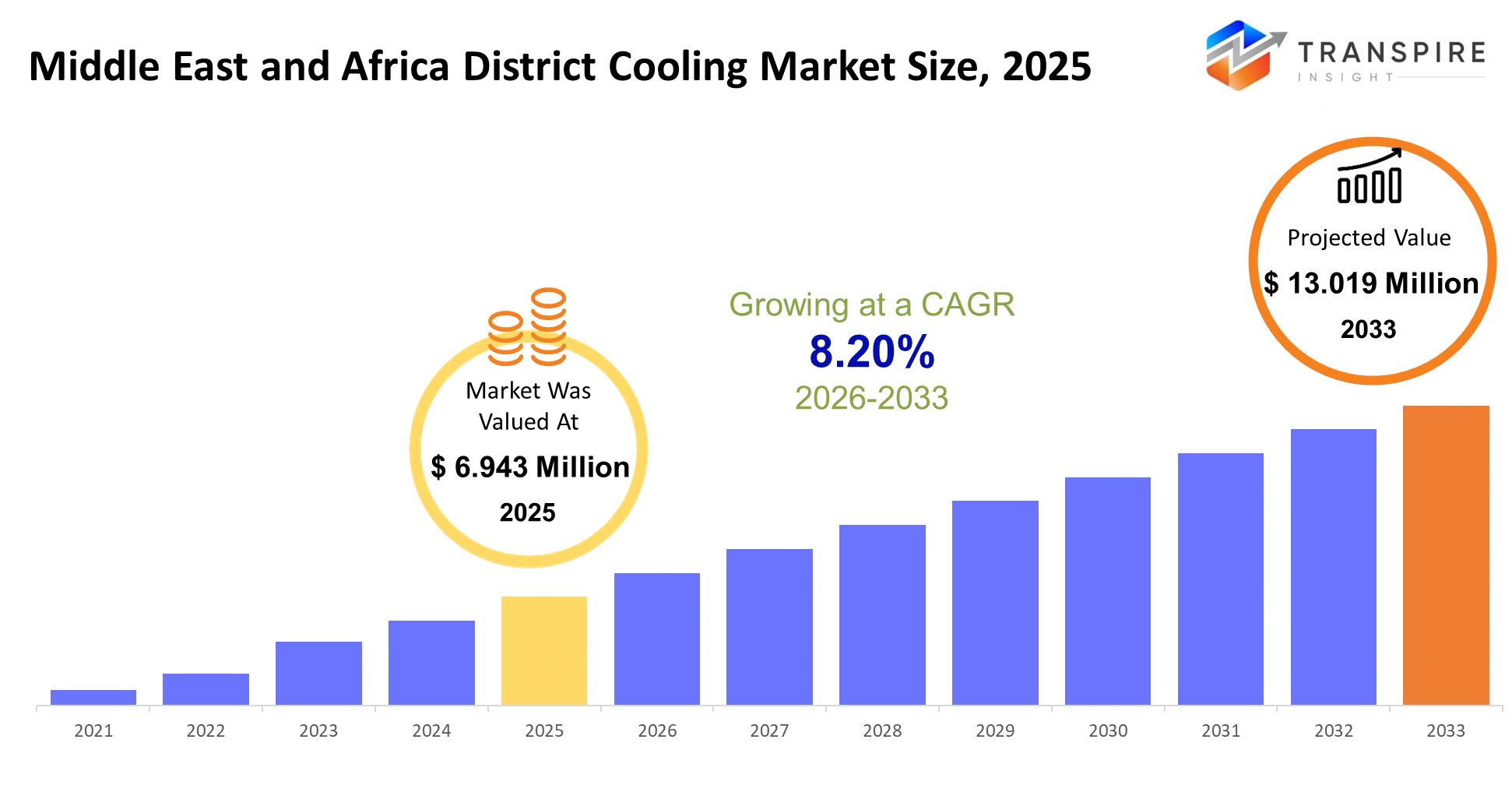
- Middle East and Africa District Cooling Market Size 2025: USD 6.943 Million
- Middle East and Africa District Cooling Market Size 2033: USD 13.019 Million
- Middle East and Africa District Cooling Market CAGR: 8.20%
- Middle East and Africa District Cooling Market Segments: By Technology (Electric Chillers, Absorption Chillers), By Cooling Type (Centralized, Decentralized), By Component (Chillers, Cooling Towers, Pumps), By Application (Commercial, Residential, Industrial), By End-User (Utilities, Real Estate Developers, Industrial Facilities)
To learn more about this report,  Download Free Sample Report
Middle East and Africa District Cooling Market Summary:
The Middle East and Africa District Cooling Market size is estimated at USD 6.943 Million in 2025 and is anticipated to reach USD 13.019 Million by 2033, growing at a CAGR of 8.20% from 2026 to 2033. The district cooling market in the Middle East and Africa region which includes Saudi Arabia, United Arab Emirates and South Africa together with the Rest of Middle East and Africa market operates within the energy and utilities sector because it determines how cities will handle heat management in their urban areas. The system will meet increasing demands for efficient and quiet centralized cooling systems which developers need to construct their mixed-use facilities. The government will enforce stricter building codes which will establish higher cooling standards that promote the use of chilled water networks instead of independent cooling systems. Organizations will enhance their operations through digital monitoring and thermal storage technology and smart metering while customers will anticipate receipt of service with fixed pricing. Urban development together with climate change will cause demand to increase according to infrastructure development requirements.
What Has the Impact of Artificial Intelligence Been on the Middle East and Africa District Cooling Market?
The Middle East and Africa district cooling market undergoes permanent transformation because artificial intelligence technology changes every aspect of data collection and analysis and real-time data usage. Middle East and Africa district cooling market operations use artificial intelligence to conduct deeper market analysis through advanced data analytics which enables machine learning models to accurately analyze consumption patterns and weather conditions and urban density data. The stakeholders will use this method to track changes in demand at micro-levels while they improve their resource planning methods. Artificial intelligence systems will improve demand prediction accuracy for Middle East and Africa district cooling systems, which will help power companies forecast peak demand periods and achieve optimal cooling distribution with minimum operational waste.
The production efficiency of centralized cooling plants will benefit from smart automation systems and predictive technology which go beyond basic analysis. The Middle East and Africa district cooling market implements AI-powered monitoring systems that identify operational issues and forecast maintenance requirements while decreasing service interruptions. The solution will reduce energy expenditures while extending the lifespan of the asset.
Key Market Trends & Insights:
- Saudi Arabia & United Arab Emirates hold the largest market share in the Middle East and Africa district cooling market in 2025 owing to mega urban development projects.
- South Africa is set to be the fastest-growing market till 2030, thanks to increased commercial infrastructural developments and energy optimization schemes.
- Centralized cooling accounts for more than 60% market share in 2025, owing to large-scale projects in real estate and industries.
- Standalone cooling is the second widely adopted technology due to its adaptability in smaller projects.
- Thermal energy storage would emerge as the fastest growing market by 2030 due to its application in peak load shaving and energy efficiency.
- The commercial real estate industry holds the largest market share of over 65% due to its applications in retail, office buildings, and hospitality sectors.
- Residential complexes are set to witness fast demand growth with smart city schemes and growing urbanization rate.
- Government and infrastructure developers form the leading end user in the Middle East and Africa district cooling market accounting for nearly 50%.
Middle East and Africa District Cooling Market Segmentation
By Technology
Electric chillers will still be preferred due to their constant operation and compatibility with contemporary power grid networks. Such equipment can facilitate huge projects where the provision of stable electricity supply is assured, thus delivering efficient cooling capacity throughout different times of the year. The emergence of absorption chillers will also receive considerable focus where there are sources of waste heat and other forms of energy. This strategy will help minimize reliance on electricity while promoting sustainable development in power-intensive regions.
The choice of technology between electric and absorption will be influenced by the degree of development of facilities and the availability of fuels. Industrial plants and commercial buildings will adopt a combination system that seeks to achieve efficiency while being economical.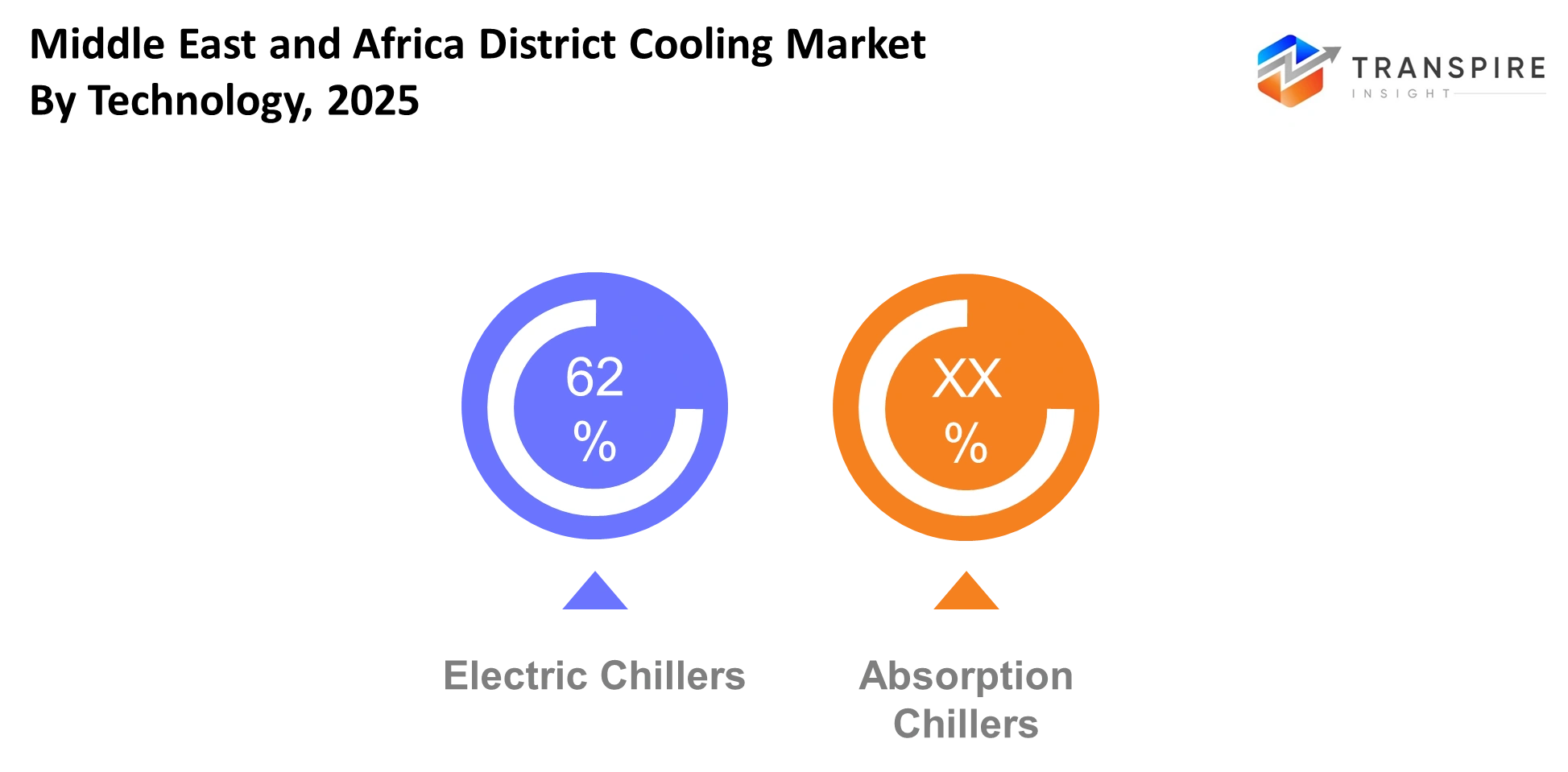
To learn more about this report, Download Free Sample Report
By Cooling Type
Centralized air conditioning systems will be more predominant in cases where there is connection of many buildings with one centralized cooling plant. This will allow saving money by reducing the number of duplicate machines. Decentralized air conditioning systems will continue to be useful in cases where there is no much infrastructure in place.
In terms of deciding whether to use centralized or decentralized air conditioning system, it will be based on the scale of project. Centralized systems will favor smart cities whereas decentralized systems will favor standalone buildings.
By Component
The chillers will be the central element, where chilled water will be produced. Constantly improving technology for chillers will increase energy efficiency and life expectancy. The cooling towers will be engaged in heat rejection; they will play an important role in achieving a balanced system. The pumps will facilitate water flow in the network, thus having an impact on performance.
All elements will need constant upgrading depending on new demands and efficiency criteria. The use of advanced sensors will make monitoring easier. Coordination among all these elements will result in efficient performance.
By Application
The business areas, including shopping centers, office complexes, and hotels, will also make up an important customer base due to the requirement for proper air conditioning. The business areas will need proper temperature control throughout the year to conduct operations comfortably. The residential sector will steadily increase as more urban housing projects arise. There will be increased demand in areas of dense population where cooling can be easily centralized.
Industrial consumption will center on process cooling in processes where regulation of temperature is necessary. Industrial facilities and processing plants will integrate cooling systems to improve productivity and product quality.
By End-User
Utility companies will be at the heart of planning and providing district cooling facilities within cities. Utility companies will concentrate on building infrastructures and delivering services for years to come. Developers of real estates will be key proponents of district cooling systems because they will incorporate district cooling within their developments in order to attract tenants.
Factories and industries will be keen on adopting systems that meet their energy needs. All the users will be involved in planning and investment decision-making based on their needs.
What are the Main Challenges for the Middle East and Africa District Cooling Market Growth?
Challenges facing the Middle East and Africa district cooling market in terms of technicalities include those arising from network complexity, energy consumption during the period of high energy use, and maintaining a big cooling system. Climate variations across the regions will also pose challenges for the cooling process. All these challenges in Middle East and Africa district cooling market operations will call for continued monitoring and application of control techniques in order to achieve efficiency.
Barriers related to manufacturing and commercialization will pose a big challenge to expansion in Middle East and Africa district cooling market. Capital investment for setting up a plant coupled with approvals and compliance will pose barriers in the project realization process. Import of equipment will also be faced by challenges such as delay which may hamper the projects rollout processes.
Adoption issues will continue to be an obstacle, especially in developing nations where infrastructural and financing problems still exist. The Middle East and Africa district cooling market will find it difficult due to poor awareness levels, shortage of trained personnel, and inadequate compatibility with current city planning programs. Such limitations in the market will hinder adoption, especially in developing countries where distributed options become a more practical choice.
Alternative cooling technology, like independent HVAC systems, will pose price competition, leading to lower adoption rates. Energy policy and technological changes will also introduce additional uncertainties, forcing the Middle East and Africa district cooling market to continually evolve.
Country Insights
The Middle East and Africa district cooling market will experience continuous business expansion together with rising requirements for energy-saving cooling systems which protect regions with hot weather. The establishment of large infrastructure projects will drive central cooling system adoption while energy efficiency will receive support from existing policies and regulations. The implementation of advanced automation systems will provide essential support for improved process management.
Saudi Arabia and the United Arab Emirates will lead the adoption of these technologies because both countries currently experience extensive construction activities. Government infrastructure projects will provide necessary cooling systems for commercial buildings which operate at high occupancy levels. The development of smart cities will create new opportunities for technology implementation.
The South African market together with other developing markets will experience gradual economic development through increased urbanization and knowledge about energy-saving technologies. The regions will determine their growth capacity based on the funding available for their infrastructure projects.
Recent Development News
In April 2026, Emirates Central Cooling Systems Corporation (Empower) announced a new district cooling supply agreement. The company will deliver over 17,500 refrigeration tonnes to major Dubai developments, expanding service coverage and supporting large-scale real estate projects.https://www.districtenergy.org/
In January 2026, National Central Cooling Company PJSC (Tabreed) was announced as a lead partner for the Sustainability Forum Middle East 2026. The move highlighted its growing role in advancing energy-efficient cooling solutions and supporting regional climate initiatives.https://www.tradingview.com/
|
Report Metrics |
Details |
|
Market size value in 2025 |
USD 6.943 Million |
|
Market size value in 2026 |
USD 7.497 Million |
|
Revenue forecast in 2033 |
USD 13.019 Million |
|
Growth rate |
CAGR of 8.20% from 2026 to 2033 |
|
Base year |
2025 |
|
Historical data |
2021 - 2024 |
|
Forecast period |
2026 - 2033 |
|
Report coverage |
Revenue forecast, competitive landscape, growth factors, and trends |
|
Regional scope |
Middle East and Africa (Saudi Arabia, United Arab Emirates, South Africa, Rest of Middle East and Africa) |
|
Key company profiled |
Tabreed, Engie, Veolia, Emirates Central Cooling, Empower, ADC Energy Systems, Siemens, Johnson Controls, Daikin, Trane, Carrier, Mitsubishi Electric, Samsung, LG, Thermax |
|
Customization scope |
Free report customization (country, regional & segment scope). Avail customized purchase options to meet your exact research needs. |
|
Report Segmentation |
By Technology (Electric Chillers, Absorption Chillers), By Cooling Type (Centralized, Decentralized), By Component (Chillers, Cooling Towers, Pumps), By Application (Commercial, Residential, Industrial), By End-User (Utilities, Real Estate Developers, Industrial Facilities) |
How Can New Companies Establish a Strong Foothold in the Middle East and Africa District Cooling Market?
The emerging enterprises will be able to create an excellent footing in the Middle East and Africa district cooling market by concentrating on the neglected areas rather than challenging the well-established utility-scale players. By focusing on mid-sized projects, industrial hubs, or hospital compounds, new businesses will be able to cater to particular cooling requirements by offering customized services. There is an increasing interest in adaptable and scalable facilities within the Middle East and Africa district cooling market, where new organizations can provide faster implementation and lower capital investments than massive central cooling plants.
New approaches will become essential in creating a competitive advantage. Innovations that utilize artificial intelligence for monitoring, predictive maintenance, and energy optimization will help overcome significant efficiency problems within the Middle East and Africa district cooling market. This technology is expected to significantly reduce operational costs and downtime, making the product attractive to software developers and facility managers. For example, some pioneering firms such as Pal Cooling Tech and EcoChill Africa have tried out hybrid cooling technology and solar cooling.
The establishment of strategic partnerships will enhance market entry capabilities. The organization will obtain project access through its partnerships with real estate developers and municipal authorities and infrastructure companies. Smart city projects enable emerging companies to develop their business through increasing demand for energy-efficient cooling solutions.
The infrastructure solutions gap will be used by companies to establish their competitive advantage in the Middle East and Africa district cooling market while developing their long-term credibility.
Key Middle East and Africa District Cooling Market Company Insights
The market for district cooling systems in the Middle East and Africa region will continue to expand because urban areas grow and people require cooling systems that use less energy. The market will experience growth from infrastructure development projects and smart city initiatives while cooling systems will become more efficient through technological progress.
The major companies that control the market include Emirates Central Cooling Systems Corporation Empower and National Central Cooling Company PJSC Tabreed because these companies operate extensive infrastructure systems and establish permanent business contracts. The market will experience substantial progress through ongoing funding for infrastructure development.
The international companies Engie and Veolia will obtain a technological advantage in the market by establishing strategic partnerships and developing advanced monitoring systems.
Company List
- Tabreed
- Engie
- Veolia
- Emirates Central Cooling
- Empower
- ADC Energy Systems
- Siemens
- Johnson Controls
- Daikin
- Trane
- Carrier
- Mitsubishi Electric
- Samsung
- LG
- Thermax
What are the Key Use-Cases Driving the Growth of the Middle East and Africa District Cooling Market?
Commercial buildings form one of the key application areas that will help the Middle East and Africa district cooling market gain momentum. It involves large malls, commercial office buildings, and other hospitality venues requiring constant cooling. The need for district cooling systems will be high for such applications, as centralized systems work more efficiently compared to independent cooling units. The need for energy-efficient solutions will play into the hands of the Middle East and Africa district cooling market.
One of the other key areas which the Middle East and Africa district cooling market will gain momentum from includes healthcare facilities. Hospital premises will have a requirement for efficient district cooling systems, which will ensure optimal indoor temperature and good air quality management.
There will be more contributions from factories and other industrial/manufacturing companies. Many of the production processes will need temperature control to preserve the products’ quality and enhance efficiency. The Middle East and Africa district cooling market is expected to support industrial facilities by providing efficient and scalable cooling technologies that can cut costs.
There will be increased contributions from residential areas and mixed-used buildings. Cooling technology is an important component of smart cities and urban areas. It will provide convenience, less noise, and reduced maintenance efforts for the users.
Middle East and Africa District Cooling Market Report Segmentation
By Technology
- Electric Chillers
- Absorption Chillers
By Cooling Type
- Centralized
- Decentralized
By Component
- Chillers
- Cooling Towers
- Pumps
By Application
- Commercial
- Residential
- Industrial
By End-User
- Utilities
- Real Estate Developers
- Industrial Facilities
Frequently Asked Questions
Find quick answers to common questions.
The Approximate Middle East and Africa District Cooling Market size for the Market will be USD 13.019 Million in 2033.
Key Segments for the Middle East and Africa District Cooling Market are By Technology (Electric Chillers, Absorption Chillers), By Cooling Type (Centralized, Decentralized), By Component (Chillers, Cooling Towers, Pumps), By Application (Commercial, Residential, Industrial), By End-User (Utilities, Real Estate Developers, Industrial Facilities).
Major Middle East and Africa District Cooling Market Players are Tabreed, Engie, Veolia, Emirates Central Cooling, Empower, ADC Energy Systems, Siemens, Johnson Controls, Daikin, Trane, Carrier, Mitsubishi Electric, Samsung, LG, Thermax.
The Current Middle East and Africa District Cooling Market size is USD 6.943 Million in 2025.
The Middle East and Africa District Cooling Market CAGR is 8.20%.
- Tabreed
- Engie
- Veolia
- Emirates Central Cooling
- Empower
- ADC Energy Systems
- Siemens
- Johnson Controls
- Daikin
- Trane
- Carrier
- Mitsubishi Electric
- Samsung
- LG
- Thermax
Recently Published Reports
-
Dec 2025
Biosimilars Market
Biosimilars Market By Product Type (Monoclonal Antibodies, Recombinant Hormones, Erythropoietin, G-CSF, Others), By Indication (Oncology, Autoimmune Diseases, Blood Disorders, Diabetes, Others), By Manufacturing Type (In-House Manufacturing, Contract Manufacturing), By Distribution Channel (Hospital Pharmacies, Retail Pharmacies, Online Pharmacies), By Industry Analysis, Size, Share, Growth, Trends, and Forecasts 2021-2033
-
Dec 2025
Gastrointestinal Endoscopy Market
Gastrointestinal Endoscopy Market By Type (Rigid Gastrointestinal Endoscope, Flexible Gastrointestinal Endoscopes, Disposable Gastrointestinal Endoscope), By Procedure Type (Colonoscopy, Gastroscopy, Duodenoscopy, Enteroscopy, Flexible Sigmoidoscopy, Others), By Application (Diagnosis, Treatment), By End-Users (Hospitals, Ambulatory Surgical Centers, Specialty Clinics, Laboratories, Others), By Industry Analysis, Size, Share, Growth, Trends, and Forecasts 2021-2033
-
Jan 2026
Rare Inherited Metabolic Disorder Drug Market
Rare Inherited Metabolic Disorder Drug Market By Drug Class (Enzyme Replacement Drugs, Gene Therapy Drugs, Substrate Reduction Drugs, Small Module Drugs, Protein Drugs), By Route of Administration(Parenteral, Oral, Intrathecal), By Clinical Development (Marketed Drugs, Late Stage Clinical Phase III, Early Stage Clinical Phase I-II, Preclinical Candidates), By Indication (Lysosomal Storage Disorders, Urea Cycle Disorders, Amino Acid Metabolic Disorders, organic Acidemias, Peroximal Disorders), By Industry Analysis, Size, Share, Growth, Trends, and Forecasts 2021-2033
-
Jan 2026
Pharmaceutical Cleanroom Technology Market
Pharmaceutical Cleanroom Technology Market By Product (Equipment, Consumables, Services); By Cleanroom Type (Standard Cleanrooms, Modular Cleanrooms); By End Use (Pharmaceutical Companies, Biotechnology Companies), By Industry Analysis, Size, Share, Growth, Trends, and Forecasts 2021-2033