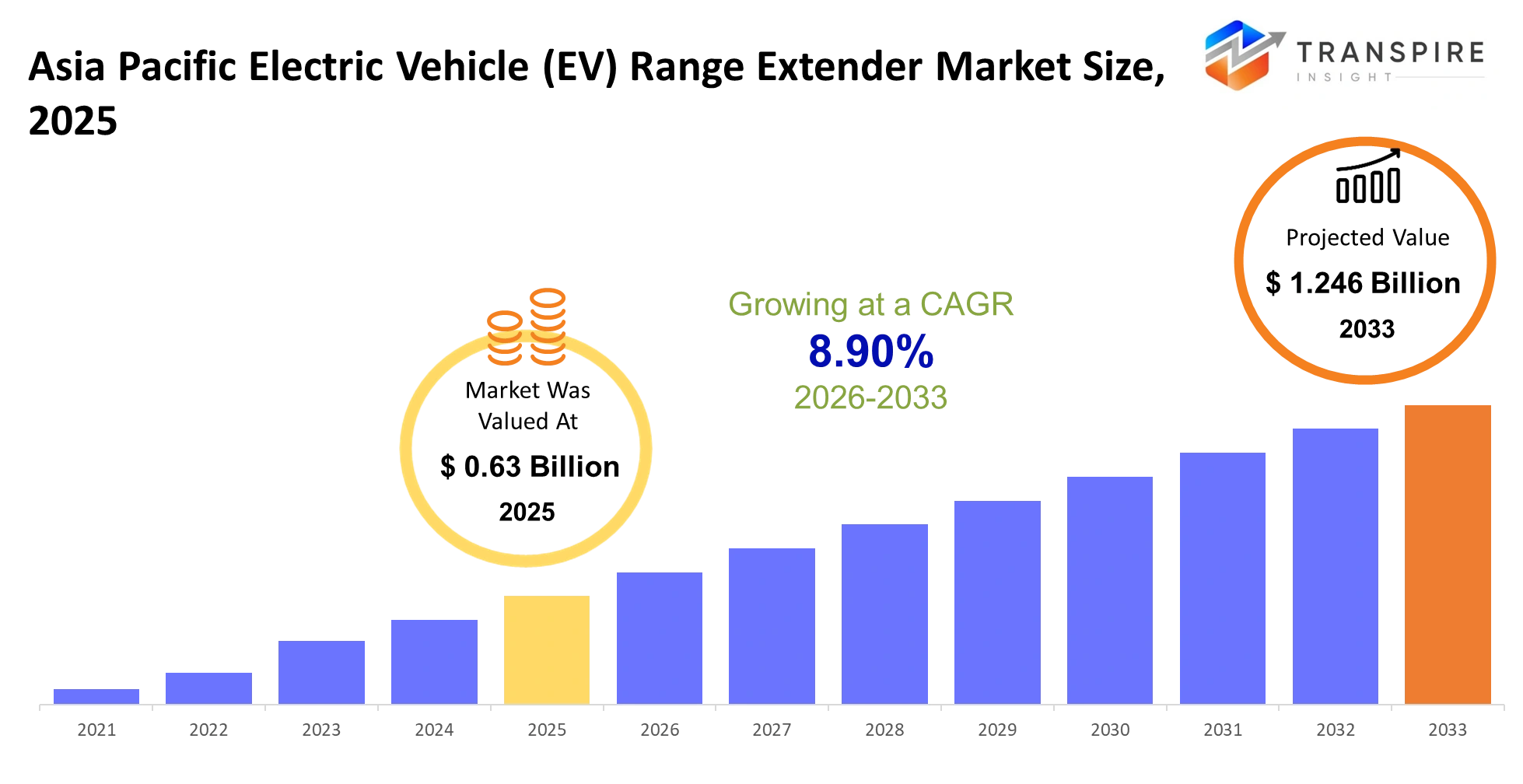
Asia Pacific Electric Vehicle (EV) Range Extender Market Size & Forecast:
- Asia Pacific Electric Vehicle (EV) Range Extender Market Size 2025: USD 0.63 Billion
- Asia Pacific Electric Vehicle (EV) Range Extender Market Size 2033: USD 1.246 Billion
- Asia Pacific Electric Vehicle (EV) Range Extender Market CAGR: 8.90%
- Asia Pacific Electric Vehicle (EV) Range Extender Market Segments: By Type (ICE-based, Fuel Cell-based, Battery-based, Hybrid Extender, Portable, Others); By Application (Passenger Vehicles, Commercial Vehicles, Buses, Trucks, Two-wheelers, Others); By Component (Engine, Generator, Battery Pack, Power Electronics, Control Unit, Others); By End-User (Automotive OEMs, Fleet Operators, Logistics, Govt, Consumers, Others).
To learn more about this report,  Download Free Sample Report
Asia Pacific Electric Vehicle (EV) Range Extender Market Summary:
The Asia Pacific Electric Vehicle (EV) Range Extender Market size is estimated at USD 0.63 Billion in 2025 and is anticipated to reach USD 1.246 Billion by 2033, growing at a CAGR of 8.90% from 2026 to 2033.
The Asia Pacific Electric Vehicle (EV) Range Extender Market operates within the clean mobility and automotive innovation sector which anticipates changing driver requirements because drivers want more flexible driving options than battery performance allows. Urban users will increasingly expect longer travel confidence without relying solely on charging networks, pushing automakers to refine compact auxiliary power units.
Product design will receive influence from advanced lightweight materials and hybridized architectural systems, while China and Japan and India implement governmental policies that establish stricter emission standards yet permit transitional technology use. Consumers will prefer solutions that provide practical efficiency, which drives demand for electric driving solutions that work well in different regional driving conditions.
What Has the Impact of Artificial Intelligence Been on the Asia Pacific Electric Vehicle (EV) Range Extender Market?
The artificial intelligence system now transforms the process of creating insights and making decisions within the Asia Pacific electric vehicle range extender market. The artificial intelligence system for the Asia Pacific electric vehicle range extender market uses vehicle usage data and charging patterns and regional mobility data to improve market research capabilities. Business organizations will use predictive analytics together with machine learning technologies to improve their ability to forecast demand changes, which will enable them to better meet customer needs. The stakeholders in the Asia Pacific electric vehicle range extender market will use artificial intelligence technology to enhance their trend prediction capabilities through advanced data analysis methods that will reveal new user preferences for compact fuel-efficient extender units which are designed for urban and semi-urban environments.
The smart automation system improves production efficiency and operational consistency in the Asia Pacific electric vehicle range extender market through its advanced capabilities. The artificial intelligence system will optimize manufacturing processes by creating efficient workflows and decreasing material waste and boosting quality control through its ability to monitor operations in real time. Machine learning supply chain optimization systems will decrease disruptions by predicting when components will become unavailable and improving delivery routes, which will result in financial savings for the company. The Asia Pacific electric vehicle range extender market will use AI-powered innovation to create customized transportation solutions which help manufacturers meet both their regional needs and their legal responsibilities as market competition increases.
Key Market Trends & Insights:
- China holds the lead in the Asia Pacific electric vehicle (EV) range extender market because it controls more than 45% of the market share in 2025 which results from strong EV production and supportive government policies.
- India will experience the fastest market growth until 2030 because of rising EV demand combined with insufficient charging stations which exist in semi-urban areas.
- The market for ICE-based range extenders shows its highest share at 60% because these systems provide cost savings while customers already know how to use them in mid-range electric vehicle models.
- Fuel cell-based systems hold the second-largest share which expands in developed markets through their adoption by premium and commercial vehicle segments.
- The battery-assisted range extenders market will experience its most significant growth between 2025 and 2030 because of upcoming energy density improvements.
- More than 65% of the market belongs to passenger vehicles because customers want vehicles which provide them with extended range for their daily commuting needs.
- The individual consumer market generates 70% of the market share because customers want affordable options which provide them with secure driving range through EV technology.
- Fleet operators represent the fastest-growing segment which uses predictive analytics and cost optimization to manage their vehicle operations across large fleets.
- The companies drive product development by applying lightweight technologies and fuel-efficient extender systems which create better vehicle functionality while decreasing environmental pollution.
- The number of strategic partnerships between companies now rises because these relationships help organizations share technologies and establish their presence in new regional markets.
Asia Pacific Electric Vehicle (EV) Range Extender Market Segmentation
By Type:
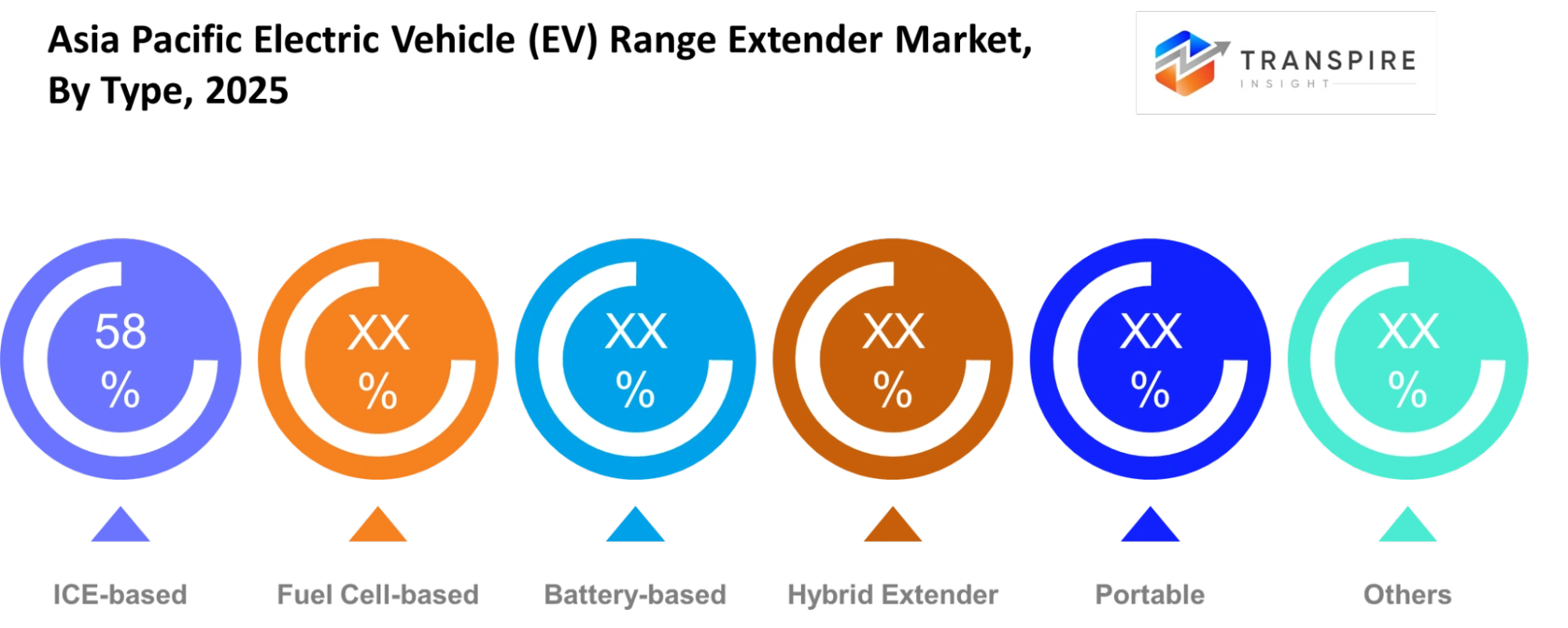
The market for electric vehicle (EV) range extenders in the Asia Pacific region includes three different system types which are ICE-based systems, fuel cell systems and battery systems and hybrid extenders, portable systems and other systems.ICE-based systems will remain widely used because they provide cost advantages through their established supply chains. Hybrid and portable solutions will support flexible use, demonstrating how different mobility needs will lead people to adopt new technologies.
To learn more about this report, Download Free Sample Report
By Application:
The Asia Pacific electric vehicle (EV) range extender market includes passenger vehicles, commercial vehicles, buses, trucks and two-wheelers and other vehicle types as its application sectors. Passenger vehicles will dominate the market because they serve as the primary mode of transportation for people who commute to work every day. International logistics requirements will create more demand for commercial vehicles and buses and trucks. The compact design of two-wheelers enables efficient last-mile transportation which will lead to their gradual adoption by urban areas.
By Component:
The Asia Pacific electric vehicle (EV) range extender market includes engine and generator, battery pack, power electronics and control unit and other components. Engine and generator units will remain core elements, ensuring consistent auxiliary power generation. The system will achieve better performance through battery packs and power electronics, which control energy distribution while control units manage system operations. The ongoing refinement process currently targets three main objectives, which include weight reduction and durability enhancement and complete system performance improvement.
By End-User:
The Asia Pacific Electric Vehicle Range Extender Market operates through various end-user segments including Automotive OEMs and Fleet Operators, Logistics, Government and Consumer and Other user groups. The automotive original equipment manufacturers will drive adoption through their work of integrating the technology into their upcoming vehicle designs. Fleet operators and logistics providers will use the technology to improve their operational reliability. Government initiatives will encourage deployment in public transport. Consumer interest will rise steadily as awareness of extended driving convenience increases.
What are the Main Challenges for the Asia Pacific Electric Vehicle (EV) Range Extender Market Growth?
The asia pacific electric vehicle (ev) range extender market needs to overcome multiple technical and operational difficulties which will impact its ability to deliver consistent performance and expand its operations. EV systems need to implement range-extender systems through careful integration, as this process introduces design challenges that reduce system efficiency. The growth of fuel efficiency balance and added vehicle weight and system reliability issues will impede progress, while supply chain interruptions of essential components will disrupt continuous production operations.
The asia pacific electric vehicle (ev) range extender market will experience slower development because of manufacturing and commercialization obstacles. The production processes will maintain their high costs because the industry needs specialized engineering skills to meet international emission standards that change from one country to another. The combination of regulatory uncertainty and different policy frameworks will result in product approval delays which will impede market entry. The high initial investment requirements together with pricing pressure will create challenges for manufacturers who want to expand their business while keeping competitive profit margins.
The adoption challenges will currently determine how the asia pacific electric vehicle (ev) range extender market will develop. The insufficient charging and refueling infrastructure which exists in developing regions will create doubt among end users. The limited understanding of range extender advantages, together with the insufficient number of skilled technicians will create obstacles to range extender technology acceptance. The combination of funding gaps and inconsistent government support will create barriers which restrict market growth in price-sensitive areas.
Market competition will increase together with future risks because battery technology develops and electric vehicle performance improves. The asia pacific electric vehicle (ev) range extender market will face pressure from declining battery costs and expanding fast-charging networks which may reduce the perceived need for auxiliary power solutions over time.
Regional Insights
China will drive regional demand because it has strong electric vehicle production capacity and backing of government policies and its existing supplier networks which enable range extender integration. Japan and South Korea will follow with steady technological progress and focus on efficient hybrid solutions, while India will emerge as a high-potential market driven by infrastructure gaps and rising need for extended driving range.
Southeast Asia will show gradual adoption supported by urban expansion and increasing awareness of electric mobility benefits. Thailand and Indonesia will invest in their electric vehicle ecosystems, creating demand for adaptable energy solutions. Australia will contribute through niche adoption, driven by long-distance travel needs and interest in reliable range-extending systems.
Recent Development News
In April 2026, Nissan launched the NX8 range-extended SUV in China. The model integrates an advanced 800V platform with extended-range capability, receiving over 8,400 orders within hours of release.
Source: https://en.wikipedia.org
In April 2026, Reuters reported rising EV adoption across Asia-Pacific due to fuel price shocks. Automakers accelerated electrified and range-extended vehicle strategies to meet surging demand for cost-efficient mobility solutions.
Source: https://www.reuters.com
|
Report Metrics |
Details |
|
Market size value in 2025 |
USD 0.63 Billion |
|
Market size value in 2026 |
USD 0.686 Billion |
|
Revenue forecast in 2033 |
USD 1.246 Billion |
|
Growth rate |
CAGR of 8.90% from 2026 to 2033 |
|
Base year |
2025 |
|
Historical data |
2021 - 2024 |
|
Forecast period |
2026 - 2033 |
|
Report coverage |
Revenue forecast, competitive landscape, growth factors, and trends |
|
Regional scope |
Asia Pacific ( China, India, Japan, South Korea, Australia, Rest of Asia Pacific) |
|
Key company profiled |
BMW, Nissan, BYD, Toyota, Hyundai, Honda, Geely, SAIC, Tesla, Ford, General Motors, Magna, AVL, Mahindra Electric, Tata Motors. |
|
Customization scope |
Free report customization (country, regional & segment scope). Avail customized purchase options to meet your exact research needs. |
|
Report Segmentation |
By Type (ICE-based, Fuel Cell-based, Battery-based, Hybrid Extender, Portable, Others); By Application (Passenger Vehicles, Commercial Vehicles, Buses, Trucks, Two-wheelers, Others); By Component (Engine, Generator, Battery Pack, Power Electronics, Control Unit, Others); By End-User (Automotive OEMs, Fleet Operators, Logistics, Govt, Consumers, Others). |
How Can New Companies Establish a Strong Foothold in the Asia Pacific Electric Vehicle (EV) Range Extender Market?
New companies which want to start operating in the Asia Pacific electric vehicle range extender market should use precise niche strategies instead of trying to compete with existing automakers. The company should develop its products to meet specific requirements which include urban delivery fleets and long-distance commercial transport because these areas show current limitations of electric vehicles. The Asia Pacific electric vehicle range extender market requires solutions which address actual customer problems that include range anxiety and charging access issues and cost concerns which affect developing markets.
The implementation of innovation strategies will create unique product features that differentiate products from their competitors. Startups can develop lightweight range extender systems which use modular designs and alternative fuels to increase efficiency without raising vehicle expenses. Compact hybrid systems are being created by emerging companies such as Horse Powertrain which develops compact hybrid systems. DeepDrive from China investigates electric drive technology which will enhance extender system functionality. The industry now trends toward better performance which uses energy more efficiently.
The creation of strategic partnerships will enhance market entry strategies for the Asia Pacific electric vehicle range extender market. Market access and product validation will progress faster through partnerships with automotive original equipment manufacturers and battery companies and mobility service providers. New companies should use data insights and predictive analytics to develop product improvements which will help them adapt to market changes and maintain their competitive advantage over time.
Key Asia Pacific Electric Vehicle (EV) Range Extender Market Company Insights
The established automotive manufacturers will sustain their market strength because they possess advanced engineering skills together with extensive distribution systems and their ongoing process of product development. Companies will enhance their market position through efficiency improvements and system weight reductions while they maintain product development according to regional emission standards and changing customer needs.
The new market competitors together with the emerging businesses will enhance competition because they will bring budget-friendly flexible solutions which match particular use cases. The company will accelerate its development process through strategic partnerships with component suppliers and technology partners while its investments in innovation and local production facilities will enhance its presence in major regional markets.
Company List
- BMW
- Nissan
- BYD
- Toyota
- Hyundai
- Honda
- Geely
- SAIC
- Tesla
- Ford
- General Motors
- Magna
- AVL
- Mahindra Electric
- Tata Motors
What are the Key Use-Cases Driving the Growth of the Asia Pacific Electric Vehicle (EV) Range Extender Market?
The Asia Pacific electric vehicle (EV) range extender market is showing growth because of real-world applications which need stable driving distances for their operations. The range extenders will provide advantages to passenger vehicles which operate in crowded urban areas because these vehicles need to travel between charging stations. This situation will help consumers who want to save money but need dependable service which does not require them to use public charging stations.
Commercial logistics and fleet operations will act as another major driver in the asia pacific electric vehicle (EV) range extender market. Delivery vans and ride-hailing vehicles and intercity transport services will need to operate for extended periods, which makes range extender systems an effective solution. Businesses will prioritize reduced downtime and predictable performance which will result in increased deployment throughout urban and semi-urban logistics systems.
The public sector and specialized services will create new business opportunities for the asia pacific electric vehicle (EV) range extender market. Emergency response vehicles and healthcare transport and municipal services will need to maintain constant operational capacity. Range extenders will provide essential support during critical operations because they enable organizations to maintain essential functions during times of weak charging access, which helps government mobility programs to expand their reach.
Asia Pacific Electric Vehicle (EV) Range Extender Market Report Segmentation
By Type
- ICE-based
- Fuel Cell-based
- Battery-based
- Hybrid Extender
- Portable
- Others
By Application
- Passenger Vehicles
- Commercial Vehicles
- Buses
- Trucks
- Two-wheelers
- Others
By Component
- Engine
- Generator
- Battery Pack
- Power Electronics
- Control Unit
- Others
By End-User
- Automotive OEMs
- Fleet Operators
- Logistics
- Govt
- Consumers
- Others
Frequently Asked Questions
Find quick answers to common questions.
The approximate Asia Pacific Electric Vehicle (EV) Range Extender Market size for the market will be USD 1.246 Billion in 2033.
Key segments for the Asia Pacific Electric Vehicle (EV) Range Extender Market are By Type (ICE-based, Fuel Cell-based, Battery-based, Hybrid Extender, Portable, Others); By Application (Passenger Vehicles, Commercial Vehicles, Buses, Trucks, Two-wheelers, Others); By Component (Engine, Generator, Battery Pack, Power Electronics, Control Unit, Others); By End-User (Automotive OEMs, Fleet Operators, Logistics, Govt, Consumers, Others).
Major Asia Pacific Electric Vehicle (EV) Range Extender Market players are BMW, Nissan, BYD, Toyota, Hyundai, Honda, Geely, SAIC, Tesla, Ford, General Motors, Magna, AVL, Mahindra Electric, Tata Motors.
The Asia Pacific Electric Vehicle (EV) Range Extender Market size is USD 0.63 Billion in 2025.
The Asia Pacific Electric Vehicle (EV) Range Extender Market CAGR is 8.90%.
- BMW
- Nissan
- BYD
- Toyota
- Hyundai
- Honda
- Geely
- SAIC
- Tesla
- Ford
- General Motors
- Magna
- AVL
- Mahindra Electric
- Tata Motors
Recently Published Reports
-
Dec 2024
ATV & UTV Market
ATV & UTV Market Size, Share & Analysis Report By Type (ATV, and UTV), By Variants (Less Than 400 CC, 400 CC To 800 CC, and More Than 800 CC), and Geography (North America, Europe, Asia-Pacific, Middle East and Africa, South and Central America), 2021 - 2031
-
Jan 2025
Automotive Central Gateway Module Market
Automotive Central Gateway Module Market Size, Share & Analysis Report By Type (Ethernet Central Gateway Module, CAN Central Gateway Module, LIN Central Gateway Module, and FlexRay), By Application (Powertrain Control, Body Control, Infotainment System, Advanced Driver Assistance Systems (ADAS), and Others), By End User (Passenger Vehicles, and Commercial Vehicles), and Geography (North America, Europe, Asia-Pacific, Middle East and Africa, South and Central America), 2021 - 2031
-
Jan 2025
Automotive Engine Oil Filter Market
Automotive Engine Oil Filter Market Size, Share & Analysis Report By Filter Type (Fuel Filter, Engine Oil Filter, Hydraulic Oil Filter, and Others), By Filter Media (Cellulose, Synthetic, and Micro), By Sales Channel (OEMs, and Aftermarket), By Vehicle Type (Passenger Cars, Light Commercial Vehicles, Heavy Duty Trucks, Buses and Coaches, and Off-road Vehicles), and Geography (North America, Europe, Asia-Pacific, Middle East and Africa, South and Central America), 2021 - 2031
-
Jan 2025
Automotive Parts Aluminium Die Casting Market
Automotive Parts Aluminium Die Casting Market Size, Share & Analysis Report By Production Process (Pressure Die Casting, Vacuum Die Casting, Squeeze Die Casting, Gravity Die Casting), By Application (Body Parts, Engine Parts, Transmission Parts, Battery And Related Components, Other Application Types), and Geography (North America, Europe, Asia-Pacific, Middle East and Africa, South and Central America), 2021 - 2031
Our Clients