
South Korea Distributed Energy Resources Management System Market Size & Forecast:
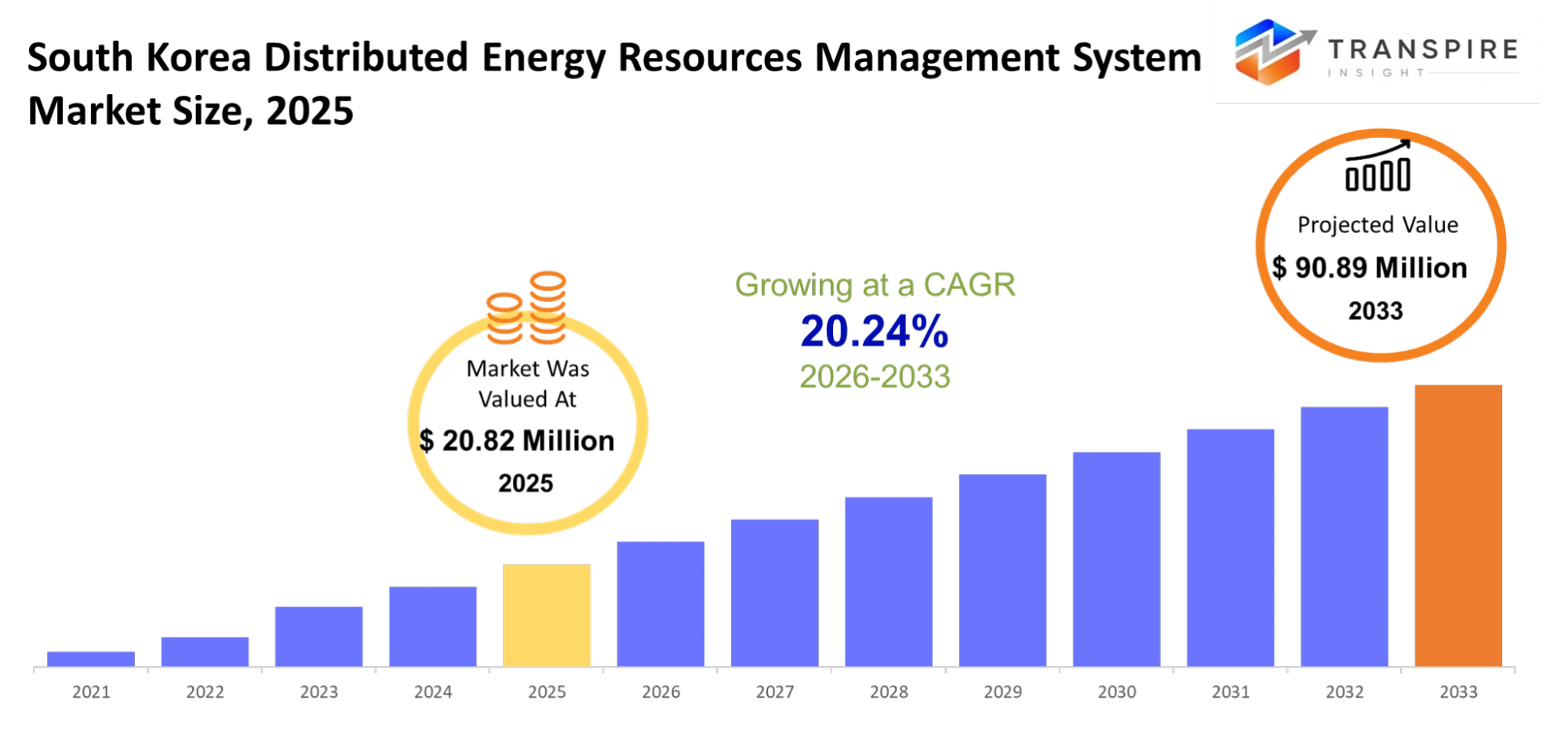
- South Korea Distributed Energy Resources Management System Market Size 2025: USD 20.82 Million
- South Korea Distributed Energy Resources Management System Market Size 2033: USD 90.89 Million
- South Korea Distributed Energy Resources Management System Market CAGR: 20.24%
- South Korea Distributed Energy Resources Management System Market Segments: By Component (Software, Hardware, Services, Platforms), By Application (Grid Management, Energy Optimization, Demand Response, Storage Integration), By End-User (Utilities, Energy Companies, Industrial Users, Smart Cities)
To learn more about this report,  Download Free Sample Report
South Korea Distributed Energy Resources Management System Market Summary:
The South Korea Distributed Energy Resources Management System Market size is estimated at USD 20.82 Million in 2025 and is anticipated to reach USD 90.89 Million by 2033, growing at a CAGR of 20.24% from 2026 to 2033.
The South Korean market for distributed energy resource management systems in the energy management and smart grid sector results from two major forces which include changing consumer preferences for decentralized power management and increasing government regulations which control grid operational stability. The combination of real-time monitoring systems with existing urban network infrastructure enables utilities and technology companies to optimize their management of distributed resources.
The operational efficiency of organizations will experience ongoing improvement because of advances in three technological fields, which include sensing technologies and cloud-based coordination systems and artificial intelligence-based forecasting methods. The upcoming years will see service providers redesign their system architectures to enable flexible energy sharing between residential areas and industrial sites, and microgrid operators according to current regulatory trends which support cleaner energy usage. The system will progress through its various deployment stages which will include establishing different deployment levels.
What Has the Impact of Artificial Intelligence Been on the South Korea Distributed Energy Resources Management System Market?
The market for distributed energy resources management systems in South Korea receives advantages from advanced machine learning and predictive analytics technologies which improve both market research capabilities and real-time data analysis.
The South Korean distributed energy resources management system market uses artificial intelligence to improve demand forecasting, helping utilities predict changes in power consumption and better manage their distributed energy resources. The South Korean distributed energy resources management system market uses artificial intelligence to enhance smart automation and operational efficiency across multiple grid networks.
AI-driven system integration accelerates energy ecosystem optimization by enhancing grid balancing and cost management processes. Smart automation, together with machine learning technologies, delivers improved supply chain management solutions for energy storage and distribution components, leading to lower costs and fewer operational interruptions.
Stakeholders use predictive analytics to analyze market trends and make informed investment decisions based on data analysis results. Artificial intelligence enables utilities and technology providers to develop customized energy management solutions which help them gain market superiority. The sector evolves into more efficient distributed energy networks because digital transformation continues to progress.
Key Market Trends & Insights:
- The capital region dominates the South Korea distributed energy resources management system market because it has more than 40% market share which results from its high industrial energy requirements.
- The southern coastal region experiences its fastest growth because of two factors: renewable energy expansion and smart grid infrastructure investments which will take place from 2025 to 2030.
- The software platforms dominate the South Korea distributed energy resources management system market because they have obtained approximately 38 percent market share through their adoption of AI-enabled grid analytics.
- The second largest market segment consists of energy storage integration systems which enable renewable energy systems to maintain balance while they perform real-time optimization.
- The segment which is experiencing the highest growth rate consists of cloud-based DERMS solutions which will continue to expand until 2026 through 2031.
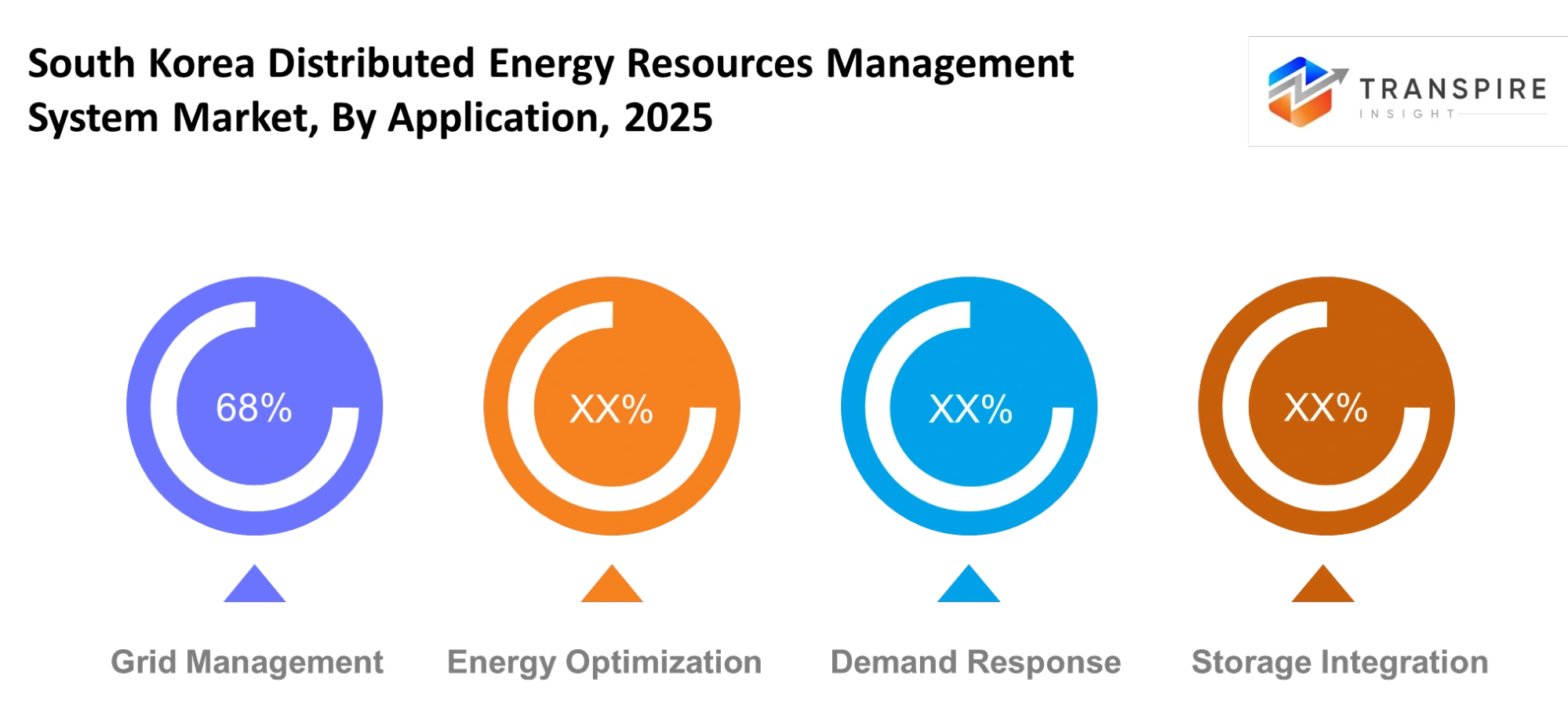
- The South Korea distributed energy resources management system market platforms show grid optimization as their main use case which constitutes approximately 45 percent of their market share.
- The fastest growing application for demand response management needs AI-based load forecasting together with smart automation to become operational.
- Utility companies hold the leading share at approximately 50% because of their implementation of large-scale digital grid transformation programs.
- The fastest-growing segment of the market consists of commercial and industrial users because businesses need to increase their energy efficiency while reducing operational costs.
- The South Korea distributed energy resources management system market features Schneider Electric, Siemens, General Electric, ABB, and Honeywell as its main market players.
South Korea Distributed Energy Resources Management System Market Segmentation
By Component :
The software tracks and manages distributed energy resources which it controls throughout the entire power network. The system provides real-time data processing capabilities together with its load distribution features and automatic system operation functions. The energy points contain installed hardware which consists of various types of meters and sensors and control devices. The organization provides services which include setting up systems and maintaining them and offering ongoing support. The platforms unite all components to create a single operational system that functions as one entity.
The software solutions enable tracking of continuous energy flow which maintains system synchronization between distributed energy resources. The tools help predict load requirements while enabling system modifications that respond to changing demand patterns. The system utilizes hardware components which include smart meters and controllers to gather field data and execute commands properly. The organization provides technical support services together with system upgrades to maintain operational functionality.
By Application :
The process of grid management establishes stability by balancing power requirements with distributed energy resources. Energy optimization focuses on efficient use of available power and reduction of loss. Demand response develops consumption patterns which match the energy requirements that occur during peak load times. The system establishes storage integration by connecting battery units with storage equipment to supply uninterrupted power while enhancing energy distribution reliability.
The process of grid management enables stable electricity transmission by managing various energy sources and their resulting power flows. Energy optimization reduces wastage through better monitoring and control systems. Demand response helps in shifting or reducing usage during high demand periods. The system enables storage integration which permits energy surplus to be stored for future use while providing continuous power supply.
To learn more about this report, Download Free Sample Report
By End-User :
The End-User group uses management systems, which enable utilities to control their vast power distribution networks. Energy companies apply these systems to manage generation and supply efficiency. Industrial operations require dependable electricity because they need power that maintains constant performance throughout their manufacturing activities. Smart cities use integrated systems to manage energy use across buildings, transport, and public infrastructure for better efficiency.
Utilities maintain grid stability while providing reliable electricity supply throughout their service areas. Energy companies achieve better operational performance when they gain enhanced control over their distributed energy resources. The industrial sector needs continuous power supply, which allows them to maintain its production processes. Smart cities use integrated energy systems to create sustainable infrastructure, which helps them manage urban energy needs. The system supports all urban energy management needs through integrated energy systems.
What are the Main Challenges for the South Korea Distributed Energy Resources Management System Market Growth?
The South Korea distributed energy resources management system market faces several technical and operational challenges that slow large-scale deployment across utilities and grid operators. The South Korea distributed energy resources management system market experiences interoperability problems because its multiple decentralized energy sources such as solar and wind, and storage systems need to work together with legacy grid infrastructure and modern digital systems. The grid stability problems emerge from two factors which include the system latency and performance limitations that occur during real-time data processing of distributed energy data.
The South Korea distributed energy resources management system market faces two main obstacles, which include manufacturing barriers and commercialization barriers that inhibit market growth. The combination of high development costs for advanced software platforms and strict regulatory compliance requirements for energy systems results in extended commercialization timeframes. The South Korea distributed energy resources management system market experiences delays because national grid authorities need complex certification procedures and integration standards to be followed.
The South Korea distributed energy resources management system market faces two main obstacles which include adoption problems and infrastructure deficiencies that particularly affect mid-tier utilities and commercial customers. The energy management and smart grid fields suffer from deployment delays because there exists a shortage of skilled professionals who specialize in AI-based systems. The digital infrastructure development process results in incomplete system integration and real-time monitoring capabilities because it creates uneven digital infrastructure development across multiple areas.
The market experiences increased pressure because two factors, market competition and future risks, combine with growing competition from alternative energy optimization technologies and their associated pricing methods. The South Korea distributed energy resources management system market faces challenges because stakeholders must navigate two sources of uncertainty: changing regulatory frameworks and fast-paced technological advancements.
Country Insights
The South Korea Distributed Energy Resources Management System Market will expand through Distributed Energy Resources Management System implementation because increasing renewable energy usage and grid modernization projects drive demand in South Korea. The system needs smart energy control together with demand response capabilities and real-time monitoring functions to achieve effective power distribution results. Digital energy coordination will become the main focus for utilities and industrial users to improve network stability through digital energy stability solutions.
The government supports clean energy transition efforts which will lead to increased solar and wind and storage system installations that use management platforms for system control. Energy balancing will become important as distributed generation expands. The combination of smart meter systems and automated control systems will enhance operational efficiency while decreasing energy losses and maintaining reliable power distribution throughout urban and industrial areas.
Regional Insights: Major demand will come from industrial zones, metropolitan cities, and renewable energy clusters across South Korea. Urban areas will adopt advanced energy management systems due to high electricity usage and smart city development programs. Digital energy coordination tools will help industrial regions maintain a stable energy supply while controlling their operational costs.
Southern coastal regions will see stronger growth driven by higher renewable installations, especially wind and solar projects. Distributed energy systems will establish presence in both island and remote locations because those areas need systems that enable them to produce their own electricity. Regional utilities will invest in digital infrastructure to improve grid flexibility, reduce peak load pressure, and support clean energy integration across locations.
Recent Development News
In March 2026, the Korea Electric Power Corporation (KEPCO) expanded its AI-driven distributed energy resource management system pilot program throughout Jeju Island. The utility upgraded its DERMS platform to better coordinate solar wind and battery storage assets for real-time grid balancing and demand response optimization across South Korea.
Source https://www.kepco.co.kr/
In April 2026, LS ELECTRIC Co., Ltd. announced the deployment of an upgraded DERMS-enabled microgrid control solution for industrial energy customers in South Korea. The system uses renewable energy forecasting and automated load control systems to enhance grid stability and energy efficiency across large manufacturing operations.
Source https://www.ls-electric.com/
|
Report Metrics |
Details |
|
Market size value in 2025 |
USD 20.82 Million |
|
Market size value in 2026 |
USD 25.01 Million |
|
Revenue forecast in 2033 |
USD 90.89 Million |
|
Growth rate |
CAGR of 20.24% from 2026 to 2033 |
|
Base year |
2025 |
|
Historical data |
2021 - 2024 |
|
Forecast period |
2026 - 2033 |
|
Report coverage |
Revenue forecast, competitive landscape, growth factors, and trends |
|
Regional scope |
United States; Canada; Mexico; United Kingdom; Germany; France; Italy; Spain; Denmark; Sweden; Norway; China; Japan; India; Australia; South Korea; Thailand; Brazil; Argentina; South Africa; Saudi Arabia; United Arab Emirates |
|
Key company profiled |
Siemens, Schneider Electric, ABB, GE, Oracle, IBM, Hitachi Energy, Honeywell, Mitsubishi Electric, Samsung SDS, LG CNS, Toshiba, Eaton, Enel X, AutoGrid |
|
Customization scope |
Free report customization (country, regional & segment scope). Avail customized purchase options to meet your exact research needs. |
|
Report Segmentation |
By Component (Software, Hardware, Services, Platforms), By Application (Grid Management, Energy Optimization, Demand Response, Storage Integration), By End-User (Utilities, Energy Companies, Industrial Users, Smart Cities) |
How Can New Companies Establish a Strong Foothold in the South Korea Distributed Energy Resources Management System Market?
New entrants can establish a strong position in South Korea's distributed energy resources. The management system market will expand through its specialized digital energy solutions which cater to smart cities and manufacturing clusters and renewable-heavy industrial zones. The South Korea distributed energy resources management system market shows that companies which implement AI-based load balancing and real-time energy optimization and predictive analytics technologies will achieve faster business growth with utilities that need to enhance grid stability.
Utilities and grid operators and technology integrators must form strategic partnerships to achieve successful product commercialization. Startups entering the South Korea distributed energy resources management system market can accelerate adoption by collaborating with industrial parks and smart city projects to deploy pilot systems that demonstrate measurable efficiency gains.
AutoGrid and Enbala Power Networks demonstrate that AI-powered energy orchestration platforms can achieve rapid growth through utility partnerships and real-time demand response innovation. New companies entering the South Korean distributed energy resources management system market need to allocate resources to interoperability and cybersecurity, as these two areas enable them to address integration issues between new systems and legacy grid systems.
Machine learning optimization together with its decentralized energy management system and predictive maintenance solution creates innovative business strategies which provide companies with significant competitive advantages. The South Korea distributed energy resources management system market offers enduring growth opportunities to new market entrants who establish their business operations according to national decarbonization targets and digital grid transformation initiatives.
Key South Korea Distributed Energy Resources Management System Market Company Insights
The adoption of distributed energy resources management systems in South Korea will experience strong growth because smart grid development and renewable energy integration receive increasing attention. The growing installation of solar and wind power systems will create demand for improved energy-balancing solutions that utility networks require.
Electricity consumption will increase in urban and industrial areas which will lead utilities to adopt advanced control systems that provide real-time monitoring and load optimization capabilities. The digital infrastructure expansion together with government programs that support energy efficiency initiatives will create a better market environment for power distribution networks to grow.
The South Korea distributed energy resources management system market will continue to experience strong competition because both global energy technology companies and local solution providers operate in the market. Companies will concentrate on software enhancements and AI-powered energy prediction systems and grid automation capabilities to boost their operational effectiveness and minimize energy network disruptions.
Company List
- Siemens
- Schneider Electric
- ABB
- GE
- Oracle
- IBM
- Hitachi Energy
- Honeywell
- Mitsubishi Electric
- Samsung SDS
- LG CNS
- Toshiba
- Eaton
- Enel X
- AutoGrid
What are the Key Use-Cases Driving the Growth of South Korea Distributed Energy Resources Management System Market?
The South Korea distributed energy resources management system market is experiencing fast growth because intelligent grid systems are needed to manage renewable energy sources which create heavy electricity demands. The South Korea distributed energy resources management system market uses AI systems for real-time energy balancing which helps maintain grid stability through coordinated control of distributed solar power, wind power, and battery storage systems.
The South Korea distributed energy resources management system market experiences its major growth through industrial manufacturing because factories implement DERMS solutions to decrease their peak load expenses and boost their energy efficiency. Automotive and semiconductor plants are increasingly using predictive analytics to schedule energy-intensive operations during low-cost periods. Healthcare facilities depend on continuous power management systems which use distributed energy intelligence to maintain operational reliability for essential equipment, thus promoting the use of these systems in the South Korea distributed energy resources management system market.
Enterprise and commercial buildings have become important use cases that leverage smart automation to reduce carbon emissions while improving energy efficiency. Demand response programs enable utilities to provide financial incentives which encourage users to reduce their electricity usage during peak demand times, thus supporting the South Korea distributed energy resources management system market. The growing use of AI technology will lead to predictive maintenance and decentralized energy orchestration solutions which will create new opportunities for businesses to expand their operations in different industries.
South Korea Distributed Energy Resources Management System Market Report Segmentation
By Component
- Software
- Hardware
- Services
- Platforms
By Application
- Grid Management
- Energy Optimization
- Demand Response
- Storage Integration
By End-User
- Utilities
- Energy Companies
- Industrial Users
- Smart Cities
Frequently Asked Questions
Find quick answers to common questions.
The approximate South Korea Distributed Energy Resources Management System Market size for the market will be USD 90.89 Million in 2033.
Key segments for the South Korea Distributed Energy Resources Management System Market are By Component (Software, Hardware, Services, Platforms), By Application (Grid Management, Energy Optimization, Demand Response, Storage Integration), By End-User (Utilities, Energy Companies, Industrial Users, Smart Cities).
Major South Korea Distributed Energy Resources Management System Market players are Siemens, Schneider Electric, ABB, GE, Oracle, IBM, Hitachi Energy, Honeywell, Mitsubishi Electric, Samsung SDS, LG CNS, Toshiba, Eaton, Enel X, AutoGrid.
The South Korea Distributed Energy Resources Management System Market size is USD 20.82 Million in 2025.
The South Korea Distributed Energy Resources Management System Market CAGR is 20.24%.
- Siemens
- Schneider Electric
- ABB
- GE
- Oracle
- IBM
- Hitachi Energy
- Honeywell
- Mitsubishi Electric
- Samsung SDS
- LG CNS
- Toshiba
- Eaton
- Enel X
- AutoGrid
Recently Published Reports
-
Dec 2024
Active Power Filter Market
Active Power Filter Market Size, Share & Analysis Report By Type (Shunt Active Power Filters, Series Active Power Filter, Hybrid Active Power Filter), By Application (Harmonics Mitigation, Reactive Power Compensation, Voltage Regulation, Power Factor Correction), By Phase (Single Phase, Three Phase), By End-User Industry (Manufacturing, Healthcare, Commercial, Automotive, Oil and Gas, Others), and Geography (North America, Europe, Asia-Pacific, Middle East and Africa, South and Central America), 2021 - 2031
-
Jan 2025
Electrical Transformer Market
Electrical Transformer Market Size, Share & Analysis Report By Core (Closed, Shell, and Berry), By Insulation (Gas, Oil, Solid, Air, and Other), By Phase (Single, and Three), By Rating (100 MVA to 500 MVA, 501 MVA to 800 MVA, and 801 MVA to 1200 MVA), and Geography (North America, Europe, Asia-Pacific, Middle East and Africa, South and Central America), 2021 – 2031
-
Jan 2025
Hydraulic Piston Pumps Market
Hydraulic Piston Pumps Market Size, Share & Analysis Report By Type (Axial Piston Pumps, Radial Piston Pumps), By Operating Pressure (Low Pressure, Medium Pressure, High Pressure), By Application (Construction, Mining, Agriculture, Automotive, Oil & Gas, Industrial Machinery, Others), By End-User (OEMs, Aftermarket), and Geography (North America, Europe, Asia-Pacific, Middle East and Africa, South and Central America), 2021 – 2031
-
Jan 2025
Laboratory Gas Generators Market
Laboratory Gas Generators Market Size, Share & Analysis Report By Product (Nitrogen Gas Generator, Hydrogen Gas Generator, Zero Air Gas Generator, Purge Gas Generator, TOC Gas Generators, Others), By Application (Gas Chromatography, Liquid Chromatography-mass Spectrometry (LC-MS), Gas Analyzers, Others), By End-user (Life Science, Chemical & Petrochemical, Food & Beverage, Others), and Geography (North America, Europe, Asia-Pacific, Middle East and Africa, South and Central America), 2021 – 2031