
Europe Immersion Cooling Fluids Market Size & Forecast:
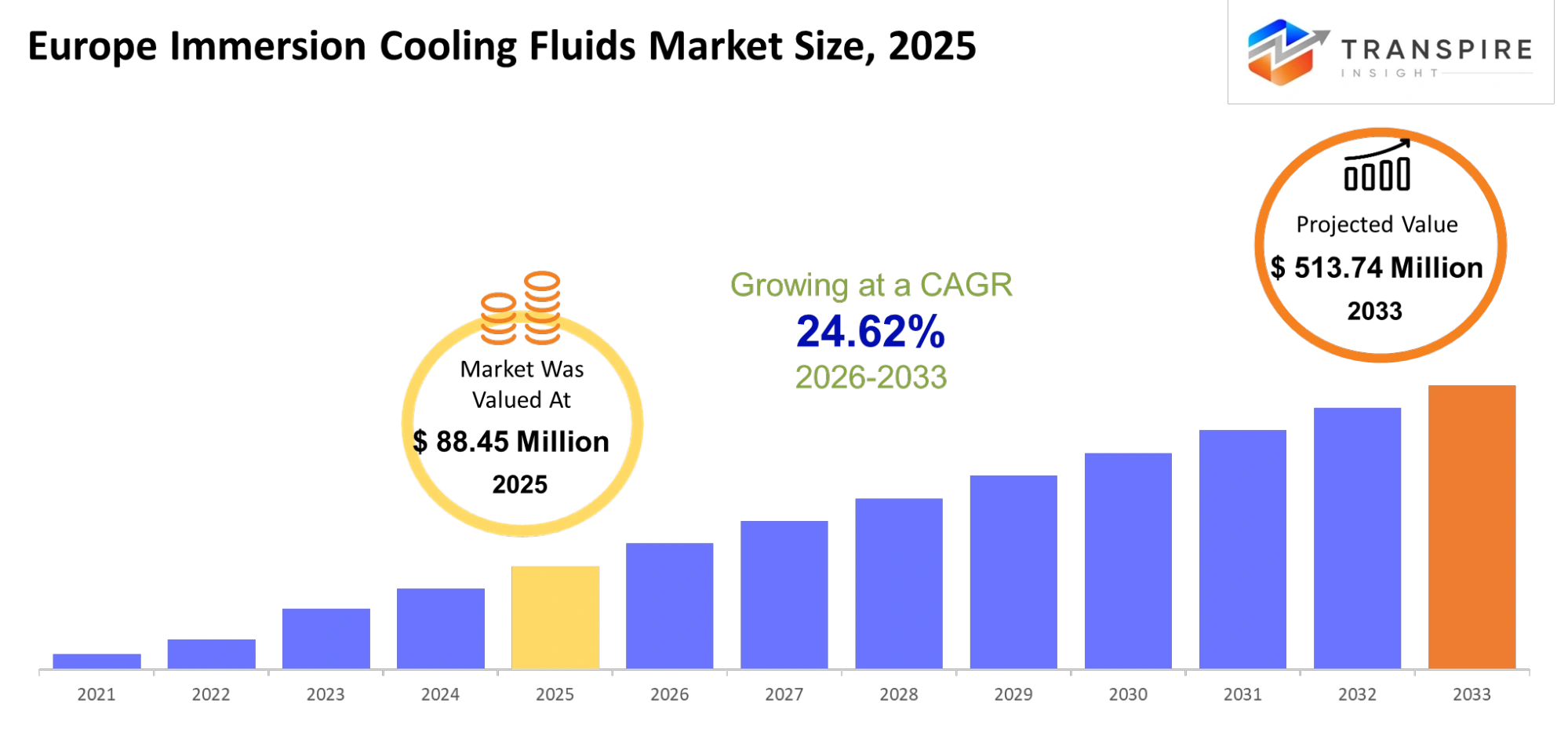
- Europe Immersion Cooling Fluids Market Size 2025: USD 88.45 Million
- Europe Immersion Cooling Fluids Market Size 2033: USD 513.74 Million
- Europe Immersion Cooling Fluids Market CAGR: 24.62%
- Europe Immersion Cooling Fluids Market Segments: By Type (Mineral Oil-based Fluids, Synthetic Fluids, Fluorocarbon Fluids, Others), By Application (Data Centers, HPC Systems, Cryptocurrency Mining, Edge Computing, Others), By End-User (IT Companies, Data Centers, Cloud Providers, Enterprises, Others), By Cooling Type (Single-phase, Two-phase, Hybrid, Others).
To learn more about this report,  Download Free Sample Report
Europe Immersion Cooling Fluids Market Summary:
The Europe Immersion Cooling Fluids Market size is estimated at USD 88.45 Million in 2025 and is anticipated to reach USD 513.74 Million by 2033, growing at a CAGR of 24.62% from 2026 to 2033. Europe’s immersion cooling fluids market addresses a practical bottleneck in high-density computing and power electronics: removing heat efficiently which traditional air cooling systems cannot accomplish. These fluids support direct liquid contact cooling in data centers and EV battery testing labs and industrial control systems which results in reduced energy consumption and improved operational reliability and enables more compact hardware designs.
Over the past 3–5 years, a clear structural shift has emerged from air and indirect liquid cooling toward full immersion systems which hyperscale data center operators use to achieve greater rack densities while maintaining reliable thermal control. The European energy price volatility which emerged after the Russia–Ukraine conflict created a major infrastructure development shift toward energy-efficient solutions which operators now pursue.
The combination of these two factors has resulted in a change of buyer behavior. Buyers now evaluate total cost of ownership rather than upfront cost which results in quicker transitions from pilot projects to full operational deployment. The result of these changes leads to suppliers achieving faster commercialization success while developing closer relationships with OEMs and experiencing greater demand for their products from edge and AI workloads.
Key Market Insights
- The Europe Immersion Cooling Fluids Market experiences significant market expansion because high-performance computing and artificial intelligence use cases need advanced thermal management solutions.
- Data centers achieved 40% energy efficiency gains through operational improvements after 2021 when they started using immersion cooling systems instead of air cooling methods.
- The innovation pipelines of the market mainly use synthetic and dielectric fluids which provide longer product life cycles and require fewer maintenance activities than traditional coolant solutions.
- The market demand of the present period matches the carbon neutrality emissions reduction goals set by Europe for 2030 which leads to increased adoption of hyperscale and edge data centers.
- The Europe immersion cooling fluids industry size is expanding as operators prioritize total cost of ownership and reduced energy consumption metrics.
- Western Europe holds the leading market position in 2025 with more than 45% market share which Germany the UK and the Netherlands actively support through their data center operations.
- Through 2030, Nordic countries develop as the fastest expanding area because they use their renewable energy resources and cooler weather conditions to create effective cooling systems.
- Attractive pricing and proven application of mineral oil-based fluids enable them to capture more than 40% market share in 2024.
- The second biggest market segment of synthetic fluids exists because these fluids provide superior dielectric capabilities and extended service life.
- The fastest-growing segment between 2025 and 2030 will be Bio-based fluids because sustainability regulations and environmental compliance requirements will drive their market expansion.
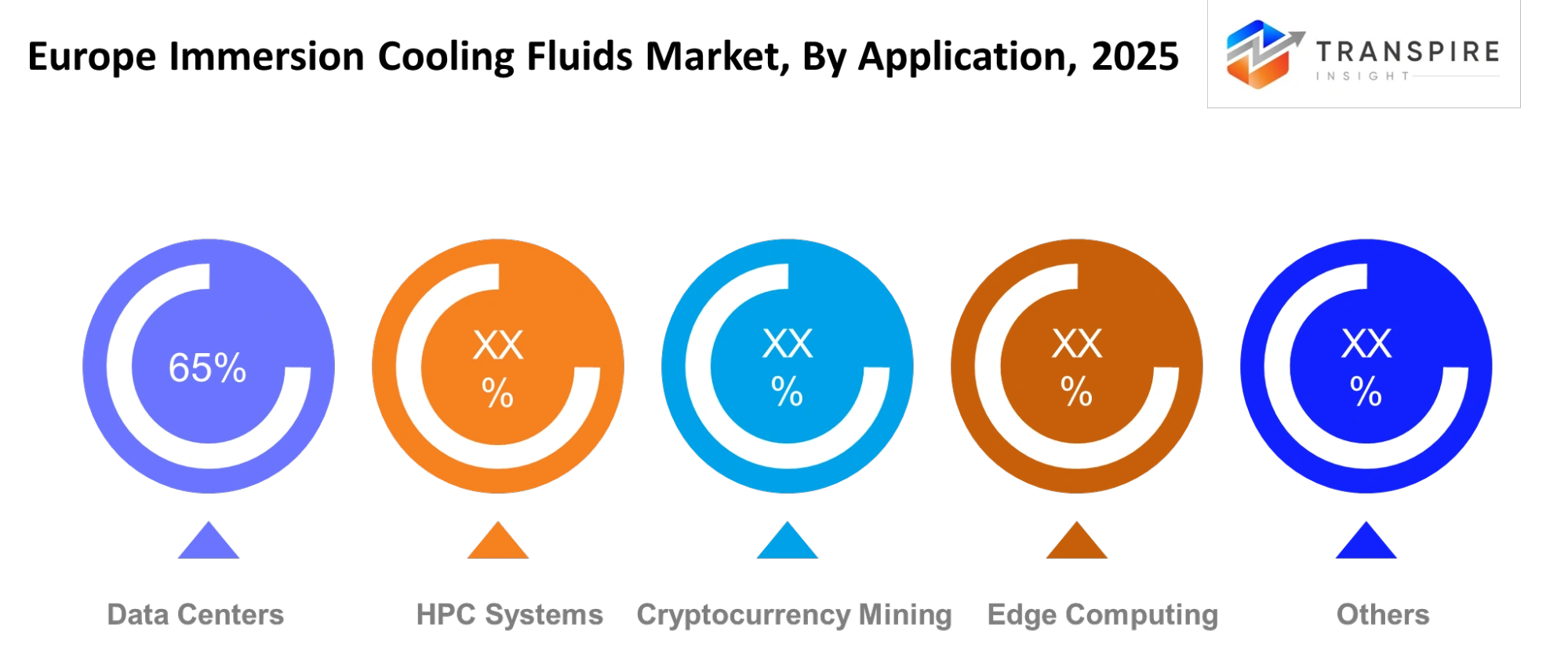
- The data center sector controls 60% of market applications in 2025 because hyperscale and artificial intelligence infrastructure continue to grow in size.
What are the Key Drivers, Restraints, and Opportunities in the Europe Immersion Cooling Fluids Market?
The European Immersion Cooling Fluids Market experiences its main growth driver because AI technologies and high-performance computing systems experience rapid development. After 2021, hyperscale operators encountered rack densities that exceeded 30 to 50 kW which rendered air cooling systems useless. European operators faced two challenges because energy prices kept changing while they needed to control power usage effectiveness to maintain their operational expenses. Immersion cooling systems create two benefits because they decrease cooling energy demands while they support higher computational power requirements for each square meter of space. The company experiences financial benefits from enhanced operational efficiency which leads to quicker business growth that results in increased demand for advanced cooling solutions and higher revenues for their suppliers.
A major structural barrier is the high upfront capital investment required to transition from legacy air-cooled infrastructure to immersion-based systems. The project requires complete rack redesign and facility retrofitting and hardware warranty compatibility testing. The changes require three years of planning plus coordination with original equipment manufacturers which creates barriers to quick implementation. Many operators choose to maintain their current systems which leads to delays in adopting new technologies that will generate revenue for fluid suppliers.
Data centers at the edge of Northern and Central Europe present a major business opportunity. 5G networks require operators to build small high-capacity centers near their customer base. Immersion cooling fits these environments by reducing space and energy constraints. The Nordic region demonstrates how edge facilities use modular design to combine immersion systems with renewable energy sources which creates a scalable model that could speed up adoption throughout distributed infrastructure networks.
What Has the Impact of Artificial Intelligence Been on the Europe Immersion Cooling Fluids Market?
European data centers and industrial sites are now using artificial intelligence and advanced digital technologies to change the way their immersion cooling systems work. The operators use AI-based control systems that operate, which adjust, which pump speeds and flow rates and thermal loads according to actual server use. The systems distribute cooling, which operates at rack level, to achieve better heat dissipation without needing any manual work. Digital twins model thermal performance together with fluid dynamics in large facilities, which enables operators to test system setups before they build physical systems.
Machine learning models enable predictions through their analysis of temperature changes together with fluid deterioration patterns and hardware stress conditions. The system can identify pump breakdowns and fluid contamination problems at an early stage, which helps to decrease unexpected operational interruptions. Through predictive thermal management and automated load balancing, operators achieve 3–5% uptime improvements together with 10–20% energy savings. AI helps organizations optimize their performance by adjusting cooling power to match work demand peaks, which decreases wasteful energy usage.
The main challenge of introducing AI technology to existing systems stops organizations because of the expensive implementation process and difficult installation procedure. The lack of standardized data architecture in many facilities, together with inconsistent sensor data, decreases model performance, which makes organizations hesitate to use the technology despite its operational advantages.
Key Market Trends
- The hyperscale operators have transitioned since 2021 from conducting pilot projects to implementing complete operational activities because their rack systems now exceed 40 kilowatts of rack power density.
- Buyers shifted their purchasing approach from capital expenditure methods toward total cost of ownership assessments after the 2022 energy crisis because they valued energy savings more than the first system acquisition expense.
- The fluid innovation market has transitioned from using mineral oil as its primary fluid to adopting synthetic and engineered fluids through companies like Shell and3M who create new dielectric performance standards.
- Data center developers increasingly integrate immersion cooling during design stages rather than retrofitting which helps them achieve faster deployment processes that lead to quicker technology adoption since 2023.
- The Nordic regions have developed into essential operational centers since 2022 because their renewable energy sources power immersion systems which help them achieve their stringent carbon emission reduction requirements.
- After 2021, Dell and HPE began certifying their hardware for immersion compatibility which helped eliminate compatibility issues and supported businesses in adopting the technology.
- The use of compact immersion systems for edge computing deployments has grown since 2023 because these systems allow urban and telecom areas with limited space to perform high-density processing operations.
- The EU climate regulations have increased requirements for operators to implement liquid cooling systems which decrease power usage effectiveness to below 1.2 in their upcoming facilities.
- The number of partnerships between fluid manufacturers and data center operators increased after 2022 which helped speed up product validation processes throughout Europe.
Europe Immersion Cooling Fluids Market Segmentation
By Type
Mineral oil-based fluids currently hold the largest share, estimated above 40% in 2024, due to cost advantages and established use in early immersion deployments. The second largest segment of the market provides support because synthetic fluids offer better thermal stability and extended service life. The market for fluorocarbon fluids operates as a small segment because of its high pricing. The mineral oil market experienced growth until 2022, when operators started to choose performance consistency over saving money in the beginning.
Facilities that operate at hyperscale now prefer synthetic formulations because these solutions provide better reliability and lower total operational costs throughout their entire lifespan. Fluorocarbon fluids continue to serve specialized environments requiring non-flammability and precise thermal control. The market for synthetic and engineered fluids will show market growth during the forecast period which will lead manufacturers to develop new chemical technologies and environmentally sustainable product lines.
By Application
Data centers will handle almost 60% of application usage in 2025 because of hyperscale growth and AI workload distribution. High-performance computing systems represent a strong secondary segment, particularly in research and simulation environments requiring stable thermal conditions. After 2022, cryptocurrency mining which started as a popular activity became less important because of regulatory scrutiny and rising energy costs.
The introduction of 5G networks and the need for local processing have made edge computing the fastest growing application since 2023. Data center operators now create their facilities to support immersion systems, instead of trying to update their existing built environments. Future growth will concentrate in edge and AI-driven deployments, which will lead suppliers to develop fluids that work for small spaces with high equipment density.
To learn more about this report, Download Free Sample Report
By End-User
IT companies and large data center operators lead end-user share, together accounting for more than half of demand in 2025. The cloud providers follow closely behind because they need to build their infrastructure and improve energy efficiency across their multiple locations. The enterprise market accounts for a smaller part of the total market which continues to grow because businesses increase their use of on-premise AI systems.
The IT and cloud markets experienced rapid growth after 2021 because businesses required more computing power while facing higher expenses linked to their energy needs. Enterprises are gradually adopting immersion solutions for specialized workloads rather than full-scale deployment. The cloud and edge operators will generate incremental demand which will result in standardization of cooling systems that offer scalability.
By Cooling Type
The present dominance of single-phase cooling systems exists because they control more than 65% of the market which results from their simpler design and reduced operational risks and their ability to connect with current infrastructure. The market for two-phase systems remains limited yet their ability to achieve superior heat transfer efficiency in high-density environments establishes them as a valuable technology. Hybrid approaches are becoming popular among operators who want to choose between efficient performance and cost-effective solutions.
The adoption of single-phase systems experienced a boost after 2021 when vendors developed better compatibility with standard server hardware. The operation of two-phase systems requires more complex systems because they need both advanced system design and specialized fluid management solutions. The future adoption of technology will progress toward hybrid solutions and advanced two-phase systems because AI workloads create thermal challenges which force technology providers to find solutions that enhance system efficiency while maintaining operational ease.
What are the Key Use Cases Driving the Europe Immersion Cooling Fluids Market?
Data centers represent the core use case which generates maximum demand because AI and high-density computing workloads experience rapid growth. Operators use immersion fluids to handle heat loads which exceed 40 kW per rack because they want to decrease energy use and keep their systems running.
The expansion of high-performance computing clusters together with telecom edge facilities enables new application development. Research institutions and cloud providers use immersion cooling to stabilize intensive simulations while telecom operators deploy compact systems to support 5G infrastructure in space-constrained urban locations.
The new use cases include EV battery testing laboratories and industrial automation systems. Automotive manufacturers use immersion cooling to maintain thermal stability during high-load testing while factories explore the technology for robotics and power electronics which need effective heat management to enable performance scaling.
|
Report Metrics |
Details |
|
Market size value in 2025 |
USD 88.45 Million |
|
Market size value in 2026 |
USD 110.03 Million |
|
Revenue forecast in 2033 |
USD 513.74 Million |
|
Growth rate |
CAGR of 24.62% from 2026 to 2033 |
|
Base year |
2025 |
|
Historical data |
2021 - 2024 |
|
Forecast period |
2026 - 2033 |
|
Report coverage |
Revenue forecast, competitive landscape, growth factors, and trends |
|
Regional scope |
Europe (Germany, United Kingdom, France, Italy, Spain and Rest of Europe) |
|
Key company profiled |
3M, ExxonMobil, Shell, Dow, BASF, Castrol, Chevron, Engineered Fluids, Green Revolution Cooling, Submer, LiquidStack, Iceotope, Fujitsu, Intel, Schneider Electric |
|
Customization scope |
Free report customization (country, regional & segment scope). Avail customized purchase options to meet your exact research needs. |
|
Report Segmentation |
By Type (Mineral Oil-based Fluids, Synthetic Fluids, Fluorocarbon Fluids, Others), By Application (Data Centers, HPC Systems, Cryptocurrency Mining, Edge Computing, Others), By End-User (IT Companies, Data Centers, Cloud Providers, Enterprises, Others), By Cooling Type (Single-phase, Two-phase, Hybrid, Others) |
Which Regions are Driving the Europe Immersion Cooling Fluids Market Growth?
The market in Western Europe operates through three main countries which include Germany and the Netherlands and the United Kingdom which have established dense data center networks that support technological progress. Operators have dedicated resources to develop advanced cooling systems because governments enforce strict rules which require energy efficiency and carbon reduction. The existing digital infrastructure together with its location to vital internet exchange points generates continuous need for advanced thermal management solutions. The fluid manufacturing sector partners with original equipment manufacturers and engineering companies to create an operational ecosystem that enables immediate implementation of new solutions while developing ongoing product advancements.
Northern Europe holds the second position, with countries such as Sweden, Finland and Denmark offering stable growth conditions. The region between these two areas receives renewable energy resources and natural cooling systems which enhance the effectiveness of immersion cooling technology. The government maintains stable rules which promote infrastructure development because they require long-term commitment from businesses. The market stability appeals to hyperscale operators who need forecastable costs and dependable power supply solutions.
Central and Eastern Europe has become the fastest growing area because digital infrastructure investments and data localization policies created new development opportunities. The construction of data centers in Poland and the Czech Republic accelerated after 2022 to decrease their dependence on Western data hubs. The ability to experiment with immersion cooling technologies benefits new companies because they find lower land and operational expenses. The region will experience major growth between 2026 and 2033 which creates business prospects for suppliers and investors who work on greenfield projects.
Who are the Key Players in the Europe Immersion Cooling Fluids Market and How Do They Compete?
The competitive landscape exhibits a semi-consolidated structure which allows a few chemical companies to dominate while niche fluid developers and system integrators enter the market with their specialized products. Existing companies maintain market share through their established supply networks and their partnerships with original equipment manufacturers, but new market entrants threaten this stability through their development of precise application products and their ability to produce customized solutions at rapid speed. Businesses now compete through their technology capabilities and their total cost of ownership, which has become the main factor for customers who want to assess their market value. Buyers now evaluate dielectric strength, thermal stability, and compatibility with immersion-ready hardware when selecting suppliers.
Shell plc develops engineered immersion fluids for hyperscale data centers based on its existing lubricant technology and worldwide distribution capabilities. The company establishes its unique market position through its comprehensive testing requirements and its collaborations with data center operators who assess operational efficiency at large-scale implementation. ExxonMobil uses the same approach as its competitors because it wants to attract customers who need longer-lasting products through its dedicated focus on fluid durability and oxidation resistance. The original equipment manufacturers provide strategic partnerships which allow companies to use their fluids in certified hardware systems, which enhances their chances of securing long-term business contracts.
3M Company established a specialized market segment for its fluorocarbon-based fluids that deliver exceptional dielectric performance to mission-critical settings which demand non-flammable materials. Castrol Limited uses co-development initiatives with server manufacturers to create unique products that provide testing capabilities and performance optimization. Engineered Fluids functions as a specialized research organization which delivers customized solutions and direct customer assistance for immersion technology to support the development of new data center sites throughout Europe.
Company List
- 3M
- ExxonMobil
- Shell
- Dow
- BASF
- Castrol
- Chevron
- Engineered Fluids
- Green Revolution Cooling
- Submer
- LiquidStack
- Iceotope
- Fujitsu
- Intel
- Schneider Electric
Recent Development News
In April 2026, Applied Digital signs $7.5 billion AI data center lease with U.S. hyperscaler: A major U.S. data center operator, Applied Digital, secured a long-term lease deal to expand AI infrastructure capacity, directly increasing demand for advanced cooling technologies like immersion fluids in high-density computing environments. The deal highlights strong hyperscaler investment in cooling-intensive AI workloads.
Source: https://www.reuters.com
In April 2026, SpaceX explores orbital data centers to overcome cooling constraints: SpaceX’s IPO plans include funding space-based data centers aimed at bypassing Earth-based cooling and power limitations. The move reflects how cooling challenges—central to immersion fluid markets—are influencing next-generation infrastructure strategies.
Source: https://www.reuters.com
What Strategic Insights Define the Future of the Europe Immersion Cooling Fluids Market?
The Europe immersion cooling fluids market is moving toward standardized, high-performance solutions integrated directly into next-generation data center design. The upcoming 5 to 7 years will experience growth because AI infrastructure needs increase and operators will need to meet new energy efficiency standards, which will make immersion systems their primary choice. The market will benefit suppliers who provide certified fluids that work together with OEM hardware systems.
Advanced direct-to-chip liquid cooling systems which need less cooling liquid present a hidden danger because they enable operators to make small improvements without needing to rebuild their entire system. If this approach gains broader OEM support, it could limit the total addressable market for immersion-specific fluids.
The development of immersion cooling systems together with renewable-powered modular data centers that operate off the grid in remote areas of Europe presents a new business opportunity. Companies should invest in co-development partnerships with hardware manufacturers and energy providers to secure early positioning in these distributed, high-efficiency infrastructure models.
Europe Immersion Cooling Fluids Market Report Segmentation
By Type
- Mineral Oil-based Fluids
- Synthetic Fluids
- Fluorocarbon Fluids
- Others
By Application
- Data Centers
- HPC Systems
- Cryptocurrency Mining
- Edge Computing
- Others
By End-User
- IT Companies
- Data Centers
- Cloud Providers
- Enterprises
- Others
By Cooling Type
- Single-phase
- Two-phase
- Hybrid
- Others
Frequently Asked Questions
Find quick answers to common questions.
The approximate Europe Immersion Cooling Fluids Market size for the market will be USD 513.74 Million in 2033.
The key segments of the Europe Immersion Cooling Fluids Market are By Type (Mineral Oil-based Fluids, Synthetic Fluids, Fluorocarbon Fluids, Others), By Application (Data Centers, HPC Systems, Cryptocurrency Mining, Edge Computing, Others), By End-User (IT Companies, Data Centers, Cloud Providers, Enterprises, Others), By Cooling Type (Single-phase, Two-phase, Hybrid, Others).
Major players in the Europe Immersion Cooling Fluids Market are 3M, ExxonMobil, Shell, Dow, BASF, Castrol, Chevron, Engineered Fluids, Green Revolution Cooling, Submer, LiquidStack, Iceotope, Fujitsu, Intel, Schneider Electric.
The current market size of the Europe Immersion Cooling Fluids Market is USD 88.45 Million in 2025.
The Europe Immersion Cooling Fluids Market CAGR is 24.62%.
- 3M
- ExxonMobil
- Shell
- Dow
- BASF
- Castrol
- Chevron
- Engineered Fluids
- Green Revolution Cooling
- Submer
- LiquidStack
- Iceotope
- Fujitsu
- Intel
- Schneider Electric
Recently Published Reports
-
Apr 2026
Handling and Lifting Equipment Market
Handling and Lifting Equipment Market Size, Share & Analysis Report By Product (Cranes and Hoists, Forklifts, Conveyor Systems, Aerial Work Platforms, Others), By Application (E-Commerce, Automotive and Railway, Food and Beverages, Aviation, Others), and Geography (North America, Europe, Asia-Pacific, Middle East and Africa, South and Central America), 2021 - 2031
-
Apr 2026
HVAC Equipment Market
HVAC Equipment Market Size, Share & Analysis Report By Heating Equipment Type (Boilers and Furnaces, Heat Pumps, and Unitary Heaters), By Ventilation Equipment (Air Handling Units, Humidifiers and Dehumidifiers, Air Filters, and Fan Coiling Units), By Air Conditioning Equipment (Unitary Air Conditioners, Room Air Conditioners, Packaged Terminal Air Conditioners, and Chillers), By End User (Commercial, Residential, Industrial, and others), and Geography (North America, Europe, Asia-Pacific, Middle East and Africa, South and Central America), 2021 – 2031
-
Apr 2026
Refrigeration Valves Market
Refrigeration Valves Market Size, Share & Analysis Report By Type (Solenoid Valves, Expansion Valves, Check Valves, Service Valves, Others), By Application (Commercial Refrigeration, Industrial Refrigeration, Transport Refrigeration, Residential Refrigeration, Air Conditioning Systems), By End User (Food and Beverage Industry, Pharmaceutical Industry, HVAC Industry, Chemical Industry, Others), and Geography (North America, Europe, Asia-Pacific, Middle East and Africa, South and Central America), 2021 – 2031
-
Apr 2026
E-Commerce Packaging Materials Market
E-Commerce Packaging Materials Market By Material Type (Corrugated Boxes, Paper & Paperboard, Foam & Cushioning Materials, Plastic Packaging, Flexible Packaging, Protective Packaging, Others), By Product(Primary Packaging, Secondary Packaging, Tertiary Packaging), By Packaging Function (Protective Packaging, Branding & Presentation Packaging, Transit & Logistic Packaging, Sustainable Packaging, Tamper Evidence Packaging), By End-User (Retail & Consumer Goods, Electronic Appliances, Food & Beverages, Healthcare & Pharmaceutical, Fashion & Apparel, Home & Furnishing, Others); By Industry Analysis, Size, Share, Growth, Trends, and Forecasts 2021-2033