
Middle East and Africa Digital Radar Market Size & Forecast:
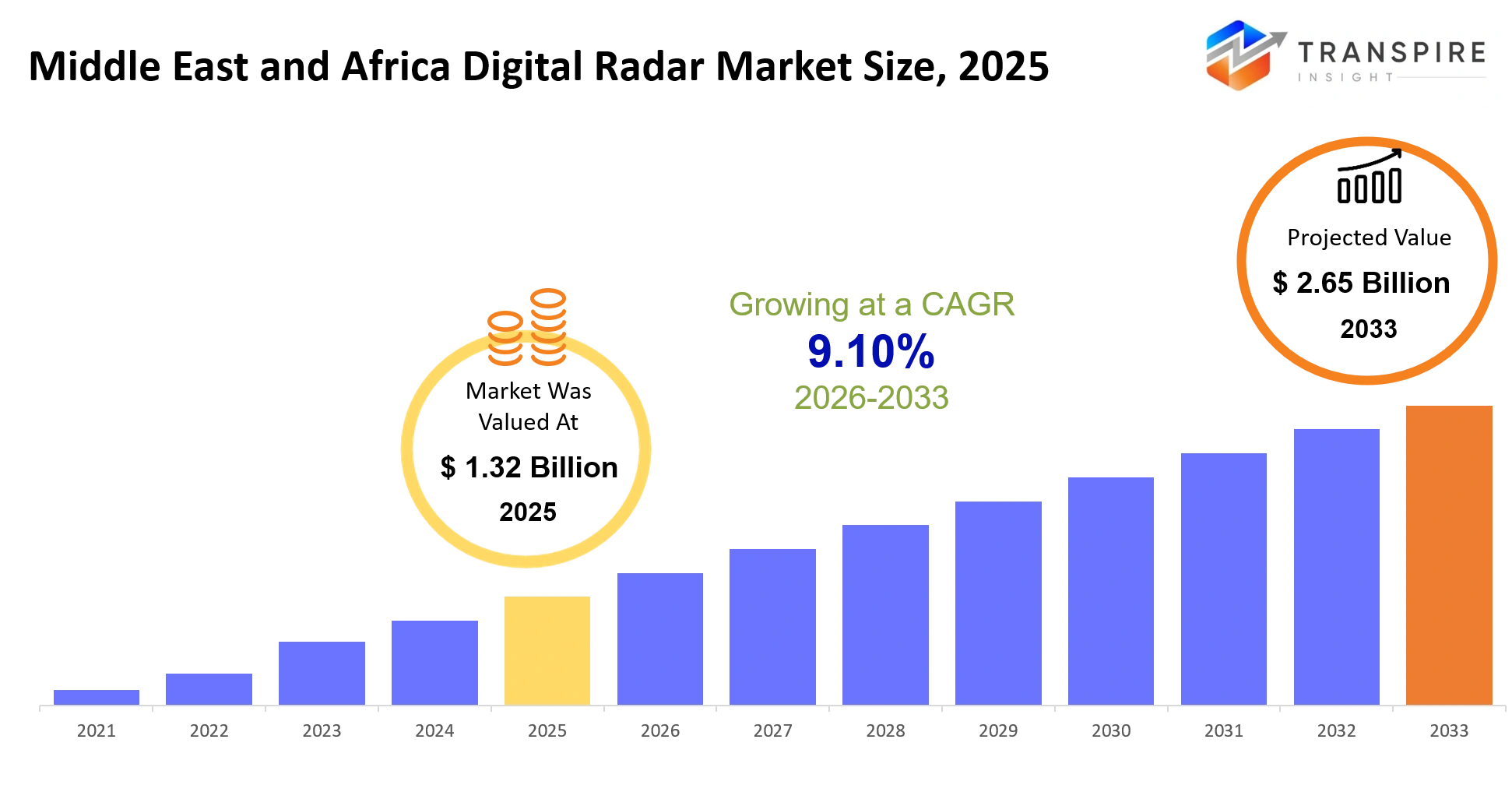
- Middle East and Africa Digital Radar Market Size 2025: USD 1.32 Billion
- Middle East and Africa Digital Radar Market Size 2033: USD 2.65 Billion
- Middle East and Africa Digital Radar Market CAGR: 9.10%
- Middle East and Africa Digital Radar Market Segments: By Radar Type (Imaging Radar, Pulse Radar, Doppler Radar, AESA Radar, FMCW Radar, Others, Others, Others); By Frequency (X Band, C Band, S Band, Ku Band, Ka Band, Others, Others, Others); By Application (Defense, Automotive, Weather Monitoring, Aviation, Marine, Others, Others, Others); By End User (Military, Government, Transportation, Industrial, Others, Others, Others, Others).
Middle East and Africa Digital Radar Market Summary
The Middle East and Africa Digital Radar Market was valued at USD 1.32 Billion in 2025. It is forecast to reach USD 2.65 Billion by 2033. That is a CAGR of 9.10% over the period.
Digital radar systems assist governments, defense agencies, airports, ports, and people running transport networks to detect, follow, and categorize objects with more precision in pretty challenging, real-world operating conditions. In the Middle East and Africa, these setups back airspace surveillance, border protection, marine monitoring, weather forecasting, and safeguards for critical infrastructure, where fast yet accurate situational awareness really matters. Over the last five years , the whole market kinda moved away from classic analog and mechanically scanned radar designs, toward software-defined approaches and Active Electronically Scanned Array , AESA style architectures, which tend to offer better resolution, quicker target tracking and also stronger protection against electronic interference.
In the region , geopolitical friction, the rise in unmanned drone activity, and ongoing funding for air defense modernization efforts all pushed procurement timelines forward. That momentum then widened deployments across both military and civilian use cases. As operators try to cover larger areas, get real-time data handling, and enable multi-domain surveillance, digital radar adoption is still climbing. Put simply, this shift is also opening fresh money paths for radar makers , integrators, and defense tech providers throughout the area.
Key Market Insights
- Saudi Arabia, UAE, and South Africa together made up almost 45% of the regional digital radar spending in 2025, so yeah quite a chunk.
- The Middle East Digital Radar Market still looks like the big driver of regional revenue, with around 68% market share during 2025.
- Meanwhile, African defense modernization programs are expected to push the quickest regional rise all the way through 2033, which is pretty notable.
- Looking closer, AESA radar systems accounted for about 31% of total market revenue in 2025, backed mainly by military procurement efforts.
- Pulse radar stayed in the number two spot, largely because it is widely placed in aviation and weather surveillance use cases.
- As for FMCW radar systems, they are forecast to show the strongest growth by 2033, mainly due to compact design, and also because power consumption stays lower.
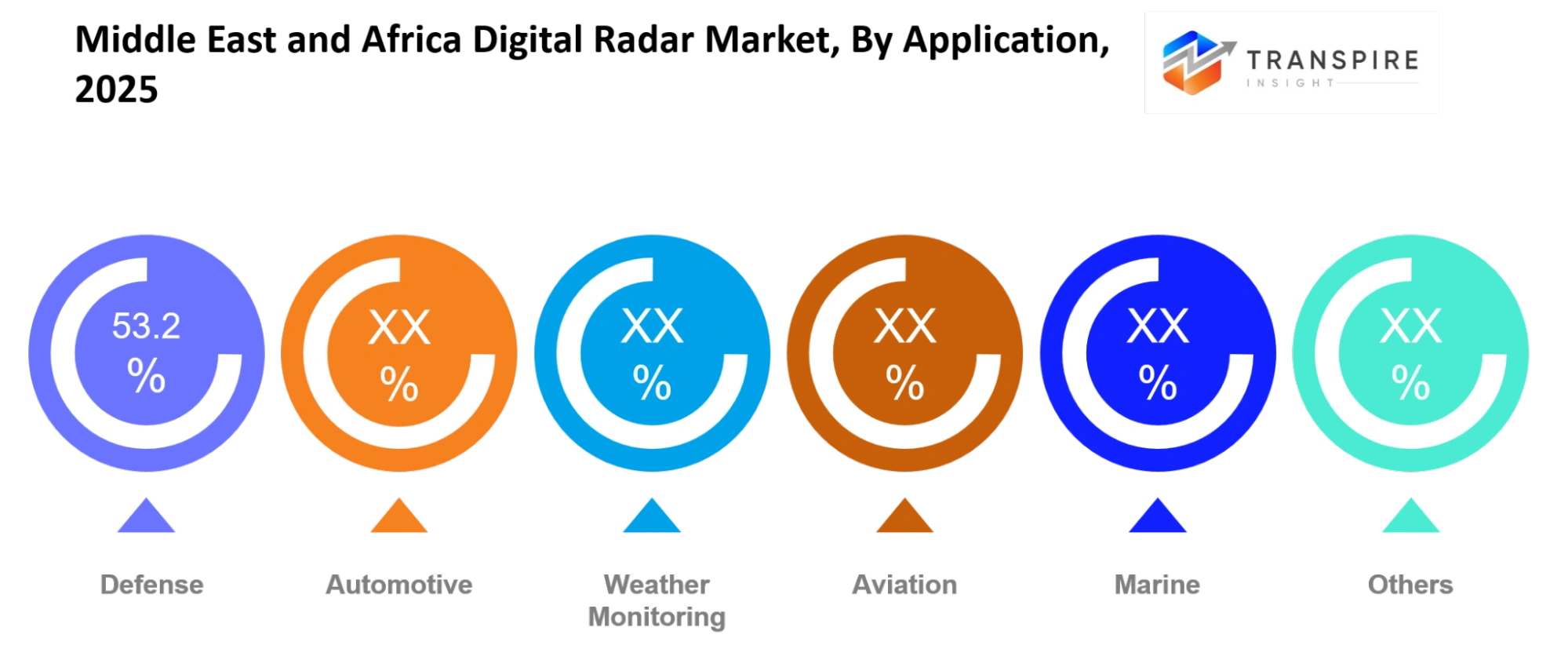
- On the demand side, defense applications contributed more than 52% of market needs in 2025, so that segment is the clear leader.
- At the same time transportation and aviation surveillance are growing, especially as regional airports begin deploying next generation monitoring systems. For end users, military organizations represented roughly 58% of spending in 2025, with border security initiatives helping a lot.
- Key players such as Lockheed Martin, RTX, Thales, Leonardo, and Hensoldt are concentrating on AESA radar innovation, AI enabled detection, and regional expansion plans.
What are the Key Drivers, Restraints, and Opportunities in the Middle East and Africa Digital Radar Market?
Defense modernization programs are, in practice, the strongest force that’s accelerating the market expansion, in a sort of ripple effect. In fact, Governments across the Gulf region and a number of selected African nations have increased spending on integrated air defense networks, after concerns rose around missile threats, drone incursions, and broader border security challenges. The shift away from mechanically scanned radar toward AESA and software-defined architectures has helped in better tracking accuracy, quicker reaction times,and stronger multi-target engagement. And yes, these gains then push up procurement budgets plus larger system integration contracts, which creates meaningful revenue paths for radar manufacturers and defense contractors.
Still, the biggest constraint is the high acquisition cost and the full lifecycle cost tied to advanced digital radar systems. Modern radar platforms tend to demand specialized semiconductor components, more complex software, secure communication networks, and personnel who are highly trained. Because of that set of needs, several African countries—especially those with tighter defense budgets—face structural barriers that are hard to bend. Procurement delays, financing limits, and reliance on foreign suppliers keep slowing deployment schedules, and they also reduce the potential market revenue that could otherwise appear.
At the same time, a major growth opportunity is showing up from counter-drone and low-altitude surveillance solutions. The fast rise in unmanned aerial vehicle activity near critical infrastructure, energy sites, ports, and even military installations has driven demand for compact digital radar platforms designed to spot small and fast-moving targets. AI-enabled radar approaches, when merged with command-and-control networks, are getting noticeable attention across Gulf Cooperation Council countries and some selected African defense agencies.
What Has the Impact of Artificial Intelligence Been on the Middle East and Africa Digital Radar Market?
Artificial intelligence is kinda transforming digital radar operations, in the sense that target detection gets better, classification accuracy increases, and decisions come faster, it can feel almost automatic. A lot of modern radar platforms now lean on AI algorithms, so they can separate aircraft, drones, vehicles, and even maritime targets from the background clutter more reliably, and this often reduces operator workload, while surveillance keeps improving. Defense organizations also push AI-enabled analytics into command centers, sort of to automate threat evaluation and to sort alerts by risk levels, not just by time.
Meanwhile, machine learning models are powering predictive maintenance efforts as well. By looking at radar signal behavior, component temperatures, power consumption rhythms, and system diagnostics, operators can spot possible failures before they become real breakdowns. This method boosts equipment availability, lowers maintenance costs, and stretches the operational life. In both aviation and defense settings, predictive maintenance tactics have brought measurable gains in system uptime and overall mission readiness.
Beyond that, advanced digital technologies are tuning radar resource allocation, spectrum handling, and target tracking performance. With real time analytics, operators can change radar parameters on the fly, depending on how the environment and mission conditions look at that moment.
Still, a noticeable limitation remains, it’s the integration complexity. AI-enabled radar solutions usually need big amounts of high quality training data, secure computing infrastructure, and dependable communications networks. In remote regions or under harsh environmental conditions, connectivity can be spotty, data may be scarce, and then algorithm performance drops, plus deployment costs tend to rise too.
Key Market Trends
- Between 2021 and 2025 , AESA radar adoption grew in a pretty noticeable way, and a lot of military operators focused on multi target tracking, plus electronic warfare resilience, kinda more than before.
- After some regional security incidents showed where critical infrastructure protection was weak, counter-drone radar purchasing then moved faster, like you could see the change pretty clearly.
- Along with defense programs, AI assisted target classification started showing up more often, it helped cut down false alarms and in some cases improved response time by as much as 30% .
- Also X band radar deployments jumped, more than 20% since 2022, mostly because target detection accuracy got better, and that part mattered a lot.
- A handful of Gulf countries boosted radar modernization budgets during 2024–2026, in order to reinforce integrated air defense networks, and it seemed planned, not casual.
- Meanwhile, radar makers reallocated investment toward software defined architectures, which support remote upgrades and that sort of operational flexibility.
- Strategic partnerships between defense electronics firms and regional governments picked up after 2024, and a lot of technology transfer initiatives were tied into that.
- On the maritime side, surveillance programs took on digital radar platforms that can watch shipping lanes, and also offshore energy assets.
- Weather monitoring agencies, for their part, upgraded Doppler radar networks to improve forecasting accuracy, and disaster preparedness capabilities, at least according to the reports.
- Companies like Thales, Leonardo, Hensoldt, and RTX also expanded AI enabled radar portfolios, to strengthen their competitive positioning.
Middle East and Africa Digital Radar Market Segmentation
By Radar Type
Imaging Radar plays a big important part in high definition surveillance, recon, and figuring out what a target might be. Defense agencies keep pushing imaging radar systems, mainly because they can form very detailed visual representations even when the weather is rough or the visibility is kind of gone. Pulse Radar still holds a strong spot, not because it is old, but because it is used everywhere in aviation surveillance, weather monitoring, and military tracking tasks.
Doppler Radar helps with velocity measurement ,as well as spotting motion and changes across aviation services and meteorological operations. AESA Radar is getting a lot more attention lately, since electronic beam steering boosts tracking speed and overall dependability. FMCW Radar is spreading through transportation and security uses, driven by its compact form and efficient power consumption. There are also other radar types, like specialized radar approaches meant for niche surveillance needs, or specific industrial requirements.
By Frequency
X Band is still a very used frequency span, largely because it gives strong target sharpness and defense surveillance abilities, you know. A lot of military and maritime monitoring setups lean on X Band tech so they can achieve dependable tracking behavior. C Band, on the other hand, fits weather monitoring, plus medium-range observation tasks where a kind of balanced performance is needed, not too much and not too little.
S Band is often chosen for long-distance air traffic control, as well as for weather viewing systems in general. Ku Band helps with fine-grain imaging and more advanced tracking applications, and Ka Band takes care of next step communication together with surveillance systems. There are also other frequency ranges that end up being used in special operational settings, they need distinctive detection traits in practice.
By Application
Defense generates the largest share of digital radar deployments, because modern military operations, well basically need continuous situational awareness, and threat detection work that never really stops. Missile defense , border security, and counter-drone missions keep supporting procurement activity across the region. Automotive uses are slowly expanding too, as advanced driver assistance technologies become more refined and competent, day by day.
Weather monitoring stays important, for forecasting, disaster management, and climate observation programs. Aviation applications help with air traffic control and also airport surveillance infrastructure. Marine applications go toward navigation safety, vessel tracking, and offshore asset protection. Other use cases include industrial monitoring and infrastructure security operations, in a more general sense.
By End User
Military organizations are taking the biggest slice of spending, mostly because defense modernization programs keep moving along across multiple regional markets, kind of continuously. Digital radar systems help with battlefield awareness, missile defense, reconnaissance and border protection duties. Government agencies are also, sort of a sizable customer pool, via homeland security, transportation, and public safety initiatives, as well.
Transportation operators use radar technologies to handle air traffic management, railway monitoring, and the whole smart mobility direction. Industrial users are leaning more and more toward digital radar solutions, for facility protection, process monitoring, and even asset management type applications. Beyond that, other end users include research institutions, plus specialized surveillance organizations, who need dependable detection for various environments.
What are the Key Use Cases Driving the Middle East and Africa Digital Radar Market?
Defense surveillance still feels like the main use case, driving adoption pretty much across the region. Military organizations depend on more advanced radar systems to pick up aircraft, missiles, drones, and also unauthorized border activity. Ongoing investments in air defense networks, plus integrated command systems, are generating the biggest chunk of market demand, at least for now.
Aviation and maritime surveillance show up as key secondary applications too. Airports increasingly use digital radar platforms to strengthen air traffic management and day to day operational safety. Meanwhile, ports, and coast guard agencies deploy radar systems to track vessel movement, shipping corridors, and the offshore energy infrastructure.
Newer directions are starting to matter as well. Think counter-drone protection around energy facilities, smarter border monitoring, and even autonomous transportation systems. AI-enabled radar technologies are getting a lot of attention for protecting critical infrastructure, especially where countries are putting money into digital transformation, and national security modernization programs.
|
Report Metrics |
Details |
|
Market size value in 2025 |
USD 1.32 Billion |
|
Market size value in 2026 |
USD 1.44 Billion |
|
Revenue forecast in 2033 |
USD 2.65 Billion |
|
Growth rate |
CAGR of 9.10% from 2026 to 2033 |
|
Base year |
2025 |
|
Historical data |
2021 - 2024 |
|
Forecast period |
2026 - 2033 |
|
Report coverage |
Revenue forecast, competitive landscape, growth factors, and trends |
|
Regional scope |
Middle East and Africa (Saudi Arabia, United Arab Emirates, South Africa, Rest of Middle East and Africa) |
|
Key company profiled |
Lockheed Martin, RTX, Thales, Leonardo, Saab, Northrop Grumman, Honeywell, Garmin, Hensoldt, Indra, Elbit, Bharat Electronics, NEC, Mitsubishi Electric, Rohde & Schwarz. |
|
Customization scope |
Free report customization (country, regional & segment scope). Avail customized purchase options to meet your exact research needs. |
|
Report Segmentation |
By Radar Type (Imaging Radar, Pulse Radar, Doppler Radar, AESA Radar, FMCW Radar, Others, Others, Others); By Frequency (X Band, C Band, S Band, Ku Band, Ka Band, Others, Others, Others); By Application (Defense, Automotive, Weather Monitoring, Aviation, Marine, Others, Others, Others); By End User (Military, Government, Transportation, Industrial, Others, Others, Others, Others). |
Which Regions are Driving the Middle East and Africa Digital Radar Market Growth?
The Middle East is still, kinda the biggest regional stage, because of hefty defense budgets, ongoing modernization of military forces and, also a solid level of public backing for security infrastructure. Saudi Arabia and the UAE keep pouring in funding for integrated air defense systems, plus border monitoring networks, and it doesn’t look like they are easing. Big procurement efforts keep backing the rollout of AESA radar platforms and next-generation command solutions. With a fairly mature defense ecosystem and a steady stream of investment, regional leadership is basically locked in.
South Africa shows up as the second-largest contributor, supported by a mix of defense know-how, aerospace know-how too, and real industrial involvement. The way things grow there feels different compared to the Gulf, because funding leans more toward staying operationally ready, and upgrading the existing surveillance setups. When government procurement plans stay consistent, they also help sustain demand for radar modernization projects. On top of that, local manufacturing strengths make the whole market more resilient, in a practical way.
Across the wider African region, the expectation is faster growth through 2033. More pressure on border protection, the need to secure critical infrastructure, and transportation modernization initiatives are opening doors for digital radar deployments. Several nations have increased surveillance spending to handle cross-border security issues and to tighten national monitoring. That kind of momentum makes it easier for technology suppliers and investors to see long-term expansion, and not just short-term wins.
Who are the Key Players in the Middle East and Africa Digital Radar Market and How Do They Compete?
Competition in global defense electronics feels fairly concentrated around the big players, especially those with solid radar engineering know how. In practice, it comes down mostly to tech performance, detection precision, resilience against electronic warfare, and also how well systems actually get stitched together. The long standing manufacturers keep trying to protect their slice of the market through innovation, while regional procurement programs end up opening doors, for newer collaborations and more local, production oriented setups.
Thales, for example, stands out via advanced AESA radar development, plus those integrated defense architectures that are meant to work as a whole, and it also brings strong coverage across air, land, and maritime surveillance. Leonardo tends to lean into multifunction radar systems and those next generation missile defense efforts, including KRONOS radar development, along with ballistic defense initiatives.
Hensoldt competes by doubling down on sensor innovation, counter drone detection capabilities, and by building partnerships that slot radar tech into newer surveillance platforms. RTX leans on a wide pool of missile defense and air surveillance know how, and Lockheed Martin emphasizes integrated defense ecosystems, plus more advanced tracking solutions. Overall, strategic partnerships AI enabled features, and localization measures keep shaping who wins, across the regional market.
Company List
- Lockheed Martin
- RTX
- Thales
- Leonardo
- Saab
- Northrop Grumman
- Honeywell
- Garmin
- Hensoldt
- Indra
- Elbit Systems
- Bharat Electronics
- NEC
- Mitsubishi Electric
- Rohde & Schwarz
Recent Development News
In January 2026, Leonardo installed the KRONOS Grand Naval radar under the Horizon Mid-Life Upgrade program. The milestone supports qualification of advanced naval air-defense capabilities and strengthens next-generation maritime radar deployment.
Source: https://www.navalnews.com
In January 2026, Leonardo and Thales Alenia Space successfully launched the third COSMO-SkyMed Second Generation radar satellite. The deployment expanded advanced radar-based Earth observation and security monitoring capabilities.
Source: https://www.leonardo.com
In June 2026, Hensoldt and Indra commenced live testing of the ECRS Mk1 AESA radar for German and Spanish Eurofighter fleets. The development advanced next-generation digital radar validation and strengthened European radar technology capabilities.
Source: https://www.janes.com
What Strategic Insights Define the Future of the Middle East and Africa Digital Radar Market?
The market is kind of structurally shifting toward fully digital software-defined and AI-enabled surveillance ecosystems that blend radar sensing with data fusion, and automated threat assessment, which is more or less what everyone is calling the baseline now. This shift is being pushed by security environments that get more and more complicated, plus expanding drone activity , and also the need for real-time situational awareness across the air land and maritime areas. In the future, competitive edge will depend less only on hardware specifications and more on software abilities, cross-system interoperability, and how well the analytics performs.
There is also a less visible risk, sorta tucked in the background, like dependence on specialized semiconductor components and advanced electronics supply chains. If anything disrupts those inputs , it could postpone production runs, and raise procurement costs for radar manufacturers and for government customers too.
At the same time, there is an emerging opportunity in AI-powered counter-drone radar networks that are meant to shield airports ports energy sites, and other critical infrastructure. Market players should focus on partnerships that bring together radar hardware, AI analytics, and command-and-control integration. Businesses that manage to set up localized support training, and ongoing maintenance ecosystems across the Middle East and Africa will likely be better placed to capture the longer-term growth chances.
Middle East and Africa Digital Radar Market Report Segmentation
By Radar Type
- Imaging Radar
- Pulse Radar
- Doppler Radar
- AESA Radar
- FMCW Radar
- Others
By Frequency
- X Band
- C Band
- S Band
- Ku Band
- Ka Band
- Others
By Application
- Defense
- Automotive
- Weather Monitoring
- Aviation
- Marine
- Others
By End User
- Military
- Government
- Transportation
- Industrial
- Others
Frequently Asked Questions
Find quick answers to common questions.
The expected Middle East and Africa Digital Radar Market size for the market will be USD 2.65 Billion in 2033.
Key segments for the Middle East and Africa Digital Radar Market are By Radar Type (Imaging Radar, Pulse Radar, Doppler Radar, AESA Radar, FMCW Radar, Others, Others, Others); By Frequency (X Band, C Band, S Band, Ku Band, Ka Band, Others, Others, Others); By Application (Defense, Automotive, Weather Monitoring, Aviation, Marine, Others, Others, Others); By End User (Military, Government, Transportation, Industrial, Others, Others, Others, Others).
Major Middle East and Africa Digital Radar Market players are Lockheed Martin, RTX, Thales, Leonardo, Saab, Northrop Grumman, Honeywell, Garmin, Hensoldt, Indra, Elbit, Bharat Electronics, NEC, Mitsubishi Electric, Rohde & Schwarz.
The Middle East and Africa Digital Radar Market size is USD 1.32 Billion in 2025.
The Middle East and Africa Digital Radar Market CAGR is 9.10% from 2026 to 2033.
- Lockheed Martin
- RTX
- Thales
- Leonardo
- Saab
- Northrop Grumman
- Honeywell
- Garmin
- Hensoldt
- Indra
- Elbit Systems
- Bharat Electronics
- NEC
- Mitsubishi Electric
- Rohde & Schwarz
About the Authors

Avinash Kumar
I’m Avinash Kumar, a Senior Research Analyst at Transpire Insight, with expertise in the Electronics and Semiconductor and Energy & Power industry. My work focuses on analyzing emerging technologies, market trends, industry developments, and innovation across these sectors. I specialize in transforming complex technical and market insights into clear, research-backed content that helps professionals, businesses, and decision-makers stay informed. Through continuous industry research and data-driven analysis, I strive to deliver accurate, reliable, and practical perspectives on the latest advancements shaping the semiconductor and energy landscape.

Chakradhar Khansole
Chakradhar serves as the Research Director at Transpire Insight, bringing over 8 years of experience in technology, innovation, and strategic market intelligence. He specializes in transforming complex market data into actionable business insights that enable organizations to make informed, growth-oriented decisions. Recognized for his strategic vision and analytical expertise, Chakradhar leads high-impact research initiatives, delivering comprehensive market assessments, competitive intelligence, and forward-looking industry analysis.
Recently Published Reports
-
Apr 2026
Fiber Optic Faceplates Market
Fiber Optic Faceplates Market Size, Share & Analysis Report By Type (< 300 mm2, 300-350 mm2, and > 350 mm2, By Application (Night Vision, Holographic Imaging, Medical, and Others), and Geography (North America, Europe, Asia-Pacific, Middle East and Africa, South and Central America), 2021 - 2031
-
Apr 2026
High Temperature Superconductors Market
High Temperature Superconductors Market Size, Share & Analysis Report By Type (1G HTS, and 2G HTS), By Application (Power Cable, Fault Current Limiter, and Transformer), and Geography (North America, Europe, Asia-Pacific, Middle East and Africa, South and Central America), 2021 - 2031
-
Apr 2026
Industrial Plugs and Socket Market
Industrial Plugs and Socket Market Size, Share & Analysis Report By Type (Industrial Plugs, Industrial Sockets), By Current (Up to 32 A, 32 to 125 A, Above 125 A), By Protection (Dustproof and Splash Proof, Waterproof, Explosion Proof), By End User (Heavy Industries, Oil and Gas, Chemicals and Pharmaceuticals, Power Generation, Others), and Geography (North America, Europe, Asia-Pacific, Middle East and Africa, South and Central America), 2021 - 2031
-
Apr 2026
InGaAs Avalanche Photodiodes Market
InGaAs Avalanche Photodiodes Market Size, Share & Analysis Report By Type (1100 - 1700 nm, and 1000 - 1600 nm), By Application (Missile Warning System, Muzzle Flash Detection, Wafer Defect Inspection, Laser Rangefinders, and Others), and Geography (North America, Europe, Asia-Pacific, Middle East and Africa, South and Central America), 2021 - 2031