
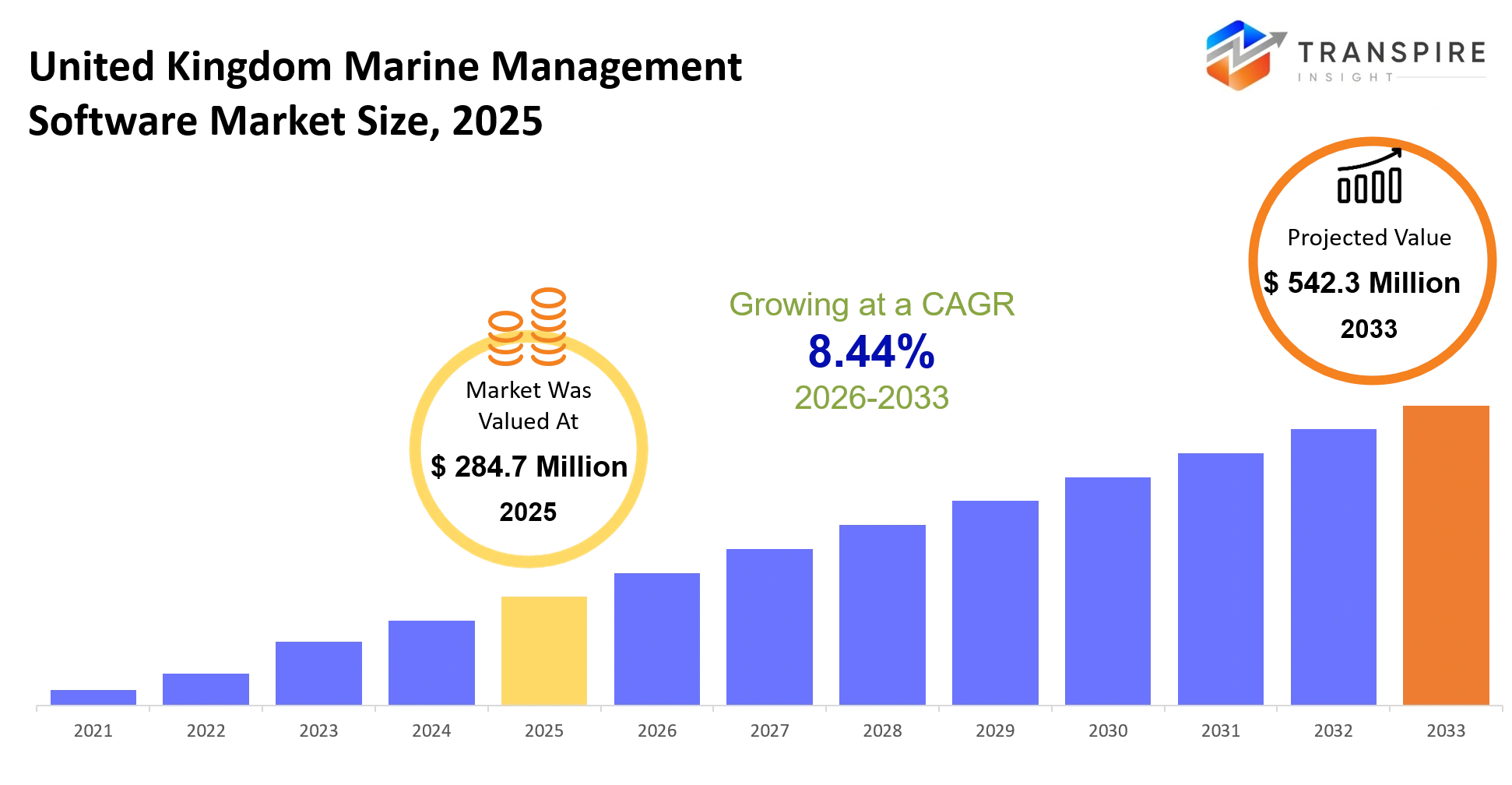
United Kingdom Marine Management Software Market Size & Forecast:
- United Kingdom Marine Management Software Market Size 2025: USD 284.7 Million
- United Kingdom Marine Management Software Market Size 2033: USD 542.3 Million
- United Kingdom Marine Management Software Market CAGR: 8.44%
- United Kingdom Marine Management Software Market Segments: By Software Type (Fleet Management Software, Port Management Software, Cargo Management Software, Navigation Software, Compliance Management Software, Others); By Deployment (Cloud-based Software, On-premise Software, Hybrid Platforms, AI-enabled Platforms, Others); By Application (Commercial Shipping, Naval Operations, Offshore Operations, Fishing Operations, Others); By End User (Shipping Companies, Port Authorities, Defense Sector, Logistics Providers, Others)
To learn more about this report,  Download Free Sample Report
United Kingdom Marine Management Software Market Summary
The United Kingdom Marine Management Software Market was valued at USD 284.7 Million in 2025. It is forecast to reach USD 307.5 Million by 2033, and yes that comes out to a CAGR of 8.44% across the period.
The United Kingdom Marine Management Software Market, basically supports the daily grind of ports, shipping fleets, offshore assets, and marine service providers. It does this by assisting them with vessel movements, maintenance schedules, compliance records, fuel consumption, cargo tracking, and crew tasks, all via centralized digital platforms. In day to day use these systems reduce operational delays, sharpen situational awareness over maritime assets, and in general help enable safer, more efficient marine operations, you know, the kind that keep things moving.
Over the last five years, the market has shown a noticeable structural change from standalone vessel management tools into cloud-based integrated platforms that tie together operational, maintenance, and regulatory workflows in near real time. At the same time, tougher environmental and emissions reporting obligations, including actions connected to international maritime decarbonization targets, have encouraged faster adoption of this software. On top of that, supply chain disruptions and port congestion, kind of proved that manual processes can fall short, so operators started investing in digital monitoring as well as planning functions. Since maritime organizations are pushing for more operational resilience, better compliance productivity, and improved asset usage, software spending is shifting toward wider rollouts across fleets and port infrastructure, and that’s keeping the market on a fairly steady growth path.
Key Market Insights
- England kind of leads the United Kingdom Marine Management Software Market, with around 68% market share in 2025, mostly supported by the big ports and the main shipping hubs. Scotland meanwhile looks like the fastest-growing region in the forecast, a lot because offshore energy investments are being ramped up and the marine asset management requirements keep widening, day by day, honestly.
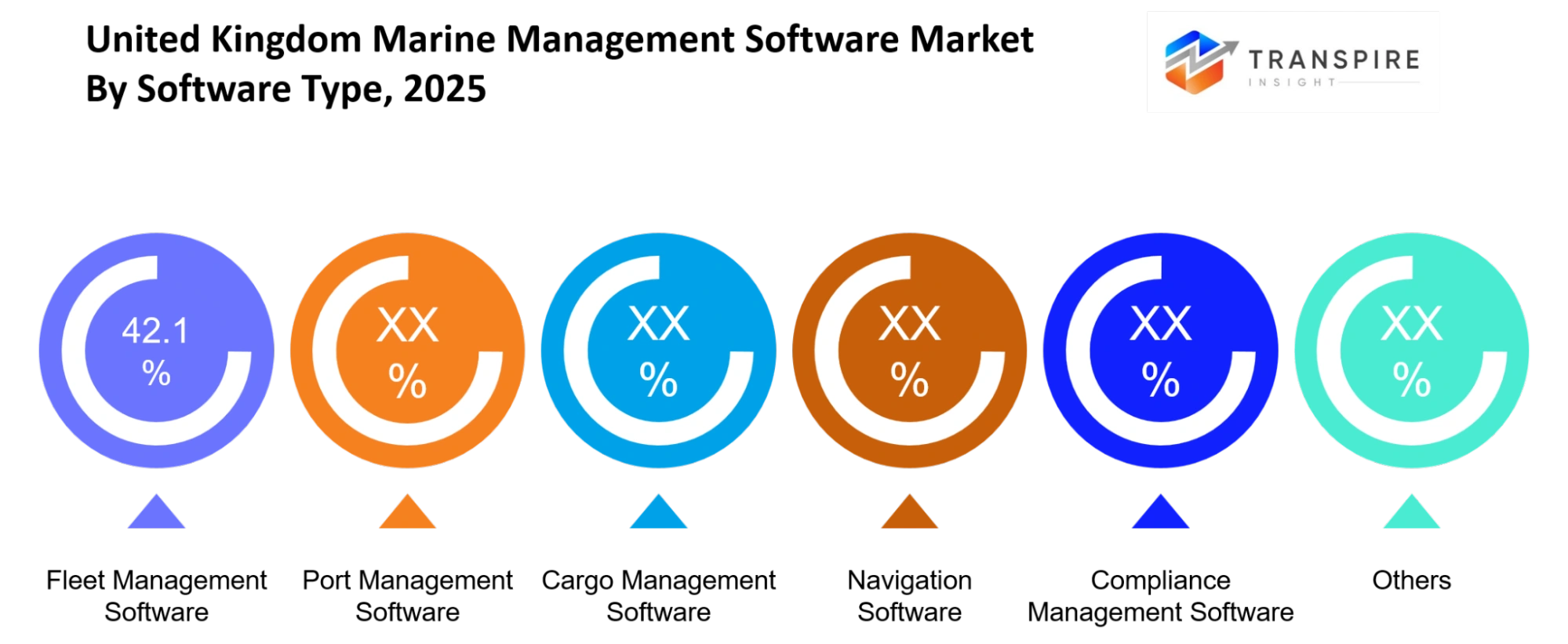
- In England the coastal industrial clusters keep pushing broader software rollout, especially for vessel monitoring, fleet optimization, and regulatory reporting too. When you break down software type, Fleet Management Software kind of sits first, taking close to 35% of the market share in 2025, and that’s largely powered by the demand for operational sightlines plus better fuel-efficiency outcomes. Right after that, Maintenance Management Software takes the second-largest slice, backed by preventive maintenance methods and the overall governance of asset lifecycles needs.
- If we look at deployment style, Cloud-based Marine Management Platforms are the fastest-growing segment through 2030, since many organizations are moving away from legacy on-premise arrangements and going toward something more flexible. On the application side, Fleet Operations Management leads the market with about 40% revenue share in 2025, which lines up with the continuous need for real-time vessel tracking and performance monitoring even when conditions shift quickly.
- Environmental Compliance Management is, like, the fastest-growing application in this space, mainly because the tighter emissions reporting and sustainability obligations keep getting pushed harder year after year. Digital reporting tools are also picking up serious momentum across commercial shipping and offshore operations, to help streamline those compliance workflows, and to cut down the whole headache factor.
- For end users, Commercial Shipping Companies are leading the United Kingdom Marine Management Software Market, with roughly 45% of total demand in 2025. At the same time, Offshore Energy Operators are the fastest-growing end-user group, mainly tied to the more offshore wind activity and expanded marine infrastructure projects. Port authorities meanwhile keep increasing their software spend, to improve operational efficiency, cargo visibility and resource planning, overall..
What are the Key Drivers, Restraints, and Opportunities in the United Kingdom Marine Management Software Market?
Driver
The most forceful growth driver in the United Kingdom Marine Management Software Market is the maritime sector’s shift, towards data led operations and regulatory compliance. Tougher emissions monitoring, vessel reporting, and safety management obligations have pushed shipping companies, port authorities and offshore operators to swap out split up manual workflows with one more integrated software platform. This move has kind of been sped up by operational disruptions seen during the recent global supply chain bottlenecks, which laid bare the weaknesses of spreadsheet based planning and disconnected data sources. Because operators are now chasing more scene setting visibility into fleet behavior, maintenance cadence, and even fuel burn, software spending becomes a straightforward route for trimming operating costs and strengthening asset utilization, which supports increased adoption rates and recurring software revenue.
Restraint
A major restraint is basically the real-world complexity of threading modern marine management software into older maritime infrastructure. A lot of vessel operators and port facilities still lean on aging operational technologies, that were never built for cloud link or quick real time data sharing. Switching, or upgrading, these systems takes real capital outlay, time consuming verification rounds, and workforce retraining that can really stretch things. And since maritime assets often stay active for decades, this difficulty feels more like a structural issue than a quick fix. The consequence often shows up as slower rollout timelines, postponed buying decisions, and fewer revenue chances for software vendors.
Opportunity
A sort of noticeable window of chance sits in the growth of offshore wind projects across the United Kingdom. As offshore power operators start running bigger bunches of support vessels and marine assets, demand keeps rising for software that can coordinate in smoother ways, and keep tabs on workloads more reliably.
What Has the Impact of Artificial Intelligence Been on the United Kingdom Marine Management Software Market?
Artificial intelligence together with more advanced digital tech is, kinda, reshaping marine management software across the United Kingdom, and it’s doing it by pushing stronger automation, clearer operational visibility and tighter regulatory oversight all at once. Newer platforms are using AI powered analytics so they can handle fleet compliance tracking on their own, monitor vessel emissions, and even run scrubber performance systems in near real time. With nonstop data collection from onboard sensors, these setups can notice when emissions readings start drifting away from the allowed limits, assemble compliance paperwork automatically, and alert operators early enough, so regulatory issues don’t sneak in, super quietly.
Also, machine learning is giving maritime work a more shrewd forecasting capability. Rather than just reacting after something goes wrong, predictive maintenance models look at engine performance, vibration fingerprints, fuel usage patterns, and equipment condition signals to anticipate breakdowns before they appear. This usually lets operators schedule maintenance in a more orderly fashion, which reduces the odds of unexpected stoppages. It also supports longer service life for assets over time. On top of that, AI based emissions prediction tools help vessel owners choose routes, tune engine settings, and manage fuel burn, and they can often improve fuel efficiency by about 5–10% while still supporting environmental compliance goals.
The operational effect is pretty big. Fleet operators usually end up with improved vessel availability, lower maintenance costs, more dependable reporting accuracy, and compliance processes that move faster. Still, one sticking point keeps showing up, the way AI integrates with legacy maritime infrastructure. A lot of vessels have older control systems, and the data gathering is kind of uneven, so the model accuracy can dip, while the overall rollout and integration costs end up higher. Also there’s limited connectivity in offshore and distant marine zones, so real time analytics get tougher, and it also dulls continuous system optimization, even when the software is already set up to do something.
Key Market Trends
- Since 2020, vessel operators have sped up migration away from on-premise setups toward cloud platforms, which makes data more available even when the fleets are spread out, basically in different regions.
- After the worldwide supply chain disruptions, shipping companies ramped up spending on real time fleet visibility tools, to cut down scheduling frictions and delays at ports, mostly because coordination was getting messy.
- AI based predictive maintenance has kind of moved on from early pilot work and into day to day use, so operators can lower unexpected equipment breakdowns and also reduce maintenance costs.
- Environmental reporting duties, that came later alongside IMO emissions regulations, pushed marine teams toward automated compliance, and also more direct emissions monitoring solutions.
- Offshore wind development around the UK coastline has created fresh demand for software that handles maintenance vessels, crew logistics, and marine assets in a single flow, even if the process feels a bit different vessel to vessel.
- Buyers are increasingly leaning toward integrated platforms rather than standalone applications, combining fleet management with maintenance scheduling, compliance reporting, and analytics inside one environment.
- Since 2021, major vendors—DNV, Wärtsilä, and Kongsberg Digital included—have grown their digital twin, and predictive analytics capabilities, faster than before.
- Port authorities have shifted budgets toward data driven operational systems, aiming to improve berth allocation, streamline cargo movement, and use resources more effectively.
- Cybersecurity is now a higher procurement priority, especially as connected vessel systems and cloud based marine platforms process bigger volumes of operational data.
- Remote monitoring adoption has gone up across both offshore and commercial fleets, so manual inspections get reduced, while operational oversight and reporting accuracy improve, at least in most deployments.
United Kingdom Marine Management Software Market Segmentation
By Software Type
-
Fleet Management Software kind of takes up a large spot here, because fleet operators really need constant visibility on assets, service cycles, fuel consumption, and basically how things turn out operationally. Digital fleet systems are helpful in a hands-on way, so companies can better plan ahead, reduce idle time, and also keep operating expenses under control a bit more tightly.
-
Port Management Software also stays pretty popular, and not only that, since there is more push toward traffic sequencing, terminal efficiency, and how resources are allocated. With more freight flowing through major ports, it seems like that momentum has shifted additional budget toward smarter, more advanced management platforms.
-
Cargo Management Software backs cargo tracing, paperwork handling, and logistics coordination, so organizations get sharper awareness across the entire supply chain. Navigation Software keeps gaining value because route optimization matters more and more, and then real-time monitoring along with safety oversight features keep showing up. Compliance Management Software focuses on regulatory submissions, environmental surveillance, and the operational documentation that is commonly demanded.
-
Other software groups exist for more niche operational requirements, and they also fit into the broader digital transformation trend across marine infrastructure.
To learn more about this report, Download Free Sample Report
By Deployment
- Cloud based software has become kinda a preferred deployment model, mainly because centralized access and scalability, plus lower infrastructure needs, that enable more operational flexibility. A lot of organizations now go with cloud solutions so it’s easier for teams to coordinate between several locations and different operational sites. Also the ongoing software updates, and remote accessibility, seem to stack on top of each other, reinforcing adoption across the industry… even more. And since digital transformation initiatives keep popping up, that same momentum continues to support cloud deployment growth.
- That said, on-premise software still matters in organizations that really want direct control over operational data and their own internal systems. Hybrid platforms blend cloud flexibility with localized control, so you end up with a more balanced deployment approach. AI enabled platforms get a lot of attention too, usually tied to predictive maintenance, automated reporting, performance monitoring, and operational analytics. There are other deployment models as well, but they typically land in more niche operational requirements and specialized infrastructure environments.
By Application
- Commercial Shipping is a big application area because operational efficiency, regulatory compliance, and asset utilization stay as the main business priorities, mostly. Digital software platforms assist with scheduling, maintenance planning, documentation, and operational monitoring kind of stuff. There is also growing pressure to cut down operational costs, so companies are leaning more into software integration across their commercial operations. Advanced analytics in particular helps with decision-making that is more informed, plus performance management, overall.
- Naval Operations use management software to keep things aligned for coordination, asset monitoring, and that maintenance planning side. Offshore Operations keep expanding software adoption because there is higher investment in offshore energy infrastructure and those more complicated operational demands, too. Fishing Operations get support for route planning, compliance tracking, and resource management capabilities. Other application areas also lean on software solutions, usually to back specialized operational and administrative functions that are harder to handle manually.
By End User
- Shipping Companies still represent a hefty slice of software use, because operational visibility, maintenance coordination, and regulatory compliance are all constant “must haves” for day-to-day business. Digital platforms support cost control, day to day workflow efficiency, and asset performance handling, even across broader operating routes. With ongoing modernization efforts, organizations end up allocating more money toward advanced software solutions, and when analytics gets woven together with automation tools, adoption becomes even more grounded.
- Port Authorities rely on management software to tighten traffic control, make better use of infrastructure, improve operational planning, and handle routine reporting chores too. The Defense Sector leans on software systems, to reinforce operational readiness, synchronize maintenance work, and carry out asset management tasks without as much friction. Logistics Providers roll out digital systems to raise cargo visibility, sharpen scheduling, and keep supply chain coordination smoother. Other end users keep shifting toward management software, mostly to boost operational efficiency and to support longer-term digital modernization goals.
What are the Key Use Cases Driving the United Kingdom Marine Management Software Market?
The main thing kind of pushing adoption in the United Kingdom Marine Management Software Market is, in a way fleet operations management, you know. For commercial vessel operators these platforms are used to keep an eye on asset performance, plan maintenance, track fuel consumption, and handle the regulatory reporting side of things too. This particular application is getting the top demand, because operational efficiency has a direct impact on profitability asset utilization, and compliance outcomes.
But it doesn’t really stop at fleet management, software uptake is also shifting into port operations and offshore energy support work. Port authorities are using digital systems to help with berth allocation coordinate cargo flow, and do smarter resource planning. On the offshore side, wind operators are increasingly relying on management platforms to coordinate maintenance vessels, crews, and inspection schedules across complex marine structures.
There are also newer directions showing up, like AI based predictive maintenance and digital twin technologies for monitoring asset performance. You can even spot early adoption in automated emissions tracking and environmental reporting tools, built to fit the changing maritime regulations. Right now though these use cases are still kind of limited, even if they look like they have strong long run potential, especially as digitalization keeps gathering momentum across the maritime sector.
|
Report Metrics |
Details |
|
Market size value in 2025 |
USD 284.7 Million |
|
Market size value in 2026 |
USD 307.5 Million |
|
Revenue forecast in 2033 |
USD 542.3 Million |
|
Growth rate |
CAGR of 8.44% from 2026 to 2033 |
|
Base year |
2025 |
|
Historical data |
2021 - 2024 |
|
Forecast period |
2026 - 2033 |
|
Report coverage |
Revenue forecast, competitive landscape, growth factors, and trends |
|
Regional scope |
United Kingdom |
|
Key company profiled |
Kongsberg Digital, Wärtsilä, ABS Group, DNV, Oracle, SAP, ABB, Veson Nautical, Inmarsat, SpecTec, DockMaster, Transas, ShipNet, Helm Operations, MarineCFO |
|
Customization scope |
Free report customization (country, regional & segment scope). Avail customized purchase options to meet your exact research needs. |
|
Report Segmentation |
By Software Type (Fleet Management Software, Port Management Software, Cargo Management Software, Navigation Software, Compliance Management Software, Others); By Deployment (Cloud-based Software, On-premise Software, Hybrid Platforms, AI-enabled Platforms, Others); By Application (Commercial Shipping, Naval Operations, Offshore Operations, Fishing Operations, Others); By End User (Shipping Companies, Port Authorities, Defense Sector, Logistics Providers, Others) |
Which Regions are Driving the United Kingdom Marine Management Software Market Growth?
England keeps showing up as the main region in this market, mostly because it has the bulk of the big commercial ports, the maritime service providers, and a wide set of technology vendors. Also, when environmental, safety, and operational rules are enforced in a strong way, companies end up adopting digital management platforms earlier than you might expect, even if people were hesitant at first. The huge cargo volumes moving through ports like Southampton, Felixstowe, and London means there’s always this ongoing requirement for fleet coordination plus compliance software. On top of that, the regional maritime ecosystem, with logistics firms, port operators, software developers, and regulatory bodies working alongside each other, keeps feeding the leadership position.
Wales is smaller than England, though it still contributes a solid share, mainly through steady infrastructure activity and day to day maritime operations that bring in market revenue. Instead of going for major expansion schemes, adoption there is backed by continued investment in port modernization, and operational efficiency programs. Maritime businesses in the area tend to concentrate on better asset utilization, sharper maintenance planning, and clearer operational visibility. In practice, that kind of measured, and kind of realistic strategy, leads to dependable software spend and long-term customer retention for the technology providers.
Scotland is showing the quickest growth, sort of pushed along by fast ramp up in offshore wind and marine energy projects. With more money going into offshore infrastructure, there is suddenly more demand for software that handles maintenance schedules, crew deployment, and the whole asset performance side. That trend is also speeding up because operators are using digital tools more and more to tighten operational control even across those remote marine areas. So between 2026 and 2033, this momentum should bring pretty attractive opportunities for software vendors and investors who want exposure to the expanding offshore sector and newer digital technologies.
Who are the Key Players in the United Kingdom Marine Management Software Market and How Do They Compete?
Competition in the United Kingdom Marine Management Software Market is still sort of moderately fragmented, in the sense that global enterprise software firms are right there with specialized maritime technology providers. Lately, tech innovation is basically the main reason companies compete because customers keep asking for a more integrated platform, one that can stitch together fleet operations, maintenance planning, compliance reporting, and performance analytics. Regular vendors try to hold their ground by rolling out product upgrades and keeping long‑term customer ties, while the smaller and more focused software players are getting momentum by covering operational holes that bigger platforms might not fully manage. On top of that, cloud deployment, automation features, and data integration are now considered major levers for purchasing decisions across the whole sector.
Kongsberg Digital leans heavily into technology innovation, especially via digital twin solutions and advanced analytics that deliver real‑time operational visibility. In practice, this helps operators fine tune asset output and shrink down time lost to downtime, which gives them a tangible edge in demanding offshore and industrial settings. Wärtsilä, on the other hand, differentiates itself through connected operational ecosystems, linking navigation, maintenance, and performance management into one unified platform. Ongoing partnerships with maritime operators, plus investments in intelligent vessel technologies, also backs up their push to expand in both commercial and offshore use cases.
DNV kinda blends software tools with compliance, certification, and risk management know-how, so customers can steer operational performance while also meeting regulatory needs through one single provider, which is … sort of convenient. Oracle on the other hand leans on scalable cloud infrastructure plus enterprise data management strengths, and it helps tie maritime operations into wider business workflows. ABS Group is more focused on safety, asset integrity, and risk-led management solutions, and that draws organizations that run critical infrastructure or high-value assets. Meanwhile, strategic partnerships, cloud centered product development, and more involvement in offshore energy projects keep edging these firms into a stronger competitive spot, even if the progress is gradual.
Company list
- Kongsberg Digital
- Wärtsilä
- ABS Group
- DNV
- Oracle
- SAP
- ABB
- Veson Nautical
- Inmarsat
- SpecTec
- DockMaster
- Transas
- ShipNet
- Helm Operations
- MarineCFO
Recent Development News
In February 2026, Kongsberg Maritime went ahead and launched its unified Digital Solutions portfolio, also in the same time they introduced the KM Performance platform. This launch kind of brought together several older, legacy software systems into one data driven ecosystem, meant to help with fleet efficiency, emissions monitoring, and regulatory compliance across day to day maritime operations. https://www.kongsberg.com
In April 2026, Wärtsilä released the NTPRO 7 next generation bridge and ship-handling simulator and managed to get a Statement of Compliance from DNV. The platform backs advanced digital navigation training, and it really shows that a lot of investment is moving toward simulation based operational readiness for these modern maritime environments. https://www.wartsila.com
In November 2025, DNV renewed its strategic partnership with the Maritime and Port Authority of Singapore (MPA). This agreement broadened the collaboration on maritime digitalization, smart-ship systems, and sustainability related projects, which is supposed to support a wider uptake of digital technologies across global marine operations. https://www.dnv.com
What Strategic Insights Define the Future of the United Kingdom Marine Management Software Market?
The United Kingdom Marine Management Software market is moving toward pretty highly integrated, data-centric operating environments, where fleet management, compliance reporting, maintenance planning and operational analytics kinda work through connected platforms not really standalone apps. This is being pushed by tougher regulatory supervision, more operational complexity, and the need for near-real time decision support across commercial ports offshore energy assets, and marine infrastructure. Over the next five to seven years, vendors that can merge artificial intelligence, cloud connectivity, and predictive analytics into one unified platform are probably going to take a bigger portion of industry spending.
There’s also a less obvious risk, which is the growing reliance on just a handful of software ecosystems. When operators start consolidating around a small set of technology providers, vendor lock-in can get stronger, cybersecurity exposure may rise, and integration issues could make operations more fragile. At the same time, there’s an opportunity quietly forming around digital twin technology for offshore wind infrastructure, especially in Scotland and other coastal energy hubs. So market participants should lean into open and interoperable platforms, and also invest in partnerships with offshore energy operators, to get ready for the next phase of digital maritime transformation.
United Kingdom Marine Management Software Market Report Segmentation
-
By Software Type
- Fleet Management Software
- Port Management Software
- Cargo Management Software
- Navigation Software
- Compliance Management Software
- Others
-
By Deployment
- Cloud-based Software
- On-premise Software
- Hybrid Platforms
- AI-enabled Platforms
- Others
-
By Application
- Commercial Shipping
- Naval Operations
- Offshore Operations
- Fishing Operations
- Others
-
By End User
- Shipping Companies
- Port Authorities
- Defense Sector
- Logistics Providers
- Others
Frequently Asked Questions
Find quick answers to common questions.
The expected United Kingdom Marine Management Software Market size for the market will be USD 542.3 Million in 2033.
By Software Type (Fleet Management Software, Port Management Software, Cargo Management Software, Navigation Software, Compliance Management Software, Others); By Deployment (Cloud-based Software, On-premise Software, Hybrid Platforms, AI-enabled Platforms, Others); By Application (Commercial Shipping, Naval Operations, Offshore Operations, Fishing Operations, Others); By End User (Shipping Companies, Port Authorities, Defense Sector, Logistics Providers, Others).
Major United Kingdom Marine Management Software Market players are Kongsberg Digital, Wärtsilä, ABS Group, DNV, Oracle, SAP, ABB, Veson Nautical, Inmarsat, SpecTec, DockMaster, Transas, ShipNet, Helm Operations, MarineCFO.
The United Kingdom Marine Management Software Market size is USD 284.7 Million in 2025.
The United Kingdom Marine Management Software Market CAGR is 8.44%from 2026 to 2033.
- Kongsberg Digital
- Wärtsilä
- ABS Group
- DNV
- Oracle
- SAP
- ABB
- Veson Nautical
- Inmarsat
- SpecTec
- DockMaster
- Transas
- ShipNet
- Helm Operations
- MarineCFO
About the Authors

Mayur Shinde
I am Mayur Shinde, a Senior Research Analyst at Transpire Insight, specializing in the Automotive & Transportation and Information & Communication Technology (ICT) Industry. My work focuses on analyzing emerging market trends, technological advancements, competitive landscapes, and industry developments to deliver accurate, data-driven insights. I am passionate about transforming complex market information into clear, actionable content that helps businesses, professionals, and decision-makers stay informed and make confident strategic decisions.

Chakradhar Khansole
Chakradhar serves as the Research Director at Transpire Insight, bringing over 8 years of experience in technology, innovation, and strategic market intelligence. He specializes in transforming complex market data into actionable business insights that enable organizations to make informed, growth-oriented decisions. Recognized for his strategic vision and analytical expertise, Chakradhar leads high-impact research initiatives, delivering comprehensive market assessments, competitive intelligence, and forward-looking industry analysis.
Recently Published Reports
-
Apr 2026
3D Optical Profiler Market
3D Optical Profiler Market Size, Share & Analysis Report By Type (Desktop 3D Optical Profiler, and Portable 3D Optical Profiler), By Technology (Confocal Technology, and White Light Interference), By End-Use Industry (Manufacturing, Research Institutions, Automotive, Aerospace and Defense, Medical Devices, and Other), and Geography (North America, Europe, Asia-Pacific, Middle East and Africa, South and Central America), 2021 - 2031
-
Apr 2026
Depth Sensor Market
Depth Sensor Market Size, Share & Analysis Report By Type (Infrared Depth Sensors, Time-of-Flight (ToF) Sensors, Stereo Vision Sensors, Structured Light Sensors, Ultrasonic Depth Sensors), By Application (Automotive, Robotics, Gaming, Consumer Electronics, Industrial Automation, Healthcare, Security & Surveillance, Others), By End Users (Automotive Manufacturers, Consumer Electronics Companies, Healthcare Providers, Industrial Companies, Security Agencies, Gaming Companies, Robotics Companies, Others), and Geography (North America, Europe, Asia-Pacific, Middle East and Africa, South and Central America), 2021 – 2031
-
Apr 2026
Digital Manufacturing Market
Digital Manufacturing Market Size, Share & Analysis Report By Component (Hardware, Software, and Services), By Technology (Robotics, 3D Printing, Internet of Things (IoT), and Others), By Application (Automotive and Transportation, Aerospace and Defense, Consumer Electronics, Industrial Machinery, and Others), By Process Type (Computer-Based Designing, Computer-Based Simulation, Computer 3D Visualization, Analytics, and Others), and Geography (North America, Europe, Asia-Pacific, Middle East and Africa, South and Central America), 2021 – 2031
-
Apr 2026
Digital Visa Services Market
Digital Visa Services Market Size, Share & Analysis Report By Type (Individual Travelers, Group Travelers), By Application (Tourism, Business Travel, Others), and Geography (North America, Europe, Asia-Pacific, Middle East and Africa, South and Central America), 2021 – 2031