

Europe Marine Scrubber Market Size & Forecast:
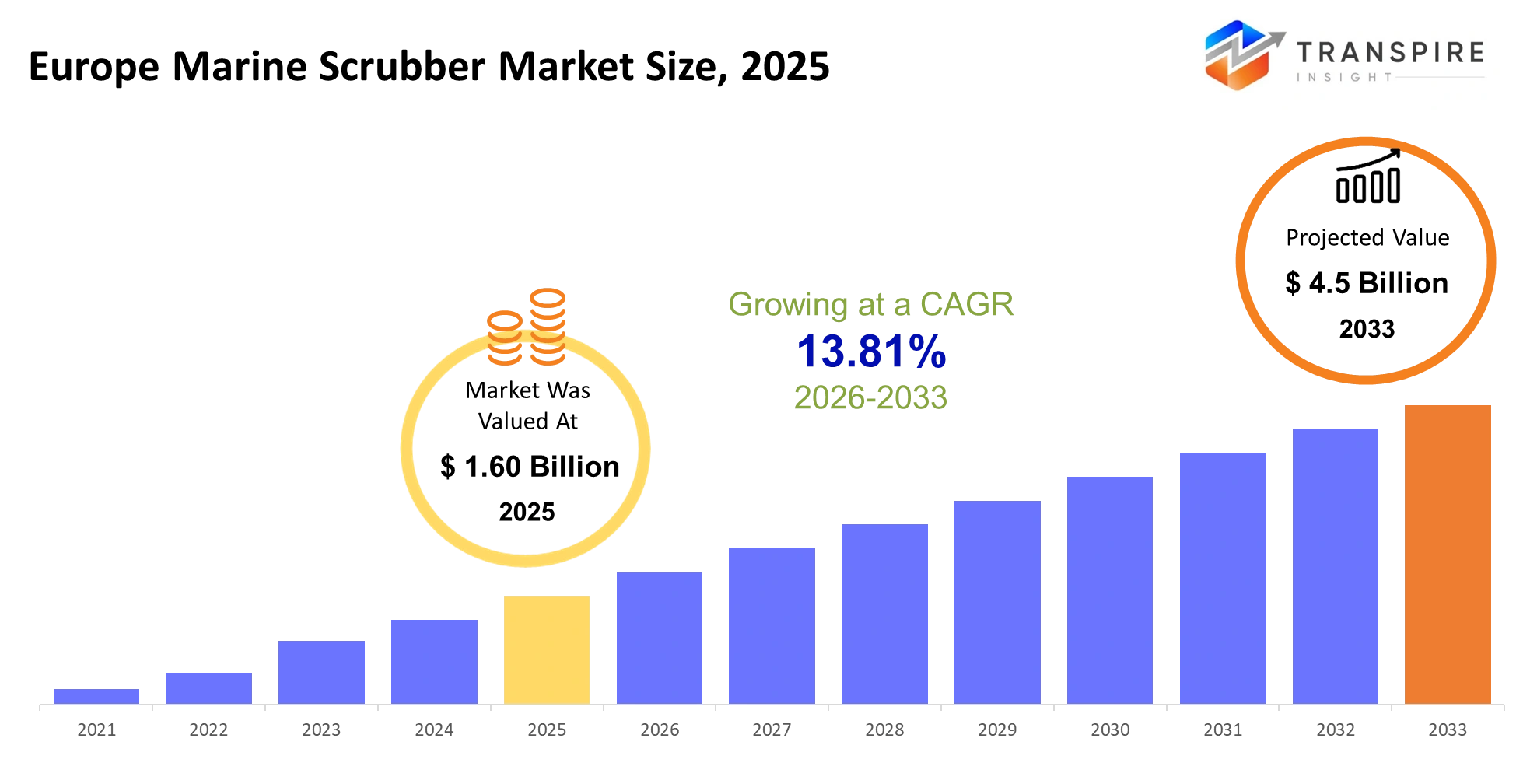
- Europe Marine Scrubber Market Size 2025: USD 1.60 Billion
- Europe Marine Scrubber Market Size 2033: USD 4.5 Billion
- Europe Marine Scrubber Market CAGR: 13.81%
- Europe Marine Scrubber Market Segments: By Type (Open-loop, Closed-loop, Hybrid, Dry Scrubbers, Others); By Application (Bulk Carriers, Tankers, Container Ships, Cruise Ships, Others); By End-User (Ship Owners, Shipping Companies, Others); By Technology (Wet Scrubber, Dry Scrubber, Hybrid Systems, Others).
To learn more about this report,  Download Free Sample Report
Europe Marine Scrubber Market Summary
The Europe Marine Scrubber Market was valued at USD 1.60 Billion in 2025. It is forecast to reach USD 4.5 Billion by 2033. That is a CAGR of 13.81% over the period.
The Europe Marine Scrubber Market supports compliance in commercial shipping by enabling vessels to reduce sulfur oxide emissions from marine fuels while continuing to operate on conventional fuel types. Scrubber systems provide ship operators with a practical solution to achieve their emission control targets because these systems permit operators to continue using their standard fuel while meeting emissions limits. The function provides essential support to long-haul fleets which operate in different regulatory zones while their expense control requires them to maintain operational flexibility.
The material installation practices in European Emission Control Areas have changed because of the new stricter maritime emission rules which emerged during the past few years after the IMO 2020 sulfur limits began to receive enforcement attention. The marine fuel price volatility which started after geopolitical events disabled global energy supply networks has become a main factor driving adoption forward. The combination resulted in ship operators giving more importance to fuel flexibility together with the need for long-term cost control. The high-consumption vessel classes adopted scrubber retrofits which generated increased revenue for system manufacturers and retrofit service providers.
Key Market Insights
- Europe's Marine Scrubber Market holds a leading position because it controls 35 to 40 percent of the market share which will persist until 2025 because European countries enforce their Emission Control Area regulations effectively.
- The Asia Pacific region will experience its fastest growth between 2025 and 2032 because shipbuilding activities and retrofitting of commercial fleets will increase during this period.
- Open-loop scrubbers maintain their market leadership position because they require lower installation expenses and users find them easy to operate.
- Operators choose hybrid scrubbers because this technology allows them to meet compliance requirements in international and coastal water environments.
- European coastal zones maintain a steady secondary market share for closed-loop systems because European regulations impose strict rules on port discharge handling.
- The application demand for bulk carriers and container ships reaches 55 percent because these ships consume large amounts of fuel during their extended distance travels.
- The cruise ship industry experiences its most rapid growth because operators need to meet environmental regulations while passengers push for sustainable practices.
- Over 50 percent of end-user adoption for shipping companies occurs because these companies use fleet-scale procurement strategies and retrofit programs to expand their operations.
- The independent ship owner industry maintains its upward trajectory because ship owners increasingly invest in compliance upgrades for their aged vessels which helps them maintain operational capacity.
- The company plans to grow through multiple strategic partnerships which include its shipyard partnerships and its long-term service contract agreements and its low-energy scrubber technology research and development initiatives that will enhance product lifecycle efficiency and compliance reliability.
What are the Key Drivers, Restraints, and Opportunities in the Europe Marine Scrubber Market?
The Europe Marine Scrubber Market exists because ship operators must comply with sulfur emission control rules which the IMO 2020 regulations and European Emission Control Areas enforcement. The rules require ship operators to select between low-sulfur fuel and exhaust gas cleaning systems which permit the use of high-sulfur fuel oil. The price of compliant fuels compared to heavy fuel oil became more expensive after energy supply disruptions occurred in 2022 which led to increased scrubber usage on bulk carriers and tankers and container fleets. The regulatory pressure creates a cost difference which shipyards and manufacturers spend on equipment retrofits to fulfill their operational needs.
The primary obstacle exists because ports which have implemented discharge restrictions create uncertainty about whether open-loop scrubbers will receive permanent regulatory approval. Ship owners experience operational challenges because they need to assess their assets against changing environmental compliance standards. High initial installation expenses create investment challenges for older ships which have short remaining operational periods. The adoption process for markets with restricted capital resources takes longer to complete because fuel economics show positive results.
Hybrid scrubber systems which include digital emission monitoring technology present significant potential for development. Ship operators increasingly prioritize flexible compliance systems capable of switching between open-loop and closed-loop modes across jurisdictions.The Northern European ports of Rotterdam and Hamburg currently expand their green shipping incentives while they develop their shore-based infrastructure, which creates optimal conditions for businesses to invest in hybrid retrofitting technologies and next-generation scrubber systems.
What Has the Impact of Artificial Intelligence Been on the Europe Marine Scrubber Market?
The development of scrubber performance systems through artificial intelligence and advanced digital systems enables European fleets to maintain continuous emission control and compliance monitoring activities. The current exhaust gas cleaning technology uses AI control systems to manage water flow and pH levels and exhaust treatment based on real-time engine performance and fuel sulfur levels. The system needs less human control to operate the system more effectively during extended maritime journeys. Centralized dashboards enable fleet operators to gather emissions information from various vessels which facilitates faster regulatory compliance reporting and helps them meet specific route compliance requirements.
Machine learning models increasingly support predictive maintenance by analyzing sensor data from pumps, scrubber towers, and washwater systems to identify early signs of fouling, corrosion, or performance degradation. These models increase operational availability because they decrease the number of unexpected equipment failures while allowing maintenance work to take place during designated port times. Shipping companies report operational improvements through better fuel efficiency and reduced compliance penalties because their emissions control systems work more reliably during high usage periods of their container and tanker fleets.
The marine emission control systems currently use AI technology because ships lack enough real-time connectivity which becomes especially problematic during long-distance transportation outside coastal regions. The system needs complete data streams for accurate model functioning but it currently operates with incomplete data which creates delays in implementing full predictive optimization for international shipping operations.
Key Market Trends
- The European Union strengthened its control of emission standards through stricter enforcement measures which forced ship operators to install scrubbers rather than using different fuels.
- The heavy fuel oil market became more profitable because fuel prices fluctuated after the 2022 geopolitical events which led to increased scrubber installations in long-distance shipping operations.
- The implementation of hybrid scrubbers increased after 2023 because operators extended their compliance activities to both open ocean areas and port-specific emission control zones.
- European coastal ports experienced a decrease in open-loop scrubber installations because new wastewater discharge regulations established more stringent operational rules.
- German and Dutch shipyards expanded their capacity to retrofit ships between 2021 and 2025 because there was an increasing need for emission control system upgrades.
- Wärtsilä and Alfa Laval developed new digital scrubber monitoring systems after 2022 to enhance compliance monitoring while minimizing system outages.
- Container shipping lines shifted their purchasing tactics because they started to focus on total operational expenses throughout the product lifetime instead of just the initial setup costs.
- The use of AI-based emission tracking systems became common after 2023 because these systems enhanced the accuracy of reporting which organizations used to manage compliance for their multiple vessels.
- Smaller shipowners postponed their installation projects because they lacked sufficient funds while major shipping companies implemented scrubber systems across their entire fleets.
- European ports developed different regulatory frameworks which created a market for scrubber systems that could change between different operational modes.
Europe Marine Scrubber Market Segmentation
By Type:
The deployment of open-loop systems in marine scrubber configurations currently represents the most cost-effective solution because it requires less upfront investment and its installation process is less complex. The technology has achieved widespread adoption among retrofitted vessels which operate in international waters, which helps maintain its market dominance. The market share of closed-loop systems remains stable because coastal areas and emission-controlled zones have implemented stricter discharge regulations. Operators who need to operate under different regulatory systems are turning to hybrid systems because these systems provide them with operational flexibility. The deployment of dry scrubbers remains limited to specific applications because their operational requirements exceed available installation space and financial resources.
The different types of systems experience separate growth patterns because regulations and fuel transitions create different challenges for each system type. Hybrid systems enable customers to follow international regulations because they can operate in two different modes without needing new systems. The strict wastewater discharge regulations at ports create additional demand for closed-loop systems. The open-loop systems expansion process faces delays because various regions have implemented tighter environmental regulations that restrict system development.

To learn more about this report, Download Free Sample Report
By Application:
Container ships and tankers maintain their primary market position because these ships consume large amounts of fuel while they operate on international trade routes which require them to meet emission standards through equipment installations. The bulk carriers market follows which back the increase of adoption through cost-effective equipment upgrade choices. The cruise ship market shows growth because of increased environmental regulations which apply to passengers and port operations. The other vessel types maintain restricted use because their operational capacity remains below needed levels.
Different ship categories experience different growth patterns which depend on fuel consumption rates and their compliance requirements with regulations and their ability to upgrade systems. Operating companies for cruise ships implement environmental improvements at a higher pace because they need to meet both brand requirements and regulations which restrict their operations near coastlines. Tankers maintain their operational requirements through demand which originates from international shipping routes. Bulk carriers show slower uptake due to margin constraints which limit their ability to invest in new technologies. Container shipping operations experience steady growth which enterprises support through international trade and emission control measures.
By End-User:
The shipping industry represents the main customer group for end-user segments because they possess unified fleet operations and procurement capabilities which enable them to install scrubber systems on several ships. Ship owners maintain a major industry position because they possess both physical assets and the ability to decide on equipment upgrades. The other end-user groups stay limited because their business operations operate at different levels of capacity.
The factors that drive growth differ according to the ownership structure and the methods used for capital distribution. Shipping companies speed up their implementation process by maintaining operational standards across their entire fleet and using their buying power to acquire products. Ship owners make specific investments when they evaluate the age of their ships and the time until those ships complete their service. Other end-users face slower expansion due to limited financing access. The future outlook shows that scrubber adoption will become more common among major fleet operators while independent owners will follow controlled retrofit patterns.
By Technology:
Wet scrubber systems hold dominant share within technology segmentation because they demonstrate operational efficiency which shipping companies worldwide have accepted as regulatory standard. Dry scrubber systems maintain niche territory because their required space and operating expenses limit their market reach. Operators who need to comply with emission regulations in both controlled and open sea zones are increasingly adopting hybrid systems. The commercial use of other technologies remains restricted because they cannot reach the stage of widespread market implementation.
Technology growth patterns reflect regulatory tightening and fuel diversification trends. Hybrid systems show strongest momentum because they allow users to operate in different regulatory environments. Wet scrubbers experience growth reduction because authorities have implemented more strict regulations in particular coastal areas. The installation process of dry scrubbers presents major challenges. The development process will concentrate on creating systems that can operate with multiple fuels while decreasing costs for environmental compliance throughout their operational lifetime.
What are the Key Use Cases Driving the Europe Marine Scrubber Market?
The main application of the Europe Marine Scrubber Market functions to ensure that vessels which use large amounts of fuel meet emission standards established by the IMO 2020 sulfur regulations which apply to container ships and tankers. The demand for scrubber systems arises because these systems allow vessels to operate with high-sulfur fuel oil while meeting the emission standards which apply to European Emission Control Areas. Long-haul operators show strong interest in adopting the technology because they achieve cost benefits from the ability to use various fuel types.
Shipping companies and fleet operators implement scrubbers on bulk carriers and cruise ships through retrofit programs which enable them to achieve regulatory compliance while maintaining operational efficiency. European cruise operators increasingly implement these systems because of passenger-facing sustainability standards which require strict adherence to port entry requirements. The moderate retrofit feasibility and extended operational lifespan of bulk carriers make them suitable for retrofitting.
The new operational scenarios of the pilot project implement digital emission monitoring and hybrid operational switching for multi-zone compliance. Shipowners begin to implement scrubber-linked carbon reporting systems which help them comply with stricter EU maritime transparency regulations, which marks their initial use of these systems for purposes beyond traditional sulfur reduction.
|
Report Metrics |
Details |
|
Market size value in 2025 |
USD 1.60 Billion |
|
Market size value in 2026 |
USD 1.82 Billion |
|
Revenue forecast in 2033 |
USD 4.5 Billion |
|
Growth rate |
CAGR of 13.81% from 2026 to 2033 |
|
Base year |
2025 |
|
Historical data |
2021 - 2024 |
|
Forecast period |
2026 - 2033 |
|
Report coverage |
Revenue forecast, competitive landscape, growth factors, and trends |
|
Regional scope |
Europe (Germany, United Kingdom, France, Italy, Spain, Rest of Europe) |
|
Key company profiled |
Wartsila, Alfa Laval, Yara Marine, Mitsubishi Heavy Industries, Clean Marine, Valmet, DuPont, ANDRITZ, Hamworthy, Fuji Electric, PureteQ, Ecospray, Saacke, CR Ocean Engineering, AEC Maritime. |
|
Customization scope |
Free report customization (country, regional & segment scope). Avail customized purchase options to meet your exact research needs. |
|
Report Segmentation |
By Type (Open-loop, Closed-loop, Hybrid, Dry Scrubbers, Others); By Application (Bulk Carriers, Tankers, Container Ships, Cruise Ships, Others); By End-User (Ship Owners, Shipping Companies, Others); By Technology (Wet Scrubber, Dry Scrubber, Hybrid Systems, Others). |
Which Regions are Driving the Europe Marine Scrubber Market Growth?
The strict enforcement of Emission Control Areas across the North Sea and Baltic Sea enables Europe to maintain its leadership position in the Europe Marine Scrubber Market. The regulatory bodies establish stringent sulfur limits which compel ship operators to use exhaust gas cleaning systems instead of depending on low-sulfur fuels. The port infrastructure in Rotterdam, Hamburg, and Antwerp provides complete support for handling large-scale retrofit operations and maintenance work. The heavy vessel traffic that exists on intra-European trade routes creates ongoing demand for maritime services. The established ship financing institutions act as a force that motivates compliance-based retrofits which helps to establish sustainable practices.
The second position of North America remains stable because shipping operators maintain their investments while regulatory authorities enforce existing rules. The adoption of technology in this region depends more on cost efficiency and fleet updating periods than the strict coastal regulations that Europe implements. The major ports of New York and Los Angeles enable shipowners to proceed with scrubber installation at a gradual pace because regulatory authorities do not impose strict requirements. The shipowners create a more stable investment environment by selecting systems according to their expected long-term operational advantages instead of needing to meet short-term compliance requirements. Operating revenue maintains consistent performance because the business system produces steady income streams.
The Asia Pacific region experiences the fastest growth rate because the shipbuilding industry in China, South Korea, and Japan undergoes rapid development. The recent improvements in shipyard capacity together with environmental upgrades that meet global maritime standards have resulted in increased scrubber deployment for both new ship constructions and existing ship retrofitting. The rising trade volumes from exports give operators more reasons to meet international emission standards which apply to their European routes. The growing financial commitment from regional shipping companies creates a stronger demand for shipping services.This growth signals strong opportunities for technology providers and retrofit specialists during 2026–2033.
Who are the Key Players in the Europe Marine Scrubber Market and How Do They Compete?
The Europe Marine Scrubber Market displays a competition situation which shows moderate consolidation because established marine engineering companies control most retrofit projects and new installation work. The market competition focuses on three main areas which are engineering reliability and lifecycle efficiency and compliance assurance instead of competing only through pricing. The shipowners use three criteria to assess vendors which include fuel savings performance and integration flexibility with engine systems and service coverage across major European ports. The operational support networks which companies require to operate their business together with certification requirements and shipyard partnerships create major obstacles for new market entrants.
Wärtsilä Corporation establishes its competitive advantage through technology-driven product differentiation which emphasizes integrated emission control systems together with digital monitoring systems. The company establishes its expansion strategy through executing long-term service agreements with fleet operators which generate ongoing revenue from maintenance activities and compliance monitoring. Alfa Laval establishes its competitive edge through its high-efficiency separation and washwater treatment technologies which specifically cater to cruise and tanker operators needing to meet European port environmental requirements. The company establishes its presence in new markets through partnerships with shipyards located in both the Netherlands and Germany.
Yara Marine Technologies operates as a retrofit specialist by providing modular scrubber systems which enable rapid installation during dry-dock scheduling. Clean Marine develops scrubber systems which use cost-effective designs to meet the specific needs of bulk carriers that operate in low-margin trade routes, thus helping price-sensitive shipowners to adopt their solution. Saacke GmbH establishes its unique market position through its combustion-integrated exhaust cleaning systems which it develops in cooperation with European shipbuilding engineers.Mitsubishi Heavy Industries extends its influence through hybrid system development and expansion into multi-fuel compliance solutions for global fleets operating on European routes.
Company List
- Wartsila
- Alfa Laval
- Yara Marine
- Mitsubishi Heavy Industries
- Clean Marine
- Valmet
- DuPont
- ANDRITZ
- Hamworthy
- Fuji Electric
- PureteQ
- Ecospray
- Saacke
- CR Ocean Engineering
- AEC Maritime
Recent Development News
“In February 2026, Alfa Laval advanced its marine exhaust gas cleaning strategy by strengthening product integration with onboard automation systems. The development improved operational efficiency for scrubber-equipped vessels operating under strict European sulfur regulations.”
Source: https://www.statsmarketresearch.com/global-marine-exhaust-gas-control-equipment-market-8071304 (Stats Market Research)
“In January 2026, Yara Marine Technologies expanded its retrofit collaboration network with European shipyards to accelerate hybrid scrubber installations. The initiative reduced installation downtime and supported faster compliance adoption across container and tanker fleets operating in Europe.”
Source: https://www.statsmarketresearch.com/global-marine-exhaust-gas-control-equipment-market-8071304 (Stats Market Research)
What Strategic Insights Define the Future of the Europe Marine Scrubber Market?
The Europe Marine Scrubber Market is currently undergoing a complete transformation which now emphasizes two factors. The market demand maintains its current level because stricter regulations apply to European Emission Control Areas and fuel prices show unstable patterns. The future growth of the market depends on businesses using digital monitoring systems together with their hybrid operational systems. A shift toward real-time compliance management has become a standard practice among international shipping companies.
European ports experience washwater discharge standard regulations which differ between countries as an unrecognized danger which continues to grow rapidly. The installed assets will become less valuable because more ports will restrict or ban open-loop operations, which will lead to decreased retrofit value and shorter periods of return on investment. AI-enabled emission orchestration platforms present fresh business opportunities through their ability to manage scrubber performance throughout entire fleets by adapting to changing routing and specific port regulations. The Northern European green shipping corridors now establish their first operational systems through infrastructure- and data-sharing pilot programs.
Market participants should first focus on creating modular hybrid scrubber systems which combine traditional scrubber designs with digital control systems, which will later ensure compliance with future regulatory requirements while maintaining operational performance.
Europe Marine Scrubber Market Report Segmentation
By Type
- Open-loop
- Closed-loop
- Hybrid
- Dry Scrubbers
- Others
By Application
- Bulk Carriers
- Tankers
- Container Ships
- Cruise Ships
- Others
By End-User
- Ship Owners
- Shipping Companies
- Others
By Technology
- Wet Scrubber
- Dry Scrubber
- Hybrid Systems
- Others
Frequently Asked Questions
Find quick answers to common questions.
The Europe Marine Scrubber Market size is USD 4.5 Billion in 2033.
Key segments for the Europe Marine Scrubber Market are By Type (Open-loop, Closed-loop, Hybrid, Dry Scrubbers, Others); By Application (Bulk Carriers, Tankers, Container Ships, Cruise Ships, Others); By End-User (Ship Owners, Shipping Companies, Others); By Technology (Wet Scrubber, Dry Scrubber, Hybrid Systems, Others).
Major Europe Marine Scrubber Market players are Wartsila, Alfa Laval, Yara Marine, Mitsubishi Heavy Industries, Clean Marine, Valmet, DuPont, ANDRITZ, Hamworthy, Fuji Electric, PureteQ, Ecospray, Saacke, CR Ocean Engineering, AEC Maritime.
The Europe Marine Scrubber Market size is USD 1.60 Billion in 2025.
The Europe Marine Scrubber Market CAGR is 13.81% from 2026 to 2033.
- Wartsila
- Alfa Laval
- Yara Marine
- Mitsubishi Heavy Industries
- Clean Marine
- Valmet
- DuPont
- ANDRITZ
- Hamworthy
- Fuji Electric
- PureteQ
- Ecospray
- Saacke
- CR Ocean Engineering
- AEC Maritime
Recently Published Reports
-
Apr 2026
Active Power Filter Market
Active Power Filter Market Size, Share & Analysis Report By Type (Shunt Active Power Filters, Series Active Power Filter, Hybrid Active Power Filter), By Application (Harmonics Mitigation, Reactive Power Compensation, Voltage Regulation, Power Factor Correction), By Phase (Single Phase, Three Phase), By End-User Industry (Manufacturing, Healthcare, Commercial, Automotive, Oil and Gas, Others), and Geography (North America, Europe, Asia-Pacific, Middle East and Africa, South and Central America), 2021 - 2031
-
Apr 2026
Electrical Transformer Market
Electrical Transformer Market Size, Share & Analysis Report By Core (Closed, Shell, and Berry), By Insulation (Gas, Oil, Solid, Air, and Other), By Phase (Single, and Three), By Rating (100 MVA to 500 MVA, 501 MVA to 800 MVA, and 801 MVA to 1200 MVA), and Geography (North America, Europe, Asia-Pacific, Middle East and Africa, South and Central America), 2021 – 2031
-
Apr 2026
Hydraulic Piston Pumps Market
Hydraulic Piston Pumps Market Size, Share & Analysis Report By Type (Axial Piston Pumps, Radial Piston Pumps), By Operating Pressure (Low Pressure, Medium Pressure, High Pressure), By Application (Construction, Mining, Agriculture, Automotive, Oil & Gas, Industrial Machinery, Others), By End-User (OEMs, Aftermarket), and Geography (North America, Europe, Asia-Pacific, Middle East and Africa, South and Central America), 2021 – 2031
-
Apr 2026
Laboratory Gas Generators Market
Laboratory Gas Generators Market Size, Share & Analysis Report By Product (Nitrogen Gas Generator, Hydrogen Gas Generator, Zero Air Gas Generator, Purge Gas Generator, TOC Gas Generators, Others), By Application (Gas Chromatography, Liquid Chromatography-mass Spectrometry (LC-MS), Gas Analyzers, Others), By End-user (Life Science, Chemical & Petrochemical, Food & Beverage, Others), and Geography (North America, Europe, Asia-Pacific, Middle East and Africa, South and Central America), 2021 – 2031