
Asia Pacific 4D Imaging Radar Market Size & Forecast:
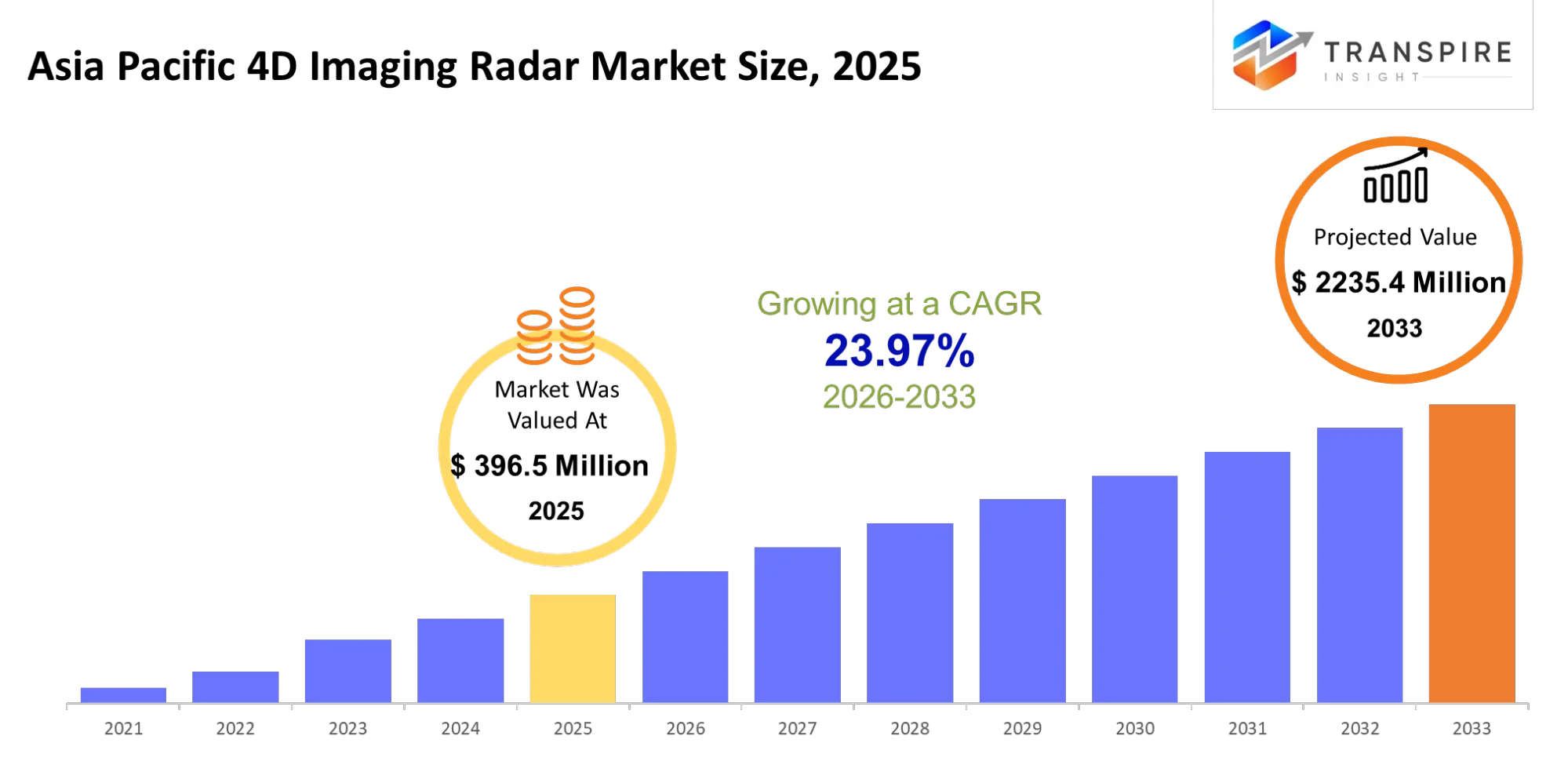
- Asia Pacific 4D Imaging Radar Market Size 2025: USD 396.5 Million
- Asia Pacific 4D Imaging Radar Market Size 2033: USD 2235.4 Million
- Asia Pacific 4D Imaging Radar Market CAGR: 23.97%
- Asia Pacific 4D Imaging Radar Market Segments: By Component (Radar Sensors, Processors, Software, Antennas, Imaging Modules, AI Engines, Connectivity Modules, Others); By Application (ADAS, Autonomous Vehicles, Traffic Monitoring, Security, Industrial Automation, Smart Cities, Others); By Frequency Band (24 GHz, 77 GHz, 79 GHz, Multi-Band, Others); By End User (Automotive, Transportation, Defense, Industrial, Others)
Asia Pacific 4D Imaging Radar Market Summary
The Asia Pacific 4D Imaging Radar Market was valued at USD 396.5 Million in 2025. It is forecast to reach USD 2235.4 Million by 2033. That is a CAGR of 23.97% over the period.
The market in the Asia Pacific 4D imaging radar sector is becoming increasingly integral for enabling more secure and autonomous driving by assisting cars and industrial equipment in detecting objects with higher resolution in adverse conditions, poor weather, low visibility and dense traffic situations. In contrast to conventional radar, 4D imaging radar allows vehicles and industrial systems to perceive detailed spatial information and the speed and direction of objects in their surroundings. Car makers can improve perception system technology without relying solely on cameras or Lidar.
This market has experienced a structural shift over the past three to five years where use in high end vehicles now has led to more widespread application within mass market passenger cars and commercial vehicles due to advances in semiconductor performance and decreasing sensor prices. The global shortage in semiconductors during and following the pandemic, exacerbated the vulnerabilities present in the supply chain and initiated new sensor redesigns with increased redundancy and scalability. The prevalence of ADAS features shifting from optional to standard have contributed to increased radar content within vehicles, enabling additional revenue streams for sensors, and software developers alike throughout the region.
Key Market Insights
- China has emerged as the dominant player in the Asia Pacific 4D Imaging Radar Market with a 45% share in 2025, backed by strong semiconductor investments and the country's early leadership in electric vehicles.
- The Japanese market held a substantial share and is driven by early implementation of autonomous driving features and an established automotive manufacturing capability.
- The Indian market is the fastest growing market between 2025 and 2032 and is attributed to increased sales of premium vehicles and government initiatives to boost intelligent mobility in the country.
- The passenger vehicles segment holds the dominant share of the Asia Pacific 4D Imaging Radar Market with almost 70% market share in 2025, driven by standardization of ADAS features across vehicles.
- Commercial vehicles represent the second largest segment of the market due to the need for improved fleet safety and growing autonomous logistics initiatives in various economies.
- The high-resolution imaging radar systems is the fastest growing product category over 2032 as industry players strive for higher object detection capabilities.
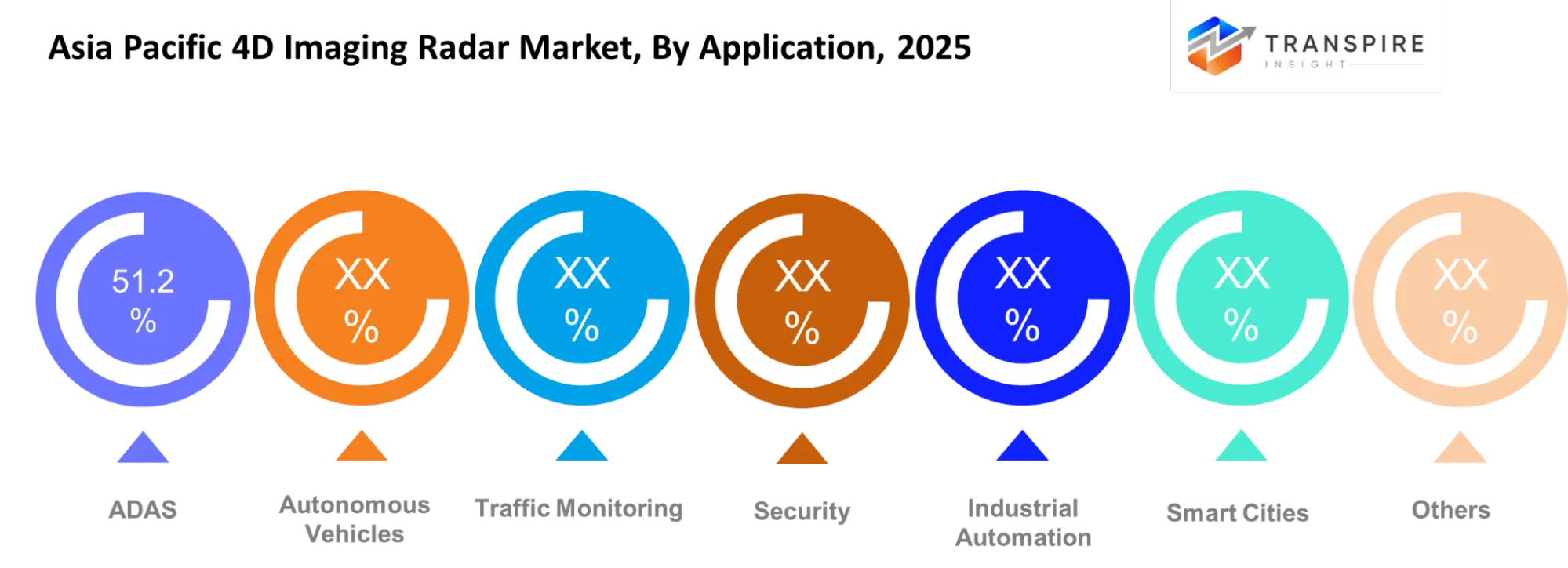
- The ADAS segment has held over 60% market share in 2025 owing to increased adoption of lane keeping assistance, adaptive cruise control and collision avoidance features.
- The autonomous driving application is the fastest growing segment as car manufacturers scale up their L2+ and L3 vehicle programs across Asia Pacific.
- Automotive OEMs continue to be the leading end-user category for imaging radar due to the dominant integration in vehicle architectures for future generation models.
- The mobility service providers and autonomous fleet operator segment are expected to register the highest growth over the forecast period.
What are the Key Drivers, Restraints, and Opportunities in the Asia Pacific 4D Imaging Radar Market?
The primary drivers of growth for the Asia Pacific 4D Imaging Radar Market are moving from a conventional Driver Assistance system to Smart & Semi-Autonomous vehicle technologies. These technologies need a sensor with object detection accuracy even in rain, fog & busy urban traffic situations, where cameras fail. The trend towards smart & semi-autonomous vehicles took off when China, Japan & South Korea increased subsidies on electric and smart vehicles and when customers started demanding for such advanced features in the middle class vehicles too. When radar became a normal technology (instead of a feature), sensor manufacturers & semiconductor providers increased revenue with an increase in the number of radar units per vehicle.
The major structural barrier for the Asia Pacific 4D Imaging Radar Market are higher investment requirements and complexity in the semiconductor supply chain. The need for complex chipsets and antennas, together with the thorough validation of software, limits the high-resolution radar supply to only a few manufacturers in Asia. It thus results in a lengthy commercialization cycle, higher vehicle costs and a delay in market penetration in cost sensitive markets.
The future of market growth will be fueled by software-defined vehicles and AI-based sensor fusion. The transition to integrated perception platforms for imaging radar, cameras & LiDAR is a trend that is well underway and driven by the large investment in intelligent driving technology and a strong semiconductor supply chain in China, pushing the adoption of 4D imaging radar in passenger and commercial vehicles to a mass scale.
What Has the Impact of Artificial Intelligence Been on the Asia Pacific 4D Imaging Radar Market?
The role of AI in the Asia Pacific 4D Imaging Radar Market has brought about improvements in a vehicle's ability to sense, process, and react to difficult driving situations. AI-enabled algorithms are used for analyzing high-volume radar point cloud data with the ability to detect vehicles, pedestrians, bicycles, and static objects with greater accuracy than conventional radar processing. Such automated perception reduces the rate of false positives and enhances the safety function even under bad weather when optical sensors lose their effectiveness.
In order to predict potential sensor failures and monitor its health, the utilization of machine learning models have become important. An OEM uses radar performance metrics in order to predict calibration drift, loss in signal, or hardware failure even prior to a malfunction, leading to longer operating times and reduction in maintenance costs, in the process enhancing the long term dependability of the sensor. Also, in conjunction with other sensors such as cameras and lidar, an AI sensor fusion platform is employed so that perception accuracy is enhanced thereby rendering more dependability in autonomous driving tasks.
The adoption of AI has had its disadvantages. High volume datasets of the conditions of different weather conditions, roads, and traffic, are required to train ML algorithms. The accumulation and tagging of such datasets can turn out to be cost intensive and require a huge amount of time. This especially becomes a hurdle in emerging markets due to lack of developed autonomous driving technology and test infrastructure.
Key Market Trends
- Automakers began shifting their ADAS architecture from camera-centric to sensor fusion from 2021 onward to improve reliability by leveraging camera, 4D radar, and lidar.
- China automotive companies ramped up sensor fusion adoption after 2022 by deploying imaging radar even on mid-range electric vehicles instead of only on premium products.
- Radar suppliers started minimizing reliance on imported chipsets since the supply chain constraint between 2020-2022 pushed manufacturers towards regional semiconductor eco-system.
- Buyers are beginning to demand for higher resolution radar with 1000+ points to detect objects in order to replace simple, narrow scope, traditional radar.
- Competition has shifted from hardware specifications to the artificial intelligence perception software, and Bosch, Continental, Huawei is making substantial investments in the sensor intelligence part.
- Automakers started placing greater importance on all-weather sensing capabilities starting from 2023 on the back of customer expectations extending beyond simple safety.
- Strategic partnerships have dramatically increased from 2022 onwards, with companies like Aptiv and Arbe Robotics forming new ventures.
- Authorities in China, Japan and South Korea began progressively expanding the testing scope for autonomous driving, thus pushing the quick adoption of advanced radar systems.
- Compact design, with lower power consumption, and smaller antenna radar modules became critical for easier integration into electric vehicles without consuming much driving range.
- Domestic technology providers have been gaining strength since 2022, with the help of the Chinese government's push for localized chip fabrication and reduced dependence on foreign suppliers.
Asia Pacific 4D Imaging Radar Market Segmentation
By Component:
Radar Sensors measure the distance, speed and position of an object very accurately under varying road and weather conditions, while the Processor provides the signal analysis and the Software converts raw information to driving and monitoring applications.
Antennas enhance signal transmitting and receiving, Imaging modules enable high-resolution images of the environment, whereas the AI engine will make faster decisions and Connectivity Modules allow communication with other applications and Other components include assisting hardware and integration technologies which would improve the whole performance in automotive, industrial and transportation applications.
By Application:
ADAS has a significant use since advanced safety features require precise object detection and precise environmental analysis. Autonomous Vehicle application uses the imaging radar to perceive the path and detect obstacles while in the traffic monitoring application imaging radar allows a real time traffic flow analysis and congestion control of smart cities.
Security application uses the radar to monitor the periphery for surveillance and detection of intrusive events whereas in industrial automation application the imaging radar offers precise detecting capabilities for the control of machines and to ensure a safe work environment and others application including government services and commercial sectors that would benefit from this technology
By Frequency Band:
Short range sensing needs as well as low cost sensing solutions use the 24GHz frequency range. The 77GHz frequency range offers high resolution and wide range detectability and is widely used across many current driver assistance and safety features on vehicle platforms.
The 79GHz frequency range uses high bandwidth for improved object resolution for advanced imaging features. Multi-band combines advantages of multiple frequencies for better features while Others cover novel frequencies that will support industrial, defense and transportation specialized needs.
By End User:
Automotive is a prominent end user segment because manufacturers are continuing to include imaging radar technology in passenger and commercial vehicles. Transportation applications include traffic management, train monitoring, and intelligent transportation systems, and require accurate sensing solutions.
Defense applications include imaging radar systems for surveillance and target tracking, especially under adverse operating conditions. Industrial uses are focused on automated factory control systems and monitoring applications, while Others are commercial or governmental organizations that require accurate sensing for specific purposes.
What are the Key Use Cases Driving the Asia Pacific 4D Imaging Radar Market?
ADAS applications have been the strongest application market for imaging radar in Asia Pacific, driven by the use of imaging radar in adaptive cruise control, automatic emergency braking, blind spot detection, lane change assistance, and others. Market demand has sustained owing to the fact that imaging radar is capable of providing precise object detection in adverse conditions like rain, fog, and poor illumination that traditional cameras lack the capability for.
Aside from passenger vehicles, the expansion has continued with the inclusion of imaging radar in commercial transportation and traffic monitoring applications. Logistics service providers have started adopting imaging radar to be integrated with trucks and delivery vehicles for safer operations and reducing risk of collisions. City planners have also utilized radar-based traffic monitoring solutions for efficient traffic management, supporting the development of ITS.
New emerging application areas are robotics, industrial automation, and smart city. Manufacturers have tested imaging radar in autonomous mobile robots and automated guided vehicles used in the warehouses, and city planners are utilizing radar-enabled pedestrian monitoring and connected infrastructure solutions, which are poised to gather momentum over the forecast period.
|
Report Metrics |
Details |
|
Market size value in 2025 |
USD 396.5 Million |
|
Market size value in 2026 |
USD 496.8 Million |
|
Revenue forecast in 2033 |
USD 2235.4 Million |
|
Growth rate |
CAGR of 23.97% from 2026 to 2033 |
|
Base year |
2025 |
|
Historical data |
2021 - 2024 |
|
Forecast period |
2026 - 2033 |
|
Report coverage |
Revenue forecast, competitive landscape, growth factors, and trends |
|
Regional scope |
Asia Pacific (India, China, Japan, Australia, South Korea, Rest of Asia Pacific) |
|
Key company profiled |
Bosch, Continental, Aptiv, Valeo, ZF, Denso, NXP, Infineon, Texas Instruments, Arbe Robotics, Uhnder, Vayyar, Huawei, Hitachi, Mitsubishi Electric |
|
Customization scope |
Free report customization (country, regional & segment scope). Avail customized purchase options to meet your exact research needs. |
|
Report Segmentation |
By Component (Radar Sensors, Processors, Software, Antennas, Imaging Modules, AI Engines, Connectivity Modules, Others); By Application (ADAS, Autonomous Vehicles, Traffic Monitoring, Security, Industrial Automation, Smart Cities, Others); By Frequency Band (24 GHz, 77 GHz, 79 GHz, Multi-Band, Others); By End User (Automotive, Transportation, Defense, Industrial, Others) |
Which Regions are Driving the Asia Pacific 4D Imaging Radar Market Growth?
China is the largest and most influential 4D imaging radar market in Asia Pacific owing to both massive electric vehicle production as well as the prevalence of policies supporting smart driving. Proactive local and national government incentives have led to widespread implementation of advanced driver assistance systems, while the push to invest in domestic chip production is lessening dependency on foreign supplies. In addition, large automotive manufacturing clusters keep component producers (semiconductors) and software developers in tight proximity to their customers, shortening the time it takes companies to bring new radar technology to market and allowing them to increase production volume more quickly and cost-effectively.
Japan is the second largest market in the region, though its market development will differ from that of China. Instead of rapid, exponential growth, Japanese OEMs will focus more on validation, safety verification, and a gradual implementation of imaging radar in to vehicle platforms. The existence of substantial R&D investments in automotive electronics will provide stability even amidst economic downturns.
India is anticipated to be the fastest-growing market as automotive companies invest more in the premium segment and deploy advanced safety technologies into more vehicle types. Recent local and national government investments in smart transportation, semiconductor manufacturing, and connected vehicle infrastructure have laid favorable groundwork for increased imaging radar uptake. A supportive government policy favoring enhanced mobility safety and domestic production will drive more suppliers to form regional partnerships and build manufacturing facilities. The market development will bring substantial business opportunities between 2026-2033.
Who are the Key Players in the Asia Pacific 4D Imaging Radar Market and How Do They Compete?
Main competition actions in the AP4D Imaging Radar Market is technology (radar performance), semiconductor (sensors and transceivers) and software (AI perception system) not price. Existing automotive suppliers are still maintaining their market share thanks to long term relationships with car OEMs and new emerging companies bring specialized camera-based imaging radar platforms and AI perception systems. Stable consolidation level is maintained because high resolution radar development takes expensive chip design, signal processing and software validation.
Bosch is dedicated to merging imaging radar with autonomous driving focused perception software that enhances object detection and all-weather sensing performance. It leverages long-term deep relationships with automakers worldwide and continues to grow through alliances centered on autonomous driving and software-defined vehicles. Continental takes an IT-centric approach along similar lines as Bosch, but sets itself apart with scalable radar platforms for premium and mass-market vehicles.
Huawei focuses on the convergence of imaging radar and connected vehicles and intelligent driving ecosystems, providing carmakers with a wider solution of software and hardware. Arbe Robotics adopts a different route as a designer of ultra-high resolution imaging radar chipsets with higher number of channels for detecting surroundings. Through strategic partnerships with automakers and technology partners, both companies facilitate commercialization development and solidify footholds in APAC markets.
Company List
- Bosch
- Continental
- Aptiv
- Valeo
- ZF
- Denso
- NXP
- Infineon
- Texas Instruments
- Arbe Robotics
- Uhnder
- Vayyar
- Huawei
- Hitachi
- Mitsubishi Electric
Recent Development News
In May 2025, Mobileye announced that a global automaker selected its Imaging Radar technology for future eyes-off autonomous driving systems. The agreement strengthened commercialization prospects for high-resolution 4D radar and reinforced demand for sensor redundancy in advanced vehicle platforms. Source https://www.mobileye.com/
In March 2026, Arbe Robotics launched its HD Imaging Radar solution for off-highway applications. The launch expanded 4D imaging radar deployment beyond passenger vehicles into agriculture, mining, and construction equipment, creating new growth opportunities for advanced sensing technologies. Source https://www.prnewswire.com/
What Strategic Insights Define the Future of the Asia Pacific 4D Imaging Radar Market?
The Asia Pacific 4D Imaging Radar Market will adopt a software focused and AI powered framework in which competitors would be better placed if they have better perception algorithms, integrated silicon chip, or better system integration than their competition and not solely reliant on their sensor hardware. This shift towards software defined vehicles and higher autonomous driving features is demanding sensors to have a consistent and reliable awareness of the environment.
A less discussed threat is the high concentration in advanced radar chipset and semiconductor fabrication markets. Overreliance on fewer suppliers might put pressure on automobile manufacturers and radar manufacturers due to increase in price of radar chipsets or supply chain disruptions due to some geoeconomic restrictions. However, an emerging opportunity is on the rise in India, with semiconductor fabrication, intelligent transportation systems, and connected mobility receiving investment, paving the way for the domestic radar ecosystem to develop. Investing in regional tie-ups and AI powered radar software would allow companies to extract value in the long run.
Asia Pacific 4D Imaging Radar Market Report Segmentation
By Component
- Radar Sensors
- Processors
- Software
- Antennas
- Imaging Modules
- AI Engines
- Connectivity Modules
By Application
- ADAS
- Autonomous Vehicles
- Traffic Monitoring
- Security
- Industrial Automation
- Smart Cities
By Frequency Band
- 24 GHz
- 77 GHz
- 79 GHz
- Multi-Band
By End User
- Automotive
- Transportation
- DefenseIndustrial
Frequently Asked Questions
Find quick answers to common questions.
The Asia Pacific 4D Imaging Radar Market size is USD 2235.4 Million in 2033.
Key segments for the Asia Pacific 4D Imaging Radar Market are By Component (Radar Sensors, Processors, Software, Antennas, Imaging Modules, AI Engines, Connectivity Modules, Others); By Application (ADAS, Autonomous Vehicles, Traffic Monitoring, Security, Industrial Automation, Smart Cities, Others); By Frequency Band (24 GHz, 77 GHz, 79 GHz, Multi-Band, Others); By End User (Automotive, Transportation, Defense, Industrial, Others).
Major Asia Pacific 4D Imaging Radar Market players are Bosch, Continental, Aptiv, Valeo, ZF, Denso, NXP, Infineon, Texas Instruments, Arbe Robotics, Uhnder, Vayyar, Huawei, Hitachi, Mitsubishi Electric.
The Asia Pacific 4D Imaging Radar Market size is USD 396.5 Million in 2025.
The Asia Pacific 4D Imaging Radar Market CAGR is 23.97% from 2026 to 2033.
- Bosch
- Continental
- Aptiv
- Valeo
- ZF
- Denso
- NXP
- Infineon
- Texas Instruments
- Arbe Robotics
- Uhnder
- Vayyar
- Huawei
- Hitachi
- Mitsubishi Electric
About the Authors

Mayur Shinde
I am Mayur Shinde, a Senior Research Analyst at Transpire Insight, specializing in the Automotive & Transportation and Information & Communication Technology (ICT) Industry. My work focuses on analyzing emerging market trends, technological advancements, competitive landscapes, and industry developments to deliver accurate, data-driven insights. I am passionate about transforming complex market information into clear, actionable content that helps businesses, professionals, and decision-makers stay informed and make confident strategic decisions.

Chakradhar Khansole
Chakradhar serves as the Research Director at Transpire Insight, bringing over 8 years of experience in technology, innovation, and strategic market intelligence. He specializes in transforming complex market data into actionable business insights that enable organizations to make informed, growth-oriented decisions. Recognized for his strategic vision and analytical expertise, Chakradhar leads high-impact research initiatives, delivering comprehensive market assessments, competitive intelligence, and forward-looking industry analysis.
Recently Published Reports
-
Apr 2026
3D Optical Profiler Market
3D Optical Profiler Market Size, Share & Analysis Report By Type (Desktop 3D Optical Profiler, and Portable 3D Optical Profiler), By Technology (Confocal Technology, and White Light Interference), By End-Use Industry (Manufacturing, Research Institutions, Automotive, Aerospace and Defense, Medical Devices, and Other), and Geography (North America, Europe, Asia-Pacific, Middle East and Africa, South and Central America), 2021 - 2031
-
Apr 2026
Depth Sensor Market
Depth Sensor Market Size, Share & Analysis Report By Type (Infrared Depth Sensors, Time-of-Flight (ToF) Sensors, Stereo Vision Sensors, Structured Light Sensors, Ultrasonic Depth Sensors), By Application (Automotive, Robotics, Gaming, Consumer Electronics, Industrial Automation, Healthcare, Security & Surveillance, Others), By End Users (Automotive Manufacturers, Consumer Electronics Companies, Healthcare Providers, Industrial Companies, Security Agencies, Gaming Companies, Robotics Companies, Others), and Geography (North America, Europe, Asia-Pacific, Middle East and Africa, South and Central America), 2021 – 2031
-
Apr 2026
Digital Manufacturing Market
Digital Manufacturing Market Size, Share & Analysis Report By Component (Hardware, Software, and Services), By Technology (Robotics, 3D Printing, Internet of Things (IoT), and Others), By Application (Automotive and Transportation, Aerospace and Defense, Consumer Electronics, Industrial Machinery, and Others), By Process Type (Computer-Based Designing, Computer-Based Simulation, Computer 3D Visualization, Analytics, and Others), and Geography (North America, Europe, Asia-Pacific, Middle East and Africa, South and Central America), 2021 – 2031
-
Apr 2026
Digital Visa Services Market
Digital Visa Services Market Size, Share & Analysis Report By Type (Individual Travelers, Group Travelers), By Application (Tourism, Business Travel, Others), and Geography (North America, Europe, Asia-Pacific, Middle East and Africa, South and Central America), 2021 – 2031