

Middle East and Africa Diesel Engine Market Size & Forecast:
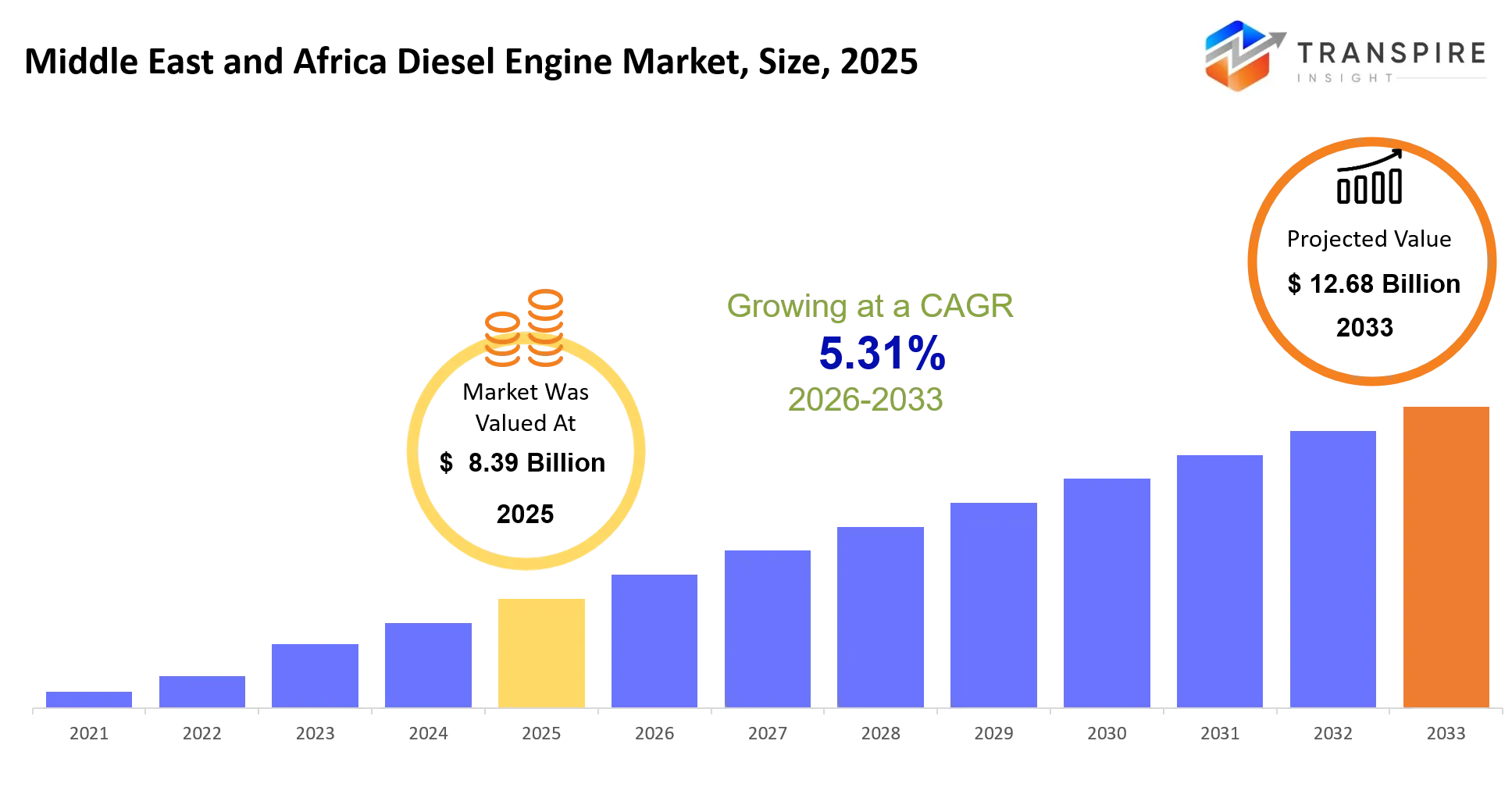
- Middle East and Africa Diesel Engine Market Size 2025: USD 8.39 Billion
- Middle East and Africa Diesel Engine Market Size 2033: USD 12.68 Billion
- Middle East and Africa Diesel Engine Market CAGR: 5.31%
- Middle East and Africa Diesel Engine Market Segments: By Engine Type (Single Cylinder, Multi-Cylinder, Heavy Duty, Medium Duty, High-Speed, Low-Speed, Stationary, Others); By Power Rating (Below 100 HP, 100–300 HP, 301–500 HP, 501–1000 HP, Above 1000 HP, Others); By Application (Automotive, Construction, Marine, Power Generation, Agriculture, Mining, Industrial Equipment, Others); By End User (Transportation, Construction, Agriculture, Industrial, Energy, Government, Defense, Others)
Middle East and Africa Diesel Engine Market Summary
The Middle East and Africa Diesel Engine Market was valued at USD 8.39 Billion in 2025. It is forecast to reach USD 12.68 Billion by 2033. That is a CAGR of 5.31% over the period.
Diesel engines still kinda are the backbone of transportation, mining, construction, agriculture, power generation, and a lot of industrial work across the Middle East and Africa. They give reliable mechanical energy, especially in places where the grid is weak or not really stable, where fuel availability can change fast, and where machines have to keep going continuously in tough situations. Over the last five years, the market has quietly shifted in a more structural way, moving toward higher-efficiency engines that come with electronic controls , better fuel injection systems, and tighter emissions management tech. But, at the same time, there’s been global energy ups and downs plus supply chain pressure after geopolitical disruptions, plus logistics bottlenecks, which really highlighted how important it is to have dependable local power and transport assets. So investments started moving quicker, not just into heavy equipment fleets, also into backup power setups and mining machinery. And as infrastructure development, energy projects, and the broader industrial growth keep going across the Gulf countries and several key African economies, operators are swapping out older equipment for more productive engines, sort of. That change supports better fuel economy, cuts down maintenance costs, and helps the equipment run at higher utilization rates. Then, in turn, it opens steady revenue chances for engine manufacturers and service providers.
Key Market Insights
- The Middle East and Africa diesel engine market is expected to hit USD 12.68 billion by 2033, showing continued capital going into factories, plants, and these sort of big infrastructure assets that keep getting upgraded.
- In 2025, the Gulf Cooperation Council countries held something like 38%–42% of the market, largely carried by very large construction , and energy focused projects that keep moving forward even when timelines get tight.
- Multi cylinder diesel engines still lead the pack with about 45% market share, mainly because transportation, mining, and power generation users really keep asking for them, again and again.
- Heavy duty engines are still the runner up category, taking roughly 25% of industry revenue in 2025, which is pretty steady compared with the rest.
- On the fastest side, high speed diesel engines are set to grow the quickest through 2033 , helped by power generation needs and also industrial backup setups where reliability really matters.
- For applications, power generation contributed nearly 30% of total demand in 2025, so it will become the main application segment without much competition.
- Mining and industrial equipment applications are expanding rapidly across Southern and Western Africa due to new resource development projects.
- Transportation remains the largest end-user segment with an estimated 35% market share, supported by freight, logistics, and commercial vehicle operations.
- Energy sector investments in remote oil, gas, and utility facilities continue to strengthen demand for reliable diesel-powered systems.
- Manufacturers increasingly integrate telematics, predictive diagnostics, and fuel-efficiency technologies to differentiate products and improve lifecycle performance.
What are the Key Drivers, Restraints, and Opportunities in the Middle East and Africa Diesel Engine Market?
The main force behind market expansion is basically large scale infrastructure and energy spending across the Gulf area, plus several African economies, so governments keep pushing faster. They’ve accelerated spend on transportation corridors, industrial zones, mining work and utility infrastructure as part of these diversification programs. All these undertakings call for construction gear, generators, trucks and industrial machinery that depend heavily on diesel power, you know. Since diesel engines give high torque, fuel availability and solid operational reliability in remote locations, equipment procurement keeps trending up. That flow pretty much backs engine sales, aftermarket services, and the need for replacements too.
The biggest problem still feels like tougher emissions rules, plus the high cost of complying with them. Newer diesel engines call for aftertreatment systems that are more advanced, electronic control layers, and cleaner fuel specifications. In many developing markets, fuel quality is still limited, and servicing infrastructure is thin or missing, period. So it becomes kind of structural, because improving fuel distribution networks and building maintenance ecosystems needs years of funding and coordination. Because of that, some fleet operators delay equipment changes, which reduces market penetration and also slows down revenue starts.
One strong opening is digitalized power and industrial operations. Mining sites, energy plants, and big industrial operators increasingly roll out connected equipment platforms that try to optimize fuel use and maintenance timing. Remote monitoring tools, predictive diagnostics and hybrid diesel power systems are getting more attention across Africa and the Gulf.
What Has the Impact of Artificial Intelligence Been on the Middle East and Africa Diesel Engine Market?
Artificial intelligence i s transforming how diesel engine operations run, mostly by boosting equipment reliability, handling fuel more smartly, and making maintenance more efficient, not just faster. In the field, industrial operators, mining companies, and power generation facilities are using AI-enabled monitoring platforms that sort of continuously watch engine temperature, vibration patterns, fuel use, and operating loads. From there, the systems automatically flag odd or abnormal behavior and then they spit out maintenance suggestions, like before a component actually fails, which is kind of the whole point.
Also, machine learning models help foresee maintenance windows, and they tune engine performance once the operating conditions start shifting, or whatever. In mining and power generation, predictive analytics can cut unexpected downtime , because they notice wear patterns inside things like fuel systems, turbochargers and cooling components. Some fleet operators have said they get clear reductions in maintenance costs, plus higher equipment availability, when they shift toward servicing based on condition rather than strict schedules.
On top of that, advanced digital technologies improve fuel efficiency by adjusting load distribution, managing idle time better, and supporting day-to-day operational scheduling. AI-supported fleet management platforms help operators meet emissions rules while still pushing higher equipment utilization. Still, there are barriers… adoption is often constrained by high implementation costs, weak digital infrastructure in remote areas, and sometimes messy or inconsistent data quality. In a lot of operating environments across Africa, connectivity is still not strong enough for continuous real-time analytics, so the overall impact of these sophisticated, AI-driven optimization systems becomes smaller than expected.
Key Market Trends
- Electronic engine controls started getting real traction since 2021, and they’ve been said to lift fuel efficiency by 5%–10% across most industrial settings, overall.
- Mining operators meanwhile have been swapping older gear for digitally monitored engines from 2022 into 2025, bit by bit, and honestly it just kept happening.
- On the power side, generation projects pushed more backup diesel capacity across Gulf countries as energy security became kinda more urgent.
- Engine manufacturers have also been putting more money into predictive maintenance platforms, and the result is fewer nasty surprises, with unexpected downtime cut by as much as 20%.
- Advanced fuel injection systems got wider use in heavy-duty equipment during the last three years, so not just limited pilots anymore.
- Service partnerships in the region grew fast, because manufacturers wanted steadier aftermarket revenue streams, not only new machine sales.
- Caterpillar and Cummins both leaned harder into connected diagnostics and remote fleet management solutions.
- At the same time hybrid power systems, mixing diesel generators with renewable energy assets, showed up in more industrial facilities after 2023.
- Emissions compliant engines that match tighter standards grabbed a larger slice of new equipment purchases.
- And finally, high-speed engine demand moved up noticeably in distributed power generation projects, which are supporting industrial expansion in a more spread out way.
Middle East and Africa Diesel Engine Market Segmentation
By Engine Type
Single-cylinder engines are typically used for the smaller ag equipment stuff, pumps, and lighter industrial jobs, where things like simplicity and cost efficiency really stay front and center. Multi-cylinder engines, meanwhile, cover commercial transport, construction machines, and general industrial gear, where you want smoother running and more power output, all together. Heavy-duty engines take on the tougher workload situations in mining, transport, and power generation setups, while the medium-duty versions kind of sit in the middle, balancing performance with operating costs across a bunch of industries.
High-speed engines show up a lot in backup power systems and industrial equipment that needs fast reaction times plus a compact layout. Low-speed engines are still a big deal for continuous-duty industrial work, especially when durability and fuel economy matter most. Stationary engines support generators and fixed installations, those places that need dependable long-term operation without a lot of drama. Then there are other specialized engine categories, which handle particular operational needs across smaller, niche industrial and commercial uses.
By Power Rating
Engines under 100 HP are pretty common in farm machines, irrigation setups, and smaller industrial units. When you look at 100–300 HP, that’s where you’ll usually find light commercial vehicles, some construction gear, and also distributed power systems. The 301–500 HP set tends to show up for bigger transportation fleets, industrial sites and medium scale electricity generation operations.
Then the 501–1000 HP segment is more about heavy industrial use, mining equipment, and very large generators that need serious output. Anything above 1000 HP gets used in major industrial facilities, energy projects, and big scale power generation installations. Also, there are other power categories that offer tailored solutions for niche operational needs, when the typical ratings simply don’t cover what’s required for performance.
By Application
In automotive uses you can see a huge portion of diesel engine deployment, especially when it comes to commercial vehicles, trucks, and logistics fleets, sort of the everyday reality. Construction work leans heavily on diesel-driven excavators, loaders cranes , and a lot of earthmoving machinery. For marine usage, vessels that run in commercial offshore, and coastal industries still depend on these engines, and power generation is still a must in areas where grid infrastructure is getting built out bit by bit.
Agriculture, too, leans on diesel for tractors, irrigation equipment, and the harvesting tools used during peak seasons. Mining activities call for high-output engines that can keep working in ugly and unforgiving conditions, and still stay on continuous schedules. In industrial setups, you’ll find them in compressors and pumps, plus manufacturing systems overall. Other uses cover specialized operational demands across commercial and institutional sectors, depending on what the site really needs.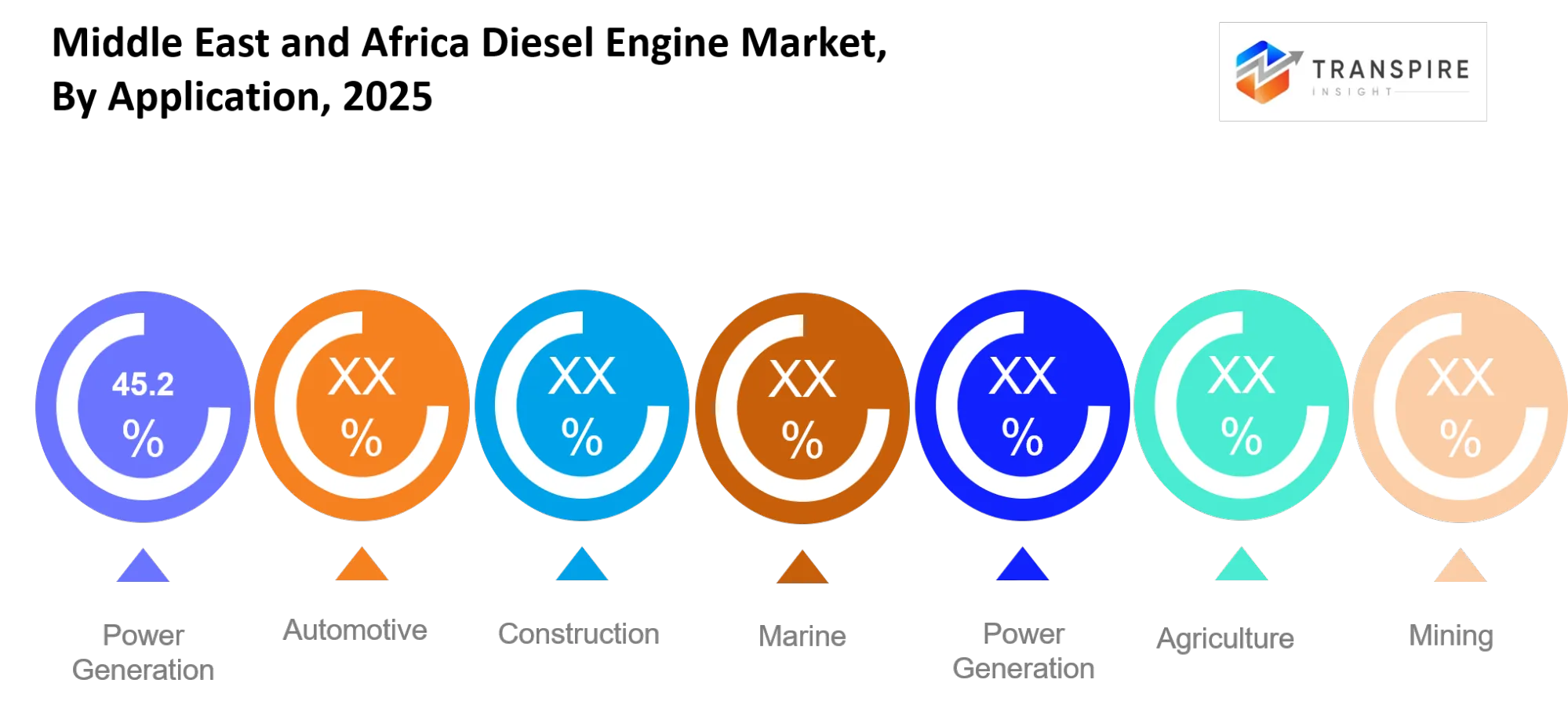
By End User
Transportation stays the big end-user category because of freight hauling, logistics work, and day-to-day commercial vehicle deployment, it’s kind of the main reason. Construction firms also lean on diesel-powered equipment for building roads, utilities and supporting that urban expansion push, especially where timing matters. Agricultural operators likewise use diesel machines for cultivation, irrigation, and harvesting tasks, these activities need dependable field performance, no question.
In the industrial world, manufacturers often count on diesel engines for production steps, backup power, and just keeping operations steady through the day. Energy companies place diesel engines in oil, gas, and utility projects that sit out in remote areas, where the environment is not exactly friendly. Government agencies and defense orgs use diesel-powered systems for transport, emergency response, and mission critical operations, things have to work when they’re needed.
Other end users cover commercial businesses and specialized service providers, they tend to have unique operational demands.
What are the Key Use Cases Driving the Middle East and Africa Diesel Engine Market?
The biggest use case is still power generation, mostly where grid reliability wobbles a bit or industrial sites need to keep running no matter what. Diesel-powered generators help manufacturing plants, energy facilities, commercial complexes and critical infrastructure projects. They’re known for high operational reliability, plus fast startup, so in a lot of industries these systems just end up being kind of indispensable.
Construction and mining use keeps growing across the region too. Heavy equipment working on mining sites, quarry operations, and big infrastructure efforts often relies on diesel engines for torque, durability, and day to day operational flexibility. Transportation fleets also count a lot here, especially as logistics networks keep expanding, because well, vehicles still need dependable power.
Then there are newer moves, like hybrid power systems that mix renewable energy assets with diesel backup generation. Remote industrial facilities and energy developments are leaning into these integrated setups more and more, trying to balance fuel efficiency, reliability, and operational resilience over the whole forecast period.
|
Report Metrics |
Details |
|
Market size value in 2025 |
USD 8.39 Billion |
|
Market size value in 2026 |
USD 8.83 Billion |
|
Revenue forecast in 2033 |
USD 12.68 Billion |
|
Growth rate |
CAGR of 5.31% from 2026 to 2033 |
|
Base year |
2025 |
|
Historical data |
2021 - 2024 |
|
Forecast period |
2026 - 2033 |
|
Report coverage |
Revenue forecast, competitive landscape, growth factors, and trends |
|
Regional scope |
United States; Canada; Mexico; United Kingdom; Germany; France; Italy; Spain; Denmark; Sweden; Norway; China; Japan; India; Australia; South Korea; Thailand; Brazil; Argentina; South Africa; Saudi Arabia; United Arab Emirates |
|
Key company profiled |
Caterpillar, Cummins, MAN, Volvo Penta, Wärtsilä, Perkins, Yanmar, Kubota, Mitsubishi Heavy Industries, Scania, Deutz, John Deere, Weichai, Isuzu, MTU . |
|
Customization scope |
Free report customization (country, regional & segment scope). Avail customized purchase options to meet your exact research needs. |
|
Report Segmentation |
By Engine Type (Single Cylinder, Multi-Cylinder, Heavy Duty, Medium Duty, High-Speed, Low-Speed, Stationary, Others); By Power Rating (Below 100 HP, 100–300 HP, 301–500 HP, 501–1000 HP, Above 1000 HP, Others); By Application (Automotive, Construction, Marine, Power Generation, Agriculture, Mining, Industrial Equipment, Others); By End User (Transportation, Construction, Agriculture, Industrial, Energy, Government, Defense, Others) |
Which Regions are Driving the Middle East and Africa Diesel Engine Market Growth?
The Gulf region, kind of leads the market, mostly because there’s a lot of infrastructure investment going on, plus energy sector momentum, and industrial diversification programs that keep expanding. Countries like Saudi Arabia and United Arab Emirates keep putting money into transportation networks, industrial cities, and utility initiatives, all of which need a significant amount of diesel powered equipment . With solid logistics infrastructure, easier access to fuel resources, and big scale construction activity , demand stays steady. Also, well developed service networks help keep equipment utilization high, and they also support regular replacement cycles.
Southern Africa is probably the next biggest contributor. In comparison with the Gulf, the growth there is more tied to mining activity, mineral processing, and industrial output, not so much to huge infrastructure mega projects. For example, South Africa still has a mature industrial base that keeps feeding ongoing equipment demand. Stable mining investment along with existing industrial operations create fairly consistent revenue prospects for engine suppliers.
East and West Africa look like they have the strongest growth momentum. New infrastructure programs, energy investments, and a wider transportation network push have really sped up equipment deployment since 2023. When logistics corridors improve, and industrial development policies move forward, it opens up fresh opportunities for equipment manufacturers as well as service providers. This trajectory is expected to pull in even more investment and additional market entry activity, all the way through 2033.
Who are the Key Players in the Middle East and Africa Diesel Engine Market and How Do They Compete?
Competition is still kinda consolidated , mostly in the sense that big global manufacturers hold a big chunk of the premium industrial and heavy duty categories. When customers compare vendors, the main stuff usually comes down to technology performance , fuel efficiency, longevity , emissions compliance , and what kind of aftermarket service they can actually deliver. The big players keep defending share with connected services, designs made for specific applications, and pretty wide regional support networks, you know.
Caterpillar kind of stands out with an integrated equipment ecosystem and its condition monitoring tech that’s pretty advanced. The dealer network is strong, and their lifecycle support services help keep customers around for longer. They keep pushing more connected equipment options and engine platforms that are tuned for construction , mining, and those industrial operations where uptime really matters.
Cummins competes using fuel efficient engine platforms , digital diagnostics, and broad application coverage. More recently, investments aimed at next generation engine technologies plus strategic partnerships help the lineup stay competitive. On top of that , advanced emissions management and predictive maintenance features back up customer operating efficiency.
Wärtsilä is more focused on energy and industrial use cases where operational efficiency and system integration really matter. They differentiate with digital optimization tools and hybrid energy solutions. MAN keeps its footing in heavy duty industrial and power applications thanks to engineering strength and designs that are performance oriented. Volvo Penta leans into intelligent power systems and operational efficiency, and that helps customers cut operating costs while still holding onto reliability.
Company List
- Caterpillar
- Cummins
- MAN
- Volvo Penta
- Wärtsilä
- Perkins
- Yanmar
- Kubota
- Mitsubishi Heavy Industries
- Scania
- Deutz
- John Deere
- Weichai
- Isuzu
- MTU
Recent Development News
"In March 2026, Caterpillar launched the new Cat C3.6 high-horsepower engine and showcased the power-dense C13D platform at CONEXPO-CON/AGG 2026. The introduction strengthens Caterpillar's industrial power portfolio and supports compliance with advanced emissions standards.https://www.cat.com/
"In March 2025, Cummins unveiled the B7.2 diesel engine for medium-duty applications as part of its HELM platform strategy. The new engine expands power and torque capabilities while improving operational flexibility for commercial and industrial users.https://www.cummins.com
What Strategic Insights Define the Future of the Middle East and Africa Diesel Engine Market?
The market seems to be sliding toward a future that’s defined more by efficiency , digitalization, and application specific performance instead of just trying to grow horsepower bigger and bigger. Industrial operators are now, more often than not, judging engines by the whole lifecycle cost, real fuel usage, uptime stability, and how well they plug into digital fleet management platforms. In other words, this movement will reward the manufacturers who can keep mechanical reliability high, while also bringing advanced analytics along with a predictive kind of service ability.
There’s also a risk that’s kinda less visible, like how adoption of alternative power solutions is speeding up in certain use cases, for example distributed energy systems and some picked industrial operations. Sure, diesel tech will still be needed across many heavy duty areas, but technology substitution could slowly start to nibble at a few equipment categories. On the other hand , one emerging opportunity is hybrid industrial power systems that blend diesel generation with renewable energy assets, plus an intelligent control platform.
So market players should put their attention on connected services , predictive maintenance technologies, and aftermarket support that’s local enough to matter. The firms that manage to build a real service ecosystem next to efficient engine platforms should land in a better place over time, because customers are increasingly thinking in terms of operational performance rather than only equipment purchase costs.
Middle East and Africa Diesel Engine Market Report Segmentation
-
By Engine Type
Single Cylinder
Multi-Cylinder
Heavy Duty
Medium Duty
High-Speed
Low-Speed
Stationary
Others -
By Power Rating
Below 100 HP
100–300 HP
301–500 HP
501–1000 HP
Above 1000 HP
Others -
By Application
Automotive
Construction
Marine
Power Generation
Agriculture
Mining
Industrial Equipment
Others -
By End User
Transportation
Construction
Agriculture
Industrial
Energy
Government
Defense
Others
Frequently Asked Questions
Find quick answers to common questions.
The Expected Middle East and Africa Diesel Engine Market size for the Market will be USD 12.68 Billion in 2033.
Key Segments for the Middle East and Africa Diesel Engine Market are By Engine Type (Single Cylinder, Multi-Cylinder, Heavy Duty, Medium Duty, High-Speed, Low-Speed, Stationary, Others); By Power Rating (Below 100 HP, 100–300 HP, 301–500 HP, 501–1000 HP, Above 1000 HP, Others); By Application (Automotive, Construction, Marine, Power Generation, Agriculture, Mining, Industrial Equipment, Others); By End User (Transportation, Construction, Agriculture, Industrial, Energy, Government, Defense, Others).
Major Middle East and Africa Diesel Engine Market players are Caterpillar, Cummins, MAN, Volvo Penta, Wärtsilä, Perkins, Yanmar, Kubota, Mitsubishi Heavy Industries, Scania, Deutz, John Deere, Weichai, Isuzu, MTU.
The Current Middle East and Africa Diesel Engine Market size is USD 8.39 Billion in 2025.
The Middle East and Africa Diesel Engine Market CAGR is 5.31% from 2026 to 2033.
- Caterpillar
- Cummins
- MAN
- Volvo Penta
- Wärtsilä
- Perkins
- Yanmar
- Kubota
- Mitsubishi Heavy Industries
- Scania
- Deutz
- John Deere
- Weichai
- Isuzu
- MTU
About the Authors

Mayur Shinde
I am Mayur Shinde, a Senior Research Analyst at Transpire Insight, specializing in the Automotive & Transportation and Information & Communication Technology (ICT) Industry. My work focuses on analyzing emerging market trends, technological advancements, competitive landscapes, and industry developments to deliver accurate, data-driven insights. I am passionate about transforming complex market information into clear, actionable content that helps businesses, professionals, and decision-makers stay informed and make confident strategic decisions.

Chakradhar Khansole
Chakradhar serves as the Research Director at Transpire Insight, bringing over 8 years of experience in technology, innovation, and strategic market intelligence. He specializes in transforming complex market data into actionable business insights that enable organizations to make informed, growth-oriented decisions. Recognized for his strategic vision and analytical expertise, Chakradhar leads high-impact research initiatives, delivering comprehensive market assessments, competitive intelligence, and forward-looking industry analysis.
Recently Published Reports
-
Apr 2026
ATV & UTV Market
ATV & UTV Market Size, Share & Analysis Report By Type (ATV, and UTV), By Variants (Less Than 400 CC, 400 CC To 800 CC, and More Than 800 CC), and Geography (North America, Europe, Asia-Pacific, Middle East and Africa, South and Central America), 2021 - 2031
-
Apr 2026
Automotive Central Gateway Module Market
Automotive Central Gateway Module Market Size, Share & Analysis Report By Type (Ethernet Central Gateway Module, CAN Central Gateway Module, LIN Central Gateway Module, and FlexRay), By Application (Powertrain Control, Body Control, Infotainment System, Advanced Driver Assistance Systems (ADAS), and Others), By End User (Passenger Vehicles, and Commercial Vehicles), and Geography (North America, Europe, Asia-Pacific, Middle East and Africa, South and Central America), 2021 - 2031
-
Apr 2026
Automotive Engine Oil Filter Market
Automotive Engine Oil Filter Market Size, Share & Analysis Report By Filter Type (Fuel Filter, Engine Oil Filter, Hydraulic Oil Filter, and Others), By Filter Media (Cellulose, Synthetic, and Micro), By Sales Channel (OEMs, and Aftermarket), By Vehicle Type (Passenger Cars, Light Commercial Vehicles, Heavy Duty Trucks, Buses and Coaches, and Off-road Vehicles), and Geography (North America, Europe, Asia-Pacific, Middle East and Africa, South and Central America), 2021 - 2031
-
Apr 2026
Automotive Parts Aluminium Die Casting Market
Automotive Parts Aluminium Die Casting Market Size, Share & Analysis Report By Production Process (Pressure Die Casting, Vacuum Die Casting, Squeeze Die Casting, Gravity Die Casting), By Application (Body Parts, Engine Parts, Transmission Parts, Battery And Related Components, Other Application Types), and Geography (North America, Europe, Asia-Pacific, Middle East and Africa, South and Central America), 2021 - 2031
Our Clients



