
United Kingdom Automotive Engine Market Size & Forecast:
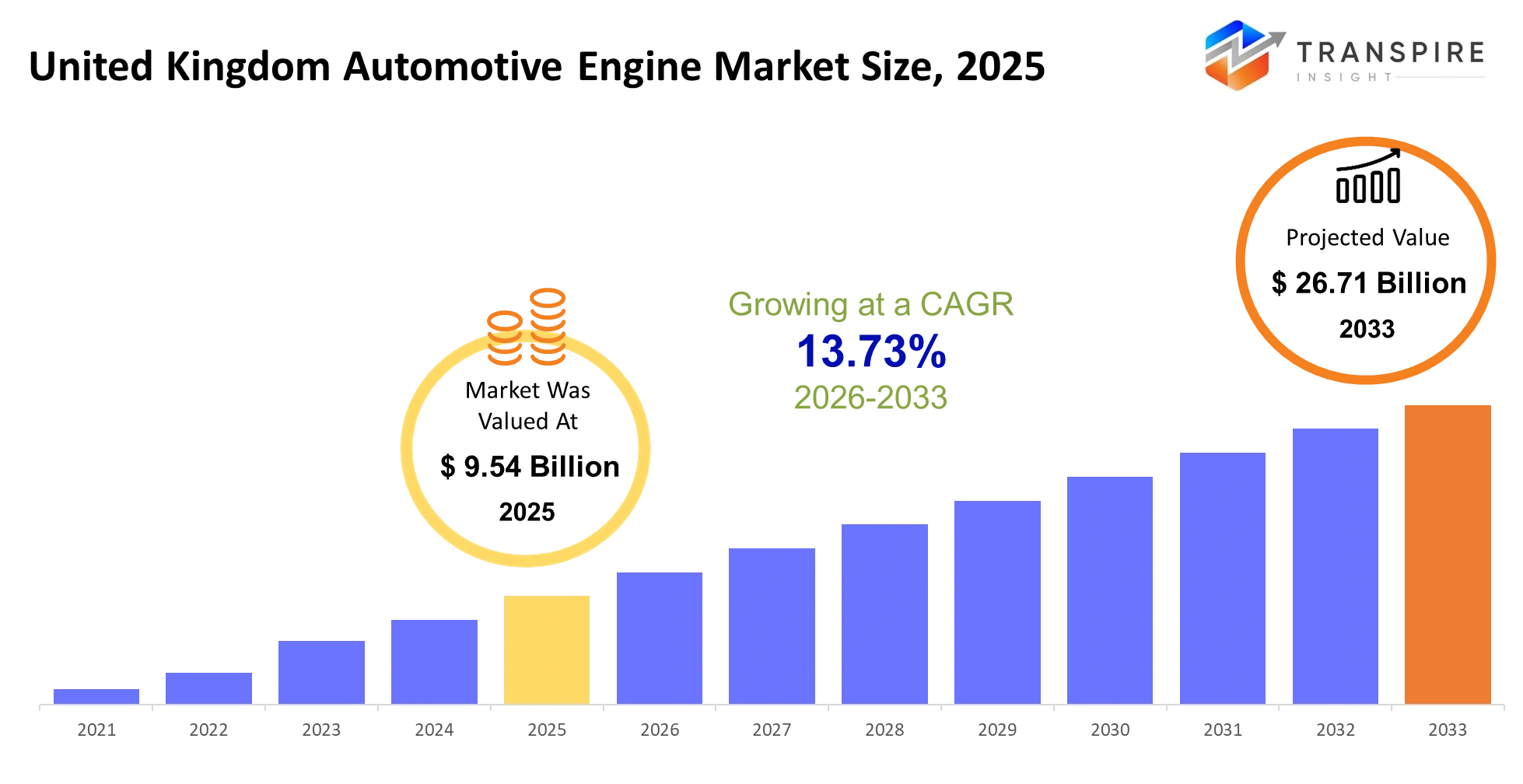
- United Kingdom Automotive Engine Market Size 2025: USD 9.54 Billion
- United Kingdom Automotive Engine Market Size 2033: USD 26.71 Billion
- United Kingdom Automotive Engine Market CAGR: 13.73%
- United Kingdom Automotive Engine Market Segments: By Type (Internal Combustion Engine, Electric Engine, Hybrid Engine, Turbocharged Engine, Diesel Engine, Others); By Application (Passenger Cars, Commercial Vehicles, EVs, SUVs, Trucks, Others); By End-User (OEMs, Aftermarket, Fleet Operators, Logistics, Automotive Industry, Others); By Component (Engine Block, Pistons, Valves, Turbochargers, Fuel Systems, Others).
To learn more about this report,  Download Free Sample Report
United Kingdom Automotive Engine Market Summary
The United Kingdom Automotive Engine Market was valued at USD 9.54 Billion in 2025. It is forecast to reach USD 26.71 Billion by 2033. That is a CAGR of 13.73% over the period.
The United Kingdom Automotive Engine Market, in a way supports passenger movement, freight logistics, industrial supply routing, and public infrastructure tasks, by supplying power to vehicles that carry goods and people through both city routes and long-distance corridors. Engine makers are now trying to juggle better fuel performance with dependable operation reliability and emission rule compliance, because transport operators are dealing with tougher environmental expectations, plus operational costs that keep climbing. Passenger car producers, delivery fleets, and commercial transport providers lean on more advanced engine systems, improving energy use while still keeping the vehicle durability, and protecting driving range as well.
In the last five years, the market went through a kinda structural change. It moved from production centered on conventional combustion, toward hybrid, electric, and hydrogen-compatible powertrain engineering. The rollout of low-emission zones in major UK cities, together with stricter zero-emission vehicle mandates, sped things up, since manufacturers and fleet owners were pushed to update older vehicle platforms. Then between 2021 and 2024, semiconductor shortages plus battery material supply shocks reworked sourcing decisions, so companies leaned into local battery investment, and more regional supply chain partnerships. All of that, together, boosted spending on software-enabled engine control, lightweight part design, and alternative fuel approaches, and those factors are now the thing that drives longer-term revenue growth across the entire automotive value chain.
Key Market Insights
- Europe basically owned the global automotive engine industry size , with something like over 32% market share in 2025 , mainly because emission compliance rules got stricter.
- Asia Pacific meanwhile showed up as the fastest-growing regional market from 2026 to 2033, supported by EV manufacturing expansion and logistics fleet modernisation , programs too.
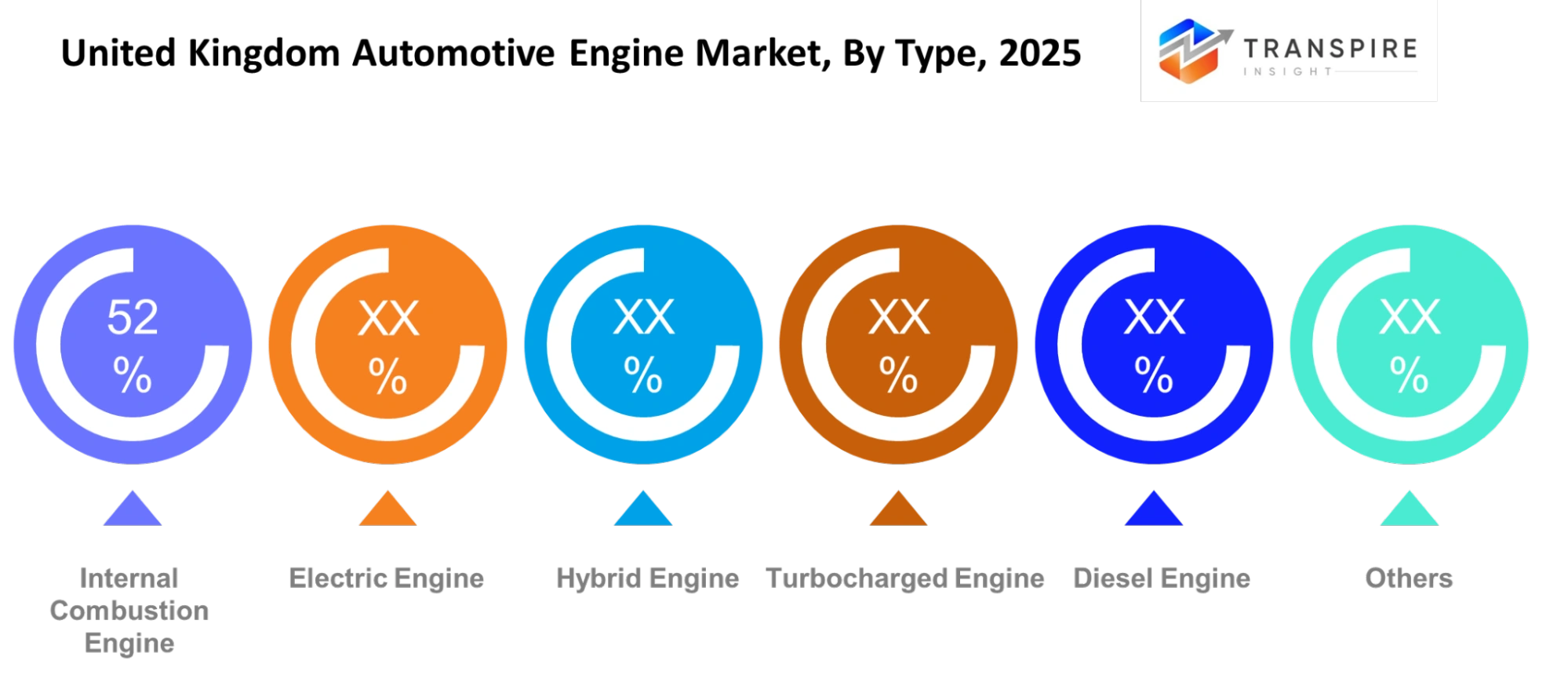
- In the United Kingdom, internal combustion engines stayed in the lead for 2025 , not because people prefer them strictly , but because commercial transport still leans on liquid fuel networks , somehow.
- Hybrid engines then grabbed the fastest growth pace after 2024 , as urban drivers wanted better fuel efficiency without losing the ability for long-distance trips and usability.
- Passenger cars made up almost 48% of total engine demand in 2025, driven by steady private mobility habits and replacement vehicle buying cycles.
- Electric commercial vans also kept gaining momentum after 2025, because logistics operators went for lower operating costs , plus they had to meet urban emission compliance requirements.
- OEMs held the strongest end-user position with more than 55% share in 2025 , helped by long-term procurement contracts and that localized manufacturing expansion approach.
- Fleet operators actually were the fastest-growing end-user group , since predictive maintenance systems cut downtime and improved fuel efficiency across delivery routes.
- Ford Motor Company and Jaguar Land Rover both pushed more hybrid and EV engine investments , to support regional manufacturing competitiveness.
- Cummins Inc. moved harder into hydrogen internal combustion engine development for freight transport uses, where lower emissions and longer operational range matter.
What are the Key Drivers, Restraints, and Opportunities in the United Kingdom Automotive Engine Market?
Stringent emission regulations stay the biggest thing driving transformation across the United Kingdom automotive engine sector, somehow always faster than expected. The government’s zero-emission vehicle mandate , plus those expanding low-emission zones, pushed manufacturers to speed up investment in hybrid systems , electric propulsion, and fuel-efficient turbocharged engines after 2023. Auto companies then responded with more local battery sourcing, software-enabled engine management, and lighter-weight component production to keep compliance on track, while still protecting vehicle performance. In practice those regulatory changes opened up new revenue lanes for engine control systems, smarter fuel injection technologies, and hybrid powertrain suppliers supporting both passenger models and commercial fleets.
One major restraint is the structural reliance on imported semiconductors, lithium-ion battery materials, and specialized electronic components needed for next-generation engine platforms. Supply chain disruptions from 2022 to 2025 showed, in a kind of stark way, how exposed automotive production is to geopolitical trade frictions and raw material price swings. Smaller manufacturers, and also aftermarket suppliers, keep dealing with slower technology take-up because high procurement costs , along with uneven component availability, reduce investment flexibility. As a result this limitation dampens production efficiency, and it can slow the broad rollout of advanced engine technologies across mid-market vehicle categories.
Hydrogen-compatible internal combustion engines also represent a notable long-term opportunity, especially for heavy-duty logistics and other commercial transport operations.Cummins along with a handful of United Kingdom engineering partners have, sort of recently, broadened their hydrogen engine development efforts aimed at freight operators who want lower emissions while keeping the same kind of range or payload capacity. At the same time, more investment in hydrogen infrastructure plus industrial decarbonization schemes could open a commercially workable route for fleet operators somewhere through 2026–2033.
What Has the Impact of Artificial Intelligence Been on the United Kingdom Automotive Engine Market?
Artificial intelligence, and these advanced digital technologies, are reshaping engine manufacturing fleet servicing, and powertrain optimization all across the United Kingdom automotive sector—kinda like a quiet overhaul, but still very real. More and more automotive manufacturers now lean on AI driven monitoring platforms to automate engine calibration, fuel injection management, and emission oversight steps both during production and after the vehicle is on the road. In practice, firms like Bosch, and Cummins, deploy connected diagnostics systems that keep checking engine temperature, vibration rhythms, fuel burn, and exhaust outputs so they can raise operational precision and stay aligned with regulatory rules. Machine learning models too, support predictive maintenance by spotting how components start to degrade, or wear, before a failure shows up, which helps fleet operators cut unexpected downtime and also push engine lifespan out further.
Meanwhile, advanced analytics platforms are being used to improve fuel efficiency and driving behavior by making real time adjustments tied to vehicle telematics, and those onboard sensing signals. Some logistics operators who use predictive servicing platforms have reported lower upkeep expenses and better fleet availability, mainly because faults are caught sooner and repair delays shrink—less waiting around. AI supported engine management systems additionally help manufacturers hit tighter emission targets, since they can forecast combustion inefficiencies and then automatically tweak performance settings. Still, adoption at scale isn’t totally smooth, because there are high integration costs, cybersecurity worries, and messy or inconsistent data quality across older fleets that don’t have the newer sensor setup.
Key Market Trends
- Since 2023, Jaguar Land Rover and Ford kind of accelerated their hybrid, electric engine investments to somehow meet tougher United Kingdom zero emission transport targets.
- Diesel engine demand dropped steadily across urban passenger vehicles after wider low emission zone enforcement in London, Birmingham and Manchester during 2024 and 2025.
- Commercial fleet operators started replacing older combustion vehicles with hybrid vans more often, to cut fuel expenses and also align with corporate sustainability pledges.
- Since 2025, Cummins pushed ahead with hydrogen internal combustion engine development for heavy duty logistics fleets, those fleets want reduced emissions while not giving up driving range.
- After semiconductor shortages and lithium price swings disrupted European engine production between 2022, and 2024, automotive manufacturers changed their battery sourcing playbooks a bit.
- Turbocharged smaller capacity engines gained a stronger uptake because manufacturers put more emphasis on fuel efficiency upgrades, while still holding onto vehicle performance across sport utility vehicle platforms, which is what customers mostly notice.
- Bosch and Delphi Technologies increased investment into connected diagnostics plus predictive maintenance systems as fleet operators asked for lower long term servicing costs.
- United Kingdom vehicle assembly plants increasingly wove in localized battery and powertrain supply chains after Tata Group’s Somerset gigafactory announcement, during 2026.
- Since 2024, automotive buyers showed more interest in hybrid sport utility vehicles, because charging infrastructure expansion stayed uneven outside major metropolitan areas.
United Kingdom Automotive Engine Market Segmentation
By Type
Internal combustion engines keep the biggest share across the United Kingdom Automotive Engine Market, mainly because passenger vehicle production , long-distance freight movement, and the established fuel supply system still keep demand steady at large scale. Electric engines show the quickest growth rate thanks to stricter emission rules, more battery investment, and also growing consumer comfort with zero-emission mobility. Hybrid engines keep getting adopted at a pretty steady pace, since hybrid technology works like a middle path between fuel economy and driving range, particularly for city lanes and outer suburban transport. Turbocharged and diesel engines remain relevant for performance models, commercial fleets, and heavy-duty hauling, because higher torque output and still strong fuel economy matter a lot for logistics as well as industrial routines.
Looking ahead, growth patterns suggest a slow migration of the market toward electric plus hybrid platforms, while internal combustion keeps sliding toward efficiency upgrades , not so much volume expansion. Engine developers are now emphasizing lighter materials, better thermal efficiency, and tighter software integration so they can stay competitive across several fuel types. Investors are also leaning more toward firms with varied engine catalogs, and stronger electrification skills. Vehicle manufacturers and fleet purchasers keep asking for adaptable powertrain options, designed to meet regulatory requirements and support long service life, without drama.
To learn more about this report, Download Free Sample Report
By Application
Passenger cars hold the top application share because everyday commuting , rising urbanization, and high consumer ownership levels continue producing reliable engine demand. SUVs follow pretty close, driven by the preference for bigger vehicles with higher ground clearance, added safety features,and general multi-purpose utility. Commercial vehicles and trucks kind a keep steady demand because freight transport, e-commerce distribution, and construction work still need durable high-output engines, with real strong load carrying ability. EV uses keep growing too as charging infrastructure gets better ,and government incentives help push low-emission adoption across private plus commercial transport networks, in practice.
Forecasts are hinting at deeper penetration of electric and hybrid powertrains in passenger cars and SUVs, however the commercial side keeps doing this balancing act, diesel efficiency vs alternative fuel integration, not fully switching yet. Automotive manufacturers are also moving toward modular engine architectures that can cover multiple vehicle classes at once, and still hit different emission targets. Investors keep watching applications connected to electrification and smart mobility services ,because long-run profitability is tied to energy efficiency and that digital connectivity piece. Fleet operators and logistics companies meanwhile lean more toward lower operating costs, predictive maintenance systems, and higher fuel economy requirements ,overall.
By End User
OEMs sit at the top of the market, mostly because large scale vehicle manufacturing agreements generate steady engine procurement across local and export production lines. Aftermarket demand stays important as older vehicle populations need replacement components ,maintenance work and engine performance refinements. Fleet operators and logistics companies create reliable revenue via volume purchasing deals and long-term service agreements, usually aimed at reliability plus day to day operational efficiency. Automotive industry demand also improves from technology partnerships around fuel systems ,turbochargers, and emission control solutions ,built to meet changing regulatory standards.
Long-term market direction seems to point toward more intense, kind of messy collaboration between OEMs, software providers, and energy technology firms, especially as connected mobility solutions get more relevant in everyday use. At the same time aftermarket players are putting more money into remanufactured engine programs, diagnostic platforms , and electric vehicle servicing capabilities, just to keep their footing during those powertrain transition windows. Investors are still leaning toward suppliers that can show advanced manufacturing capacity plus digital service integration, since predictive maintenance and data-driven fleet management tend to protect margins. Fleet buyers meanwhile are often more focused on durability, energy efficiency, and reducing lifecycle cost when they decide what to purchase.
By Component
Engine blocks end up being the biggest component share, not only because structural durability matters, but also because thermal stability stays critical across basically all engine categories. Pistons, valves, and fuel systems keep steady demand, since combustion efficiency , fuel delivery precision, and emission control really depend on component performance quality. Turbochargers see strong growth as the market shifts toward smaller engine designs that can still deliver higher power output and better fuel economy. Meanwhile advanced fuel systems are picking up momentum too, because emission rules force accurate combustion management and lower carbon output across both passenger and commercial vehicles.
Future component development leans a lot on lightweight alloys, heat tolerant materials, and electronics that, in a way, tune engine efficiency up without losing performance. Product developers are also shifting funds toward smart detection systems, upgraded injection mechanisms, and more compact turbocharging setups, which really help hybrid plus electric assisted platforms stay workable. Investors keep an eye on component suppliers that have real research strength and scalable production workflows, because regulatory pressure basically forces quick tech swaps, sometimes sooner than people expect. Vehicle makers and buyers moreover ask for fewer maintenance moments, extended component lifespan , and better interoperability with low emission mobility solutions, overall.
What are the Key Use Cases Driving the United Kingdom Automotive Engine Market?
Passenger vehicle transportation still seems to be the main reason behind demand in the United Kingdom Automotive Engine Market, even if people talk about lots of other things. For a lot of drivers, daily commuting and intercity travel are basically the baseline, plus private vehicle ownership keeps engine installation numbers moving across compact cars sedans and sport utility vehicles. Replacement cycles are strong too, and there’s ongoing pressure for fuel efficient mobility, so companies keep investing in more advanced engine technologies.
On the commercial side, logistics and fleet transportation are slowly picking up pace, mostly because e-commerce distribution keeps expanding and urban delivery services are everywhere. Fleet operators are choosing fuel efficient and hybrid powered vehicles more often, not just to lower operating expenses but also to meet emission rules that are being rolled out in major urban centers. Meanwhile, construction and infrastructure also stay steady, since heavy duty engines are needed for trucks and utility vehicles.
Some of the more emerging use cases sound a bit futuristic, like connected autonomous vehicles, and propulsion systems supported by hydrogen that fit low emission transport networks. Automotive manufacturers, along with technology firms, keep testing smart powertrain integration, for mobility as a service platforms, and even for long range freight applications. In addition, government decarbonization targets plus clean transport funding programs are likely to push adoption of these next generation engine ideas during the forecast period.
|
Report Metrics |
Details |
|
Market size value in 2025 |
USD 9.54 Billion |
|
Market size value in 2026 |
USD 10.85 Billion |
|
Revenue forecast in 2033 |
USD 26.71 Billion |
|
Growth rate |
CAGR of 13.73% from 2026 to 2033 |
|
Base year |
2025 |
|
Historical data |
2021 - 2024 |
|
Forecast period |
2026 - 2033 |
|
Report coverage |
Revenue forecast, competitive landscape, growth factors, and trends |
|
Regional scope |
United Kingdom |
|
Key company profiled |
Ford, Volkswagen, BMW, Mercedes-Benz, Toyota, Honda, Hyundai, Nissan, Jaguar Land Rover, Stellantis, Renault, Volvo, Cummins, Bosch, Delphi Technologies. |
|
Customization scope |
Free report customization (country, regional & segment scope). Avail customized purchase options to meet your exact research needs. |
|
Report Segmentation |
By Type (Internal Combustion Engine, Electric Engine, Hybrid Engine, Turbocharged Engine, Diesel Engine, Others); By Application (Passenger Cars, Commercial Vehicles, EVs, SUVs, Trucks, Others); By End-User (OEMs, Aftermarket, Fleet Operators, Logistics, Automotive Industry, Others); By Component (Engine Block, Pistons, Valves, Turbochargers, Fuel Systems, Others). |
Which Regions are Driving the United Kingdom Automotive Engine Market Growth?
Europe is basically leading the automotive engine market because of strict emission rules, plus a more advanced manufacturing capability, and also solid policy support for cleaner, low-emission mobility. In practice, Germany, the United Kingdom, and France keep putting real money into hybrid and electric powertrain development, but they still manage to hold onto big passenger and commercial vehicle production volumes. There are also these well-established supplier networks, research centers, and component manufacturing clusters that kind of keep the innovation going, including things like fuel systems, turbochargers, and engine efficiency technologies. And yes, regulatory enforcement across the European Union stays strong, which pushes faster adoption of cleaner and more efficient engine platforms in both public and private transport fleets.
North America keeps a pretty stable market position thanks to steady vehicle demand, high consumer spending power, and continued investment from long-standing automotive manufacturers. It feels different from Europe though, because in North America demand is tied more tightly to pickup trucks, sport utility vehicles and long-distance commercial transport, which means higher-performance engines are needed. Fleet modernization programs in logistics and construction keep supporting replacement demand for fuel-efficient diesel and hybrid technologies, even when budgets feel tight. Stable financing conditions, mature aftermarket services, and long-term infrastructure spending plans also help the region stay a dependable contributor to global market revenue.
Asia Pacific shows the quickest uptick, mostly because rapid industrialization, vehicle ownership going up, and pretty aggressive government backing for homegrown electric vehicle manufacturing. China , India, South Korea and Japan, lately ramped up their spending on battery production plants, charging stations, and cleaner mobility inducements, which in turn shifted how regional engines get demanded. Meanwhile , expanding city populations plus big logistics operations, make it easier for commercial vehicle engines to get bought, and they also support hybrid transport setups. All this regional growth ends up opening up real avenues for component vendors, engine designers and even investors who are chasing long-term expansion from 2026 to 2033.
Who are the Key Players in the United Kingdom Automotive Engine Market and How Do They Compete?
The United Kingdom Automotive Engine Market has this sort of moderate consolidation vibe, where global automotive manufacturers are in the same arena as specialized engineering and component firms,and yeah it’s not really only about who undercuts whom. Competition kind of piles up around fuel economy, electrification readiness, emission rule compliance, and longer-term sturdiness rather than pure pricing pressure. Established players keep trying to hold share using advanced hybrid architectures, lighter engine materials, and integrated digital diagnostics. At the same time, newer electric mobility firms challenge the older combustion-driven business model,somewhat aggressively. Research collaborations plus local production networks and even aftermarket servicing strength tend to shift competitive positioning across both passenger and commercial vehicle categories.
Rolls-Royce Holdings is mostly about high-performance powertrain engineering and advanced combustion efficiency approaches,aimed at premium and heavy-duty vehicle uses. Their sustained investment in low-carbon propulsion research,including hybrid-compatible systems, helps separate them from competitors who are more volume-minded. Jaguar Land Rover keeps building presence with luxury SUV platforms backed by electrified engine integration and improved thermal control arrangements. They also lean on battery collaboration deals and investment in electric vehicle production capacity, which supports longer-range growth across European and Asian markets.
Cummins Inc. competes through durable diesel units along with alternative fuel engines that fleets and logistics operators use pretty widely. Their broad aftermarket service coverage and predictive maintenance software tools support ongoing customer stickiness, especially for fleet buyers who care about uptime.Ford Motor Company differentiates through turbocharged EcoBoost engine technology that balances performance with fuel efficiency across passenger and commercial vehicles. Expansion into hybrid commercial vans and connected fleet management services strengthens regional competitiveness as emission standards tighten across the transport sector.
Company List
- Ford
- Volkswagen
- BMW
- Mercedes-Benz
- Toyota
- Honda
- Hyundai
- Nissan
- Jaguar Land Rover
- Stellantis
- Renault
- Volvo
- Cummins
- Bosch
- Delphi Technologies
Recent Development News
In April 2026, Jaguar Land Rover secured UK government backing for Tata Group’s Agratas battery gigafactory project in Somerset. The £380 million funding commitment supports domestic EV battery production for future Jaguar Land Rover electric vehicles and strengthens the regional supply chain for next-generation automotive powertrain systems.
Source: https://www.theguardian.com
In May 2026, Stellantis entered a preliminary partnership agreement with Jaguar Land Rover to explore joint vehicle development in the United States. The collaboration aims to reduce development costs, accelerate technology sharing, and strengthen electrified vehicle expansion strategies amid increasing global competition and tariff pressures.
Source: https://www.reuters.com
What Strategic Insights Define the Future of the United Kingdom Automotive Engine Market?
The United Kingdom Automotive Engine Market is headed toward a kinda mixed powertrain setup where electric, hybrid, and alternative fuel engines are living together , instead of fully swapping out internal combustion systems in the next ten years or so. On top of that, regulatory pressure around emissions , plus heavier investment in energy-efficient mobility and more localized battery production, keeps pushing the transition forward. Still, there is an overlooked snag: a growing dependence on imported battery materials and semiconductor components. That could expose automakers to supply interruptions , sudden price swings, and even geopolitical trade limits when demand spikes, or when supply lines get strained.
At the same time a new opportunity is forming, especially around hydrogen-compatible internal combustion engines for commercial transport and heavy-duty fleet use. This matters a lot because logistics operators are looking for lower-emission options without giving up driving range. Players in the space should focus on adaptable manufacturing platforms that can handle more than one propulsion pathway, rather than betting everything on only a single engine strategy. Firms that bring together software integration, alternative fuel compatibility, and steady regional supply chains will probably lock in better long-term positioning by 2033, even as the market keeps moving.
United Kingdom Automotive Engine Market Report Segmentation
By Type
- Internal Combustion Engine
- Electric Engine
- Hybrid Engine
- Turbocharged Engine
- Diesel Engine
- Others
By Application
- Passenger Cars
- Commercial Vehicles
- EVs
- SUVs
- Trucks
- Others
By End-User
- OEMs
- Aftermarket
- Fleet Operators
- Logistics
- Automotive Industry
- Others
By Component
- Engine Block
- Pistons
- Valves
- Turbochargers
- Fuel Systems
- Others
Frequently Asked Questions
Find quick answers to common questions.
The United Kingdom Automotive Engine Market size is USD 26.71 Billion in 2033.
Key segments for the United Kingdom Automotive Engine Market are By Type (Internal Combustion Engine, Electric Engine, Hybrid Engine, Turbocharged Engine, Diesel Engine, Others); By Application (Passenger Cars, Commercial Vehicles, EVs, SUVs, Trucks, Others); By End-User (OEMs, Aftermarket, Fleet Operators, Logistics, Automotive Industry, Others); By Component (Engine Block, Pistons, Valves, Turbochargers, Fuel Systems, Others).
Major United Kingdom Automotive Engine Market players are Ford, Volkswagen, BMW, Mercedes-Benz, Toyota, Honda, Hyundai, Nissan, Jaguar Land Rover, Stellantis, Renault, Volvo, Cummins, Bosch, Delphi Technologies.
The United Kingdom Automotive Engine Market size is USD 9.54 Billion in 2025.
The United Kingdom Automotive Engine Market CAGR is 13.73% from 2026 to 2033.
- Ford
- Volkswagen
- BMW
- Mercedes-Benz
- Toyota
- Honda
- Hyundai
- Nissan
- Jaguar Land Rover
- Stellantis
- Renault
- Volvo
- Cummins
- Bosch
- Delphi Technologies
Recently Published Reports
-
Apr 2026
ATV & UTV Market
ATV & UTV Market Size, Share & Analysis Report By Type (ATV, and UTV), By Variants (Less Than 400 CC, 400 CC To 800 CC, and More Than 800 CC), and Geography (North America, Europe, Asia-Pacific, Middle East and Africa, South and Central America), 2021 - 2031
-
Apr 2026
Automotive Central Gateway Module Market
Automotive Central Gateway Module Market Size, Share & Analysis Report By Type (Ethernet Central Gateway Module, CAN Central Gateway Module, LIN Central Gateway Module, and FlexRay), By Application (Powertrain Control, Body Control, Infotainment System, Advanced Driver Assistance Systems (ADAS), and Others), By End User (Passenger Vehicles, and Commercial Vehicles), and Geography (North America, Europe, Asia-Pacific, Middle East and Africa, South and Central America), 2021 - 2031
-
Apr 2026
Automotive Engine Oil Filter Market
Automotive Engine Oil Filter Market Size, Share & Analysis Report By Filter Type (Fuel Filter, Engine Oil Filter, Hydraulic Oil Filter, and Others), By Filter Media (Cellulose, Synthetic, and Micro), By Sales Channel (OEMs, and Aftermarket), By Vehicle Type (Passenger Cars, Light Commercial Vehicles, Heavy Duty Trucks, Buses and Coaches, and Off-road Vehicles), and Geography (North America, Europe, Asia-Pacific, Middle East and Africa, South and Central America), 2021 - 2031
-
Apr 2026
Automotive Parts Aluminium Die Casting Market
Automotive Parts Aluminium Die Casting Market Size, Share & Analysis Report By Production Process (Pressure Die Casting, Vacuum Die Casting, Squeeze Die Casting, Gravity Die Casting), By Application (Body Parts, Engine Parts, Transmission Parts, Battery And Related Components, Other Application Types), and Geography (North America, Europe, Asia-Pacific, Middle East and Africa, South and Central America), 2021 - 2031
Our Clients