
Global Low Speed Vehicle Market Size & Forecast
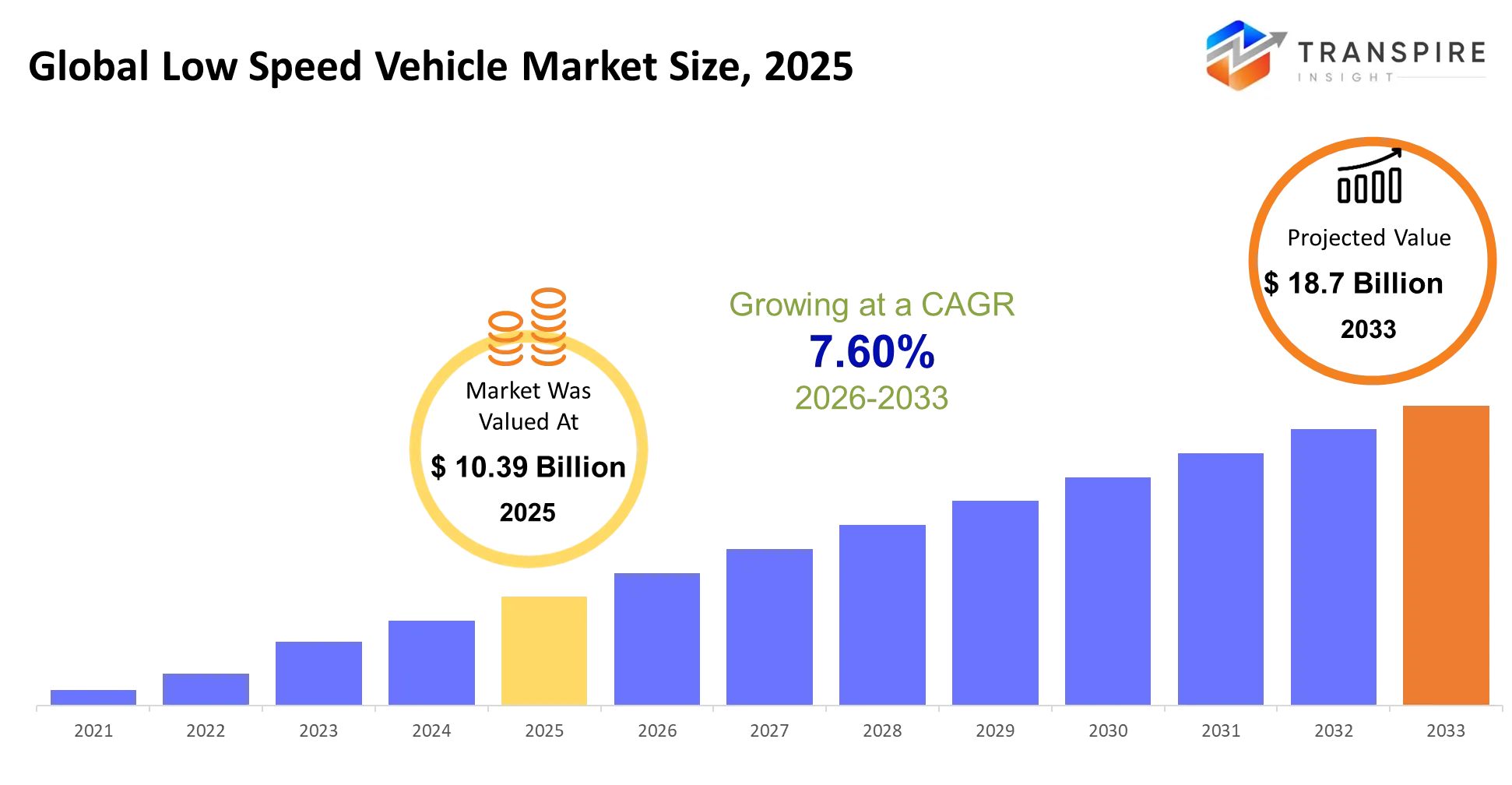
- Global Low Speed Vehicle Market Size 2025: USD 10.39 Billion
- Global Low Speed Vehicle Market Size 2033: USD 18.7 Billion
- Global Low Speed Vehicle Market CAGR: 7.60%
- Global Low Speed Vehicle Market Segments: By Vehicle Type (Passenger LSV, Utility LSV), By Powertrain (Electric, Gasoline), By Application (Golf Courses, Industrial Facilities, Tourism & Resorts, Residential Communities)
To learn more about this report,  Download Free Sample Report
Global Low Speed Vehicle Market Summary
The global low speed vehicle market was valued at USD 10.39 billion in 2025. It is expected to reach USD 18.7 billion by 2033, growing at a CAGR of 7.60%. Low speed vehicles operate at maximum speeds between 20 and 25 miles per hour, filling a transportation gap between golf carts and conventional automobiles in controlled environments like gated communities, resort properties, and industrial campuses. Electric powertrains dominate with 61% market share because battery technology now delivers 40 to 60 miles of range per charge, which covers the daily operating requirements of most LSV users without the noise, emissions, or fuel logistics of gasoline engines.
Two major shifts reshaped this market between 2020 and 2025. First, several U.S. states expanded LSV road access regulations, allowing these vehicles on public roads with speed limits up to 35 mph in designated areas. This regulatory change converted LSVs from purely recreational or campus-restricted vehicles into viable short-distance transportation for residential neighborhoods and small towns. Second, the residential community segment accelerated adoption as retirement communities and planned developments in Florida, Arizona, and California began treating LSVs as primary transportation within community boundaries, creating concentrated demand in specific geographic markets.
Current market growth follows a substitution pattern rather than new mobility creation. Golf courses replacing aging gasoline fleets with electric LSVs, industrial facilities substituting forklifts and utility trucks with specialized LSV platforms, and residential communities adopting LSVs instead of second cars for local trips all represent replacement purchases with clear economic justifications. The revenue implication is that LSV demand now tracks facility construction, residential development, and fleet replacement cycles rather than consumer discretionary spending, which provides more predictable growth than purely recreational vehicle markets.
Key Global Low Speed Vehicle Market Insights
- North America leads the global low speed vehicle market with a 47.2% share in 2024, driven by favorable state regulations and established LSV infrastructure in retirement and resort communities.
- Europe accounts for 28.3% of the market in 2024, with growth concentrated in golf course operations and tourism destinations across Mediterranean countries.
- Electric powertrains command a dominant 61% market share in 2024, favored for lower operating costs, zero emissions, and improved battery range capabilities.
- Gasoline LSVs hold 39% of the market, primarily serving applications requiring extended range or rapid refueling in remote locations without charging infrastructure.
- Passenger LSVs account for 54.7% of unit sales in 2024, driven by residential community adoption and tourism applications.
- Utility LSVs represent 45.3% of the market, serving industrial facilities, airports, and large campus environments requiring cargo capacity.
- Golf course applications lead with 32.4% market share in 2024, as courses upgrade aging fleets and expand to accommodate growing player volumes.
- Residential community applications are growing at 9.8% CAGR through 2033, reflecting planned development expansion in Sun Belt states.
- Polaris Inc. holds approximately 16-19% of the global market share in 2025, maintaining leadership through diverse vehicle platforms spanning passenger and utility segments.
- Textron Inc. expanded its E-Z-GO division capacity by 18% in 2024, adding production lines in Georgia to meet growing golf course and resort demand.
What are the Key Drivers, Restraints, and Opportunities in the Global Low Speed Vehicle Market?
State-level regulatory expansion in the United States created addressable markets that did not exist five years ago. Arizona, Florida, Texas, and California all modified their vehicle codes between 2019 and 2024 to permit LSV operation on designated public roads, which converted these vehicles from private property equipment into street-legal transportation. This regulatory shift enabled residential communities to plan entire neighborhoods around LSV use, with dedicated low-speed lanes, charging stations, and parking infrastructure. The direct impact appears in unit volumes: master-planned communities in Florida and Arizona now specify LSV compatibility in development plans, creating pre-sold demand before construction begins. Developers can charge premium lot prices for LSV-accessible neighborhoods, which justifies the infrastructure investment and drives sustained procurement from LSV manufacturers.
The primary barrier limiting faster market penetration is range anxiety in applications beyond controlled campuses. Electric LSVs typically deliver 40 to 60 miles per charge, which works fine for golf courses, resorts, and gated communities where trips are short and charging infrastructure is centralized. However, adoption stalls in rural residential areas and agricultural applications where users need 80 to 100 miles of daily range and cannot rely on mid-day charging. Battery technology improvements have not yet closed this gap at price points LSV buyers will accept. The cost implication is significant: adding battery capacity to reach 80-mile range increases vehicle price by $3,000 to $4,500, which pushes LSVs above the threshold where buyers consider them cost-competitive with used conventional vehicles or utility ATVs.
The clearest opportunity lies in industrial facility logistics, particularly at airports, seaports, and large manufacturing campuses where internal transportation currently relies on conventional utility trucks and vans. These facilities face increasing pressure to reduce Scope 1 emissions while maintaining operational efficiency across sprawling properties. Electric utility LSVs can replace diesel trucks for cargo movement within facility boundaries, delivering emissions reductions without sacrificing cargo capacity or operating speed. Club Car and Polaris are both developing heavy-duty utility LSV platforms with 1,500 to 2,000-pound payload ratings specifically for this segment, targeting facilities with existing electrification mandates and capital budgets allocated for fleet modernization.
What Has the Impact of Artificial Intelligence Been on the Global Low Speed Vehicle Market?
Fleet management platforms now use AI-driven route optimization and predictive maintenance scheduling for large LSV deployments at resorts, universities, and industrial facilities. Companies like Polaris and Textron have integrated telematics systems that monitor vehicle location, battery state of charge, and component wear patterns across entire fleets. Machine learning algorithms analyze this data to predict battery failures weeks before they occur, schedule preventive maintenance during off-peak periods, and optimize charging schedules to extend battery lifespan. Resort operators running 200 to 300 LSVs report 20-25% reductions in unplanned downtime after implementing AI-based fleet management, which translates directly to fewer spare vehicles needed and lower total cost of ownership.
Computer vision and sensor fusion technologies are enabling limited autonomous capabilities in controlled environments. Several golf courses and retirement communities have piloted autonomous LSVs that navigate predefined routes without drivers, serving as scheduled shuttles between amenity centers and residential areas. These systems use LIDAR, cameras, and GPS to follow designated paths while avoiding obstacles and pedestrians. The technology works well in geofenced environments with mapped routes and predictable traffic patterns, though regulatory frameworks for autonomous LSVs remain unclear in most jurisdictions. Early adopters report cost savings on labor for shuttle services, but deployment remains limited to properties with dedicated budgets for experimental technology.
The main limitation on broader AI adoption is the fragmented nature of LSV operations. Unlike commercial vehicles or ride-hailing fleets where thousands of vehicles operate under centralized management, most LSV deployments are small, with individual golf courses, communities, or facilities operating 10 to 50 vehicles independently. This fragmentation means operators cannot generate the data volumes needed to train robust AI models, and software vendors cannot achieve economies of scale needed to justify custom development. The technology gap favors large operators like resort chains and industrial facility managers who run multi-site fleets, while smaller, independent operators lack access to AI-driven optimization tools.
Key Market Trends
- State transportation departments in Arizona, Florida, and Texas expanded LSV-legal road networks between 2022 and 2024, adding over 5,000 miles of designated routes.
- Residential community developers in Sun Belt states shifted from treating LSVs as optional amenities to incorporating them as core transportation infrastructure in master plans.
- Golf course operators accelerated fleet electrification, with electric LSV share of golf cart sales rising from 52% in 2020 to 68% in 2024.
- Lithium-ion battery prices declined 35% between 2020 and 2024, narrowing the price gap between electric and gasoline LSV models to under $2,000.
- Resort and hotel chains began offering LSVs as guest transportation, creating a new rental market segment that did not exist before 2022.
- Industrial facilities at airports and seaports started pilot programs replacing conventional utility trucks with electric LSVs for landside cargo movement.
- Chinese manufacturers entered the North American market in 2023, offering electric LSVs priced 25-30% below incumbent brands to establish distribution.
- Insurance companies developed LSV-specific coverage products in 2024, addressing gaps in traditional auto policies for vehicles operating in mixed-use environments.
Global Low Speed Vehicle Market Segmentation
By Vehicle Type
The global low speed vehicle market segments by vehicle type into passenger and utility configurations. Passenger LSVs account for 54.7% of unit sales, designed with seating for two to six occupants and minimal cargo space. These vehicles serve golf courses, residential communities, resort properties, and tourism destinations where the primary function is moving people short distances in comfort. Passenger LSVs feature automotive-style seating, windshields, side doors, and basic climate control in premium models. The market share reflects widespread adoption in retirement communities across Florida, Arizona, and California, where residents use LSVs as primary transportation for shopping trips, dining, and social activities within community boundaries.
Utility LSVs represent 45.3% of the market, engineered with cargo beds, towing capacity, and heavy-duty suspensions for light industrial and maintenance applications. These vehicles operate at golf courses for grounds maintenance, industrial facilities for parts delivery, airports for baggage handling, and large campus environments for service operations. Utility LSVs typically sacrifice passenger comfort for load capacity, with flatbed or stake-side cargo beds rated for 800 to 1,500 pounds. The segment is growing faster than passenger LSVs at 8.2% CAGR through 2033, driven by industrial facility electrification mandates and airport sustainability initiatives. Operators value utility LSVs for their ability to replace conventional utility trucks in emission-controlled environments while maintaining operational productivity.
By Powertrain
Electric powertrains dominate with 61% market share, powered by lithium-ion battery packs delivering 40 to 60 miles of range per charge. Electric LSVs cost $2,000 to $3,000 more than gasoline equivalents at purchase but deliver lower operating costs through eliminated fuel expenses and reduced maintenance requirements. The total cost of ownership crossover occurs between 2,000 and 3,000 operating hours, which most golf courses, resorts, and residential fleets achieve within three to four years. Electric LSVs also meet emissions requirements for indoor operations and noise restrictions in residential environments, making them the only viable option for many applications. Charging infrastructure represents a minor barrier because most LSV operators already have facilities with electrical service, and Level 2 charging completes overnight using standard 208-240 volt outlets.
Gasoline powertrains hold 39% of the market, serving applications where extended range, rapid refueling, or remote operations favor internal combustion. Gasoline LSVs use small-displacement engines between 400cc and 600cc, delivering similar performance to electric models while providing 100 to 150 miles of range per tank. The segment concentrates in agricultural applications, hunting preserves, and remote resort properties where charging infrastructure does not exist or where operators need vehicles that can refuel in minutes rather than hours. Gasoline LSVs also serve as backup vehicles for operators in regions with unreliable electrical grids or extreme weather that affects battery performance. The segment is declining at 2.1% annually as battery technology improves and charging infrastructure expands, but it maintains relevance in specific niches where electric alternatives cannot yet compete on operational flexibility.

To learn more about this report, Download Free Sample Report
By Application
Golf courses account for 32.4% of LSV demand, operating fleets of 50 to 300 vehicles depending on course size and player volume. Golf remains the dominant application because courses represent concentrated markets with predictable replacement cycles and clear economic cases for electrification. Courses typically operate LSVs for 3,000 to 5,000 hours annually, reaching end-of-life at five to seven years. Fleet replacement represents substantial capital expenditure, with a typical 18-hole course investing $300,000 to $500,000 every five years to maintain its fleet. Electric LSVs now dominate new golf cart purchases at over 68% market share, driven by lower operating costs and noise reduction that improves player experience.
Industrial facilities represent 23.8% of the market, using utility LSVs for cargo movement, parts delivery, maintenance operations, and security patrols across large properties. Airports, seaports, manufacturing campuses, and logistics centers operate LSVs as internal transportation alternatives to conventional trucks and vans. These applications value payload capacity and durability over passenger comfort, creating demand for heavy-duty utility platforms. The segment is growing at 8.9% CAGR through 2033 as facilities face Scope 1 emissions reduction mandates and seek alternatives to diesel-powered ground support equipment.
Tourism and resort applications account for 21.6% of the market, concentrated at beach resorts, theme parks, hotel properties, and retirement communities. Resorts use LSVs for guest transportation, luggage handling, and staff mobility across sprawling properties. The application creates unique requirements for appearance and comfort because LSVs serve as guest-facing transportation rather than purely functional equipment. Premium models with upgraded seating, audio systems, and custom paint command $5,000 to $8,000 price premiums over basic golf cart specifications.
Residential communities represent 22.2% of LSV demand and the fastest-growing application at 9.8% CAGR through 2033. Master-planned communities in Sun Belt states now incorporate LSV infrastructure in development plans, creating pre-sold markets for manufacturers. Residents purchase LSVs for local transportation to shopping, dining, and recreational facilities within community boundaries, treating them as alternatives to second cars rather than recreational vehicles. This shift in buyer motivation changed purchasing patterns, with families willing to spend $12,000 to $18,000 on electric passenger LSVs equipped with automotive features like doors, windshields, and climate control.
What are the Key Use Cases Driving the Global Low Speed Vehicle Market?
The primary application is golf course fleet operations, where LSVs serve as rental units for player transportation and as utility vehicles for grounds maintenance and beverage cart services. Golf courses operate LSVs for 3,000 to 5,000 hours annually over five to seven years before replacement, creating predictable procurement cycles. Electric LSVs now dominate this segment because they eliminate fuel costs, reduce maintenance requirements, and operate quietly without disturbing play. Course managers calculate payback periods of three to four years when switching from gasoline to electric fleets, which drives replacement purchases even when existing vehicles remain functional.
Adjacent demand is building in residential community transportation, where LSVs serve as primary vehicles for local trips within gated neighborhoods and planned developments. Retirement communities in Florida, Arizona, and California have adopted LSVs as core transportation infrastructure, with residents using them for shopping, dining, and social activities rather than conventional vehicles. This application requires more comfort and features than golf course vehicles, creating demand for premium passenger LSVs with doors, windshields, air conditioning, and automotive-grade seating. Buyers in this segment treat LSVs as transportation rather than recreation, justifying $15,000 to $20,000 purchase prices for well-equipped models.
Emerging applications center on industrial logistics at large facilities requiring internal cargo movement without conventional trucks. Airports, seaports, and manufacturing campuses are piloting electric utility LSVs for baggage handling, parts delivery, and security patrol operations. These facilities face emissions reduction mandates but need cargo capacity and operating speeds that golf carts cannot provide. Utility LSVs with 1,500 to 2,000-pound payload ratings bridge the gap between conventional golf carts and full-size trucks, delivering emissions compliance without sacrificing operational productivity. Polaris, Club Car, and Yamaha are all developing heavy-duty utility platforms specifically for this emerging segment, targeting facilities with capital budgets allocated for fleet electrification.
Report Overview Table
|
Report Metrics |
Details |
|
Market size value in 2025 |
USD 10.39 Billion |
|
Market size value in 2026 |
USD 11.2 Billion |
|
Revenue forecast in 2033 |
USD 18.7 Billion |
|
Growth rate |
CAGR of 7.60% from 2026 to 2033 |
|
Base year |
2025 |
|
Historical data |
2021 – 2024 |
|
Forecast period |
2026 – 2033 |
|
Report coverage |
Revenue forecast, competitive landscape, growth factors, and trends |
|
Regional scope |
United States; Canada; Mexico; United Kingdom; Germany; France; Italy; Spain; Denmark; Sweden; Norway; China; Japan; India; Australia; South Korea; Thailand; Brazil; Argentina; South Africa; Saudi Arabia; United Arab Emirates |
|
Key companies profiled |
Polaris Inc., Textron Inc., Yamaha Motor Co. Ltd., Deere & Company, Kubota Corporation, Club Car LLC, Columbia Vehicle Group Inc., Garia A/S, Star EV Corporation, Bintelli Electric Vehicles, Marshell Green Power, Eagle EV LLC, Xiamen Dalle Electric Car Co. Ltd., Dongguan Excellence Golf & Sightseeing Car Co. Ltd., Suzhou Eagle Electric Vehicle Manufacturing Co. Ltd. |
|
Customization scope |
Free report customization (country, regional & segment scope). Avail customized purchase options to meet your exact research needs. |
|
Report Segmentation |
By Vehicle Type (Passenger LSV, Utility LSV), By Powertrain (Electric, Gasoline), By Application (Golf Courses, Industrial Facilities, Tourism & Resorts, Residential Communities) |
Which Regions are Driving the Global Low Speed Vehicle Market Growth?
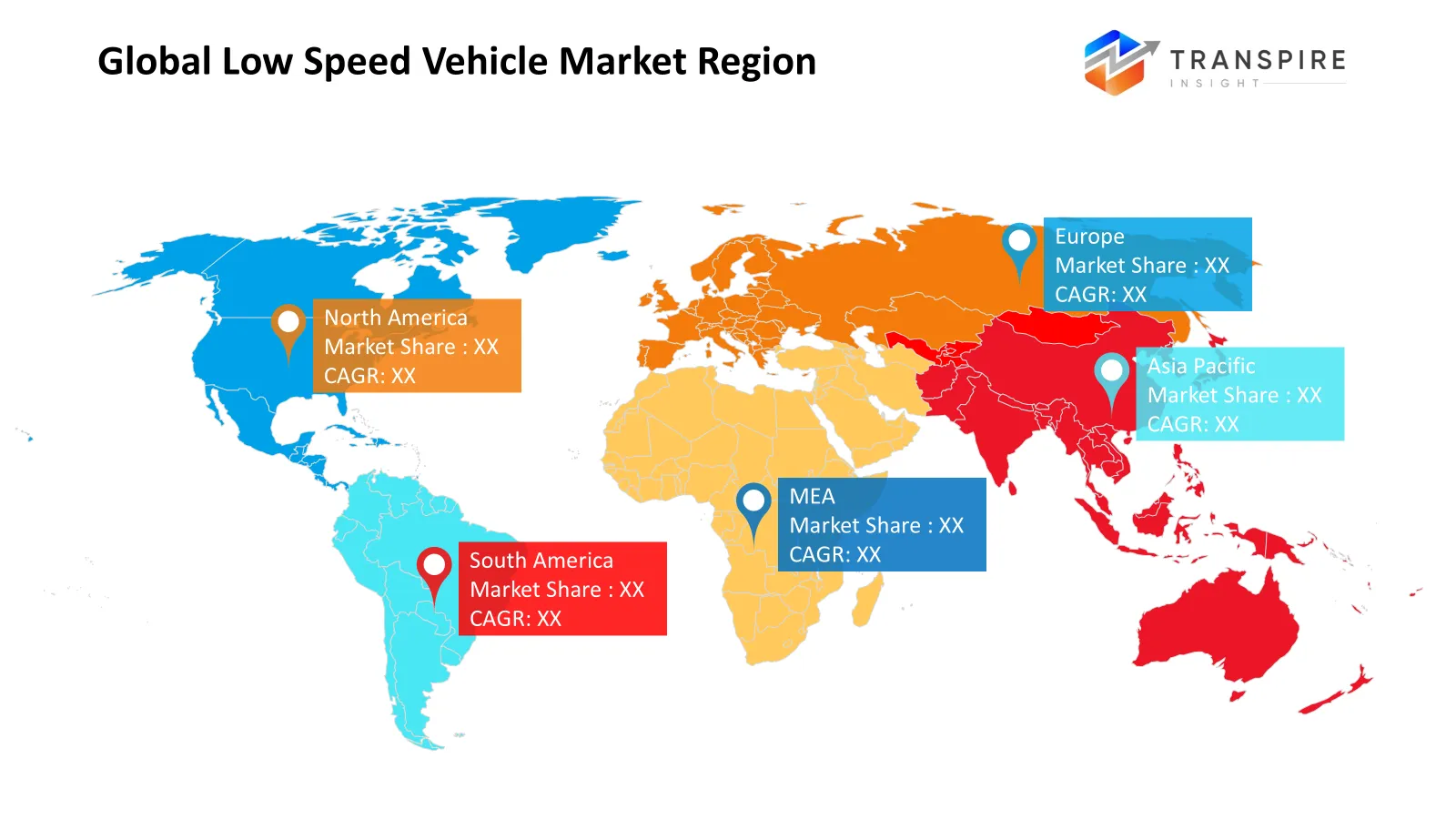
North America leads the global market with 47.2% share in 2024, and the dominance stems from regulatory infrastructure that other regions lack. State vehicle codes in Arizona, Florida, Texas, and California permit LSV operation on public roads with speed limits up to 35 mph, creating legal frameworks that enable residential community and municipal adoption beyond private property. The United States also hosts the world's largest concentration of golf courses, with over 16,000 facilities representing consistent replacement demand for course fleets. Residential development patterns in Sun Belt states favor master-planned communities with dedicated LSV infrastructure, creating pre-sold demand before neighborhoods complete construction. The combination of supportive regulations, established recreational infrastructure, and residential development momentum creates a self-reinforcing market that other regions cannot easily replicate.
Europe contributes 28.3% of global revenue and competes on tourism and golf applications rather than residential adoption. Mediterranean countries including Spain, Portugal, and southern France host resort properties and golf courses that operate LSV fleets for guest transportation. European growth is constrained by road regulations that limit LSV use to private property and designated tourism zones, preventing the residential community adoption that drives North American growth. European markets also face higher vehicle costs due to emissions certification requirements and safety standards that exceed basic LSV specifications. This creates a higher-value, lower-volume market segment where operators pay premium prices for vehicles meeting European regulatory frameworks.
Asia Pacific, particularly China, represents the fastest-growing region at 11.3% CAGR through 2033. The growth catalyst is tourism development and golf course construction in China, Southeast Asia, and Australia. Chinese manufacturers have entered the market with electric LSVs priced 25-30% below Western competitors, targeting domestic golf courses and resort properties while building export channels to North America and Europe. Residential LSV adoption remains minimal in Asia Pacific because urban density and transportation patterns favor conventional vehicles or two-wheelers over low-speed alternatives. For market entrants and investors, Asia Pacific offers the highest growth rate through 2033, though profitability remains challenged by intense price competition from domestic Chinese manufacturers operating on thin margins.
To learn more about this report, Download Free Sample Report
Who are the Key Players in the Global Low Speed Vehicle Market and How Do They Compete?
The market sits in moderate consolidation. Polaris, Textron (E-Z-GO), Yamaha, and Club Car collectively hold approximately 55-60% of global market share, but no single player dominates sufficiently to set industry pricing or standards unilaterally. Competition operates on three dimensions: distribution network density, product line breadth, and brand reputation with commercial buyers. The largest players maintain dealer networks providing local sales, service, and parts support, which matters for fleet operators who cannot afford extended downtime. Mid-tier manufacturers rely on distributors or direct sales to price-sensitive buyers willing to sacrifice service accessibility for lower purchase costs.
Polaris competes through product diversification and premium positioning. The company offers LSV platforms under multiple brands including Polaris GEM for street-legal applications and Ranger EV for utility work. Polaris targets commercial and municipal buyers with vehicles exceeding basic golf cart specifications, offering features like automotive-grade suspensions, highway-capable speeds, and cargo capacities reaching 1,500 pounds. The company expanded LSV production capacity by 22% between 2023 and 2025, adding assembly lines in Minnesota to serve growing residential community and industrial demand. Polaris differentiates on quality and feature content rather than price, maintaining margins through premium positioning. Textron competes through its E-Z-GO division, which dominates the golf course segment with decades of market presence and established dealer relationships. E-Z-GO focuses on fleet sales to golf courses, resorts, and large commercial buyers, offering volume discounts and multi-year service contracts that lock in recurring revenue. The company updated its electric platform in 2023, adopting lithium-ion batteries across all models to deliver extended range and faster charging that appeal to high-utilization operators.
Yamaha and Club Car occupy similar market positions, competing on reliability and service network coverage. Both companies serve golf courses and commercial buyers who value dealer support and parts availability over cutting-edge features. Yamaha leverages its powersports brand reputation to appeal to buyers who associate the name with quality and durability, while Club Car (owned by Ingersoll Rand) targets industrial and municipal applications with heavy-duty utility models. Chinese manufacturers including Xiamen Dalle and Marshell Green Power entered the North American market in 2023, offering electric LSVs at 25-30% price discounts to incumbent brands. These companies target price-sensitive buyers and smaller operators willing to accept limited dealer networks and longer parts lead times in exchange for lower capital costs.
- Polaris Inc.
- Textron Inc.
- Yamaha Motor Co. Ltd.
- Deere & Company
- Kubota Corporation
- Club Car LLC
- Columbia Vehicle Group Inc.
- Garia A/S
- Star EV Corporation
- Bintelli Electric Vehicles
- Marshell Green Power
- Eagle EV LLC
- Xiamen Dalle Electric Car Co. Ltd.
- Dongguan Excellence Golf & Sightseeing Car Co. Ltd.
- Suzhou Eagle Electric Vehicle Manufacturing Co. Ltd.
Recent Developments
In April 2026, Polaris Inc. announced expansion of its GEM electric vehicle production facility in Anaheim, California, adding capacity for 8,000 additional units annually to meet growing demand from residential communities and municipalities. https://www.polaris.com
In March 2026, Textron Inc. completed pilot deployment of autonomous E-Z-GO LSVs at three retirement communities in Florida, testing scheduled shuttle services between residential areas and amenity centers. https://www.textron.com
What Strategic Insights Define the Future of the Global Low Speed Vehicle Market?
Over the next five to seven years, the low speed vehicle market will be shaped by regulatory expansion into municipal applications rather than purely private property use. Several U.S. states are considering frameworks that would permit LSVs on additional public road classifications, potentially opening entire small towns and suburban neighborhoods to LSV adoption beyond gated communities. If these regulations pass, the addressable market expands from master-planned communities representing a few million potential buyers to suburban households representing tens of millions. This regulatory pathway is more consequential for market growth than any product technology improvement manufacturers could deliver.
The risk that growth projections overlook is competition from personal electric vehicles entering from adjacent categories. Companies developing neighborhood electric vehicles, electric microcars, and enclosed electric scooters are targeting the same short-distance transportation use cases as LSVs but with different regulatory classifications and potentially lower prices. If these alternatives gain regulatory approval for road use in categories that LSVs currently dominate, they could capture share from LSV manufacturers who designed their products around outdated regulatory frameworks. This substitution risk is highest in residential community applications where buyers value weather protection and cargo capacity over golf cart heritage.
The opportunity that remains undervalued is autonomous shuttle services in controlled environments. Retirement communities, resort properties, and large corporate campuses all operate scheduled shuttle services using LSVs with drivers, representing labor costs that autonomous technology could eliminate. The technology for geofenced autonomous operation already exists and has been demonstrated in pilot projects, but regulatory approval and liability frameworks remain undefined. The first manufacturers to navigate these regulatory barriers and deploy commercially viable autonomous LSVs will capture a new revenue stream from operators currently spending $40,000 to $60,000 annually per driver on shuttle labor costs. This opportunity is realistic for deployment in the 2027-2029 window, ahead of broader autonomous vehicle adoption in public spaces.
By Vehicle Type
- Passenger LSV
- Utility LSV
By Powertrain
- Electric
- Gasoline
By Application
- Golf Courses
- Industrial Facilities
- Tourism & Resorts
- Residential Communities
Frequently Asked Questions
Find quick answers to common questions.
The Global Low Speed Vehicle Market is expected to reach USD 18.7 Billion by 2033.
Key segments for the Global Low Speed Vehicle Market are By Vehicle Type (Passenger LSV, Utility LSV), By Powertrain (Electric, Gasoline), By Application (Golf Courses, Industrial Facilities, Tourism & Resorts, Residential Communities).
Major Global Low Speed Vehicle Market players are Polaris Inc., Textron Inc., Yamaha Motor Co. Ltd., Deere & Company, Kubota Corporation, Club Car LLC, Columbia Vehicle Group Inc., Garia A/S, Star EV Corporation, Bintelli Electric Vehicles, Marshell Green Power, Eagle EV LLC, Xiamen Dalle Electric Car Co. Ltd., Dongguan Excellence Golf & Sightseeing Car Co. Ltd., Suzhou Eagle Electric Vehicle Manufacturing Co. Ltd.
The Global Low Speed Vehicle Market size is USD 10.39 Billion in 2025.
The Global Low Speed Vehicle Market CAGR is 7.60% from 2026 to 2033.
- Polaris Inc.
- Textron Inc.
- Yamaha Motor Co. Ltd.
- Deere & Company
- Kubota Corporation
- Club Car LLC
- Columbia Vehicle Group Inc.
- Garia A/S
- Star EV Corporation
- Bintelli Electric Vehicles
- Marshell Green Power
- Eagle EV LLC
- Xiamen Dalle Electric Car Co. Ltd.
- Dongguan Excellence Golf & Sightseeing Car Co. Ltd.
- Suzhou Eagle Electric Vehicle Manufacturing Co. Ltd.
Recently Published Reports
-
Apr 2026
ATV & UTV Market
ATV & UTV Market Size, Share & Analysis Report By Type (ATV, and UTV), By Variants (Less Than 400 CC, 400 CC To 800 CC, and More Than 800 CC), and Geography (North America, Europe, Asia-Pacific, Middle East and Africa, South and Central America), 2021 - 2031
-
Apr 2026
Automotive Central Gateway Module Market
Automotive Central Gateway Module Market Size, Share & Analysis Report By Type (Ethernet Central Gateway Module, CAN Central Gateway Module, LIN Central Gateway Module, and FlexRay), By Application (Powertrain Control, Body Control, Infotainment System, Advanced Driver Assistance Systems (ADAS), and Others), By End User (Passenger Vehicles, and Commercial Vehicles), and Geography (North America, Europe, Asia-Pacific, Middle East and Africa, South and Central America), 2021 - 2031
-
Apr 2026
Automotive Engine Oil Filter Market
Automotive Engine Oil Filter Market Size, Share & Analysis Report By Filter Type (Fuel Filter, Engine Oil Filter, Hydraulic Oil Filter, and Others), By Filter Media (Cellulose, Synthetic, and Micro), By Sales Channel (OEMs, and Aftermarket), By Vehicle Type (Passenger Cars, Light Commercial Vehicles, Heavy Duty Trucks, Buses and Coaches, and Off-road Vehicles), and Geography (North America, Europe, Asia-Pacific, Middle East and Africa, South and Central America), 2021 - 2031
-
Apr 2026
Automotive Parts Aluminium Die Casting Market
Automotive Parts Aluminium Die Casting Market Size, Share & Analysis Report By Production Process (Pressure Die Casting, Vacuum Die Casting, Squeeze Die Casting, Gravity Die Casting), By Application (Body Parts, Engine Parts, Transmission Parts, Battery And Related Components, Other Application Types), and Geography (North America, Europe, Asia-Pacific, Middle East and Africa, South and Central America), 2021 - 2031
Our Clients