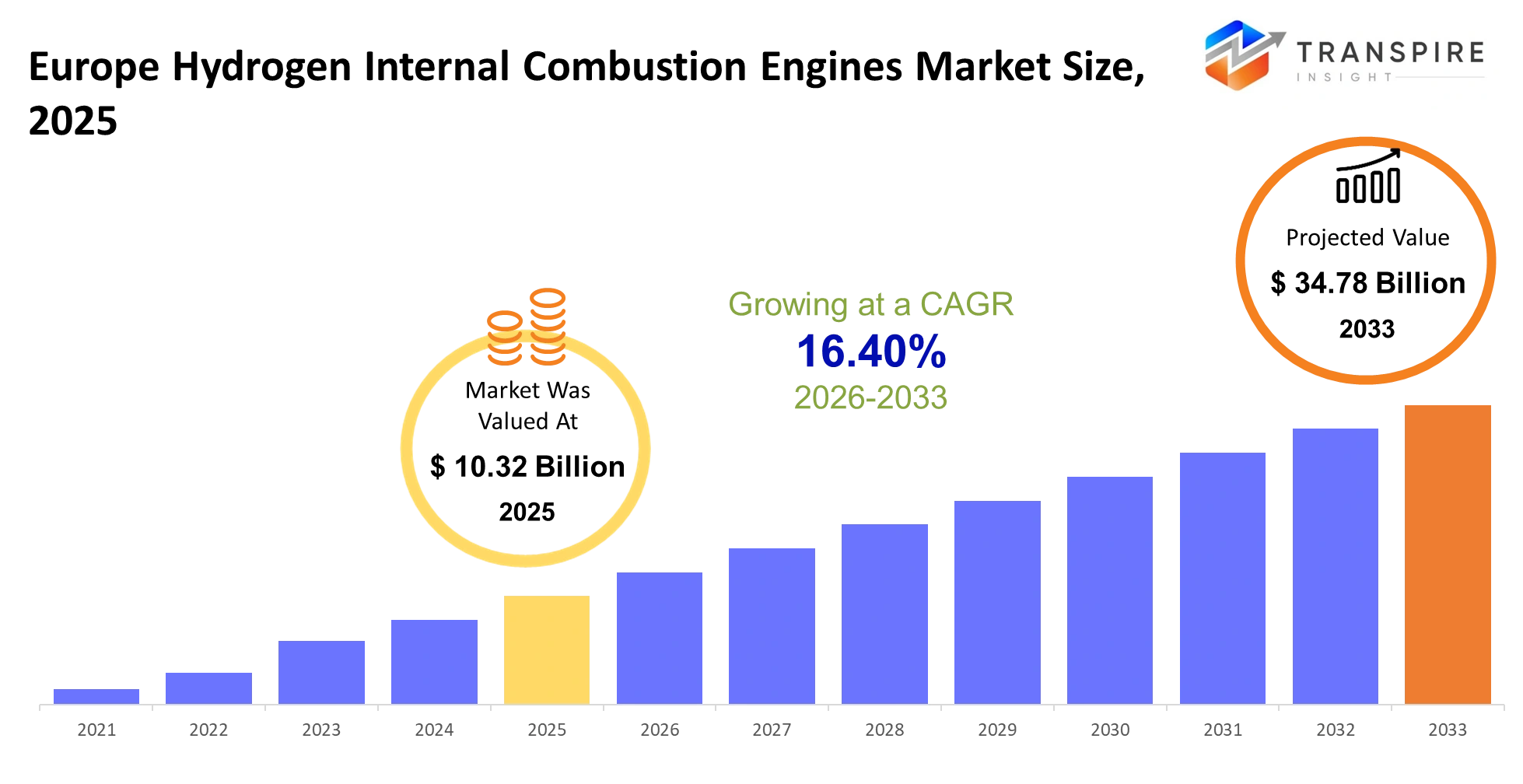
Europe Hydrogen Internal Combustion Engines Market Size & Forecast:
- Europe Hydrogen Internal Combustion Engines Market Size 2025: USD 10.32 Billion
- Europe Hydrogen Internal Combustion Engines Market Size 2033: USD 34.78 Billion
- Europe Hydrogen Internal Combustion Engines Market CAGR: 16.40%
- Europe Hydrogen Internal Combustion Engines Market Segments: By Type (Hydrogen ICE Passenger Vehicles, Hydrogen ICE Commercial Vehicles, Stationary Engines, Others); By Application (Transportation, Power Generation, Industrial Use, Marine, Aviation, Others); By End-User (Automotive Companies, Energy Companies, Industrial Firms, Governments, Logistics Companies, Others); By Technology (Direct Injection, Port Fuel Injection, Dual Fuel Systems, Turbocharged Systems, Others).
To learn more about this report,  Download Free Sample Report
Europe Hydrogen Internal Combustion Engines Market Summary:
The Europe Hydrogen Internal Combustion Engines Market size is estimated at USD 10.32 Billion in 2025 and is anticipated to reach USD 34.78 Billion by 2033, growing at a CAGR of 16.40% from 2026 to 2033.
The European market for hydrogen internal combustion engines in clean mobility and industrial powertrain systems establishes its own unique market position because Europe is currently transforming its energy and transportation systems. The market will demonstrate how fleet operators and manufacturers will shift towards low-emission solutions while keeping their current engine designs. Demand patterns will emerge from logistics companies and heavy-duty transportation customers who want solutions that allow for partial electrification instead of complete electric systems. The development of hydrogen storage systems and combustion control technology together with new retrofitting methods will enhance both performance metrics and cost-effectiveness throughout the upcoming period. The combination of two elements the regulations for carbon emissions and the public funding of hydrogen infrastructure will establish a reliable atmosphere which motivates hesitant customers to implement these solutions.
What Has the Impact of Artificial Intelligence Been on the Europe Hydrogen Internal Combustion Engines Market?
Artificial intelligence is progressively altering the methods which European hydrogen internal combustion engine market utilizes to produce insights and make decisions. The implementation of artificial intelligence in European hydrogen internal combustion engine market analysis will assist businesses in handling extensive data sets because it will allow them to identify demand trends and regional adoption patterns with higher accuracy. Stakeholders will achieve better results when predicting changes in fuel selection and infrastructure development and government actions through using machine learning models and predictive analytics. The use of artificial intelligence in research about European hydrogen internal combustion engines market enables businesses to develop competitive advantages through better strategic planning and reduced uncertainty.
Smart automation will create a fundamental change in production systems and operational processes within the European hydrogen internal combustion engine market. AI-based systems will boost operational effectiveness through better combustion processes, enhanced quality assurance, and improved design of components. AI solutions will help supply chain networks achieve better adaptability by predicting disruptions and managing inventory and logistics processes. The use of AI technology in European hydrogen internal combustion engine market environments will drive innovation because it enables manufacturers to customize engine performance for various industrial and transportation applications. European hydrogen internal combustion engine market businesses that use artificial intelligence technologies will develop a competitive advantage through their ability to make speedy choices, which results in decreased operational waste and expanded business capacity.
Key Market Trends & Insights:
- Western European countries control more than 45% of the hydrogen internal combustion engines market in Europe which will exist in 2025 because of their robust policy support and their initial hydrogen technology implementation.
- Northern Europe becomes the most rapidly expanding area between 2026 and 2032 because of its implementation of green hydrogen initiatives and its pursuit of ambitious carbon neutrality objectives.
- The market for heavy-duty engines will reach its peak in 2025 when this segment holds almost 50% of total market share because logistics and long-distance freight operations need these engines.
- The second biggest market share belongs to medium-duty engines which gain from their use in urban delivery operations and the shift of municipal fleets to this technology.
- The retrofit engine solutions market will experience its highest growth rate until 2032 because of the trend towards affordable fleet conversion.
- The commercial transportation sector controls approximately 55% of the market because European countries show strong interest in hydrogen-powered trucks and buses.
- The industrial power generation sector will expand most rapidly because decentralized energy systems and backup power systems will drive their demand.
- Companies in the logistics and transportation sector hold about 60% market share because they need to reduce emissions and update their vehicle fleets.
- Hydrogen engines show the highest growth rate in their usage for off-grid operations among users of construction and mining industries.
- Through advanced research and development together with AI-based engineering solutions organizations reach market leadership by improving their operational performance and cutting their product development expenses.
Europe Hydrogen Internal Combustion Engines Market Segmentation
By Type:
The analysis divides hydrogen-based technology into three categories which are hydrogen-powered passenger vehicles and hydrogen-powered commercial vehicles and stationary engines and other systems. Hydrogen ice passenger vehicles will receive limited market penetration because customers prefer driving systems they already know. Hydrogen ice commercial vehicles will dominate because logistics fleets require durable long-range solutions. The stationary engines will provide backup power together with power distribution capabilities. The other segments will include specialized machinery which operates in off-road conditions.
By Application:
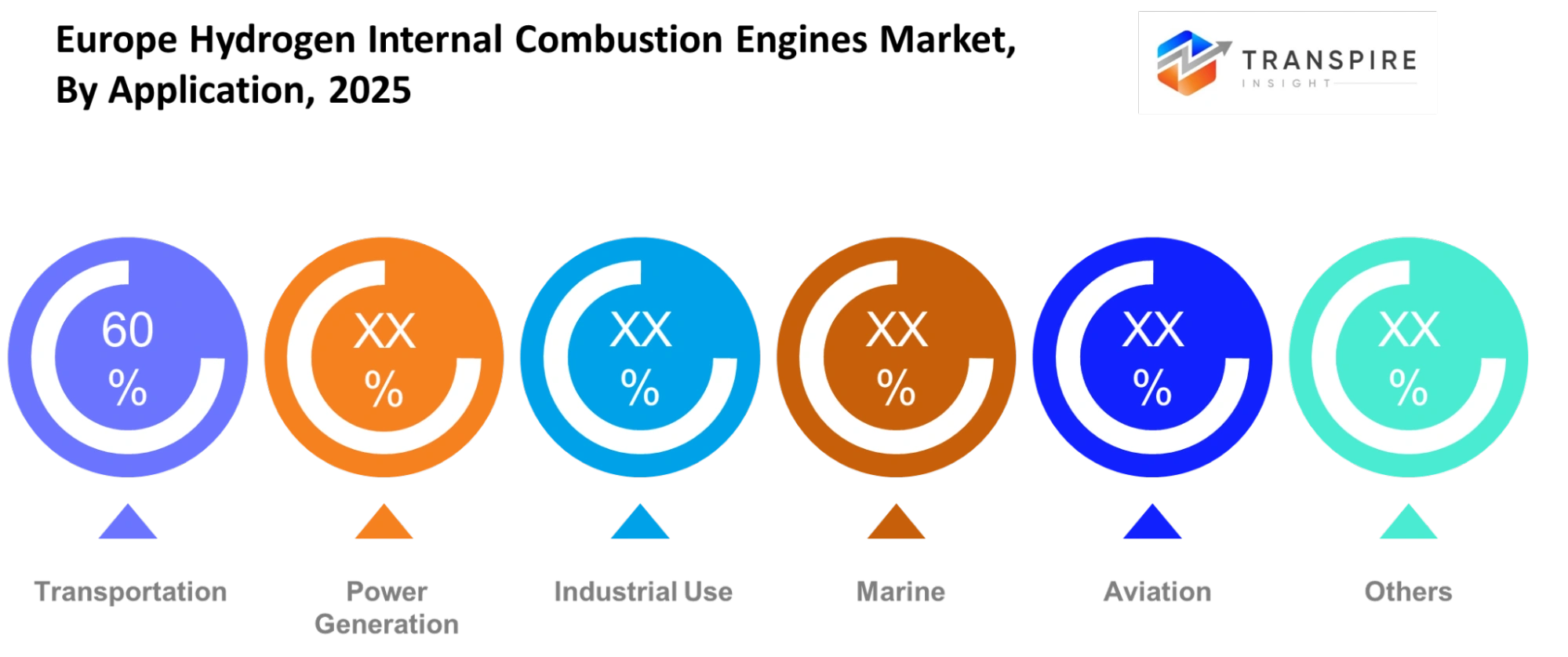
The main drivers of demand in transportation will work to reduce emissions through freight and public transit systems. Power generation will expand through decentralized hydrogen fuel-based systems. Industrial use will increase in heavy manufacturing environments. Marine and aviation will conduct pilot deployments while other applications will handle emerging and experimental use cases.
To learn more about this report, Download Free Sample Report
By End-User:
Automotive companies will develop engine platforms which provide flexible design options. Energy companies will support hydrogen supply integration. Industrial firms will adopt engines for continuous operations. The government will use policy support to promote adoption. Logistics companies will continue to be the main users while other sectors will include construction and agriculture.
By Technology:
Direct injection will enhance combustion efficiency while boosting performance. The implementation of port fuel injection systems will result in simpler system integration which brings about reduced operational costs. Dual fuel systems will enable users to switch between hydrogen and traditional fuel sources. Turbocharged systems will deliver increased power output while other technologies will maintain focus on achieving better results through optimization and emission reduction efforts.
What are the Main Challenges for the Europe Hydrogen Internal Combustion Engines Market Growth?
The hydrogen internal combustion engine market in Europe confronts major technical and operational challenges which will determine its future growth potential. Hydrogen combustion still presents efficiency gaps compared to conventional fuels, along with concerns around engine durability and thermal management.The process of hydrogen storage and handling remains complex because it needs high-pressure systems which create additional design limitations. The European hydrogen internal combustion engines market faces ongoing challenges because heavy-duty applications need both scalable solutions and reliable performance.
The European hydrogen internal combustion engines market will experience reduced progress because manufacturing and commercialization obstacles exist. Production processes demand specialized materials and engineering adjustments, which raise costs and extend development timelines. The regulatory regulations for emissions and safety standards will create additional approval requirements which will postpone the implementation of large-scale projects. Market limitations will also stem from high initial investment requirements, making it difficult for smaller manufacturers to compete or enter the space efficiently.
The Europe hydrogen internal combustion engines market will face significant adoption difficulties because hydrogen refueling stations do not exist and supply networks differ from one region to another. The uncertain fuel availability together with the existing shortage of hydrogen system technicians will make many end users reluctant to proceed. The banking system will not finance projects because of funding gaps and companies do not know their return on investment. Battery-electric and fuel cell technologies will create more competitive pressure because these alternatives receive current market support and policy backing.
Regional Insights
The European hydrogen internal combustion engines market will experience gradual changes because three factors will determine market development these factors include policy decisions industrial needs and the current state of infrastructure development. Areas that have hydrogen production and distribution networks will see faster market growth while other areas will experience market expansion through a slower and more careful process.
Western Europe will lead because it has established hydrogen programs which receive backing from regulatory bodies and it maintains a strong industrial base that supports quick deployment of hydrogen-based engines. Northern Europe will experience fast progress because of its renewable hydrogen initiatives and its commitment to sustainability objectives. Southern and Eastern Europe will progress at a steady pace which they will need to overcome because they currently lack necessary infrastructure and funding resources which will affect their adoption schedule.
Recent Development News
In April 2026, Cummins announced strategic partnerships to strengthen its hydrogen engine portfolio, accelerating commercialization of hydrogen internal combustion engines for heavy-duty transport and industrial use.
Source: https://www.openpr.com
In March 2026, Deutz AG expanded its hydrogen engine strategy through acquisitions and joint ventures aimed at scaling production in off-highway and stationary engine segments.
Source: https://www.openpr.com
|
Report Metrics |
Details |
|
Market size value in 2025 |
USD 10.32 Billion |
|
Market size value in 2026 |
USD 12.01 Billion |
|
Revenue forecast in 2033 |
USD 34.78 Billion |
|
Growth rate |
CAGR of 16.40% from 2026 to 2033 |
|
Base year |
2025 |
|
Historical data |
2021 - 2024 |
|
Forecast period |
2026 - 2033 |
|
Report coverage |
Revenue forecast, competitive landscape, growth factors, and trends |
|
Regional scope |
Europe (Germany, United Kingdom, France, Italy, Spain, Rest of Europe) |
|
Key company profiled |
Toyota, BMW, Cummins, MAN Energy Solutions, Volvo, Hyundai, Kawasaki Heavy Industries, Bosch, Deutz, Wärtsilä, Rolls-Royce, Renault, Stellantis, Honda, Yanmar. |
|
Customization scope |
Free report customization (country, regional & segment scope). Avail customized purchase options to meet your exact research needs. |
|
Report Segmentation |
By Type (Hydrogen ICE Passenger Vehicles, Hydrogen ICE Commercial Vehicles, Stationary Engines, Others); By Application (Transportation, Power Generation, Industrial Use, Marine, Aviation, Others); By End-User (Automotive Companies, Energy Companies, Industrial Firms, Governments, Logistics Companies, Others); By Technology (Direct Injection, Port Fuel Injection, Dual Fuel Systems, Turbocharged Systems, Others). |
How Can New Companies Establish a Strong Foothold in the Europe Hydrogen Internal Combustion Engines Market?
European hydrogen internal combustion engine markets require new market entrants to create unique product offerings instead of competing against multiple industry players. Companies that focus on off-highway equipment and backup power systems and municipal fleets will achieve quicker market entry because of reduced competition in those specialized areas. Emerging companies will achieve successful market entrance by developing solutions which match existing industry demand for low-emission products and retrofit technologies.
The hydrogen internal combustion engines market in Europe requires companies to establish their market credibility through innovative research projects. The combustion optimization and lightweight engine parts and efficient hydrogen storage systems which companies invest in will help them resolve major performance issues. Market entry will become more effective through strategic partnerships which link hydrogen supply companies and infrastructure developers and research institutions. New market entrants will benefit from collaboration because it enables them to minimize development expenses while gaining better access to essential distribution networks.
The European hydrogen internal combustion engine market needs companies to establish market presence by addressing specific challenges which exist in their industry. The startup Keyou operates diesel engine retrofitting services which enable logistics companies to decrease emissions through hydrogen-powered engine systems without needing to replace their complete vehicle fleets. The CMB.TECH company develops hydrogen-powered engine technology for application in heavy transportation and industrial use cases. Startups which develop precise solutions through their specialized research will create new market opportunities while building strong market presence.
Key Europe Hydrogen Internal Combustion Engines Market Company Insights
The European hydrogen internal combustion engines market will establish its competitive framework through ongoing investments in environmentally friendly engine technologies. The market participants will develop solutions that enhance efficiency while they control expenses and maintain system compatibility which will create an ecosystem that supports both new ideas and existing operational methods to determine their future success in the market.
Leading companies will strengthen their competitive advantage through their research investment programs which they will combine with strategic partnerships and their efforts to expand operations throughout crucial European markets. Product development will focus on performance and emission control improvements. The new market entrants will establish their presence through targeted niche markets and retrofit products while existing companies will maintain their market lead through their extensive distribution channels and superior engineering expertise.
Company List
- Toyota
- BMW
- Cummins
- MAN Energy Solutions
- Volvo
- Hyundai
- Kawasaki Heavy Industries
- Bosch
- Deutz
- Wärtsilä
- Rolls-Royce
- Renault
- Stellantis
- Honda
- Yanmar
What are the Key Use-Cases Driving the Growth of the Europe Hydrogen Internal Combustion Engines Market?
The hydrogen internal combustion engine market in Europe is expanding because heavy-duty transportation systems use hydrogen technology for their long-haul trucks and buses that need dependable low-emission solutions. Fleet operators use hydrogen internal combustion engine solutions to achieve their stringent carbon emissions goals while maintaining their existing engine technologies and refueling methods. The use case establishes a market growth pathway because it enables users to switch from diesel engines to electric power systems.
The European hydrogen internal combustion engine market grows because industrial and manufacturing industries make their investments. Hydrogen-powered engines are being tested by steel plants and major production facilities to provide on-site electricity and drive equipment. These applications create strong demand from energy-intensive environments because they use less fossil fuel while keeping their operations running smoothly.
The European hydrogen internal combustion engines market relies on two main factors which include backup power systems and distributed power generation systems. Data centers and healthcare facilities and remote infrastructure projects are increasingly considering hydrogen ICE systems for reliable energy supply. The need for backup solutions that deliver cleaner energy without depending on grid systems drives this transition.
The European hydrogen internal combustion engine market will grow because new applications develop in construction and mining and marine industries. The hydrogen engine system works as a scalable solution for these industries which need to generate high power output because their infrastructure development process reaches its final stage.
Europe Hydrogen Internal Combustion Engines Market Report Segmentation
By Type
- Hydrogen ICE Passenger Vehicles
- Hydrogen ICE Commercial Vehicles
- Stationary Engines
- Others
By Application
- Transportation
- Power Generation
- Industrial Use
- Marine
- Aviation
- Others
By End-User
- Automotive Companies
- Energy Companies
- Industrial Firms
- Governments
- Logistics Companies
- Others
By Technology
- Direct Injection
- Port Fuel Injection
- Dual Fuel Systems
- Turbocharged Systems
- Others
Frequently Asked Questions
Find quick answers to common questions.
The approximate Europe Hydrogen Internal Combustion Engines Market size for the market will be USD 34.78 Billion in 2033.
Key segments for the Europe Hydrogen Internal Combustion Engines Market are By Type (Hydrogen ICE Passenger Vehicles, Hydrogen ICE Commercial Vehicles, Stationary Engines, Others); By Application (Transportation, Power Generation, Industrial Use, Marine, Aviation, Others); By End-User (Automotive Companies, Energy Companies, Industrial Firms, Governments, Logistics Companies, Others); By Technology (Direct Injection, Port Fuel Injection, Dual Fuel Systems, Turbocharged Systems, Others).
Major Europe Hydrogen Internal Combustion Engines Market players are Toyota, BMW, Cummins, MAN Energy Solutions, Volvo, Hyundai, Kawasaki Heavy Industries, Bosch, Deutz, Wärtsilä, Rolls-Royce, Renault, Stellantis, Honda, Yanmar.
The Europe Hydrogen Internal Combustion Engines Market size is USD 10.32 Billion in 2025.
The Europe Hydrogen Internal Combustion Engines Market CAGR is 16.40%.
- Toyota
- BMW
- Cummins
- MAN Energy Solutions
- Volvo
- Hyundai
- Kawasaki Heavy Industries
- Bosch
- Deutz
- Wärtsilä
- Rolls-Royce
- Renault
- Stellantis
- Honda
- Yanmar
Recently Published Reports
-
Apr 2026
ATV & UTV Market
ATV & UTV Market Size, Share & Analysis Report By Type (ATV, and UTV), By Variants (Less Than 400 CC, 400 CC To 800 CC, and More Than 800 CC), and Geography (North America, Europe, Asia-Pacific, Middle East and Africa, South and Central America), 2021 - 2031
-
Apr 2026
Automotive Central Gateway Module Market
Automotive Central Gateway Module Market Size, Share & Analysis Report By Type (Ethernet Central Gateway Module, CAN Central Gateway Module, LIN Central Gateway Module, and FlexRay), By Application (Powertrain Control, Body Control, Infotainment System, Advanced Driver Assistance Systems (ADAS), and Others), By End User (Passenger Vehicles, and Commercial Vehicles), and Geography (North America, Europe, Asia-Pacific, Middle East and Africa, South and Central America), 2021 - 2031
-
Apr 2026
Automotive Engine Oil Filter Market
Automotive Engine Oil Filter Market Size, Share & Analysis Report By Filter Type (Fuel Filter, Engine Oil Filter, Hydraulic Oil Filter, and Others), By Filter Media (Cellulose, Synthetic, and Micro), By Sales Channel (OEMs, and Aftermarket), By Vehicle Type (Passenger Cars, Light Commercial Vehicles, Heavy Duty Trucks, Buses and Coaches, and Off-road Vehicles), and Geography (North America, Europe, Asia-Pacific, Middle East and Africa, South and Central America), 2021 - 2031
-
Apr 2026
Automotive Parts Aluminium Die Casting Market
Automotive Parts Aluminium Die Casting Market Size, Share & Analysis Report By Production Process (Pressure Die Casting, Vacuum Die Casting, Squeeze Die Casting, Gravity Die Casting), By Application (Body Parts, Engine Parts, Transmission Parts, Battery And Related Components, Other Application Types), and Geography (North America, Europe, Asia-Pacific, Middle East and Africa, South and Central America), 2021 - 2031
Our Clients