
South Korea Diesel Generator Market Size & Forecast:
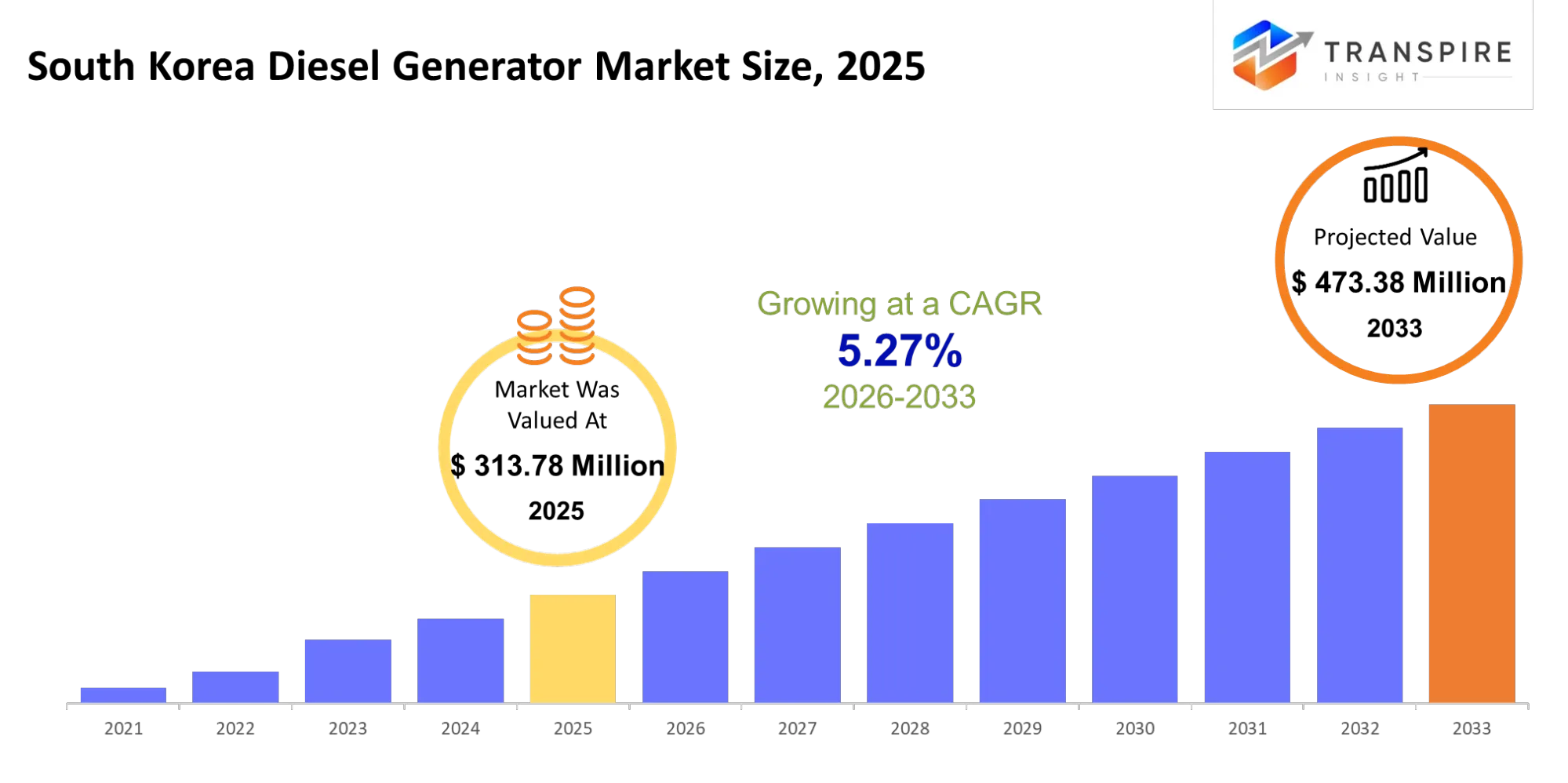
- South Korea Diesel Generator Market Size 2025: USD 313.78 Million
- South Korea Diesel Generator Market Size 2033: USD 473.38 Million
- South Korea Diesel Generator Market CAGR: 5.27%
- South Korea Diesel Generator Market Segments: By Power Rating (Below 75 kVA, 75–375 kVA, 375–750 kVA, Above 750 kVA, Others); By Application (Standby Power, Peak Shaving, Prime Power, Continuous Power, Others); By End User (Industrial Sector, Commercial Sector, Residential Sector, Data Centers, Others); By Fuel Type (Diesel-powered Generators, Hybrid Diesel Generators, Dual-fuel Generators, Others); By Mobility (Portable Generators, Stationary Generators, Trailer-mounted Generators, Others)
To learn more about this report,  Download Free Sample Report
South Korea Diesel Generator Market Summary
The South Korea Diesel Generator Market was valued at USD 313.78 Million in 2025. It is forecast to reach USD 473.38 Million by 2033. That is a CAGR of 5.27% over the period.
Diesel generators in South Korea basically keep industrial plants, data centers, shipbuilding yards, and commercial facilities running when grid power gets weird, unstable or when peak demand spikes. In real life they work as a backup, plus a supplemental power source, so you don't get production downtime, and you can safeguard high value operations especially in energy intensive sectors like manufacturing and maritime infrastructure.
Over the last 3–5 years, the market has shifted in a more permanent way toward higher efficiency and lower emission generator systems. This is mostly because stricter air quality rules, and also industrial decarbonization targets that are changing how people buy equipment. One big factor that moved everything faster was tighter emissions compliance requirements for industrial machinery, and at the same time supply chain disruptions during the post pandemic recovery, which really showed the risks of power instability at critical sites. So, customers are more often upgrading older diesel sets with digitally monitored, fuel optimized systems. This improves uptime reliability, while also moving spending and revenue toward premium, compliant generator solutions, instead of only basic capacity.
Key Market Insights
- South Korea Diesel Generator Market is moving, sort of, toward higher efficiency and low emission systems, and the upgraded units actually make up something like 33% of the fresh installations in 2025.
- The Seoul Capital Region seems to take the lead on demand, with roughly 42% share, mainly because hyperscale data centers and semiconductor fabs are piling in there, plus the commercial infrastructure is pretty dense, so it stacks up.
- The Southeastern industrial belt is growing the quickest, bringing in nearly 28% of the added demand, and it is largely driven by shipbuilding as well as export manufacturing expansion—though people often say it in a broader way.
- Medium-capacity diesel generators are currently the most visible category, taking more than 38% share, and they’re used a lot in industrial and commercial backup setups.
- High-capacity generators sit around 27% share, and they are typically put in shipyards, utilities, and heavy industrial complexes where continuous resilience isn’t optional.
- Smart hybrid diesel generator systems are the ones scaling fastest, with an estimated 9–11% annual growth, mostly from IoT monitoring and fuel optimization adoption.
- Industrial backup power is the biggest application use, at about 45% share, which basically mirrors how manufacturing and infrastructure teams rely on uninterrupted production.
- Data center demand is climbing quickly, and generator procurement goes up by over 25% between 2022 and 2025 across the Seoul metropolitan clusters.
- Manufacturing stays as the top end-user segment, hovering near 40% share, with automation driven production continuity requirements helping it stay on top.
- Major players like Caterpillar Inc., Cummins Inc., Doosan Enerbility, Mitsubishi Heavy Industries, Wärtsilä, and Rolls-Royce Holdings are pushing ahead through hybrid integration digital monitoring and emissions compliant generator upgrades, kind of in parallel instead of one at a time.
What are the Key Drivers, Restraints, and Opportunities in the South Korea Diesel Generator Market?
The main driver for the South Korea Diesel Generator Market is the rising dependency on steady, uninterrupted power in semiconductor production lines, shipyards, and hyperscale data centers. There is also this frequent load volatility in industrial clusters, so many operators feel pushed to install large backup configurations that switch on immediately when the grid starts acting unstable. Honestly that operational need shows up pretty directly as demand for capital gear, plus aftermarket servicing revenue too, and it becomes even more visible for generator sets with digital monitoring, since they cut downtime losses.
Then there is a restraint that’s getting tighter, especially environmental rules aimed at diesel emissions in urban and industrial zones. These regulations raise compliance costs and make operators hesitant to keep leaning on conventional diesel units, particularly in Seoul and other high-density surrounding areas. It becomes sort of structural, because firms either pay for expensive retrofit solutions or they start moving toward hybrid alternatives, and both paths tend to stretch timelines, which slows down procurement activity and squeezes the usual growth of traditional diesel generator demand.
On the opportunity side, hybridization and smart energy integration are starting to look more mainstream. Industrial sites are increasingly pairing diesel generators with battery storage, and also with renewable microgrids, to reduce fuel consumption and hit ESG expectations at the same time. For instance, some smart factory campuses in the southern industrial corridors are running AI-driven hybrid backup setups that coordinate diesel output with stored renewable energy. This shift is opening additional revenue channels for advanced system integrators and manufacturers that provide intelligent energy management platforms, not just basic diesel hardware.
What Has the Impact of Artificial Intelligence Been on the South Korea Diesel Generator Market?
Artificial intelligence is a kind of reshaping of operational efficiency inside backup power setups across South Korea, especially in industrial and maritime settings where uptime is everything. In newer diesel generator setups, AI based control systems are now used more and more to automate load balancing, keep an eye on exhaust performance and even fine tune fuel injection timing in real time. Basically, they cut down on manual fuss while also giving faster response accuracy when sudden power fluctuations show up, you know.
At the same time machine learning models are being pushed into predictive maintenance workflows. They sort through vibration patterns, shifts in fuel consumption and temperature swings, so operators can spot early wear in key parts and arrange maintenance well before anything breaks. The outcome is steadier equipment availability and lower unexpected outage expenses, in particular for data centers and shipbuilding operations, where delays can stack up fast.
From an operational angle, AI enabled systems have shown measurable wins, like 10–15% better fuel efficiency and up to a 20% drop in unplanned downtime across digitally upgraded generator fleets. Still, adoption is held back by integration complexity and those higher front end costs, mostly for legacy generator units that don’t really have standardized digital interfaces. Also, limited real time connectivity in offshore maritime areas makes full scale AI deployment harder, so hybrid monitoring approaches tend to be more common than fully autonomous ones.
Key Market Trends
- Industrial operators sort of moved 35% of the fresh installs toward low emission generator models after the enforcement for air quality got stricter in 2023, yeah.
- Then data center expansion did something similar, it boosted diesel generator procurement by 28% from 2022 to 2025 across the Seoul metro clusters.
- Hybrid diesel-battery systems started getting more interest, they cut fuel usage by almost 18% during early pilot deployments in industrial sites.
- In Busan shipbuilding areas, the hubs said adoption of high capacity generators climbed 22%, especially for export driven vessel production cycles.
- AI enabled monitoring systems also helped a lot, predictive maintenance got more accurate by over 25% in more advanced industrial facilities.
- Cummins Inc. along with the other firms expanded localized service networks in Korea to improve their response time by 30%.
- Generator retrofitting demand kept rising, because 40% of the installed base was above the recommended emission compliance thresholds.
- Smart factory spending meanwhile increased dependence on automated backup systems, tied into IoT energy management platforms.
- Fuel optimization tech brought operating costs down by around 12–15% in newer diesel generator deployments across manufacturing units.
- Finally, maritime compliance upgrades sped up replacement cycles for older generator units, in export oriented shipping fleets.
South Korea Diesel Generator Market Segmentation
By Power Rating
Under 75 kVA, the market position is quite strong in South Korea for Diesel Generator Market overall, because small commercial buildings, retail outlets, and even residential complexes often choose compact backup sets when outages are short term. Buying decisions in this band stay pretty cost sensitive, and the standardized build approach helps keep replacement timelines pretty regular. Also, the high installation density across urban micro infrastructure means there is a stable baseline of demand.
The growth here is mostly pushed by more small business infrastructure and a bigger dependence on nonstop digital payment systems, especially in retail spaces. The 75–375 kVA band is building momentum too, mainly as mid-sized manufacturing plants, as well as commercial sites, start selecting units that can run longer. Then 375–750 kVA tends to fit heavy industrial clusters, while anything above 750 kVA is more concentrated in shipyards, data centers, and large scale utilities. Other setups include tailored industrial configurations, used for specific load conditions that don’t match the typical profiles. Across the forecast period 75–375 kVA is expected to grow the fastest, as mid scale industrial automation continues to deepen and spread.
By Application
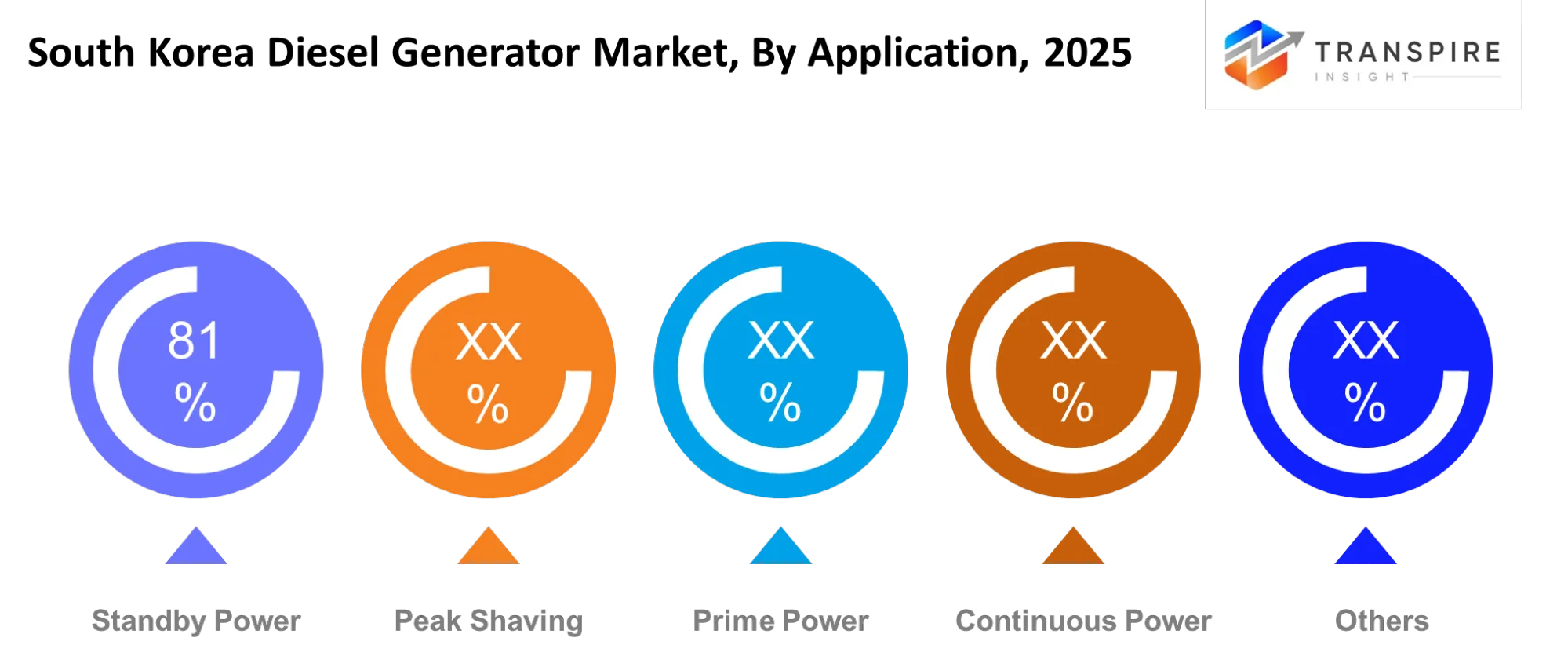
Standby power kind of holds the dominant position because so many hospitals, data centers, and manufacturing plants rely on it, and when the grid hiccups the losses show up fast, like operational ones. In addition, this segment seems to catch a lot of regulatory attention around keeping critical infrastructure running, so yeah the focus is there. Purchases often lean more toward dependability than pure cost, which ends up reinforcing market leadership.
The rise in standby systems is further supported by more digital infrastructure and also tighter uptime expectations in service industries. Peak shaving is getting more momentum too, since industrial users try to cope with electricity cost volatility during those high tariff periods. Prime power shows up more in remote industrial operations while continuous power stays mostly limited to niche, specialized off grid facilities. Other configurations pop up as well, for example hybrid grid-support setups. Looking across the forecast horizon, peak shaving is expected to grow quickly as energy cost optimization becomes a top concern for major industrial players.
To learn more about this report, Download Free Sample Report
By End User
The industrial space tends to lead, mainly because it needs uninterrupted running for manufacturing, petrochemical, and shipbuilding sites. High energy intensity, plus the insistence on production continuity, means diesel generators become this kind of core infrastructure. When they run through long cycles, it actually supports predictable demand, more or less stable over time.
Industrial adoption keeps rising, and that’s backed by factory automation, along with growth in export focused manufacturing clusters. In the commercial area, things are climbing too, fairly steady, driven by retail complexes and office infrastructure taking more of this equipment. Residential usage is still a bit narrow, mainly to high-rise apartment blocks and backup installations across cities.
Data centers show up as a rapidly expanding segment, because hyperscale cloud keeps widening, and edge computing is being pushed harder. The remaining areas cover defense usage and public infrastructure, which are not as big but still meaningful. Over the forecast window, data centers are expected to grow the quickest since digital workloads just keep intensifying.
By Fuel Type
Diesel powered generators kind of keep a strong position, mostly because they are steady, reliable, the fuel is there in a practical way, and the whole maintenance world around them is already well established. You still see these systems show up quite often in industrial and commercial backup cases, where you really want that operational certainty, every day and without surprises. In addition, mature supply chains help keep the adoption happening in a smooth way.
The momentum behind diesel is also tied to how heavy industries keep leaning on them, yet hybrid diesel generators are starting to pull more interest. This is often because they can connect better with battery storage and other renewable energy setups. Dual-fuel generators stay more niche, but they are slowly expanding in places where fuel flexibility matters and where emission optimization is a key requirement. There are also other options, like experimental low-carbon layouts, but those are not as common.So over the forecast period hybrid diesel systems are expected to grow the fastest, as energy transition policies support more adaptable backup architectures, instead of only single fuel thinking.
By Mobility
Stationary generators pretty much dominate the South Korea Diesel Generator Market, mainly because they’re already built for ongoing use in industrial plants, data centers, and commercial back up infrastructure where you can’t really move things around. In plain terms these setups tend to deliver higher capacity and they usually stay more stable over time, so critical facilities keep choosing them, over and over.
The push for stationary models also comes from more spending on permanent industrial build outs and on digital facilities. At the same time portable generator adoption keeps climbing in construction sites and smaller commercial environments where mobility matters and power is needed for short bursts. Trailer-mounted generators are also getting more attention for disaster recovery efforts and for temporary industrial arrangements, where speed is everything. Other categories cover specialized mobile units for military use and emergency response teams.
If you look at the forecast period, the trailer-mounted segment is expected to grow the fastest. That’s largely because customers want flexible, quick-deployment power solutions and they need them without delays.
What are the Key Use Cases Driving the South Korea Diesel Generator Market?
In the South Korea Diesel Generator Market, the main, kind of obvious use case is industrial standby power for manufacturing plants, semiconductor sites, and those big production hubs. These places don’t really allow even brief grid interruptions, so diesel generators get installed to keep the output steady and shield expensive production lines from downtime losses, plus the usual equipment damage.
Beyond that, the scope starts showing data center power assurance and also maritime auxiliary setups. In the Seoul metro area, hyperscale data centers lean on diesel backup units, because their uptime obligations are strict, like not negotiable. Meanwhile in Busan and Ulsan, shipbuilding yards, as well as port operators, use generators for vessel trials, loading and handling workflows, and onboard auxiliary power.
Some newer scenarios are also appearing, like hybrid microgrid integration, and this smart factory energy optimization trend. Industrial parks are starting to pair diesel generators with battery storage, and renewable inputs too. At the same time AI-controlled energy systems are being tested to trim fuel consumption and manage emissions related compliance costs, especially as environmental rules get tighter and tighter.
|
Report Metrics |
Details |
|
Market size value in 2025 |
USD 313.78 Million |
|
Market size value in 2026 |
USD 330.32 Million |
|
Revenue forecast in 2033 |
USD 473.38 Million |
|
Growth rate |
CAGR of 5.27%from 2026 to 2033 |
|
Base year |
2025 |
|
Historical data |
2021 - 2024 |
|
Forecast period |
2026 - 2033 |
|
Report coverage |
Revenue forecast, competitive landscape, growth factors, and trends |
|
Regional scope |
South Korea |
|
Key company profiled |
Cummins, Caterpillar, Mitsubishi Heavy Industries, Kohler, Rolls-Royce Power Systems, Generac Power Systems, Hyundai Power Products, Doosan Portable Power, Yanmar, Atlas Copco, Kirloskar Electric, FG Wilson, Perkins Engines, MTU Onsite Energy, Honda Power Equipment |
|
Customization scope |
Free report customization (country, regional & segment scope). Avail customized purchase options to meet your exact research needs. |
|
Report Segmentation |
By Power Rating (Below 75 kVA, 75–375 kVA, 375–750 kVA, Above 750 kVA, Others); By Application (Standby Power, Peak Shaving, Prime Power, Continuous Power, Others); By End User (Industrial Sector, Commercial Sector, Residential Sector, Data Centers, Others); By Fuel Type (Diesel-powered Generators, Hybrid Diesel Generators, Dual-fuel Generators, Others); By Mobility (Portable Generators, Stationary Generators, Trailer-mounted Generators, Others) |
Which Regions are Driving the South Korea Diesel Generator Market Growth?
The Seoul Capital Region kind of leads the South Korea Diesel Generator Market, mainly because it has a dense bunch of hyperscale data centers, plus financial infrastructure, and those tall commercial complexes. Because uptime is strict across the digital infrastructure, standby power got turned into a mandatory investment, not really some optional asset. Also, the region gets strong regulatory follow-through on grid reliability, so facilities feel pushed to keep certified backup systems. So overall, this whole setup keeps the demand steady for high-efficiency diesel generators, and not just the basic ones—more the units with advanced monitoring capabilities.
Meanwhile, the southeastern industrial corridor, with Ulsan and Gyeongnam in the mix, adds a more stable second-tier demand base. That comes from shipbuilding, petrochemical output, and export manufacturing. Here, it’s less about pure data continuity, and more about heavy industrial resilience when loads swing around. Big shipyards and factories tend to invest in high-capacity setups, to keep production cycles running, and to support vessel assembly activities without much downtime. As a result, the region becomes a steady, and kind of predictable revenue stream for global equipment suppliers.
The fastest-growing area is Busan and the surrounding port-linked zones, largely tied to maritime modernization and broader logistics growth. Port automation projects that have been rolling in, plus fleet upgrades, have increased how much they rely on onboard power systems and shore-side power solutions. On top of that, newer environmental compliance rules for how ports operate are speeding up the replacement of older generator sets, with cleaner and more digitally controlled systems. Looking at 2026–2033, this region is expected to pull in strong investor interest, because it’s connected to major shipping routes and ongoing infrastructure expansion.
Who are the Key Players in the South Korea Diesel Generator Market and How Do They Compete?
The South Korea Diesel Generator market is kind of moderately consolidated, where global engine makers are right there with domestic industrial equipment firms. In practice, the competition is more about technology efficiency, meeting emissions rules, being responsive with service, and having tighter digital monitoring integration, not only about price. Most established players protect their share with long-term industrial contracts, while the newer entrants kind of lean into hybrid configurations and smart energy integration, that sort of thing.
Cummins Inc. shows up with high-efficiency engine platforms and predictive maintenance capabilities that are plugged into industrial backup setups. Caterpillar Inc. goes for rugged, high-capacity generator sets, the ones that are heavily used in shipyards and big manufacturing facilities. Mitsubishi Heavy Industries keeps building momentum using low-emission marine-grade generator technologies, which fit better with the stricter port requirements. Doosan Enerbility also leans on domestic manufacturing strengths and close service coverage, to win industrial and infrastructure deals.
Meanwhile, Rolls-Royce Holdings tends to focus on premium, digitally optimized power solutions for data centers and maritime use. Their edge is basically integrated automation platforms combined with high reliability expectations for mission-critical environments. Overall, companies keep expanding via localized partnerships with Korean shipbuilders, digital energy management collaborations, plus continuous upgrades toward hybrid diesel-battery systems, which match the decarbonization pressure that’s coming from regulation and customer demands.
Company List
- Cummins
- Caterpillar
- Mitsubishi Heavy Industries
- Kohler
- Rolls-Royce Power Systems
- Generac Power Systems
- Hyundai Power Products
- Doosan Portable Power
- Yanmar
- Atlas Copco
- Kirloskar Electric
- FG Wilson
- Perkins Engines
- MTU Onsite Energy
- Honda Power Equipment
Recent Development News
In December 2023, Cummins Inc. announced the launch of new C1760D5, C1875D5, and C2000D5B diesel generator models. These high-capacity generator sets enhance power density and reliability for industrial and critical infrastructure applications, strengthening Cummins’ position in high-output backup power solutions.https://www.industryarc.com
In March 2025, Sun Pharmaceutical Industries Ltd. announced the acquisition of Checkpoint Therapeutics, expanding its oncology-focused portfolio. Although primarily pharmaceutical, the acquisition strengthens its access to oncology treatment ecosystems that influence healthcare infrastructure power backup demand, including diesel generator deployment in cancer treatment facilities.https://www.facebook.com
What Strategic Insights Define the Future of the South Korea Diesel Generator Market?
The South Korea Diesel Generator Market is slowly moving into a kind of hybrid backup power setup, where diesel solutions feel more like bridge assets, not really permanent backbone infrastructure. I mean this shift is happening alongside digital infrastructure growth getting faster, plus stricter emissions enforcement, and also because distributed energy systems are being stitched into industrial clusters. In the next 5–7 years, buyers will likely prefer intelligent, low-emission, and hybrid-compatible generator sets more and more, instead of the older conventional standalone units, that sort of thing.
There is also a quieter risk, and it is tied to how fast battery storage and hydrogen based backup approaches can replace diesel. In urban centers, that swap could weaken long term diesel reliance sooner than many forecasts assume. At the same time there is a real upside that is less talked about: AI orchestrated microgrid integration especially in shipbuilding zones and smart factories. In those places, diesel generators can act as flexible load balancing resources, not just power suppliers. Players in this market should keep focusing on modular hybrid ready designs, plus stronger digital monitoring tools, because in the future competitiveness will hinge less on raw output capacity and more on how smart the whole system behaves, you know.
South Korea Diesel Generator Market Report Segmentation
By Power Rating
- Below 75 kVA
- 75–375 kVA
- 375–750 kVA
- Above 750 kVA
- Others
By Application
- Standby Power
- Peak Shaving
- Prime Power
- Continuous Power
- Others
By End User
- Industrial Sector
- Commercial Sector
- Residential Sector
- Data Centers
- Others
By Fuel Type
- Diesel-powered Generators
- Hybrid Diesel Generators
- Dual-fuel Generators
- Others
By Mobility
- Portable Generators
- Stationary Generators
- Trailer-mounted Generators
- Others
Frequently Asked Questions
Find quick answers to common questions.
The estimated South Korea Diesel Generator Market size for the market will be USD 473.38 Million in 2033.
Key segments for the South Korea Diesel Generator Market are By Power Rating (Below 75 kVA, 75–375 kVA, 375–750 kVA, Above 750 kVA, Others); By Application (Standby Power, Peak Shaving, Prime Power, Continuous Power, Others); By End User (Industrial Sector, Commercial Sector, Residential Sector, Data Centers, Others); By Fuel Type (Diesel-powered Generators, Hybrid Diesel Generators, Dual-fuel Generators, Others); By Mobility (Portable Generators, Stationary Generators, Trailer-mounted Generators, Others).
Major South Korea Diesel Generator Market players are Cummins, Caterpillar, Mitsubishi Heavy Industries, Kohler, Rolls-Royce Power Systems, Generac Power Systems, Hyundai Power Products, Doosan Portable Power, Yanmar, Atlas Copco, Kirloskar Electric, FG Wilson, Perkins Engines, MTU Onsite Energy, Honda Power Equipment.
The South Korea Diesel Generator Market size is USD 313.78 Million in 2025.
The South Korea Diesel Generator Market CAGR is 5.27% from 2026 to 2033.
- Cummins
- Caterpillar
- Mitsubishi Heavy Industries
- Kohler
- Rolls-Royce Power Systems
- Generac Power Systems
- Hyundai Power Products
- Doosan Portable Power
- Yanmar
- Atlas Copco
- Kirloskar Electric
- FG Wilson
- Perkins Engines
- MTU Onsite Energy
- Honda Power Equipment
About the Authors

Avinash Kumar
I’m Avinash Kumar, a Senior Research Analyst at Transpire Insight, with expertise in the Electronics and Semiconductor and Energy & Power industry. My work focuses on analyzing emerging technologies, market trends, industry developments, and innovation across these sectors. I specialize in transforming complex technical and market insights into clear, research-backed content that helps professionals, businesses, and decision-makers stay informed. Through continuous industry research and data-driven analysis, I strive to deliver accurate, reliable, and practical perspectives on the latest advancements shaping the semiconductor and energy landscape.

Chakradhar Khansole
Chakradhar serves as the Research Director at Transpire Insight, bringing over 8 years of experience in technology, innovation, and strategic market intelligence. He specializes in transforming complex market data into actionable business insights that enable organizations to make informed, growth-oriented decisions. Recognized for his strategic vision and analytical expertise, Chakradhar leads high-impact research initiatives, delivering comprehensive market assessments, competitive intelligence, and forward-looking industry analysis.
Recently Published Reports
-
Apr 2026
Active Power Filter Market
Active Power Filter Market Size, Share & Analysis Report By Type (Shunt Active Power Filters, Series Active Power Filter, Hybrid Active Power Filter), By Application (Harmonics Mitigation, Reactive Power Compensation, Voltage Regulation, Power Factor Correction), By Phase (Single Phase, Three Phase), By End-User Industry (Manufacturing, Healthcare, Commercial, Automotive, Oil and Gas, Others), and Geography (North America, Europe, Asia-Pacific, Middle East and Africa, South and Central America), 2021 - 2031
-
Apr 2026
Electrical Transformer Market
Electrical Transformer Market Size, Share & Analysis Report By Core (Closed, Shell, and Berry), By Insulation (Gas, Oil, Solid, Air, and Other), By Phase (Single, and Three), By Rating (100 MVA to 500 MVA, 501 MVA to 800 MVA, and 801 MVA to 1200 MVA), and Geography (North America, Europe, Asia-Pacific, Middle East and Africa, South and Central America), 2021 – 2031
-
Apr 2026
Hydraulic Piston Pumps Market
Hydraulic Piston Pumps Market Size, Share & Analysis Report By Type (Axial Piston Pumps, Radial Piston Pumps), By Operating Pressure (Low Pressure, Medium Pressure, High Pressure), By Application (Construction, Mining, Agriculture, Automotive, Oil & Gas, Industrial Machinery, Others), By End-User (OEMs, Aftermarket), and Geography (North America, Europe, Asia-Pacific, Middle East and Africa, South and Central America), 2021 – 2031
-
Apr 2026
Laboratory Gas Generators Market
Laboratory Gas Generators Market Size, Share & Analysis Report By Product (Nitrogen Gas Generator, Hydrogen Gas Generator, Zero Air Gas Generator, Purge Gas Generator, TOC Gas Generators, Others), By Application (Gas Chromatography, Liquid Chromatography-mass Spectrometry (LC-MS), Gas Analyzers, Others), By End-user (Life Science, Chemical & Petrochemical, Food & Beverage, Others), and Geography (North America, Europe, Asia-Pacific, Middle East and Africa, South and Central America), 2021 – 2031