
Europe Data Center Generator Market Size & Forecast:
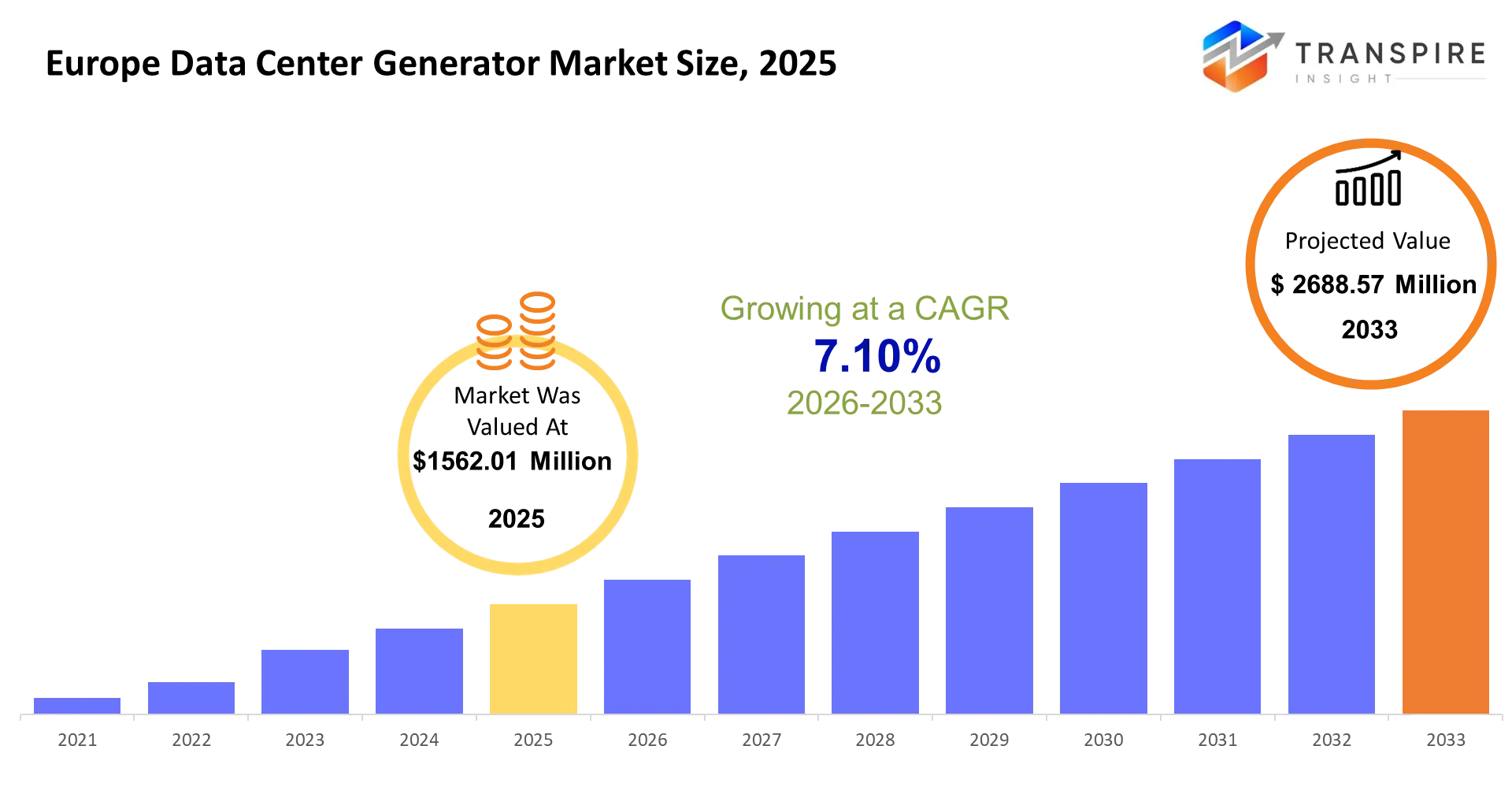
- Europe Data Center Generator Market Size 2025: USD 1562.01 Million
- Europe Data Center Generator Market Size 2033: USD 2688.57 Million
- Europe Data Center Generator Market CAGR: 7.10%
- Europe Data Center Generator Market Segments: By Type (Diesel Generators, Gas Generators, Hybrid Generators, Others), By Application (Hyperscale Data Centers, Colocation, Enterprise Data Centers, Others), By End-User (IT Companies, Telecom Companies, BFSI, Others), By Capacity (Below 1MW, 1–2MW, Above 2MW, Others).
To learn more about this report,  Download Free Sample Report
Europe Data Center Generator Market Summary:
The Europe Data Center Generator Market size is estimated at USD 1562.01 Million in 2025 and is anticipated to reach USD 2688.57 Million by 2033, growing at a CAGR of 7.10% from 2026 to 2033. The data center generator market of Europe provides essential support for maintaining digital operations which hyperscale cloud campuses and colocation facilities and financial networks and public-sector IT infrastructure depend upon. The generators provide their final power protection through their ability to maintain power supply during grid failures and voltage shifts and power interruptions. The systems protect all operations which include AI processing and edge computing and healthcare data management and industrial automation because any downtime will result in money loss and operational disruptions.
The market has evolved from traditional diesel backup systems to modern backup systems which use battery storage and advanced energy management systems. The transition gained speed after the Russia-Ukraine conflict caused the Europe energy crisis which showed weaknesses in both regional power systems and fuel supply chain operations. The operators developed advanced backup systems which required them to obtain new systems that provided better fuel options and longer operational periods and met higher emissions control requirements. The new trend leads to increased facility costs which also drives up revenue for post-sales services that include system tracking and upkeep and combined power system monitoring.
Key Market Insights
- Western Europe controlled almost half of the Europe Data Center Generator Market in 2025 because of its extensive development of hyperscale infrastructure.
- The Nordic countries between now and 2032 will experience their fastest growth because Sweden Finland and Denmark are developing data centers that operate on renewable energy.
- Operators choose diesel generators for their systems which operated above 58% of the market in 2025 because the generators provide dependable service during high-load periods and they support extended emergency backup operations.
- Gas-powered generator systems developed into the second-largest market segment because European countries developed better natural gas infrastructure while decreasing their emissions requirements.
- Operating organizations choose hybrid generator systems because these systems combine with battery storage to create the fastest expanding market segment which will continue growing until 2032.
- The Europe Data Center Generator Market needs Tier III and Tier IV data centers which account for almost 62% of the market because these standards require data centers to maintain complete system operation and backup facilities.
- Cloud and hyperscale applications dominated with approximately 54% market share in 2025 because AI computing and enterprise migration increased power density requirements.
- Telecom companies deploy edge data centers in secondary European cities because these data centers represent the fastest growing deployment segment of their low-latency digital network expansion.
- Colocation providers maintained their position as the top end-user market segment because businesses increasingly seek colocation services to handle their data center operations.
- Telecom and 5G infrastructure operators represent the fastest-growing end-user category as Europe expands regional edge computing networks through 2030.
- EU emissions regulations force data center operators in Europe to switch to generators that produce lower emissions and use versatile fuel sources in their backup power systems.
What are the Key Drivers, Restraints, and Opportunities in the Europe Data Center Generator Market?
The Europe Data Center Generator Market experiences its strongest growth because hyperscale data centers and AI-focused data centers are expanding rapidly throughout Western Europe and Northern Europe. The shift began to accelerate when cloud providers and AI infrastructure operators started using high-density computing clusters that require more power than standard enterprise servers. The increase in rack densities forced operators to abandon their previous method of depending on grid stability because the 2022 European energy crisis revealed weaknesses in regional electricity networks. The incident prompted colocation providers and hyperscale companies to boost their investments in backup power solutions which provide extended operational time through redundant power systems. The value of generator procurement has increased because operators now choose systems that offer higher capacity and digital monitoring and fuel flexibility instead of basic standby units.
The market face its most significant obstacle because European emissions regulations prohibit all activities in the industry. Urban areas establish strict regulations that control diesel generator testing durations and nitrogen oxide emissions and noise production. Advanced filtration systems and hybrid integration and low-emission fuel configurations require compliance implementation which results in substantial installation expenses. The regulatory requirements create two major challenges for conventional generator manufacturers because they extend deployment periods while limiting revenue potential in highly populated areas like Germany and the Netherlands.
The Nordic region currently presents a significant business opportunity because its renewable energy systems and efficient cooling systems support large artificial intelligence and hyperscale business operations. The countries of Sweden and Finland have developed into important centers for advanced data center operations. The transition to hybrid generator systems which use battery storage together with hydrotreated vegetable oil and other fuels has created higher demand for these systems. The next market expansion will benefit vendors who provide low-emission backup power systems designed for high-density AI facilities.
What Has the Impact of Artificial Intelligence Been on the Europe Data Center Generator Market?
The Europe Data Center Generator Market experiences transformation through artificial intelligence and advanced digital technologies which change backup power systems from their traditional reactive infrastructure mode to automatic energy asset operation through predictive maintenance. The operators use AI-based control systems which conduct continuous monitoring of generator temperature and fuel usage together with vibration measurement and load distribution in hyperscale data centers. The systems achieve power system stability through automatic runtime sequencing and power distribution adjustment processes which minimize the need for human operation while building operational stability.
The integration of machine learning models into systems enables them to predict when maintenance operations need to occur. The analysis of historical engine behavior combined with sensor data analysis enables operators to detect potential component failures which occur before breakdowns happen especially in alternators and cooling systems and fuel injection units. The large colocation facilities in Western Europe apply predictive analytics to decrease unplanned service interruptions while they enhance their maintenance procedures which results in decreased service expenditures and better equipment durability. AI-based energy management systems increase fuel efficiency through their capacity to optimize generator operation during times of peak demand and backup testing processes.
The digital monitoring technologies provide solutions for regulatory compliance through their ability to automate emissions monitoring and maintenance record-keeping and performance documentation for low-emission generator fleets. The current AI platform system implementation still encounters actual hurdles because organizations need to spend extensive financial resources while they face challenges related to existing backup systems which require complete system changes. Many older facilities also lack standardized operational datasets which reduces model accuracy and slows large-scale deployment of predictive systems.
Key Market Trends
- The hyperscale operators have expanded their generator capacity procurement practices since 2021 because AI workloads have increased their average rack power densities beyond conventional enterprise limits.
- European colocation providers extended their backup runtime requirements from 24 hours to 48-hour resilience targets after experiencing the energy crisis between Russia and Ukraine.
- Between 2020 and 2025, operators improved their diesel runtime efficiency and reduced emissions through the adoption of hybrid generator systems that combined lithium-ion batteries with other power sources.
- The Nordic countries experienced a surge of major facility investments because their renewable energy-powered grids provided hyperscale data center developers with lower long-term operational expenses.
- Cummins and Rolls-Royce Holdings shifted their product development activities toward HVO-compatible and low-NOx generator platforms because of new EU compliance requirements.
- Data center operators adopted AI-driven predictive maintenance platforms since 2023 which reduced unplanned generator downtime and enhanced fuel management accuracy.
- Urban markets including Frankfurt and Amsterdam implemented stricter noise and emissions regulations which required suppliers to create new enclosure systems and exhaust treatment technologies.
- The supply chain disruptions that began in 2022 resulted in longer lead times for alternators and switchgear and control systems which caused buyers to focus on building local sourcing partnerships.
- Telecom providers built low-latency infrastructure to support 5G applications which led to expansion of edge data center deployments throughout secondary European cities.
- The industry began to use integrated monitoring software and remote diagnostics and lifecycle maintenance service capabilities as competitive differentiators which replaced generator horsepower as the main evaluation factor by 2025.
Europe Data Center Generator Market Segmentation
By Type
Diesel generators maintain their leading market share because hyperscale operators and colocation providers need systems that deliver extended backup power and instant capacity during power outages. Diesel systems supply reliable power for large facilities that operate in Germany the United Kingdom and the Netherlands because these systems have demonstrated operational reliability and their fuel logistics networks are already established. Urban markets observe growing adoption of low-carbon backup systems through the second-largest market segment which includes gas generators that comply with European emissions regulations.
Operators choose hybrid generators because this technology combines battery storage with advanced controls to achieve better fuel efficiency and lower testing emissions and higher energy performance. The growing demand for hydrotreated vegetable oil compatible systems is transforming how organizations buy equipment. Future competition among manufacturers will focus on developing low-emission technologies and remote diagnostics and modular architectures which will lead to energy resilience solutions that combine multiple components instead of producing separate generator systems.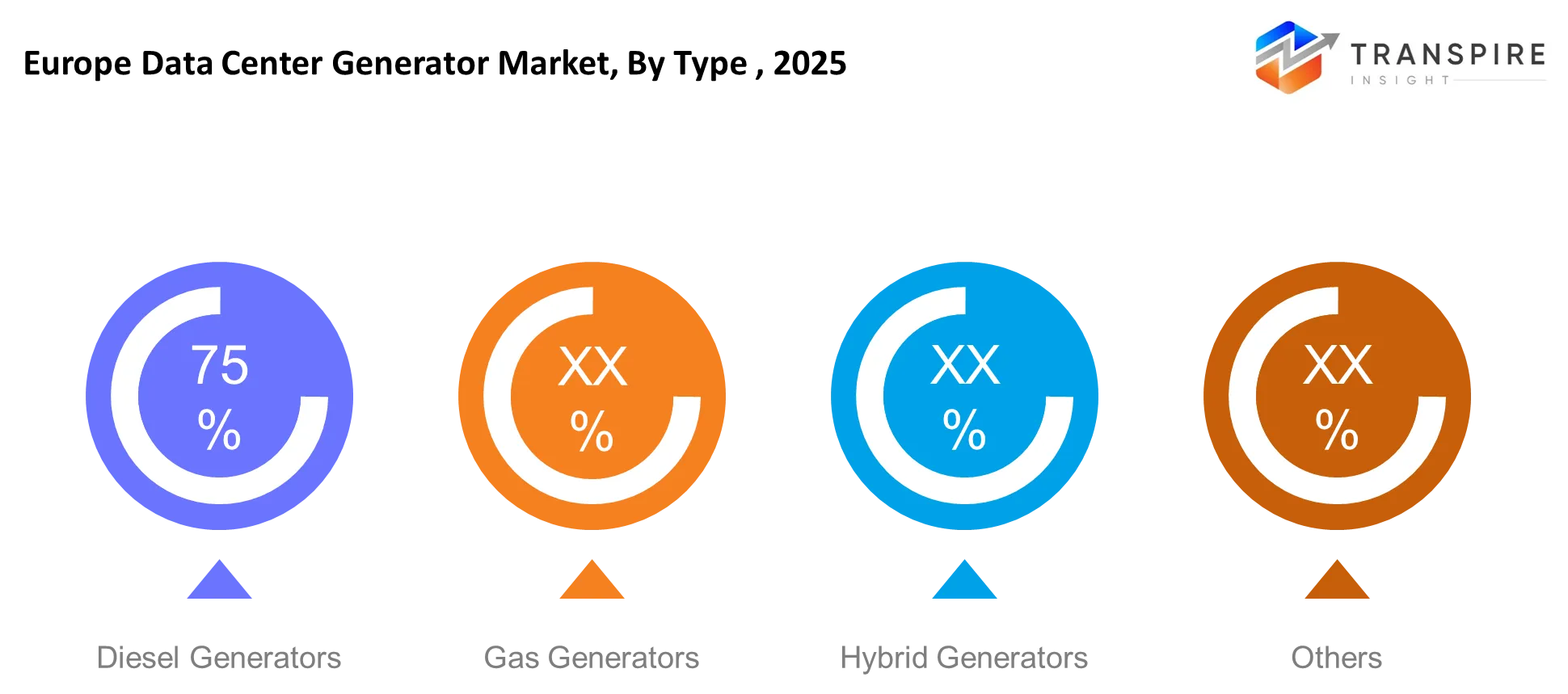
To learn more about this report, Download Free Sample Report
By Application
The primary application of hyperscale data centers serves as the main technology requirement for cloud service providers and artificial intelligence infrastructure operators who need constant access to their backup power systems. The rise of AI workloads has driven higher rack density requirements which in turn created a need for backup power systems that provide extended operational capabilities. The second major application area for colocation facilities occurs because companies choose to use third-party operators who provide guaranteed system uptime to manage their digital assets.
The healthcare manufacturing and public sector industries create persistent requirements for enterprise data center services because these sectors need dedicated facilities to meet compliance and security mandates. Telecom companies are expanding their low-latency infrastructure for 5G networks which makes edge computing sites a crucial growth opportunity in the industry. The upcoming investments will focus on establishing distributed backup systems and developing smart energy management solutions and creating modular systems that can be deployed quickly throughout secondary cities in Europe.
By End-User
The end-user market remains under the control of IT companies which operate data centers throughout Western and Northern Europe together with cloud computing companies and software companies and digital platform operators. Hyperscale technology companies have increased their purchasing activities due to enterprises expanding their cloud services and investing in artificial intelligence processing. The fastest-growing end-user segment consists of telecom companies which need localized backup power for their 5G-enabled edge infrastructure deployment.
The BFSI sector preserves its market strength because financial institutions need to maintain continuous transaction processing while they meet disaster recovery requirements and regulatory compliance standards. Government agencies and healthcare organizations also contribute stable procurement demand due to growing cybersecurity and digital records requirements. The upcoming market expansion will increasingly rely on organizations that establish permanent service agreements together with predictive maintenance alliances and monitoring system integration. Buyers now focus more on backup power supplier selection after they complete their assessment of lifecycle reliability and fuel flexibility and automated compliance reporting.
By Capacity
Generators above 2MW hold the largest capacity share because hyperscale campuses and large colocation hubs require centralized backup systems which can sustain their dense computing operations during extended power interruptions. Major facilities in Frankfurt and London and Dublin now use multi-megawatt generator arrays because they need to meet increasing power redundancy requirements. The 1–2MW category remains important for mid-sized enterprise facilities and regional colocation centers which need to balance their performance requirements with their installation cost requirements.
Systems below 1MW continue to provide support for smaller enterprise sites and edge data centers and telecom infrastructure which needs to achieve space efficiency through quick deployment. The demand for advanced backup systems which can synchronize multiple loads and sustain AI-driven facilities has changed because of new usage patterns. Manufacturers are creating modular high-capacity systems which include digital controls and fuel optimization capabilities. Investors are also directing capital toward scalable infrastructure platforms which can support future expansion without needing to redesign their systems or interrupt their operations.
What are the Key Use Cases Driving the Europe Data Center Generator Market?
The primary application of backup generator systems exists in hyperscale and colocation facilities because cloud platforms and AI processing centers and financial networks require complete power availability without any interruptions. Frankfurt London and Dublin multiple campuses operate their essential services through their multi-megawatt backup systems which protect against power outages and scheduled maintenance activities.
Telecom operators and enterprise facilities are increasing their use of 5G technology because edge computing requires them to have more localized power systems that can withstand outages. Healthcare providers and BFSI institutions are also investing in digitally monitored generator systems to support critical operations disaster recovery infrastructure and regulatory compliance obligations.
AI centers require modular data centers while investors build renewable energy systems which use battery storage with hydrotreated vegetable oil compatible generators as backup power solutions. Nordic countries currently serve as experimental sites where testing of low-emission backup ecosystems occurs which support carbon-conscious hyperscale developments and distributed edge infrastructure.
|
Report Metrics |
Details |
|
Market size value in 2025 |
USD 1562.01 Million |
|
Market size value in 2026 |
USD 1663.51 Million |
|
Revenue forecast in 2033 |
USD 2688.57 Million |
|
Growth rate |
CAGR of 7.10% from 2026 to 2033 |
|
Base year |
2025 |
|
Historical data |
2021 - 2024 |
|
Forecast period |
2026 - 2033 |
|
Report coverage |
Revenue forecast, competitive landscape, growth factors, and trends |
|
Regional scope |
Europe (Germany, United Kingdom, France, Italy, Spain and Rest of Europe) |
|
Key company profiled |
Caterpillar, Cummins, Rolls-Royce, Kohler, Mitsubishi Heavy Industries, Generac, MTU Onsite Energy, Atlas Copco, Himoinsa, Yanmar, FG Wilson, Perkins, Doosan, Wärtsilä, Kirloskar |
|
Customization scope |
Free report customization (country, regional & segment scope). Avail customized purchase options to meet your exact research needs. |
|
Report Segmentation |
By Type (Diesel Generators, Gas Generators, Hybrid Generators, Others), By Application (Hyperscale Data Centers, Colocation, Enterprise Data Centers, Others), By End-User (IT Companies, Telecom Companies, BFSI, Others), By Capacity (Below 1MW, 1–2MW, Above 2MW, Others) |
Which Regions are Driving the Europe Data Center Generator Market Growth?
The market is most advanced in Western Europe because its countries Germany, the United Kingdom, Ireland, and the Netherlands host the largest number of hyperscale and colocation data centers. Global cloud providers and AI infrastructure operators continue to establish their operations at this location because of its effective digital policies, advanced power distribution systems, and extensive fiber optic networks. The established carrier networks in Frankfurt, London, and Dublin function as vital connection points because these networks support extensive enterprise cloud service transitions. Organizations continuously invest in advanced backup power systems and hybrid generator integration and predictive monitoring technologies because they must meet strict uptime standards and emissions compliance regulations.
The Northern Europe region represents the second largest market, but its market operations differ from Western Europe because energy efficiency and renewable energy procurement methods, which require less infrastructure than traditional methods, define purchasing patterns. The data centers in Sweden, Finland, and Denmark operate on lower costs because of their stable economies and access to renewable energy and their ability to maintain cooler temperatures. The regional governments have established permanent environmental regulations which create a stable investment environment that hyperscale developers and colocation operators can use to plan their investments. The stable market conditions have developed a trustworthy business environment for companies that provide low-emission generators and battery-supported backup systems and environmentally-friendly power systems which support digital growth.
The governments and telecom operators in Southern and Eastern Europe are driving digital infrastructure modernization efforts which have resulted in the fastest market growth for these regions. Countries such as Spain, Poland, and Italy have expanded investments in edge computing facilities, regional cloud infrastructure.
Who are the Key Players in the Europe Data Center Generator Market and How Do They Compete?
The Market for Europe Data Center Generators displays a moderately consolidated competitive framework because global power equipment OEMs lead the market while regional integrators provide additional support. Incumbent companies use their engineering expertise and extensive service networks to maintain their market position, whereas new market entrants concentrate on developing hybrid systems and low-emission technologies. The current competitive environment requires companies to demonstrate emissions compliance through their digital monitoring abilities and their capacity to provide ongoing service support.
Cummins enhances its market presence through HVO-compatible generator systems and unified digital monitoring solutions which boost operational effectiveness for hyperscale data centers. Caterpillar designs its backup systems to provide high reliability while maintaining a worldwide service network and using predictive diagnostics technology. The two companies extend their presence in Europe through maintenance contracts and collaborations with colocation operators, who require both guaranteed uptime and effective service delivery methods that function efficiently throughout their global operations.
Rolls-Royce MTU division develops gas and dual-fuel generator systems which provide data centers with reliable power while producing lower emissions throughout European urban areas. Atlas Copco establishes its unique identity through its mobile and modular power systems, which enable quick installation for edge data centers. Mitsubishi Heavy Industries concentrates on developing high-capacity gas turbines, while forming new partnerships with European utilities and infrastructure providers who wish to construct large-scale AI-based data entry centers.
Company List
- Caterpillar
- Cummins
- Rolls-Royce
- Kohler
- Mitsubishi Heavy Industries
- Generac
- MTU Onsite Energy
- Atlas Copco
- Himoinsa
- Yanmar
- FG Wilson
- Perkins
- Doosan
- Wärtsilä
- Kirloskar
Recent Development News
In May 2026, ABB invests $200M to expand European power equipment production amid data center boom: ABB announced a major €200M investment to expand medium-voltage grid equipment production across Europe. The move directly targets rising electricity demand from AI and data centers, strengthening power infrastructure resilience across multiple EU countries.
Source: https://www.reuters.com
In May 2026, Stellanor acquires eight UK data centers in £123M deal: Stellanor significantly increased its European footprint by acquiring eight data centers from Redcentric, boosting its capacity and grid-connected infrastructure. The expansion strengthens its position in high-density colocation and AI-focused workloads.
Source: https://www.itpro.com
What Strategic Insights Define the Future of the Europe Data Center Generator Market?
The Europe Data Center Generator Market is currently developing integrated low-emission digitally controlled backup power systems that replace traditional backup generator systems. The market experiences growth because of two factors which include hyperscale AI infrastructure development and the European Union implementation of decarbonization regulations that require operators to use flexible fuel systems together with hybrid energy storage and performance tracking. The industry now moves towards permanent energy resilience solutions which will replace its existing business model that focuses on equipment sales.
A less visible risk emerges from accelerating substitution by large-scale battery energy storage systems in short-duration backup scenarios. Mid-tier and edge applications will decrease their use of conventional generators because lithium-ion batteries and solid-state storage technologies become more advanced. The supply chain needs specialized engine components and alternator materials which creates a risk because these components become more expensive.
Data centers in Nordic and Baltic regions which focus on AI research present a new business opportunity for companies because the renewable-heavy energy systems create demand for hybrid generator-battery systems that produce extremely low emissions. Companies that establish early relationships with these initiatives will achieve lasting competitive benefits.
The market requires participants to focus on modular hybrid systems which need predictive maintenance software because these elements will generate consistent revenue streams while maintaining market share against stricter energy transition regulations.
Europe Data Center Generator Market Report Segmentation
By Type
- Diesel Generators
- Gas Generators
- Hybrid Generators
- Others
By Application
- Hyperscale Data Centers
- Colocation
- Enterprise Data Centers
- Others
By End-User
- IT Companies
- Telecom Companies
- BFSI
- Others
By Capacity
- Below 1MW
- 1–2MW
- Above 2MW
- Others
Frequently Asked Questions
Find quick answers to common questions.
The Approximate Europe Data Center Generator Market size for the market will be USD 2688.57 Million in 2033.
The key Segments of the Europe Data Center Generator Market are By Type (Diesel Generators, Gas Generators, Hybrid Generators, Others), By Application (Hyperscale Data Centers, Colocation, Enterprise Data Centers, Others), By End-User (IT Companies, Telecom Companies, BFSI, Others), By Capacity (Below 1MW, 1–2MW, Above 2MW, Others).
Major Players in the Europe Data Center Generator Market are Caterpillar, Cummins, Rolls-Royce, Kohler, Mitsubishi Heavy Industries, Generac, MTU Onsite Energy, Atlas Copco, Himoinsa, Yanmar, FG Wilson, Perkins, Doosan, Wärtsilä, Kirloskar.
The Current Market size of the Europe Data Center Generator Market is USD 1562.01 Million in 2025.
The Europe Data Center Generator Market CAGR is 7.10%.
- Caterpillar
- Cummins
- Rolls-Royce
- Kohler
- Mitsubishi Heavy Industries
- Generac
- MTU Onsite Energy
- Atlas Copco
- Himoinsa
- Yanmar
- FG Wilson
- Perkins
- Doosan
- Wärtsilä
- Kirloskar
Recently Published Reports
-
Apr 2026
Active Power Filter Market
Active Power Filter Market Size, Share & Analysis Report By Type (Shunt Active Power Filters, Series Active Power Filter, Hybrid Active Power Filter), By Application (Harmonics Mitigation, Reactive Power Compensation, Voltage Regulation, Power Factor Correction), By Phase (Single Phase, Three Phase), By End-User Industry (Manufacturing, Healthcare, Commercial, Automotive, Oil and Gas, Others), and Geography (North America, Europe, Asia-Pacific, Middle East and Africa, South and Central America), 2021 - 2031
-
Apr 2026
Electrical Transformer Market
Electrical Transformer Market Size, Share & Analysis Report By Core (Closed, Shell, and Berry), By Insulation (Gas, Oil, Solid, Air, and Other), By Phase (Single, and Three), By Rating (100 MVA to 500 MVA, 501 MVA to 800 MVA, and 801 MVA to 1200 MVA), and Geography (North America, Europe, Asia-Pacific, Middle East and Africa, South and Central America), 2021 – 2031
-
Apr 2026
Hydraulic Piston Pumps Market
Hydraulic Piston Pumps Market Size, Share & Analysis Report By Type (Axial Piston Pumps, Radial Piston Pumps), By Operating Pressure (Low Pressure, Medium Pressure, High Pressure), By Application (Construction, Mining, Agriculture, Automotive, Oil & Gas, Industrial Machinery, Others), By End-User (OEMs, Aftermarket), and Geography (North America, Europe, Asia-Pacific, Middle East and Africa, South and Central America), 2021 – 2031
-
Apr 2026
Laboratory Gas Generators Market
Laboratory Gas Generators Market Size, Share & Analysis Report By Product (Nitrogen Gas Generator, Hydrogen Gas Generator, Zero Air Gas Generator, Purge Gas Generator, TOC Gas Generators, Others), By Application (Gas Chromatography, Liquid Chromatography-mass Spectrometry (LC-MS), Gas Analyzers, Others), By End-user (Life Science, Chemical & Petrochemical, Food & Beverage, Others), and Geography (North America, Europe, Asia-Pacific, Middle East and Africa, South and Central America), 2021 – 2031