
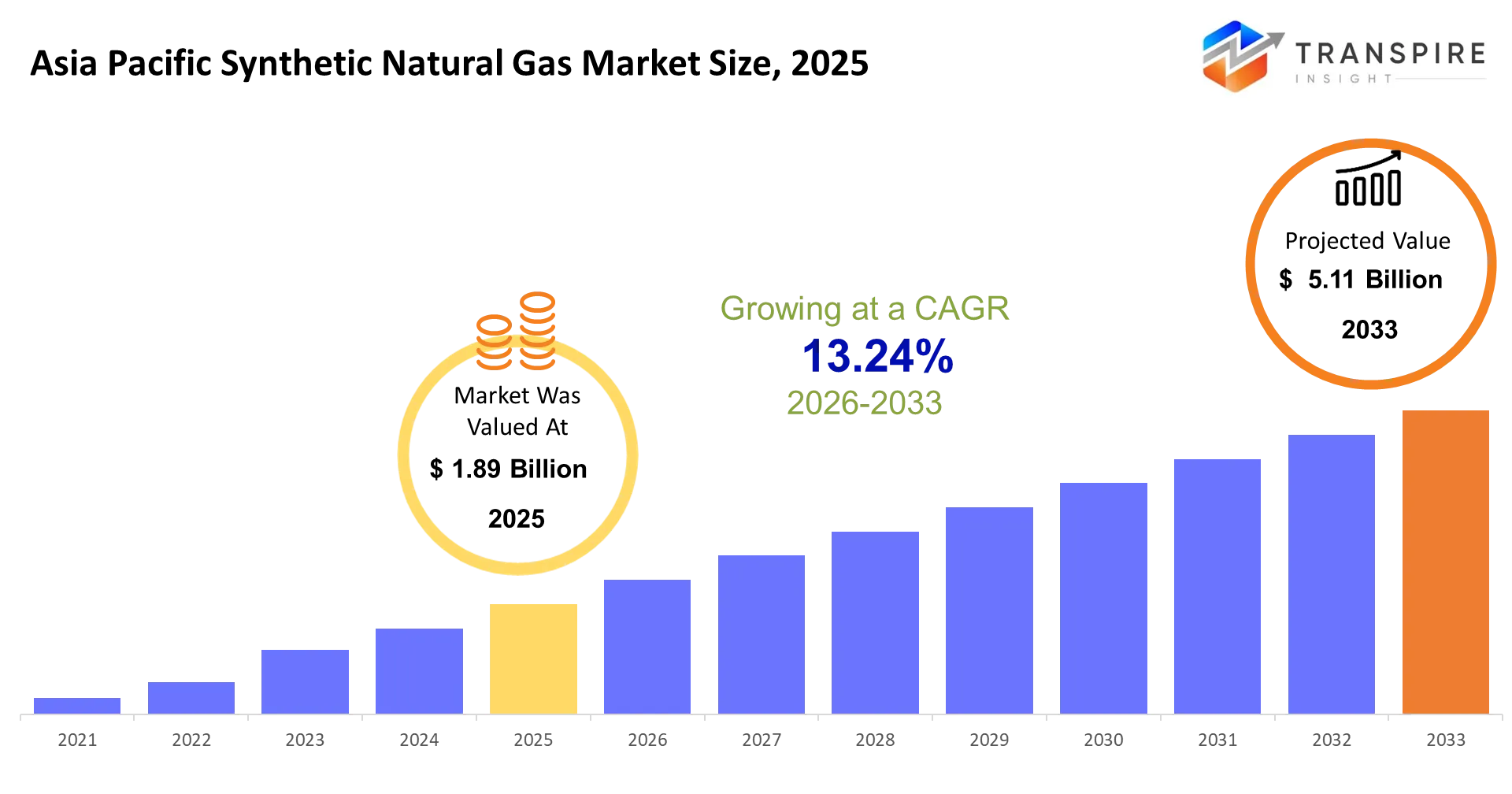
Asia Pacific Synthetic Natural Gas Market Size & Forecast:
- Asia Pacific Synthetic Natural Gas Market Size 2025: USD 1.89 Billion
- Asia Pacific Synthetic Natural Gas Market Size 2033: USD 5.11 Billion
- Asia Pacific Synthetic Natural Gas Market CAGR: 13.24%
- Asia Pacific Synthetic Natural Gas Market Segments: By Type (Coal-based SNG, Biomass-based SNG, Power-to-Gas SNG, Others); By Application (Power Generation, Industrial Fuel, Residential Heating, Transportation, Others); By End-User (Energy Companies, Industrial Firms, Utilities, Government, Others); By Technology (Gasification, Methanation, Catalytic Conversion, Others)
To learn more about this report,  Download Free Sample Report
Asia Pacific Synthetic Natural Gas Market Summary
The Asia Pacific Synthetic Natural Gas Market was valued at USD 1.89 Billion in 2025. It is forecast to reach USD 5.11 Billion by 2033. That is a CAGR of 13.24% over the period.
The Asia Pacific synthetic natural gas market provides utilities and industrial manufacturers and gas grid operators with a low-carbon energy solution that they can use through existing pipeline and storage systems without needing to spend money on hydrogen or complete electrification system changes. The solution enables heavy industries to achieve decarbonization for their operations that require high temperatures while they maintain dependable fuel sources. The market has developed from pilot projects to infrastructure deployment during the past five years because local governments now recognize renewable and low-carbon gases as essential grid assets instead of temporary solutions.
The introduction of carbon pricing in Japan and the implementation of gas allocation reforms across major Asian countries have driven this transformation. Geopolitical disruptions to LNG trade together with supply shortages demonstrated the dangers of relying on imports which resulted in policymakers choosing to support domestic synthetic gas production methods. The project economics have improved which has led to utility offtake agreements and created a shift from grant-based revenue development to commercial supply contract models.
Key Market Insights
- The Synthetic Natural Gas Market in Asia Pacific reaches its highest market share through East Asia which controls approximately 48% of the market in 2025 because Japan, South Korea and China maintain their strong policy support for the industry.
- The Southeast Asian market develops at the fastest pace until 2032 because industrial decarbonization initiatives advance in Thailand and Indonesia and Singapore.
- The Asia Pacific Synthetic Natural Gas Market expands through strategic gas infrastructure improvements which help import-dependent countries build supply security.
- Coal-to-SNG remains the leading production segment, contributing approximately 42% of industry size in 2025 due to established production assets in China.
- Biomass-derived synthetic gas represents the second-largest market share, supported by renewable fuel integration targets and government-backed waste-to-energy initiatives.
- The period from 2023 until 2032 will see power-to-gas technology experience its most rapid growth because of decreasing electrolyzer prices and increasing renewable electricity production.
- In 2025 industrial heating will control almost 46% of the market because manufacturers use synthetic gas to reduce emissions while keeping their existing combustion equipment.
- The national gas blending requirements together with low-carbon energy transition plans create the strongest demand for grid injection applications.
- The Asia Pacific Synthetic Natural Gas Market sees approximately 39% of its demand from utilities which operate compatible infrastructure at a large scale.
- Decarbonization compliance requirements which extend until 2030 drive rapid growth in chemicals and heavy manufacturing as the main user groups.
What are the Key Drivers, Restraints, and Opportunities in the Asia Pacific Synthetic Natural Gas Market?
The region experiences its strongest market growth for synthetic natural gas because of two factors which include carbon compliance framework restrictions and rising energy security requirements. Japanese and South Korean governments together with specific Chinese regions have implemented more rigorous industrial emissions regulations while they support the development of low-carbon gas transmission systems. The shift started to gain traction after LNG price fluctuations together with supply interruptions demonstrated the financial risks associated with importing LNG. Utilities and industrial operators increase their investment in synthetic natural gas because it enables them to achieve carbon reduction goals without needing to replace their existing gas distribution systems. The technology enables faster system implementation because it works with existing systems which enables quicker business agreements that boost project financial performance.
The market faces its greatest actual market obstacle through its existing high production expenses. The process of manufacturing synthetic natural gas needs expensive methanation technology together with large electrolyzer systems and dependable renewable energy sources. The system requirements need extended infrastructure development together with electrical grid upgrades which make it impossible to resolve them immediately. The inconsistent pricing of renewable energy in various Asia Pacific markets creates economic challenges for projects. The cost imbalance creates two negative impacts on the project center which leads to investment decision delays and restricts short-term income generation by preventing businesses from expanding their operations.
The most obvious potential for expansion exists through the development of power-to-gas integration facilities which are currently being developed in Northeast Asia. The investment programs that Japan establishes for hydrogen and synthetic fuel development will create conditions which enable commercial-scale deployment. The combination of offshore wind energy production with methanation technology will enable the establishment of regional synthetic gas distribution networks which will unlock long-term utility procurement agreements and create new market revenue generation opportunities.
What Has the Impact of Artificial Intelligence Been on the Asia Pacific Synthetic Natural Gas Market?
Artificial intelligence and advanced digital systems are increasingly improving how synthetic gas facilities across Asia Pacific manage production efficiency, plant reliability, and carbon performance. The operators use AI-enabled control platforms to create automated systems that monitor methanation reactors and balance gas composition and regulate feedstock flow in real time. The systems process sensor data from pressure and temperature and catalyst performance metrics to create automatic corrections which maintain output quality while decreasing process variations. Digital optimization tools have increased conversion efficiency by 5 to 10 percent through their application in numerous pilot-scale power-to-gas projects because they decrease unplanned process disruptions.
Machine learning models are also strengthening predictive capabilities across synthetic fuel infrastructure. The utilities apply predictive maintenance algorithms to detect early indicators of electrolyzer degradation and catalyst deactivation and compressor wear before actual system failures happen. The system has enabled organizations to extend equipment uptime and reduce maintenance expenses because it allows them to plan operational interventions instead of needing to respond to equipment failures. AI-driven forecasting models are also improving renewable electricity input scheduling, allowing producers to better align synthetic gas generation with low-cost power availability and reducing operating expenses.
The main limitation remains integration complexity. Many regional facilities operate on legacy industrial control systems that were not designed for AI-based optimization. The process of retrofitting these plants needs extensive financial resources because the operational datasets from commercial-scale synthetic gas projects are insufficient to achieve model accuracy during real-world production fluctuations.
Key Market Trends
- The Japanese and South Korean utilities stopped conducting feasibility studies in 2022 to begin their planning process for synthetic gas procurement throughout their national carbon neutrality programs.
- China has moved its focus from developing coal-based synthetic gas to implementing hybrid renewable methanation projects since carbon intensity regulations became stricter in 2023.
- Power developers who specialize in renewable energy established more partnerships with Mitsubishi Heavy Industries and Tokyo Gas during the time period between 2023 and 2025 to develop commercial applications for power-to-gas technology.
- The LNG price shocks which occurred in 2022 and 2023 forced industrial customers to establish new fuel procurement methods which resulted in an unanticipated increase in synthetic gas contract negotiations throughout Northeast Asia.
- The costs for electrolyzers experienced a decline of almost 18 percent between 2021 and 2025 which made renewable methanation pathways more feasible for utility-scale project developers.
- The regulatory bodies of Singapore and Japan started to support grid-integration incentives from 2024 onward to promote faster pipeline compatibility testing after they abandoned their previous funding model for isolated demonstration projects.
- Companies that purchase synthetic gas now consider infrastructure compatibility to be more important than using hydrogen directly because this enables them to decrease retrofit expenses by 30 percent for their existing gas systems.
- Air Liquide and ENGIE have formed strategic partnerships which now emphasize transferring technology between countries instead of constructing individual production facilities.
- The standard implementation of digital optimization platforms in pilot facilities since 2024 has enabled methanation systems to achieve better conversion stability while decreasing operational downtime.
Asia Pacific Synthetic Natural Gas Market Segmentation
By Type :
The Asia Pacific Synthetic Natural Gas Market demonstrates strong demand for Coal-based SNG because China and India possess substantial coal reserves. The process of coal gasification delivers continuous production of gas which meets both energy requirements and industrial demands while decreasing the need for imported natural gas.
The cleaner energy objectives drive increased interest in biomass-based SNG and power-to-gas SNG systems. The power-to-gas system generates energy from hydrogen and carbon dioxide while biomass converts organic waste into fuel.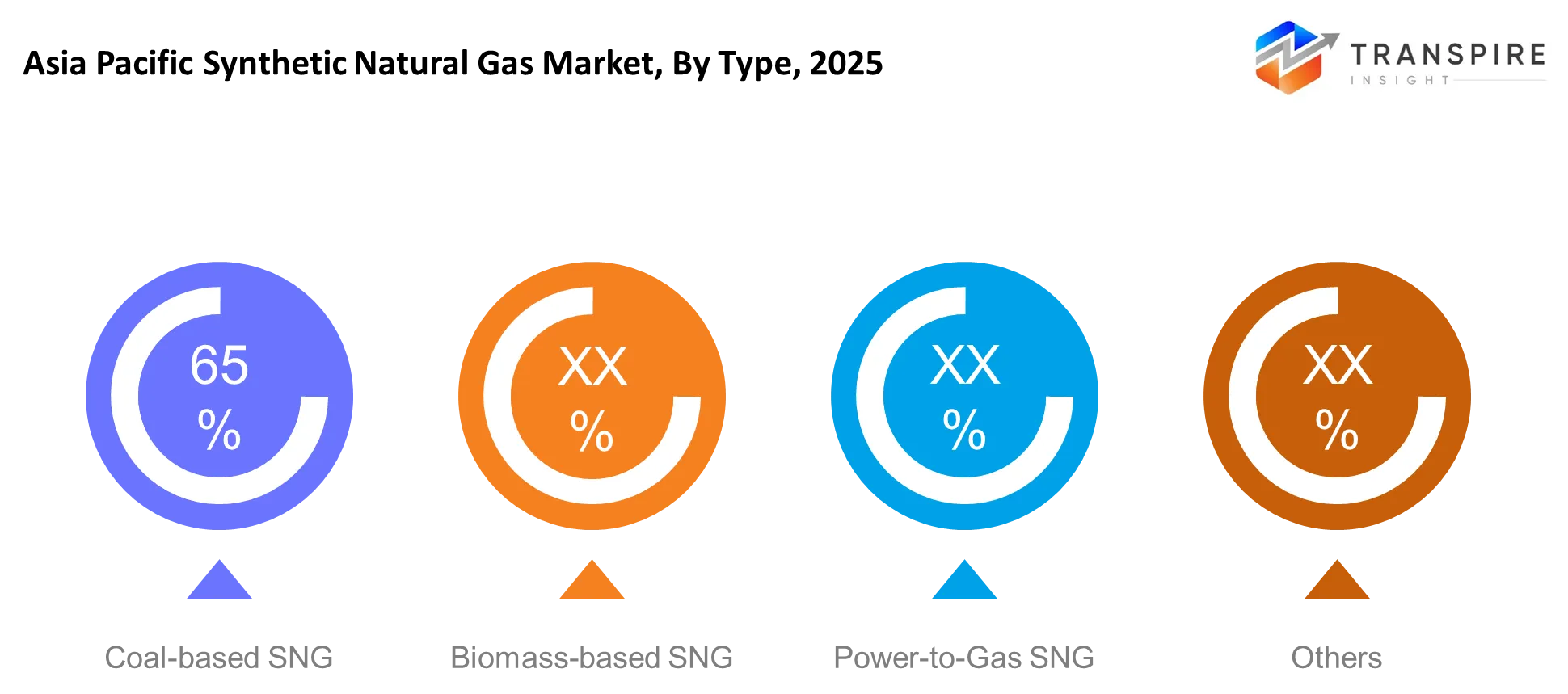
To learn more about this report, Download Free Sample Report
By Application :
Electricity generation together with industrial fuel use represents the principal purposes of synthetic natural gas within the Asia Pacific Synthetic Natural Gas Market. SNG provides electricity generation facilities and major industrial operations with dependable fuel supply. The system helps to decrease demand on standard natural gas delivery infrastructure.
The rate of SNG adoption for residential heating purposes and transportation applications continues to increase. SNG serves as a power source for backup energy systems and chemical manufacturing processes. The region needs other applications to maintain energy balance during times of peak demand in developing and industrial economies.
By End-User :
Energy companies together with utilities establish the primary foundation for synthetic natural gas infrastructure development. SNG plants receive investment which enhances energy security for Asia Pacific markets that experience unpredictable gas demand during their urban and industrial growth periods.
SNG technologies achieve wider use because of support from industrial companies and government initiatives. Industrial users need consistent fuel sources while governments work to advance cleaner energy options. Research organizations and specialized operators who study energy transition together with fuel diversification form another category of end-users.
By Technology :
The Asia Pacific Synthetic Natural Gas Market uses gasification as its main technological foundation. The process converts coal and biomass materials into syngas which serves as the basis for manufacturing fuels on an industrial scale. The method enjoys widespread use because of its resource accessibility and existing system setup.
The process of methanation together with catalytic conversion transforms syngas into methane through a quality enhancement method. The technologies enable better operational performance while decreasing harmful gas emissions. Advanced energy projects throughout the region experience rising adoption of clean production techniques for energy generation.
What are the Key Use Cases Driving the Asia Pacific Synthetic Natural Gas Market?
The primary application of synthetic natural gas in the Asia Pacific region serves industrial heat production needs within steel manufacturing and chemical processing and refining operations. The industries depend on uninterrupted operation at extreme temperatures which makes synthetic gas their preferred solution because it can be used with their existing combustion systems without needing expensive system upgrades and it helps them meet stricter carbon emission standards.
New applications are developing for both utility-scale gas blending and distributed power generation systems. Japanese and South Korean regional utilities are using low-carbon synthetic gas for transmission network injections which help stabilize power supply while large manufacturing facilities operate their private power systems which minimize their LNG import price exposure.
The marine fuel applications of synthetic gas use it as a bunkering fuel for short-sea shipping and as a seasonal energy storage solution that connects to offshore wind projects. The two applications exist as early-stage projects because current maritime emissions rules and power-to-gas infrastructure investments create conditions that will enable future commercial deployment during the forecast period.
|
Report Metrics |
Details |
|
Market size value in 2025 |
USD 1.89 Billion |
|
Market size value in 2026 |
USD 2.14 Billion |
|
Revenue forecast in 2033 |
USD 5.11 Billion |
|
Growth rate |
CAGR of 13.24% from 2026 to 2033 |
|
Base year |
2025 |
|
Historical data |
2021 - 2024 |
|
Forecast period |
2026 - 2033 |
|
Report coverage |
Revenue forecast, competitive landscape, growth factors, and trends |
|
Regional scope |
Asia Pacific (India, China, Japan, Australia,South Korea, Rest of Asia Pacific) |
|
Key company profiled |
Air Liquide, Linde, Siemens Energy, Shell, ExxonMobil, BP, Sasol, Mitsubishi Heavy Industries, Thyssenkrupp, Haldor Topsoe, Honeywell UOP, GE, Air Products, McPhy, Johnson Matthey |
|
Customization scope |
Free report customization (country, regional & segment scope). Avail customized purchase options to meet your exact research needs. |
|
Report Segmentation |
By Type (Coal-based SNG, Biomass-based SNG, Power-to-Gas SNG, Others); By Application (Power Generation, Industrial Fuel, Residential Heating, Transportation, Others); By End-User (Energy Companies, Industrial Firms, Utilities, Government, Others); By Technology (Gasification, Methanation, Catalytic Conversion, Others) |
Which Regions are Driving the Asia Pacific Synthetic Natural Gas Market Growth?
The Asia Pacific synthetic natural gas market maintains its highest level of activity in East Asia because the region partners its strong industrial energy requirements with advanced gas distribution systems and its commitment to aggressive decarbonization regulations. Japan South Korea and China have created national hydrogen and synthetic fuel roadmaps which establish regulatory frameworks that enable low-carbon gas integration.The leadership receives support from well-established pipeline systems and active participation from large power companies and engineering expertise that Tokyo Gas and Sinopec bring to the table. The region also benefits from ongoing public and private funding which links renewable energy projects with commercial synthetic gas development.
Southeast Asia contributes different economic value because it depends less on government regulations and more on its ability to sustain economic growth through efficient energy diversification methods. Singapore, Thailand, and Malaysia have added synthetic gas into their industrial modernization programs instead of using it as an independent method for reducing carbon emissions. The controlled method has established consistent demand from electric utilities and manufacturing companies that export goods and need to maintain fuel options and supply reliability. Southeast Asia provides a more predictable business atmosphere because its infrastructure development plans and financial management practices follow established procedures while East Asia pushes for rapid expansion through government initiatives.
Oceania is becoming the fastest-growing regional market because of its increasing renewable energy development and growing interest in power-to-gas conversion projects. The region advanced from testing stage to commercial viability because of Australia’s recent investments in large electrolyzer systems and synthetic fuel demonstration projects. The increased use of synthetic gas technology in mining and heavy manufacturing industries results from fleet modernization efforts and stricter industrial emissions regulations. The period from 2026 to 2033 offers market entrants and investors a strategic opportunity to build production partnerships and establish their presence in the emerging export-focused synthetic gas market.
Who are the Key Players in the Asia Pacific Synthetic Natural Gas Market and How Do They Compete?
The Asia Pacific synthetic natural gas market displays moderate competition because companies need to develop their technological capabilities and their project execution abilities and their long-term utility relationships to compete with each other. The existing industrial gas and engineering companies maintain a competitive edge because synthetic gas deployment requires specialized knowledge in methanation system operation and electrolyzer system integration and infrastructure system compatibility. The existing market players use demonstration-scale commercialization to protect their existing market presence while emerging renewable energy companies enter the market through power-to-gas alliances. The main competition aspect between companies shows their ability to deliver dependable technology that works with existing local infrastructure.
**Mitsubishi Heavy Industries** competes through advanced methanation engineering and system integration for utility-scale projects. The company holds a technological advantage in Japan’s regulated energy transition market because it operates a system that combines carbon capture technology with synthetic fuel production. The company continues expanding through collaborations with domestic utilities and hydrogen ecosystem developers.
**Air Liquide** differentiates itself through process optimization expertise and industrial-scale gas handling infrastructure. The company uses its modular synthetic gas systems to provide industrial customers with simpler deployment options. The company expands its presence in Northeast Asia through strategic partnerships that extend its operational capacity.
Company List
- Air Liquide
- Linde
- Siemens Energy
- Shell
- ExxonMobil
- BP
- Sasol
- Mitsubishi Heavy Industries
- Thyssenkrupp
- Haldor Topsoe
- Honeywell UOP
- GE
- Air Products
- McPhy
- Johnson Matthey
Recent Development News
In October 2025, NTPC Limited formed a partnership with Engineers India Limited to construct a coal-to-synthetic natural gas facility in India. The collaboration aims to convert high-ash domestic coal into cleaner synthetic gas to support power generation and industrial fuel demand, advancing India’s coal gasification-based energy transition.
Source https://www.ntpc.co.in/
In January 2026, NTPC Limited revealed its intention to spend around ₹10,000 crore on a coal-to-synthetic natural gas facility which will operate in Chhattisgarh with an annual output capacity of 5 lakh tonnes. The project will implement coal gasification technologies to create domestic fuel security by using its own coal resources while decreasing the need for imported gas. Source https://www.business-standard.com/
What Strategic Insights Define the Future of the Asia Pacific Synthetic Natural Gas Market?
The Asia Pacific synthetic natural gas market will start connecting its gas networks to utility-scale systems between 2023 and 2025 instead of staying limited to its testing facilities. The decarbonization requirement of industrial operations combined with energy security needs. The market will transition from testing its technology to establishing permanent supply agreements which will become operational in Northeast Asia. The less perceptible danger to business operations exists because organizations select new technological solutions to replace existing systems.
The development of hydrogen transportation infrastructure and the decrease in electrification expenses will result in synthetic gas projects losing their current market advantage. The restricted number of engineering companies that dominate essential methanation functionalities creates market concentration risks for businesses. The Australian renewable export corridors which connect to offshore wind projects present a major business opportunity to create synthetic gas trade routes to Japan and South Korea through methanation operations.
The most effective approach for market participants involves obtaining early offtake pacts from utility and industrial sectors which need flexible infrastructure solutions. Businesses that establish customer demand before their production facilities reach full capacity will find it easier to manage technology expense fluctuations while maintaining their profit margins against growing competition.
Asia Pacific Synthetic Natural Gas Market Report Segmentation
By Type
- Coal-based SNG
- Biomass-based SNG
- Power-to-Gas SNG
By Application
- Power Generation
- Industrial Fuel
- Residential Heating
- Transportation
By End-User
- Energy Companies
- Industrial Firms
- Utilities
- Government
By Technology
- Gasification
- Methanation
- Catalytic Conversion
Frequently Asked Questions
Find quick answers to common questions.
The Asia Pacific Synthetic Natural Gas Market size is USD 5.11 Billion in 2033.
Key Segments for the Asia Pacific Synthetic Natural Gas Market are By Type (Coal-based SNG, Biomass-based SNG, Power-to-Gas SNG, Others); By Application (Power Generation, Industrial Fuel, Residential Heating, Transportation, Others); By End-User (Energy Companies, Industrial Firms, Utilities, Government, Others); By Technology (Gasification, Methanation, Catalytic Conversion, Others).
Major Asia Pacific Synthetic Natural Gas Market Players are Air Liquide, Linde, Siemens Energy, Shell, ExxonMobil, BP, Sasol, Mitsubishi Heavy Industries, Thyssenkrupp, Haldor Topsoe, Honeywell UOP, GE, Air Products, McPhy, Johnson Matthey.
The Asia Pacific Synthetic Natural Gas Market size is USD 1.89 Billion in 2025.
The Asia Pacific Synthetic Natural Gas Market CAGR is 13.24% from 2026 to 2033.
- Air Liquide
- Linde
- Siemens Energy
- Shell
- ExxonMobil
- BP
- Sasol
- Mitsubishi Heavy Industries
- Thyssenkrupp
- Haldor Topsoe
- Honeywell UOP
- GE
- Air Products
- McPhy
- Johnson Matthey
Recently Published Reports
-
Apr 2026
Active Power Filter Market
Active Power Filter Market Size, Share & Analysis Report By Type (Shunt Active Power Filters, Series Active Power Filter, Hybrid Active Power Filter), By Application (Harmonics Mitigation, Reactive Power Compensation, Voltage Regulation, Power Factor Correction), By Phase (Single Phase, Three Phase), By End-User Industry (Manufacturing, Healthcare, Commercial, Automotive, Oil and Gas, Others), and Geography (North America, Europe, Asia-Pacific, Middle East and Africa, South and Central America), 2021 - 2031
-
Apr 2026
Electrical Transformer Market
Electrical Transformer Market Size, Share & Analysis Report By Core (Closed, Shell, and Berry), By Insulation (Gas, Oil, Solid, Air, and Other), By Phase (Single, and Three), By Rating (100 MVA to 500 MVA, 501 MVA to 800 MVA, and 801 MVA to 1200 MVA), and Geography (North America, Europe, Asia-Pacific, Middle East and Africa, South and Central America), 2021 – 2031
-
Apr 2026
Hydraulic Piston Pumps Market
Hydraulic Piston Pumps Market Size, Share & Analysis Report By Type (Axial Piston Pumps, Radial Piston Pumps), By Operating Pressure (Low Pressure, Medium Pressure, High Pressure), By Application (Construction, Mining, Agriculture, Automotive, Oil & Gas, Industrial Machinery, Others), By End-User (OEMs, Aftermarket), and Geography (North America, Europe, Asia-Pacific, Middle East and Africa, South and Central America), 2021 – 2031
-
Apr 2026
Laboratory Gas Generators Market
Laboratory Gas Generators Market Size, Share & Analysis Report By Product (Nitrogen Gas Generator, Hydrogen Gas Generator, Zero Air Gas Generator, Purge Gas Generator, TOC Gas Generators, Others), By Application (Gas Chromatography, Liquid Chromatography-mass Spectrometry (LC-MS), Gas Analyzers, Others), By End-user (Life Science, Chemical & Petrochemical, Food & Beverage, Others), and Geography (North America, Europe, Asia-Pacific, Middle East and Africa, South and Central America), 2021 – 2031