
Asia Pacific Shipbuilding Market Size & Forecast:
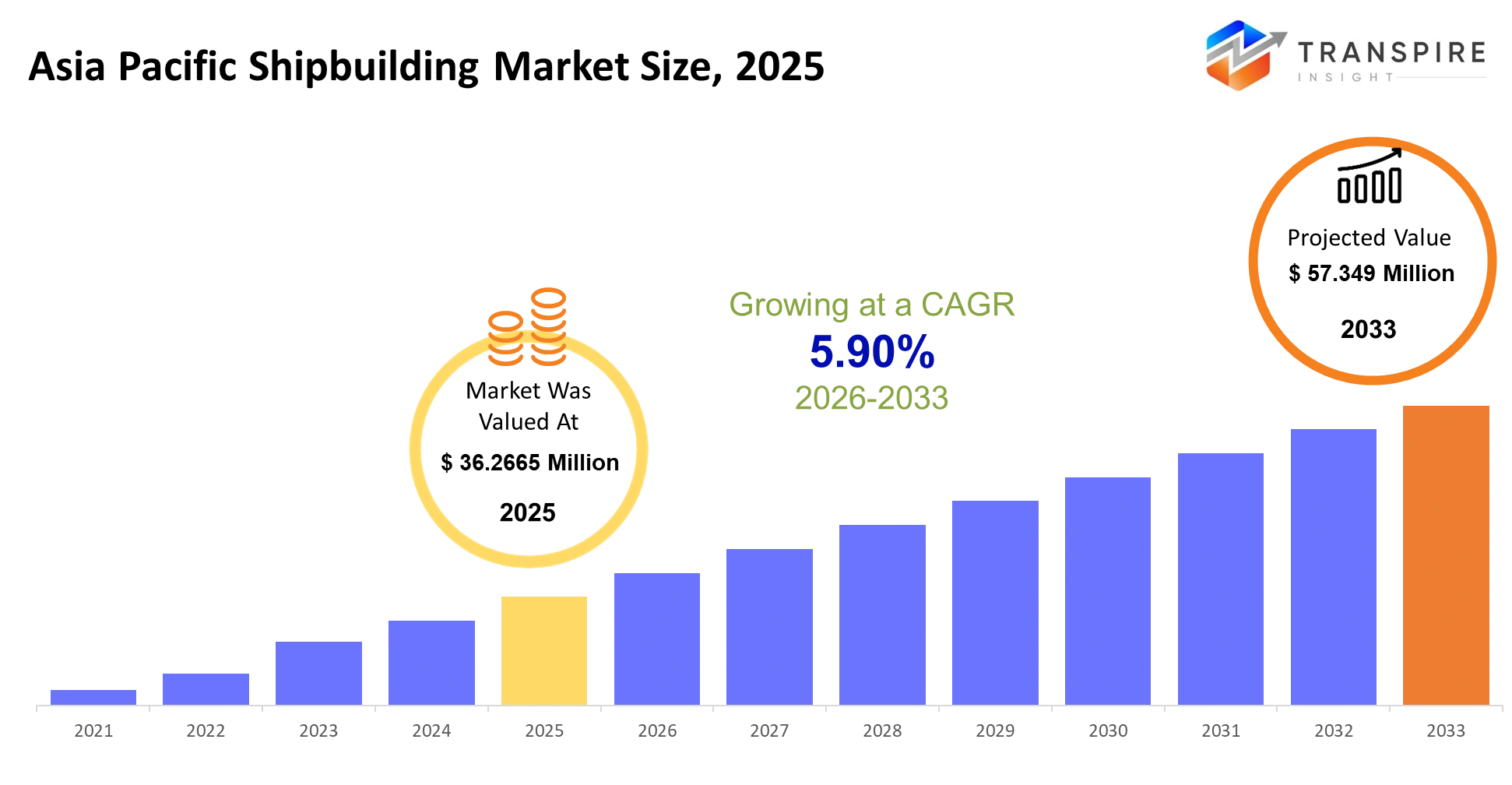
- Asia Pacific Shipbuilding Market Size 2025: USD 36.2665 Million
- Asia Pacific Shipbuilding Market Size 2033: USD 57.349 Million
- Asia Pacific Shipbuilding Market CAGR: 5.90%
- Asia Pacific Shipbuilding Market Segments: By Type (Commercial Ships, Naval Ships, Offshore Vessels, Cargo Ships, Tankers, Others); By Application (Transport, Defense, Energy, Logistics, Fishing, Others); By End-User (Shipowners, Defense, Govt, Offshore Companies, Logistics Firms, Others); By Material (Steel, Aluminum, Composite, Hybrid, Advanced Materials, Others)
To learn more about this report,  Download Free Sample Report
Asia Pacific Shipbuilding Market Summary:
The Asia Pacific Shipbuilding Market size is estimated at USD 36.2665 Million in 2025 and is anticipated to reach USD 57.349 Million by 2033, growing at a CAGR of 5.90% from 2026 to 2033.
The shipbuilding market in the Asia Pacific region will establish a major industrial sector which will specialize in vessel construction and maintenance for commercial and military operations and offshore activities conducted along coastal regions. The shipping industry will require ships which use less fuel and meet digital design standards because their shipping routes will expand and environmental regulations will become more demanding. Automation technologies and smart design tools and cleaner propulsion systems will drive changes in shipyard production processes while enhancing operational accuracy. Producers will need to create products more quickly while meeting higher safety requirements because buyer preferences will evolve. The design process and material selection in the Asia Pacific shipbuilding market will be determined by upcoming emissions regulations and maritime safety changes which will shift operational priorities towards sustainable practices and effective resource management and advanced monitoring technologies.
What Has the Impact of Artificial Intelligence Been on the Asia Pacific Shipbuilding Market?
Artificial intelligence transforms shipbuilding operations in the Asia Pacific region through its ability to create data-based production systems, which increase operational efficiency and decision-making time. The Asia Pacific shipbuilding market uses AI technology to improve market research results by studying real-time data about demand patterns and trade flows and vessel utilization trends. Artificial intelligence in the Asia Pacific shipbuilding market is also strengthening predictive analytics, which enables companies to forecast order patterns and minimize unused capacity in their shipyards.
Smart automation and machine learning are enhancing production efficiency in the Asia Pacific shipbuilding market by streamlining welding operations, design simulation, and quality inspection processes. These systems eliminate human mistakes while accelerating construction processes and maintaining project quality throughout extensive operations.
Asian shipbuilding companies now consider artificial intelligence implementation as an essential element for establishing market leadership through their use of intelligent systems which enhance energy-efficient ship design and lifecycle maintenance methods. Market trends indicate growing demand for digital shipyards that use artificial intelligence to monitor operations via IoT sensor integration. The Asia Pacific shipbuilding market will experience continuous growth because automation, together with machine learning and predictive analytics, will enhance both productivity and industrial growth capacity.
Key Market Trends & Insights:
- East Asia controls 55 to 60% of the Asia Pacific shipbuilding market in 2025 because Chinese and South Korean and Japanese shipyard operations have developed strong capacity.
- The Southeast Asia region is expected to experience the fastest growth in the Asia Pacific shipbuilding market, driven by port investments and trade corridor expansion between 2025 and 2030.
- The Asia Pacific shipbuilding market achieves its highest share from commercial ships which account for almost 40% of the market because global freight movement and fleet replacement cycles drive demand.
- The offshore vessels segment is the second-largest market segment because its growth depends on oil and gas and renewable offshore energy development across coastal regions.
- The naval ships segment leads the Asia Pacific shipbuilding market through its expansion, which results from defense budget increases and security modernization efforts between 2024 and 2030.
- The Asia Pacific shipbuilding market sees its highest market share in transport logistics applications which account for approximately 45 percent of the market because maritime trade plays a crucial role in its operations.
- The expansion of offshore wind and LNG transport operations drives the energy-related shipping applications forward as the sector experiences its fastest development.
- The shipowners segment maintains the highest market share among end users because they need to expand their fleet through new acquisitions and existing fleet replacements.
- The Asia Pacific shipbuilding market sees its highest growth rate through offshore companies who drive demand for deep-sea exploration activities.
- The Asia Pacific shipbuilding market achieves greater efficiency through ongoing shipyard automation upgrades which drive continuous innovation.
Asia Pacific Shipbuilding Market Segmentation
By Type:
The Asia Pacific Shipbuilding Market breaks down into segments which include commercial ships, naval ships, offshore vessels, cargo ships and tankers and additional categories. Commercial ships will support trade expansion through their operational functions while naval ships will focus on defense upgrades across coastal nations.
Offshore vessels will support energy exploration activities. The Asian Pacific Shipbuilding Market will experience continuous growth because shipping demand across international routes and energy transportation needs will drive demand for more efficient and long-lasting ship designs.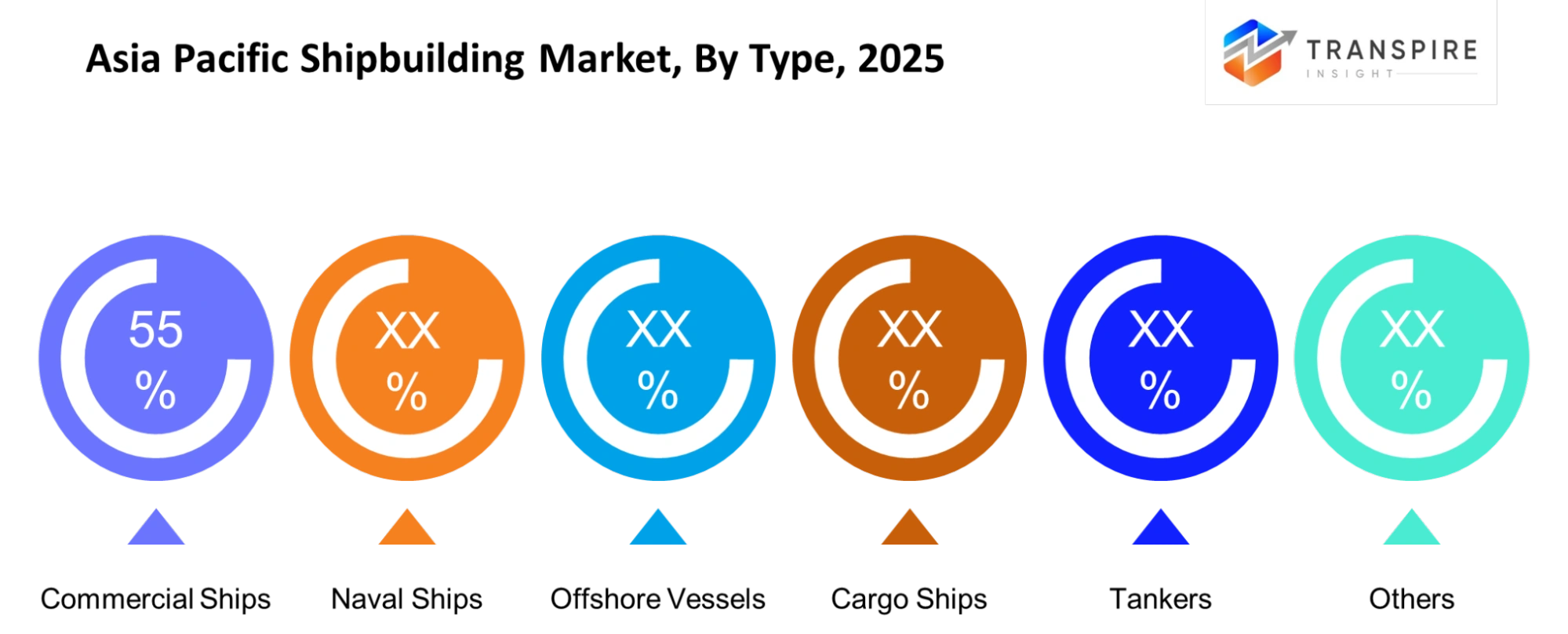
To learn more about this report, Download Free Sample Report
By Application:
The Asia Pacific Shipbuilding Market divides into segments based on seven applications which include transport, defense, energy, logistics, fishing and additional categories. The transport and logistics sectors will drive economic growth because trade volumes increase and supply chain networks expand.
Defense applications will grow with modernization programs, while energy use cases will expand through offshore projects. The fishing industry will help the Asia Pacific Shipbuilding Market because it provides essential resources for local food systems and supports the economic development of coastal communities.
By End-User:
The Asia Pacific Shipbuilding Market will divide its market according to shipowners defense agencies, government bodies, offshore companies, logistics firms and additional sectors. Shipowners will focus on cost efficiency and fleet expansion, while defense and government sectors will prioritize security and modernization.
Offshore companies and logistics firms will support trade and resource movement. The Asia Pacific Shipbuilding Market will experience growth because all end-user groups will start investing in advanced and efficient vessel systems.
By Material:
The Asia Pacific Shipbuilding Market will use material-based segmentation to identify steel and aluminum and composite and hybrid and advanced materials and additional materials. Steel will remain widely used due to strength and cost balance while aluminum and composites will support lightweight and fuel-efficient designs. Advanced materials will improve durability and performance.
The Asia Pacific Shipbuilding Market will continue evolving as material innovation supports greener, stronger, and more efficient shipbuilding solutions across all vessel categories.
What are the Main Challenges for the Asia Pacific Shipbuilding Market Growth?
The Asia Pacific shipbuilding market experiences delays because its technological and operational limitations restricts development of increasingly complex projects which require exacting standards. The execution process experiences delays because ship design stability problems and extended production times and the need for imported marine parts. The introduction of advanced propulsion systems in the Asian Pacific shipbuilding market creates testing and certification challenges which demand extensive time and technical expertise from multiple suppliers.
The Asia Pacific shipbuilding market struggles to implement manufacturing and commercialization processes because it must comply with strict regulations while facing increasing labor expenses and needing substantial financial investment.
The Asia Pacific shipbuilding market experiences restricted growth because both adoption and infrastructure problems exist, which particularly affects developing nations that struggle to maintain a consistent supply of skilled workers. The modernization process faces acceleration problems because shipyards lack access to contemporary facilities and face financial shortages. Smaller shipping companies within the Asia Pacific shipbuilding market encounter difficulties when they attempt to use digital systems and environmentally friendly technologies due to their limited resources.
The Asia Pacific shipbuilding market faces competition from global shipyards and new transportation technologies, which create its future risks. The market faces pricing competition which decreases profit margins while environmental regulations force shipbuilders to spend more on compliance. The Asia Pacific shipbuilding market requires ongoing innovation together with cost-effective solutions to achieve its long-term stability requirements which exist because of current growth obstacles.
Regional Insights
The Asia Pacific Shipbuilding Market will experience strong demand from East Asia which possesses advanced production capabilities and a skilled workforce together with extensive infrastructure resources. South Korea Japan and China will maintain their position as leading producers through their advanced shipyards and automated manufacturing operations. The Asia Pacific Shipbuilding Market growth will receive a boost from increasing export activities and defense modernization efforts in coastal economies.
The development of Southeast Asia will continue because investors are increasing their funding for both port facilities and inter-island transportation systems. The demand for smaller shipyards will continue to exist because increased trade activities and energy transportation needs drive their operations. South Asia will achieve economic growth through industrial development and the ability to produce goods at competitive costs. The Asia Pacific Shipbuilding Market will grow continuously as developing economies improve their production methods through better regional cooperation and technology transfer programs.
Recent Development News
In March 2026, HD Hyundai Heavy Industries declared its expansion of ship maintenance and naval systems operations across the Asia-Pacific region, which increased its capacity to service defense and commercial vessels. The company demonstrated through its contract growth, which included frigate upgrades and electronic systems integration, that modernization programs maintained a constant operational pace in the Asia Pacific shipbuilding sector. The update demonstrates that governments throughout the region are increasing their budgets for fleet operational readiness and lifecycle maintenance support services. https://www.reuters.com
In April 2026, Mitsubishi Shipbuilding continued its focus on low-emission marine technologies by advancing ammonia-fueled engine systems and related vessel components for commercial deployment. The initiative aims to reduce carbon output in shipping routes heavily used across East and Southeast Asia, supporting decarbonization targets. This development strengthens innovation-led demand in the asia pacific shipbuilding market, especially for alternative fuel carriers and sustainable fleet upgrades. https://www.mhi.com
|
Report Metrics |
Details |
|
Market size value in 2025 |
USD 36.2665 Million |
|
Market size value in 2026 |
USD 38.405 Million |
|
Revenue forecast in 2033 |
USD 57.349 Million |
|
Growth rate |
CAGR of 5.90% from 2026 to 2033 |
|
Base year |
2025 |
|
Historical data |
2021 - 2024 |
|
Forecast period |
2026 - 2033 |
|
Report coverage |
Revenue forecast, competitive landscape, growth factors, and trends |
|
Regional scope |
Asia Pacific (China, India, Japan, South Korea, Australia, Rest of Asia Pacific) |
|
Key company profiled |
Hyundai Heavy Industries, Samsung Heavy Industries, Daewoo Shipbuilding, Mitsubishi Heavy Industries, Kawasaki Heavy Industries, COSCO Shipping, China Shipbuilding, Fincantieri, ST Engineering, Damen, Keppel Offshore, Hanwha Ocean, Imabari Shipbuilding, Tsuneishi, Oshima Shipbuilding |
|
Customization scope |
Free report customization (country, regional & segment scope). Avail customized purchase options to meet your exact research needs. |
|
Report Segmentation |
By Type (Commercial Ships, Naval Ships, Offshore Vessels, Cargo Ships, Tankers, Others); By Application (Transport, Defense, Energy, Logistics, Fishing, Others); By End-User (Shipowners, Defense, Govt, Offshore Companies, Logistics Firms, Others); By Material (Steel, Aluminum, Composite, Hybrid, Advanced Materials, Others) |
How Can New Companies Establish a Strong Foothold in the Asia Pacific Shipbuilding Market?
The maritime economy requires new companies which want to enter Asia Pacific shipbuilding markets to develop specialized expertise, advanced engineering skills and secure partnerships. The shipping industry needs to establish distinct market positions by using environmentally friendly ship design methods and modular ship construction techniques and digital twin technology.
The Asia Pacific shipbuilding industry undergoes transformation through technology-based market entry methods which SeaTech Marine Solutions and HullAI show as these two companies use AI-enabled predictive maintenance and autonomous navigation systems to boost operational efficiency. Japanese and South Korean shipyards provide established partnerships which help companies build their reputation while gaining access to vital supply channels.
The Asia Pacific shipbuilding market requires companies to solve the main industry challenges, which include excessive fuel usage and port traffic jams, and the development of integrated smart logistics systems for upcoming smart cities and coastal production centers. New businesses can build sustainable market presence by developing innovation plans which match their maritime product needs in specific regional markets.
Key Asia Pacific Shipbuilding Market Company Insights
The Asia Pacific Shipbuilding Market will enable new companies to establish their market position through their dedication to providing specialized services while managing operational costs and establishing supply partnerships with regional vendors. The market will experience continuous growth because of trade expansion and coastal development which create strong demand. The implementation of digital tools combined with effective production planning methods will enable faster deliveries while minimizing operational waste. The Asia Pacific Shipbuilding Market will benefit from ongoing investment efforts to develop cutting-edge infrastructure systems.
The new market entrants will experience intense competition from existing companies which possess greater operational capacity. The success of the organization depends on its ability to establish a distinct market presence through its technology assets and adaptable manufacturing capabilities. The company will achieve market growth through its emphasis on sustainable materials and data-driven planning, together with strong relationships with clients, which will enhance its market visibility and stability.
Company List
- Hyundai Heavy Industries
- Samsung Heavy Industries
- Daewoo Shipbuilding
- Mitsubishi Heavy Industries
- Kawasaki Heavy Industries
- COSCO Shipping
- China Shipbuilding
- Fincantieri
- ST Engineering
- Damen
- Keppel Offshore
- Hanwha Ocean
- Imabari Shipbuilding
- Tsuneishi
- Oshima Shipbuilding
What are the Key Use-Cases Driving the Growth of the Asia Pacific Shipbuilding Market?
The requirement for particular maritime facilities has increased across the three sectors of offshore energy operations, defense supply operations, and regional maritime trade routes. The asian shipbuilding industry enables this transition through its enhanced production capacity and its advanced manufacturing capabilities. The healthcare supply chain system depends on two major factors which include better cold-chain maritime transportation and better bulk material transportation methods used by manufacturing industries. The asian shipbuilding industry experiences continuous growth because of increased international trade and the development of ships that connect to port facilities.
The development of smart port systems together with automation technologies has created new requirements for designing vessels and developing their maintenance schedules. The asia pacific shipbuilding industry is experiencing growth because of predictive analytics and fuel-efficient propulsion systems and digital monitoring systems. The distribution networks for consumer goods use quicker maritime transportation services while industrial exporters use maritime transportation to decrease their operational interruptions. The asia pacific shipbuilding industry enables regional corridors to implement green technologies and use their fleets effectively through scalable solutions.
The growing naval modernization investment together with offshore renewable energy projects will create additional production requirements. The asia pacific shipbuilding industry demonstrates high growth capacity because of its modular construction methods and its artificial intelligence design optimization systems. The implementation of energy transition programs and international trade agreements will drive up adoption rates. The asia pacific shipbuilding market will continue to grow because of long-term infrastructure development and industrial sector diversification.
Asia Pacific Shipbuilding Market Report Segmentation
By Type
- Commercial Ships
- Naval Ships
- Offshore Vessels
- Cargo Ships
- Tankers
- Others
By Application
- Transport
- Defense
- Energy
- Logistics
- Fishing
- Others
By End-User
- Shipowners
- Defense
- Govt
- Offshore Companies
- Logistics Firms
- Others
By Material
- Steel
- Aluminum
- Composite
- Hybrid
- Advanced Materials
- Others
Frequently Asked Questions
Find quick answers to common questions.
The Approximate Asia Pacific Shipbuilding Market size for the Market will be USD 57.349 Million in 2033.
Key Segments for the Asia Pacific Shipbuilding Market are By Type (Commercial Ships, Naval Ships, Offshore Vessels, Cargo Ships, Tankers, Others); By Application (Transport, Defense, Energy, Logistics, Fishing, Others); By End-User (Shipowners, Defense, Govt, Offshore Companies, Logistics Firms, Others); By Material (Steel, Aluminum, Composite, Hybrid, Advanced Materials, Others).
Major Asia Pacific Shipbuilding Market Players are Hyundai Heavy Industries, Samsung Heavy Industries, Daewoo Shipbuilding, Mitsubishi Heavy Industries, Kawasaki Heavy Industries, COSCO Shipping, China Shipbuilding, Fincantieri, ST Engineering, Damen, Keppel Offshore, Hanwha Ocean, Imabari Shipbuilding, Tsuneishi, Oshima Shipbuilding.
The Current Asia Pacific Shipbuilding Market size is USD 36.2665 Million in 2025.
The Asia Pacific Shipbuilding Market CAGR is 5.90%.
- Hyundai Heavy Industries
- Samsung Heavy Industries
- Daewoo Shipbuilding
- Mitsubishi Heavy Industries
- Kawasaki Heavy Industries
- COSCO Shipping
- China Shipbuilding
- Fincantieri
- ST Engineering
- Damen
- Keppel Offshore
- Hanwha Ocean
- Imabari Shipbuilding
- Tsuneishi
- Oshima Shipbuilding
Recently Published Reports
-
Dec 2024
ATV & UTV Market
ATV & UTV Market Size, Share & Analysis Report By Type (ATV, and UTV), By Variants (Less Than 400 CC, 400 CC To 800 CC, and More Than 800 CC), and Geography (North America, Europe, Asia-Pacific, Middle East and Africa, South and Central America), 2021 - 2031
-
Jan 2025
Automotive Central Gateway Module Market
Automotive Central Gateway Module Market Size, Share & Analysis Report By Type (Ethernet Central Gateway Module, CAN Central Gateway Module, LIN Central Gateway Module, and FlexRay), By Application (Powertrain Control, Body Control, Infotainment System, Advanced Driver Assistance Systems (ADAS), and Others), By End User (Passenger Vehicles, and Commercial Vehicles), and Geography (North America, Europe, Asia-Pacific, Middle East and Africa, South and Central America), 2021 - 2031
-
Jan 2025
Automotive Engine Oil Filter Market
Automotive Engine Oil Filter Market Size, Share & Analysis Report By Filter Type (Fuel Filter, Engine Oil Filter, Hydraulic Oil Filter, and Others), By Filter Media (Cellulose, Synthetic, and Micro), By Sales Channel (OEMs, and Aftermarket), By Vehicle Type (Passenger Cars, Light Commercial Vehicles, Heavy Duty Trucks, Buses and Coaches, and Off-road Vehicles), and Geography (North America, Europe, Asia-Pacific, Middle East and Africa, South and Central America), 2021 - 2031
-
Jan 2025
Automotive Parts Aluminium Die Casting Market
Automotive Parts Aluminium Die Casting Market Size, Share & Analysis Report By Production Process (Pressure Die Casting, Vacuum Die Casting, Squeeze Die Casting, Gravity Die Casting), By Application (Body Parts, Engine Parts, Transmission Parts, Battery And Related Components, Other Application Types), and Geography (North America, Europe, Asia-Pacific, Middle East and Africa, South and Central America), 2021 - 2031
Our Clients