

United Kingdom Diesel Exhaust Fluid Market Size & Forecast:
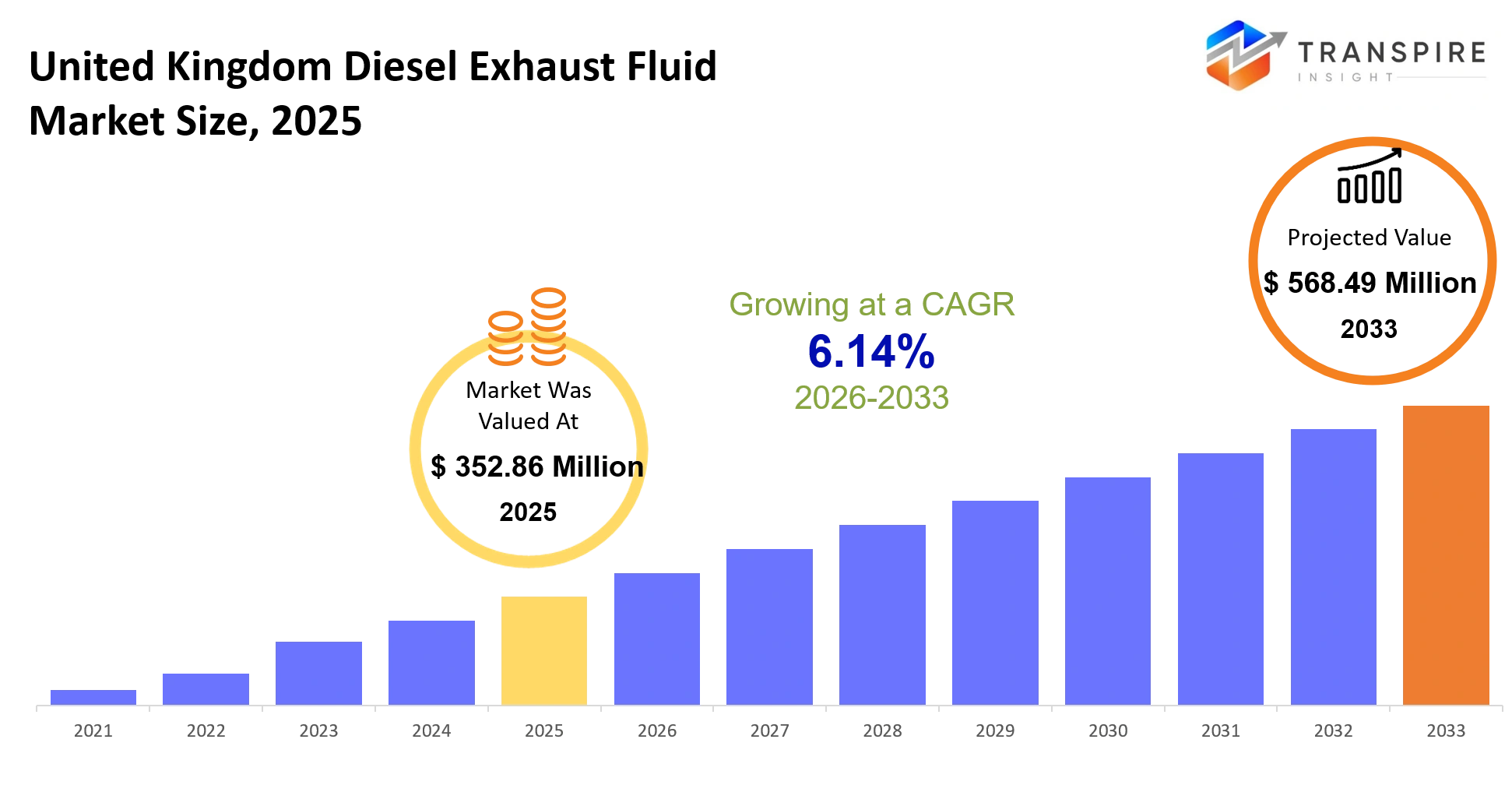
- United Kingdom Diesel Exhaust Fluid Market Size 2025: USD 352.86 Million
- United Kingdom Diesel Exhaust Fluid Market Size 2033: USD 568.49 Million
- United Kingdom Diesel Exhaust Fluid Market CAGR: 6.14%
- United Kingdom Diesel Exhaust Fluid Market Segments: By Product Type (Standard DEF, Premium DEF, Bulk DEF, Packaged DEF, Others); By Application (Commercial Vehicles, Passenger Vehicles, Agricultural Machinery, Construction Equipment, Marine Engines, Others); By Distribution Channel (Fuel Stations, OEM Dealerships, Online Retail, Industrial Suppliers, Others); By End User (Fleet Operators, Individual Vehicle Owners, Construction Companies, Farmers, Others)
To learn more about this report,  Download Free Sample Report
United Kingdom Diesel Exhaust Fluid Market Summary
The United Kingdom Diesel Exhaust Fluid Market was valued at USD 352.86 Millionin 2025. It is forecast to reach USD 568.49 Million by 2033. That is a CAGR of 6.14%over the period.
The United Kingdom Diesel Exhaust Fluid (DEF) market matters in a kinda critical way for diesel powered vehicles and industrial equipment, it helps them keep up with modern emissions rules. DEF ends up feeding Selective Catalytic Reduction (SCR) systems, which then cut nitrogen oxide emissions from heavy duty trucks, construction machinery, agricultural equipment, and various commercial fleets. In real life, it basically allows operators to stay compliant with environmental regulations while also keeping engine performance and fuel efficiency, not just on paper but in day to day use.
Over the last five years, the whole market has moved around, more than before—there’s been a structural shift as tighter Euro VI emission standards, plus fleet decarburization plans, made SCR adoption spread across transport and industrial areas. One big trigger was the post pandemic bounce back in logistics activity, together with more intense regulatory attention on emissions. That combo pushed higher DEF consumption across freight, distribution, and infrastructure projects. And as fleet managers refresh their equipment and treat compliance as the priority, DEF usage becomes more of a recurring operational necessity , not so much a choice you only make sometimes. This change is improving revenue visibility for DEF suppliers, and it’s also backing longer term market growth across the United Kingdom.
Key Market Insights
- England kind of dominates the United Kingdom Diesel Exhaust Fluid Market, with an estimated 65%+ market share in 2025, partly because freight and logistics activity is so concentrated there.
- Scotland looks like the fastest-growing regional market up through 2033, driven by infrastructure projects, commercial transport expansion, and a sort of steady shift toward industrial fleet modernization.
- On the product side, automotive-grade DEF is leading at roughly 70% market share, which ties back to how widely SCR systems are showing up in heavy duty commercial vehicles.
- Meanwhile, industrial and off-road DEF applications are estimated to hold about 25%+ share, supported by construction mining and agricultural machinery use, where the requirements are a bit different but the need stays consistent.
- Also, bulk DEF supply solutions are forecast to grow the quickest between 2025 and 2033, since fleet operators are trying to chase lower per-liter operating costs, and frankly they like the economics.
- In terms of end use, commercial transportation is still the leading application segment, contributing nearly 60% of total DEF consumption in 2025.
- Construction equipment is among the faster-expanding areas too, especially as stricter emissions regulations start extending to non-road mobile machinery.
- Large fleet operators hold around 55% of end-user demand, largely due to compliance requirements, plus the fact they benefit from predictable replenishment cycles.
- At the same time, independent logistics providers are ramping up DEF procurement, because fleet renewal programs are accelerating across the UK transportation sector.
- Key players—like Yara International, Brenntag, GreenChem, CF Industries, and Air1—are strengthening their positions through bulk distribution networks, digital inventory management, product quality certification, and strategic logistics partnerships.
What are the Key Drivers, Restraints, and Opportunities in the United Kingdom Diesel Exhaust Fluid Market?
The biggest growth driver is basically the continued enforcement of pretty stringent vehicle emissions regulations across the United Kingdom. Euro VI rules push for substantial reductions in nitrogen oxide emissions from diesel engines , which makes SCR technology kind of essential if operators want to stay within compliance. Because SCR systems depend on Diesel Exhaust Fluid to work correctly , every new compliant truck, bus, or heavy duty vehicle ends up generating recurring DEF demand, like more and more people just keep needing it. Fleet operators also increasingly treat DEF procurement as a required operating expense instead of an optional “green” lever . That whole pattern ends up giving suppliers and distributors steady recurring revenue, and it also helps them expand market penetration across logistics, public transport, and industrial activities.
The strongest restraint , though, is the long-term shift toward battery-electric and other alternative-fuel commercial vehicles. Even if diesel engines still dominate heavy duty transport today, electrification strategies within fleets are gradually lowering reliance on SCR-equipped trucks and similar units. The issue here is structural , since infrastructure investments, decarbonization policies from the government, and manufacturer product roadmaps are now putting more emphasis on zero-emission technologies. Consequently, some portion of future DEF demand may be displaced , which can cap market growth and also shrink long-term revenue prospects in certain transport segments.
A very clear opportunity is expanding DEF consumption in non-road mobile machinery and industrial equipment fleets. Construction, agriculture , material handling, and infrastructure development projects increasingly lean on modern diesel engines that are already fitted with SCR systems .
What Has the Impact of Artificial Intelligence Been on the United Kingdom Diesel Exhaust Fluid Market?
Artificial intelligence and advanced digital technologies are, more and more, helping how DEF is handled across commercial fleets and industrial settings. Fleet operators are now rolling out AI-enabled telematics platforms that, in real time, watch vehicle emissions systems, DEF consumption patterns, and compliance status. They can spot abnormal consumption behavior automatically, which lowers the chance of SCR malfunctions and keeps regulatory violations from showing up.
And then, there is machine learning, kind of quietly doing predictive maintenance. By looking at engine operating conditions, DEF injector performance, temperature readings, plus older fault logs, the models can foresee component failures before they actually happen. Fleet managers then can curb unexpected downtime and keep vehicle availability steadier. A few logistics providers also rely on predictive analytics to arrange DEF replenishment timing, this reduces inventory expenses , while also avoiding supply interruptions.
On top of that, modern digital platforms boost day-to-day efficiency through route optimization and fuel management tools. When engine performance monitoring gets better, it usually means stronger fuel economy, fewer maintenance expenses , and better emissions compliance results. In bigger fleet environments, these tools can add up to clear reductions in operating costs and even administrative load.
Still, adoption doesn’t move as fast as people hope. Integration expenses and data quality problems keep slowing things down. A lot of older commercial vehicles simply do not have compatible sensors or the connectivity setup, so AI-driven analytics can only go so far. Also, smaller operators often have trouble making the business case for tech spend, and that hesitation drags deployment in parts of the market.
Key Market Trends
- Since 2021, DEF consumption has been rising, kind of in step with the faster swapping out of older diesel trucks and buses for Euro VI compliant fleets.
- Bulk dispensing systems got a lot more attention too, as bigger logistics operators are reporting lower handling costs of around 10–15% , which sounds minor but adds up.
- DEF suppliers are also rolling out digital inventory monitoring platforms more and more, mostly to tighten up replenishment timing and keep customers from drifting elsewhere.
- From 2022 into 2025 , construction equipment SCR adoption has expanded noticeably, because the emissions rules for off road machinery kept tightening.
- At the same time, fleet operators increasingly pair telematics systems with the DEF workflow, so they can see DEF levels, emissions compliance status and maintenance needs in real time without guessing.
- Some strategic partnerships between chemical distributors and logistics providers have also expanded regionally, which helps explain why DEF availability across the UK feels more consistent lately.
- Premium DEF options with certified purity standards have gained traction too, as operators try to guard SCR system performance from slow degradation.
- Independent transport companies, for their part, are often moving away from packaged DEF buys, and toward bulk contracts instead , aiming for better cost predictability over longer periods.
- Predictive maintenance technologies are playing a role as well, lowering unplanned SCR downtime by catching problems sooner and enabling quicker intervention.
- Major players including Yara International, Brenntag, GreenChem, and CF Industries are still putting money into distribution infrastructure, plus service expansion, to keep up with that momentum.
United Kingdom Diesel Exhaust Fluid Market Segmentation
By Product Type
Standard DEF keeps the dominant position since it is broadly adopted across commercial fleets, industrial gear, and transportation uses that need steady emissions compliance. Premium DEF stays in the second-largest share mostly because more buyers are leaning toward high-purity blends that help the SCR system perform well and lower worries about maintenance. Bulk DEF already has a solid foothold with the large fleet operators that are hunting cost efficiency via big volume purchasing. Packaged DEF is still common among smaller operators and individual users who really like the easy access and convenience, while the Others bucket covers more specific and niche needs.
Standard DEF is projected to keep leading , largely because the usage habits are set and it’s widely reachable through distribution networks. Bulk DEF should grow quicker than the rest, as fleet operators adopt centralized storage and dispensing setups more and more. Premium DEF will likely gain traction, as people put more weight on equipment reliability and day to day operational effectiveness. Packaged DEF will keep serving decentralized users, and the Others category should keep expanding at a steady pace through specialized industrial applications.
By Application
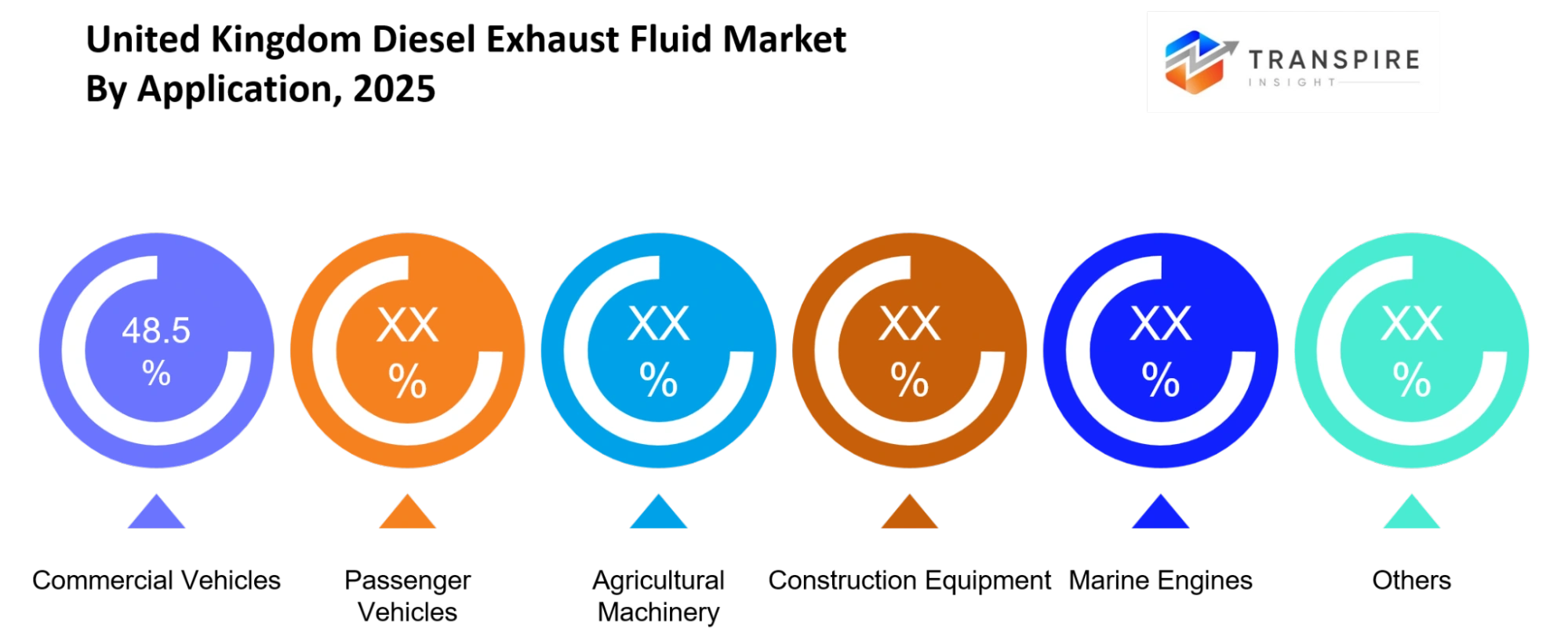
Commercial Vehicles kinda hold the leading position overall, mostly because they’re used a lot in freight transportation, logistics, and also public transport operations, you know. Passenger Vehicles come next, it’s the second-largest chunk, and it’s supported by diesel-powered cars along with light commercial vehicles that have SCR systems fitted. Agricultural Machinery still shows pretty stable demand thanks to modern farming equipment and yeah the way farms keep upgrading. Construction Equipment contributes strongly too, driven by infrastructure plans and industrial development activities, not too surprising. Marine Engines and Others add extra demand as well, especially from specialized diesel-powered operations where reliability matters.
Commercial Vehicles are expected to keep the leadership role, since people keep depending on diesel-powered transportation networks without really changing it much. Construction Equipment is projected to be the fastest growing, mainly because emissions regulations are increasingly covering non-road machinery now, and that’s the big shift. Agricultural Machinery should benefit from the ongoing mechanization trend, while Passenger Vehicles likely keep a steady demand level inside the existing diesel vehicle fleets. Marine Engines and Others are set to keep expanding too, because compliance requirements keep showing up in those specialized applications.
To learn more about this report, Download Free Sample Report
By Distribution Channel
Fuel Stations pretty much dominate the market, because a broad geographic footprint makes DEF easier to reach and buy all the time, sort of, frequent purchases become routine. Industrial Suppliers sit in the second slot, mainly by taking care of high-volume buyers via bulk contracts and slightly tailored delivery arrangements. OEM Dealerships stay visible too, supplying DEF while also handling vehicle servicing, so it feels like one-stop rather than separate stops. Online Retail keeps gaining ground as digital purchasing convenience becomes the default for many customers. The Others bucket covers specialized procurement paths and smaller, local distribution networks.
Fuel Stations are expected to stay out in front, largely from strong access and already-formed customer buying habits. Online Retail is projected to show the quickest momentum, since more businesses are leaning into digital procurement workflows, instead of the traditional routes. Industrial Suppliers should further solidify their footprint through long-term supply agreements, plus value-added services that, frankly, reduce friction. OEM Dealerships and the Others category will likely keep benefiting from tighter customer ties and service-based sales opportunities, even when the market mood shifts.
By End User
Fleet Operators seem to keep the lead, largely because big vehicle fleets need DEF replenishment on an ongoing basis, so they can stay inside regulatory compliance rules and keep things running efficiently. Construction Companies are probably right behind them, since infrastructure work tends to rely on SCR-equipped machinery pretty constantly. Farmers add a meaningful chunk of demand too , especially with modern ag equipment, and Individual Vehicle Owners keep a steady level of consumption from diesel passenger vehicles plus light commercial vehicles. The Others bucket is a mix , including a range of industrial and specialized users, so it doesn’t really behave like one single pattern.
Fleet Operators are also expected to keep showing up as the largest revenue contributor, transportation activity keeps creating repeat DEF needs. Farmers are projected to grow the quickest, as newer agricultural machinery adoption ramps up across different farming operations. Construction Companies should continue broadening their demand, driven by equipment modernization and the steady pace of project development. Individual Vehicle Owners and Others are likely to remain fairly steady in consumption, mainly supported by the continuing use of diesel-powered assets.
What are the Key Use Cases Driving the United Kingdom Diesel Exhaust Fluid Market?
The biggest source of DEF consumption pretty much comes from heavy duty commercial transportation, like long haul trucks and freight carriers. Delivery fleets and public transportation vehicles also lean on SCR systems to meet emissions rules, yet still keep day to day performance steady. Because these vehicles rack up high mileage and tend to stay in use almost all the time, DEF replenishment keeps showing up as a regular need, again and again.
Outside transportation, DEF adoption is also pushing deeper into construction equipment, agricultural machinery, and a bunch of industrial diesel powered assets. Excavators, loaders, tractors, plus generators are being fitted more often with SCR technology, which then turns into more demand for contractors, infrastructure developers, and agricultural operators. It’s kind of a snowball effect.
Also, some newer opportunities are slowly forming around large scale backup power systems, port operations, and specialized industrial equipment fleets. With emissions standards getting tougher in non road applications, modern diesel engines that use advanced emissions control technologies are expected to produce new DEF consumption streams across the whole forecast period.
|
Report Metrics |
Details |
|
Market size value in 2025 |
USD 352.86 Million |
|
Market size value in 2026 |
USD 374.51 Million |
|
Revenue forecast in 2033 |
USD 568.49 Million |
|
Growth rate |
CAGR of 6.14% from 2026 to 2033 |
|
Base year |
2025 |
|
Historical data |
2021 - 2024 |
|
Forecast period |
2026 - 2033 |
|
Report coverage |
Revenue forecast, competitive landscape, growth factors, and trends |
|
Regional scope |
United Kingdom |
|
Key company profiled |
Yara International, BASF, Shell, TotalEnergies, CF Industries, GreenChem, Cummins, Airgas, BlueDEF, Brenntag, Mitsui Chemicals, Nissan Chemical, Kelas Environmental Protection, Old World Industries, BP |
|
Customization scope |
Free report customization (country, regional & segment scope). Avail customized purchase options to meet your exact research needs. |
|
Report Segmentation |
By Product Type (Standard DEF, Premium DEF, Bulk DEF, Packaged DEF, Others); By Application (Commercial Vehicles, Passenger Vehicles, Agricultural Machinery, Construction Equipment, Marine Engines, Others); By Distribution Channel (Fuel Stations, OEM Dealerships, Online Retail, Industrial Suppliers, Others); By End User (Fleet Operators, Individual Vehicle Owners, Construction Companies, Farmers, Others) |
Which Regions are Driving the United Kingdom Diesel Exhaust Fluid Market Growth?
England still comes across as the most dominant area within the United Kingdom Diesel Exhaust Fluid market, mostly because there’s a lot going on with freight corridors, distribution centers, and everyday industrial motion, plus big clusters of commercial vehicle fleets. You can see it when major logistics hubs around London, Birmingham, Manchester, and the South East keep feeding steady DEF consumption, especially from heavy-duty transport operators who run routes on repeat. And on top of that, the push for stricter vehicle emissions rules, plus the broad shift toward Euro VI-compliant fleets, really locks in regional demand. Add in established fuel retailers, chemical distributors, storage infrastructure, and bulk dispensing networks, and it kind of becomes this full ecosystem that helps large-scale DEF distribution move more cleanly and with better replenishment speed.
Scotland, in comparison, takes a smaller slice than England, but it has a slightly different feel , more tied to industrial resilience and long-range infrastructure investment. Energy projects, agricultural operations, construction work, and regional freight logistics keep DEF demand fairly stable across the country. Instead of being driven primarily by logistics volume like in England, Scotland leans on diversified industrial end users, which usually means less up-and-down buying behavior. There’s also the steady weight of regulatory compliance expectations, alongside fleet modernization programs that continue rolling forward, so suppliers working in Scotland can expect more dependable revenue streams.
Wales is looking like the fastest-growing regional market, and it’s not just a theory. Infrastructure buildouts, upgrades for commercial transport and the gradual renewal of industrial fleets are speeding things up. In more recent times, investments in transportation projects, port modernization initiatives, and construction activity have raised the deployment of SCR-equipped equipment and commercial vehicles, so DEF usage is climbing alongside those changes.
Who are the Key Players in the United Kingdom Diesel Exhaust Fluid Market and How Do They Compete?
Competition in the United Kingdom Diesel Exhaust Fluid Market feels moderately consolidated, kinda like big chemical producers and more specialized DEF suppliers, they’re all going after the same customers while trying to look a bit different. Most of it comes down to supply reliability and product certification , plus how far they can distribute, and whether they can actually support fleets with service when something goes wrong. Price still matters a lot, especially for high-volume buyers , but lately operational continuity and product quality are becoming even more influential because SCR system failures can bring compliance trouble and vehicle downtime too. So suppliers are leaning into logistics infrastructure, bulk delivery networks, digital inventory control, and lower-carbon product development. Basically, they do not want to fight only on cost, not anymore.
Yara International seems to strengthen its position via the Air1 brand and one of the industry’s largest AdBlue distribution footprints. Their edge comes from integrated ammonia production, large storage capability, and telemetry-based bulk supply systems, which are helpful for big commercial fleets. On top of that, they are pushing investment into lower-carbon ammonia production pathways, to support future low-emission DEF options, more or less.
BASF, on the other hand, differentiates with certified product quality and carbon-footprint reduction initiatives. The launch of AdBlue ZeroPCF gives fleet operators a lower-emission DEF alternative, backed by verified certification benchmarks. GreenChem meanwhile emphasizes fleet-first service models, bulk distribution, and tailored dispensing infrastructure. Then CF Industries leans on upstream urea production capacity, to improve supply resilience and reduce interruptions, while Brenntag extends market reach through its broad chemical logistics network plus long-standing relationships with industrial customers.
Company List
- Yara International
- BASF
- Shell
- TotalEnergies
- CF Industries
- GreenChem
- Cummins
- Airgas
- BlueDEF
- Brenntag
- Mitsui Chemicals
- Nissan Chemical
- Kelas Environmental Protection
- Old World Industries
- BP
Recent Development News
"In February 2026, BASF launched AdBlue GE (Green Electricity), a diesel exhaust fluid produced using 100% renewable electricity. The product strengthens BASF’s low-carbon DEF portfolio and helps fleet operators reduce supply-chain emissions associated with SCR compliance.http://www.esgnews.earth
"In March 2024, BASF launched AdBlue ZeroPCF, the first AdBlue product with a certified product carbon footprint below 0.05 kg CO₂ per kilogram. The launch introduced a differentiated low-carbon DEF solution for transportation and industrial customers seeking lower Scope 3 emissions.https://www.basf.com
"In May 2026, Hutchinson Transport entered a multi-year partnership with GreenChem Solutions to support dedicated AdBlue distribution across the United Kingdom. The agreement expands GreenChem’s logistics capacity and strengthens DEF supply availability for commercial transport, agricultural, and industrial customers.https://hutchinsontransport.comgt
What Strategic Insights Define the Future of the United Kingdom Diesel Exhaust Fluid Market?
The United Kingdom Diesel Exhaust Fluid Market is moving, in a structural way, toward something more service-oriented and technology-enabled, not just plain commodity sales. In the next five to seven years, growth is going to rely more on fleet management integration, automated replenishment systems, and compliance-centered service contracts, because operators want smoother day to day output. There’s also a risk that is less in-your-face—battery-electric and hydrogen-powered commercial vehicles are being adopted faster and faster, so in some transport segments DEF use could slowly drop over the long run even if the market still looks like it’s expanding right now.
Meanwhile, a real opportunity is starting to show up inside non-road mobile machinery, where stricter emissions rules are pushing SCR adoption across construction, agriculture, and industrial equipment fleets. Companies should take the lead by investing in bulk distribution infrastructure, digital monitoring platforms, and low-carbon DEF production abilities, so they can keep customers longer and stay relevant as decarbonization plans keep shifting around.
United Kingdom Diesel Exhaust Fluid Market Report Segmentation
By Product Type
- Standard DEF
- Premium DEF
- Bulk DEF
- Packaged DEF
- Others
By Application
- Commercial Vehicles
- Passenger Vehicles
- Agricultural Machinery
- Construction Equipment
- Marine Engines
- Others
By Distribution Channel
- Fuel Stations
- OEM Dealerships
- Online Retail
- Industrial Suppliers
- Others
By End User
- Fleet Operators
- Individual Vehicle Owners
- Construction Companies
- Farmers
- Others
Frequently Asked Questions
Find quick answers to common questions.
The expected United Kingdom Diesel Exhaust Fluid Market size for the market will be USD 568.49 Million in 2033.
Key segments for the United Kingdom Diesel Exhaust Fluid Market are By Product Type (Standard DEF, Premium DEF, Bulk DEF, Packaged DEF, Others); By Application (Commercial Vehicles, Passenger Vehicles, Agricultural Machinery, Construction Equipment, Marine Engines, Others); By Distribution Channel (Fuel Stations, OEM Dealerships, Online Retail, Industrial Suppliers, Others); By End User (Fleet Operators, Individual Vehicle Owners, Construction Companies, Farmers, Others).
Major United Kingdom Diesel Exhaust Fluid Market players are Yara International, BASF, Shell, TotalEnergies, CF Industries, GreenChem, Cummins, Airgas, BlueDEF, Brenntag, Mitsui Chemicals, Nissan Chemical, Kelas Environmental Protection, Old World Industries, BP.
The United Kingdom Diesel Exhaust Fluid Market size is USD 352.86 Million in 2025.
The United Kingdom Diesel Exhaust Fluid Market CAGR is 6.14% from 2026 to 2033.
- Yara International
- BASF
- Shell
- TotalEnergies
- CF Industries
- GreenChem
- Cummins
- Airgas
- BlueDEF
- Brenntag
- Mitsui Chemicals
- Nissan Chemical
- Kelas Environmental Protection
- Old World Industries
- BP
About the Authors

Avinash Kumar
I’m Avinash Kumar, a Senior Research Analyst at Transpire Insight, with expertise in the Electronics and Semiconductor and Energy & Power industry. My work focuses on analyzing emerging technologies, market trends, industry developments, and innovation across these sectors. I specialize in transforming complex technical and market insights into clear, research-backed content that helps professionals, businesses, and decision-makers stay informed. Through continuous industry research and data-driven analysis, I strive to deliver accurate, reliable, and practical perspectives on the latest advancements shaping the semiconductor and energy landscape.

Chakradhar Khansole
Chakradhar serves as the Research Director at Transpire Insight, bringing over 8 years of experience in technology, innovation, and strategic market intelligence. He specializes in transforming complex market data into actionable business insights that enable organizations to make informed, growth-oriented decisions. Recognized for his strategic vision and analytical expertise, Chakradhar leads high-impact research initiatives, delivering comprehensive market assessments, competitive intelligence, and forward-looking industry analysis.
Recently Published Reports
-
Apr 2026
Active Power Filter Market
Active Power Filter Market Size, Share & Analysis Report By Type (Shunt Active Power Filters, Series Active Power Filter, Hybrid Active Power Filter), By Application (Harmonics Mitigation, Reactive Power Compensation, Voltage Regulation, Power Factor Correction), By Phase (Single Phase, Three Phase), By End-User Industry (Manufacturing, Healthcare, Commercial, Automotive, Oil and Gas, Others), and Geography (North America, Europe, Asia-Pacific, Middle East and Africa, South and Central America), 2021 - 2031
-
Apr 2026
Electrical Transformer Market
Electrical Transformer Market Size, Share & Analysis Report By Core (Closed, Shell, and Berry), By Insulation (Gas, Oil, Solid, Air, and Other), By Phase (Single, and Three), By Rating (100 MVA to 500 MVA, 501 MVA to 800 MVA, and 801 MVA to 1200 MVA), and Geography (North America, Europe, Asia-Pacific, Middle East and Africa, South and Central America), 2021 – 2031
-
Apr 2026
Hydraulic Piston Pumps Market
Hydraulic Piston Pumps Market Size, Share & Analysis Report By Type (Axial Piston Pumps, Radial Piston Pumps), By Operating Pressure (Low Pressure, Medium Pressure, High Pressure), By Application (Construction, Mining, Agriculture, Automotive, Oil & Gas, Industrial Machinery, Others), By End-User (OEMs, Aftermarket), and Geography (North America, Europe, Asia-Pacific, Middle East and Africa, South and Central America), 2021 – 2031
-
Apr 2026
Laboratory Gas Generators Market
Laboratory Gas Generators Market Size, Share & Analysis Report By Product (Nitrogen Gas Generator, Hydrogen Gas Generator, Zero Air Gas Generator, Purge Gas Generator, TOC Gas Generators, Others), By Application (Gas Chromatography, Liquid Chromatography-mass Spectrometry (LC-MS), Gas Analyzers, Others), By End-user (Life Science, Chemical & Petrochemical, Food & Beverage, Others), and Geography (North America, Europe, Asia-Pacific, Middle East and Africa, South and Central America), 2021 – 2031