
Middle East and Africa Used Car Market Size & Forecast:
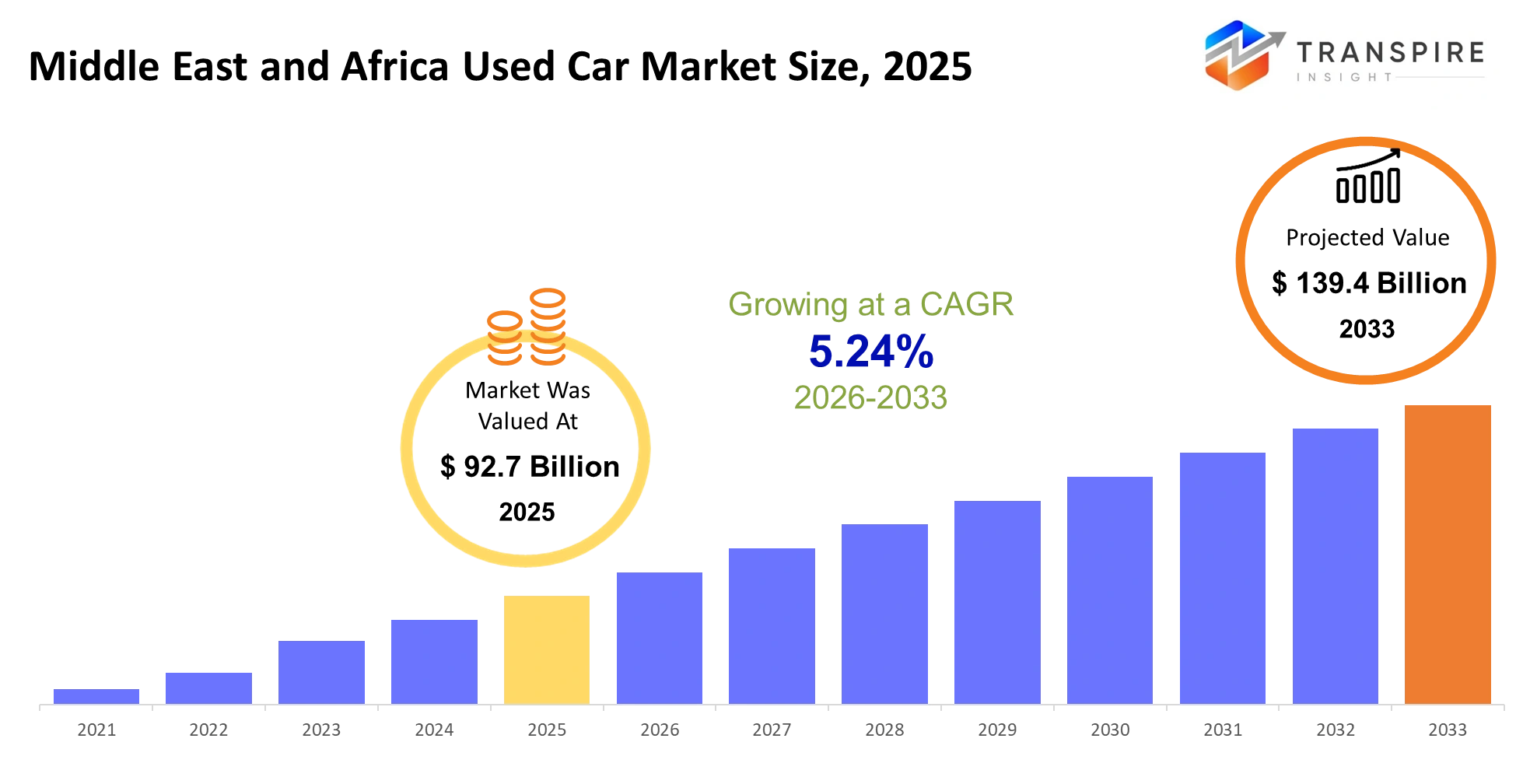
- Middle East and Africa Used Car Market Size 2025: USD 92.7 Billion
- Middle East and Africa Used Car Market Size 2033: USD 139.4 Billion
- Middle East and Africa Used Car Market CAGR: 5.24%
- Middle East and Africa Used Car Market Segments: By Type (Hatchback, Sedan, SUV, Luxury Cars, Others); By Application (Personal Use, Commercial Use, Ride-sharing, Fleet Usage, Others); By End-User (Individual Buyers, Dealers, Fleet Operators, Businesses, Others); By Fuel Type (Petrol, Diesel, Electric, Hybrid, Others).
To learn more about this report,  Download Free Sample Report
Middle East and Africa Used Car Market Summary
The Middle East and Africa Used Car Market was valued at USD 92.7 Billion in 2025. It is forecast to reach USD 139.4 Billion by 2033. That is a CAGR of 5.24% over the period.
The Middle East and Africa used car market kind of works as a liquidity channel for mobility, allowing consumers fleet operators and even dealers to keep vehicles running longer, at a lower capital cost, while still getting access to personal and commercial transport. It basically links people who need affordable movement with sellers who want better asset turnover, and more and more digital platforms help here, standardizing things like pricing and inspection workflows across dealer networks that are really fragmented.
In the last five years the market moved in a more structural way away from informal, negotiation heavy deals. Instead it shifted toward platform-led ecosystems that roll together valuation algorithms, vehicle certification, and even embedded financing. You could say this change picked up speed after pandemic-era supply chain disruptions pushed new vehicle prices higher and dragged out delivery times, so buyers leaned harder on the secondary vehicle channel. Consequently digital adoption jumped quickly in Gulf economies and in a few major African urban centers.
Put together, this tech uptake plus the affordability pressure improved transaction transparency and reduced search friction, which then directly lifted platform-led resale volumes and gave dealers more ways to monetize. So today market growth is showing not only higher demand, but also better conversion efficiency across digital resale infrastructure, where the workflow is, in practice, much smoother.
Key Market Insights
- GCC region really kinda dominates the Middle East and Africa Used Car Market with roughly 42% share in 2025 ,mostly because digital marketplace penetration is strong and vehicle turnover cycles are high.
- East Africa is becoming the fastest moving region (2025–2030) ,and that feels tied to looser import regulations and this quick spread of digital automotive marketplaces in general.
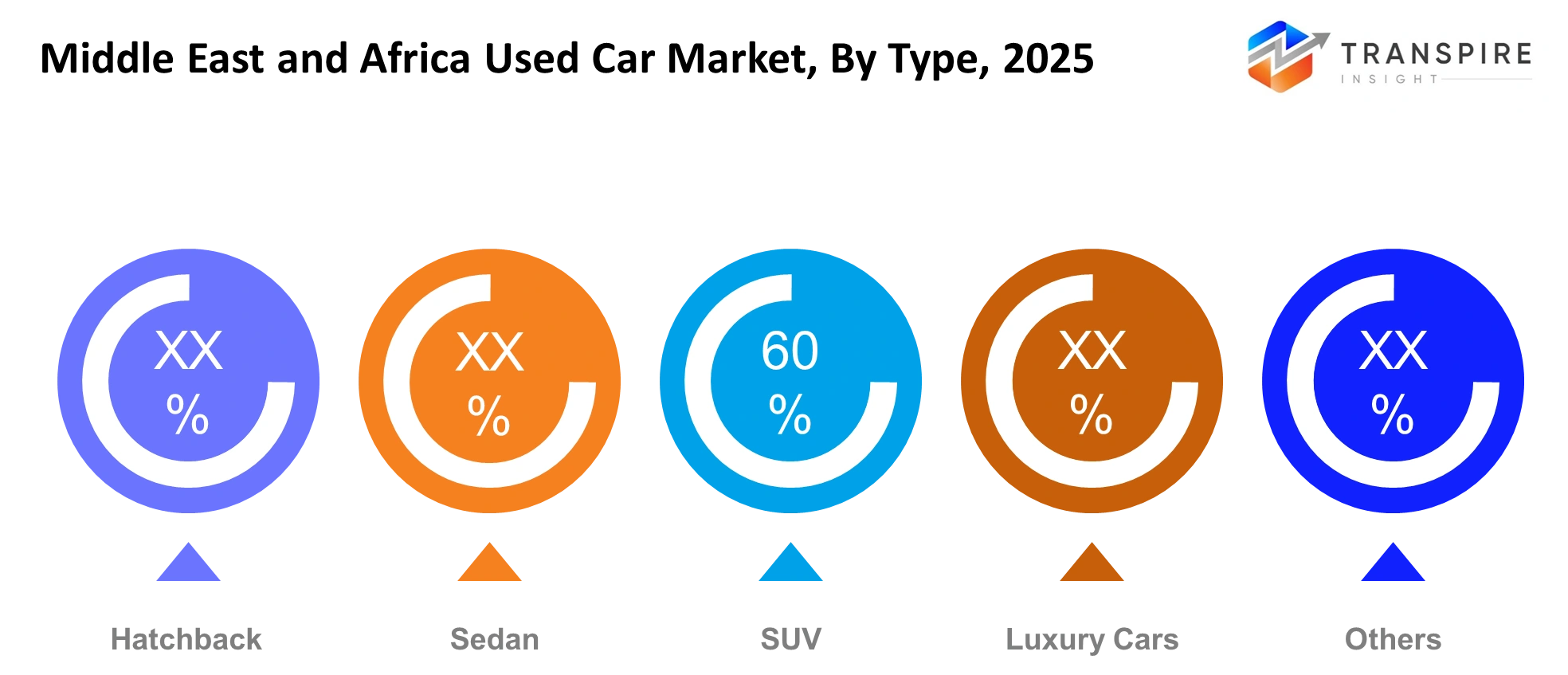
- When you look at vehicle type ,SUVs are still the top choice with more than 38% share, and it’s backed by consumer liking for durability, especially across mixed road conditions and all those uneven routes.
- Sedans take the second spot ,while certified pre-owned electric vehicles are showing the quickest momentum from 2025 to 2033.
- For application demand ,personal mobility is leading with almost 55% share, mainly because people are stuck with affordability limits when it comes to brand-new vehicle purchases.
- Ride-sharing plus fleet usage are the segments growing fastest, largely due to the expansion of urban mobility platforms that keep popping up.
- For end-user demand, individual buyers stay in front with over 60% share in the Middle East and Africa Used Car Market, and it’s basically because financing accessibility gaps still exist in new car markets.
- Meanwhile fleet operators are the fastest-growing end-user group, since logistics and mobility firms are optimizing cost per asset lifecycle ,trying to make the whole deal work longer and cheaper.
- Regional expansion into the Gulf and East African markets is going faster than before, largely because the demand for certified pre-owned cars keeps climbing.
- And then there is this whole technology adoption angle, like computer vision inspections, and predictive pricing models, it’s doing the thing where it creates real competitive differentiation, plus higher retention rates for the platform.
What are the Key Drivers, Restraints, and Opportunities in the Middle East and Africa Used Car Market?
The strongest driver really shaping the Middle East and Africa used car market is this quick move toward digital payment and service platforms that kinda blend valuation, inspection, and even financing into one continuous workflow. It started to feel much faster after 2021, mainly because new vehicle prices kept climbing, and lending rules got tighter,so more buyers ended up looking at certified pre-owned alternatives. The visible effect shows up as quicker inventory turnover, more frequent deals, and better monetization for the platform operators who basically steer both pricing and the financing steps.
One big structural problem is fragmented vehicle history data and the fact that registration systems are inconsistent across multiple African markets. Lots of cars don’t have standardized maintenance logs, or verified accident histories, so it becomes hard for pricing systems to stay accurate and it hurts buyer confidence too. That kind of gap slows scaling, and it makes platforms keep leaning on manual checks, which raises transaction costs and also keeps digital penetration lower outside the main urban centers.
A promising new opening is fintech-backed vehicle financing that gets built right into resale platforms, especially in places like the UAE, Saudi Arabia, and Kenya. Digital lenders are starting to insert credit scoring models inside the marketplace ecosystems, so approvals can happen almost instantly right at the point of sale. This merging of used-car resale with embedded finance is likely to make vehicles more affordable and pull in more buyers, especially first-time participants. Platforms that manage credit, inspection, and ownership transfer as one connected process should end up capturing a disproportionate share of transaction value as these ecosystems continue to mature.
What Has the Impact of Artificial Intelligence Been on the Middle East and Africa Used Car Market?
Artificial intelligence and newer digital tools are kinda changing the way used vehicle ecosystems work across the Middle East and Africa, mostly by making pricing more accurate, inspections more dependable, and transactions faster, or at least smoother in practice. Platform operators are now rolling out AI driven vehicle valuation engines that look at mileage, accident history, and local demand behavior to kind of automate pricing calls across online marketplaces. As a result, manual appraisal time gets cut, and listings tend to stay more consistent across big dealer groups, even when teams are split.
On top of that, digital inspection systems using computer vision can spot body damage and mechanical wear too, which supports more standardized certification steps. This in turn strengthens buyer confidence, because the documents feel less random and more repeatable.
Meanwhile machine learning models are increasingly used for predictive maintenance among fleet operators and ride hailing companies by studying telematics signals, like engine condition, braking habits, and fuel usage. With these setups, operators can push out repairs until theyre actually needed, which helps extend the vehicle lifespan and reduce unexpected breakdowns. In digitally integrated fleets, this has been linked to better fleet uptime by roughly 10–15%, depending on the environment and how well the data is fed in. AI tools for demand forecasting also help dealers rotate inventory faster, lowering holding costs and improving resale speed in denser city hubs.
Still, adoption is uneven because several African markets struggle with high quality historical vehicle data and consistent digital recordkeeping, so the models don’t always perform the same. Also, the integration cost for AI enabled inspection and pricing solutions can be heavy for smaller dealerships, so deployment slows down. That’s true even though the efficiency gains in larger platform ecosystems are pretty strong.
Key Market Trends
- Since 2021, Gulf buyers kind of shifted away from offline dealer bargaining toward digital marketplaces that basically standardize pricing and shorten deal time through verified listings, so it feels faster , less messy.
- Between 2022 and 2025 , financing-linked used car purchases also went up, mainly because banks started integrating right into platforms like Cars24 and with some regional dealers, directly.
- After 2023, certified inspection systems expanded across the UAE and South Africa, which improved buyer confidence and also cut down post-sale disagreement rates in secondary car markets, even when the vehicle history was “not so clear”.
- Dealer networks across Africa moved toward hybrid online offline setups as platforms in the spirit of OLX Group raised listing verification expectations, step by step.
- Then in 2024 , subscription vehicles and lease-return units began entering resale channels more often, driven by fleet rotation rules used in urban mobility services.
- Cross-border vehicle imports into East Africa increased after 2023, partly because age restrictions got more relaxed and port customs digitization systems became more reliable.
- Platforms like Kavak rolled out stronger refurbishment and warranty-backed resale models, so trust expectations in Gulf markets got reshaped, quietly but steadily.
- Ride hailing operators increased their secondary vehicle sourcing after 2022 , because operating cost optimization started replacing the idea of long-term fleet ownership.
- And in South Africa, bank repossessed vehicles started showing up on digital auction platforms at higher rates , which boosted the penetration of more formal resale channels since 2023.
Middle East and Africa Used Car Market Segmentation
By Type
SUVs keep the main lead in the Middle East and Africa used car market , mostly because there is steady demand from urban families and travelers who go long distances and care about durability and how well the car handles different roads. More importantly, higher ground clearance and the fit for mixed surfaces in parts of Africa plus GCC highways makes SUVs feel more practical than sedans or hatchbacks. Still, luxury cars do not disappear , they keep a solid portion too, backed by higher income groups in Gulf countries and the usual faster replacement cycles for vehicles.
Sedans carry on in a fairly stable way, pushed by affordability and fuel economy, especially in South Africa and some regions of North Africa where people are more budget minded. Hatchbacks stay useful for crowded cities , partly because costs for upkeep are lower, and it is easier to weave through congestion. When it comes to luxury, luxury SUVs are getting adopted a bit quicker than classic luxury sedans , mainly because resale value stays stronger, and that matters when buyers think about the future.
SUV dominance should grow even more, as shoppers move toward versatile models with better safety ratings and multi purpose utility. Any market players that push for certified inspection , plus offer financing options for SUV resale units , should end up with higher transaction volumes during the forecast period.
To learn more about this report, Download Free Sample Report
By Application
Personal use remains the biggest slice , linked to how households typically own vehicles and how replacement happens on affordability driven schedules in urban plus semi urban areas. At the same time, buyers lean more toward pre owned vehicles because import duties remain firm and new car pricing keeps climbing, particularly across Gulf and many African economies. Ride sharing platforms also add weight, since mobility services keep expanding quickly in big cities .
Fleet usage and commercial applications are kind of picking up steam , as logistics companies and corporate mobility providers try to squeeze operating costs by going for secondary vehicle acquisition. In practice businesses are rotating fleets faster— so they can manage depreciation better and keep operational efficiency more steady, especially across transport and delivery services. And yeah dealers still sit right in the middle of the whole transaction stream, like acting as a middle channel between institutional sellers and individual buyers , even when online methods look stronger.
Looking ahead , demand is likely to lean more toward digitally integrated application models, where ride hailing providers and fleet operators depend on standardized vehicle grading frameworks. Platforms that help streamline bulk procurement while also handling lifecycle tracking will keep building stronger institutional ties , over time.
By End-User
Individual buyers account for the biggest portion, mostly because of their heavy reliance on low cost mobility options and because new vehicle financing access is still limited in several regions. Dealers continue to matter a lot here , since they aggregate inventory and support financing facilitation, particularly in dense urban areas where transactions happen frequently. Fleet operators are also showing a rising footprint as commercial mobility spreads further into logistics and transport services.
Businesses keep joining secondary vehicle markets to cut down capital spending , and they use it to extend asset utilization cycles. Dealer networks remain influential because confidence, inspection capability, and financing access still depend a lot on physical verification in many places. Fleet operators tend to get the advantage from bulk purchase agreements and replacement schedules that are more predictable.
Over time, digital-first dealer platforms and institutional fleet procurement channels will start to reshape how transactions get built, sort of in a quieter way. People who keep their eyes on integrated dealer-fintech ecosystems, should see advantages, because vehicle resale work is getting more formal, more regulated , and more traceable.
By Fuel Type
Petrol vehicles still dominate the used car market. This is mostly because there are a lot of them around, the upfront cost tends to feel lower, and servicing infrastructure is already well established in both towns and remote areas. Diesel vehicles keep a solid footprint in commercial and logistics use cases, where fuel efficiency and torque performance matter day to day. Hybrid vehicles stay a smaller slice, but they are steadily growing, mainly as awareness about fuel economy slowly spreads.
Electric vehicles are still in an early stage, but interest is climbing—especially in Gulf countries. That momentum is linked to government sustainability programs, plus fleet modernization pushes. Fuel-based vehicles continue to lead across African markets too, because charging infrastructure is limited, and it often feels inconsistent depending on the region. Hybrid models can be viewed as a bridge category, linking traditional mobility with the shift toward electric adoption.
Next, growth is expected to concentrate around hybrid and electric resale channels as regulations tighten and infrastructure spending rises. Market participants who build certified EV inspection and battery valuation systems will likely capture an early-mover edge, particularly across emerging secondary electric vehicle ecosystems.
What are the Key Use Cases Driving the Middle East and Africa Used Car Market?
Core adoption in the Middle East and Africa used car market is basically powered by replacement vehicle buys through online-to-offline resale platforms, but people often just zoom in on affordability and a verified condition, rather than handing over that new car premium. Meanwhile the high import costs on vehicles , and then a few financing limits here and there, push consumers toward certified pre owned cars, mostly in the urban Gulf areas and in South African markets. So it kind of all settles into this steady need for inspection-backed offers, plus dealer-supported listings , like yeah.
And after that, the use cases keep widening out. Like for instance corporate fleet rotation, and ride hailing operator procurement, where logistics and mobility companies cycle vehicles around to squeeze down total cost of ownership. Leasing firms and bank repossession routes also contribute to the secondary supply, which in practice links financial services to the resale inventory movement across a bunch of major urban centers.
On the newer side, people are talking about subscription style vehicle ownership models and cross-border digital resale corridors that are enabled by standardized inspection systems. This is picking up traction in places like the UAE and Kenya, where fintech tie-ins and regulatory digitization are making the transactions more transparent … and then, it’s easier to scale those asset light mobility services too.
|
Report Metrics |
Details |
|
Market size value in 2025 |
USD 92.7 Billion |
|
Market size value in 2026 |
USD 97.5 Billion |
|
Revenue forecast in 2033 |
USD 139.4 Billion |
|
Growth rate |
CAGR of 5.24% from 2026 to 2033 |
|
Base year |
2025 |
|
Historical data |
2021 - 2024 |
|
Forecast period |
2026 - 2033 |
|
Report coverage |
Revenue forecast, competitive landscape, growth factors, and trends |
|
Regional scope |
Middle East and Africa (Saudi Arabia, United Arab Emirates, South Africa, Rest of Middle East and Africa) |
|
Key company profiled |
CarMax, AutoNation, Penske Automotive, Carvana, Vroom, TrueCar, Cars24, OLX Autos, Kavak, Dubizzle, Toyota, Honda, Ford, Hyundai, Nissan. |
|
Customization scope |
Free report customization (country, regional & segment scope). Avail customized purchase options to meet your exact research needs. |
|
Report Segmentation |
By Type (Hatchback, Sedan, SUV, Luxury Cars, Others); By Application (Personal Use, Commercial Use, Ride-sharing, Fleet Usage, Others); By End-User (Individual Buyers, Dealers, Fleet Operators, Businesses, Others); By Fuel Type (Petrol, Diesel, Electric, Hybrid, Others). |
Which Regions are Driving the Middle East and Africa Used Car Market Growth?
In the Gulf Cooperation Council region, the used car market kinda leads across the Middle East and Africa mainly because of strong disposable income levels, pretty high vehicle ownership rates, and fast digital marketplace adoption. On top of that, government led mobility modernization efforts, plus strict vehicle inspection rules, have made people trust certified resale channels more, especially in the UAE , and Saudi Arabia. There’s also a solid automotive financing ecosystem that keeps transaction numbers moving, and when you add structured dealer networks together with online platforms, it helps inventory flow stay continuous. So overall, it’s this mix of regulatory maturity and digital infrastructure that keeps the region dominant in both value and transaction efficiency.
South Africa is the second big one , and it’s backed by a long standing automotive retail culture and a relatively stable financial services setup. In contrast to the Gulf, growth there is less about luxury demand and more about affordability driven resale loops, where price conscious buyers stretch vehicle lifespans through secondary ownership channels. Regulatory enforcement for roadworthiness testing and insurance conditions stays consistent, which helps maintain steady turnover. Then you’ve got established dealership networks and bank-backed financing options, so the market holds up even when macro conditions get shaky, even if contributions stay steady rather than explosive.
East Africa is now showing up as the fastest growing area, pushed by higher vehicle import activity, growing urban mobility demands, and newer gains in port handling and customs speed, especially in Kenya and Tanzania. Since 2023, inflows have picked up a lot after some import age constraints were eased, and after digital customs processing got better, which together makes things move more quickly at the border.Over the 2026–2033 period, this momentum is expected to attract platform-based resale operators and fintech-backed financing providers seeking high-growth, underpenetrated automotive markets.
Who are the Key Players in the Middle East and Africa Used Car Market and How Do They Compete?
The Middle East and Africa used car market stays kinda fragmented, and it’s formed by a blend of informal dealers, digital classifieds platforms, and online resale ecosystems that are scaling really fast. Competition now leans on price clarity, vehicle inspection credibility, and full transaction assistance, not just basic listings that anyone can paste. Traditional dealers still try to hold share by managing local stock and keeping access to financing, but the digital-first guys are changing what buyers expect, mostly by cutting information gaps and making sales cycles shorter. Also the geography feels important , because the Gulf is adopting digital tools faster while parts of Africa are still stuck with hybrid offline-to-online approaches, you know, one step at a time.
In that setting, Dubizzle Group keeps building strength with a marketplace-led setup, where car listings are paired with valuation tools and dealer subscription options. This creates better conversion for urban buyers in the UAE. Their edge is basically strong local liquidity plus deep dealer connections, so cars spend less time on the listing screens than in more fragmented competitors. Then there’s Cars24, which goes for full-stack vehicle deals, including inspection, pricing algorithms, and direct purchasing. That whole package raises trust and helps inventory move faster, especially when they expand across Gulf regions.
AutoTrader South Africa, meanwhile, leans on certified listings and dealer partnerships to keep trust in a market where financing limits steer buyer behavior, more than digital adoption by itself. Finally, OLX Group uses broad category coverage and network effects across several African markets, so listings can get more cross-border visibility even when sellers are not local.Meanwhile, Kavak differentiates through standardized refurbishment hubs and warranty-backed resale models, supporting expansion into Dubai and targeting premium trust-driven buyers in digitally mature Gulf segments.
Company List
- CarMax
- AutoNation
- Penske Automotive
- Carvana
- Vroom
- TrueCar
- Cars24
- OLX Autos
- Kavak
- Dubizzle
- Toyota
- Honda
- Ford
- Hyundai
- Nissan
Recent Development News
In April 2025, CARS24 announced expansion of its Middle East operations through enhanced full-stack vehicle purchasing and inspection services. The initiative strengthened its buy-sell-refurbish model in Gulf markets, reducing transaction friction and improving buyer trust through standardized vehicle certification systems.
Source: https://en.wikipedia.org/
In September 2025, Kavak expanded its reconditioning and AI-driven pricing ecosystem into Dubai, integrating refurbishment facilities with financing and warranty-backed resale services. The move improved vehicle standardization and increased adoption of certified pre-owned vehicles in digitally mature Gulf markets.
Source: https://en.wikipedia.org
What Strategic Insights Define the Future of the Middle East and Africa Used Car Market?
The Middle East and Africa used car market is kind of structurally shifting, toward platform-led and trust based transactions, as digital marketplaces replace these fragmented dealer ecosystems. In the next five to seven years pricing transparency tools, standardized inspections , and embedded financing will keep deciding transaction velocity , more and more, helped by rising smartphone penetration and also by tighter consumer expectations on what the vehicle history actually says. Because of that, overall, the whole thing is pushing back on the need for big physical dealership networks, and value creation moves toward data-rich intermediaries.
There is also a risk that’s a little less obvious, financing concentration. Meaning, if you’re relying on only a small set of lending partners, then liquidity cycles can get tighter fast during interest rate changes, or when credit is being tightened. So even if demand is more or less stable, inventory turnover can still slow down, in a way that surprises people.On the flip side, an opportunity is starting to take shape around certified pre-owned electrified vehicles, especially in the UAE and Saudi Arabia. Regulatory incentives and fleet modernization programs are beginning to reshape the resale channels, and that’s creating a more repeatable demand pattern.
Market participants should probably invest in an integrated inspection-to-financing setup that reduces transaction uncertainty and pulls customers in earlier, kind of before the actual purchase moment. Platforms that can unify valuation accuracy, warranty coverage and credit access, will likely do better than competitors that are only fragmented listing based, or “just listings” with limited support.
Middle East and Africa Used Car Market Report Segmentation
By Type
- Hatchback
- Sedan
- SUV
- Luxury Cars
- Others
By Application
- Personal Use
- Commercial Use
- Ride-sharing
- Fleet Usage
- Others
By End-User
- Individual Buyers
- Dealers
- Fleet Operators
- Businesses
- Others
By Fuel Type
- Petrol
- Diesel
- Electric
- Hybrid
- Others
Frequently Asked Questions
Find quick answers to common questions.
The Middle East and Africa Used Car Market size is USD 139.4 Billion in 2033.
Key segments for the Middle East and Africa Used Car Market are By Type (Hatchback, Sedan, SUV, Luxury Cars, Others); By Application (Personal Use, Commercial Use, Ride-sharing, Fleet Usage, Others); By End-User (Individual Buyers, Dealers, Fleet Operators, Businesses, Others); By Fuel Type (Petrol, Diesel, Electric, Hybrid, Others).
Major Middle East and Africa Used Car Market players are CarMax, AutoNation, Penske Automotive, Carvana, Vroom, TrueCar, Cars24, OLX Autos, Kavak, Dubizzle, Toyota, Honda, Ford, Hyundai, Nissan.
The Middle East and Africa Used Car Market size is USD 92.7 Billion in 2025.
The Middle East and Africa Used Car Market CAGR is 5.24% from 2026 to 2033.
- CarMax
- AutoNation
- Penske Automotive
- Carvana
- Vroom
- TrueCar
- Cars24
- OLX Autos
- Kavak
- Dubizzle
- Toyota
- Honda
- Ford
- Hyundai
- Nissan
Recently Published Reports
-
Apr 2026
ATV & UTV Market
ATV & UTV Market Size, Share & Analysis Report By Type (ATV, and UTV), By Variants (Less Than 400 CC, 400 CC To 800 CC, and More Than 800 CC), and Geography (North America, Europe, Asia-Pacific, Middle East and Africa, South and Central America), 2021 - 2031
-
Apr 2026
Automotive Central Gateway Module Market
Automotive Central Gateway Module Market Size, Share & Analysis Report By Type (Ethernet Central Gateway Module, CAN Central Gateway Module, LIN Central Gateway Module, and FlexRay), By Application (Powertrain Control, Body Control, Infotainment System, Advanced Driver Assistance Systems (ADAS), and Others), By End User (Passenger Vehicles, and Commercial Vehicles), and Geography (North America, Europe, Asia-Pacific, Middle East and Africa, South and Central America), 2021 - 2031
-
Apr 2026
Automotive Engine Oil Filter Market
Automotive Engine Oil Filter Market Size, Share & Analysis Report By Filter Type (Fuel Filter, Engine Oil Filter, Hydraulic Oil Filter, and Others), By Filter Media (Cellulose, Synthetic, and Micro), By Sales Channel (OEMs, and Aftermarket), By Vehicle Type (Passenger Cars, Light Commercial Vehicles, Heavy Duty Trucks, Buses and Coaches, and Off-road Vehicles), and Geography (North America, Europe, Asia-Pacific, Middle East and Africa, South and Central America), 2021 - 2031
-
Apr 2026
Automotive Parts Aluminium Die Casting Market
Automotive Parts Aluminium Die Casting Market Size, Share & Analysis Report By Production Process (Pressure Die Casting, Vacuum Die Casting, Squeeze Die Casting, Gravity Die Casting), By Application (Body Parts, Engine Parts, Transmission Parts, Battery And Related Components, Other Application Types), and Geography (North America, Europe, Asia-Pacific, Middle East and Africa, South and Central America), 2021 - 2031
Our Clients