

Middle East and Africa Dairy Products Market Size & Forecast:
- Middle East and Africa Dairy Products Market Size 2025: USD 47.52 Million
- Middle East and Africa Dairy Products Market Size 2033: USD 69.09 Million
- Middle East and Africa Dairy Products Market CAGR: 4.80%
- Middle East and Africa Dairy Products Market Segments: By Product Type (Milk, Cheese, Yogurt, Butter, Cream, Ice Cream, Dairy Desserts, Others); By Distribution Channel (Supermarkets, Convenience Stores, Online Retail, Specialty Stores, Others); By End User (Households, Foodservice, Hospitality, Food Processing, Others); By Source (Cow Milk, Buffalo Milk, Goat Milk, Sheep Milk, Others)
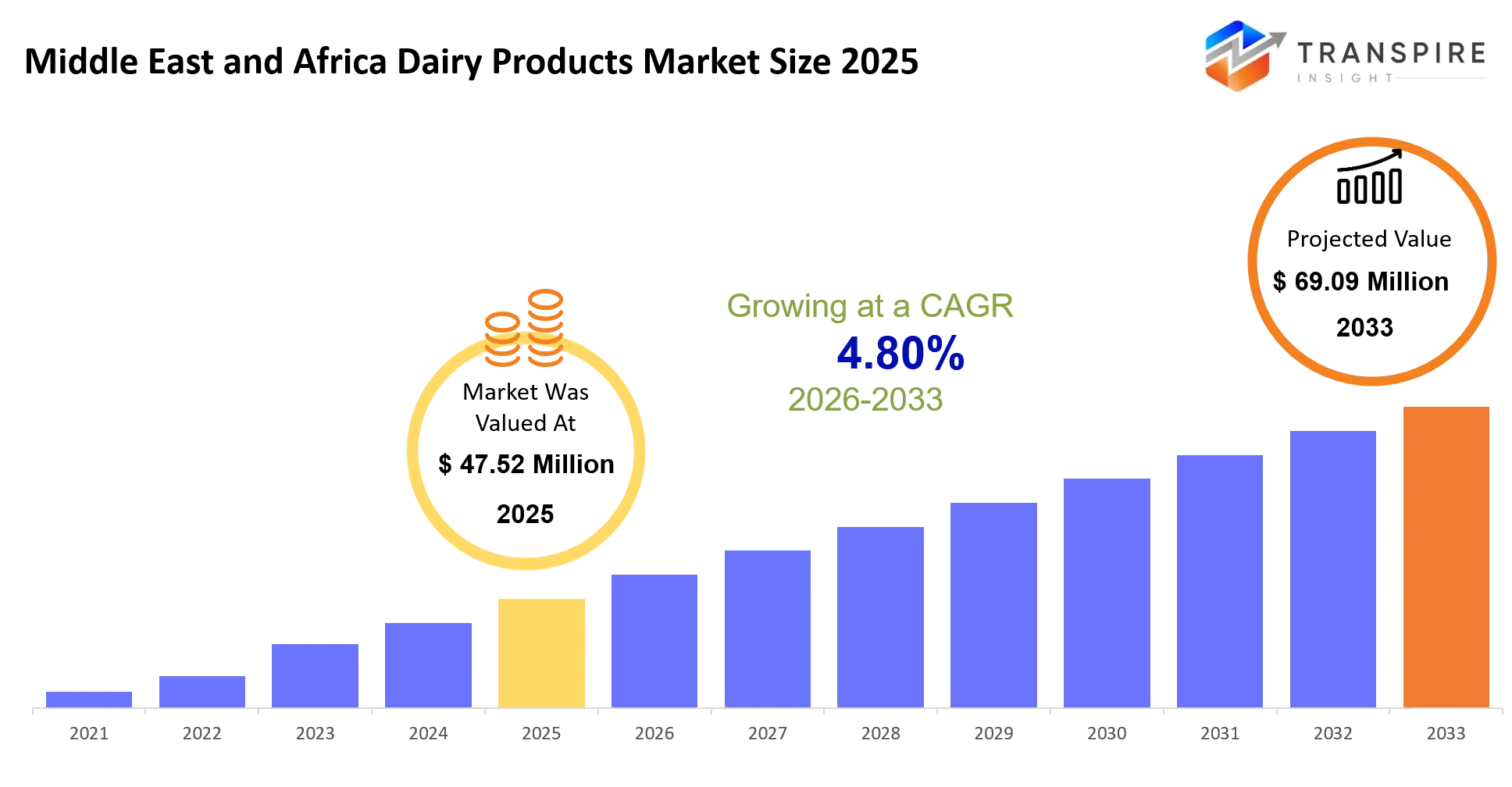
Middle East and Africa Dairy Products Market Summary
The Middle East and Africa Dairy Products Market was valued at USD 47.52 Million in 2025. It is forecast to reach USD 69.09 Million by 2033. That is a CAGR of 4.80% over the period.
The dairy products industry kind sits in the middle of giving essential nutrition to homes, restaurants, food processors, and hospitality businesses across the Middle East and Africa. Besides just regular milk, the market also really backs larger food manufacturing, bakery making, beverage formulation, and value-added nutrition offerings that need steady dairy inputs, day after day. As people slowly diversify what they eat, dairy producers are widening their line-up including premium, fortified, and convenience-led items, so they can match those shifting consumer expectations which are not standing still.
Over the past five years, the market has moved, sort of in a structural manner, toward value-added dairy kinds like yogurt, flavored milk, cheese, and functional dairy items. At the same time, supply chain disruptions after global commodity swings , along with agricultural input inflation, made companies invest more in local production and not just the usual stuff. That meant more attention for cold-chain infrastructure and sourcing diversification, as well. Honestly this change helped improve product availability, and also reinforced regional food security plans. Growth is also getting a lift from urban retail expansion, deeper uptake in organized foodservice channels, and higher demand for packaged dairy products. All of this is shaping new income routes for manufacturers, while also inviting more spending into processing capacity, product innovation, and distribution networks.
Key Market Insights
- The Middle East and Africa Dairy Products Market seems to be moving away from plain liquid milk, toward these more value built goods like cheese, yogurt, and also dairy desserts, kind of you know.
- In general, the Gulf Cooperation Council countries represent close to 45% of the regional dairy income, helped by pretty advanced retail setups and cold-chain networks too.
- Saudi Arabia takes the lead in regional market share, because of large dairy production scales, integrated supply chains, and also strong local, domestic appetite.
- Meanwhile, Sub-Saharan Africa is still the quickest growing area, with urbanization rates going over 4% each year in multiple economies, so that helps demand.
- Cheese makes up around 28% of total product revenue, so it becomes the top category across both retail and foodservice.
- Yogurt is showing up as the fastest accelerating product segment, with growth numbers beyond 6% annually in the major cities.
- On the demand side, households provide more than 55% of overall market pull, keeping household consumption as the leading end user group.
- Also, online dairy retail sales have risen by more than 20% since 2021, mainly due to digital grocery portals and home delivery offerings.
- The expansion efforts keep going from companies like Nestlé, Danone, Lactalis, Almarai, FrieslandCampina, and Arla Foods, through product launches and regional investments, step by step.
- Premium dairy items—those enriched with protein, probiotics, and vitamins—are also grabbing a noticeable share among health focused consumers, because people are looking for wellness, basically.
What are the Key Drivers, Restraints, and Opportunities in the Middle East and Africa Dairy Products Market?
The most powerful growth driver comes from fast investment in internal food security and dairy processing skills. Governments across Gulf countries have been pushing agricultural resilience, after disruptions in worldwide food supply lines and commodity markets… so the direction kinda shifted. This policy, sorta motivated major dairy players to grow local processing sites, tune up cold-chain logistics and squeeze more production efficiency out of the existing capacity. When domestic supply starts getting steadier, retailers and foodservice operators can draw from more consistent dairy inventories, and that helps revenue growth not only in one place, but across several channels as well. Also, the expansion of organized retail networks makes it easier to deepen market presence for labeled or branded dairy items.
The biggest sticking point is still the heavy reliance on imported feed, agricultural inputs, and climate-sensitive farming and livestock systems. In many countries nearby there’s water scarcity, there’s limited arable land, and livestock upkeep costs can be pretty high. These structural limits cannot really be fixed overnight, because they demand long-term agricultural investment, infrastructure development, and reforms in how resources are handled. So, production costs stay exposed to swings in global commodity prices, and that can press margins, plus it may weaken price competitiveness in some markets.
A clear chance shows up in functional and premium dairy products. Protein-heavy yogurt, probiotic drinks, fortified milk, and specialty cheese are drawing funds from multinational and regional manufacturers. Places like Saudi Arabia, the United Arab Emirates, South Africa, and Kenya are seeing more shelf space set aside for value-added dairy ranges.
What Has the Impact of Artificial Intelligence Been on the Middle East and Africa Dairy Products Market?
Artificial intelligence is, kind of, increasingly transforming dairy production, processing and distribution operations across the region. Dairy manufacturers are rolling out AI-enabled monitoring systems to help automate production scheduling , quality checks, packaging tasks, and inventory management, all in this smoother way. Computer vision tools can spot packaging defects and product inconsistencies in real time, so it cuts waste a bit and lifts overall production effectiveness.
Machine learning models are also lending a hand with predictive maintenance across processing facilities. The sensors on equipment collect operational data and that data helps flag potential failures before breakdowns happen. In practice this improves plant uptime, brings down maintenance expenses, and also reduces those unexpected production interruptions. And on the dairy farming side, AI based herd management systems are analyzing animal health indicators, milk yield patterns and even feeding behavior to fine-tune productivity plus better use of resources.
On top of that, advanced analytics platforms assist manufacturers with demand prediction and inventory arrangement. Better forecasting means less spoilage, stronger supply chain coordination, and more reliable retail product availability. Some producers even report noticeable reductions in inventory loss and logistics inefficiencies when they use AI assisted planning systems.
Still, adoption is not even everywhere. The costs to implement, plus limited digital infrastructure in some African markets, and shortages of specialized technical expertise, these issues keep wider deployment from moving as fast as it could. Also, data quality problems and fragmented supply chains can weaken the performance of several AI applications, especially for smaller dairy operators.
Key Market Trends
- Since 2021, premium yogurt and probiotic categories have been showing up more often on shelf spaces across the main Gulf retail chains. Not just presence, but like, that expansion felt pretty steady.
- Cheese consumption also went up in a calm , almost consistent way, as quick service restaurants spread through Saudi Arabia, UAE, and even South Africa.
- Meanwhile online grocery platforms managed to lift dairy sales penetration by more than 20% versus the pre pandemic baseline, so yeah the shift was real.
- From 2022 to 2025 regional dairy processors put money into cold chain infrastructure pretty aggressively, mainly to cut product losses, less waste, more steadiness.
- Almarai and several other big producers then accelerated their production growth, aiming to reinforce food security and supply reliability.
- Functional dairy products with protein, vitamins, and probiotics started gaining noticeable share after 2023, and this was not subtle.
- Retailers, for their part, dedicated more shelf area to premium imported and specialty cheese categories during the last three years.
- Sustainability efforts are now more and more tied to water efficiency, livestock productivity, plus emissions reduction across dairy operations.
- Manufacturers also leaned into new partnerships with foodservice operators, trying to lock in steady demand from hospitality and restaurant channels.
- Finally, local production strategies strengthened after global commodity disruptions, which helped reduce exposure to import linked supply risks.
Middle East and Africa Dairy Products Market Segmentation
By Product Type
Milk still seems like the backbone of dairy consumption across the region, mainly because households use it often and because retail is there in a pretty solid way. Fresh milk, long-life milk, flavored milk, and even fortified versions keep pulling in a lot of consumer attention. As organized retail keeps growing it makes products easier to find across cities and semi-urban zones , so accessibility really goes up. On top of that, investments in processing have helped upgrade quality and also extend shelf life, a lot.
Cheese has basically carved out a solid spot in both foodservice and retail. Yogurt also keeps climbing in popularity, especially with probiotic options, mixed flavors, and high protein varieties. Butter and cream stay steady, driven by bakery needs, confectionery use and hospitality operations too. Ice cream and other dairy desserts get a lift from innovation, premium leaning, and the continued shift toward indulgent food categories that people seem to want more of. Beyond that, other dairy products add extra variety with specialized nutrition and region linked offerings, which helps keep things interesting.
By Distribution Channel
Supermarkets act like the main distribution route, mainly due to their big mix of products, proper refrigeration options, and that steady stream of shoppers. Big retail groups give manufacturers real visibility, good chances for promotion, and wider geographic reach. Convenience stores still matter a lot for everyday consumption buys, plus that little impulse moment. And as cities keep growing, the channel footprint keeps expanding too.
Online retail has grown a lot more lately , especially with grocery delivery services and the whole digital shopping ecosystem. Specialty outlets pull in customers who want premium items, imported options, and health oriented dairy products. Besides that, other paths like traditional trade locations and independent retailers still contribute in a fairly clear way to where people can actually find the products across different regions. Overall, spreading the channels out helps extend market reach and keeps customer engagement more active.
By End User
Households take the biggest slice of dairy consumption because there is a regular demand for milk, cheese, yogurt, butter, and other closely related products. Ongoing daily nutritional needs, plus the fact that product variety keeps broadening, still push residential buying. Retail expansion also helps make dairy easier to find, across several income groups, and this improves access in a fairly direct way. Branded dairy items keep strong penetration with household consumers, you know, they stick around.
Meanwhile foodservice and hospitality count as major commercial demand drivers. Restaurants, cafés, hotels, and catering operations use dairy inputs quite a lot when they prepare menu items and also for beverage production. Food processing firms depend on dairy inputs for packaged foods, bakery goods, confectionery items, and nutritional formulations. There are also other end user groups that add extra consumption, mainly through institutional use cases, and a few more specialized applications too.
By Source
Cow milk kind of dominates production and consumption, because there are already farming setups in place, it fits well with processing systems, and it has a wide range of product uses. a lot of the mainstream dairy items that people know today are made from cow milk, largely because supply chains are efficient and large-scale commercial access is pretty common. There’s also continued investment in dairy farming, which in turn keeps pushing output growth along. Plus, product standardization helps manufacturers and retailers, in a way that’s easier to manage and predict.
Buffalo milk still matters in certain markets, mainly due to its higher fat content and the more traditional taste preferences in those regions. Goat milk has been getting attention for specialty nutrition angles, and it fits into premium dairy segments as well. Sheep milk backs niche cheese making and region specific dairy specialties. And then other milk origins offer extra chances for expanding product variety, and for more specialized nutritional directions, depending on what the market is looking for.
What are the Key Use Cases Driving the Middle East and Africa Dairy Products Market?
Household nutrition is still, somehow, the dominant application area. Daily intake of milk, cheese, yogurt, and butter keeps taking the largest slice of demand, because these items work as staple food things across a lot of regional diets. When there is steady retail availability plus broad product ranges, people end up consuming more often.
Foodservice and hospitality use cases are also growing, like when restaurant chains, cafes, hotels, and catering operators keep upping their dairy intake in beverages, bakery-based goods, desserts and ready-to-eat meals. On the flip side, food processing firms use dairy ingredients in packaged foods, confectionery products, and nutrition blends, this kind of thing adds even more pull towards commercial distribution.
Newer use cases are showing up too, like functional nutrition products and more specialized dairy formulations. High-protein dairy drinks, probiotic yogurt products, and fortified dairy options are getting attention from health-focused buyers. Premium dairy ingredients for sports nutrition ,and clinical nutrition applications open extra opportunities over the forecast timeline.
|
Report Metrics |
Details |
|
Market size value in 2025 |
USD 47.52 Million |
|
Market size value in 2026 |
USD 49.75 Million |
|
Revenue forecast in 2033 |
USD 69.09 Million |
|
Growth rate |
CAGR of 4.80% from 2026 to 2033 |
|
Base year |
2025 |
|
Historical data |
2021 - 2024 |
|
Forecast period |
2026 - 2033 |
|
Report coverage |
Revenue forecast, competitive landscape, growth factors, and trends |
|
Regional scope |
United States; Canada; Mexico; United Kingdom; Germany; France; Italy; Spain; Denmark; Sweden; Norway; China; Japan; India; Australia; South Korea; Thailand; Brazil; Argentina; South Africa; Saudi Arabia; United Arab Emirates |
|
Key company profiled |
Nestle, Danone, Lactalis, Fonterra, FrieslandCampina, Arla Foods, Savencia, DMK Group, Yili, Mengniu, Almarai, Saputo, Amul, Unilever, Meiji |
|
Customization scope |
Free report customization (country, regional & segment scope). Avail customized purchase options to meet your exact research needs. |
|
Report Segmentation |
By Product Type (Milk, Cheese, Yogurt, Butter, Cream, Ice Cream, Dairy Desserts, Others); By Distribution Channel (Supermarkets, Convenience Stores, Online Retail, Specialty Stores, Others); By End User (Households, Foodservice, Hospitality, Food Processing, Others); By Source (Cow Milk, Buffalo Milk, Goat Milk, Sheep Milk, Others) |
Which Regions are Driving the Middle East and Africa Dairy Products Market Growth?
The Gulf region is kinda leading market revenue generation , because of solid purchasing power, more advanced retail infrastructure, and quite significant investments into domestic dairy production. Saudi Arabia stays especially influential , mainly due to large scale integrated dairy operations and the food security initiatives that are going on. Modern cold chain systems help improve product distribution efficiency, and also keep product quality more stable. With strong regulatory backing and ongoing investment activity , the region keeps that leadership position.
South Africa comes next as the second-largest contributor, but it really differs from the Gulf markets—partly because it has a mature agricultural base and an already established dairy processing sector. Stable production systems, diversified consumer demand, and developed retail networks all support a consistent market performance. Local manufacturing capabilities further limit dependence on imported dairy products. This mix basically builds a dependable platform for long term industry growth.
Sub Saharan Africa is expected to show the fastest expansion , moving forward until 2033. Urban population growth is rising alongside retail modernization, while investments in food processing infrastructure are changing dairy consumption patterns. Multiple countries are widening their cold chain networks and tightening supply chain efficiency. All of that together creates solid opportunities for manufacturers, investors, and distribution partners who are aiming for long term market expansion.
Who are the Key Players in the Middle East and Africa Dairy Products Market and How Do They Compete?
Competition shows up as this kinda blend of multinational dairy giants and, on the other side, very strong regional producers. Most market players try to outdo each other using production capacity, distribution footprint, product refinement, nutritional framing, and of course pricing maneuvers. Lately, premium categories , functional dairy products, and value-added lines have turned into the main little battlegrounds, because many manufacturers want to stand out beyond plain traditional milk items.
Nestlé leans hard into nutrition first dairy solutions, and it also pours a lot into sustainable sourcing programs, as well as ongoing product development. Danone keeps differentiating via probiotic dairy and health-aimed portfolios, aiming directly at wellness driven consumers. Lactalis, meanwhile, leans on a wide international roster of cheese and dairy brands, to push market penetration across a range of consumer groups.
Almarai takes advantage of vertically coordinated production systems, which gives it stronger supply chain control and smoother operations across Gulf markets. FrieslandCampina puts emphasis on ingredient innovation, deep dairy know-how, and strategic collaborations so it can strengthen its role in commercial food and beverage applications. Arla Foods keeps moving forward with premium dairy offerings, regional investments, and sustainability centered manufacturing initiatives. Taken together these approaches help companies tighten market positioning, build better customer stickiness, and pick up growth opportunities across different regional environments .
Company List
- Nestlé
- Danone
- Lactalis
- Fonterra
- FrieslandCampina
- Arla Foods
- Savencia
- DMK Group
- Yili
- Mengniu
- Almarai
- Saputo
- Amul
- Unilever
- Meiji
Recent Development News
In June 2026, Nestlé published its first Dairy Plan report. The report highlighted collaboration with more than 130,000 dairy farmers and over 200 suppliers to improve productivity, sustainability, and dairy supply chain performance, strengthening long-term industry development.https://www.nestle.com/media/news/first-dairy-plan-report (Nestlé)
In April 2026, Almarai entered strategic agreements with the Shareek Program and the Ministry of Investment. The agreements support large-scale food industry investments and strengthen regional food security and dairy production capabilities.
https://www.almarai.com/en/corporate/media-center (Almarai Newsroom)
In July 2025, FrieslandCampina Professional expanded its strategic partnership with IMCD across EMEA markets. The collaboration strengthened ingredient distribution capabilities and improved access to dairy solutions across Middle Eastern and African food manufacturers.https://www.imcdgroup.com/media-centre/press-releases/frieslandcampina-professional-and-imcd-to-expand-food-and-beverage-ingredients-p-MCTVLD5QD55FAOZCF4ZNDYRSJ4UY (IMCD)
What Strategic Insights Define the Future of the Middle East and Africa Dairy Products Market?
The market is moving toward more localization, product premiumization, and value added nutrition, sort of in that direction for a while now. At the same time, food security priorities , retail modernization, and investments in processing infrastructure will keep reshaping how firms compete over the next several years. Companies that can tie production efficiency together with premium product innovation are probably the ones set to grab the strongest growth chances.
There’s also a less visible risk, more like a background thing, that comes from exposure to feed costs, water availability, and climate related agricultural stresses. These issues can affect production economics and profitability even when consumption trends look favorable . Still, functional dairy offerings— enriched with probiotics, protein, and specialized nutritional ingredients— are showing up as an opportunity, but they remain underpenetrated in many places.
Market participants should lean into investments in advanced processing technologies, improvements in cold chain efficiency, and product lines that feel truly differentiated rather than generic. Organizations that build resilient supply chains while scaling up value added dairy offerings will likely be positioned better to protect long term market share and profitability through 2033.
Middle East and Africa Dairy Products Market Report Segmentation
-
By Product Type
Milk
Cheese
Yogurt
Butter
Cream
Ice Cream
Dairy Desserts
Others -
By Distribution Channel
Supermarkets
Convenience Stores
Online Retail
Specialty Stores
Others -
By End User
Households
Foodservice
Hospitality
Food Processing
Others -
By Source
Cow Milk
Buffalo Milk
Goat Milk
Sheep Milk
Others
Frequently Asked Questions
Find quick answers to common questions.
The Expected Middle East and Africa Dairy Products Market size for the Market will be USD 69.09 Million in 2033.
Key Segments for the Middle East and Africa Dairy Products Market are By Product Type (Milk, Cheese, Yogurt, Butter, Cream, Ice Cream, Dairy Desserts, Others); By Distribution Channel (Supermarkets, Convenience Stores, Online Retail, Specialty Stores, Others); By End User (Households, Foodservice, Hospitality, Food Processing, Others); By Source (Cow Milk, Buffalo Milk, Goat Milk, Sheep Milk, Others).
Major Middle East and Africa Dairy Products Market Players are Nestle, Danone, Lactalis, Fonterra, FrieslandCampina, Arla Foods, Savencia, DMK Group, Yili, Mengniu, Almarai, Saputo, Amul, Unilever, Meiji.
The Current Middle East and Africa Dairy Products Market size is USD 47.52 Million in 2025.
The Middle East and Africa Dairy Products Market CAGR is 4.80% from 2026 to 2033.
- Nestlé
- Danone
- Lactalis
- Fonterra
- FrieslandCampina
- Arla Foods
- Savencia
- DMK Group
- Yili
- Mengniu
- Almarai
- Saputo
- Amul
- Unilever
- Meiji
About the Authors

Chetan Dhatrak
I’m Chetan Dhatrak, a Senior Research Analyst at Transpire Insight, specializing in the Consumer Goods, Foods and Beverages industry. I focus on analyzing market trends, consumer behavior, competitive landscapes, and industry developments to deliver accurate, data-driven insights. My research at Transpire Insight is built on credible sources and in-depth analysis, helping businesses and readers better understand market dynamics, emerging opportunities, and evolving consumer preferences. I’m committed to creating reliable, well-researched content that supports informed decision-making and reflects the latest developments in the consumer goods and food & beverage sectors.

Chakradhar Khansole
Chakradhar serves as the Research Director at Transpire Insight, bringing over 8 years of experience in technology, innovation, and strategic market intelligence. He specializes in transforming complex market data into actionable business insights that enable organizations to make informed, growth-oriented decisions. Recognized for his strategic vision and analytical expertise, Chakradhar leads high-impact research initiatives, delivering comprehensive market assessments, competitive intelligence, and forward-looking industry analysis.
Recently Published Reports
-
Apr 2026
Baby Infant Formula Market
Baby Infant Formula Market Size, Share & Analysis Report By ype (Infant Milk, Follow On Milk, Specialty Baby Milk, Growing-Up Milk), By Ingredient (Carbohydrate, Fat, Protein, Minerals, Vitamins, and Others), By Product Form (Powder, Liquid, and Ready-to-feed), By Distribution Channels (Supermarket/Hypermarket, Specialty Store, Pharmacies, Online Retail, and Others), and Geography (North America, Europe, Asia-Pacific, Middle East and Africa, South and Central America), 2021 - 2031
-
Apr 2026
Edible Insects for Animal Feed Market
Edible Insects for Animal Feed Market Size, Share & Analysis Report By Type (Insect Powder, Insect Meal, Insect Bar, Insect Paste, Insect Oil, and Others), By Insect Type (Beetles, Cricket, Caterpillar, Hymenoptera, Orthoptera, Tree Bugs, and Others), By Application (Livestock, Pet Food, and Aquaculture), By Livestock Type (Poultry, Swine, and Others), and Geography (North America, Europe, Asia-Pacific, Middle East and Africa, South and Central America), 2021 - 2031
-
Apr 2026
Food Industry Disinfection and Bacterial Control Market
Food Industry Disinfection and Bacterial Control Market Size, Share & Analysis Report By Type (Chemical Disinfectants, Physical Disinfectants, and Biocides and Antimicrobials), By Application (Food Processing Equipment Surface Disinfection, Food Preparation Areas Surface Disinfection, Storage Areas Surface Disinfection, Anti-microbial Coatings Food Preservation, and Preservative Solutions Food Preservation), By End User (Meat and Poultry Processing, Dairy Processing, Seafood Processing, Bakery and Confectionery, Restaurants and Commercial Kitchens, and Food Service Providers), By Sales Channel (Online, Offline), and Geography (North America, Europe, Asia-Pacific, Middle East and Africa, South and Central America), 2021 - 2031
-
May 2026
Freeze Dried Food Market
Freeze Dried Food Market Size, Share & Analysis Report By Product Type (Fruits, Vegetables, Freeze-Dried Dairy Products, Freeze-Dried Meat and Seafood, Freeze-Dried Pet Food, and Prepared Meal), By Nature (Organic, and Conventional), By Form (Powdered, Granules, and Diced), By End Use (Breakfast Cereals, Dairy Products, Bakery & Confectionery, Nutritional Bars & Supplements, Powdered Beverages, Snacks, and Retail (Household)), and Geography (North America, Europe, Asia-Pacific, Middle East and Africa, South and Central America), 2021 - 2031