
Asia Pacific Dairy Blends Market Size & Forecast:
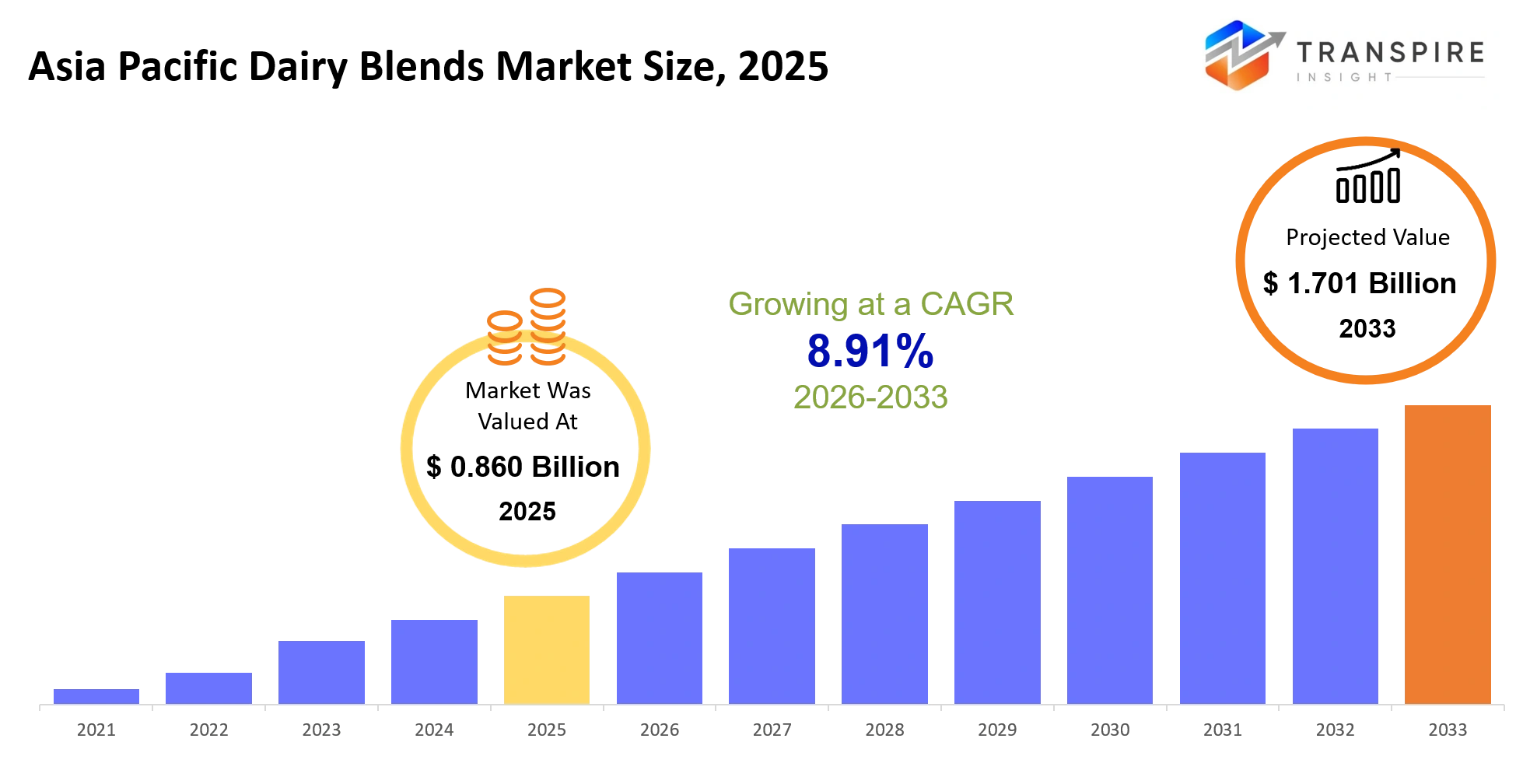
- Asia Pacific Dairy Blends Market Size 2025: USD 0.860 Billion
- Asia Pacific Dairy Blends Market Size 2033: USD 1.701 Billion
- Asia Pacific Dairy Blends Market CAGR: 8.91%
- Asia Pacific Dairy Blends Market Segments: By Product Type (Butter Blends, Cheese Blends, Cream Blends, Yogurt Blends, Milk Powder Blends, Dairy Fat Blends, Functional Dairy Blends, Others); By Application (Bakery, Confectionery, Dairy Products, Infant Nutrition, Beverages, Food Processing, Others); By Form (Powder, Liquid, Paste, Others); By End User (Food Manufacturers, Retail, Foodservice, Others).
To learn more about this report,  Download Free Sample Report
Asia Pacific Dairy Blends Market Summary
The Asia Pacific Dairy Blends Market was valued at USD 0.860 Billion in 2025. It is forecast to reach USD 1.701 Billion by 2033. That is a CAGR of 8.91% over the period.
In the Asia Pacific dairy blends market, food manufacturers are kind of supported by the availability of formulated mixes that blend dairy and non-dairy ingredients. These mixes get used in bakery , confectionery, ice cream and beverage production, mainly to keep costs steadier, help with texture, and also make sure supply stays dependable even when operations are large-scale and tightly scheduled. Over the last five years the market didn’t just grow, it shifted in a more structural way toward hybrid dairy formulations, because processors are increasingly picking protein-fortified and fat-replaced blends. This trend is kind of enabled by improvements in emulsification techniques and more consistent ingredient standardization across industrial food manufacturing.
That shift was also sped up by dairy price volatility , and then by pandemic-era supply chain disruptions, which made the risk of relying only on traditional milk solids a lot more obvious. So manufacturers had to diversify their formulations, just to keep production moving without interruption. Because of that, adoption has widened notably among industrial bakeries and quick service food producers, where these dairy blends act like a stabilizer for incoming ingredient expenses. They also help extend shelf life, and they support scalable reformulation, which is what ends up driving revenue growth for ingredient suppliers, across the region.
Key Market Insights
- Asia Pacific Dairy Blends Market, i mean is mostly led by China, which holds around 30–35% share because of strong processed food manufacturing, plus dairy imports that keep things moving steady.
- Meanwhile Southeast Asia shows a sort of steady uptake too , as industrial bakery and beverage sectors keep scaling ingredient standardization, sort of more and more.
- When it comes to formats, powdered dairy blends basically lead the Asia Pacific Dairy Blends Market with close to 55% share, mainly for the longer shelf life , and because it’s easy transport and handling.
- Liquid dairy blends are still the second-largest segment , they’re widely used in frozen desserts and also for beverage formulations.
- Protein-enriched blends and fat-replacement blends are the fastest-growing category through 2025–2030, driven by demand for healthier profiles and simpler nutrition strategies.
What are the Key Drivers, Restraints, and Opportunities in the Asia Pacific Dairy Blends Market?
The primary driver of the Asia Pacific Dairy Blends Market is the rising cost volatility of raw milk and dairy solids, which pushed food makers toward blended formulations that do stabilize pricing inputs, and also make production way more predictable. This trend kind of sped up after global supply chain disruptions showed those dependency risks in dairy procurement, so companies leaned into long term contracts and hybrid ingredient systems. In practical terms this helps improve margin control for food processors, more directly than before.
One main restraint is the structural dependency on high-quality dairy input sourcing, and it’s still uneven across a bunch of Asia Pacific countries. Cold chain infrastructure is limited in many regions, and milk fat standardization can be inconsistent. That basically restricts broad adoption in markets where consumers are super cost sensitive. As a result, formulation becomes more complex, and it slows down uniform product scaling, leading to delayed commercialization for mid tier manufacturers.
The biggest opportunity is in the rapid expansion of protein-fortified and functional dairy blends aimed at health focused consumers, especially in urban areas across Asia. India, Vietnam, and Indonesia are seeing growing demand for nutrition enhanced packaged foods. If manufacturers invest in precision formulation technologies and enzymatic processing systems they can craft customized blends for sports nutrition, infant nutrition and even premium bakery uses, which can open up new revenue streams.
What Has the Impact of Artificial Intelligence Been on the Asia Pacific Dairy Blends Market?
Artificial intelligence is sort of, and increasingly, transforming the Asia Pacific Dairy Blends Market by helping with formulation accuracy, demand forecasting, and supply chain optimization across big-scale dairy ingredient manufacturing. In practice machine learning models are now used to forecast raw milk price swings and tweak blend composition in real time, so manufacturers can keep product quality steady while also trimming input costs. On top of that, AI powered quality-control systems do continuous checks on protein ratios , moisture levels, and fat distribution during production, which tends to improve batch consistency and cuts down wastage levels a bit.
Then there is predictive analytics too, it helps a lot with inventory and logistics planning by anticipating demand shifts in bakery, confectionery, and beverage related segments. That sort of reduces the chances of overproduction and makes warehouse operations run more smoothly, especially for powdered dairy blends that need longer storage cycles. In more mature plants, AI supported automation has lifted operational efficiency by about 10–15% , mainly from better resource allocation and less manual back and forth during blending operations.
Still, adoption is held back, mostly because integration costs can be high and digital infrastructure is fragmented across many mid-sized dairy processors in the Asia Pacific region. Quite a few facilities also struggle with high quality training datasets, and specifically for region tailored dairy formulations, so model accuracy drops in real-world production conditions.
Key Market Trends
- After 2023, dairy processors kind of shifted away from just milk solids, to these hybrid blends , because price volatility messed with raw dairy procurement cycles across the Asia Pacific region.
- Manufacturers kept leaning into protein-fortified blends, almost a 25% jump from 2022 to 2025, and it was mostly functional nutrition demand in urban food markets that pushed it forward.
- Then food producers moved toward powdered dairy blends post 2021, more or less for shelf stability reasons , and also to cut down cold chain reliance across regional distribution networks.
- QSR chains also ramped up procurement of standardized dairy blends after 2022, aiming for consistent taste profiles as outlet networks scaled up fast, throughout Asia.
- In China, regulatory tightening on food labeling after 2023 forced companies to tighten up ingredient transparency, so dairy blend formulations got more standardized.
- Ingredient suppliers like Fonterra and FrieslandCampina grew Asia-focused production hubs between 2022 and 2025 , mainly to reduce import dependency risk and that kind of exposure.
- At the same time, demand started shifting toward cost stabilized formulations, since bakery manufacturers dealt with 15–20% swings in input costs for dairy ingredients during broader global supply disruptions.
- Innovation in dairy blends sort of moved toward enzymatic processing and emulsification technologies after 2024 , trying to lock in texture consistency for large scale industrial use.
- And in Southeast Asia, processors have been importing dairy blends at double digit growth since 2023, which aligns with rising packaged food consumption and ongoing urbanization trends, too.
Asia Pacific Dairy Blends Market Segmentation
Product Type :
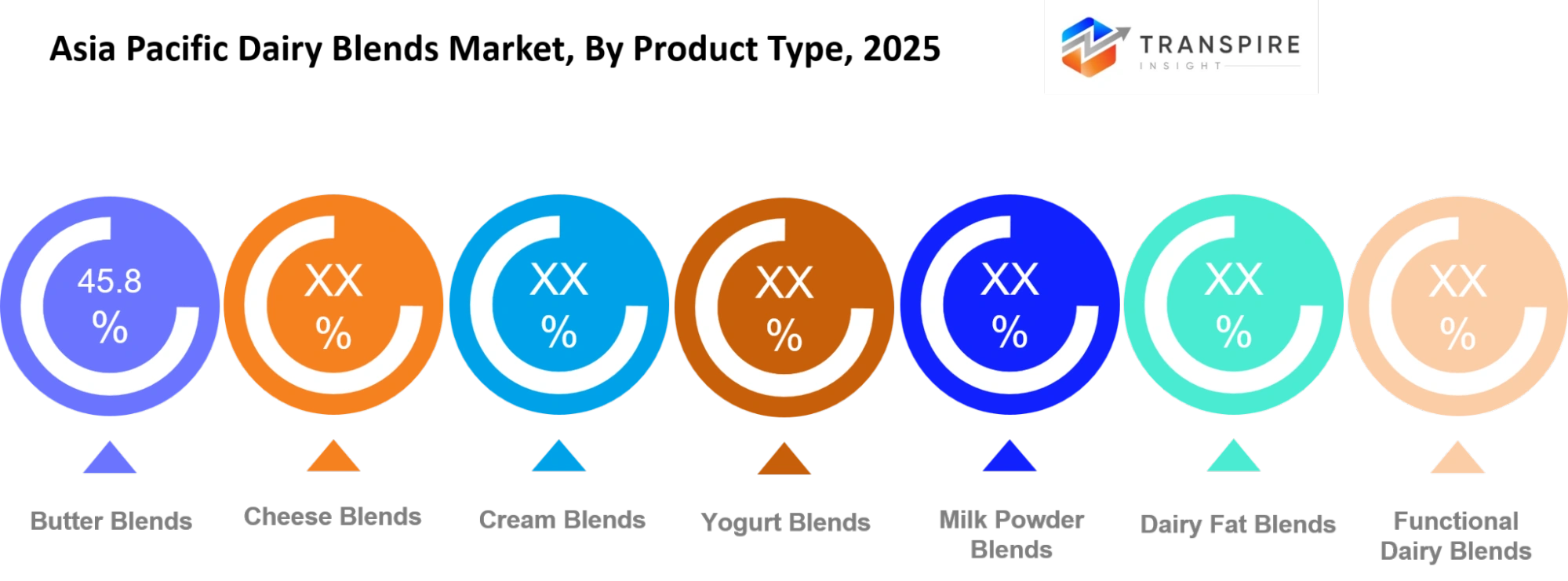
Butter blends help keep a steady kind of taste and spreadability in bakery items and packaged foods, especially when raw butter prices do this kind of wobbling. Cheese blends also bring a more predictable texture along with melt quality for processed food lines, which makes things easier for the production teams. Cream blends are usually picked for desserts and beverages, because they give a smoother consistency and it feels more even. Yogurt blends do the job for fortified dairy products and milk powder blends are still pretty common, since they store better and travel simpler across long supply chains, even in those big logistics chains.
More recently, dairy fat blends and functional dairy blends are showing up with higher importance, mainly for cost control, and for nutrition targeting in processed foods too. Dairy fat blends let food makers adjust the fat level, without having to change the overall product structure, or at least not much. Functional dairy blends lean into protein enrichment and health-focused options, like a more “do this for you” type of positioning. Then the other blends cover those customized formulations for industrial food processing, where manufacturers want flexibility in taste, texture and shelf life, across very large production runs, and the margins.
To learn more about this report, Download Free Sample Report
By Application :
Bakery applications still seem to be the biggest user of dairy blends, helping with cakes, pastries, and packaged baked goods that need a steady texture and some cost control. Confectionery also leans on dairy blends so the chocolate and sweets stay smooth, with a more even flavor balance. Dairy products applications cover reformulated milk based items where shelf life tends to stretch longer, and the taste has to stay standardized across mass production systems, or at least close enough.
Infant nutrition depends on controlled dairy blends, mainly for consistent nutrient makeup and the usual safety requirements. For beverage applications, dairy blends are used to boost mouthfeel, and sometimes to soften the production cost pressure that shows up. Food processing is more like a broad umbrella for industrial use, where dairy blends can replace fresh dairy inputs, or just supplement them when needed. Other applications include ready to eat meals and processed snacks that really need dairy functionality to remain stable during long storage and transport cycles, which is where things can get messy if the blend is wrong
By Form :
Powder form pretty much dominates, since it lasts longer on shelf life, it’s easier to move around and you also need less refrigeration across huge distribution networks. Powder dairy blends kind of help with bulk food manufacturing where consistent mixing really matters, you know, for the final feel and taste. Liquid form is mostly used in chilled products and beverage applications, because direct integration into the production lines tends to boost efficiency, and it helps with texture control, too.
Then you have paste form, which shows up in certain bakery and confectionery processes where controlled viscosity is needed , so the blending stays uniform. Other options include customized semi-processed blends that are built for industrial food production systems. In the end, form selection depends on storage conditions, cost efficiency, and processing speed, and manufacturers are slowly shifting toward more flexible formats that reduce wastage and keep production running more continuously, especially in high-volume operations.
By End User :
Food manufacturer(s) show up as the biggest end user group ,because dairy blends enable large scale production of bakery products, confectionery items, and various packed food. In practical terms ,these folks use the blends to handle cost swings while still keeping the product quality steady even when output is high. Retail demand also stays pretty even, mostly driven by packaged dairy based ingredients that people use for home cooking and smaller scale prep.
Then there are foodservice operators who lean on dairy blends to keep flavor and texture reliably aligned across both restaurants and quick service chains. This part of the market ,really depends on set formulations, so they can cut prep time and also keep supply more stable. Besides those groups ,you also have institutional catering plus industrial kitchens that need bulk dairy inputs for large meal production runs. For them, uniformity and cost control continue to be the main priorities ,even when volumes climb.
What are the Key Use Cases Driving the Asia Pacific Dairy Blends Market?
Dairy blends in the Asia Pacific market are still mostly pushed by bakery and confectionery production, like the main use case really. Industrial manufacturers count on blended dairy ingredients to help stabilize texture, keep cost fluctuations under control, an d also to maintain consistent quality across mass lines. Big processors use these blends to swap out variable fresh dairy inputs and keep production running smoothly in high volume plants that serve urban retail demand.
Then beverage formulation kinda follows, along with frozen dessert production, and both are clearly expanding. Quick service restaurants and packaged food manufacturers are leaning more on standardized dairy blends, because they want a uniform taste, better shelf stability, and faster production cycles across many outlets, plus distribution channels in fast growing metropolitan areas. It’s less about improvising and more about repeating the same result, each time.
Meanwhile, functional nutrition and infant formula development look like emerging use cases with solid growth potential. Manufacturers are starting to fold protein-enriched and fortified dairy blends into health focused products, which is also helped by tighter nutritional labeling requirements. At the same time, demand for specialized dietary solutions is rising in urban Asia Pacific consumer segments, so there’s more momentum here than before.
|
Report Metrics |
Details |
|
Market size value in 2025 |
USD 0.860 Billion |
|
Market size value in 2026 |
USD 0.936 Billion |
|
Revenue forecast in 2033 |
USD 1.701 Billion |
|
Growth rate |
CAGR of 8.91% from 2026 to 2033 |
|
Base year |
2025 |
|
Historical data |
2021 - 2024 |
|
Forecast period |
2026 - 2033 |
|
Report coverage |
Revenue forecast, competitive landscape, growth factors, and trends |
|
Regional scope |
Asia Pacific (India, China, Japan, Australia, South Korea, Rest of Asia Pacific) |
|
Key company profiled |
Fonterra, FrieslandCampina, Kerry Group, Arla Foods, Lactalis, Saputo, Danone, Nestle, Royal VIV Buisman, Abbott, Meiji, Yili, Mengniu, Amul, Dairy Farmers. |
|
Customization scope |
Free report customization (country, regional & segment scope). Avail customized purchase options to meet your exact research needs. |
|
Report Segmentation |
By Product Type (Butter Blends, Cheese Blends, Cream Blends, Yogurt Blends, Milk Powder Blends, Dairy Fat Blends, Functional Dairy Blends, Others); By Application (Bakery, Confectionery, Dairy Products, Infant Nutrition, Beverages, Food Processing, Others); By Form (Powder, Liquid, Paste, Others); By End User (Food Manufacturers, Retail, Foodservice, Others). |
Which Regions are Driving the Asia Pacific Dairy Blends Market Growth?
China is leading the Asia Pacific Dairy Blends Market, more or less because it has this huge food processing base and a pretty strong industrial dairy appetite. You can see it in how the manufacturing clusters are extensive , they let producers keep running bakery, confectionery, and packed food lines that depend on standardized dairy inputs. Also, the tighter food safety rules have basically nudged manufacturers to stick to consistent formulation routines, and that makes blended dairy ingredients easier to adopt. On top of that, logistics are well-developed and cold chain infrastructure is solid, so high-volume distribution works smoothly across domestic plus export routes.
Japan is more like a stable contributor, though it feels more mature. It’s backed by tightly regulated food quality systems and advanced processing standards. Demand doesn’t jump wildly, it just grows steadily because people keep buying convenience foods and those premium dairy-based products. In a way, unlike China, the momentum in Japan isn’t so much about size, but about precision formulation and quality assurance needs. There’s also long-term investment in food technology, so dairy blends get added, but in a controlled, ongoing manner for industrial uses.
India, on the other hand, looks like the fastest-moving region in the Asia Pacific Dairy Blends Market. That’s mostly due to rapid expansion in quick service restaurants and packaged food manufacturing since 2023. With more urban consumers, demand is rising for cost-stable dairy ingredients, and those help producers scale output without too much volatility. Government support for food processing infrastructure has improved the supply chain efficiency too, which cuts down procurement bottlenecks. This growth is a clear signal for entry opportunities, especially for ingredient suppliers aiming at high-volume , price-sensitive food production ecosystems, through 2033.
Who are the Key Players in the Asia Pacific Dairy Blends Market and How Do They Compete?
The competitive landscape of the Asia Pacific Dairy Blends Market still looks moderately consolidated, with big dairy and ingredient players around the world staying pretty influential over formulation standards and supply networks. Instead of price only, most of the fighting seems to lean into product customization, cost efficiency , and supply reliability. A lot of established firms try to lock in longer term agreements with industrial food processors, and even QSR chains, just to keep revenue streams steady. On top of that , it’s the technological advancement in blending precision plus protein fortification that kinda shapes how companies position themselves competitively.
You can see it in how firms operate. Fonterra tends to push large scale supply integration, along with export networks across Asia, which gives it an edge in those high volume industrial contracts. FrieslandCampina differentiates more through advanced dairy processing know how and ingredient solutions that are tailored for bakery and beverage manufacturers. Kerry Group leans into formulation innovation and functional nutrition blends, and that helps it stay strong in premium and health focused applications. Saputo Inc. expands via strategic acquisitions and distribution partnerships, which in turn strengthens its presence across Asia Pacific food manufacturing hubs. Arla Foods, on the other hand , concentrates on high quality protein ingredients and collaborative product development with foodservice brands, supporting a more consistent expansion across urban demand centers.
Company List
- Fonterra
- FrieslandCampina
- Kerry Group
- Arla Foods
- Lactalis
- Saputo
- Danone
- Nestle
- Royal VIV Buisman
- Abbott
- Meiji
- Yili
- Mengniu
- Amul
- Dairy Farmers
Recent Development News
In April 2026, Fonterra launched three new foodservice dairy products at Food & Hospitality Asia 2026 in Singapore. The launch expanded Fonterra’s portfolio for professional kitchens across Southeast Asia and strengthened its position in value-added dairy ingredient solutions, supporting broader adoption of blended dairy formulations in the regional foodservice sector.
Source: https://www.fonterra.com/
In March 2026, FrieslandCampina advanced the integration of its acquisition of Milcobel completed in 2025. The acquisition strengthened supply resilience, expanded production capabilities, and improved access to ingredient markets, reinforcing FrieslandCampina’s ability to serve food manufacturers using dairy blend formulations across Asia Pacific.
Source: https://www.dairyreporter.com/
What Strategic Insights Define the Future of the Asia Pacific Dairy Blends Market?
The Asia Pacific Dairy Blends Market is drifting toward a more specialized and formulation driven future, where value creation is gonna lean less on sheer volume expansion and more on ingredient customization , maybe. Over the next five to seven years, food manufacturers will increasingly choose dairy blends that are built for specific nutritional, functional, and processing needs, not just generic use. This change will be nudged by tighter cost management pressure, stronger product differentiation, and the rising adoption of fortified components in packaged foods and beverages.
There’s also a less visible risk hiding in plain sight, basically the concentration of critical dairy raw material supplies in only a small set of exporting regions. If something hits , like climate volatility, feed cost spikes, or trade policy adjustments, it can cause supply imbalances that then ripple into blend production economics across Asia Pacific. Meanwhile, there’s an emerging opening that’s getting more attention, precision nutrition use cases. Protein enriched and age specific dairy formulations are starting to draw investment, especially in India and Southeast Asia where processed nutrition markets are building momentum, quite quickly.
For players in the market, it makes sense to strengthen formulation know-how and regional sourcing relationships early on. Those who grow adaptable supply networks and application specific product lines will be in a better spot to win premium margins as buyer requirements become more exacting and tuned to demand.
Asia Pacific Dairy Blends Market Report Segmentation
By Product Type
- Butter Blends
- Cheese Blends
- Cream Blends
- Yogurt Blends
- Milk Powder Blends
- Dairy Fat Blends
- Functional Dairy Blends
By Application
- Bakery
- Confectionery
- Dairy Products
- Infant Nutrition
- Beverages
- Food Processing
By Form
- Powder
- Liquid
- Paste
By End User
- Food Manufacturers
- Retail
- Foodservice
Frequently Asked Questions
Find quick answers to common questions.
The Asia Pacific Dairy Blends Market size is USD 1.701 Billion in 2033.
Key segments for the Asia Pacific Dairy Blends Market are By Product Type (Butter Blends, Cheese Blends, Cream Blends, Yogurt Blends, Milk Powder Blends, Dairy Fat Blends, Functional Dairy Blends, Others); By Application (Bakery, Confectionery, Dairy Products, Infant Nutrition, Beverages, Food Processing, Others); By Form (Powder, Liquid, Paste, Others); By End User (Food Manufacturers, Retail, Foodservice, Others).
Major Asia Pacific Dairy Blends Market players are Fonterra, FrieslandCampina, Kerry Group, Arla Foods, Lactalis, Saputo, Danone, Nestle, Royal VIV Buisman, Abbott, Meiji, Yili, Mengniu, Amul, Dairy Farmers.
The Asia Pacific Dairy Blends Market size is USD 0.860 Billion in 2025.
The Asia Pacific Dairy Blends Market CAGR is 8.91% from 2026 to 2033.
- Fonterra
- FrieslandCampina
- Kerry Group
- Arla Foods
- Lactalis
- Saputo
- Danone
- Nestle
- Royal VIV Buisman
- Abbott
- Meiji
- Yili
- Mengniu
- Amul
- Dairy Farmers
About the Authors

Chetan Dhatrak
I’m Chetan Dhatrak, a Senior Research Analyst at Transpire Insight, specializing in the Consumer Goods, Foods and Beverages industry. I focus on analyzing market trends, consumer behavior, competitive landscapes, and industry developments to deliver accurate, data-driven insights. My research at Transpire Insight is built on credible sources and in-depth analysis, helping businesses and readers better understand market dynamics, emerging opportunities, and evolving consumer preferences. I’m committed to creating reliable, well-researched content that supports informed decision-making and reflects the latest developments in the consumer goods and food & beverage sectors.

Chakradhar Khansole
Chakradhar serves as the Research Director at Transpire Insight, bringing over 8 years of experience in technology, innovation, and strategic market intelligence. He specializes in transforming complex market data into actionable business insights that enable organizations to make informed, growth-oriented decisions. Recognized for his strategic vision and analytical expertise, Chakradhar leads high-impact research initiatives, delivering comprehensive market assessments, competitive intelligence, and forward-looking industry analysis.
Recently Published Reports
-
Apr 2026
Baby Infant Formula Market
Baby Infant Formula Market Size, Share & Analysis Report By ype (Infant Milk, Follow On Milk, Specialty Baby Milk, Growing-Up Milk), By Ingredient (Carbohydrate, Fat, Protein, Minerals, Vitamins, and Others), By Product Form (Powder, Liquid, and Ready-to-feed), By Distribution Channels (Supermarket/Hypermarket, Specialty Store, Pharmacies, Online Retail, and Others), and Geography (North America, Europe, Asia-Pacific, Middle East and Africa, South and Central America), 2021 - 2031
-
Apr 2026
Edible Insects for Animal Feed Market
Edible Insects for Animal Feed Market Size, Share & Analysis Report By Type (Insect Powder, Insect Meal, Insect Bar, Insect Paste, Insect Oil, and Others), By Insect Type (Beetles, Cricket, Caterpillar, Hymenoptera, Orthoptera, Tree Bugs, and Others), By Application (Livestock, Pet Food, and Aquaculture), By Livestock Type (Poultry, Swine, and Others), and Geography (North America, Europe, Asia-Pacific, Middle East and Africa, South and Central America), 2021 - 2031
-
Apr 2026
Food Industry Disinfection and Bacterial Control Market
Food Industry Disinfection and Bacterial Control Market Size, Share & Analysis Report By Type (Chemical Disinfectants, Physical Disinfectants, and Biocides and Antimicrobials), By Application (Food Processing Equipment Surface Disinfection, Food Preparation Areas Surface Disinfection, Storage Areas Surface Disinfection, Anti-microbial Coatings Food Preservation, and Preservative Solutions Food Preservation), By End User (Meat and Poultry Processing, Dairy Processing, Seafood Processing, Bakery and Confectionery, Restaurants and Commercial Kitchens, and Food Service Providers), By Sales Channel (Online, Offline), and Geography (North America, Europe, Asia-Pacific, Middle East and Africa, South and Central America), 2021 - 2031
-
May 2026
Freeze Dried Food Market
Freeze Dried Food Market Size, Share & Analysis Report By Product Type (Fruits, Vegetables, Freeze-Dried Dairy Products, Freeze-Dried Meat and Seafood, Freeze-Dried Pet Food, and Prepared Meal), By Nature (Organic, and Conventional), By Form (Powdered, Granules, and Diced), By End Use (Breakfast Cereals, Dairy Products, Bakery & Confectionery, Nutritional Bars & Supplements, Powdered Beverages, Snacks, and Retail (Household)), and Geography (North America, Europe, Asia-Pacific, Middle East and Africa, South and Central America), 2021 - 2031