
South Korea Ready-to-Drink Beverages Market Size & Forecast:
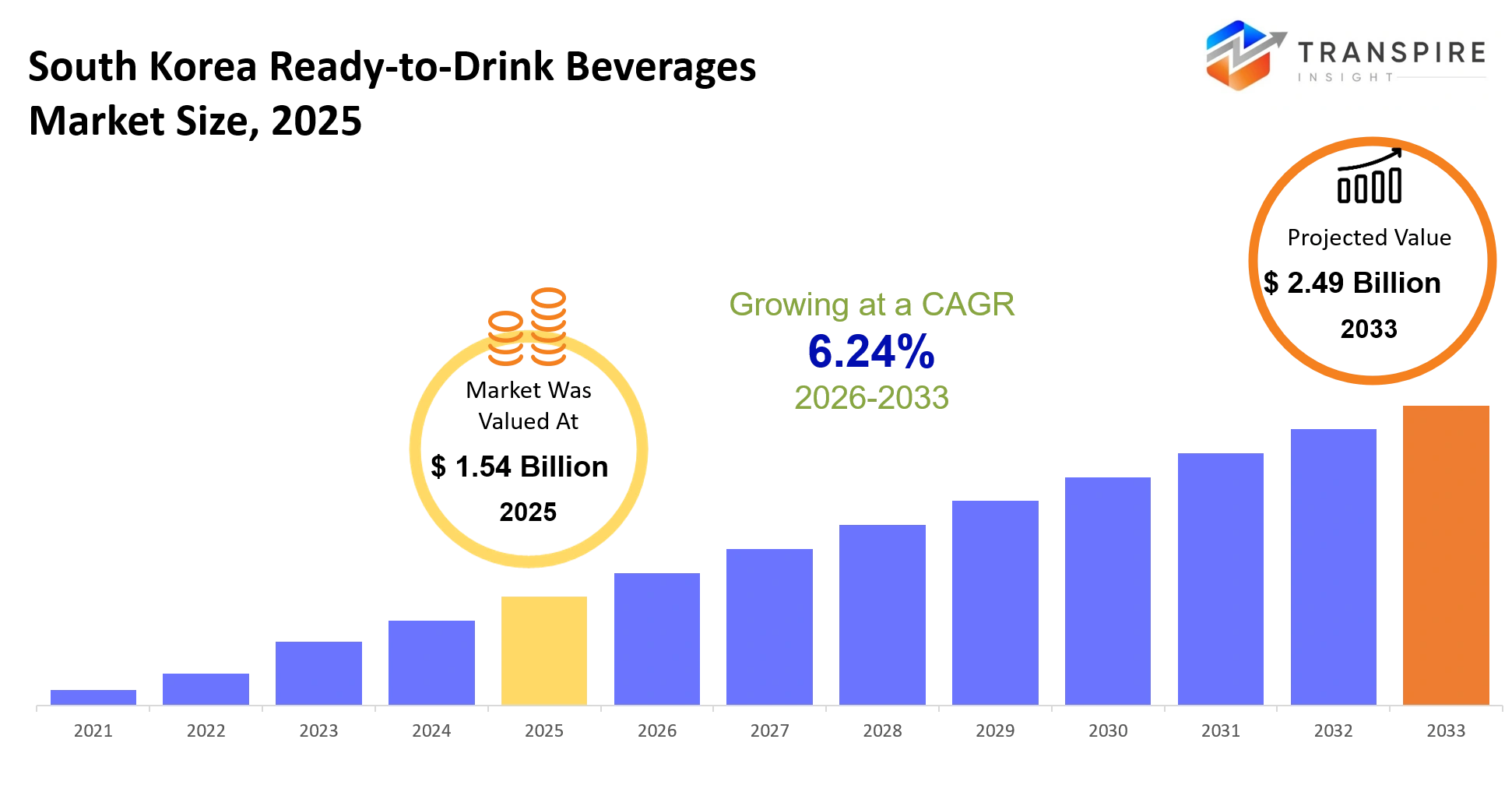
- South Korea Ready-to-Drink Beverages Market Size 2025: USD 1.54 Billion
- South Korea Ready-to-Drink Beverages Market Size 2033: USD 2.49 Billion
- South Korea Ready-to-Drink Beverages Market CAGR: 6.24%
- South Korea Ready-to-Drink Beverages Market Segments: By Product Type (Tea, Coffee, Energy Drinks, Juice, Others); By Packaging (Bottles, Cans, Cartons, Others); By Distribution (Retail, Online, Foodservice, Others)
To learn more about this report,  Download Free Sample Report
South Korea Ready-to-Drink Beverages Market Summary
The South Korea Ready-to-Drink Beverages Market was valued at USD 1.54 billion in 2025. It is forecast to reach USD 2.49 billion by 2033. That is a CAGR of 6.24% over the period.
The market for ready-to-drink (RTD) refreshments and functional nutrition systems in South Korea mainly serves time-sensitive consumers, i.e. commuters and office workers via vending machines, convenience stores and rapid-delivery retail networks. The RTD beverages are consumed as opposed to being prepared at home. Within this market, instant formats have replaced traditional consumption not only in coffee and tea but also in the energy drink category and in functional hydration.
The ready-to-drink beverage market has experienced a significant transformation from carbonated beverages that contain high levels of sugar to lower sugar and functional RTD beverages (e.g. protein drinks, RTD coffee and teas that are focused on consumer wellness) over the last 3 to 5 years. The COVID-19 disruption was one of the major triggers which drove consumption from food service channels to a greater dependence on retail and quick commerce. This shift has caused brands to change the way they develop and distribute products that are packaged and shelf-stable.
Manufacturers have moved quickly to reformulate their products and to increase their product's premium positioning by utilizing mobile consumer-based health-oriented positioning and compact packaging. This has resulted in a faster SKU turnover, increased control by convenience retail, and an increased use of innovation as a means of generating revenue throughout the value chain.
Key Market Insights
- The market for ready-to-drink (RTD) beverages in South Korea is changing into a convenience-based hydration system that provides convenience and hydration to customers on the go in both retail and vending environments.
- It is anticipated that the South Korean RTD Beverage market will grow at a constant rate during the forecast period due to the new functional drinks being produced and premium products being purchased in urban areas.
- The Capital region of Korea has the greatest market share for ready-to-drink (RTD) beverages at nearly 45% of total revenues in 2025 because of the high density of convenience stores, which has created an urban lifestyle.
- Non-Capital areas of South Korea are expected to be the fastest-growing segment in sales for RTD beverages from 2024 - 2028, as retailers continue to open more stores and also expand their e-commerce capabilities.
- The RTD coffee segment has the largest market share of 38% of total revenue with a rich coffee culture and significant daily usage by people commuting to work and those working in office settings.
- The RTD tea category is the second largest segment for RTD beverages and is positioned as low sugar while also providing high levels of antioxidants, which is an important element of consumer choice with respect to beverage products.
- The fastest-growing segment of the RTD beverage market is functional beverages (e.g., protein drinks, vitamin-fortified drinks, etc.), both functional beverages and wellness-driven purchases will continue to encompass a large number of purchases through 2024 - 2029.
- Approximately 60% of RTD beverage stores are located in convenience stores, demonstrating the strong dependence of the Korea RTD Beverage Sector on the accessibility of immediate retail store purchases.
- Both e-commerce and quick commerce applications are the fastest-growing forms of store purchases with a very high level of repeat transactions due to subscription and app-based loyalty programs.
What are the Key Drivers, Restraints, and Opportunities in the South Korea
Drivers
The South Korea Ready-to-Drink Beverages Market is experiencing rapid growth driven by a significant trend toward functional convenience consumption, especially among urban commuters and office workers who have given up on traditional meal-based drinks in favour of readily consumable RTD products. This trend has been significantly accelerated as a result of the COVID-19 pandemic, which has given rise to single-serve packaged beverages being accepted as the norm in both retail and vending environments. As a result of this shift, manufacturers have been expanding their low-sugar RTD coffee, protein drinks and fortified tea offerings in all segments of the market, which has directly led to increased frequency of purchase per person and, subsequently, increased sales per retailer in urban centres with a high population density.
Restraints
However, a major constraint facing the South Korea RTD Beverages Market is the significant concentration of shelf space allocated to convenience store chains, resulting in structural barriers of entry for small producers. Large retailers such as convenience store chains favour proven-selling brands when it comes to allocating shelf space, which limits the diversity of the number of products on store shelves, and subsequently delays the rate of diffusion of innovation. Additionally, the concentration of shelf space between large retailers also suppresses the growth of new entrants in the South Korea RTD Beverages Market, as their access to distribution has become increasingly controlled and dependent upon negotiations for product listings, rather than through open competition.
Opportunities
With the use of AI technology with smart vending machine infrastructure at air terminals, metro transit stations, and bus transit hubs across Seoul and Busan, there are now opportunities for "personal beverage formulation". Many beverage makers (Lotte Chilsung Beverage, Coca-Cola) are building predictive vending machines that provide product suggestions based on data inputs including temperature, time-of-day and previous purchases of customers; thus, allowing companies to provide much more personal customer experiences as this concept continues to grow in popularity.
What Has the Impact of Artificial Intelligence Been on the South Korea Ready-to-Drink Beverages Market?
The market for bottled drinks in South Korea is undergoing major changes as advanced digital technology and artificial intelligence (AI) continue to revolutionize the way manufacture, distribute and target consumers throughout the various urban delivery channels in the country. In manufacturing operations, bottling lines continue to use AI-based automation, including real-time monitoring to identify defects in artificial packaging, which reduces the workload associated with manual inspection of product quality, and also improves the consistency of bottling and packaging process. In addition, predictive maintenance for filling and labeling equipment through the use of machine learning allows manufacturers to minimize unplanned downtime, thereby improving stability of production output within high-capacity (RTD) beverage manufacturing systems.
From a commercial perspective, many companies in South Korea use predictive analytics to forecast demand at both vending operators and convenience stores. In doing so, businesses analyze historical sales data, weather patterns and commuter patterns for optimal inventory placement at vending and convenience store locations, therefore reducing potential stock out conditions as well as improving sell-through rates and eliminating waste for perishable category (RTD) beverage products like dairy-based products and functional teas. In addition, digital vending systems in metropolitan areas such as Seoul utilize algorithms to recommend product(s) to consumers thereby improving conversions, based on previous purchase behavior.
Costs associated with integrating AI across the fragmented South Korean retail system and traditional bottling technology presents some challenges for smaller and mid-size producers, who otherwise would not have the ability to implement advanced analytical capabilities due to the lack of uniformly standardized data across the relevant technology systems.
Key Market Trends
- In the years to come, South Korean consumers will continue to demand more functional beverages instead of carbonated beverages. The demand for ready-to-drink (RTD) coffee will continue to grow rapidly, especially among commuters returning to work in 2023. The volume of sales in convenience stores will also continue to increase, particularly in high pedestrian traffic areas of major cities within South Korea.
- Following the recovery from the pandemic in 2021, private label RTD products sold at convenience stores have created intense price competition and significantly reduced dependence on branded suppliers for purchase of RTD products that are considered to be of high value.
- The number of people buying ready-to-drink (RTD) teas that are low in sugar increased in 2020, as beverage manufacturers began to create new formulations of their products due to shifting consumer preferences towards health. As consumers became more health-conscious about what they buy, they increasingly began to buy reduced-sugar and functional (RTD) beverage categories.
- The health and wellness segment of the beverage category continued to grow rapidly in 2021, as suppliers were introducing new beverages with added value to their product lines.
- The functional RTD beverage category includes beverages that contain protein, collagen, and vitamins, which have grown in popularity in 2021 and contributed significantly to the premium category.
- Other companies listed above expanded their offerings with premium RTD beverages utilizing premium ingredients and different types of packaging during 2021.
- Artificial intelligence (AI)-driven vending machines in Seoul began to recommend RTD beverages based on consumer purchasing behavior at the point-of-sale following their introduction in 2023, resulting in substantial increases in conversion rates on sales of RTD beverages.
- Sales of RTD beverages via e-commerce and quick commerce channels accelerated following 2021 due to increased demand for convenience.
South Korea Ready-to-Drink Beverages Market Segmentation
By Product Type
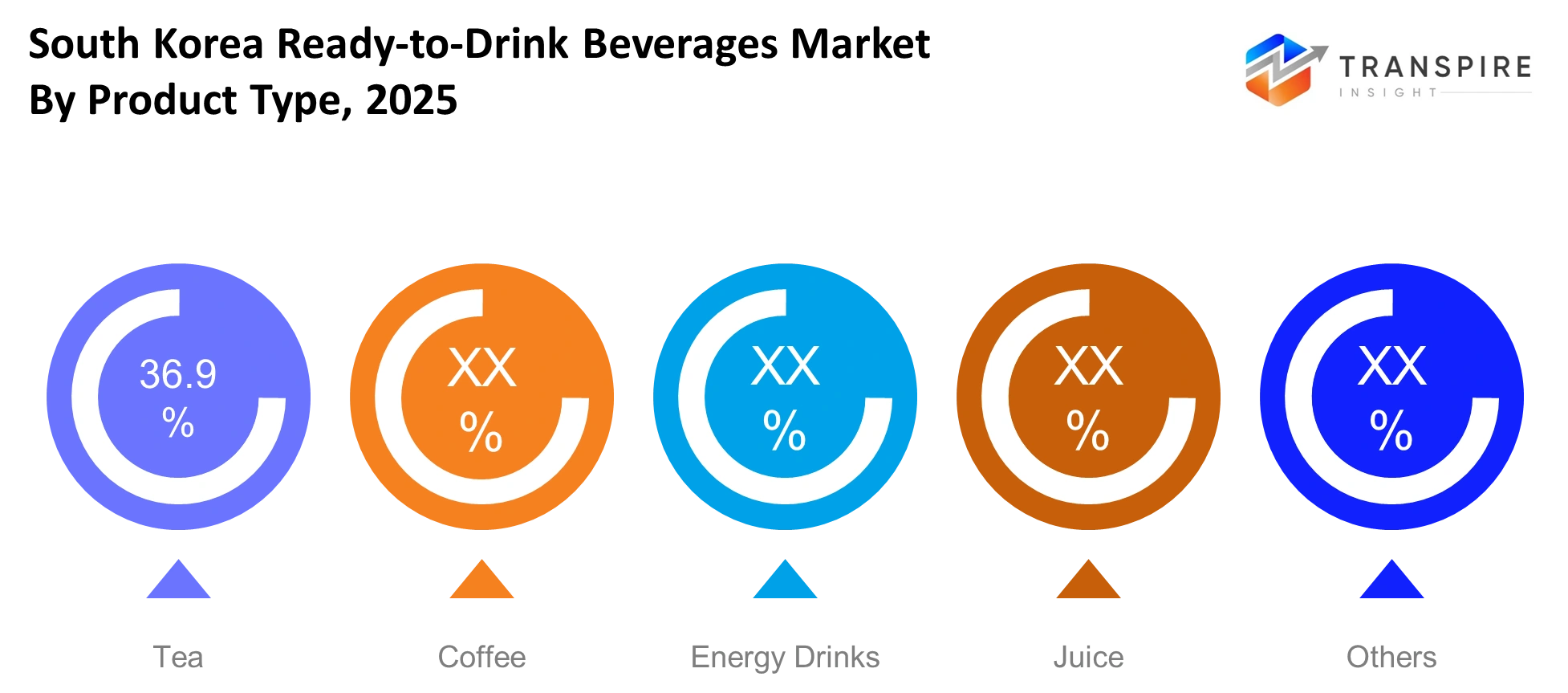
The South Korea Ready-to-Drink Beverages Market is led by coffee products. This is because many people in South Korea have to travel to work and they need something to drink while they are on their way. They like to drink the South Korea Ready-to-Drink Beverages like coffee because it helps them stay awake.The South Korea Ready-to-Drink Beverages Market also has tea which is getting popular. This is because companies are making tea drinks that're low in sugar and have antioxidants. This started happening around 2022.The South Korea Ready-to-Drink Beverages Market also has energy drinks which are getting more popular. This is because young people in South Korea want to stay awake and focused when they are studying or working.The South Korea Ready-to-Drink Beverages Market also has juice and other special drinks. These drinks are getting more popular because they have vitamins and are good for people in South Korea.Companies are always making products and changing old ones to keep the South Korea Ready-to-Drink Beverages Market fresh. This helps the South Korea Ready-to-Drink Beverages Market keep growing.People in South Korea want the South Korea Ready-to-Drink Beverages that're good for them and easy to take on the go. They like the South Korea Ready-, to-Drink Beverages because they are easy to drink while they are traveling to work.
To learn more about this report, Download Free Sample Report
By Packaging
In the South Korea Ready-to-Drink Beverages Market bottles are the most popular because people can carry them around easily. They are especially popular in convenience stores. Cans are also popular for coffee and energy drinks because they are cheap to make and can be sold in quantities. Cartons are getting popular for milk-based drinks and special drinks because people care about the environment. People are also buying packs of drinks because they do not want to waste anything. Companies are making exciting packaging to make their products stand out. The South Korea Ready-to-Drink Beverages Market is moving towards packaging that's light can be recycled and is easy to carry around.
By distribution
In South Korea ready-to-drink beverages are sold in stores.This is because there are convenience stores around and people often buy things on a whim.Online shopping is also becoming popular as companies can deliver products fast.Additionally cafes and restaurants have started selling drinks after a slow period.Vending machines are being set up in places like train stations so people can grab a drink while traveling.Companies are using systems to track their stock levels so they do not run out of products.The ready-to-drink beverages market in South Korea is using a mix of online sales to reach more customers.The market is also making use of stores, shopping and vending machines to sell more drinks.South Korea Ready-, to-Drink Beverages Market is really focusing on making drinks available everywhere.
What are the Key Use Cases Driving the South Korea Ready-to-Drink Beverages Market?
In South Korea's ready-to-drink (RTD) beverage market, the prevalence of commuter-driven consumer behavior helps to fuel core adoption of RTD coffee and tea products as a fast source of hydration for people who are traveling or in-between work. Most of these consumers purchase their RTD beverages from convenience stores or vending machine locations, as they allow quick and easy access to RTD products in busy urban environments. Consumers tend to make repeat purchases of RTD beverages on a daily basis due to an abundance of foot traffic in high density city areas combined with little time to prepare food.
As consumers in South Korea continue to incorporate workplace and fitness related hydration into their daily routines, there has also been an increased demand for functional RTD beverages among office workers and younger consumers for energy and wellness purposes. Retail and food service locations also contribute to this increased demand for RTD beverages by promoting packaged RTD products as companion items to ready-to-eat meals. As a result, the number of consumers purchasing RTD beverages in workplaces or gyms will continue to expand as employers and gyms will introduce easier access to RTD beverages into their employees' and members' daily routines.
Several new use cases for consuming RTD beverages are emerging including: AI-based personalized vending recommendations; RTD delivery via quick commerce; and use of data-driven vending at transit locations (e.g., in Seoul and Busan) where vending machine suggestions are influenced by time of day, weather conditions, and historical purchase behavior, all of which indicate an increased focus on digital integration in the future.
|
Report Metrics |
Details |
|
Market size value in 2025 |
USD 1.54 Billion |
|
Market size value in 2026 |
USD 1.63 Billion |
|
Revenue forecast in 2033 |
USD 2.49 Billion |
|
Growth rate |
CAGR of 6.24% from 2026 to 2033 |
|
Base year |
2025 |
|
Historical data |
2021 - 2024 |
|
Forecast period |
2026 - 2033 |
|
Report coverage |
Revenue forecast, competitive landscape, growth factors, and trends |
|
Regional scope |
South Korea |
|
Key company profiled |
Nestle, Coca-Cola, PepsiCo, Suntory, Starbucks, Lotte Chilsung, Dongwon, Nongshim, Dole, Danone, Monster Beverage, Red Bull, Ito En, Unilever, CJ Foods |
|
Customization scope |
Free report customization (country, regional & segment scope). Avail customized purchase options to meet your exact research needs. |
|
Report Segmentation |
By Product Type (Tea, Coffee, Energy Drinks, Juice, Others); By Packaging (Bottles, Cans, Cartons, Others); By Distribution (Retail, Online, Foodservice, Others) |
Which Regions are Driving the South Korea Ready-to-Drink Beverages Market Growth?
The metropolitan area of Seoul has the most leading ready-to-drink beverage market in South Korea; this is due to Seoul's heavy retail infrastructure as well as having a large number of commuters. There are numerous convenience stores located in business and transit areas providing consistent availability of product offerings. The advanced development of the logistics system and the efficiency of the cold-chain system allow for rapid restocking of high-volume SKUs. Additionally, these are major beverage manufacturers that have strong brand recognition in this region that will test new RTD formats in urban pilot markets. The dominant revenue share is acquired from this region due to continuous product innovation and high purchase frequency of products from office workers.
The second largest contributor to the RTD beverage market is Busan, as well as the surrounding industrial zones along its coastline. The port and the area provide stable population, consumer demands and workforce; although the RTD beverage industry relies heavily on predictable consumption of logistics workers, port workers and manufacturing clusters as compared to Seoul, where many consumers continuously experiment with beverage consumption. Additionally, established distribution networks are tied to the maritime route, and therefore providing consistent availability of product across the industrial retailer to the consumer. Furthermore, this area has long-term corporate supply contracts with beverage manufacturers to support consistent demand cycles, regardless of the consumer demand cycle.
The fastest-growing area includes secondary inland cities, such as Daejeon and Daegu; as a result of modernization and expansion of quick commerce retail stores, there has been a reshaping of how consumers have access to RTD beverages. Increased investment
Who are the Key Players in the South Korea Ready-to-Drink Beverages Market and How Do They Compete?
The South Korean Ready-to-Drink Beverage Market is dominated by a narrow group of multinational and domestic rivals who control most of the shelf space and vending locations in convenience stores. Large incumbents protect their share through aggressive retail contracts, frequent SKU rotations, brand loyalty, and strong business-to-business relationships in RTD coffee and functional beverages.Innovation-driven disruptions are likely to be more influential than price-driven competition and new entrants face challenges such as limited convenience store listings and high distribution costs.Product distinction and channel control are now critical to defining an organisation's competitive position compared to traditional advertising and scale.
Coca-Cola has a competitive advantage due to its wide range of RTD coffee and tea products, which incorporate localised flavours and cater to Korean preferences. Coca-Cola has developed packaging innovations, which include smaller, portable formats that fit with commuter consumption patterns. Coca-Cola's expansion strategy includes developing partnerships with convenience store chains and vending operators in order to guarantee consistent nationwide availability within urban transit hubs.
Lotte Chiulsung Beverage (Lotte) is strengthening its position by integrating with domestic retailers and sourcing products locally, particularly within low-sugar and functional drink categories. Similarly, PepsiCo is competing through product diversification and cross-brand bundling strategies in the convenience channel. Both organisations are also expanding through distribution partnerships.
Company List
- Nestle
- Coca-Cola
- PepsiCo
- Suntory
- Starbucks
- Lotte Chilsung Beverage
- Dongwon Industries
- Nongshim
- Dole
- Danone
- Monster Beverage
- Red Bull
- Ito En
- Unilever
- CJ Foods
Recent Development News
In 2026, the South Korea Ready-to-Drink Beverages Market saw notable product innovation activity driven by premium RTD expansion and localization strategies. LOTTE Asahi Liquor announced the launch of “Asahi CLEAR HIGHBALL,” marking the introduction of canned RTD whisky-highball beverages in South Korea. The product targets urban consumers seeking convenient, ready-mixed alcoholic refreshment formats with standardized taste consistencyhttps://www.asahigroup-holdings.com
In early 2026, The Coca-Cola Company continued restructuring and portfolio optimization in Korea, focusing on strengthening its beverage system and improving operational efficiency across key RTD categories. The company’s 2025–2026 strategy emphasizes disciplined execution and long-term system stability across regional markets, including Asia. https://www.coca-colacompany.com
In 2025, Lotte Chilsung Beverage expanded its zero-sugar RTD portfolio, with strong growth in its “Milkis Zero” and related functional beverage lines, reflecting a broader shift toward low-calorie and health-positioned drinks in Korea. The company recorded sustained category expansion across domestic and export markets, reinforcing premiumization in RTD segments. https://pulse.mk.co.kr
What Strategic Insights Define the Future of the South Korea Ready-to-Drink Beverages Market?
The South Korea Ready-to-Drink Beverages Market is changing. People now want drinks that're good for their health and delivered fast. They choose drinks based on how they make them feel, how quickly they can get them and what benefits they offer. Traditional branding is not enough.
Over the 5 to 7 years shopping for drinks will be influenced by technology and people's busy city lifestyles. This will make people buy drinks on impulse. They will buy drinks as part of their routine like when they are moving around the city or at work. RTD beverages will become a part of life.
There is a risk for drink manufacturers. Many of them rely on a few convenience store chains. This can lead to prices and less control over where their drinks are sold. If these stores change their contracts or join together it could hurt the drink manufacturers profits. Reduce the variety of drinks available.
There is also an opportunity. New vending machines can be used in places like train stations. These machines can sell drinks based on what people're doing and the weather. For example if it's hot outside the machine can sell drinks. Companies that make drinks should work directly with retailers and make drinks that use data. This way they can stay competitive as retail stores become more controlled by computers and algorithms. South Korea Ready-, to-Drink Beverages Market participants must adapt to these changes.
South Korea Ready-to-Drink Beverages Market Report Segmentation
By Product Type
- Tea
- Coffee
- Energy Drinks
- Juice
- Others
By Packaging
- Bottles
- Cans
- Cartons
- Others
By Distribution Channel
- Retail
- Online
- Foodservice
- Others
Frequently Asked Questions
Find quick answers to common questions.
The expected South Korea Ready-to-Drink Beverages Market size for the market will be USD 2.49 Billion in 2033.
Key segments for the South Korea Ready-to-Drink Beverages Market are By Product Type (Tea, Coffee, Energy Drinks, Juice, Others); By Packaging (Bottles, Cans, Cartons, Others); By Distribution (Retail, Online, Foodservice, Others)
Major South Korea Ready-to-Drink Beverages Market players are given in points Dentsply Sirona, Carestream Dental, Planmeca, Vatech, Envista, J Morita, Acteon, NewTom, Owandy, Asahi Roentgen, Yoshida Dental, Genoray, Cefla, Ray, PreXion.
The South Korea Ready-to-Drink Beverages Market size is USD 1.54 Billion in 2025.
The South Korea Ready-to-Drink Beverages Market CAGR is 6.24% from 2026 to 2033.
- Nestle
- Coca-Cola
- PepsiCo
- Suntory
- Starbucks
- Lotte Chilsung Beverage
- Dongwon Industries
- Nongshim
- Dole
- Danone
- Monster Beverage
- Red Bull
- Ito En
- Unilever
- CJ Foods
About the Authors

Chetan Dhatrak
I’m Chetan Dhatrak, a Senior Research Analyst at Transpire Insight, specializing in the Consumer Goods, Foods and Beverages industry. I focus on analyzing market trends, consumer behavior, competitive landscapes, and industry developments to deliver accurate, data-driven insights. My research at Transpire Insight is built on credible sources and in-depth analysis, helping businesses and readers better understand market dynamics, emerging opportunities, and evolving consumer preferences. I’m committed to creating reliable, well-researched content that supports informed decision-making and reflects the latest developments in the consumer goods and food & beverage sectors.

Chakradhar Khansole
Chakradhar serves as the Research Director at Transpire Insight, bringing over 8 years of experience in technology, innovation, and strategic market intelligence. He specializes in transforming complex market data into actionable business insights that enable organizations to make informed, growth-oriented decisions. Recognized for his strategic vision and analytical expertise, Chakradhar leads high-impact research initiatives, delivering comprehensive market assessments, competitive intelligence, and forward-looking industry analysis.
Recently Published Reports
-
Apr 2026
Baby Infant Formula Market
Baby Infant Formula Market Size, Share & Analysis Report By ype (Infant Milk, Follow On Milk, Specialty Baby Milk, Growing-Up Milk), By Ingredient (Carbohydrate, Fat, Protein, Minerals, Vitamins, and Others), By Product Form (Powder, Liquid, and Ready-to-feed), By Distribution Channels (Supermarket/Hypermarket, Specialty Store, Pharmacies, Online Retail, and Others), and Geography (North America, Europe, Asia-Pacific, Middle East and Africa, South and Central America), 2021 - 2031
-
Apr 2026
Edible Insects for Animal Feed Market
Edible Insects for Animal Feed Market Size, Share & Analysis Report By Type (Insect Powder, Insect Meal, Insect Bar, Insect Paste, Insect Oil, and Others), By Insect Type (Beetles, Cricket, Caterpillar, Hymenoptera, Orthoptera, Tree Bugs, and Others), By Application (Livestock, Pet Food, and Aquaculture), By Livestock Type (Poultry, Swine, and Others), and Geography (North America, Europe, Asia-Pacific, Middle East and Africa, South and Central America), 2021 - 2031
-
Apr 2026
Food Industry Disinfection and Bacterial Control Market
Food Industry Disinfection and Bacterial Control Market Size, Share & Analysis Report By Type (Chemical Disinfectants, Physical Disinfectants, and Biocides and Antimicrobials), By Application (Food Processing Equipment Surface Disinfection, Food Preparation Areas Surface Disinfection, Storage Areas Surface Disinfection, Anti-microbial Coatings Food Preservation, and Preservative Solutions Food Preservation), By End User (Meat and Poultry Processing, Dairy Processing, Seafood Processing, Bakery and Confectionery, Restaurants and Commercial Kitchens, and Food Service Providers), By Sales Channel (Online, Offline), and Geography (North America, Europe, Asia-Pacific, Middle East and Africa, South and Central America), 2021 - 2031
-
May 2026
Freeze Dried Food Market
Freeze Dried Food Market Size, Share & Analysis Report By Product Type (Fruits, Vegetables, Freeze-Dried Dairy Products, Freeze-Dried Meat and Seafood, Freeze-Dried Pet Food, and Prepared Meal), By Nature (Organic, and Conventional), By Form (Powdered, Granules, and Diced), By End Use (Breakfast Cereals, Dairy Products, Bakery & Confectionery, Nutritional Bars & Supplements, Powdered Beverages, Snacks, and Retail (Household)), and Geography (North America, Europe, Asia-Pacific, Middle East and Africa, South and Central America), 2021 - 2031