
Asia Pacific Glass Packaging For Food & Beverages Market Size & Forecast:
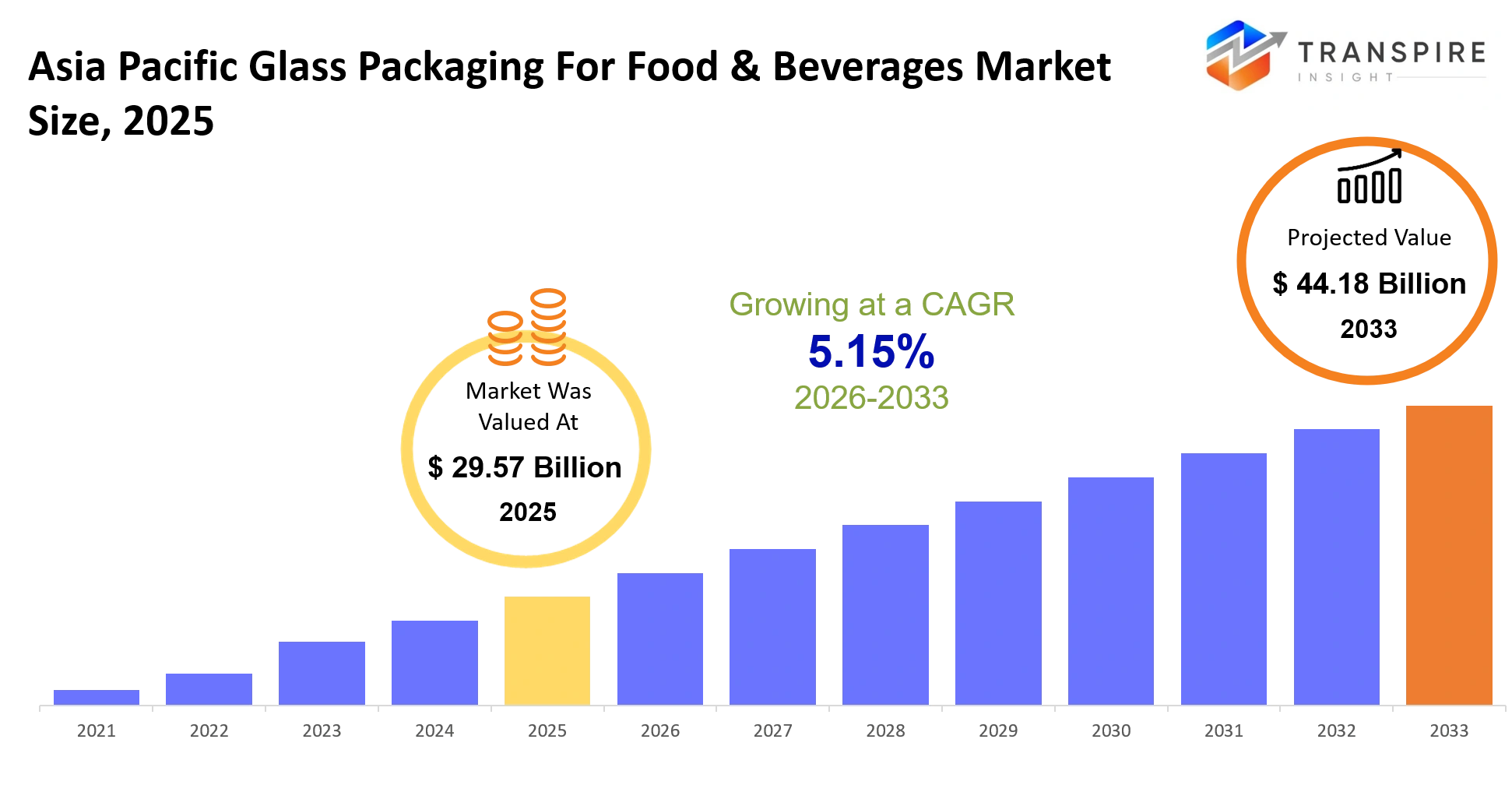
- Asia Pacific Glass Packaging For Food & Beverages Market Size 2025: USD 29.57 Billion
- Asia Pacific Glass Packaging For Food & Beverages Market Size 2033: USD 44.18 Billion
- Asia Pacific Glass Packaging For Food & Beverages Market CAGR: 5.15%
- Asia Pacific Glass Packaging For Food & Beverages Market Segments: By Product Type (Bottles, Jars, Vials, Containers, Ampoules, Growlers, Others); By Color (Clear, Amber, Green, Blue, Others); By Application (Alcoholic Beverages, Non-Alcoholic Beverages, Food Packaging, Dairy Products, Sauces & Condiments, Others); By End User (Food Manufacturers, Beverage Companies, Retailers, Others).
To learn more about this report,  Download Free Sample Report
Asia Pacific Glass Packaging For Food & Beverages Market Summary
The Asia Pacific Glass Packaging For Food & Beverages Market was valued at USD 29.57 Billion in 2025. It is forecast to reach USD 44.18 Billion by 2033. That is a CAGR of 5.15% over the period.
The Asia Pacific Glass Packaging for Food & Beverages Market is really important for keeping food and drinks safe. It does this by providing containers that do not affect the taste of the food. This helps companies that make drinks, dairy products and packaged food meet what the consumers want. Consumers want quality, safety and sustainability.
Over the few years the Asia Pacific Glass Packaging for Food & Beverages Market has changed a lot. Now people prefer glass packaging over plastic because it is better for the environment. The governments in the Asia Pacific region have made rules to reduce waste. This has made companies use glass of plastic. The Asia Pacific Glass Packaging for Food & Beverages Market has seen a change because of this.
The Asia Pacific Glass Packaging for Food & Beverages Market is doing well because people want to buy products that're safe and good for the environment. Companies are using glass containers more and more. This is especially true for food and drinks. When people buy these products they think about whether the packaging's good for the environment and whether the product is of good quality. The Asia Pacific Glass Packaging for Food & Beverages Market is going to keep doing because of this.
Key Market Insights
- The Asia Pacific Glass Packaging For Food & Beverages market is growing fast. One reason is that people want eco- packaging that won't react with food, which some other materials can do. It's a choice but it matters a lot.
- Market growth is expected to continue, and that’s mainly because there are new rules being enforced to reduce waste from 2020 to 2025. So, many companies end up switching over to glass packaging . Glass is recyclable too, and that helps a lot with the overall push.
- In the Asia Pacific Glass Packaging For Food & Beverages Market, China has a major role. By 2025, China is projected to take roughly 35 percent of the market, not just a small share. This happens largely because China produces a lot of beverages, and the whole market is heavily connected with China's beverage production, especially bottle demand.
- India is also the one that’s growing from 2024 to 2030. That growth is tied to more people moving into cities, plus food and other product companies are expanding . With that, more individuals are buying things that come in glass bottles, and the use of glass keeps rising.
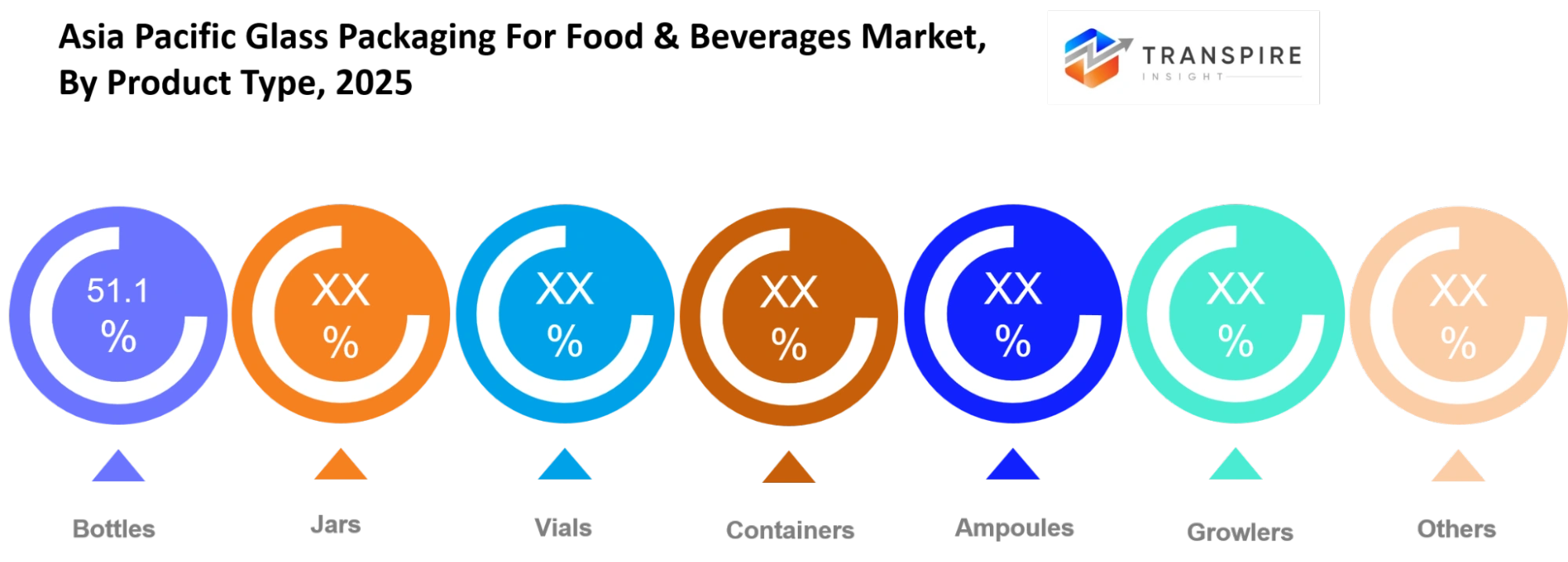
- The Asia Pacific Glass Packaging For Food & Beverages Market is led by bottles, which have 55 percent of the market because they are used a lot to package beverages.
- Jars are the most used product and they are often used to package dairy products, sauces and preserved food.
- The biggest use of the Asia Pacific Glass Packaging For Food & Beverages Market is for premium beverages, like alcohol and carbonated drinks which make up over 45 percent of the market.
- The growing part of the Asia Pacific Glass Packaging For Food & Beverages Market is non-alcoholic functional beverages because people are getting more interested in being healthy.
- Companies that make food are the users of the Asia Pacific Glass Packaging For Food & Beverages Market but there is also a growing demand for packaging for cosmetics and other beauty products.
- Big companies like O-I Glass, Ardagh Group, Verallia, Vidrala and Gerresheimer are doing a lot to make the Asia Pacific Glass Packaging For Food & Beverages Market better. They are making glass and working with other companies in the Asia Pacific region. The Asia Pacific Glass Packaging For Food & Beverages Market is getting stronger because of this.
What are the Key Drivers, Restraints, and Opportunities in the Asia Pacific Glass Packaging For Food & Beverages Market?
Drivers
They are making rules to stop people from using single-use plastics. Governments in the Asia Pacific region have been working on this from 2020 to 2025. They want companies that make food and drinks to use glass containers instead because these can be recycled.
The Asia Pacific Glass Packaging For Food & Beverages Market is also getting bigger because some big companies want to use glass packaging to keep their drinks fresh. These companies like the Asia Pacific Glass Packaging For Food & Beverages Market because glass packaging does not affect the taste of their drinks. The Asia Pacific Glass Packaging For Food & Beverages Market is happy about this because it means that companies will buy glass containers from them. The Asia Pacific Glass Packaging For Food & Beverages Market will benefit from this as companies will sign term contracts with the companies that make glass containers, which is good, for the Asia Pacific Glass Packaging For Food & Beverages Market.
Restraints
However there is a problem with the Asia Pacific Glass Packaging For Food & Beverages Market. It is expensive to make and transport glass containers. The Asia Pacific Glass Packaging For Food & Beverages Market needs a lot of energy to make glass containers. This makes it hard for companies that make food and beverages to use glass containers. They have to pay a lot of money to transport the glass containers. This is especially true in some parts of Southeast Asia and South Asia where people do not want to pay a lot of money for food and beverages.
Opportunities
The Asia Pacific Glass Packaging For Food & Beverages Market has a chance to grow if it can make glass containers. Some companies like O-I Glass and Verallia are trying to make glass containers. They are using machines to make the glass containers lighter. This will make it cheaper to transport the glass containers. The Asia Pacific Glass Packaging For Food & Beverages Market is also growing in India and Vietnam. More people are drinking beverages in these countries. They want to buy them in glass containers. This is good for the Asia Pacific Glass Packaging For Food & Beverages Market because it means that companies will sell glass containers.
What Has the Impact of Artificial Intelligence Been on the Asia Pacific Glass Packaging For Food & Beverages Market?
The Asia Pacific Glass Packaging for Food & Beverages Market is in a bit of a shift lately, mostly due to intelligence, and brand new digital technologies. Honestly, these changes help it run smoother, especially about using less energy and keeping emissions more controlled across glass factories and logistics. Artificial intelligence is now being put to work to supervise the systems that manage furnaces, and also the exhaust gases during cleaning processes. So it sort of helps confirm the furnaces are operating properly, and not just burning extra energy for no reason.
In some glass factories, computer systems are tracking things like pressure and temperature, just to make sure emissions stay within acceptable levels. Because of that, workers don’t need to constantly be checking every detail, and the plants can stay compliant in a more steady way. In addition, artificial intelligence supports making the transport of glass more efficient too. It’s commonly done by forecasting and planning truck routes, for those heavy glass container loads. That approach cuts fuel use, lowers emissions, and in general makes the whole movement less wasteful, in a quieter kind of manner.
However many glass factories are not using intelligence because it is expensive to set up. Some factories still use machines that are not connected to the internet, which makes it hard to use new digital systems. This is slowing down the use of intelligence in the Asia Pacific Glass Packaging for Food & Beverages Market. The Asia Pacific Glass Packaging for Food & Beverages Market needs to update its factories so that artificial intelligence can be used more. The Asia Pacific Glass Packaging for Food & Beverages Market will benefit from intelligence if it can make the necessary changes.
Key Market Trends
- After 2021 the use of glass and glass became more and more popular mostly after bans got put in place. Around this time companies that make stuff people use every day started to use glass in 25 percent of their packaging which is a big change.
- Then starting in 2022 beverage manufacturers began using premium glass bottles made of glass. The reason was simple: they wanted to keep the taste of their drinks the same and at the time have glass bottles that look more distinct, you know, in cities where there is already a lot going on and competition is high. In short they were trying to make their brands stand out with a more style and less "same as everyone else" vibes using glass to do it.
- In China after 2020 they were able to produce a lot of glass packaging made of glass. China did this by upgrading their furnaces with machines that can control temperature precisely and the result was that glass could be made more efficiently while also using less energy. So yeah more output, waste and steadier production—China made a lot of glass packaging using glass.
- In India between 2023 and 2025 more people started to use glass containers made of glass for drinks. This happened because more people were shopping at organized stores that're easy to spot and simple to navigate.
- People in India, it seems, liked using glass containers made of glass for drinks. I found them useful day to day.
- O-I Glass there is a company with that name that makes a type of glass that's lighter. They said the new glass is 15 percent lighter compared with the kind of glass. This makes it easier to transport. It also reaches stores faster. So the new glass from O-I Glass is lighter and overall better.
- Ardagh Group and Verallia began doing business in Asia after 2022. The goal was to make sure there would be glass available for people living there.
- They also wanted to cut down on how much glass they had to bring from other countries so fewer shipments, fewer trips and less extra hassle, all related to glass.
- In 2023 glass makers started to use computers to control the temperature in furnaces. This helps them produce glass with quality and fewer defects so there are fewer mistakes in the final product made of glass.
- Companies that make alcoholic drinks started to use glass for their packaging and they are using glass to package their drinks.
Asia Pacific Glass Packaging For Food & Beverages Market Segmentation
By Product Type:
Glass bottles are still kind of the popular pick, people use them a lot for alcoholic ,and non alcoholic drinks, so yeah they keep showing up everywhere. Lately more people seem to be looking for packaging that can be recycled, and at the same time it does not somehow change or affect the taste of what’s inside. That’s probably why glass bottles get used again and again for drinks and the more premium kinds of beverages. Bottle makers are also working on making the bottles a bit lighter, so it costs less to move them around and they use less energy too. On top of that, they’re using machines to form the bottles, so everything is basically consistent and doesn’t crack as easily, at least in normal handling. The Asia Pacific market is growing faster too, largely because more beverages are being exported across regions.
Glass jars meanwhile are used a lot for food packaging, like jam, sauce and dairy items. People also like the visibility, you can actually see what you’re buying, so jars remain a common choice. You’ll also find some medicines and special liquids in glass containers because they have to stay very clean, and they can’t be contaminated in any way. A few firms are even leaning into reusable glass packaging for drinks, so it can come back into use rather than being thrown away. Overall, the Asia Pacific Glass Packaging For Food & Beverages Market is growing, because glass packaging keeps getting used for a wider range of products, not just one category.
To learn more about this report, Download Free Sample Report
By Color:
Clear glass is a choice because you can see what's inside the bottle. It looks great on store shelves. Companies that make food and drinks prefer glass because it makes their products look appealing and people trust them more when they see the product inside.The reason clear glass is gaining popularity is that companies want their products to stand out in stores. They also aim to make glass bottles lighter to save on materials.This way companies can showcase their products in the possible way. Clear glass bottles are a way to display products.
Some drinks and foods need to be protected from light so they are packaged in amber or green glass. Amber glass is used a lot for beer and some foods and green glass is used for wine and some special drinks. Some companies are also using other colored glasses for special products where the packaging needs to look different.
By Application:
Glass packaging is really popular for drinks like beer, wine and spirits. Companies use glass packaging for these drinks because glass packaging keeps the drinks fresh and the drinks look good, in glass packaging. Lots of people are drinking beer, wine and spirits so companies are making beer, wine and spirits. Companies are also sending beer, wine and spirits to countries, which is making the market for beer, wine and spirits grow.
People are also drinking non-alcoholic drinks like juice and soda and companies are using glass packaging for these products. Glass is also used for packaging food like sauce and ready-to-eat products because it keeps them fresh for longer. Dairy products are also packaged in glass because it is safe and looks good. The Asia Pacific Glass Packaging For Food & Beverages Market is growing because more and more people are buying these products in stores.
By End User:
Companies that make food are using glass packaging more and more, because they want to keep their products fresh and safe, you know . They’re choosing glass for processed food, dairy goods and even sauce . Also, they are trying to make the products look “ nicer “ in a way, plus they care about being more environmentally aware. To help with all of that, they use packaging machines , so working with glass becomes simpler and less time consuming.
When it comes to drinks , the glass packaging users are pretty clear, people are buying bottled drinks more and more . And then there are the stores, they’re stocking items in glass containers too, which is basically pushing the market forward. Even smaller producers are jumping in, partly because their products appear more premium, and also because glass is generally seen as a better option for the environment. The Asia Pacific Glass Packaging For Food & Beverages Market keeps expanding too, since more people are shopping online and in physical stores .
What are the Key Use Cases Driving the Asia Pacific Glass Packaging For Food & Beverages Market?
The Asia Pacific Glass Packaging for Food and Beverages Market is mostly used for packaging beverages. This is because beer, wine and spirits manufacturers really need this kind of packaging. They like glass because it helps keep the taste of the drink the same. It does not react with the drink and it makes the brand look expensive.Companies that export their products also use glass bottles because they have to meet quality standards in other countries. They have to make sure their products stay good for a time on store shelves.
People are also starting to use glass for packaging -alcoholic drinks and food like juice, soda, sauces and dairy products. Food and drink companies like glass jars and bottles because they make the product look good and they are clean. They help the product last longer. More and more stores are opening in cities in the Asia Pacific area which helps companies that use glass packaging.
Some companies are now using glass packaging for drinks that are good for you like energy drinks and health drinks. They like glass because it makes their products look clean and expensive. Small companies that make drinks and food in batches are also trying out glass packaging that can be used again. This is becoming more popular because people are starting to care about the environment and they like to buy expensive things. Glass packaging for food and beverages is used for these things because it is good for the environment and it makes products look expensive.
|
Report Metrics |
Details |
|
Market size value in 2025 |
USD 29.57 Billion |
|
Market size value in 2026 |
USD 31.08 Billion |
|
Revenue forecast in 2033 |
USD 44.18 Billion |
|
Growth rate |
CAGR of 5.15% from 2026 to 2033 |
|
Base year |
2025 |
|
Historical data |
2021 - 2024 |
|
Forecast period |
2026 - 2033 |
|
Report coverage |
Revenue forecast, competitive landscape, growth factors, and trends |
|
Regional scope |
Asia Pacific |
|
Key company profiled |
O-I Glass, Ardagh Group, Verallia, Vetropack, Vidrala, BA Glass, Nihon Yamamura, Toyo Glass, Hindustan National Glass, AGI Greenpac, Piramal Glass, Saverglass, Gerresheimer, SGD Pharma, Vetri Speciali. |
|
Customization scope |
Free report customization (country, regional & segment scope). Avail customized purchase options to meet your exact research needs. |
|
Report Segmentation |
By Product Type (Bottles, Jars, Vials, Containers, Ampoules, Growlers, Others); By Color (Clear, Amber, Green, Blue, Others); By Application (Alcoholic Beverages, Non-Alcoholic Beverages, Food Packaging, Dairy Products, Sauces & Condiments, Others); By End User (Food Manufacturers, Beverage Companies, Retailers, Others). |
Which Regions are Driving the Asia Pacific Glass Packaging For Food & Beverages Market Growth?
China is the leader in the Asia Pacific Glass Packaging for Food and Beverages Market. This is because China has a big manufacturing base and people in China use a lot of beverages and packaged foods. The government in China is very strict about reducing plastic use. Food and beverage companies are using glass packaging instead. China also has a lot of clusters that help make glass production easier with things like energy-efficient furnaces and automated lines. The country has a logistics network and can export goods easily which makes China a strong supply hub in the region.
Japan is a market with a steady demand for glass packaging. People in Japan like to buy premium food and beverages which helps drive this demand. Japan's strength is not about making a lot of glass packaging. About making high-quality products. The companies in Japan are very stable. Invest in their businesses for the long term. The rules and regulations in Japan are already part of the process so there are no big surprises. Japan has brands that use glass packaging for things like alcoholic beverages and specialty foods which helps keep the revenue coming in.
India is growing fast. More and more people are moving to cities. They have more money to spend. There are also stores selling packaged foods, which helps the glass packaging market. In years India has invested in making more glass and building infrastructure for bottling beverages. The government in India wants to reduce single-use plastic so companies are using glass containers more and more. This means there are opportunities for manufacturers and investors in India especially between 2026 and 2033 in the mid-tier and premium packaging segments. The Asia Pacific Glass Packaging for Food and Beverages Market in India is expected to keep growing. Glass packaging is becoming more popular in India and the Asia Pacific Glass Packaging for Food and Beverages Market is benefiting from this trend.
Who are the Key Players in the Asia Pacific Glass Packaging For Food & Beverages Market and How Do They Compete?
The Asia Pacific Glass Packaging for Food and Beverages Market has a few companies that make most of the glass packaging. These companies have a lot of control over how much they make.. There are also smaller companies in each region that try to sell their products for less money. The companies that make glass packaging have to be good at making their products without using much energy. They also have to make sure their products are light and can be recycled. The big companies try to keep their customers happy by giving them deals. The smaller companies try to compete by making their products for money in countries where it is cheaper to make things.
O-I Glass is one of the companies. It is getting better at making glass packaging by using machines that make big furnaces more efficient. This helps them make bottles that're lighter but still strong. The company is also making glass packaging in Asia and working with drink companies to give them good prices and help them be more sustainable. Verallia is another company that's good at making glass packaging. It makes bottles that use energy to make and look really good. The company is working with companies in Asia to get its products to customers more easily.
Ardagh Group is a company that makes glass and metal packaging. This means it can make all kinds of packaging for drink companies. The company is trying to be more efficient and reliable by using machines to help it work. It is also trying to get its products to customers quickly. Gerresheimer and SGD Pharma are companies that make glass packaging for medicine and other high-end products. They make sure their products are very clean and meet all the rules. These companies are trying to grow by selling their products to companies that need packaging rather than trying to sell to everyone. The Asia Pacific Glass Packaging for Food and Beverages Market is very competitive. Companies, like O-I Glass, Verallia, Ardagh Group, Gerresheimer and SGD Pharma are all trying to be the best.
Company List
- O-I Glass
- Ardagh Group
- Verallia
- Vetropack
- Vidrala
- BA Glass
- Nihon Yamamura
- Toyo Glass
- Hindustan National Glass
- AGI Greenpac
- Piramal Glass
- Saverglass
- Gerresheimer
- SGD Pharma
- Vetri Speciali
Recent Development News
“In January 2025, Ardagh Group announced expansion of its glass packaging capacity across Asia-linked supply networks. The initiative improves supply stability for beverage manufacturers and strengthens regional distribution efficiency for food-grade glass containers.
Source: https://www.ardaghgroup.com
In March 2025, O-I Glass introduced upgraded lightweight glass manufacturing technology for beverage packaging operations. The development reduces material usage and transportation cost while improving production efficiency for Asia Pacific customers.
Source: https://www.o-i.com
In February 2026, Verallia entered a strategic collaboration with regional beverage producers to expand low-carbon glass bottle supply solutions. The partnership supports decarbonization goals and improves access to sustainable packaging across fast-growing Asian food and beverage markets.
Source: https://www.verallia.com
What Strategic Insights Define the Future of the Asia Pacific Glass Packaging For Food & Beverages Market?
The Asia Pacific Glass Packaging for Food & Beverages Market is going to change a lot over the 5 to 7 years. It will become more about being good for the environment and having quality products. This is because the government is making rules to protect the environment and people in cities want packaging that can be recycled.The Asia Pacific Glass Packaging for Food & Beverages Market will grow if manufacturers can make things lighter and use energy to make them. Buyers do not just think about the price anymore, they also think about how much bad stuff's released into the air when something is made.
There is a problem that's not very obvious. The Asia Pacific Glass Packaging for Food & Beverages Market needs a lot of energy to make glass. If it costs a lot to get energy it will be hard for companies to make money even if people want to buy more of their products. This might mean that some companies will not be able to grow and some small companies will not be able to compete.At the time the Asia Pacific Glass Packaging for Food & Beverages Market has a good chance to grow if it uses special packaging that can be tracked. This packaging has a digital passport that shows how much bad stuff was released into the air when it was made. This will help companies that make drinks to show that their products are good for the environment and meet the rules of countries.
Companies that make glass packaging should spend money on equipment that uses less energy and systems that can track their products. This will help them to stay competitive as buyers start to want products that are good for the environment and can be tracked. The Asia Pacific Glass Packaging for Food & Beverages Market will be about this, in the future.
Asia Pacific Glass Packaging For Food & Beverages Market Report Segmentation
By Product Type
- Bottles
- Jars
- Vials
- Containers
- Ampoules
- Growlers
- Others
By Color
- Clear
- Amber
- Green
- Blue
- Others
By Application
- Alcoholic Beverages
- Non-Alcoholic Beverages
- Food Packaging
- Dairy Products
- Sauces & Condiments
- Others
By End User
- Food Manufacturers
- Beverage Companies
- Retailers
- Others
Frequently Asked Questions
Find quick answers to common questions.
The expected Asia Pacific Glass Packaging For Food & Beverages Market size for the market will be USD 44.18 Billion in 2033.
Key segments for the Asia Pacific Glass Packaging For Food & Beverages Market are By Product Type (Bottles, Jars, Vials, Containers, Ampoules, Growlers, Others); By Color (Clear, Amber, Green, Blue, Others); By Application (Alcoholic Beverages, Non-Alcoholic Beverages, Food Packaging, Dairy Products, Sauces & Condiments, Others); By End User (Food Manufacturers, Beverage Companies, Retailers, Others).
Major Asia Pacific Glass Packaging For Food & Beverages Market players are O-I Glass, Ardagh Group, Verallia, Vetropack, Vidrala, BA Glass, Nihon Yamamura, Toyo Glass, Hindustan National Glass, AGI Greenpac, Piramal Glass, Saverglass, Gerresheimer, SGD Pharma, Vetri Speciali.
The Asia Pacific Glass Packaging For Food & Beverages Market size is USD 29.57 Billion in 2025.
The Asia Pacific Glass Packaging For Food & Beverages Market CAGR is 5.15% from 2026 to 2033.
- O-I Glass
- Ardagh Group
- Verallia
- Vetropack
- Vidrala
- BA Glass
- Nihon Yamamura
- Toyo Glass
- Hindustan National Glass
- AGI Greenpac
- Piramal Glass
- Saverglass
- Gerresheimer
- SGD Pharma
- Vetri Speciali
About the Authors

Kartik bhong
I am Kartik Bhong, a Senior Research Analyst at Transpire Insight, specializing in the Packaging, Manufacturing, and Construction industry. My work focuses on analyzing market trends, emerging technologies, industry regulations, and competitive landscapes to deliver accurate, data-driven insights. I am passionate about transforming complex industry information into clear, practical content that helps businesses, professionals, and decision-makers stay informed and make confident strategic decisions. Through continuous research and a strong commitment to accuracy, I strive to create reliable, well-researched content that reflects the latest developments across these dynamic industries and supports the vision of Transpire Insight in delivering valuable market intelligence.

Chakradhar Khansole
Chakradhar serves as the Research Director at Transpire Insight, bringing over 8 years of experience in technology, innovation, and strategic market intelligence. He specializes in transforming complex market data into actionable business insights that enable organizations to make informed, growth-oriented decisions. Recognized for his strategic vision and analytical expertise, Chakradhar leads high-impact research initiatives, delivering comprehensive market assessments, competitive intelligence, and forward-looking industry analysis.
Recently Published Reports
-
Apr 2026
Pharmaceutical Cold Chain Packaging Market
Pharmaceutical Cold Chain Packaging Market By Material (Plastic,(Polyethylene (PE), Polypropylene (PP), Polyethylene Terephthalate (PET), Expanded Polystyrene (EPS), Polyurethane (PU),Others), Paper, Metal, Others), By Product (Small Boxes, Pallets, Large Sized Pallet Containers, Others), By End Use (Biopharmaceutical Companies, Clinical Research Organizations, Hospitals, Research Institutes, Logistics and Distribution Companies, Others)”, By Industry Analysis, Size, Share, Growth, Trends, and Forecasts 2026-2033
-
Apr 2026
Active & Intelligent Packaging Market
Active & Intelligent Packaging Market By Type (Active Packaging, Smart Packaging), By Material (Polymer-Based, Paper & Board-Based, Metal-Based, Glass-Based), By Technology (Time-Temperature Indicators, Freshness Indicators, RFID, Antimicrobial Packaging, Modified Atmosphere Packaging), By Application (Food & Beverages, Pharmaceutical, Cosmetics & Personal Care, Electronics & Consumer Goods, Others), By Industry Analysis, Size, Share, Growth, Trends, and Forecasts 2026-2033
-
Apr 2026
Biodegradable Cut Flower Packaging Market
Biodegradable Cut Flower Packaging Market By Material Type (Paper & Paperboard, Biodegradable Plastics, Natural Fibers, Molded Pulp, Others), By Product Type (Sleeves, Wraps, Boxes & Cartons, Bags & Pouches, Inserts & Holders), By Application (Roses, Carnations, Tulips, Chrysanthemums, Mixed Flowers, Others) and By Distribution Channel (Direct Sales, Distributors & Wholesalers, Online Channels), By Industry Analysis, Size, Share, Growth, Trends, and Forecasts 2026-2033
-
May 2026
Pharmaceutical Packaging Market
Pharmaceutical Packaging Market By Material Type (Plastic, Glass, Metal, Paper & Paperboard, Others), By Packaging Type (Bottles, Blister Packs, Vials, Ampoules, Pouches & Sachets, Others) and By End User (Hospitals & Clinics, Retail Pharmacies, Online Pharmacies, Pharmaceutical Manufacturers), By Industry Analysis, Size, Share, Growth, Trends, and Forecasts 2026-2033