
Middle East and Africa CRAC Market Size & Forecast
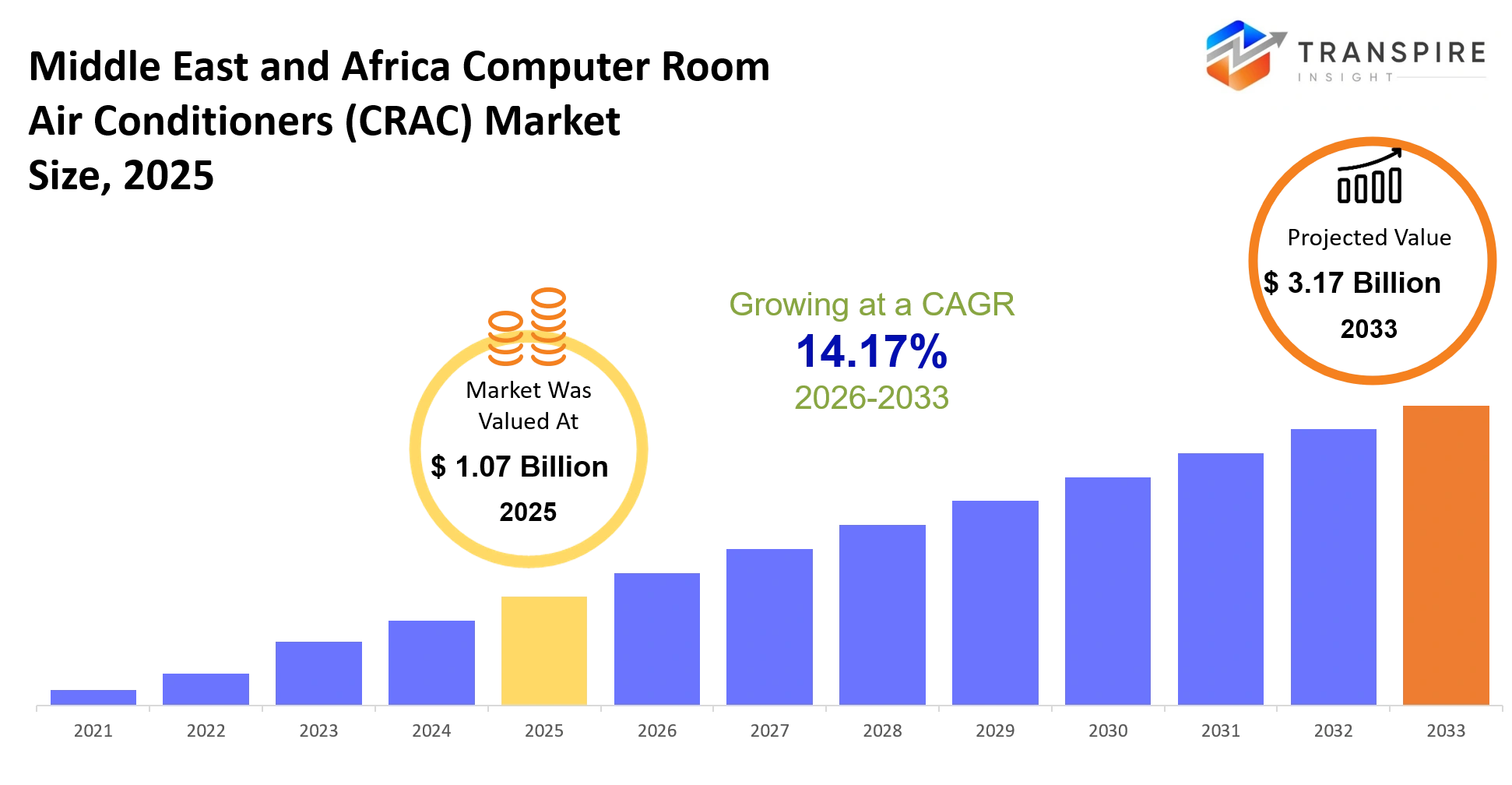
- Middle East and Africa CRAC Market Size 2025: USD 1.07 Billion
- Middle East and Africa CRAC Market Size 2026: USD 1.21 Billion
- Middle East and Africa CRAC Market Size 2033: USD 3.17 Billion
- Middle East and Africa CRAC Market CAGR: 14.17%
- Middle East and Africa CRAC Market Segments: By Type (Floor Mounted CRAC, Ceiling Mounted CRAC, In-Row CRAC, Precision Cooling Units, Chilled Water CRAC, DX CRAC, Others), By Capacity (Below 100 kW, 100–200 kW, 200–300 kW, Above 300 kW, Others), By Application (Data Centers, Server Rooms, Telecom Facilities, Healthcare IT, BFSI, Others), By End User (IT & Telecom, Colocation Providers, Enterprises, Government, Healthcare, Others)
Middle East and Africa CRAC Market Summary
Computer Room Air Conditioners kind of keep exact temperature AND humidity steady inside data centers, server rooms, and other sensitive infrastructure sites. In the Middle East and Africa, the demand sits right where rapid data center expansion meets harsh outdoor heat, so CRAC demand ends up much higher than equipment replacement timing alone would normally imply. Data center operators in the UAE, Saudi Arabia, Egypt, and South Africa see ambient temperatures go beyond 45 degrees Celsius in the hottest summer stretch, so CRAC units end up running at max load for long stretches. That constant stress then speeds up hardware wear and makes replacement plans feel sooner than planned.
The market’s more structural change really took form around 2020 to 2022, when big oil and gas producers along with financial service operators started making commitments to own cloud infrastructure instead of outsourcing it. Saudi Arabia’s NEOM plan, the UAE’s Smart Dubai initiative and other similar government-backed projects in South Africa and Egypt created procurement rules for locally hosted data centers that, before then, basically weren’t there. Those initiatives pushed for fast deployment of industrial-scale CRAC systems to back both public cloud services and national digital transformation goals.
But the real-world trigger for wider CRAC use was the COVID-19 pandemic, it basically showed how fragile supply chains could get. Operators who had leaned on imported equipment ran into longer lead times when manufacturing slowdowns and bottlenecks disturbed global supply chains during 2021 and 2022. As a result, facility managers had to tweak the purchasing approach toward vendors that had regional warehouse inventory, and also local on-site service options.
Key Middle East and Africa CRAC Market Insights
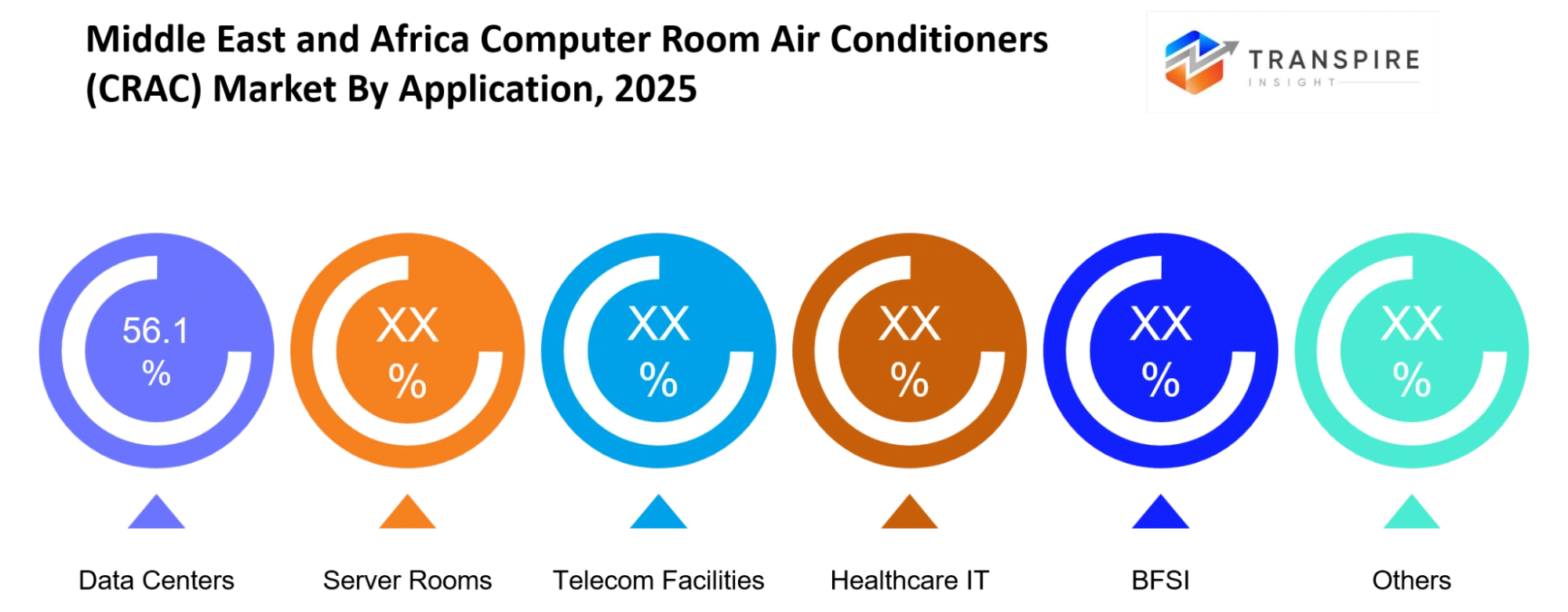
- Data Centers kind of account for 56.1% of the region’s CRAC market revenue in 2025, with the whole thing mostly pushed by hyperscale cloud infrastructure expansion across the UAE, Saudi Arabia and Johannesburg co-location clusters.
- The UAE has roughly 32% of the regional CRAC market share, and it’s anchored by Dubai’s role as a cloud infrastructure hub, serving Middle Eastern and North African clients who want geographic data residency.
- Floor Mounted CRAC units dominate the product type segment at 38% market share in 2025, because these setups need minimal installation complexity, and they also allow flexible relocation within older data center layouts, which people tend to reuse.
- Precision Cooling Units are the fastest-growing product type, growing at a CAGR above 17% through 2033, driven by healthcare IT uptake and government facilities where ultra-stable environmental control is basically non-negotiable.
- For capacity, Below 100 kW makes up 42% of unit shipments in 2025, since smaller server rooms and telecommunications equipment rooms keep pulling steady baseline demand across the region.
- Meanwhile, Above 300 kW is also rising about 18% each year, reflecting the expansion of hyperscale data center projects in Saudi Arabia and the UAE, and those projects need massive CRAC deployment.
- Vertiv controls around 24% of the regional market share, largely due to Liebert branding in data centers, plus strategic partnerships with key regional facilities operators.
- Schneider Electric and STULZ together land another 35% market share, because their combined cooling-and-power distribution know-how gets packaged into integrated facility solutions.
- Colocation providers are also ramping CRAC spending 16% faster than enterprises, as the region’s shared data center infrastructure market grows from 12 major facilities in 2020 to more than 40 by 2025.
What are the Key Drivers, Restraints, and Opportunities in the Middle East and Africa CRAC Market?
Driver: The Government backed digital transformation moves across the UAE , Saudi Arabia , Egypt , and South Africa push a more structural kind of need for data center infrastructure that then kind of filters down into CRAC procurement. These administrations have been pretty clear about commitments to data sovereignty, building domestic cloud infrastructure, and driving a digital economy, so that naturally leads to installing hyperscale facilities that need industrial scale cooling systems. In the UAE, specifically, over USD 15 billion was announced for cloud infrastructure through 2025, and almost all of it practically means CRAC equipment that can handle 24/7 operation in brutal ambient heat .
Restraint: High ambient temperatures are a real problem since they mess with CRAC effectiveness and they also raise the cooling load , which in turn increases system failure risk . Basically equipment that was built for temperate climates ends up operating outside its expected efficiency band during the Middle Eastern and North African summer months. That situation tends to stretch MTBF cycles, and facility managers often respond by installing oversized CRAC capacity as a thermal safety cushion, which ends up increasing capex per megawatt installed . On top of that, supply chain complexity and long lead times for specialized equipment from manufacturers that are more concentrated in Europe and North America can slow scaling right when demand spikes
Opportunity: The overlap between renewable energy expansion and CRAC demand also opens up a forward looking chance for joined up cooling and power solutions. Solar capacity across the Middle East is expanding quickly, and with that comes intermittent power availability, so CRAC systems must be responsive and able to run under variable load . Vendors that offer CRAC hardware together with predictive controls, tuned for that variable power input, are positioning themselves as enablers of more sustainable data center infrastructure.
What Has the Impact of Artificial Intelligence Been on the Middle East and Africa CRAC Market?
Artificial intelligence is basically re-shaping CRAC operations via predictive thermal management and anomaly detection in cooling performance ,and it’s getting more and more common. Machine learning models trained on facility thermal data now forecast equipment failure about 30 to 45 days ahead by spotting tiny shifts in motor current, refrigerant pressure, and compressor runtime “signatures.” Vertiv and Schneider Electric have taken these predictive functions and built them into their cloud-connected monitoring platforms, so facility managers can plan maintenance early , instead of waiting for failures that mess up service continuity.
AI-driven load optimization also changes CRAC settings in real time based on how workloads are spread across server racks. That cuts avoidable cooling energy consumption roughly 12 to 18 percent. This is especially handy in the region where outside warmth makes “extra” cooling painfully expensive. Facilities using AI-optimized CRAC systems typically see operational cost reductions of USD 40,000 to USD 85,000 every year per megawatt of IT load handled, and this is what ends up justifying the higher prices for the premium hardware and software.
The catch is integration complexity. Retrofitting old CRAC units with AI monitoring can be a heavy lift , since it often means new software infrastructure and sometimes swapping control hardware that was never meant to be network-connected. A lot of existing systems in the region were installed before cloud connectivity was routine so the overall cost of AI adoption becomes prohibitive for smaller-scale operations. So you end up with a sort of split market, where large data centers and government sites can afford the investment, while smaller server room operators stay with traditional thermostatic control.
Key Market Trends
- UAE and Saudi Arabia, together bring about 58% of the regional CRAC spending in 2025, it’s mostly tied to hyperscale data center build outs in Jeddah, Riyadh, Dubai and Abu Dhabi, honestly.
- Floor Mounted CRAC units still sit at 38% market share but they’re sliding about 2% each year, since newer facilities increasingly call for In-Row and Precision Cooling designs, more often than before.
- In-Row CRAC systems are climbing fast at 16% annually, because operators are chasing thermal efficiency by using direct rack-integrated cooling placement.
- Chilled Water CRAC systems are also widening, growing 15% year-over-year, especially within government and enterprise deployments where scalability matters, and equipment lifespan is treated like a long term promise.
- Systems under 100 kW account for 42% of unit shipments in 2025, but their share keeps shrinking as average facility sizes move toward multi-megawatt setups.
- Systems above 300 kW are the fastest growing capacity slice, at an 18% CAGR, fueled largely by hyperscale procurement activity across the region.
- Meanwhile, colocation providers expanded from 12 major facilities in 2020 to more than 40 by 2025, which is creating ongoing CRAC installation, plus replacement demand in lots of different locations.
- Vertiv boosted its Middle East service infrastructure by 45% during 2023 and 2024, and set up local repair capabilities in Dubai, Jeddah, and Johannesburg, so downtime can be handled quicker.
- Schneider Electric rolled out its EcoStruxure facility management platform to 22 new customer sites across the region in 2024, packaging CRAC hardware alongside cloud based operations software.
- And for Healthcare IT facilities, CRAC requirements are getting stricter, they’re now demanding higher redundancy and failover capability, reflecting how critical medical data infrastructure has become, day by day.
Middle East and Africa CRAC Market Segmentation
By Type
Floor Mounted CRAC units hold about 38% of the market share, based on legacy installed-base data, and yeah it’s still a big chunk in a lot of older data centers. In general these systems need fairly minimal structural work and they allow flexible repositioning inside the existing facility layouts, which is kind of why teams like them. Retrofit activity also keeps unit volumes steady when operators upgrade their cooling infrastructure. Still, the share is slipping, because new builds are increasingly leaning on In-Row and Precision Cooling architectures as a kind of default standard. That installed base should keep creating replacement demand for roughly eight to twelve years, until the equipment hits end-of-life and then gets swapped out.
Now In-Row CRAC systems are growing around 16% each year, mostly from adoption in new large-scale data center construction. These coolers mount directly between server racks, so there is less need for hot-aisle overhead circulation, and the energy impact is lower by about 8 to 12 percent when compared with floor-mounted approaches. Colocation providers are also specifying In-Row designs in fresh facilities, mainly to signal better operational efficiency while also reducing what customers pay for cooling. Growth should speed up as the region’s remaining legacy sites finish modernization cycles, and then move on to newer deployments.
Precision Cooling Units are expanding at about 17% CAGR, especially for government, healthcare, and financial services, where environmental control tolerance tends to be more strict than typical data center requirements. These units provide stronger humidity management and temperature stability, which helps protect sensitive equipment and supports regulatory compliance. Government procurement in the UAE and Saudi Arabia is increasingly writing Precision Cooling into requirements as a baseline standard. This means the addressable market size is expanding beyond the traditional data center scope, honestly even into adjacent use cases.
Chilled Water CRAC systems are growing 15% annually, mostly in large facilities where centralized water cooling infrastructure can support multiple cooling zones. T
By Capacity
Under 100 kW capacity systems count for 42% of unit shipments, kind of covering small server rooms, telecom facilities and also distributed edge computing spots. They generally do well because of standardized form factors and easy vendor access. Overall growth feels modest, mainly because this portion is mature and it’s more of a replacement wave than a real capacity expansion push. On top of that, compact units from LG Electronics and Mitsubishi Electric are now showing up more often, which is nudging this segment into retail and small business environments, a bit more than before.
Next, the 100 to 200 kW capacity tier makes up 28% of shipment volume and it is still rising about 12% per year. This capacity band supports mid sized enterprise server rooms and smaller colocation sites. In practice, these systems are a cost friendly option for operators who don’t need hyperscale infrastructure. Also, new regional manufacturing efforts by Delta Electronics and Huawei are moving production nearer to end customers. That tends to shorten lead times and lower costs, which helps adoption.
For 200 to 300 kW capacity systems, growth is around 14% annually and they represent 15% of today’s shipment volume. These units are geared toward cluster scale deployments inside regional data center facilities. You can see strong momentum because colocation providers are adding capacity in steps across multiple locations. Pricing in the mid range also makes replacement cycles happen more regularly compared with larger installations, so demand can refresh sooner.
Finally, anything above 300 kW is the fastest growing segment, sitting at about 18% CAGR, and it mainly serves hyperscale data center installations. Only a few vendors, including Vertiv and Schneider Electric, offer equipment at this scale. That limited supply helps protect margins and can lead to vendor lock in. Procurement often runs through government channels too, and that usually means local service capability is required, so vendors with regional infrastructure tend to benefit.
By Application
Data Centers command 56.1% of application-level demand, and it’s kind of anchored by government-backed cloud infrastructure initiatives across the UAE and Saudi Arabia. Hyperscale facility build outs are pushing baseline CRAC procurement volumes, which should keep the market trending upward through 2033, at least that’s the expectation. Colocation facilities are still the fastest-growing data center subsegment, because shared infrastructure is becoming the go-to model for mid-market operators. On top of that , equipment replacement cycles in these locations are usually six to eight years shorter than in enterprise IT infrastructure, so demand stays pretty steady.
Server Rooms make up 22% of application demand, and you see them across enterprise headquarters, banking facilities, healthcare institutions, and government administrative offices. These distributed deployments tend to bring higher per location service revenue compared with data centers, since facility managers often don’t have deep cooling expertise. Growth is mainly tied to government modernization programs, where multiple departmental server rooms get consolidated into a shared facility setup.
Telecom Facilities are 12% of application demand, and they’re rising 13% annually. This is happening as regional telecom providers roll out more 5G infrastructure, and that means distributed cooling for network equipment cabinets. Meanwhile, edge computing at cell tower sites is creating brand new CRAC use cases in remote areas where heat management is harder to handle, which is, well, pretty obvious once you’re there.
Healthcare IT, BFSI, and Other applications together account for 10% of demand, and Healthcare IT is the one growing fastest at 18% CAGR. Regulatory requirements around data protection and business continuity are also pushing investment into dedicated cooling infrastructure at healthcare and financial service facilities across the region.
By End User
IT and Telecom operators make up about 44% of regional CRAC spending, really anchored by government procurement for digital transformation stuff and telecom expansion too. This slice is still rising around 15% every year as government IT modernization speeds up, and private telecom 5G deployment keeps accelerating. A lot of purchases flow through central government channels, and those tend to come with requirements for local service and regional parts availability, kind of regardless of the vendor.
Colocation Providers take roughly 26% of the market demand, and they’re growing about 18% annually as the region’s shared data center market matures. These operators are pushing capacity hard across UAE, Saudi Arabia, and South Africa, mainly to support customers who want alternatives to public cloud infrastructure. Every time a new colocation facility gets installed, it tends to trigger CRAC procurement in the 500 kW to 2 MW band , so it adds up quickly.
Enterprises account for 18% of spending and are expanding 11% annually. The reason is that larger corporations install dedicated cooling infrastructure in order to expand server capacity, which then feeds replacement demand. Government-linked entities and financial services in particular are putting priority on data center modernization, so there’s replacement demand happening at the same time as capacity expansion.
Meanwhile, Government and Healthcare facilities together sit at about 12% of spending but they’re growing fast, around 16% each year . This is driven by regulatory mandates around data sovereignty plus uptime guarantees, which basically pushes the need for dedicated infrastructure. They’re moving away from outsourced cooling toward owned infrastructure, so the procurement becomes capex-intensive, with more equipment cycles and longer planning windows.
What are the Key Use Cases Driving the Middle East and Africa CRAC Market?
Hyperscale data center cooling is sort of the main, big use case, it takes up like 56% of the regional CRAC capacity . Government backed cloud infrastructure projects in the UAE, Saudi Arabia, and Egypt also push hard for multi-megawatt cooling systems that run nonstop in super harsh ambient heat. Those big deployments end up anchoring vendor relationships, and they generate procurement volume that keeps market growth moving forward. Facility operators in this segment care about reliability first, then energy efficiency right after, so it all helps premium pricing for newer cooling architectures.
Banking and financial services infrastructure modernization is actually the fastest-growing use case at 18% year on year expansion . Central banks and major financial institutions across the region are reworking older server room setups into purpose-built data centers, and they’re doing it with modern CRAC systems. Regulatory obligations around data residency, and business continuity, are what’s really driving that shift, and it creates procurement waves through the region’s financial hubs.
Government digital transformation initiatives bring in some emerging use cases too, where CRAC systems support citizen-facing digital services, healthcare data platforms, and administrative IT consolidation. A lot of these government projects often require local vendor involvement, plus regional service infrastructure, and that’s opening access for vendors that have already invested in Middle East and Africa presence.
Report Overview Table
|
Report Metrics |
Details |
|
Market size value in 2025 |
USD 1.07 Billion |
|
Market size value in 2026 |
USD 1.21 Billion |
|
Revenue forecast in 2033 |
USD 3.17 Billion |
|
Growth rate |
CAGR of 14.17% from 2026 to 2033 |
|
Base year |
2025 |
|
Historical data |
2021 - 2024 |
|
Forecast period |
2026 - 2033 |
|
Report coverage |
Revenue forecast, competitive landscape, growth factors, and trends |
|
Regional scope |
United Arab Emirates; Saudi Arabia; South Africa; Egypt; Nigeria; Kuwait; Qatar; Bahrain; Oman; Kenya; Ghana; Morocco; Tunisia |
|
Key companies profiled |
Vertiv, Schneider Electric, STULZ, Rittal, Daikin, Mitsubishi Electric, Johnson Controls, Huawei, Delta Electronics, Eaton, Hitachi, Trane, Fujitsu, LG Electronics, Airedale |
|
Customization scope |
Free report customization (country, regional & segment scope). Avail customized purchase options to meet your exact research needs. |
|
Report Segmentation |
By Type (Floor Mounted CRAC, Ceiling Mounted CRAC, In-Row CRAC, Precision Cooling Units, Chilled Water CRAC, DX CRAC, Others), By Capacity (Below 100 kW, 100–200 kW, 200–300 kW, Above 300 kW, Others), By Application (Data Centers, Server Rooms, Telecom Facilities, Healthcare IT, BFSI, Others), By End User (IT & Telecom, Colocation Providers, Enterprises, Government, Healthcare, Others) |
Which Regions are Driving the Middle East and Africa CRAC Market Growth?
The UAE kinda dominates the region with around 32% market share, mostly because Dubai sits as a cloud infrastructure hub and the government cloud push helps a lot. The country runs nine big data center clusters with more than 120 MW of installed IT capacity, which means industrial level CRAC systems are kind of a must. On top of that government procurement via the UAE telecom authority, and the federal government digitalization programs, basically require local vendor presence plus regional service infrastructure. And since Dubai is like a Middle Eastern cloud gateway for customers from Europe and Asia, it keeps generating steady demand for CRAC capacity expansion.
Saudi Arabia, on the other hand, is the fastest growing market, landing at 17% CAGR, helped by NEOM and Vision 2030 digital transformation efforts that demand hyperscale data center build outs. There’s also the renewable energy ramp, which opens up opportunities for integrated cooling systems that can be tuned for variable power availability. Government purchasing favors local vendor partnerships and regional manufacturing, so the competitive landscape is shifting… especially in ways that benefit vendors who already have Saudi service capabilities.
Then South Africa holds about 18% of regional market share and it grows roughly 13% each year. This is driven by Johannesburg co location cluster expansion, plus enterprise IT infrastructure modernization across many industries. The region is dealing with water scarcity issues too, so adoption of water cooled and hybrid cooling architectures is increasing. Competition is getting more intense as Vertiv and Schneider Electric expand their South African service infrastructure, to support the region’s growing data center market.
Who are the Key Players in the Middle East and Africa CRAC Market and How Do They Compete?
The market exhibits moderate consolidation at the top tier, with Vertiv, Schneider Electric, and STULZ collectively controlling approximately 70% of regional revenue. Below these three dominant vendors, a mid-tier of specialized cooler manufacturers and regional distributors compete on price and local service availability. Competition revolves around equipment availability, regional service depth, and integration with property management software platforms. Vendors without local repair infrastructure or regional parts inventory face extended delivery times that disadvantage them in competitive bids.
Vertiv dominates through its Liebert brand positioning in data centers and strategic partnerships with regional facilities operators and colocation providers. The vendor operates service centers in Dubai, Jeddah, and Cairo, enabling rapid response to equipment failures. Schneider Electric competes through bundled cooling and power infrastructure offerings that appeal to facilities managers seeking integrated solutions. STULZ differentiates through energy-efficient cooling architecture and long-term cost of ownership positioning that resonates with government and enterprise buyers sensitive to operating expenses.
Rittal, Daikin, and Mitsubishi Electric compete in the mid-market through regional distribution partnerships and focused capacity segments. Huawei and Delta Electronics are emerging competitors leveraging existing relationships with telecom and enterprise customers to cross-sell CRAC solutions. Government procurement preferences in Saudi Arabia and the UAE are creating openings for vendors with local manufacturing or service operations, which favors Delta Electronics' regional manufacturing footprint.
Middle East and Africa CRAC Market Companies
- Vertiv
- Schneider Electric
- STULZ
- Rittal
- Daikin
- Mitsubishi Electric
- Johnson Controls
- Huawei
- Delta Electronics
- Eaton
- Hitachi
- Trane
- Fujitsu
- LG Electronics
- Airedale
Recent Developments
In March 2026, Vertiv announced the opening of a regional service center in Jeddah, Saudi Arabia, committing to USD 8.5 million in equipment inventory and technical staff to support government and enterprise CRAC deployments across the kingdom. This expansion positions Vertiv to support NEOM and Vision 2030 data center infrastructure initiatives. https://www.vertiv.com/news
In January 2026, Schneider Electric launched its EcoStruxure Facility Management platform across 22 new customer sites in the UAE and Saudi Arabia, bundling CRAC hardware with cloud-based operations monitoring and predictive maintenance capabilities. The platform aggregates thermal, power, and facility operations data into a unified dashboard that reduces cooling energy consumption by 12 to 15 percent. https://www.se.com/news
In February 2026, Delta Electronics inaugurated a regional manufacturing facility in Dubai producing modular CRAC units for colocation and enterprise facilities. The facility is expected to reduce lead times by 30 to 40 days and enable local customization of cooling systems for Middle Eastern ambient conditions and customer-specific requirements. https://www.deltaww.com/news
What Strategic Insights Define the Future of the Middle East and Africa CRAC Market?
The region's CRAC market will consolidate around cloud-connected, AI-optimized cooling systems as government digital transformation initiatives mandate modern infrastructure standards. The underlying force is data sovereignty and latency requirements that are shifting cloud infrastructure away from purely imported solutions toward regional hyperscale facilities. Vendors that position hardware as part of a larger building intelligence and energy management ecosystem rather than as standalone cooling equipment will capture the highest-margin contracts with government and enterprise buyers.
The hidden risk is extreme weather volatility driven by climate change, which will increase ambient cooling loads and potentially stress CRAC infrastructure beyond design parameters. Extended heat waves that push ambient temperatures beyond 50 degrees Celsius will create demand for oversized cooling capacity and backup refrigeration systems that current specifications do not accommodate. Facilities planners should account for 20 percent additional cooling headroom compared to historical equipment sizing practices.
The opportunity lies in renewable energy integration, where CRAC systems optimized for variable power input will become a competitive necessity. Solar installations are expanding across the region, and data center operators will increasingly require cooling systems capable of responding to intermittent power availability. Vendors that bundle predictive load management and variable-capacity cooling architecture will enable customers to operate profitably on renewable power, creating a differentiation pathway in an otherwise commoditizing market.
Middle East and Africa CRAC Market Report Segmentation
By Type
- Floor Mounted CRAC
- Ceiling Mounted CRAC
- In-Row CRAC
- Precision Cooling Units
- Chilled Water CRAC
- DX CRAC
- Others
By Capacity
- Below 100 kW
- 100–200 kW
- 200–300 kW
- Above 300 kW
- Others
By Application
- Data Centers
- Server Rooms
- Telecom Facilities
- Healthcare IT
- BFSI
- Others
By End User
- IT & Telecom
- Colocation Providers
- Enterprises
- Government
- Healthcare
- Others
Frequently Asked Questions
Find quick answers to common questions.
The Middle East and Africa CRAC Market size is expected to reach USD 3.17 Billion by 2033.
The key segments are By Type (Floor Mounted CRAC, Ceiling Mounted CRAC, In-Row CRAC, Precision Cooling Units, Chilled Water CRAC, DX CRAC, Others), By Capacity (Below 100 kW, 100–200 kW, 200–300 kW, Above 300 kW, Others), By Application (Data Centers, Server Rooms, Telecom Facilities, Healthcare IT, BFSI, Others), and By End User (IT & Telecom, Colocation Providers, Enterprises, Government, Healthcare, Others).
Major players include Vertiv, Schneider Electric, STULZ, Rittal, Daikin, Mitsubishi Electric, Johnson Controls, Huawei, Delta Electronics, Eaton, Hitachi, Trane, Fujitsu, LG Electronics, and Airedale.
The Middle East and Africa CRAC Market size is USD 1.07 Billion in 2025.
The Middle East and Africa CRAC Market CAGR is 14.17% from 2026 to 2033.
- Vertiv
- Schneider Electric
- STULZ
- Rittal
- Daikin
- Mitsubishi Electric
- Johnson Controls
- Huawei
- Delta Electronics
- Eaton
- Hitachi
- Trane
- Fujitsu
- LG Electronics
- Airedale
About the Authors

Chetan Dhatrak
I’m Chetan Dhatrak, a Senior Research Analyst at Transpire Insight, specializing in the Consumer Goods, Foods and Beverages industry. I focus on analyzing market trends, consumer behavior, competitive landscapes, and industry developments to deliver accurate, data-driven insights. My research at Transpire Insight is built on credible sources and in-depth analysis, helping businesses and readers better understand market dynamics, emerging opportunities, and evolving consumer preferences. I’m committed to creating reliable, well-researched content that supports informed decision-making and reflects the latest developments in the consumer goods and food & beverage sectors.

Chakradhar Khansole
Chakradhar serves as the Research Director at Transpire Insight, bringing over 8 years of experience in technology, innovation, and strategic market intelligence. He specializes in transforming complex market data into actionable business insights that enable organizations to make informed, growth-oriented decisions. Recognized for his strategic vision and analytical expertise, Chakradhar leads high-impact research initiatives, delivering comprehensive market assessments, competitive intelligence, and forward-looking industry analysis.
Recently Published Reports
-
Apr 2026
Bottled Water Market
Bottled Water Market Size, Share & Analysis Report By Product Type (Still Bottled Water, Carbonated Bottled Water, Functional Bottled Water, and Others), By Packaging (PET, Cans, and Others), By Sales Channel (Supermarkets/Hypermarkets, Convenience Stores/Drug Stores, Grocery Stores/Club Stores, Foodservice, and Others) and Geography (North America, Europe, Asia-Pacific, Middle East and Africa, South and Central America), 2021 - 2032
-
Apr 2026
Color Cosmetic Packaging Market
Color Cosmetic Packaging Market Size, Share & Analysis Report By Application (Mascara Packaging, Liquid Packaging, and Liquid Face), By Type (Tubes & Bottles, Pens & Markers, Compacts & Containers, and Droppers & Pumps), and Geography (North America, Europe, Asia-Pacific, Middle East and Africa, South and Central America), 2021 - 2031
-
Apr 2026
External Microphone For Camera Market
External Microphone For Camera Market Size, Share & Analysis Report By Type (Shotgun Microphone, Lavalier Microphone, and Others), By Application (Digital Camera, Professional Video Camera, and Others), and Geography (North America, Europe, Asia-Pacific, Middle East and Africa, South and Central America), 2021 - 2031
-
Apr 2026
Foot Orthotic Insoles Market
Foot Orthotic Insoles Market Size, Share & Analysis Report By Type (Pre-fabricated, and Custom-made), By Material (Thermoplastic, Composite Carbon Fiber, and Others), By Distribution Channel (Drug Stores, Hospitals & Clinics, and Others), and Geography (North America, Europe, Asia-Pacific, Middle East and Africa, South and Central America), 2021 - 2031