

United Kingdom Financial Aggregator Market Size & Forecast:
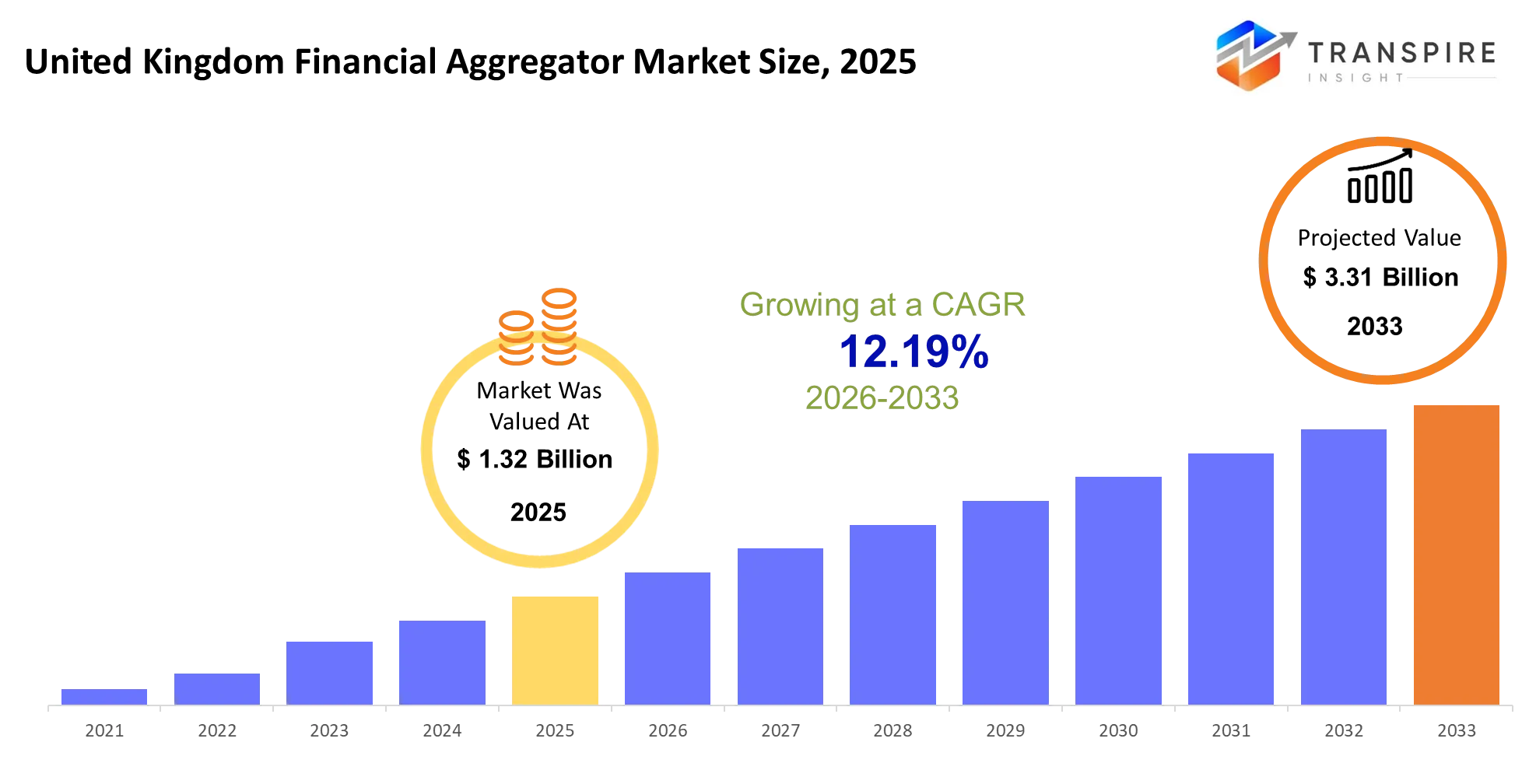
- United Kingdom Financial Aggregator Market Size 2025: USD 1.32 Billion
- United Kingdom Financial Aggregator Market Size 2033: USD 3.31 Billion
- United Kingdom Financial Aggregator Market CAGR: 12.19%
- United Kingdom Financial Aggregator Market Segments: By Service Type (Account Aggregation, Investment Aggregation, Loan Aggregation, Insurance Aggregation, Expense Tracking, Wealth Management Aggregation, Others); By Deployment (Cloud-based Platforms, Mobile-based Platforms, API-based Platforms, AI-enabled Platforms, Others); By Application (Personal Finance Management, SME Finance Management, Digital Banking, Investment Management, Expense Management, Others); By Technology (Open Banking APIs, AI & ML Analytics, Blockchain-enabled Platforms, Data Analytics, Others)
To learn more about this report,  Download Free Sample Report
United Kingdom Financial Aggregator Market Summary
The United Kingdom Financial Aggregator Market was valued at USD 1.32 Billion in 2025. It is forecast to reach USD 3.31 Billion by 2033. That is a CAGR of 12.19% over the period.
The United Kingdom Financial Aggregator Market lets consumers, fintech platforms, and financial institutions pull together banking lending, and investment information into one place, like unified dashboards, so they can act on real time financial signals. Basically it cuts down on the mess of having multiple accounts, so lenders can underwrite faster , fintech apps can make services more tailored, and enterprises gain clearer cash flow sight.
Over the past 3–5 years the whole thing has sort of moved in a more structural direction toward open banking APIs, swapping screen-scraping methods with regulated consent based data sharing, under PSD2 frameworks that are pretty well established. One of the big pushes was how fast financial services digitized during the pandemic era restrictions, that situation basically forced banks and fintech teams to stitch together cloud native aggregation solutions for remote onboarding, plus quicker credit evaluations. So now the momentum is less about standalone apps, and more about ecosystem interoperability , revenue too is leaning into embedded finance structures and API driven data monetization across the United Kingdom Financial Aggregator Market.
Key Market Insights
- Open banking APIs now power over 80% of new financial aggregation integrations across UK fintech platforms in 2025.
- United Kingdom Financial Aggregator Market increasingly integrates real-time transaction enrichment to improve credit underwriting accuracy by nearly 35% in lending workflows.
- API-based aggregation platforms reduce onboarding time for fintech users by 40–60%, accelerating customer acquisition cycles in digital banking.
- Plaid and Tink dominate API connectivity partnerships across UK financial ecosystems.
- Embedded finance adoption on UK platforms accounts for nearly 28% of new aggregator-based revenue streams in 2025.
- Cloud-native deployment models now account for over 70% of new financial aggregation infrastructure investments in the United Kingdom Financial Aggregator Market.
- Real-time payment visibility features have increased SME adoption rates of aggregation tools by 32% year-on-year.
- TrueLayer expansion into merchant payments strengthens competitive positioning in API-first aggregation.
- Fraud detection integration within aggregation platforms reduces identity-related onboarding risk by approximately 25%.
- Competitive differentiation is shifting toward data enrichment depth rather than simple account aggregation functionality.
What are the Key Drivers, Restraints, and Opportunities in the United Kingdom Financial Aggregator Market?
The United Kingdom Financial Aggregator Market is, if you look at it closely, driven mostly by the regulatory push around open banking frameworks. Those frameworks basically required standardized APIs for secure data sharing, and in practice they changed how firms pull information, like moving away from the old fractured access ways. Fintech firms could then build more scalable aggregation layers that span banking, lending, and investment ecosystems. So now financial institutions increasingly depend on aggregation platforms for fast credit scoring, more tailored financial guidance, and embedded payment capabilities. It’s also pushing up transaction based revenue, while improving how well they keep customers, which sounds simple but really matters.
Still, there’s a restraint that keeps showing up. Interoperability across legacy banking systems remains a persistent problem. Many traditional institutions run on legacy core banking infrastructure that does not fully support real-time API connectivity. As a result, data synchronisation can lag, and the aggregated financial view is less accurate than it should be. That kind of structural limitation also raises integration costs for fintech providers and slows adoption, especially among mid-tier banks and credit unions. They often have fewer modernization budgets, so progress is uneven.
On the opportunity side, embedded finance ecosystems are starting to look really strong. In this model, non-financial platforms such as e-commerce providers, payroll services, and similar systems incorporate aggregation tools to offer instant credit and practical money management features. For instance, SME oriented platforms are increasingly building in real time cash flow analytics, powered by aggregation APIs. Over the forecast period, this expansion beyond traditional banking channels is expected to unlock additional revenue layers across the United Kingdom Financial Aggregator Market, in an increasingly immediate way.
What Has the Impact of Artificial Intelligence Been on the United Kingdom Financial Aggregator Market?
Artificial intelligence is pretty much reshaping the United Kingdom Financial Aggregator Market , mostly because it helps with data normalization, better transaction categorization, and real time financial intelligence. These days, machine learning models are often used to automatically classify spending habits across accounts, making financial profiling more accurate for lending, wealth management, and budgeting tools. With this kind of automation there is less manual reconciliation work, so processing runs faster for fintech platforms that are operating at scale and need everything to keep moving.
Another big area is predictive analytics, where AI models try to forecast cash flow trends, detect unusual transaction patterns, and assist with proactive fraud detection. In many financial aggregation platforms, behavioral models are used to anticipate overdraft risks and tune credit product suggestions. That can boost approval accuracy and also help lenders lower their default exposure. On the operations side these improvements tend to speed up onboarding and reduce how much customer support is needed, while also making personalization a bit more precise across digital banking ecosystems.
Still, AI adoption has a limitation, mainly because data quality is inconsistent across multiple banking sources. Differences in transaction labeling standards, plus historical datasets that are incomplete , can drag down model accuracy, particularly when you deal with cross-border situations or multi bank aggregation setups. And there is another issue, privacy rules are strict, so full scale training on sensitive financial data is harder. This slows down more advanced AI deployment across the United Kingdom Financial Aggregator Market, even when the use cases are clearly promising.
Key Market Trends
- Since 2022 the open banking transition has somehow cut down reliance on screen scraping by almost 85% across UK fintech platforms, like it’s not just a small change.
- API standardization has also sped up data synchronization by around 45% , and that makes real-time financial visibility better for end users.
- MX Technologies pushed enrichment capabilities further, so transaction-level insight accuracy improved across aggregator systems. In 2025 embedded finance adoption jumped pretty sharply, with more than 30% of fintech apps folding aggregation APIs straight into what they already built.
- Fraud prevention systems now live inside aggregation platforms, and that reportedly lowered identity fraud attempts by 22% during digital onboarding.
- At the same time cloud-native fintech infrastructure has become the main choice, accounting for roughly 70% of new deployments in the United Kingdom Financial Aggregator Market.
- Envestnet boosted advisory automation through aggregated financial data analytics. Cross platform dashboards also increased user engagement time by 38% across mobile banking applications.
- Tools for regulatory compliance automation reduced reporting costs by about 27% for financial institutions.
- And now API monetization models are starting to replace subscription-only revenue setups across major fintech aggregators.
United Kingdom Financial Aggregator Market Segmentation
By Service Type
Account Aggregation kind of holds the lead, because real time visibility across several bank accounts, cards, and digital wallets has turned into this core thing for retail users and fintech platforms. Its widespread adoption is helped along by open banking frameworks, plus the need for one unified financial dashboard that kinda cuts down on manual reconciliation when financial relationships are all over the place. Investment Aggregation sits in the next slot, still, mainly because wealth platforms are more and more embedding multi asset portfolio tracking for retail investors and advisory firms. Expense Tracking has solid penetration too, due to the growing desire for budgeting automation plus smarter transaction categorization for personal accounts, and even SME use cases. Meanwhile Loan Aggregation keeps expanding as digital lending platforms lean on consolidated credit data so underwriting can happen faster, and not feel as slow.
Account Aggregation should stay structurally dominant as API connectivity keeps expanding between banks and fintech ecosystems, no big surprise there. Investment Aggregation is likely to grow faster because more people are getting involved with digital wealth offerings, and platforms keep layering cross asset analytics into user dashboards. Wealth Management Aggregation may gain momentum, especially as advisory services move toward data driven personalization models. Developers and investors are expected to pay attention to enriched data intelligence, real time syncing capabilities, and interoperability across banking and investment systems, sort of all at once.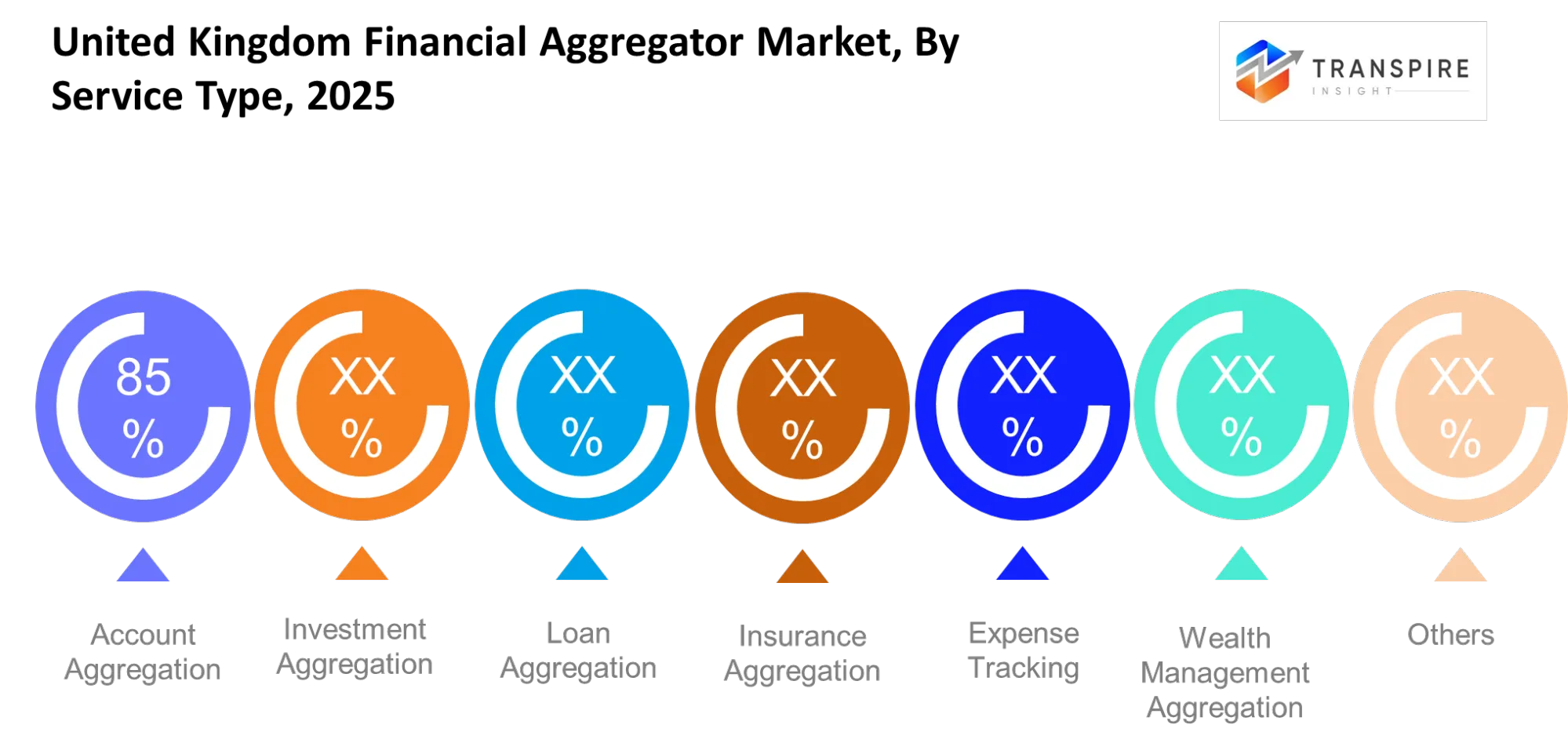
To learn more about this report, Download Free Sample Report
By Deployment
Cloud-based Platforms kind of hold the leading position, mostly because financial aggregation services need scalable infrastructure that can deal with high frequency data syncing across several institutions at once. Cloud adoption is also strongly backed by fintech firms, who tend to push for rapid deployment , reduced upkeep costs, and smoother integration with banking APIs. Meanwhile, Mobile-based Platforms stay in the second place, since lots of consumers now rely on smartphones for everyday money awareness, transaction watching and quick alerts. API-based Platforms are moving ahead fast too, largely because they function as the backbone of open banking ecosystems, so secure and standardized financial data sharing is basically possible.
Cloud-based Platforms are expected to keep leading, because scalability plus cost efficiency still matter a lot for the rising transaction volumes. API-based Platforms are projected to grow the fastest, as demand keeps rising for embedded finance and third party financial service tie-ins. AI-enabled Platforms are getting more attention as predictive analytics becomes core to financial choices, and also to fraud spotting. Technology providers are expected to lean into hybrid architectures, mixing API-first design , cloud scalability, and intelligence layers powered by AI.
By Application
Personal Finance Management still takes the lead by a big margin, mostly because people now rely more on a single , sort of unified dashboard to keep track of how they spend, save , and plan money, even when it’s spread across several accounts. The strong adoption comes from a few things that kind of stack together, like more general financial awareness, subscription-style budgeting tools that make it easier, and real-time transaction categorization that basically auto-sorts activity. Digital Banking sits in the second-largest spot, too, since many banks are rolling in aggregation tools to boost customer engagement and lower churn .
SME Finance Management is growing at a steady pace, which is probably tied to the fact that more companies want cash flow visibility and automated reconciliation, not just manual work, you know. Looking ahead, Personal Finance Management is expected to keep the dominant position, especially as financial literacy features and embedded budgeting options become normal across most banking apps. For speed of growth, SME Finance Management is projected to expand the fastest, since smaller businesses are increasingly adopting integrated financial dashboards to monitor liquidity and tighten up expense optimization. Meanwhile, Investment Management applications are also getting stronger, largely due to higher retail participation in digital investing platforms.
In the future, development will likely shift toward hyper-personalization, more predictive financial insights, and embedded advisory services that work across different parts of the digital ecosystem, rather than in one isolated app.
By Technology
Open Banking APIs are kind of holding the dominant position, mostly because regulatory standardization has made it possible to share secure, structured financial data between banks and fintech platforms. You know, strong ecosystem participation, plus compliance frameworks, keeps reinforcing API based integration as the main infrastructure layer, not just a nice add on. AI & ML Analytics sits in the second largest spot, because platforms are using machine learning more and more for things like transaction categorization, fraud detection, and financial forecasting. And Data Analytics is still widely used for reporting, performance tracking, and basically customer behavior analysis across financial platforms.
Open Banking APIs are expected to keep leading, largely due to ongoing regulatory support, and also expansion of these interconnected financial ecosystems. AI & ML Analytics is projected to grow the fastest, since predictive financial modeling is becoming central for user engagement and risk assessment too. Meanwhile Blockchain-enabled Platforms are emerging gradually for secure identity verification, and also for audit transparency use cases. Going forward, the tech evolution will focus more on mixing API interoperability with intelligent automation layers, to improve real time financial decision making, even when things change quickly.
What are the Key Use Cases Driving the United Kingdom Financial Aggregator Market?
In the United Kingdom Financial Aggregator Market, the main use case is personal financial management, where users bring together multiple bank accounts at once to monitor spending, savings, and investments in real time. This area tends to pull the most attention because it boosts financial clarity, and it also makes budgeting feel more precise for individuals and, honestly, for SMEs too.
There are also side applications such as credit underwriting and lending decisioning. In that scenario lenders lean on aggregated information to judge income consistency, and repayment behavior more carefully. On top of that, wealth management platforms are increasingly relying on consolidated financial profiles to suggest investments that fit retail and mass-affluent customers.
Looking ahead, emerging use cases are emerging in embedded finance within non-banking environments like payroll systems or e-commerce apps. Here, the real time aggregation is used for fast credit scoring, plus automated financial advisory features that almost feel immediate.
|
Report Metrics |
Details |
|
Market size value in 2025 |
USD 1.32 Billion |
|
Market size value in 2026 |
USD 1.48 Billion |
|
Revenue forecast in 2033 |
USD 3.31 Billion |
|
Growth rate |
CAGR of 12.19% from 2026 to 2033 |
|
Base year |
2025 |
|
Historical data |
2021 - 2024 |
|
Forecast period |
2026 - 2033 |
|
Report coverage |
Revenue forecast, competitive landscape, growth factors, and trends |
|
Regional scope |
United Kingdom |
|
Key company profiled |
Plaid, Tink, Yodlee, TrueLayer, MX Technologies, Finicity, Revolut, Moneyhub, Salt Edge, Mastercard, Visa, Intuit, Fiserv, Envestnet, Experian |
|
Customization scope |
Free report customization (country, regional & segment scope). Avail customized purchase options to meet your exact research needs. |
|
Report Segmentation |
By Service Type (Account Aggregation, Investment Aggregation, Loan Aggregation, Insurance Aggregation, Expense Tracking, Wealth Management Aggregation, Others); By Deployment (Cloud-based Platforms, Mobile-based Platforms, API-based Platforms, AI-enabled Platforms, Others); By Application (Personal Finance Management, SME Finance Management, Digital Banking, Investment Management, Expense Management, Others); By Technology (Open Banking APIs, AI & ML Analytics, Blockchain-enabled Platforms, Data Analytics, Others) |
Which Regions are Driving the United Kingdom Financial Aggregator Market Growth?
London is still kind of the main gravitational hub for the United Kingdom Financial Aggregator Market, mostly because there’s a thick cluster of fintech startups, big banking organizations, and regulatory bodies all packed into one place. It also gets a boost from pretty strong open banking adoption, which is pushed along by the Financial Conduct Authority, plus some earlier work on API standardization that sort of set the tone. On top of that, there’s a mature venture capital setup that keeps backing fintech infrastructure companies, especially the ones focused on financial data aggregation. So in practice, the whole thing keeps feeding innovation, and that helps maintain global competitiveness in digital banking solutions.
Then the South East region shows up next, more steady, less headline grabbing, supported by solid corporate banking adoption and it’s close enough to benefit from London’s wider financial ecosystem. Compared to the capital this area leans a bit more toward enterprise banking integration, and mid-sized financial institutions that use aggregation tools to improve operational efficiency. There’s also investment activity that feels steady rather than overly speculative, with banks opting for gradual modernization instead of something disruptive, or fully transformative in one leap. As a result, there’s a reliable demand base for these aggregation technologies, and it doesn’t really disappear.
The fastest-growing part is Northern England, which is moving more quickly because fintech cluster development is accelerating in cities like Manchester and Leeds. There have been recent investments in digital infrastructure, along with regional innovation grants that nudge financial technology adoption among SMEs and challenger banks. Better cloud connectivity, and lower operational costs, too, have made it easier for fintech to expand beyond London, without the same friction. Over the period 2026–2033, this kind of shift is expected to decentralize innovation and also widen the participation across the United Kingdom Financial Aggregator Market in a more distributed way.
Who are the Key Players in the United Kingdom Financial Aggregator Market and How Do They Compete?
Competition in the United Kingdom financial aggregator market is kind of moderately consolidated , with API infrastructure providers, and fintech data platforms really sitting in the middle of the core connectivity stuff. The incumbents are usually holding their ground via regulatory compliance know how, plus high-quality data enrichment… while new players tend to go after more specific APIs and embedded finance solutions. At this point the “fight” isn’t just plain data aggregation anymore, it has moved toward real-time analytics, stronger security controls, and deeper ecosystem integration, which honestly feels like the whole point.
Companies like Plaid and Tink compete by widening their API coverage, and also by tightening partnerships with UK banks and fintech applications. Their edge is mostly scalable infrastructure, meaning they can onboard partners quickly, and push high-frequency data updates without getting stuck. Then there is TrueLayer , which differentiates with merchant payment integration that’s solid, plus real-time access to financial data, as it keeps expanding into embedded finance use cases.
Meanwhile, Yodlee leans into deeper financial analytics and enterprise-level tools for banks and wealth managers . Experian, on the other hand, taps its credit bureau backbone and links aggregation with risk scoring models. Strategic expansion across these firms is largely powered by agreements with banks, API ecosystem alliances , and ongoing spending on AI driven financial intelligence capabilities, even when the rollout is a bit messy at first.
Company List
• Plaid
• Tink
• Yodlee (Envestnet)
• TrueLayer
• MX Technologies
• Finicity (Mastercard)
• Revolut
• Moneyhub
• Salt Edge
• Mastercard
• Visa
• Intuit
• Fiserv
• Envestnet
• Experian
Recent Development News
In February 2026, TrueLayer and Amazon expanded their UK partnership to roll out “Pay by Bank” at checkout, enabling direct account-to-account payments through open banking APIs and accelerating merchant adoption of card-free payment rails.https://www.openbankingexpo.com
In February 2026, eBay announced a strategic investment in TrueLayer alongside the launch of its Pay by Bank feature in the UK, strengthening open banking-based checkout flows and reducing dependence on traditional card networks.https://thefinrate.com
In February 2026, Plaid completed an employee share sale valuing the company at around $8 billion, reinforcing investor confidence in open banking infrastructure and supporting continued expansion of its UK and European financial data aggregation services.https://www.techcrunch.com
What Strategic Insights Define the Future of the United Kingdom Financial Aggregator Market?
The United Kingdom Financial Aggregator Market is structurally moving toward an API-first, embedded finance driven ecosystem where financial data turns into a programmable asset rather than just a static, service layer. Over the next 5–7 years growth will be shaped by deeper integration between banks, fintech platforms, and non financial digital ecosystems , all together in a more seamless way. A less visible risk is that the industry can become more dependent on a small number of dominant API infrastructure providers, and that could spark concentration risk. It also may lead to pricing leverage issues for downstream fintech firms, even if nobody notices it at first.
At the same time there’s a pretty major emerging opportunity that sits in cross industry embedded finance, especially within payroll, retail, and SME SaaS platforms that are starting to integrate real time financial intelligence. Market participants should really put emphasis on modular API architectures and also on multi provider redundancy strategies so they reduce dependency risk while still capturing those expansion opportunities across embedded financial ecosystems.
United Kingdom Financial Aggregator Market Report Segmentation
By Service Type
- Account Aggregation
- Investment Aggregation
- Loan Aggregation
- Insurance Aggregation
- Expense Tracking
- Wealth Management Aggregation
- Others
By Deployment
- Cloud-based Platforms
- Mobile-based Platforms
- API-based Platforms
- AI-enabled Platforms
- Others
By Application
- Personal Finance Management
- SME Finance Management
- Digital Banking
- Investment Management
- Expense Management
- Others
By Technology
- Open Banking APIs
- AI & ML Analytics
- Blockchain-enabled Platforms
- Data Analytics
- Others
Frequently Asked Questions
Find quick answers to common questions.
The Expected United Kingdom Financial Aggregator Market size for the Market will be USD 3.31 Billion in 2033.
Key Segments for the United Kingdom Financial Aggregator Market are By Service Type (Account Aggregation, Investment Aggregation, Loan Aggregation, Insurance Aggregation, Expense Tracking, Wealth Management Aggregation, Others); By Deployment (Cloud-based Platforms, Mobile-based Platforms, API-based Platforms, AI-enabled Platforms, Others); By Application (Personal Finance Management, SME Finance Management, Digital Banking, Investment Management, Expense Management, Others); By Technology (Open Banking APIs, AI & ML Analytics, Blockchain-enabled Platforms, Data Analytics, Others).
Major United Kingdom Financial Aggregator Market Players are Plaid, Tink, Yodlee, TrueLayer, MX Technologies, Finicity, Revolut, Moneyhub, Salt Edge, Mastercard, Visa, Intuit, Fiserv, Envestnet, Experian.
The Current United Kingdom Financial Aggregator Market size is USD 1.32 Billion in 2025.
The United Kingdom Financial Aggregator Market CAGR is 12.19% from 2026 to 2033.
• Plaid
• Tink
• Yodlee (Envestnet)
• TrueLayer
• MX Technologies
• Finicity (Mastercard)
• Revolut
• Moneyhub
• Salt Edge
• Mastercard
• Visa
• Intuit
• Fiserv
• Envestnet
• Experian
About the Authors

Mayur Shinde
I am Mayur Shinde, a Senior Research Analyst at Transpire Insight, specializing in the Automotive & Transportation and Information & Communication Technology (ICT) Industry. My work focuses on analyzing emerging market trends, technological advancements, competitive landscapes, and industry developments to deliver accurate, data-driven insights. I am passionate about transforming complex market information into clear, actionable content that helps businesses, professionals, and decision-makers stay informed and make confident strategic decisions.

Chakradhar Khansole
Chakradhar serves as the Research Director at Transpire Insight, bringing over 8 years of experience in technology, innovation, and strategic market intelligence. He specializes in transforming complex market data into actionable business insights that enable organizations to make informed, growth-oriented decisions. Recognized for his strategic vision and analytical expertise, Chakradhar leads high-impact research initiatives, delivering comprehensive market assessments, competitive intelligence, and forward-looking industry analysis.
Recently Published Reports
-
Apr 2026
3D Optical Profiler Market
3D Optical Profiler Market Size, Share & Analysis Report By Type (Desktop 3D Optical Profiler, and Portable 3D Optical Profiler), By Technology (Confocal Technology, and White Light Interference), By End-Use Industry (Manufacturing, Research Institutions, Automotive, Aerospace and Defense, Medical Devices, and Other), and Geography (North America, Europe, Asia-Pacific, Middle East and Africa, South and Central America), 2021 - 2031
-
Apr 2026
Depth Sensor Market
Depth Sensor Market Size, Share & Analysis Report By Type (Infrared Depth Sensors, Time-of-Flight (ToF) Sensors, Stereo Vision Sensors, Structured Light Sensors, Ultrasonic Depth Sensors), By Application (Automotive, Robotics, Gaming, Consumer Electronics, Industrial Automation, Healthcare, Security & Surveillance, Others), By End Users (Automotive Manufacturers, Consumer Electronics Companies, Healthcare Providers, Industrial Companies, Security Agencies, Gaming Companies, Robotics Companies, Others), and Geography (North America, Europe, Asia-Pacific, Middle East and Africa, South and Central America), 2021 – 2031
-
Apr 2026
Digital Manufacturing Market
Digital Manufacturing Market Size, Share & Analysis Report By Component (Hardware, Software, and Services), By Technology (Robotics, 3D Printing, Internet of Things (IoT), and Others), By Application (Automotive and Transportation, Aerospace and Defense, Consumer Electronics, Industrial Machinery, and Others), By Process Type (Computer-Based Designing, Computer-Based Simulation, Computer 3D Visualization, Analytics, and Others), and Geography (North America, Europe, Asia-Pacific, Middle East and Africa, South and Central America), 2021 – 2031
-
Apr 2026
Digital Visa Services Market
Digital Visa Services Market Size, Share & Analysis Report By Type (Individual Travelers, Group Travelers), By Application (Tourism, Business Travel, Others), and Geography (North America, Europe, Asia-Pacific, Middle East and Africa, South and Central America), 2021 – 2031