
Europe Financial App Market Size & Forecast:
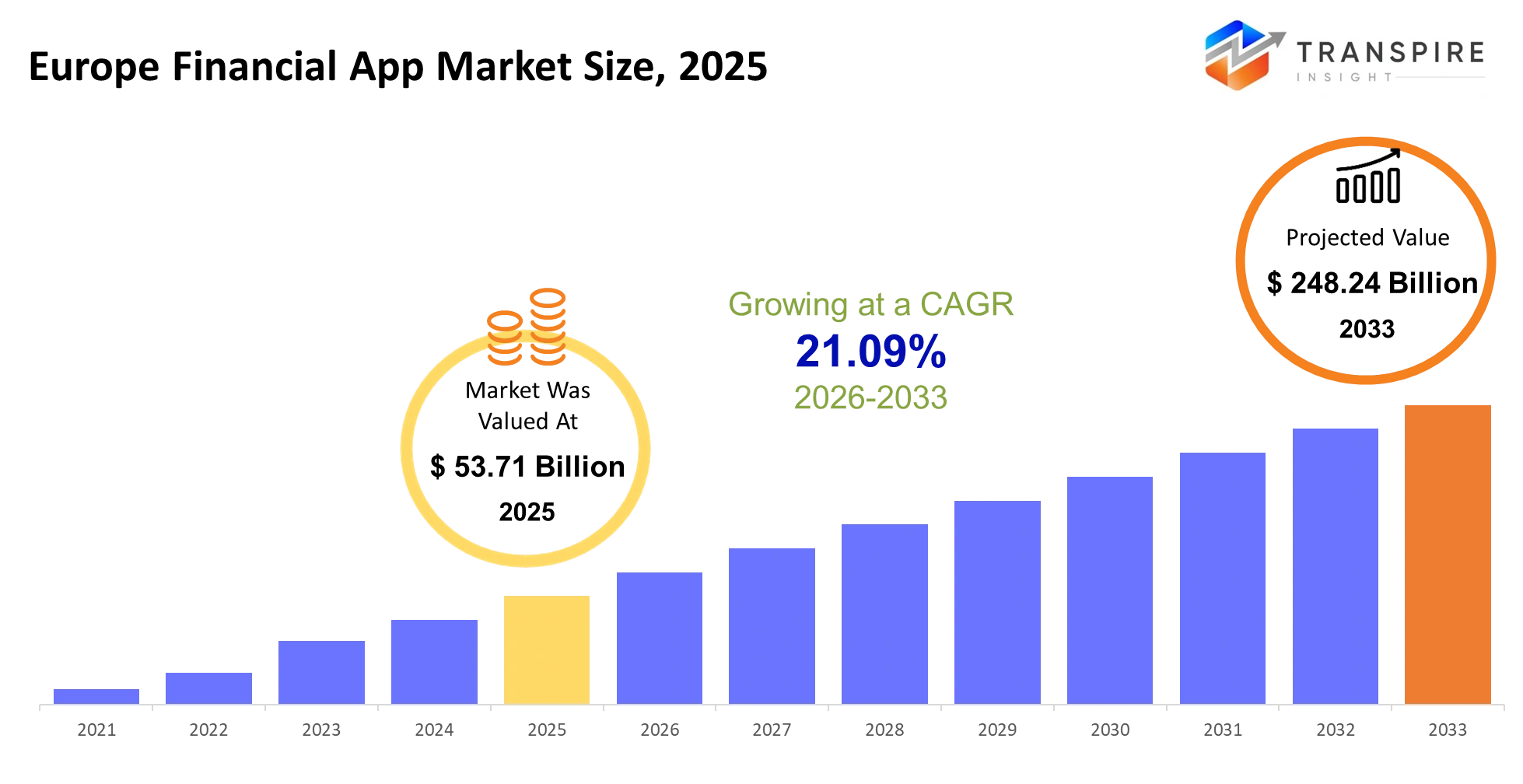
- Europe Financial App Market Size 2025: USD 53.71 Billion
- Europe Financial App Market Size 2033: USD 248.24 Billion
- Europe Financial App Market CAGR: 21.09%
- Europe Financial App Market Segments: By Type (Payment Apps, Investment Apps, Banking Apps, Lending Apps, Others), By Application (Personal Finance, Business Finance, Trading, Budgeting, Others), By End-User (Individuals, SMEs, Enterprises, Others), By Platform (iOS, Android, Web, Others).
To learn more about this report,  Download Free Sample Report
Europe Financial App Market Summary:
The Europe Financial App Market size is estimated at USD 53.71 Billion in 2025 and is anticipated to reach USD 248.24 Billion by 2033, growing at a CAGR of 21.09% from 2026 to 2033. The European financial applications market has developed into an essential component of daily financial management which lets consumers and businesses execute all their payment and lending and investing and budgeting and international transaction needs through one mobile application. The platforms enable users to make financial decisions rapidly while using their mobile devices to conduct business across multiple European markets without needing to visit physical bank branches.
The market has experienced a complete transformation during the past three to five years which has led to mobile banking systems becoming integrated into complete financial ecosystems that use open banking rules and API-based systems. The implementation of PSD2 made it easier for banks to share customer data with fintech companies which enabled applications to provide users with seamless access to payment and credit scoring and insurance and wealth management services. People began using digital payments differently because of the COVID-19 pandemic which made contactless payments and mobile application-based financial transactions more popular with both consumers and merchants. The transition led to higher user confidence in digital finance systems which resulted in more financial transactions and created new income sources through subscription model and interchange fee and embedded lending product sales.
Key Market Insights
- The European Financial Application Market saw its primary market control through Western Europe which held 42 percent of total market share during 2025 with the United Kingdom, Germany, and France acting as its main driving forces.
- The Nordic countries show the fastest regional development between now and 2030 because they exhibit high rates of fintech implementation and cashless payment usage.
- The Central and Eastern European region demonstrates increasing need for mobile banking applications because its digital financial systems continue to develop.
- The German market holds a considerable portion of the fintech sector because small and medium-sized enterprises (SMEs) develop their digital operations and adopt mobile payment systems.
- The European Financial Application Market saw mobile payment apps become its main product category because they produced almost 38 percent of total market revenue during 2025.
- Digital banking platforms maintained their position as the second most important market segment because more customers now prefer financial services that do not require physical branch locations.
- The period from 2025 to 2030 will show AI-based personal finance applications and wealth management solutions as the most rapidly expanding market segment.
- The retailers began to use embedded finance solutions for their customer applications which included lending and insurance and payment systems.
- Peer-to-peer payments represented more than 34 percent of total application usage in the European fintech ecosystem during 2025.
- The investment and robo-advisory applications experienced their most rapid growth because younger users started to utilize app-based investment platforms.
- The European market saw strong growth for cross-border remittance applications because more migrant workers moved between countries.
- The subscription-based budgeting applications obtained greater market share because inflation drove more users to require spending analysis solutions.
- The Europe Financial Application Market showed retail consumers as the main market group because they held about 67 percent market share in 2025.
What are the Key Drivers, Restraints, and Opportunities in the Europe Financial App Market?
The strongest force accelerating the Europe Financial App Market is the expansion of open banking infrastructure under PSD2 regulations. The regulation requires banks to establish secure API connections which allow third-party providers to access their systems. This led to a quick transition that brought financial services into retail stores and mobility services and online shopping platforms. Financial application providers established new revenue streams through subscription services and interchange payments and transaction-based income sources. The widespread adoption of instant payments and digital wallets also reduced customer acquisition costs for fintech firms which enabled them to expand their operations across multiple European markets.
The fragmented regulatory and banking system of Europe stands as the main obstacle which prevents the market from achieving its full potential. Financial app providers must navigate different licensing standards, consumer protection rules, tax systems, and cybersecurity requirements across EU and non-EU countries. The complex system increases expenses for compliance while it creates obstacles that prevent platforms from expanding their operations across national borders. Smaller fintech companies often delay market entry because adapting products to multiple jurisdictions requires significant capital investment and legal resources. The result leads to slower regional market consolidation which decreases revenue possibilities for startups that want to expand their operations throughout Europe.
The upcoming business growth opportunity will emerge through AI-powered financial personalization services. European fintech companies purchase predictive analytics tools to create automated systems which handle savings management, credit scoring processes, fraud detection operations, and real-time investment advice delivery. The younger digital-first audience in Germany and the Netherlands displays high adoption rates for AI-powered wealth management systems. The implementation of embedded AI systems helps businesses to increase customer retention rates so their customers will make more transactions which results in enhanced recurring revenue streams and improved customer lifetime value.
What Has the Impact of Artificial Intelligence Been on the Europe Financial App Market?
The European Financial Application Market experiences fundamental transformation because artificial intelligence and advanced digital technologies enable automated customer service and better fraud detection and superior financial decision support systems. Financial institutions together with fintech companies and digital wallet services increasingly implement AI-based automated systems for managing their loan approval processes and biometric identity verification and anti-money laundering transaction monitoring activities. Mobile banking platforms now achieve user conversion rate improvements through automated onboarding systems that complete customer verification processes in under ten minutes compared to their previous multiple-day requirement.
Digital finance ecosystems now acquire better predictive abilities through the enhanced capabilities of machine learning models. Behavioral analytics present data to financial applications, which use this information to forecast spending patterns and identify unusual transaction activities and create tailored savings and investment suggestions that update in real-time. The AI-powered fraud detection engines process millions of transactions at once to assist financial institutions in decreasing fraudulent payment activities while they enhance their transaction approval processes. European fintech companies achieve better customer retention rates and faster service response times through the implementation of conversational AI and predictive analytics tools into their software solutions.
The present AI adoption process encounters its main challenge because European banks lack proper data privacy standards and their banking systems operate with incomplete connections. Banks need to make large financial commitments for AI system implementation because current banking systems make it hard to connect with their existing systems and because GDPR regulations limit their access to customer financial data needed for algorithm development.
Key Market Trends
- The adoption of PSD2 through open banking which began in 2021 has enabled fintech platforms to create financial integrations through their APIs which let users make payments and borrow money and manage their budgets directly from their consumer applications.
- By 2024 contactless payment usage reached more than 60% of in-store transactions throughout multiple European nations which resulted in permanent changes to mobile wallet usage patterns.
- Revolut and N26 expanded their business operations beyond digital banking services to include insurance and trading and subscription-based financial services after 2022.
- The AI-powered fraud detection systems replaced rule-based transaction monitoring systems which existed in major European fintech platforms. The system now handles fraud detection through automatic decision-making which decreases payment authorization errors while increasing approval rates.
- The demand for low-cost international money transfer services entered a growth phase during 2022 and 2023 after geopolitical instability and inflation caused cross-border payment applications to become more popular.
- European banks began to form partnerships with fintech companies because mobile-first startups offered younger customers faster account setup and app-based financial management solutions.
- The adoption of embedded finance reached rapid growth after e-commerce and mobility platforms began to offer buy-now-pay-later services as checkout options since 2021.
- The financial application sector saw an increase in cybersecurity funding after regulators established stricter rules for digital identity verification and anti-money laundering compliance which became effective after 2023.
- The development of SME-specific financial applications advanced from basic payment features to complete cash flow management systems which include invoicing and payroll automation and real-time expense tracking.
- The Scandinavian nations established themselves as global leaders in cashless payment systems by developing instant payment networks and decreasing their reliance on traditional banking services which started after 2020.
Europe Financial App Market Segmentation
By Type
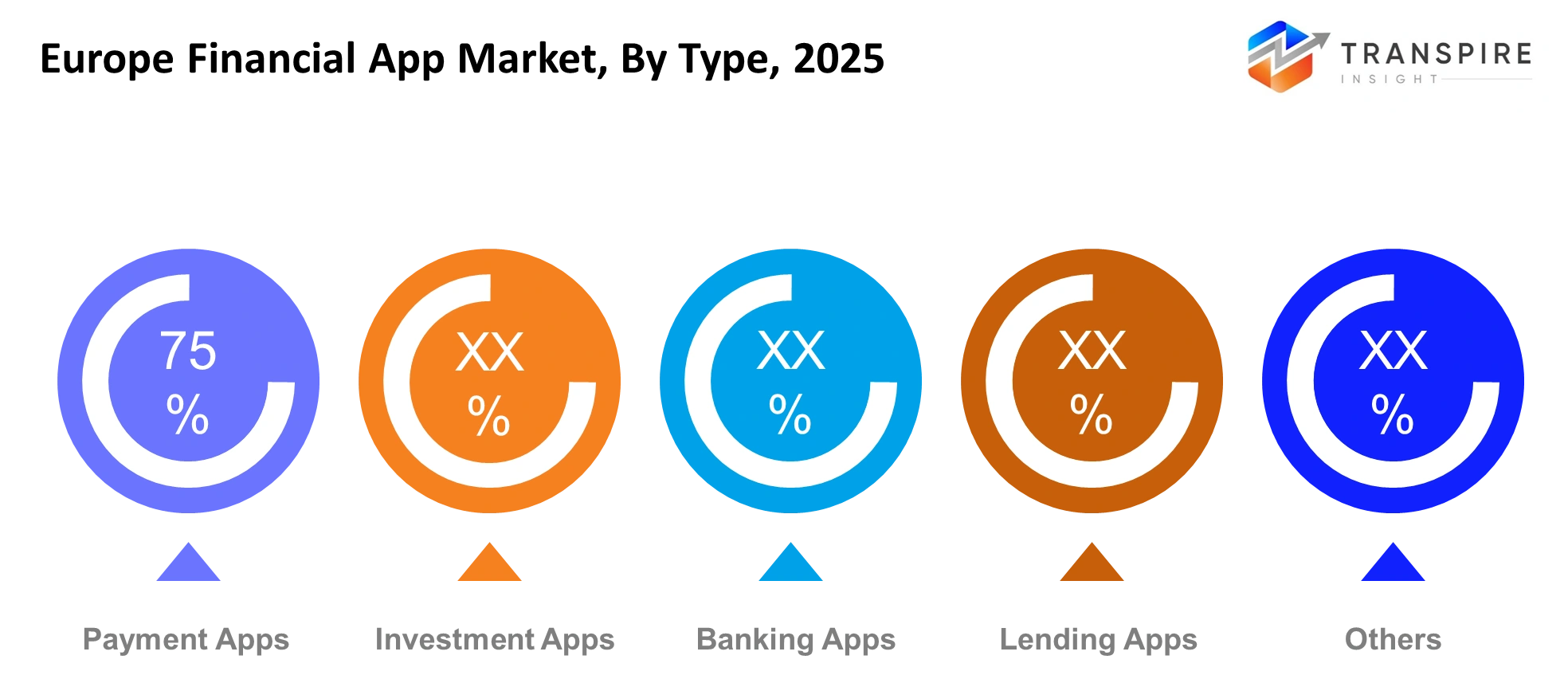
Payment apps dominate the market segment because European consumers now conduct their daily transactions through mobile wallets and peer-to-peer transfers and contactless payment systems. The combination of strong merchant acceptance and real-time payment infrastructure developments has resulted in increased transaction volumes for digital payment platforms. Banking apps maintain the second-largest share because users want branch-free account management and savings tools and credit services that work together. Young consumers now use retail trading and robo-advisory services and digital credit platforms which causes investment apps and lending apps to expand their user base.
Traditional banks need open banking regulations to create business partnerships with financial technology companies. The lending applications must follow additional compliance requirements which include two main areas: credit scoring and fraud monitoring. The market will develop toward platforms that provide payment and investment and insurance and budgeting services through a single ecosystem. Investors increasingly prioritize scalable fintech models with subscription revenue streams and cross-border payment capabilities while users continue shifting toward consolidated financial management experiences.
To learn more about this report, Download Free Sample Report
By Application
Personal finance applications now dominate the application market because users need digital solutions to track their expenses and make payments and manage their savings and automate their bill payments. European countries experienced increased adoption of budgeting and spending analytics applications after 2022 because of inflation pressures and rising living expenses. Business finance applications serve as the second largest market segment because small and medium-sized enterprises increase their digital operations through cloud-based platforms that support payroll and invoicing and supplier payment processes. Trading applications show increasing user activity because younger investors who prefer app-based investment solutions are now entering the market for commission-free investing and cryptocurrency trading.
Demand patterns show major differences between applications because retail customers prefer services that provide them with convenience and customized experiences while businesses need solutions that improve their work processes and enable them to see all their transactions. Budgeting applications now feature AI-driven recommendation systems and automated financial planning tools as their core components. Future expansion will likely focus on embedded finance ecosystems which enable financial services to operate within e-commerce and mobility and enterprise software platforms thus creating more stable revenue streams for service providers.
By End-User
The end-user segment has its highest market share through individual users because urban European populations have increased their smartphone usage and digital payment systems and app-based banking services. Consumers now choose instant account access together with contactless payments and customized financial insights instead of traditional banking services which require them to visit physical branches. The end-user market for small and medium-sized enterprises has the highest growth rate because digital invoicing and automated bookkeeping and integrated payment systems have become essential for companies that want to achieve operational efficiency. Companies worldwide use treasury management software and corporate expense applications to enhance their financial transparency across different regional offices.
The different end-user groups show unique purchasing patterns because individual users need systems which provide easy operation and strong security protection while business users need systems which support compliance needs and operational expansion. Financial institutions are therefore developing segmented product strategies that address varying transaction volumes and regulatory obligations. The future market development will show increased AI usage together with subscription-based financial services and advanced business user customization for automated financial management systems which operate in various European countries.
By Platform
The platform sector sees Android systems as the leading operating system because their devices exist at lower price points which enables users in developed and developing European markets to adopt them extensively. Developers who create financial applications choose to build on Android platforms because they need to reach more customers who use mobile devices in markets where people prefer to use their phones for online transactions. The iOS operating system maintains its status as a high-end platform because users with more money spend more, choose subscription services, and use investment and wealth management software more than other users. Web-based platforms continue to serve their enterprise clients and professional users who need advanced dashboards and analytics tools and access to multiple devices.
The specific requirements of different platforms become essential because cybersecurity requirements and app store rules and data privacy regulations vary between different systems. Financial service providers increasingly invest in cross-platform compatibility to maintain consistent user experiences and strengthen retention rates. Users will expect quicker and tailored digital banking services which will lead to future development in biometric authentication and AI-driven interfaces and financial technology systems that connect mobile and desktop systems.
What are the Key Use Cases Driving the Europe Financial App Market?
Mobile payments and digital banking stand as the primary methods which European users adopt. Financial applications now allow consumers to conduct instant transfers and make contactless retail payments while settling utility bills and managing their accounts in real time. The combination of high smartphone usage and improved instant payment systems has resulted in increased transaction activity throughout urban areas.
Small and medium enterprises now use Business finance applications to handle their invoicing, payroll, expense management and supplier payment processes through cloud-based financial systems. The growth of investment and trading applications stems from their ability to attract young retail investors through commission-free investing and app-based wealth management services which began in Germany and France and Nordic countries.
The two new use cases of AI-powered financial coaching and embedded finance integration inside e-commerce and mobility platforms have emerged as financial industry innovators. The fintech industry conducts experiments with predictive credit scoring and automated insurance recommendations through behavioral analytics. The applications exist as early-stage technology systems which demonstrate strong future value because open banking ecosystems continue to develop throughout Europe.
|
Report Metrics |
Details |
|
Market size value in 2025 |
USD 53.71 Billion |
|
Market size value in 2026 |
USD 65.04 Billion |
|
Revenue forecast in 2033 |
USD 248.24 Billion |
|
Growth rate |
CAGR of 21.09% from 2026 to 2033 |
|
Base year |
2025 |
|
Historical data |
2021 - 2024 |
|
Forecast period |
2026 - 2033 |
|
Report coverage |
Revenue forecast, competitive landscape, growth factors, and trends |
|
Regional scope |
Europe (Germany, United Kingdom, France, Italy, Spain and Rest of Europe) |
|
Key company profiled |
PayPal, Square, Stripe, Revolut, Robinhood, Klarna, Wise, Adyen, SoFi, Chime, Nubank, Monzo, Cash App, Venmo, Zelle. |
|
Customization scope |
Free report customization (country, regional & segment scope). Avail customized purchase options to meet your exact research needs. |
|
Report Segmentation |
By Type (Payment Apps, Investment Apps, Banking Apps, Lending Apps, Others), By Application (Personal Finance, Business Finance, Trading, Budgeting, Others), By End-User (Individuals, SMEs, Enterprises, Others), By Platform (iOS, Android, Web, Others). |
Which Regions are Driving the Europe Financial App Market Growth?
The Western European region dominates the European Financial App Market because it possesses developed banking systems and attracts substantial fintech funding and maintains favorable regulations for digital finance. The UK and Germany and France and the Netherlands formed their open banking systems through their early adoption of the PSD2 regulation and the development of API standards. People in cities with large populations and high smartphone usage patterns began using mobile banking systems and contactless payment methods and app-based investment platforms at increasing rates. The region maintains its position as the top market for both personal and business financial software because it has global fintech centers and venture capital networks and digital identity systems and traditional banks.
Northern Europe stands as the second largest regional market but its growth patterns show major differences from Western Europe because the market depends more on its digital payment adoption and financial trust levels than its overall market size. Scandinavian countries created economies that depend entirely on digital transactions because their banks continuously modernized their systems and people accessed the internet at reliable speeds and they trusted digital banking systems. The regional banking and fintech sectors make ongoing funding commitments towards instant payment technologies and biometric security measures and AI-powered customer service solutions while maintaining their market presence throughout Europe. The reliable transaction growth pattern creates steady revenue streams which enable financial app companies and institutional investors to depend on Northern Europe as a dependable source of income.
Who are the Key Players in the Europe Financial App Market and How Do They Compete?
The European Financial App Market shows moderate competition because existing banks protect their primary deposits while fintech companies attract customers through quick digital solutions. Companies compete today through their capacity to integrate various technologies which includes open banking APIs and embedded finance solutions while they used to compete through pricing methods. Companies must comply with PSD2 regulations and data security requirements which creates competitive boundaries that force them to establish their uniqueness through faster operations and better user experiences and system compatibility.
Revolut develops its super-app by integrating multiple services which include payments and trading and cryptocurrencies and insurance into its subscription-based system. N26 establishes itself as a unique banking service through its German digital banking system which operates under EU passporting regulations and provides mobile account management to city-based workers. Wise establishes a market edge through its budget-friendly international transfer service which utilizes its proprietary foreign exchange system and direct connections to small and medium-sized enterprises and banking institutions. The companies achieve growth through their ecosystem partnerships and targeted international expansion while they avoid conventional expansion methods that depend on opening new branches.
PayPal increases its market presence by integrating merchant ecosystems and promoting digital wallet usage and establishing buy-now-pay-later solutions throughout European e-commerce sites which enhance its market power during customer purchasing processes. Adyen enables retailers to handle their online and physical store payments through a unified commerce system which operates on a single API-based platform. The two companies achieve market growth by forming strategic alliances with major retailers and developing omnichannel payment systems which they implement across European regions.
Company List
- PayPal
- Square
- Stripe
- Revolut
- Robinhood
- Klarna
- Wise
- Adyen
- SoFi
- Chime
- Nubank
- Monzo
- Cash App
- Venmo
- Zelle
Recent Development News
In May 2026, Vanguard Expands European Financial App and ETF Platform Strategy : Vanguard announced plans to nearly double its European assets to $1 trillion by 2030. The company said it will expand its digital investment offerings, increase ETF products, and deepen partnerships with fintech and financial app platforms across Europe. The move reflects growing competition in Europe’s retail investing and mobile wealth-management app ecosystem.
Source: https://www.reuters.com
In May 2026, Wise Completes Nasdaq Shift to Accelerate Financial App Expansion: London-based Wise completed its transition to a primary Nasdaq listing while retaining a secondary London listing. The company stated the move would support expansion of its cross-border payments infrastructure and digital banking app capabilities. Wise also highlighted growth in multi-currency banking services and plans for deeper U.S. payment network integration.
Source: https://www.reuters.com
What Strategic Insights Define the Future of the Europe Financial App Market?
The Europe Financial App Market will develop into complete financial ecosystems that provide payment methods and lending services and investment solutions and insurance products through platforms that do not belong to financial institutions. The transformation occurs because open banking has reached its advanced state and API standards have become established and consumers and small businesses need financial solutions that work in real time. In the next 5 to 7 years businesses will gain competitive advantage through their capability to connect their applications with retail and mobility and enterprise software systems rather than through their ability to deliver independent product features.
The increasing platform concentration creates a hidden risk because a small number of fintech infrastructure companies and super-app ecosystems control both transaction routing systems and customer data access rights. The smaller companies face dependency risk which leads to market instability because it creates pricing pressure and sudden changes in policies that affect data-sharing systems.
AI-based financial orchestration systems which connect cash flow forecasting and credit allocation and automated investment functions create a new business opportunity for SME platforms in Central and Eastern Europe because their digital financial development remains inconsistent throughout the region.
Market participants should focus on building API stacks that enable interoperability while establishing partnerships with enterprise software vendors to obtain distribution pathways which will become essential once ecosystem consolidation reaches its peak.
Europe Financial App Market Report Segmentation
By Type
- Payment Apps
- Investment Apps
- Banking Apps
- Lending Apps
- Others
By Application
- Personal Finance
- Business Finance
- Trading
- Budgeting
- Others
By End-User
- Individuals
- SMEs
- Enterprises
- Others
By Platform
- iOS
- Android
- Web
- Others
Frequently Asked Questions
Find quick answers to common questions.
The approximate Europe Financial App Market size for the market will be USD 248.24 Billion in 2033.
The key segments of the Europe Financial App Market are By Type (Payment Apps, Investment Apps, Banking Apps, Lending Apps, Others), By Application (Personal Finance, Business Finance, Trading, Budgeting, Others), By End-User (Individuals, SMEs, Enterprises, Others), By Platform (iOS, Android, Web, Others).
Major players in the Europe Financial App Market are PayPal, Square, Stripe, Revolut, Robinhood, Klarna, Wise, Adyen, SoFi, Chime, Nubank, Monzo, Cash App, Venmo, Zelle.
The current market size of the Europe Financial App Market is USD 53.71 Billion in 2025.
The Europe Financial App Market CAGR is 21.09%.
- PayPal
- Square
- Stripe
- Revolut
- Robinhood
- Klarna
- Wise
- Adyen
- SoFi
- Chime
- Nubank
- Monzo
- Cash App
- Venmo
- Zelle
Recently Published Reports
-
Apr 2026
3D Optical Profiler Market
3D Optical Profiler Market Size, Share & Analysis Report By Type (Desktop 3D Optical Profiler, and Portable 3D Optical Profiler), By Technology (Confocal Technology, and White Light Interference), By End-Use Industry (Manufacturing, Research Institutions, Automotive, Aerospace and Defense, Medical Devices, and Other), and Geography (North America, Europe, Asia-Pacific, Middle East and Africa, South and Central America), 2021 - 2031
-
Apr 2026
Depth Sensor Market
Depth Sensor Market Size, Share & Analysis Report By Type (Infrared Depth Sensors, Time-of-Flight (ToF) Sensors, Stereo Vision Sensors, Structured Light Sensors, Ultrasonic Depth Sensors), By Application (Automotive, Robotics, Gaming, Consumer Electronics, Industrial Automation, Healthcare, Security & Surveillance, Others), By End Users (Automotive Manufacturers, Consumer Electronics Companies, Healthcare Providers, Industrial Companies, Security Agencies, Gaming Companies, Robotics Companies, Others), and Geography (North America, Europe, Asia-Pacific, Middle East and Africa, South and Central America), 2021 – 2031
-
Apr 2026
Digital Manufacturing Market
Digital Manufacturing Market Size, Share & Analysis Report By Component (Hardware, Software, and Services), By Technology (Robotics, 3D Printing, Internet of Things (IoT), and Others), By Application (Automotive and Transportation, Aerospace and Defense, Consumer Electronics, Industrial Machinery, and Others), By Process Type (Computer-Based Designing, Computer-Based Simulation, Computer 3D Visualization, Analytics, and Others), and Geography (North America, Europe, Asia-Pacific, Middle East and Africa, South and Central America), 2021 – 2031
-
Apr 2026
Digital Visa Services Market
Digital Visa Services Market Size, Share & Analysis Report By Type (Individual Travelers, Group Travelers), By Application (Tourism, Business Travel, Others), and Geography (North America, Europe, Asia-Pacific, Middle East and Africa, South and Central America), 2021 – 2031