
South Korea Blockchain-as-a-Service Market Size & Forecast:
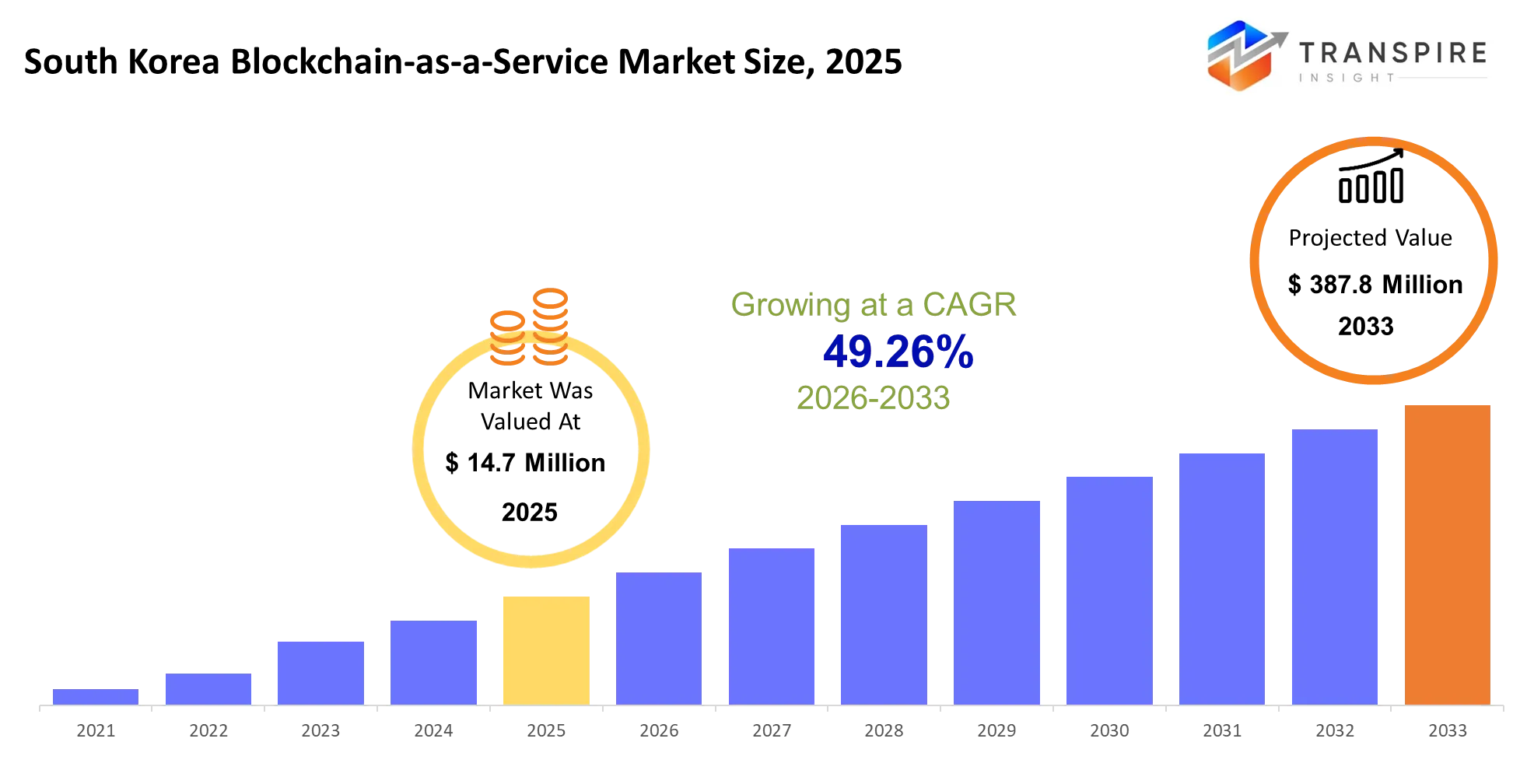
- South Korea Blockchain-as-a-Service Market Size 2025: USD 14.7 Million
- South Korea Blockchain-as-a-Service Market Size 2033: USD 387.8 Million
- South Korea Blockchain-as-a-Service Market CAGR: 49.26%
- South Korea Blockchain-as-a-Service Market Segments: By Service Type (Smart Contract Services, Blockchain Integration Services, Managed Blockchain Services, Blockchain Consulting Services, Others); By Deployment (Public Blockchain, Private Blockchain, Hybrid Blockchain, Consortium Blockchain, Others); By Application (Supply Chain Management, Digital Identity Management, Payments & Transactions, Asset Tracking, Others); By End User (BFSI, Healthcare, Government, Retail, IT & Telecom, Others); By Technology (Ethereum-based Platforms, Hyperledger Platforms, Multi-chain Platforms, Others)
To learn more about this report,  Download Free Sample Report
South Korea Blockchain-as-a-Service Market Summary
The South Korea Blockchain-as-a-Service Market was valued at USD 14.7 Million in 2025. It is forecast to reach USD 387.8 Million by 2033. That is a CAGR of49.26% over the period.
In South Korea, Blockchain-as-a-Service is mostly used to cut out a lot of friction in enterprise data sharing, helping firms run secure shared ledgers without having to build full blockchain infrastructure from scratch. It can do near real time verification of transactions across banking networks, supply chains, logistics paperwork, and digital identity systems, where several parties need synchronized and tamper-proof records.
Over the last few years, the market sort of changed in a more structural way, moving away from isolated on-premise blockchain pilots and toward cloud connected, API driven BaaS platforms delivered by providers like Samsung SDS and LG CNS. One big reason that sped things up was the post pandemic supply chain disruption, it revealed inefficiencies in manual document handling and the cross-border traceability steps, that used to drag.
So now enterprises are placing more weight on interoperable blockchain layers that get embedded inside existing ERP platforms and fintech systems. This shift has been showing up as shorter go to market timelines, particularly in financial settlement, trade documentation, and government backed digital trust services.
Key Market Insights
- The Seoul metropolitan region is kinda dominating with almost 55% share in the South Korea Blockchain-as-a-Service Market, mostly because the enterprise and fintech ecosystem is concentrated pretty densely there.
- Busan and Incheon feel like the fastest growing areas, this is backed by smart port digitization and those cross-border trade blockchain initiatives that keep expanding.
- The platform-based BaaS solutions section is holding the lead segment share, largely because enterprises are getting onboarded quickly, plus the modular blockchain deployment models are making things easier.
- Integration services are actually the fastest-growing segment too, since many firms are trying to connect blockchain with ERP, cloud, and even legacy banking systems, more or less as a priority.
- For applications, supply chain finance leads with about 38–40% share, driven by the need for real time invoice verification and trade transparency, especially where audit trails matter.
- Digital identity management is also showing up as a high-growth application across government and financial services ecosystems, and it’s getting more traction each year.
- When it comes to end users, BFSI stays dominant, using blockchain for payments, clearing, and compliance automation.
- Government and public sector adoption is speeding up through digital document verification and national blockchain pilot programs, so the momentum keeps building.
- Overall, strategic advantage comes from hybrid cloud deployments, strong enterprise partnerships and blockchain-as-a-platform innovation, with a clear focus on regulated industries.
What are the Key Drivers, Restraints, and Opportunities in the South Korea Blockchain-as-a-Service Market?
The main, kinda driver in the South Korea Blockchain-as-a-Service Market is enterprise demand for trusted data sync across fragmented ecosystems, and honestly it feels like that’s the real push behind a lot of decisions. Financial institutions, logistics providers, and government agencies are leaning on blockchain more and more to cut down reconciliation delays and to reduce the dependence on manual checks and re-verification. Also, the move toward cloud-native deployment, backed by players like Samsung SDS, has made it easier to start. By swapping capital heavy infrastructure for subscription based services, adoption gets a direct speed boost and recurring revenue patterns show up sooner.
Now, the biggest thing that holds the market back is interoperability complexity, especially when it comes to different blockchain frameworks plus legacy enterprise systems. A lot of organizations run hybrid IT setups where blockchain still has to play nice with older ERP systems and proprietary databases. This is where integration costs climb quickly, and deployment schedules tend to stretch out, for reasons that are pretty easy to guess. On top of that, regulatory ambiguity around cross-border handling of digital assets keeps commercialization from really going all the way. So, revenue growth in international use cases becomes limited, even when demand exists.
A strong opportunity, however, sits in real-world asset tokenization and in expanding government supported digital trust networks. Korea’s digital finance agenda is moving forward, and CBDC exploration by financial authorities helps set conditions for scalable blockchain infrastructure. As asset digitization keeps widening its scope in areas like trade finance, real estate, and securities settlement, BaaS providers can open up new revenue routes. This would happen through regulated, high volume transaction ecosystems rather than via one-off experiments.
What Has the Impact of Artificial Intelligence Been on the South Korea Blockchain-as-a-Service Market?
Artificial intelligence is kinda reshaping Blockchain-as-a-Service platforms in South Korea , mostly by turbocharging automation for smart contract execution plus enterprise workflow checks. AI-powered systems are now being used more and more to sniff out oddities in transaction patterns, then they flag potential fraud or compliance issues before settlement is fully locked in. In enterprise blockchain networks run by companies such as LG CNS , AI is also slipping into monitoring layers, so the whole thing can feel smoother, with node performance tuned up and transaction latency dialed down across distributed systems.
Machine learning models are improving predictive skills in blockchain networks too, like by forecasting transaction loads, spotting bottlenecks earlier, and steering resource allocation across cloud nodes. That kind of tuning helps throughput efficiency rise and it also cuts operational downtime during high volume use cases, including trade finance and supply chain tracking. Because of this, many enterprises are seeing steadier performance and better cost effectiveness for blockchain-enabled work.
Still, AI adoption in this market isn’t totally frictionless, it runs into limits from fragmented, siloed enterprise data setups. A lot of blockchain networks are kept inside closed consortiums, and that means access to big , diverse datasets is restricted , even though those datasets are usually needed to train high accuracy models. Also, real time AI processing hits latency problems when nodes are cross border, and there are inconsistent data standards across industries, which just slows down the full scale intelligent automation effort overall.
Key Market Trends
- Enterprise adoption of blockchain-as-a-service kind of climbed to around 32% of large Korean firms in 2025, sort of because compliance and audit automation needs became a bigger deal.
- More or less, cloud based deployment models replaced over 60% of the on premise blockchain pilots from 2022 thru 2025, especially inside enterprise settings where scaling mattered.
- Samsung SDS kept expanding its enterprise blockchain APIs, which helped make integration faster with ERP and logistics systems across Asia.
- Meanwhile, government led digital identity pilots pushed blockchain further into public services, roughly up about 25% year on year, not just in theory but in real rollout cycles.
- For cross border trade documentation, systems that relied on blockchain based verification frameworks cut processing time by close to 40%.
- In BFSI, blockchain usage still holds the largest portion with more than 45% of enterprise implementations connected to payments and settlements.
- Also, when teams paired blockchain with AI driven monitoring, transaction anomaly detection improved by nearly 30% in enterprise deployments, which is pretty solid.
- Consortium blockchain models turned more or less dominant compared with private chains, mainly due to shared governance, less duplicated infrastructure cost, and smoother coordination.
- Finally, tokenization pilots in real estate and securities started accelerating fast after 2024 regulatory sandbox approvals, and it kept gaining traction after that too.
South Korea Blockchain-as-a-Service Market Segmentation
By Service Type
Smart Contract Services, they kinda hold a leading position because of strong enterprise adoption across financial settlement automation, logistics verification, and digital contract execution systems, you know. Large enterprises like standardized smart contract modules too, since it lowers the manual reconciliation costs and boosts transaction transparency within multi-party ecosystems. Also, when there is established integration with enterprise cloud platforms it makes this segment easier to take up in regulated industries
The growth, in practice, is pushed by the rising demand for automated compliance workflows in banking and supply chain operations. Meanwhile Blockchain Integration Services seem to be expanding faster, mainly because organizations want to link legacy ERP systems with distributed ledger infrastructure, that helps interoperability. Managed Blockchain Services are getting more traction among mid-sized enterprises, they would rather offload infrastructure management to a third party to cut down technical complexity. Blockchain Consulting Services stay steady, powered by early-stage adoption planning and architecture design needs. Then “others” covers API-based modular blockchain tools as well.
Over the forecast period, integration-led services should outperform standalone offerings, since enterprises are prioritizing system compatibility and operational scalability, rather than going separate.
By Deployment
Private Blockchain kind of holds the dominant position because there is strong adoption in financial institutions, government agencies , and enterprise supply chain networks where data confidentiality really matters. It uses controlled access structures and it also brings higher transaction security , so it fits regulated environments that need strict compliance and auditability. In practice, the enterprise preference for permissioned networks tends to reinforce that kind of market standing.
The growth here is pushed by the rising need for secure internal data exchange systems , especially those that limit exposure to external threats. Consortium Blockchain is also expanding steadily as industries move toward shared governance models across banks logistics providers and trade networks to improve collaboration efficiency. Hybrid Blockchain is getting more momentum since organizations mix private security with public verification capabilities, for cross-border transactions. Public Blockchain adoption is still limited but it is inching upward in areas like digital identity and tokenization pilots. Other types include experimental multi-layer deployment frameworks.Over the forecast period, hybrid and consortium models will gain additional share as enterprises look for a balance between scalability and regulatory alignment.
By Application
Supply Chain Management is in the leading role, mostly because everyone leans on real-time tracking, invoice validation, and cross-border trade paperwork across the manufacturing + logistics web. Businesses really push blockchain in order to cut down reconciliation lags, and for better traceability through multi-tier supply webs, not just one lane. And when it connects with enterprise resource planning systems, that’s when the dominance kind of locks in, because it makes everything feel more continuous and less scattered.
This segment is also moving ahead because trade keeps getting more global, and customers want shipment verification that feels transparent and consistent. Digital Identity Management is growing quickly too, since governments and financial institutions are putting in secure identity checks for citizens and customers—those frameworks keep getting expanded, step by step. Payments & Transactions stay a solid driver as well, largely due to blockchain settlement efficiency inside banking ecosystems. Asset Tracking is getting more attention in high-value logistics and manufacturing, where tamper-proof lifecycle monitoring matters a lot, sometimes it’s the difference between loss and control. Other use cases include insurance enablement, plus compliance reporting, those kinds of operational needs.
Over the forecast period, identity and payments applications will pick up speed as regulatory rules mature, and as enterprise trust networks spread further in the market.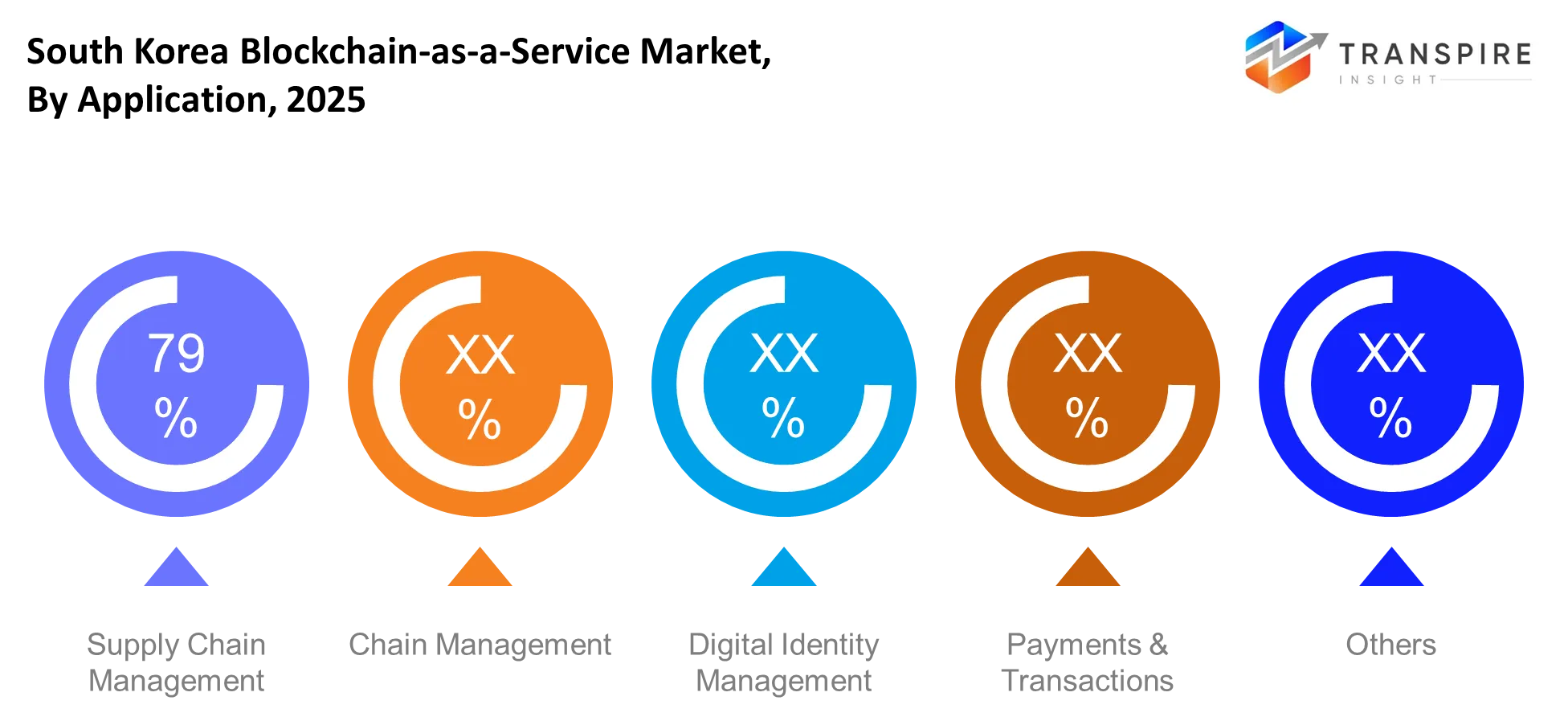
To learn more about this report, Download Free Sample Report
By End User
BFSI keeps the big lead because blockchain is already used pretty widely for clearing, settlement, fraud prevention, and those regulatory compliance workflows that everyone worries about. Financial institutions tend to push for secure plus real-time transaction validation, and that really cuts down operational delays and it also trims reconciliation costs. On top of that, strong regulatory oversight kind of supports a more structured, at-scale rollout, not just small pilots.
This segment grows mainly as banking keeps going through digital transformation and as the need for automated compliance systems keeps rising. Government adoption is moving along steadily, especially with digital identity programs, plus public service digitization initiatives that are expanding month after month. Healthcare is also picking up momentum, because hospitals want protected patient data exchange and pharmaceutical traceability systems that can actually be audited. Retail is getting more blockchain traction too, driven by loyalty program tokenization and supply chain transparency requirements that show up more often now. IT & Telecom brings a steadier demand pattern, mostly from infrastructure-level blockchain integration services. Then you’ve got the other players like education and logistics operators too.
Across the forecast period, government and healthcare will speed up further, as data security and interoperability requirements tighten up, and become more intense, like suddenly everyone needs it yesterday.
By Technology
Ethereum based Platform stuff sits in a strong spot, mainly because lots of developers already adopted it, the smart contracts feel more mature, and it plays nicely with enterprise blockchain frameworks. There’s also pretty solid ecosystem backing and these ongoing protocol upgrades , so for application building and tokenization it tends to be the “go to” idea. Plus strong tooling and scalability upgrades help it stay out in front, even when things get competitive.
In general this segment keeps moving because more enterprises are trying decentralized applications and doing asset digitization experiments. Hyperledger based platforms are also pushing further into regulated areas, where permissioned blockchain setups are needed for compliance plus data privacy. Then there are multi chain Platforms, which are picking up speed, because enterprises want interoperability across multiple blockchain networks. That way they can reduce the whole vendor lock in thing. Other examples include protocol specific frameworks that are designed around smaller enterprise needs, almost like custom fit solutions . Over the forecast period, the multi chain architecture side should grow faster , since organizations care more about cross network compatibility and more flexible deployment strategies across their whole enterprise landscape.
What are the Key Use Cases Driving the South Korea Blockchain-as-a-Service Market?
In the South Korea Blockchain-as-a-Service Market, the main thing people talk about is basically supply chain finance and trade documentation, where firms lean on blockchain to make invoices “agree” with each other, align shipment logs, and track payment milestones in real time. So it ends up cutting down those reconciliation lags, plus it tends to make trust a bit steadier between exporters, banks, and the logistics teams.
Beyond that, secondary applications show up as digital identity verification and banking settlement systems, and this is especially visible across BFSI organizations and various government service platforms. They are growing because more enterprises are pairing blockchain with cloud ERP setups and fintech APIs, in order to keep compliance tighter and also reduce the chance of fraud happening in the first place.
Then there are the newer, emerging applications like asset tokenization and smart contract driven insurance automation. These are picking up speed in regulated financial spaces, where programmable assets and “self executing” claims handling can lower operational hassle and shorten settlement timeframes quite a lot.
|
Report Metrics |
Details |
|
Market size value in 2025 |
USD 14.7 Million |
|
Market size value in 2026 |
USD 23.5 Million |
|
Revenue forecast in 2033 |
USD 387.8 Million |
|
Growth rate |
CAGR of49.26% from 2026 to 2033 |
|
Base year |
2025 |
|
Historical data |
2021 - 2024 |
|
Forecast period |
2026 - 2033 |
|
Report coverage |
Revenue forecast, competitive landscape, growth factors, and trends |
|
Regional scope |
South Korea |
|
Key company profiled |
Samsung SDS, LG CNS, IBM, Microsoft, Oracle, Amazon Web Services, Google Cloud, SAP, Huawei, Tencent Cloud, Accenture, Infosys, Wipro, Deloitte, SK Telecom |
|
Customization scope |
Free report customization (country, regional & segment scope). Avail customized purchase options to meet your exact research needs. |
|
Report Segmentation |
By Service Type (Smart Contract Services, Blockchain Integration Services, Managed Blockchain Services, Blockchain Consulting Services, Others); By Deployment (Public Blockchain, Private Blockchain, Hybrid Blockchain, Consortium Blockchain, Others); By Application (Supply Chain Management, Digital Identity Management, Payments & Transactions, Asset Tracking, Others); By End User (BFSI, Healthcare, Government, Retail, IT & Telecom, Others); By Technology (Ethereum-based Platforms, Hyperledger Platforms, Multi-chain Platforms, Others) |
Which Regions are Driving the South Korea Blockchain-as-a-Service Market Growth?
Seoul Capital Area still feels like the dominant spot in the South Korea Blockchain-as-a-Service Market, mainly because so many financial institutions, tech conglomerates, and regulatory bodies are sort of gathered there. Big enterprises move toward blockchain platforms for trade finance, identity verification and digital settlement workflows within that region, because the places where decisions get made and the fintech ecosystems are tightly clustered. You can also see how the innovation arms of companies like Samsung SDS, plus cloud-integrated enterprise service providers, help keep infrastructure more available and make it easier to get enterprises onboarded quickly. On top of that, being close to national policy institutions means alignment with changing digital asset regulations happens faster, which just keeps Seoul’s leadership position stronger.
Busan works as a stable second-tier region, mostly driven by its long-standing maritime logistics and port-centered economy. Unlike Seoul, where the finance ecosystem takes the lead, Busan’s blockchain adoption is more anchored in shipping documentation, port clearance automation and international trade settlement systems. Large logistics operators and port authorities tend to favor blockchain for operational predictability, not so much for constant experimentation, so adoption stays steady rather than disruptive. Ongoing investments in smart port infrastructure and cross-border shipping corridors also support consistent enterprise participation, which helps the whole thing keep momentum without big swings.
Incheon is the fastest-growing area, largely because its logistics hubs are modernizing quickly and because its airport-linked trade infrastructure keeps expanding. The recent growth in air cargo handling capacity plus digitized customs processing has created demand for real-time blockchain verification systems. Government-backed smart logistics programs have pushed adoption of distributed ledger platforms for freight tracking and compliance, and that combination has made Incheon pull ahead more noticeably.
Who are the Key Players in the South Korea Blockchain-as-a-Service Market and How Do They Compete?
South Korea's Blockchain-as-a-Service Market looks kinda moderately consolidated , but it still has a noticeable skew toward enterprise IT integrators and the big global cloud providers. You don’t really see the competition being only about price, it is more like, who can integrate the fastest, who shows better regulatory compliance readiness, and who can actually play nicely with older legacy enterprise systems. The established players keep their footing through long, deep enterprise contracts, while the cloud hyperscalers push harder by bundling blockchain services with AI and data platforms and so on.
Samsung SDS leans into enterprise-grade blockchain integration, especially when it comes to logistics and manufacturing systems, and it benefits from its strong position inside Korean conglomerate IT infrastructure. LG CNS goes a bit more toward smart city and public sector blockchain deployments, and it keeps expanding via government digital identity programs and smart infrastructure work. IBM, on the other hand, competes with hybrid cloud blockchain frameworks and enterprise security solutions, and it is backed by its digital asset and AI infrastructure stack in regulated industries. Microsoft folds blockchain services into Azure, combining AI with distributed ledger tools to pursue fintech plus broader enterprise modernization plans. And meanwhile Amazon Web Services keeps growing adoption by offering scalable cloud-native blockchain deployment models, that kind of reduces onboarding friction for mid-sized enterprises.
Together, these companies are forming partnerships with Korean financial institutions and logistics operators, more like through ecosystem alliances rather than selling as a standalone product , so they can lock in longer-term enterprise contracts.
Company List
- Samsung SDS
- LG CNS
- IBM
- Microsoft
- Oracle
- Amazon Web Services
- Google Cloud
- SAP
- Huawei
- Tencent Cloud
- Accenture
- Infosys
- Wipro
- Deloitte
- SK Telecom
Recent Development News
"In April 2026, Samsung SDS announced a strategic partnership with Google Cloud. The collaboration expands enterprise adoption of cloud-native AI and distributed infrastructure solutions, strengthening blockchain-enabled digital trust services across regulated industries."http://pulse.mk.co.kr
"In April 2026, LG CNS was named Google Cloud Partner of the Year 2026 for Korea. The recognition highlights its enterprise AI and cloud integration capabilities that increasingly support blockchain-based digital transformation use cases."http://dbr.donga.com
What Strategic Insights Define the Future of the South Korea Blockchain-as-a-Service Market?
South Korea Blockchain-as-a-Service Market is kind of moving, structurally, toward regulated digital finance infrastructure where blockchain is basically becoming an embedded layer inside banking, logistics, and public service systems, not really a standalone tech. This change is being pushed by the overlap between stablecoin frameworks, CBDC pilots, and enterprise cloud uptake, which is slowly standardizing distributed ledger usage across a bunch of different industries.
There is also a more quiet risk, like vendor concentration inside a pretty small cluster of hyperscalers and system integrators, and that could shrink innovation variety . It can also make enterprises a bit too dependent, especially if one provider underperforms or changes direction. At the same time, there’s an emerging opportunity that’s easier to miss, post-quantum secure blockchain infrastructure. It’s getting more attention because financial institutions are prepping for longer term cryptographic resilience, not just today’s security.
For the market players, it might be smarter to focus on ecosystem positioning via consortium involvement and platforms that emphasize interoperability, instead of doing isolated product deployments. Companies that line up early with regulated digital currency frameworks plus hybrid cloud architectures may end up with more durable enterprise agreements going through 2033.
South Korea Blockchain-as-a-Service Market Report Segmentation
By Service Type
- Smart Contract Services
- Blockchain Integration Services
- Managed Blockchain Services
- Blockchain Consulting Services
- Others
By Deployment
- Public Blockchain
- Private Blockchain
- Hybrid Blockchain
- Consortium Blockchain
- Others
By Application
- Supply Chain Management
- Digital Identity Management
- Payments & Transactions
- Asset Tracking
- Others
By End User
- BFSI
- Healthcare
- Government
- Retail
- IT & Telecom
- Others
By Technology
- Ethereum-based Platforms
- Hyperledger Platforms
- Multi-chain Platforms
- Others
Frequently Asked Questions
Find quick answers to common questions.
The Expected South Korea Blockchain-as-a-Service Market size for the Market will be USD 387.8 Million in 2033.
Key Segments for the South Korea Blockchain-as-a-Service Market are By Service Type (Smart Contract Services, Blockchain Integration Services, Managed Blockchain Services, Blockchain Consulting Services, Others); By Deployment (Public Blockchain, Private Blockchain, Hybrid Blockchain, Consortium Blockchain, Others); By Application (Supply Chain Management, Digital Identity Management, Payments & Transactions, Asset Tracking, Others); By End User (BFSI, Healthcare, Government, Retail, IT & Telecom, Others); By Technology (Ethereum-based Platforms, Hyperledger Platforms, Multi-chain Platforms, Others).
Major South Korea Blockchain-as-a-Service Market Players are Samsung SDS, LG CNS, IBM, Microsoft, Oracle, Amazon Web Services, Google Cloud, SAP, Huawei, Tencent Cloud, Accenture, Infosys, Wipro, Deloitte, SK Telecom.
The Current South Korea Blockchain-as-a-Service Market size is USD 14.7 Million in 2025.
The South Korea Blockchain-as-a-Service Market CAGR is 49.26% from 2026 to 2033.
- Samsung SDS
- LG CNS
- IBM
- Microsoft
- Oracle
- Amazon Web Services
- Google Cloud
- SAP
- Huawei
- Tencent Cloud
- Accenture
- Infosys
- Wipro
- Deloitte
- SK Telecom
Recently Published Reports
-
Apr 2026
3D Optical Profiler Market
3D Optical Profiler Market Size, Share & Analysis Report By Type (Desktop 3D Optical Profiler, and Portable 3D Optical Profiler), By Technology (Confocal Technology, and White Light Interference), By End-Use Industry (Manufacturing, Research Institutions, Automotive, Aerospace and Defense, Medical Devices, and Other), and Geography (North America, Europe, Asia-Pacific, Middle East and Africa, South and Central America), 2021 - 2031
-
Apr 2026
Depth Sensor Market
Depth Sensor Market Size, Share & Analysis Report By Type (Infrared Depth Sensors, Time-of-Flight (ToF) Sensors, Stereo Vision Sensors, Structured Light Sensors, Ultrasonic Depth Sensors), By Application (Automotive, Robotics, Gaming, Consumer Electronics, Industrial Automation, Healthcare, Security & Surveillance, Others), By End Users (Automotive Manufacturers, Consumer Electronics Companies, Healthcare Providers, Industrial Companies, Security Agencies, Gaming Companies, Robotics Companies, Others), and Geography (North America, Europe, Asia-Pacific, Middle East and Africa, South and Central America), 2021 – 2031
-
Apr 2026
Digital Manufacturing Market
Digital Manufacturing Market Size, Share & Analysis Report By Component (Hardware, Software, and Services), By Technology (Robotics, 3D Printing, Internet of Things (IoT), and Others), By Application (Automotive and Transportation, Aerospace and Defense, Consumer Electronics, Industrial Machinery, and Others), By Process Type (Computer-Based Designing, Computer-Based Simulation, Computer 3D Visualization, Analytics, and Others), and Geography (North America, Europe, Asia-Pacific, Middle East and Africa, South and Central America), 2021 – 2031
-
Apr 2026
Digital Visa Services Market
Digital Visa Services Market Size, Share & Analysis Report By Type (Individual Travelers, Group Travelers), By Application (Tourism, Business Travel, Others), and Geography (North America, Europe, Asia-Pacific, Middle East and Africa, South and Central America), 2021 – 2031