

Asia Pacific Enterprise Resource Planning Market Size & Forecast:
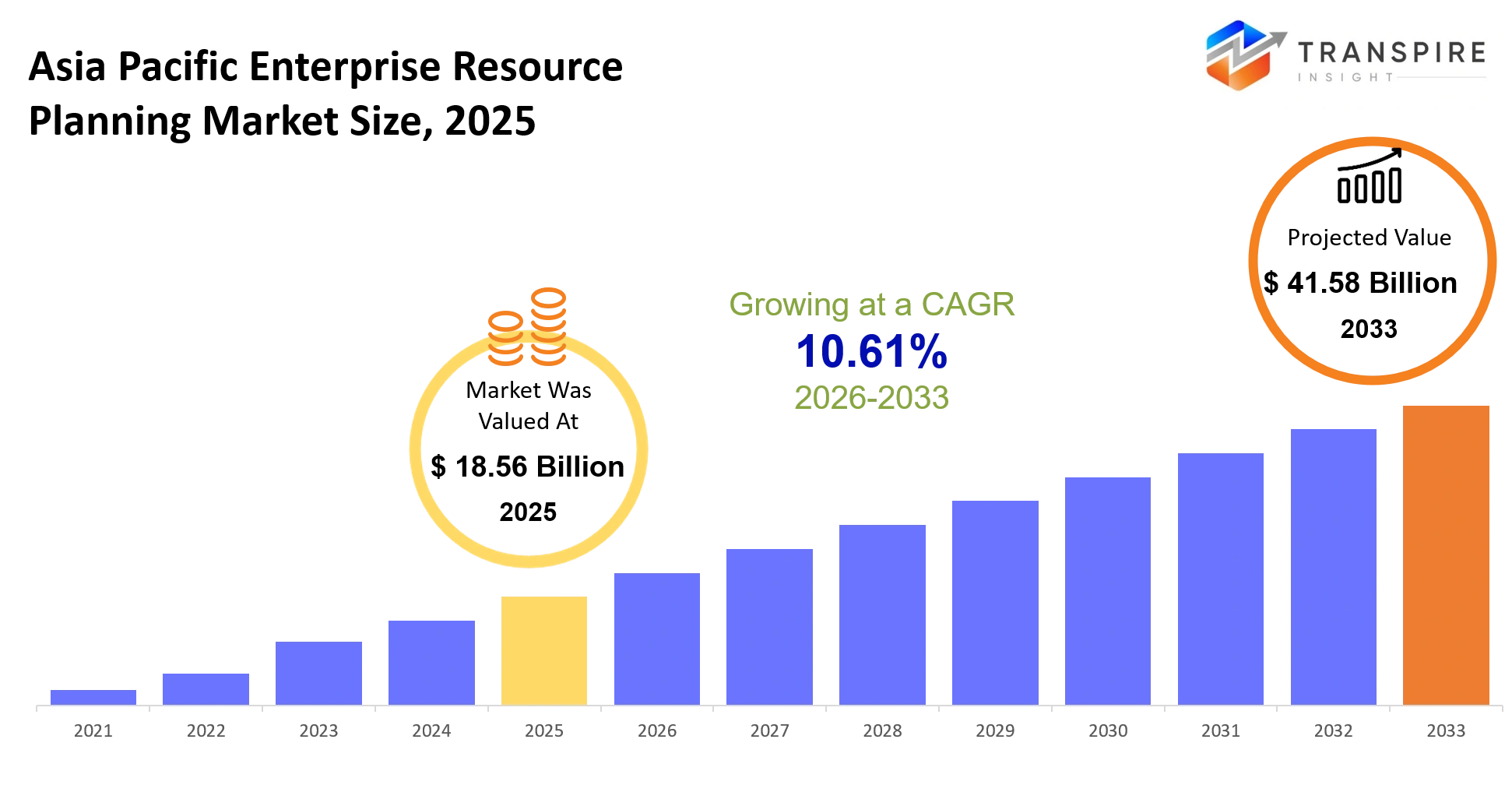
- Asia Pacific Enterprise Resource Planning Market Size 2025: USD 18.56 Billion
- Asia Pacific Enterprise Resource Planning Market Size 2033: USD 41.58 Billion
- Asia Pacific Enterprise Resource Planning Market CAGR: 10.61%
- Asia Pacific Enterprise Resource Planning Market Segments: By Component (ERP Software, Consulting Services, Implementation Services, Support Services, Analytics Tools, Integration Services, Training Services, Others); By Deployment (Cloud ERP, On-Premise ERP, Hybrid ERP, SaaS ERP, Private Cloud ERP, Multi-Cloud ERP, Industry-Specific ERP, Others); By Enterprise Size (Large Enterprises, SMEs, Startups, Mid-Sized Enterprises, Public Sector Organizations, Nonprofits, Educational Institutions, Others); By End User (Manufacturing, Retail, BFSI, Healthcare, IT & Telecom, Logistics, Government, Others)
Asia Pacific Enterprise Resource Planning Market Summary
The Asia Pacific Enterprise Resource Planning Market was valued at USD 18.56 Billion in 2025. It is forecast to reach USD 41.58 Billion by 2033. That is a CAGR of 10.61% over the period.
Market scope:Asia Pacific Enterprise Resource Planning market is primarily aimed at enabling business organizations to use the digital backbone for managing business processes that pertain to finance, procurement, manufacturing, inventory, human resources, and supply chain. Practically ERP allows companies to eliminate redundant processes and manual reconciliation so that companies can achieve swift decision making, optimize costs and react to market volatilities efficiently. Over the last few years the market has witnessed structural changes from on premise solutions to cloud based and AI integrated ERP solutions which support real time analysis and ongoing process automation.
The outbreak of COVID-19 pandemic and related supply chain vulnerabilities, further propelled this market to transition, as the organization looks out for visibility over suppliers, inventory and production network. ERP spending is getting more aligned with operational resilience as manufacturers in the region expand their businesses and the service sector automates their businesses, bringing recurring revenue through subscriptions, updates, and industry specific solutions.
Key Market Insights
- East Asia leads the market share with approximately 45% in 2025 owing to huge manufacturing ecosystems and developed digital infrastructure.
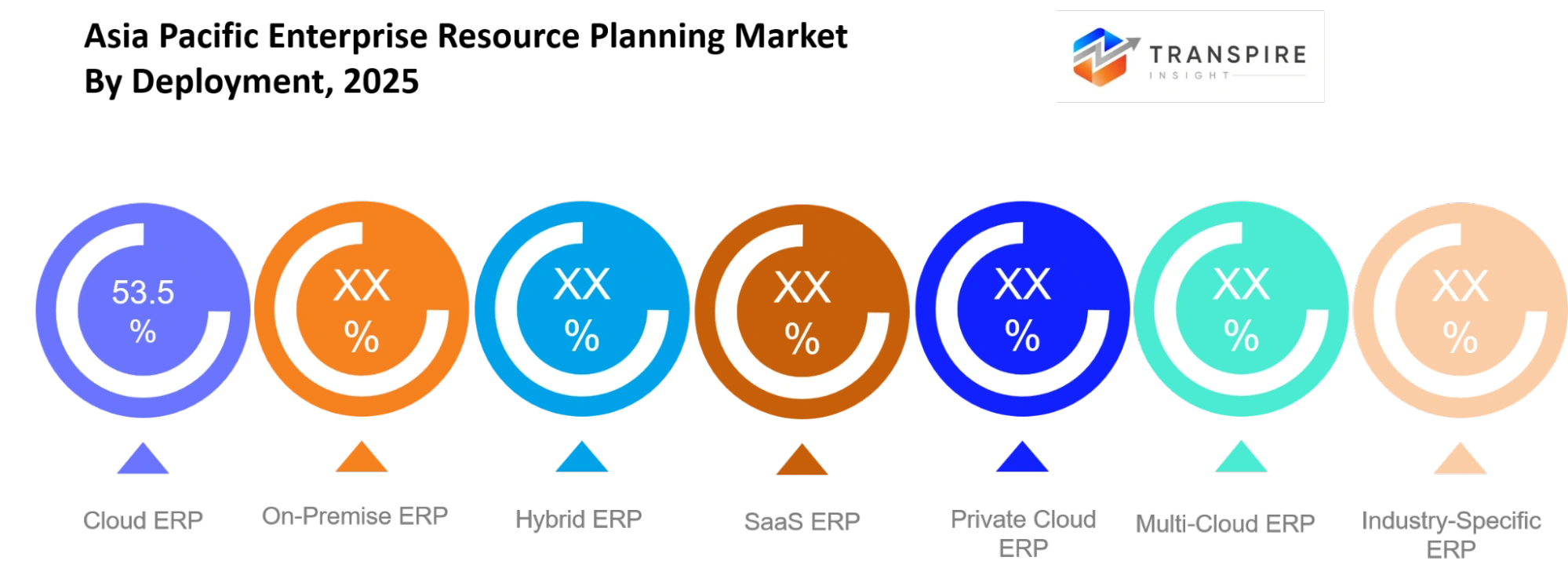
- The most prominent segment in the market share is cloud ERP accounting for nearly 50% share in 2025 as organizations are moving from legacy on premise systems.
- The hybrid ERP market share stands second in the market share because of organizations' need for more flexibility without compromising over sensitive business information control.
- The AI-enabled ERP market share is the fastest-growing segment during 2025-2032 driven by embedded analytics and automated intelligent workflows.
- Applications in manufacturing lead the market share by approximately 30% as organizations integrate production planning, procurement and inventory management with each other.
- Rapidly growing retail & e-commerce applications as the organizations are demanding on-line and off-line (omnichannel) inventory view and real-time customer analytics.
- Large organizations account for a market share of nearly 60% because of huge multi-site operations and higher spending capacity on IT infrastructure.
- Small & medium sized enterprises will form a fastest-growing end user segment as they require lower deployment costs for subscriptions based ERP models.
- Key vendors in the ERP market are SAP, Oracle, Microsoft, Infor, Sage and Workday who are in constant competition with one another by innovating the ERP platform through embedded features.
- Competition is created through geographical expansion, industry-specific ERP applications and cloud data centers across regions and tie-ups with system integrators.
What are the Key Drivers, Restraints, and Opportunities in the Asia Pacific Enterprise Resource Planning Market?
The most powerful growth driver impacting the Asia Pacific Enterprise Resource Planning Market is the increasing adoption of cloud-first digital transformation strategies across businesses. It is largely witnessing manufacturing, retail, healthcare and financial services adopting cloud based ER platforms to streamline the fragmented old applications and obtain real-time visibility into business operations. After the COVID-19 crisis revealed severe gaps in supply chain and inventory management, this transition has accelerated rapidly. The infrastructure expenditure has declined along with faster implementation cycles with the emergence of subscription based models for ERP vendors who can earn recurring revenue and further increase customer base within the mid-market segment.
There are some significant structural barriers for the Asia Pacific Enterprise Resource Planning Market and are considered a major drawback of this market; data migration and legacy system integration. Majority of the enterprises utilize decades old applications that are designed around unique business workflows and processes within organizations; these need to be redesigned before being integrated with newer systems which involve considerable investment in infrastructure and worker training. Risk of operational disruption among organizations holds them back from readily adopting the changes, thereby decreasing short term revenue potential for software vendors and impacting large-scale enterprise ERP rollouts.
One of the largest opportunities for Artificial Intelligence (AI) as an extension of ERPs lies in AI driven forecasting, automated accounting and intelligent procurement in most of the Asia Pacific region. Many developing countries such as India, Indonesia and Vietnam have a high investment in digital infrastructure and the ERP market in this region offers considerable scope for cloud vendors to establish industry-specific solutions and discover new avenues of revenue generation.
What Has the Impact of Artificial Intelligence Been on the Asia Pacific Enterprise Resource Planning Market?
Artificial intelligence is reshaping ERP across Asia Pacific as systems are reoriented from transaction engines to decision-making tools that predict performance. Businesses increasingly deploy AI for automated processing of invoices, approvals of procurements, validation of payroll and management of inventories, allowing them to eliminate manual effort and gain greater operational efficiency. By applying machine learning algorithms to historical purchasing behaviors and supply chain data, businesses are better positioned to forecast demands, control excess inventories and minimize shortages.
Sophisticated digital technologies have also come to play in the areas of financial planning and risk management. Data analytics that use AI help uncover spending abnormalities, predict trends in cash flows, and make recommendations on procurements instantly. ERP implementations for manufacturers on smart ERP systems show shorter planning cycles, improved production scheduling and significant increases in inventory turnover. Retail companies find new benefits in automatic replenishments which give improved accuracy in ordering and a better fulfillment rate for consumers.
However, there are certain limitations which hinder the growth of AI. Combining existing ERP systems with new AI functionalities is an expensive and resource intensive task that necessitates large data quality; many enterprises have disparate data and uneven governance which ultimately leads to inferior models and long implementation time until business values of smart enterprise systems materialize.
Key Market Trends
- In 2020, the transition from on-premise systems to cloud ERP has become predominant. Over half of the newly deployed systems were distributed under a subscription model.
- The demand for an integrated ERP suite-including production, procurement and analytics-over old standalone legacy applications, which had existed for decades, increased among manufacturing organizations.
- AI was an additional option before the 2022 implementation but had become a mandatory feature with the embedding of automated workflows and predictive forecasting features into ERP solutions.
- The increase in ERP implementation in small and medium organizations accelerated due to decreasing prices for implementation and up to 30% in upfront investment with reduced cloud subscriptions compared with traditional deployments.
- The rise of industry-specific ERP solutions for retail, health care and manufacturing industries occurred when companies in Southeast Asia began to request solutions more precisely adapted to their sectors.
- The introduction of data residency laws in some of Asia Pacific economies made it necessary for global ERP vendors to set up cloud infrastructure and cooperate with local hosting partners.
- The competition accelerated the process of forging new AI partnerships and acquiring specialized providers (SAP, Oracle, Microsoft, Infor) with enhanced technology to complete their ecosystems.
- In 2023, there was a growing demand for inter-operable ERP solutions, which made vendors actively involved in low-code platforms and API interfaces.
- As a result of the supply chain disruptions post-pandemic, the approach toward acquiring ERP changed, with businesses focusing on end-to-end transparency and scenario management features.
- The need for ESG and carbon accounting has been identified as an upcoming buying criterion, pushing ERP vendors toward developing tools to report sustainability.
Asia Pacific Enterprise Resource Planning Market Segmentation
By Component:
ERP Software is at the heart of an enterprise resource planning solution and processes functions like finance, procurement, inventory, manufacturing, and human resources from a common database. Organizations select ERP software to enhance transparency and simplify data handling.Increasing awareness and development for real-time decision-making has increased adoption of innovative ERP solutions among many sectors.
Consulting Services, facilitate an organization to determine business needs, and find right ERP solutions according to the business objective. Installation, data transfer and system configuration is facilitated through Implementation Services and the system upkeep is dealt through Support Services which offer timely maintenance and troubleshooting. With additional support in forms of Analytics Tools, Integration Services, Training Services, etc the functionality of the system can be enhanced.
By Deployment:
Cloud ERP solutions have enabled organizations to access applications via a web-based interface, minimizing need for physical infrastructure. Since these solutions offer pricing models and speed of deployment as other options, many organizations have moved towards cloud solutions. Frequent up-dates, along with quick and simple scalability offered, further enhance a cloud solution.
On- Premise ERP solution remains prevalent for an organization that needs extensive control over internal systems and data. Hybrid ERP solution provides a mixture of both, so that an organization can attain flexibility and maintain necessary control over systems. Apart from these, SaaS ERP, Private Cloud ERP, Multi- Cloud ERP, Industry- Specific ERP and other solution models are also used based on different needs.
By Enterprise Size:
Large Enterprises utilize ERP solutions in coordination across several business units, locations, and departments. With ample investing capability, they are quick to adopt features like predictive analytics, AI, and the fully integrated supply chain management process. Enterprise-wide visibility is still a competitive edge for larger firms.
SMEs, Startups, Mid-sized Enterprises, Public sector organizations, non-profits, and educational institutions, amongst others, increasingly turn to ERP solutions as productivity improvements, automation, and reducing manual processes gain momentum. Lower adoption barriers to using affordable subscription models and cloud deployments have made ERPs more accessible for organizations of varying sizes, helping them streamline operations and secure long-term performance.
By End User:
Manufacturing is one of the biggest end-user segments that leverages ERP solutions to manage their schedules, inventories, procurements, and quality control. The Retail sector uses ERPs to manage their inventories, customer data, and their respective sales channels. In the BFSI industry, such integrated solutions facilitate better financial management, improve compliance, and ensure operational transparency.
Similarly, Healthcare uses these solutions to manage administrative tasks for their patients and their procurements, while IT and Telecom sectors manage their project implementation and service delivery more effectively using these solutions. Logistics providers, Government agencies, among other industries also continue to adopt ERPs to streamline operations, enhance data visibility, and build up the enterprise for expansion in the long term.
What are the Key Use Cases Driving the Asia Pacific Enterprise Resource Planning Market?
The adoption of the Asia Pacific Enterprise Resource Planning Market has its predominant use case driven by the manufacturing industry. Businesses in the manufacturing sector depend on the ERP platform for the co-ordination of supply chain, scheduling of the manufacturing activities, controlling of the inventory and quality management on one platform, and also to enhance the resource and operational time. It provides better transparency in the factory and along the supplier network.
Retail and BFSI are considered as the other vital application areas as both the industries require better controls on the customers' data, financials and over the omnichannel transactions. Retail industries utilize the ERP platform to have the stock aligned across the store and across the online space, whereas,BFSI uses it to manage their compliance, reporting, and risk.
Emerging applications include AI-driven forecasting, sustainability reports. Carbon accounting, prediction, and automated buying are now being integrated in the ERP platform. Although these applications are still in the developing phase, these are expected to grow rapidly as regulatory constraints increase and the companies' want to perform their business based on data.
|
Report Metrics |
Details |
|
Market size value in 2025 |
USD 18.56 Billion |
|
Market size value in 2026 |
USD 20.53 Billion |
|
Revenue forecast in 2033 |
USD 41.58 Billion |
|
Growth rate |
CAGR of 10.61% from 2026 to 2033 |
|
Base year |
2025 |
|
Historical data |
2021 - 2024 |
|
Forecast period |
2026 - 2033 |
|
Report coverage |
Revenue forecast, competitive landscape, growth factors, and trends |
|
Regional scope |
Asia Pacific (India, China, Japan, Australia, South Korea, Rest of Asia Pacific) |
|
Key company profiled |
SAP, Oracle, Microsoft, Infor, Epicor, Sage, IFS, Unit4, Acumatica, NetSuite, Odoo, Workday, Tally Solutions, Ramco Systems, QAD |
|
Customization scope |
Free report customization (country, regional & segment scope). Avail customized purchase options to meet your exact research needs. |
|
Report Segmentation |
By Component (ERP Software, Consulting Services, Implementation Services, Support Services, Analytics Tools, Integration Services, Training Services, Others); By Deployment (Cloud ERP, On-Premise ERP, Hybrid ERP, SaaS ERP, Private Cloud ERP, Multi-Cloud ERP, Industry-Specific ERP, Others); By Enterprise Size (Large Enterprises, SMEs, Startups, Mid-Sized Enterprises, Public Sector Organizations, Nonprofits, Educational Institutions, Others); By End User (Manufacturing, Retail, BFSI, Healthcare, IT & Telecom, Logistics, Government, Others) |
Which Regions are Driving the Asia Pacific Enterprise Resource Planning Market Growth?
East Asia continues to be the leading segment of the Asia Pacific ERP Market due to robust industrial capability, developed digital infrastructure, and a long history of adopting enterprise software. China, Japan and South Korea continue to be major spenders on smart manufacturing and cloud computing which creates a good market for implementation of ERP systems among large organizations. Government-driven schemes promoting digitalization and industrial automation have accelerated software upgrades across various industries. The existence of a well-established technology vendor, cloud providers, consulting and system integrator ecosystem have continued to be a key factor for leadership.
Oceania holds the position as the second largest regional segment in Asia Pacific ERP Market, however, the drivers of growth are relatively different from that in East Asia. Australia and New Zealand focus largely on the service industry, healthcare industry, mining and finance sector compared to the industrial sector with large scale manufacturing capability. The market is primarily driven by stable macroeconomic conditions, clear data governance framework and consistent investment on cloud technology to promote legacy system upgrades. It can serve as a reliable source of predictable recurring ERP revenues and long-term subscriptions of software.
Southeast Asia stands to emerge as the fastest growing segment driven by government and private sectors fast tracking digital transformation plans. Government initiated investment in Indonesia, Vietnam, Thailand and Malaysia on cloud infrastructure, workforce skills development and industrial modernization initiatives drives organizations of small and medium scale towards adopting ERP. Increasing export volumes in manufacturing and boom in e-commerce activities have given rise to a larger demand for efficient business process management systems. The growth for 2026-2033 will likely result in abundant opportunities for market vendors and investors focusing on market expansion in under-penetrated and highly digitizing segments.
Who are the Key Players in the Asia Pacific Enterprise Resource Planning Market and How Do They Compete?
The Asia Pacific Enterprise Resource Planning Market is moderately consolidated, with both international technology providers, regional companies, and niche specialists contesting the market. In this space, technology innovation has now become the primary basis for competition, as customers desire AI driven analytics, cloud flexibility, industry-specific capabilities instead of stand-alone software. While legacy vendors attempt to hold market share through widening their ecosystem of products and services, newer vendors seek to penetrate the underserved small and medium enterprises through subscription-based solutions and rapid deployment strategies.
SAP differentiate their offering by a focus on robust manufacturing functions and tailored industry specific ERP solutions that allow integrated supply chain planning, production control, and sustainability reporting in a single platform. Oracle differentiate with a cloud first approach and an embedded AI component that allows for the automation of financial, procurement, and workforce management through unified applications. Both vendors continue to boost their presence in the region through significant investments in local cloud infrastructure, and through the engagement of system integrators and consulting partners.
Microsoft compete through an integration of ERP functionality with productivity tools, analytical systems and AI components, facilitating a truly integrated business environment irrespective of enterprise size. Infor focus on industry-specific solutions for the manufacturing, healthcare, and distribution sectors, while Workday expands their footprint on the strength of their robust human capital management and financial planning functionality. Both vendors achieve a competitive advantage by offering specialized solutions with scalability from the cloud, and through continuous innovation in their respective products.
Company List
- SAP
- Oracle
- Microsoft
- Infor
- Epicor
- Sage
- IFS
- Unit4
- Acumatica
- NetSuite
- Odoo
- Workday
- Tally Solutions
- Ramco Systems
- QAD
Recent Development News
In February 2026, SAP announced new Business AI and cloud ERP customer wins across Asia Pacific. The company expanded adoption of SAP Business Suite and AI-enabled ERP solutions among enterprises in Japan, India, New Zealand, and the Philippines, reinforcing cloud ERP modernization across the region. Source https://news.sap.com/
In April 2026, SAP held the Asia Pacific Partner Summit in Bangkok to strengthen partnerships around AI-ready ERP and cloud business applications. The event accelerated collaboration with regional partners and highlighted SAP's strategy to expand embedded AI and cloud ERP capabilities across Asia Pacific markets. Sourcehttps://events.sap.com/
What Strategic Insights Define the Future of the Asia Pacific Enterprise Resource Planning Market?
The Asia Pacific ERP market is structurally trending toward truly unified cloud first enterprise ecosystems where AI powered decision engines supplant static workflows. Software replacement is an ancillary concern to ongoing, continuous optimization of finance/SCM/production networks in real time intelligence. The unknown risk is in the increased concentration of vendors. A few global players could potentially lock customers into platforms that may ultimately be difficult/expensive to customize.
An unknown opportunity is the fast integration of ERP platforms with the regulatory level ESG and carbon reporting regimes within the manufacturing hubs of India/Southeast Asia. ERPs will shift from an operational component to a compliance layer. Vendors that focus on a modular, interoperable infrastructure, which will enable greater ease in integrating with regulatory frameworks and the aforementioned AI capabilities, will win over purchasing organizations.
Asia Pacific Enterprise Resource Planning Market Report Segmentation
By Component
- ERP Software
- Consulting Services
- Implementation Services
- Support Services
- Analytics Tools
- Integration Services
- Training Services
By Deployment
- Cloud ERP
- On-Premise ERP
- Hybrid ERP
- SaaS ERP
- Private Cloud ERP
- Multi-Cloud ERP
- Industry-Specific ERP
By Enterprise Size
- Large Enterprises
- SMEs
- Startups
- Mid-Sized Enterprises
- Public Sector Organizations
- Nonprofits
- Educational Institution
By End User
- Manufacturing
- Retail
- BFSI
- Healthcare
- IT & Telecom
- Logistics
- Government
Frequently Asked Questions
Find quick answers to common questions.
The Asia Pacific Enterprise Resource Planning Market size is USD 41.58 Billion in 2033.
Key segments for the Asia Pacific Enterprise Resource Planning Market are By Component (ERP Software, Consulting Services, Implementation Services, Support Services, Analytics Tools, Integration Services, Training Services, Others); By Deployment (Cloud ERP, On-Premise ERP, Hybrid ERP, SaaS ERP, Private Cloud ERP, Multi-Cloud ERP, Industry-Specific ERP, Others); By Enterprise Size (Large Enterprises, SMEs, Startups, Mid-Sized Enterprises, Public Sector Organizations, Nonprofits, Educational Institutions, Others); By End User (Manufacturing, Retail, BFSI, Healthcare, IT & Telecom, Logistics, Government, Others).
Major Asia Pacific Enterprise Resource Planning Market players are SAP, Oracle, Microsoft, Infor, Epicor, Sage, IFS, Unit4, Acumatica, NetSuite, Odoo, Workday, Tally Solutions, Ramco Systems, QAD.
The Asia Pacific Enterprise Resource Planning Market size is USD 18.56 Billion in 2025.
The Asia Pacific Enterprise Resource Planning Market CAGR is 10.61% from 2026 to 2033.
- SAP
- Oracle
- Microsoft
- Infor
- Epicor
- Sage
- IFS
- Unit4
- Acumatica
- NetSuite
- Odoo
- Workday
- Tally Solutions
- Ramco Systems
- QAD
About the Authors

Chetan Dhatrak
I’m Chetan Dhatrak, a Senior Research Analyst at Transpire Insight, specializing in the Consumer Goods, Foods and Beverages industry. I focus on analyzing market trends, consumer behavior, competitive landscapes, and industry developments to deliver accurate, data-driven insights. My research at Transpire Insight is built on credible sources and in-depth analysis, helping businesses and readers better understand market dynamics, emerging opportunities, and evolving consumer preferences. I’m committed to creating reliable, well-researched content that supports informed decision-making and reflects the latest developments in the consumer goods and food & beverage sectors.

Chakradhar Khansole
Chakradhar serves as the Research Director at Transpire Insight, bringing over 8 years of experience in technology, innovation, and strategic market intelligence. He specializes in transforming complex market data into actionable business insights that enable organizations to make informed, growth-oriented decisions. Recognized for his strategic vision and analytical expertise, Chakradhar leads high-impact research initiatives, delivering comprehensive market assessments, competitive intelligence, and forward-looking industry analysis.
Recently Published Reports
-
Apr 2026
Bottled Water Market
Bottled Water Market Size, Share & Analysis Report By Product Type (Still Bottled Water, Carbonated Bottled Water, Functional Bottled Water, and Others), By Packaging (PET, Cans, and Others), By Sales Channel (Supermarkets/Hypermarkets, Convenience Stores/Drug Stores, Grocery Stores/Club Stores, Foodservice, and Others) and Geography (North America, Europe, Asia-Pacific, Middle East and Africa, South and Central America), 2021 - 2032
-
Apr 2026
Color Cosmetic Packaging Market
Color Cosmetic Packaging Market Size, Share & Analysis Report By Application (Mascara Packaging, Liquid Packaging, and Liquid Face), By Type (Tubes & Bottles, Pens & Markers, Compacts & Containers, and Droppers & Pumps), and Geography (North America, Europe, Asia-Pacific, Middle East and Africa, South and Central America), 2021 - 2031
-
Apr 2026
External Microphone For Camera Market
External Microphone For Camera Market Size, Share & Analysis Report By Type (Shotgun Microphone, Lavalier Microphone, and Others), By Application (Digital Camera, Professional Video Camera, and Others), and Geography (North America, Europe, Asia-Pacific, Middle East and Africa, South and Central America), 2021 - 2031
-
Apr 2026
Foot Orthotic Insoles Market
Foot Orthotic Insoles Market Size, Share & Analysis Report By Type (Pre-fabricated, and Custom-made), By Material (Thermoplastic, Composite Carbon Fiber, and Others), By Distribution Channel (Drug Stores, Hospitals & Clinics, and Others), and Geography (North America, Europe, Asia-Pacific, Middle East and Africa, South and Central America), 2021 - 2031