

Asia Pacific Human Resource Management Market Size & Forecast:
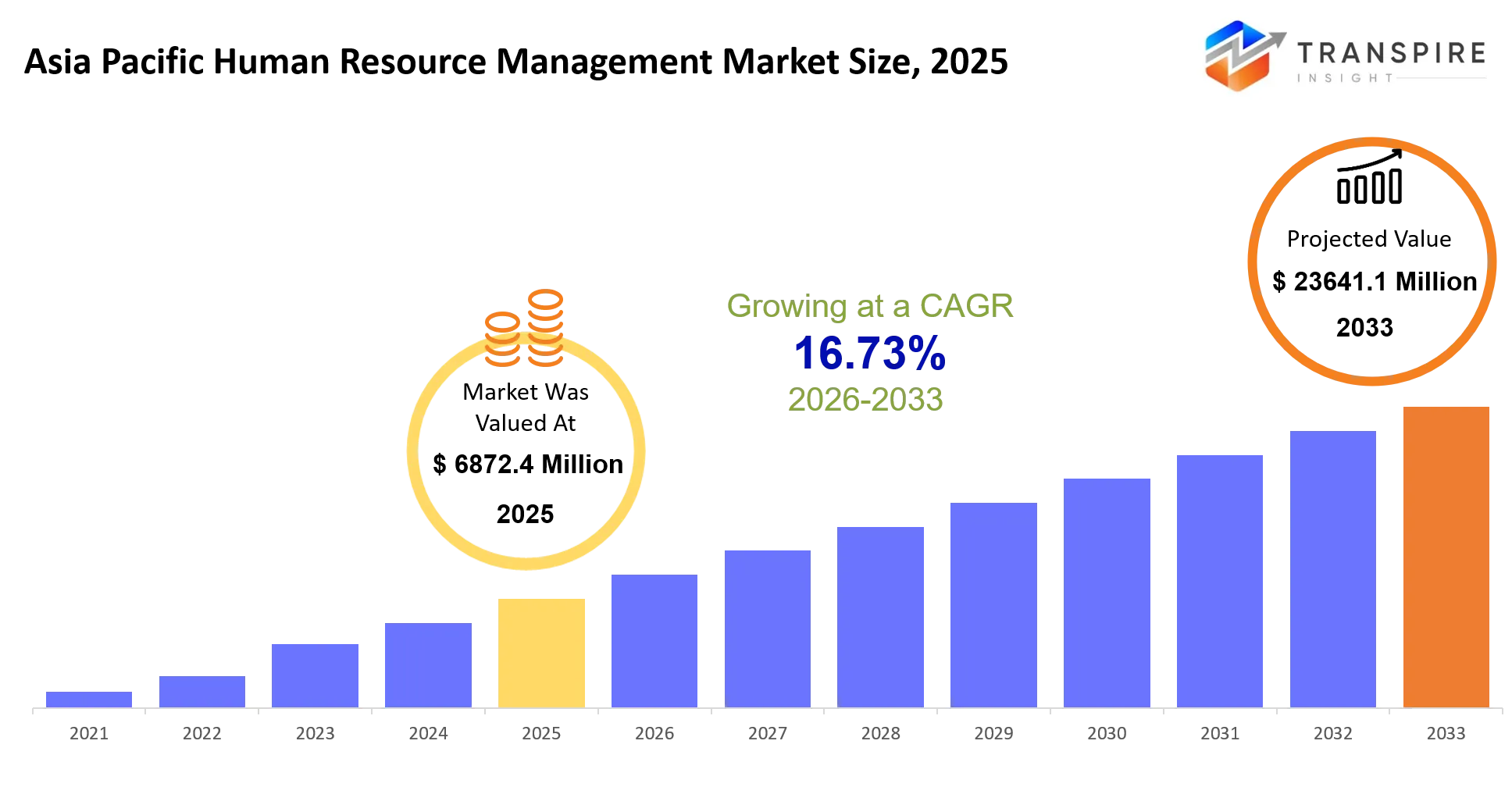
- Asia Pacific Human Resource Management Market Size 2025: USD 6872.4 Million
- Asia Pacific Human Resource Management Market Size 2033: USD 23641.1 Million
- Asia Pacific Human Resource Management Market CAGR: 16.73%
- Asia Pacific Human Resource Management Market Segments: By Solution Type (Payroll, Talent, Workforce, Recruitment, Performance, Learning, Benefits, Others) By Deployment Mode (Cloud, On-Premise, Hybrid, SaaS, Private Cloud, Public Cloud, Mobile, Others) By Enterprise Size (Large, SMEs, Startups, Government, Education, Healthcare, Manufacturing, Others) By Industry Vertical (IT, BFSI, Healthcare, Manufacturing, Retail, Education, Government, Others)
To learn more about this report,  Download Free Sample Report
Asia Pacific Human Resource Management Market Summary
The Asia Pacific Human Resource Management Market was valued at USD 6872.4 Million in 2025. It is forecast to reach USD 23641.1 Million by 2033. That is a CAGR of 16.73% over the period.
Asia Pacific Human Resource Management (HRM) market, it basically helps companies deal with one of the more complex operational headache things: recruiting, grooming, compensating, and keeping employees—like across many sites, different business divisions, and all those regulatory rules that never feel simple. Usually, HRM platforms let manufacturers, logistics players, tech companies, and service organizations line up workforce planning, payroll processing, compliance checks, performance tracking, and even employee engagement, but in a bigger coordinated way, at scale.
Over the past five years, the market has shifted quite a bit, away from separate on-premise HR systems and toward cloud based, integrated talent and workforce management platforms. The COVID-19 pandemic, kind of, pushed it forward quickly, because organizations had to support remote, then hybrid workforces. At the same time they had to keep productivity up and stay compliant. So, companies started putting more money into digital HR infrastructure, self service employee tools, and workforce analytics, faster than before.
Right now, growth is mainly pulled by the need to handle bigger and more spread out workforces while also dealing with talent shortages and changing labor regulations. This change is also raising the rate of software adoption, widening subscription style revenue streams, and making more organizations view workforce data as a strategic business resource not just an administrative back office task.
Key Market Insights
- China is really big in the Asia Pacific Human Resource Management Market. It has 32 percent of the market in 2025. This is because big companies in China are using technology.
- India is growing fast until 2030. This is happening because many companies are using software as a service and there are new startups. Also companies are making their workforce more formal.
- Countries in Southeast Asia are also growing a lot. This is because they are investing in cloud-based platforms for resources and tools to automate work.
- Australia and Japan have a share of the market. They have technology for human resources and their companies use software in a mature way.
- Payroll Management is the part of the market. It has 24 percent of the revenue in 2025. This is because companies have to follow rules.
- Talent Management Solutions are the biggest part. They help companies find the people and keep their employees.
- Workforce Analytics and AI-enabled HR solutions are growing fast. They help companies make decisions based on data.
- Companies are also using platforms, for learning and development. They want their workers to have the skills they need for the world.
- Employee Lifecycle Management is the application. It has 30 percent of the market. Companies want to be able to see everything that is happening with their workforce.
- Recruitment and onboarding applications are growing the fastest. Companies are competing with each other to find the workers.
What are the Key Drivers, Restraints, and Opportunities in the Asia Pacific Human Resource Management Market?
The bigg est push that’s accelerating the Asia Pacific Human Resource Management Market, kind of, is the quick move toward cloud based and AI enabled tools for workforce management. This change really picked up after many companies across the region started leaning into hybrid or distributed work arrangements, and well, that exposed weaknesses in the older HR systems they already had. Now employers expect one centralized solution, not scattered ones, that can handle payroll, recruiting, regulatory compliance, ongoing performance monitoring, and also employee engagement, all across several offices or locations. Because of that, enterprises are throwing more funding at subscription type HR software, which basically gives vendors those recurring revenue streams, while also widening use among both large firms and mid size players.
Even so, data privacy concerns regulatory complexity, and system integration headaches are still the biggest obstacles when the market tries to spread further. HR platforms end up working with extremely sensitive employee details, and that data has to align with each country specific rules, like in China, India, Japan and Australia. The issue is, the requirements don’t move in sync, so organizations face structural friction, plus they often need localized setup configurations just to stay compliant. On top of that, companies have to plug new HR platforms into the existing enterprise ecosystem, and that usually increases implementation costs and extends deployment schedules. Honestly this level of messiness can slow down buying decisions and can reduce uptake among organizations that are more cost constrained.
Generative AI plus workforce analytics feels like the most promising growth opportunity for the next phase of market development, honestly. Organizations keep putting more money into AI driven recruitment, skills mapping, and this kind of predictive workforce planning tools. India along with Southeast Asia are looking like especially attractive markets too, where spend on digital transformation keeps going up and the technology ecosystems are getting broader. That combination is making conditions pretty favorable for advanced HR tech deployment, in a way that’s hard to ignore.
What Has the Impact of Artificial Intelligence Been on the Asia Pacific Human Resource Management Market?
Artificial intelligence plus advanced digital technologies are kinda reshaping the Asia Pacific Human Resource Management Market, mainly by automating a bunch of labor intensive HR steps and at the same time improving workforce decision making. Now, AI driven HR platforms often take over resume screening, candidate matching, interview scheduling, payroll validation, benefits administration, and also compliance monitoring. Big enterprises typically rely on intelligent workflow engines to handle thousands of employee transactions with very little manual effort, this lowers the administrative burden and makes response time faster, not only smoother.
On top of that, machine learning models are adding even more predictive strength across workforce management systems. Companies are using predictive analytics to estimate employee attrition, spot skills gaps earlier, guess future hiring needs, and fine tune workforce allocation. Recruitment platforms, meanwhile, look at past hiring results and employee performance records to boost selection precision, where as workforce analytics tools let managers foresee staffing shortages before they start hurting day to day operations.
These technologies are delivering measurable operational improvements. Automated recruitment systems can reduce time-to-hire by several weeks, while AI-assisted payroll and compliance tools lower processing errors and improve regulatory adherence. Workforce planning platforms also help organizations control labor costs and improve employee retention by identifying engagement risks early.
However, a big limitation still shows up when AI solutions have to be integrated with older legacy enterprise systems. Many organizations run fragmented HR infrastructures, so it takes a lot of money plus data standardization, and then also change management, before advanced analytics and automation tools can really deliver their full value. The problem keeps lingering, and it also slows adoption, especially for mid sized organizations across the emerging Asia Pacific economies.
Key Market Trends
- Since 2020 companies have been moving their HR systems from their servers to cloud platforms really fast. This has helped them get things up and running quicker and get a view of their workforce.
- AI-powered recruitment tools have become really popular between 2022 and 2025. They are now used by companies to automate the process of screening candidates and managing interviews.
- There have been some changes in the rules and regulations in India, Australia and Singapore. Because of this companies are looking for ways to automate payroll and make sure they are following all the rules.
- Big companies have started to move from doing performance reviews just once a year. Instead they are using platforms that give feedback. This has made employee engagement technologies more important.
- After 2021 companies have been using workforce analytics a lot more. They want to use data to understand how to keep employees make them more productive and plan for the future.
- SAP SuccessFactors, Workday Oracle HCM and Darwinbox have all been investing more in regions. They are competing with each other by adding features and using artificial intelligence.
- Platforms that focus on employee experience have become really important. This is because many companies are now using work models all the time, especially in the technology, financial services and professional services sectors.
- Companies are trying to simplify their HR systems by combining applications into one platform. This helps reduce the number of software programs they use and makes it easier to manage their workforce.
- In the Asia Pacific region companies have started to focus on the skills a person has when hiring, rather than just their degree. This change happened after 2023.
- Generative AI has become a factor in the HR industry in 2024 and 2025. It is helping companies automate job descriptions plan their workforce and provide support, for HR services.
Asia Pacific Human Resource Management Market Segmentation
By Solution Type:
Payroll solutions keep a strong hold on the market, mostly because organizations need to handle employee pay correctly while navigating shifting labor rules and tax requirements. Automated payroll platforms lower the manual churn, boost the precision of records , and make it easier for companies to stay compliant across different locations. You can see really strong adoption with large enterprises , and mid-sized companies are starting to use them more and more. That mix seems to support steady growth for this category.
On the other hand, talent management solutions stay pretty central in workforce planning since businesses keep prioritizing recruitment, retention and employee growth. Workforce analytics, plus AI-enabled HR solutions, are getting more traction because better data-driven workforce sequencing leads to sharper hiring choices and performance insights. Learning and development platforms are also pulling in more funding, because employers want to grow digital skills, and strengthen long-term workforce capacity.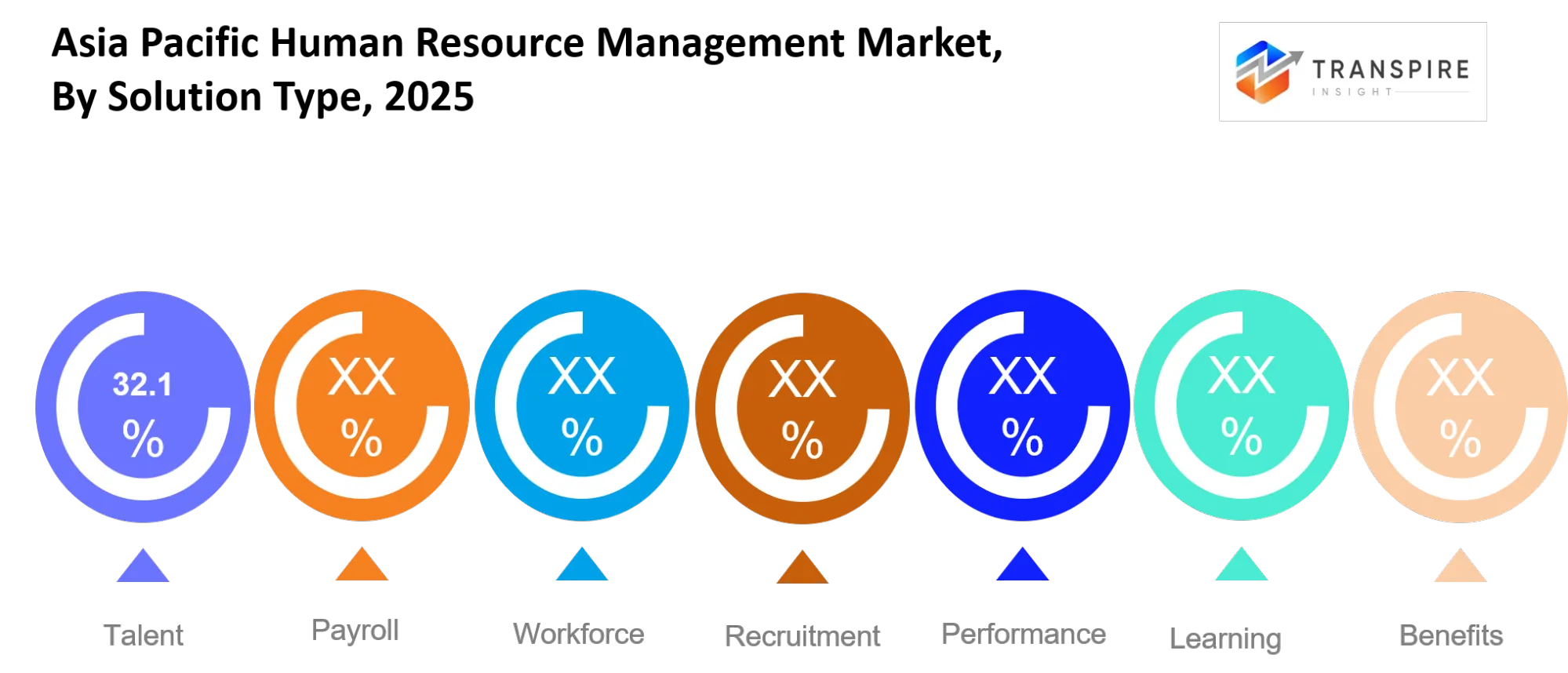
To learn more about this report, Download Free Sample Report
By Deployment Mode:
Cloud deployment has pretty much become the go-to option in lots of industries, mainly because it needs less infrastructure, tends to roll out faster, and makes scaling feel way less painful. In practice, teams get real time access to workforce data, software updates that don’t take weeks, and better coordination across departments. And honestly, with hybrid schedules and remote work arrangements becoming normal, the cloud platform adoption across the region keeps getting pushed even harder.
Meanwhile, on premise deployment is still hanging around for organizations that have strict data control requirements and already have internal IT systems that work. Hybrid models are getting more traction too, since companies can juggle security expectations while still leaning on cloud based applications for flexibility, which is kinda the sweet spot. SaaS based solutions also keep growing, because subscription models lower the upfront costs and make tech management simpler for expanding enterprises, even when resources are limited.
By Enterprise Size:
Big enterprises take up a meaningful portion of HR tech spending because more intricate workforce designs need advanced management skills. Rather than piecemeal tools, integrated platforms can help with payroll administration, workforce planning, compliance oversight, and employee engagement across different business units. And since digital transformation efforts don’t really slow down, companies still look for ways to fund more sophisticated HR systems.
Meanwhile, small and medium-sized enterprises are starting to adopt newer HR platforms, partly because cloud options feel more affordable and reachable. With flexible pricing models and a more straightforward rollout, fewer obstacles show up , compared with the past. Even startup organizations are pushing the market along too by investing in scalable workforce management tools, designed for fast scaling and smoother day-to-day operations .
By Industry Vertical:
The tech sector still feels like one of the biggest users of HR management software, mainly because there is intense competition for skilled talent and also the need for fast talent sourcing. With advanced workforce analytics and recruitment technologies employers can spot skill gaps more quickly , and they can also strengthen employee staying power. And then there are all those ongoing digital transformation efforts that keep pushing investments into new, modern HR platforms, kinda constantly.
Beyond that, manufacturing, healthcare, financial services, and government organizations show up as solid adoption channels too. Things like regulatory compliance obligations , workforce scheduling demands, and employee performance oversight goals nudge companies to roll these systems out in many sectors. As the emphasis keeps shifting toward workforce productivity, operational visibility, and long term talent growth it should keep supporting adoption across lots of different industry verticals, even when priorities change..
What are the Key Use Cases Driving the Asia Pacific Human Resource Management Market?
Payroll administration still seems to be the main thing that pushes adoption across the market, like, almost everywhere. Bigger employers lean on digital HR platforms to handle compensation, tax calculations, attendance records and regulatory reporting, across several locations. This part creates the strongest demand since payroll accuracy really does play into compliance, employee morale, and day to day operational continuity.
Recruitment management plus workforce planning are getting more traction too, especially within technology, healthcare, manufacturing, and financial services organizations. Employers use these tools to cope with talent gaps, make the hiring workflow more streamlined, and get better at workforce allocation. At the same time learning and development platforms are also getting a closer look , because companies have to respond to shifting skill needs and all those digital transformation efforts.
We’re seeing emerging applications like AI guided skills mapping and predictive workforce analytics, and honestly it’s starting to look pretty important. These systems let organizations spot upcoming talent gaps, estimate employee turnover, and also back succession planning. On top of that there are generative AI assistants for employee support and automated HR service delivery which show real promise, since companies want more efficiency and slightly more personalized workforce experiences during the forecast period, even if the wording changes a bit from one team to the next.
|
Report Metrics |
Details |
|
Market size value in 2025 |
USD 6872.4 Million |
|
Market size value in 2026 |
USD 8006.4 Million |
|
Revenue forecast in 2033 |
USD 23641.1 Million |
|
Growth rate |
CAGR of 16.73% from 2026 to 2033 |
|
Base year |
2025 |
|
Historical data |
2021 - 2024 |
|
Forecast period |
2026 - 2033 |
|
Report coverage |
Revenue forecast, competitive landscape, growth factors, and trends |
|
Regional scope |
United States; Canada; Mexico; United Kingdom; Germany; France; Italy; Spain; Denmark; Sweden; Norway; China; Japan; India; Australia; South Korea; Thailand; Brazil; Argentina; South Africa; Saudi Arabia; United Arab Emirates |
|
Key company profiled |
SAP SuccessFactors, Oracle HCM, Workday, ADP, UKG, Ceridian, Zoho, BambooHR, Darwinbox, Cornerstone, Ramco, Microsoft, IBM, Sage, Deel |
|
Customization scope |
Free report customization (country, regional & segment scope). Avail customized purchase options to meet your exact research needs. |
|
Report Segmentation |
By Solution Type (Payroll, Talent, Workforce, Recruitment, Performance, Learning, Benefits, Others) By Deployment Mode (Cloud, On-Premise, Hybrid, SaaS, Private Cloud, Public Cloud, Mobile, Others) By Enterprise Size (Large, SMEs, Startups, Government, Education, Healthcare, Manufacturing, Others) By Industry Vertical (IT, BFSI, Healthcare, Manufacturing, Retail, Education, Government, Others) |
Which Regions are Driving the Asia Pacific Human Resource Management Market Growth?
East Asia still feels like the market’s main engine, basically because of big enterprise employers around there, plus advanced digital infrastructure, and also strong, government backed digital transformation programs. China, Japan, and South Korea keep putting real money into workforce digitization , since organizations are chasing better efficiency compliance and productivity… all together. And then the large multinational corporations that work across these economies, they tend to need integrated HR platforms that can actually handle those messy workforce setups, and also the regulatory obligations that come along with them. There’s a mature enterprise software ecosystem, lots of cloud adoption, and now wider use of artificial intelligence, which together makes a pretty solid base that keeps the regional leadership going.
Oceania sits as the second most influential regional market, with Australia acting as the key contributor. Now, unlike East Asia , the growth story here is more tied to steady technology spending, pretty well-established labor regulations and ongoing investment in workforce modernization, not this huge enterprise expansion style. Companies are increasingly leaning toward cloud-based HR platforms, to improve employee experience, workforce planning, and compliance management. Digital readiness is strong, and the regulatory framework feels predictable enough, so the region ends up being a dependable contributor to the market revenue overall.
South Asia is coming up as the fastest growing area, kinda pushed by India’s expanding digital economy and the quick shift toward enterprise software. Lately the rate of growth feels faster because lots of firms are going cloud-first, plus startups are popping up more , and there’s also more funding directed at tools for workforce management. Across tech, financial services, healthcare and manufacturing, organizations are moving toward more capable HR platforms, mostly to handle bigger teams and workforces that are more spread out. That overall push seems to open real openings for software providers, implementation partners , and investors who want a window into these high-growth enterprise technology markets from 2026 through 2033.
Who are the Key Players in the Asia Pacific Human Resource Management Market and How Do They Compete?
In the Asia Pacific Human Resource Management Market, competition is kinda moderately consolidated , but still you see global enterprise software firms right there with regional cloud native specialists , so it’s not just one lane. Tech capability, more or less has become the main thing people look at, because organizations are trying to grab platforms that bring payroll, talent management, workforce analytics, compliance, and employee experience together, all in one space, without too much extra fuss. The longer established players keep pushing to hold market share using artificial intelligence, automation, and those ecosystem partnerships , while the newer entrants tend to pressure the traditional providers with swifter deployment models and more localized functions. Where vendors sit in the competitive map now depends heavily on platform flexibility, regulatory compliance coverage, and whether they can support different workforce structures across several countries , at once.
SAP SuccessFactors feels like it kind of stands apart because it is deeply plugged into enterprise resource planning environments,so teams can link workforce data with broader business operations. On top of that there is ongoing investment in AI based talent intelligence and workforce planning features,which makes it more attractive to big multinational employers. Workday meanwhile leans on a unified cloud architecture where finance and workforce management data sit together,so organizations can do better planning and make decisions using one platform. Also the expansion is increasingly about product improvements that fold in machine learning, plus predictive analytics across workforce areas.
Oracle HCM Cloud goes after the market with heavy automation, embedded analytics, and strong compliance support that fits complicated multinational setups. It also has the capability to run very large scale workforce environments,which can be a real advantage for organizations working across different jurisdictions. Darwinbox has built a solid position by focusing on mobile-first HR experiences that match local business requirements , especially across Asia. Through strategic partnerships, localized product development, and moving further into new Asia Pacific markets, Darwinbox is able to compete with larger international software providers while still handling specific workforce management needs in emerging economies.
Company List
Key Market Players
- SAP SuccessFactors
- Oracle HCM
- Workday
- ADP
- UKG
- Ceridian
- Zoho
- BambooHR
- Darwinbox
- Cornerstone
- Ramco Systems
- Microsoft
- IBM
- Sage
- Deel
Recent Development News
"In March 2025, Darwinbox secured a $140 million strategic investment co-led by Partners Group and funds managed by KKR. The funding is being used to accelerate international expansion and strengthen AI-powered HR technology capabilities, increasing competitive pressure across Asia Pacific HR software markets. [https://newsroom.darwinbox.com
"In February 2025, Oracle launched new AI agents within Oracle Cloud HCM. The release introduced AI-powered tools for onboarding, career development, performance management, and administrative automation, helping organizations improve productivity and expand adoption of intelligent HR platforms. [https://www.oracle.com
"In June 2026, Oracle secured a U.S. government-wide contract to provide a unified cloud-based human resources platform across federal agencies. The agreement highlights growing institutional confidence in large-scale cloud HR systems and reinforces Oracle’s position in the global human capital management software market. [https://www.reuters.com
What Strategic Insights Define the Future of the Asia Pacific Human Resource Management Market?
Over the next five to seven years, the Asia Pacific Human Resource Management Market is likely to drift beyond simple process digitization and move toward workforce intelligence platforms that blend artificial intelligence, skills analytics, automation, and business planning in one connected ecosystem. The main push here is that organizations keep getting pressured to handle workforce productivity, real talent shortages, and regulatory complexity, but they need to do it with real-time data not the usual administrative kind of workflows. And once HR teams are treated as more strategic, the software money will shift more and more to predictive features plus decision support, instead of just record keeping, alone.
There’s also a quieter kind of risk that doesn’t get talked about as much, market concentration around just a handful of cloud platform providers. When enterprises start combining many workforce functions onto a small set of vendors, switching costs can rise, and then customers end up feeling locked into proprietary ecosystems, which… can reduce their flexibility overall.
On the upside, there’s a developing opportunity around AI powered skills intelligence platforms in India and Southeast Asia, since workforce transformation efforts are picking up speed there. Players in the market should really focus on localized AI capabilities and regulatory compliance frameworks. These elements are expected to become the differentiators that matter most when it comes to winning long-term enterprise contracts across the region.
Asia Pacific Human Resource Management Market Report Segmentation
By Solution Type
- Payroll Management
- Talent Management
- Workforce Management
- Recruitment Management
- Performance Management
- Learning & Development
- Benefits Administration
- Others
By Deployment Mode
- Cloud
- On-Premise
- Hybrid
- Software as a Service (SaaS)
- Private Cloud
- Public Cloud
- Mobile-Based Solutions
- Others
By Enterprise Size
- Large Enterprises
- Small & Medium Enterprises (SMEs)
- Startups
- Government Organizations
- Educational Institutions
- Healthcare Organizations
- Manufacturing Enterprises
- Others
By Industry Vertical
- Information Technology (IT)
- Banking, Financial Services & Insurance (BFSI)
- Healthcare
- Manufacturing
- Retail
- Education
- Government
- Others
Frequently Asked Questions
Find quick answers to common questions.
The Expected Asia Pacific Human Resource Management Market size for the Market will be USD 23641.1 Million in 2033.
Key Segments for the Asia Pacific Human Resource Management Market are By Solution Type (Payroll, Talent, Workforce, Recruitment, Performance, Learning, Benefits, Others) By Deployment Mode (Cloud, On-Premise, Hybrid, SaaS, Private Cloud, Public Cloud, Mobile, Others) By Enterprise Size (Large, SMEs, Startups, Government, Education, Healthcare, Manufacturing, Others) By Industry Vertical (IT, BFSI, Healthcare, Manufacturing, Retail, Education, Government, Others).
Major Asia Pacific Human Resource Management Market Players are SAP SuccessFactors, Oracle HCM, Workday, ADP, UKG, Ceridian, Zoho, BambooHR, Darwinbox, Cornerstone, Ramco, Microsoft, IBM, Sage, Deel.
The Current Asia Pacific Human Resource Management Market size is USD 6872.4 Million in 2025.
The Asia Pacific Human Resource Management Market CAGR is 16.73% from 2026 to 2033.
- SAP SuccessFactors
- Oracle HCM
- Workday
- ADP
- UKG
- Ceridian
- Zoho
- BambooHR
- Darwinbox
- Cornerstone
- Ramco Systems
- Microsoft
- IBM
- Sage
- Deel
About the Authors

Mayur Shinde
I am Mayur Shinde, a Senior Research Analyst at Transpire Insight, specializing in the Automotive & Transportation and Information & Communication Technology (ICT) Industry. My work focuses on analyzing emerging market trends, technological advancements, competitive landscapes, and industry developments to deliver accurate, data-driven insights. I am passionate about transforming complex market information into clear, actionable content that helps businesses, professionals, and decision-makers stay informed and make confident strategic decisions.

Chakradhar Khansole
Chakradhar serves as the Research Director at Transpire Insight, bringing over 8 years of experience in technology, innovation, and strategic market intelligence. He specializes in transforming complex market data into actionable business insights that enable organizations to make informed, growth-oriented decisions. Recognized for his strategic vision and analytical expertise, Chakradhar leads high-impact research initiatives, delivering comprehensive market assessments, competitive intelligence, and forward-looking industry analysis.
Recently Published Reports
-
Apr 2026
3D Optical Profiler Market
3D Optical Profiler Market Size, Share & Analysis Report By Type (Desktop 3D Optical Profiler, and Portable 3D Optical Profiler), By Technology (Confocal Technology, and White Light Interference), By End-Use Industry (Manufacturing, Research Institutions, Automotive, Aerospace and Defense, Medical Devices, and Other), and Geography (North America, Europe, Asia-Pacific, Middle East and Africa, South and Central America), 2021 - 2031
-
Apr 2026
Depth Sensor Market
Depth Sensor Market Size, Share & Analysis Report By Type (Infrared Depth Sensors, Time-of-Flight (ToF) Sensors, Stereo Vision Sensors, Structured Light Sensors, Ultrasonic Depth Sensors), By Application (Automotive, Robotics, Gaming, Consumer Electronics, Industrial Automation, Healthcare, Security & Surveillance, Others), By End Users (Automotive Manufacturers, Consumer Electronics Companies, Healthcare Providers, Industrial Companies, Security Agencies, Gaming Companies, Robotics Companies, Others), and Geography (North America, Europe, Asia-Pacific, Middle East and Africa, South and Central America), 2021 – 2031
-
Apr 2026
Digital Manufacturing Market
Digital Manufacturing Market Size, Share & Analysis Report By Component (Hardware, Software, and Services), By Technology (Robotics, 3D Printing, Internet of Things (IoT), and Others), By Application (Automotive and Transportation, Aerospace and Defense, Consumer Electronics, Industrial Machinery, and Others), By Process Type (Computer-Based Designing, Computer-Based Simulation, Computer 3D Visualization, Analytics, and Others), and Geography (North America, Europe, Asia-Pacific, Middle East and Africa, South and Central America), 2021 – 2031
-
Apr 2026
Digital Visa Services Market
Digital Visa Services Market Size, Share & Analysis Report By Type (Individual Travelers, Group Travelers), By Application (Tourism, Business Travel, Others), and Geography (North America, Europe, Asia-Pacific, Middle East and Africa, South and Central America), 2021 – 2031