
United Kingdom Employment Screening Services Market Size & Forecast:
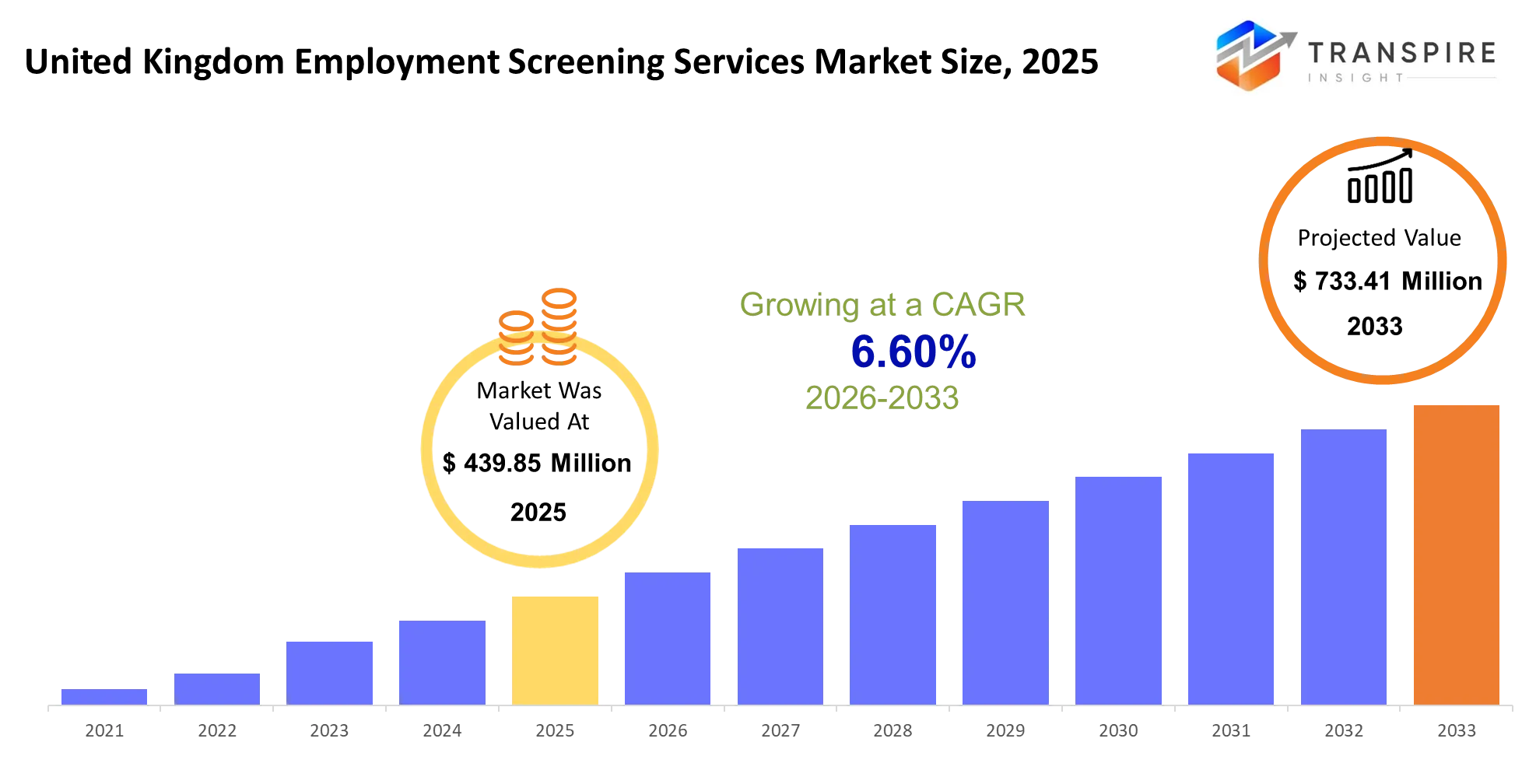
- United Kingdom Employment Screening Services Market Size 2025: USD 439.85 Million
- United Kingdom Employment Screening Services Market Size 2033: USD 733.41 Million
- United Kingdom Employment Screening Services Market CAGR: 6.60%
- United Kingdom Employment Screening Services Market Segments: By Service Type (Background Verification, Criminal Record Checks, Drug Testing, Credit Checks, Identity Verification, Education Verification, Employment Verification, Others); By Deployment (Cloud-based Screening Platforms, On-premise Platforms, AI-enabled Screening Systems, Mobile-based Platforms, Others); By Application (BFSI, Healthcare, IT & Telecom, Government, Retail, Manufacturing, Education, Others); By End User (Large Enterprises, SMEs, Recruitment Agencies, Government Organizations, Others)
To learn more about this report,  Download Free Sample Report
United Kingdom Employment Screening Services Market Summary
The United Kingdom Employment Screening Services Market was valued at USD 439.85 Million in 2025. It is forecast to reach USD 733.41 Million by 2033. That is a CAGR of 6.60%over the period.
In the United Kingdom , the Employment Screening Services market plays a major role in supporting employers to confirm candidate credentials , criminal records, employment background, identity papers, and regulatory adherence before onboarding anyone. You know, in real life these services typically lower hiring fraud , reduce the odds of workplace misconduct , and help avoid compliance missteps across multiple sectors like banking, health care , logistics, retail , and public administration.
Over the past five years , things have moved pretty fast: the market has been drifting away from manual, post-hiring verification toward digital, continuous screening that’s built into HR software and also plugs into remote hiring processes. The sudden growth of hybrid work, plus cross-border recruitment after the COVID-19 disruption , kind of sped up this shift, so now employers need to validate candidates more quickly across different jurisdictions . Meanwhile, stricter UK data governance standards and the financial sector’s compliance requirements nudged enterprises even harder toward automated screening platforms.
And since organizations are shortening recruitment timelines while still managing fraud exposure, providers with API-based verification , AI-enabled identity checks, and broader global compliance coverage are winning more sizable contract agreements , and also more recurring enterprise revenue.
Key Market Insights
- In 2025 London and Southeast England were basically about 38% of United Kingdom Employment Screening Services Market revenue, mostly because the financial services crowd is concentrated there.
- Also, AI-driven identity verification saw adoption rise by more than 30% from 2022 to 2025 among enterprise employers handling remote onboarding tasks, and you can kind of see the momentum there.
- Criminal background checks stayed in the lead, taking roughly 34% of the market in 2025 , since regulated industries need ongoing workforce compliance.
- Digital identity verification became the quickest-growing slice too, especially once biometric onboarding started getting used more heavily across fintech, healthcare, and remote recruitment platforms.
- Banking, financial services, and insurance together made up over 27% of the overall screening demand in 2025, largely tied to FCA compliance and fraud prevention expectations.
- Healthcare screening adoption jumped pretty noticeably after NHS staffing shortages pushed more temporary hiring, plus credential validation expectations increased during 2023–2025.
- HireRight, First Advantage, Sterling, and Checkr turned up the pressure in competition through automated verification, and via API-based HR integrations too.
- More providers began teaming up with HRIS and applicant tracking software firms to shrink screening turnaround times, from multiple days down to near real-time processing.
- Meanwhile mid-sized UK employers leaned into subscription-style screening agreements between 2024 and 2026 to keep recurring compliance duties organized and efficient.
- And finally continuous employee monitoring alongside sanctions screening, got more traction after financial institutions tightened internal governance and boosted misconduct prevention programs.
What are the Key Drivers, Restraints, and Opportunities in the United Kingdom Employment Screening Services Market?
The main growth driver in the United Kingdom Employment Screening Services Market is basically the structural digitization of hiring and workforce compliance workflows. Remote recruitment , cross border hiring, and hybrid work models have pushed employers to validate candidate identities and qualifications without any real in-person contact. Financial institutions , healthcare providers ,and logistics operators now fold screening straight into onboarding systems, this helps reduce fraud exposure and also speeds up the hiring cycle. Regulatory pressure, coming from the Financial Conduct Authority, plus safeguarding standards in healthcare and education have further nudged budgets toward automated verification tools. As a result screening providers can see more recurring revenue opportunities, year after year.
Still, the biggest restraint has a lot to do with the messiness of data privacy compliance and how fragmented international verification rules are. UK employers that hire globally have to handle GDPR requirements , but also country specific access rules for criminal records, and then there is inconsistent data availability across different jurisdictions. That sort of structural snag can slow verification timelines down and it raises operating costs for providers too. Smaller companies often wait longer to adopt these solutions, because building and maintaining compliant cross border screening infrastructure takes serious legal, technical, and cybersecurity spending.
Looking ahead, a major future opportunity sits in AI enabled continuous screening and ongoing workforce risk monitoring. Many employers want more than a one time pre employment check. They want something like periodic, always-on verification. AI based behavioral analytics, sanctions monitoring, and automated identity authentication platforms are starting to gain momentum, especially within regulated industries where oversight matters.
What Has the Impact of Artificial Intelligence Been on the United Kingdom Employment Screening Services Market?
Artificial intelligence has a lot, and I mean a lot , changed how employment screening providers handle candidate verification, compliance checks, and risk reviews across the United Kingdom. AI powered document recognition tools now sort of automate identity validation by checking passports, driving licences, and employment records in just a few minutes rather than taking several days. Screening firms also lean on machine learning models to pick out odd patterns in candidate timelines, spot fraudulent credentials, and even rank the more serious cases so they get a manual look. In practice, these upgrades have helped onboarding move quicker for sectors with big hiring numbers like banking, retail, healthcare, and logistics.
On top of that, modern digital methods have improved day to day operations too. Automated workflows connected to HR software platforms reduced the admin burden and in some larger hiring setups, cut the turnaround time by more than forty percent. Predictive analytics are also becoming more common for ongoing employee oversight, where they check sanctions registers, adverse media signals, and regulatory risks in near real time. Providers that offer API based verification services often see better client retention, since employers now expect a faster and more scalable hiring setup.
Still, AI take up isn’t totally smooth, there are practical limits. Data quality can be inconsistent especially when validating international work histories, or when public databases are scattered. Smaller employers in particular feel the pinch with integration costs, and they may have legacy HR systems that don’t fit easily with AI enabled screening platforms.
Key Market Trends
- From 2022 to 2026 employers started moving away from manual screening, sort of, into AI-assisted verification platforms, in order to speed up recruitment decisions.
- In the same stretch the adoption of continuous employee monitoring also grew… especially across banking and fintech firms after financial misconduct investigations got louder and regulatory scrutiny intensified, y'know.
- Digital identity verification climbed by more than 30% since 2023, mainly because remote onboarding became the norm at many multinational employers.
- Healthcare orgs leaned harder into credential verification after a wave of temporary staffing revealed qualification gaps and safeguarding compliance risks, pretty clearly.
- Screening turnaround times dropped, quite a lot, as providers began integrating directly with HRIS and applicant tracking systems using API based connections rather than handoffs.
- Veremark pushed ahead aggressively across 2025–2026 via acquisitions plus AI focused investment plans that supported global verification services, all at once.
- Mid market UK employers were increasingly choosing subscription style screening services instead of “single transaction only” verification contracts, particularly after 2024.
- At the same time, adverse media and sanctions monitoring became more common after geopolitical instability ramped up, and anti-money laundering enforcement got more strict across Europe.
- Biometric identity authentication started gaining traction among fintech and gig economy platforms, they wanted faster fraud prevention during remote candidate onboarding.
- And overall competitive differentiation shifted, not as much on price alone, more toward verification speed, automation capabilities, plus broader multi country compliance coverage.
United Kingdom Employment Screening Services Market Segmentation
By Service Type
Background Verification holds that dominant market position , because employers across regulated industries need full candidate validation before onboarding. Financial institutions, healthcare providers, and government agencies lean heavily on employment history checks, address validation, and identity matching, to limit fraud exposure and also workplace misconduct risk. Criminal Record Checks keep the second-largest place, largely driven by safeguarding obligations , and tighter compliance rules in education, healthcare, and public sector recruitment. Identity Verification keeps showing fast expansion because remote hiring models require secure digital authentication systems capable of verifying candidates without that physical documentation review thing.
Credit Checks remain pretty relevant inside banking and financial services hiring, while Drug Testing stays more concentrated in transportation, logistics, and industrial job environments. Education Verification and Employment Verification also keep steady demand, since cross-border hiring and resume fraud still generate operational headaches and reputational hazards for employers.
Background Verification along with Identity Verification are expected to reinforce long-term leadership , as enterprises more and more embed automated screening into digital hiring workflows. Criminal Record Checks are likely to keep steady growth because safeguarding enforcement and workforce compliance standards keep broadening across regulated sectors. AI-enabled identity authentication and biometric verification systems might bring the quickest service innovations during the forecast period.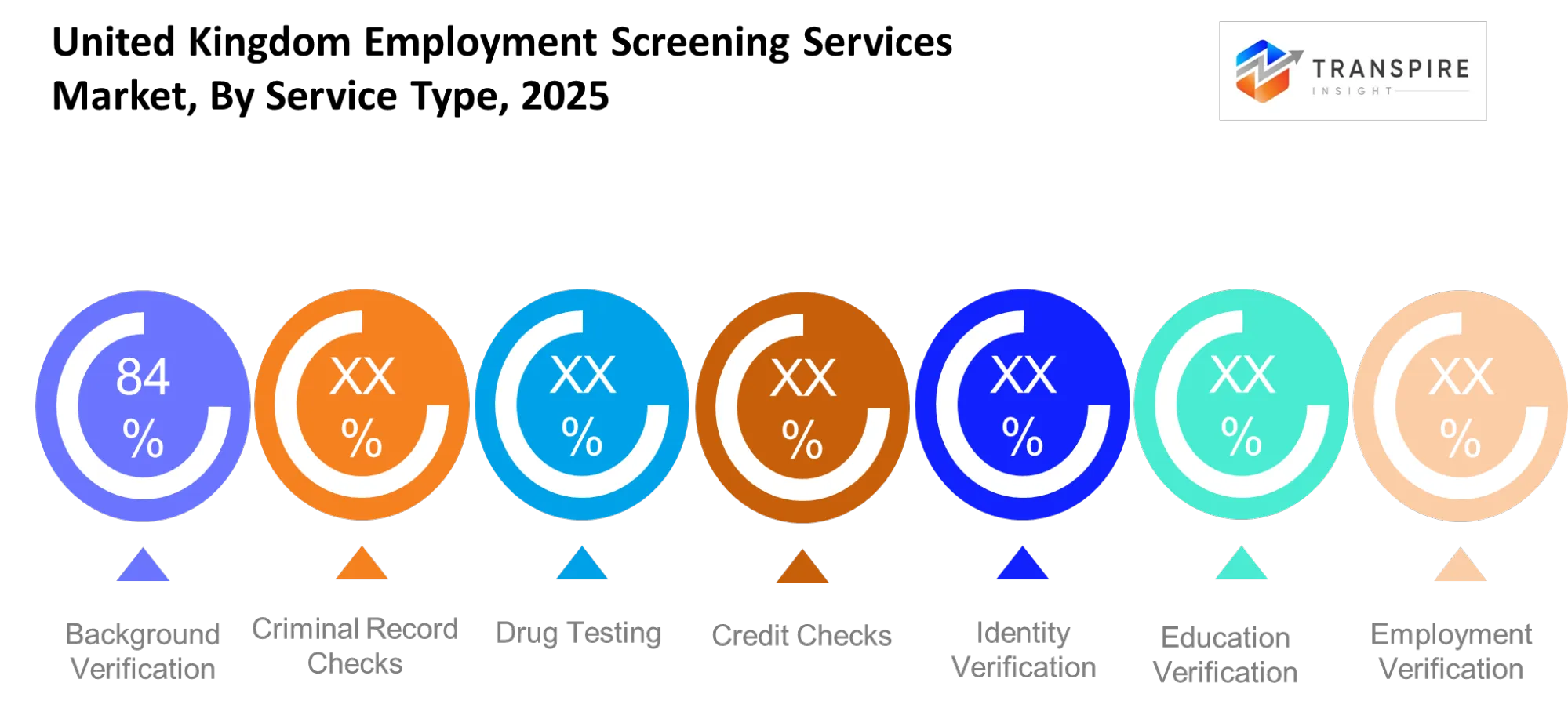
To learn more about this report, Download Free Sample Report
By Deployment
Cloud based Screening Platforms still hold the dominant position, largely because enterprises are leaning more and more toward scalable verification systems that can plug in directly with applicant tracking software, and remote onboarding setups. You know, the whole faster rollout ability, plus lower upkeep costs, and the fact that it’s easier to access across many offices keeps pushing adoption forward.AI-enabled Screening Systems keep the second-largest spot too, as automation makes verification happen quicker, improves fraud detection capability, and generally raises operational efficiency especially in high-volume hiring environments.
Mobile based Platforms are also expanding pretty quickly, mainly since recruiters ( and candidates ) increasingly depend on smartphone driven document submission along with digital identity authentication processes. On-premise platforms still see selective demand in government agencies and major financial institutions, where internal data governance matters a lot, and where cybersecurity oversight is stricter, almost by default.
Other deployment models remain kind of limited, mostly confined to niche setups or older, legacy workforce compliance systems.In the near term, cloud based infrastructure is expected to keep structural dominance, since multinational employers tend to ask for flexible and globally accessible screening operations. AI-enabled platforms are also set up for the fastest technological growth, because machine learning keeps getting better at document analysis, risk scoring, and even continuous employee monitoring. Mobile first verification systems should gain more traction as well, particularly among gig economy employers and decentralized workforce environments. Technology developers are expected to emphasize cybersecurity, API interoperability, and compliance automation pretty aggressively, to strengthen overall enterprise adoption during the forecast period.
By Application
BFSI keeps the dominant market place going, since banks, insurance providers, and fintech companies work under tight workforce compliance rules, and also anti-fraud regulations. There is a lot of reliance on criminal background checks credit verification and sanctions screening, which keeps screening expenditure more or less sustained across the financial industry. Healthcare sits in the second-largest spot because safeguarding requirements stay firm, temporary staffing is expanding, and there are always professional license verification obligations. IT & Telecom is still getting more traction, mainly due to remote hiring, outsourced staffing models, and international recruitment, all of that tends to increase dependence on digital verification infrastructure. Government agencies keep a steadier demand because security clearance procedures are ongoing, and public-sector hiring standards don’t really slow down. Meanwhile, Retail and Manufacturing lean more on volume based workforce screening, mostly to keep operations continuous and workplace safety in good shape.
BFSI applications should still hold long-term leadership, because stopping financial misconduct and keeping regulatory accountability front and center are persistent hiring priorities. Healthcare plus IT & Telecom are expected to expand faster, as digital recruitment keeps accelerating, and cross-border workforce mobility makes verification complexity harder than before. Government related screening demand should remain structurally stable, with continued investment in compliance modernization for public organizations. Over the forecast horizon, application growth will likely tilt toward vendors that can deliver industry specific compliance workflows, provide rapid verification turnaround, and automate workforce monitoring systems without constant manual touch.
By End User
Large Enterprises hold the dominant market position, mostly because multinational corporations deal with big recruitment volumes, a bundle of complex compliance duties, and workforces that are spread across regions. They also tend to keep stronger investment power for integrated screening platforms and ongoing employee monitoring systems, so it sort of stays reinforced. SMEs still sit with the second-largest position, since small and mid-sized businesses increasingly lean on outsourced verification services in order to cut down internal compliance risk, plus hiring inefficiencies that otherwise pile up. Recruitment Agencies keep growing pretty fast, because third-party hiring firms need scalable verification infrastructure that can back multiple clients across different industries. Government Organizations maintain a steadier demand, due to mandatory background checks, security-sensitive recruitment workflows, and long-term workforce governance requirements. Other end-user groups stay mostly concentrated within specialized workforce management and temporary staffing settings.
Large Enterprises are expected to stay in the lead, mainly since workforce risk management and global compliance obligations keep getting more intricate, year after year. SMEs are also likely to show the fastest adoption growth, as cloud-based subscription models lower deployment costs and make things easier to access for smaller employers. Recruitment Agencies are positioned for strong expansion too, because outsourced hiring activity keeps rising across healthcare, retail, and technology sectors. During the forecast period, end-user competition will increasingly reward providers who can blend automation efficiency, compliance transparency, and adaptable service customization, so different organizational hiring models can be covered without friction.
What are the Key Use Cases Driving the United Kingdom Employment Screening Services Market?
In the United Kingdom Employment Screening Services Market the biggest use case is still pre-employment verification , especially for regulated industries like banking , healthcare , education, and government services. In practice employers lean on criminal record checks, right to work validation, and employment history verification. The idea is to lower fraud risk, follow safeguarding rules, and steer clear of reputational trouble when they do large-scale hiring.
Alongside that, neighboring adoption is growing too, across logistics, gig economy platforms, and technology firms that oversee remote or contract driven workforces. More companies are screening temporary staff delivery personnel and freelance contractors, mostly to satisfy insurance requirements and build stronger operational reliability. At the same time financial institutions have also increased continuous sanctions monitoring plus adverse media screening for current staff who handle sensitive transactions.
Looking forward, newer use cases are showing up, like AI driven continuous workforce oversight paired with biometric identity authentication, which gets built into digital onboarding experiences. Also cross-border hiring is picking up, so there is more demand for multilingual , multi jurisdiction verification systems that can validate global employment backgrounds and academic credentials in real time.
|
Report Metrics |
Details |
|
Market size value in 2025 |
USD 439.85 Million |
|
Market size value in 2026 |
USD 468.87 Million |
|
Revenue forecast in 2033 |
USD 733.41 Million |
|
Growth rate |
CAGR of 6.60%from 2026 to 2033 |
|
Base year |
2025 |
|
Historical data |
2021 - 2024 |
|
Forecast period |
2026 - 2033 |
|
Report coverage |
Revenue forecast, competitive landscape, growth factors, and trends |
|
Regional scope |
United Kingdom |
|
Key company profiled |
HireRight, First Advantage, Sterling, Checkr, Experian, ADP, Accurate Background, Paychex, GoodHire, Veremark, Zinc, Capita, Reed Screening, Kroll, ESR |
|
Customization scope |
Free report customization (country, regional & segment scope). Avail customized purchase options to meet your exact research needs. |
|
Report Segmentation |
By Service Type (Background Verification, Criminal Record Checks, Drug Testing, Credit Checks, Identity Verification, Education Verification, Employment Verification, Others); By Deployment (Cloud-based Screening Platforms, On-premise Platforms, AI-enabled Screening Systems, Mobile-based Platforms, Others); By Application (BFSI, Healthcare, IT & Telecom, Government, Retail, Manufacturing, Education, Others); By End User (Large Enterprises, SMEs, Recruitment Agencies, Government Organizations, Others) |
Which Regions are Driving the United Kingdom Employment Screening Services Market Growth?
England stays the dominant regional market kinda because the financial institutions cluster, multinational corporations gather, healthcare networks keep expanding, and public-sector employers keep hiring there. London is still the main hub , mostly since financial services firms deal with some of the strictest workforce compliance expectations across Europe. On top of that, the region gains from quicker HR technology uptake and a pretty mature digital recruitment ecosystem, which helps with automated screening integration. There’s also solid regulatory action coming from financial and safeguarding authorities, so the need for ongoing employee verification services keeps lasting, long term.
Scotland, meanwhile, looks like a steadier secondary market and its growth is tied to public administration, energy, and higher education. This isn’t like London’s rapid, high pressure hiring cycle in the finance world. In Scotland, the screening requirement is more strongly driven by long-running institutional recruitment practices and public-sector governance norms. Universities, healthcare providers, and energy firms repeatedly put money into compliance-heavy background verification processes. The area also benefits from steady spending on public infrastructure and workforce modernisation efforts, which, in turn, support recurring screening contracts.
Northern Ireland is starting to look like the fastest-growing regional slice, mainly due to more technology investment, the expansion of shared services, and rising cross-border employment that links back to the Republic of Ireland. In the past three years, many multinational employers have built or expanded operational hubs in Belfast to tap into skilled labor while paying lower day-to-day operating costs compared with London. That change has boosted the demand for flexible digital verification solutions , the kind that can handle international hiring compliance smoothly.
Who are the Key Players in the United Kingdom Employment Screening Services Market and How Do They Compete?
The competitive landscape of the United Kingdom Employment Screening Services Market stays somewhat moderately fragmented, you know like global verification providers competing right there next to regional specialists and technology-focused startups. Lately the battle is less about sheer transactional pricing and more about automation ability, turnaround speed, the regulatory compliance setup, and how well everything plugs into enterprise HR systems. The big, established firms hold on to their share with wider verification networks and enterprise scale compliance services, while the newer players tend to lean into API based platforms and AI enabled screening routines.
HireRight differentiates itself with multinational screening coverage, digital identity verification tools, and enterprise workforce compliance integration. They keep expanding partnerships with recruitment outsourcing outfits and HR technology providers too, to boost large scale hiring operations. Sterling, meanwhile, leans on advanced automation and fast verification processing, built for high volume hiring contexts like retail , and logistics.
Veremark seems to focus hard on AI enabled workforce trust solutions, plus continuous employee monitoring services. Their growth approach also includes acquisitions and embedded HR platform integrations that back global verification workflows. Checkr aims at technology firms and gig economy platforms using developer friendly APIs, and automated screening infrastructure that’s tuned for quick onboarding. And Experian, it uses its credit and identity data strengths to improve fraud prevention and financial compliance screening services across regulated sectors.
Company List
- HireRight
- First Advantage
- Sterling
- Checkr
- Experian
- ADP
- Accurate Background
- Paychex
- GoodHire
- Veremark
- Zinc
- Capita
- Reed Screening
- Kroll
- ESR
Recent Development News
In February 2026, Veremark secured $26 million in funding to expand its global background screening and workplace integrity platform. The investment will accelerate AI-driven verification tools, whistleblowing solutions, and international compliance screening capabilities across enterprise hiring markets.http://www.veremark.com
In September 2025, Veremark announced acquisition of Agenda Screening Services. The acquisition strengthened Veremark’s UK screening footprint and expanded its automation, API integration, and international employee verification capabilities.http://agenda-screening.co.uk
What Strategic Insights Define the Future of the United Kingdom Employment Screening Services Market?
The United Kingdom Employment Screening Services Market is kind of slowly shifting toward continuous, AI enabled workforce trust management, not just that one-time pre employment verification thing. Most employers seem to want ongoing monitoring abilities that bundle identity authentication, sanctions screening, behavioral risk detection, and regulatory compliance together into a single digital hiring environment. That move is being pushed by hybrid work expansion , more complicated cross border hiring, and stronger expectations around corporate accountability.
One risk people do not talk about enough is how regulators are getting more intense about AI driven hiring choices and those automated candidate profiles. If oversight bodies end up requiring tougher transparency rules for algorithmic screening tools, then providers could get hit with increased compliance expenses and slower rollout schedules. Still, biometric identity verification along with real time workforce intelligence platforms looks like a serious opportunity too, especially for financial services and healthcare , where sensitive data and compliance exposure are always on the table.
Market players should focus on interoperable screening platforms, plus solid API infrastructure and explainable AI features. Vendors that manage to blend rapid automation with auditable compliance processes will probably stand a better chance of winning enterprise agreements and keeping long term recurring revenue.
United Kingdom Employment Screening Services Market Report Segmentation
By Service Type
- Background Verification
- Criminal Record Checks
- Drug Testing
- Credit Checks
- Identity Verification
- Education Verification
- Employment Verification
- Others
By Deployment
- Cloud-based Screening Platforms
- On-premise Platforms
- AI-enabled Screening Systems
- Mobile-based Platforms
- Others
By Application
- BFSI
- Healthcare
- IT & Telecom
- Government
- Retail
- Manufacturing
- Education
- Others
By End User
- Large Enterprises
- SMEs
- Recruitment Agencies
- Government Organizations
- Others
Frequently Asked Questions
Find quick answers to common questions.
The Expected United Kingdom Employment Screening Services Market size for the Market will be USD 733.41 Million in 2033.
Key Segments for the United Kingdom Employment Screening Services Market are By Service Type (Background Verification, Criminal Record Checks, Drug Testing, Credit Checks, Identity Verification, Education Verification, Employment Verification, Others); By Deployment (Cloud-based Screening Platforms, On-premise Platforms, AI-enabled Screening Systems, Mobile-based Platforms, Others); By Application (BFSI, Healthcare, IT & Telecom, Government, Retail, Manufacturing, Education, Others); By End User (Large Enterprises, SMEs, Recruitment Agencies, Government Organizations, Others).
Major United Kingdom Employment Screening Services Market Players are HireRight, First Advantage, Sterling, Checkr, Experian, ADP, Accurate Background, Paychex, GoodHire, Veremark, Zinc, Capita, Reed Screening, Kroll, ESR.
The Current United Kingdom Employment Screening Services Market size is USD 439.85 Million in 2025.
The United Kingdom Employment Screening Services Market CAGR is 6.60% from 2026 to 2033.
- HireRight
- First Advantage
- Sterling
- Checkr
- Experian
- ADP
- Accurate Background
- Paychex
- GoodHire
- Veremark
- Zinc
- Capita
- Reed Screening
- Kroll
- ESR
About the Authors

Mayur Shinde
I am Mayur Shinde, a Senior Research Analyst at Transpire Insight, specializing in the Automotive & Transportation and Information & Communication Technology (ICT) Industry. My work focuses on analyzing emerging market trends, technological advancements, competitive landscapes, and industry developments to deliver accurate, data-driven insights. I am passionate about transforming complex market information into clear, actionable content that helps businesses, professionals, and decision-makers stay informed and make confident strategic decisions.

Chakradhar Khansole
Chakradhar serves as the Research Director at Transpire Insight, bringing over 8 years of experience in technology, innovation, and strategic market intelligence. He specializes in transforming complex market data into actionable business insights that enable organizations to make informed, growth-oriented decisions. Recognized for his strategic vision and analytical expertise, Chakradhar leads high-impact research initiatives, delivering comprehensive market assessments, competitive intelligence, and forward-looking industry analysis.
Recently Published Reports
-
Apr 2026
3D Optical Profiler Market
3D Optical Profiler Market Size, Share & Analysis Report By Type (Desktop 3D Optical Profiler, and Portable 3D Optical Profiler), By Technology (Confocal Technology, and White Light Interference), By End-Use Industry (Manufacturing, Research Institutions, Automotive, Aerospace and Defense, Medical Devices, and Other), and Geography (North America, Europe, Asia-Pacific, Middle East and Africa, South and Central America), 2021 - 2031
-
Apr 2026
Depth Sensor Market
Depth Sensor Market Size, Share & Analysis Report By Type (Infrared Depth Sensors, Time-of-Flight (ToF) Sensors, Stereo Vision Sensors, Structured Light Sensors, Ultrasonic Depth Sensors), By Application (Automotive, Robotics, Gaming, Consumer Electronics, Industrial Automation, Healthcare, Security & Surveillance, Others), By End Users (Automotive Manufacturers, Consumer Electronics Companies, Healthcare Providers, Industrial Companies, Security Agencies, Gaming Companies, Robotics Companies, Others), and Geography (North America, Europe, Asia-Pacific, Middle East and Africa, South and Central America), 2021 – 2031
-
Apr 2026
Digital Manufacturing Market
Digital Manufacturing Market Size, Share & Analysis Report By Component (Hardware, Software, and Services), By Technology (Robotics, 3D Printing, Internet of Things (IoT), and Others), By Application (Automotive and Transportation, Aerospace and Defense, Consumer Electronics, Industrial Machinery, and Others), By Process Type (Computer-Based Designing, Computer-Based Simulation, Computer 3D Visualization, Analytics, and Others), and Geography (North America, Europe, Asia-Pacific, Middle East and Africa, South and Central America), 2021 – 2031
-
Apr 2026
Digital Visa Services Market
Digital Visa Services Market Size, Share & Analysis Report By Type (Individual Travelers, Group Travelers), By Application (Tourism, Business Travel, Others), and Geography (North America, Europe, Asia-Pacific, Middle East and Africa, South and Central America), 2021 – 2031