

Middle East and Africa Combi Ovens Market Size & Forecast:
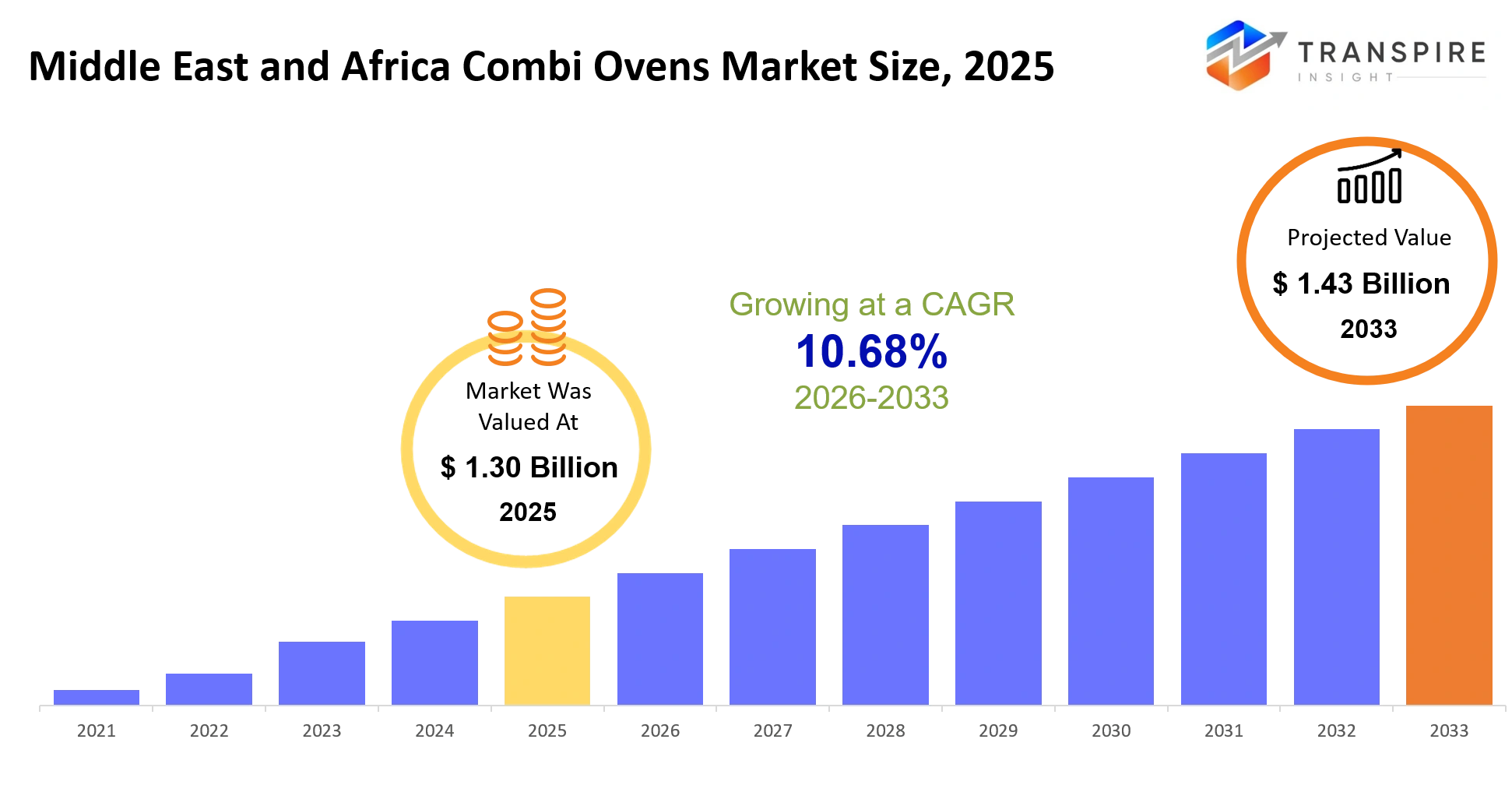
- Middle East and Africa Combi Ovens Market Size 2025: USD 1.30 Billion
- Middle East and Africa Combi Ovens Market Size 2033: USD 1.43 Billion
- Middle East and Africa Combi Ovens Market CAGR: 10.68%
- Middle East and Africa Combi Ovens Market Segments: By Product Type (Electric Combi Ovens, Gas Combi Ovens, Boiler-Based Ovens, Boilerless Ovens, Others); By Capacity (Small, Medium, Large, Others); By End User (Hotels, Restaurants, Bakeries, Catering Services, Others); By Application (Baking, Roasting, Steaming, Grilling, Others).
To learn more about this report,  Download Free Sample Report
Middle East and Africa Combi Ovens Market Summary
The Middle East and Africa Combi Ovens Market was valued at USD 1.30 Billion in 2025. It is forecast to reach USD 1.43 Billion by 2033. That is a CAGR of 10.68% over the period.
Combi ovens kind of turned into a really critical piece of gear in commercial kitchens, because they blend steam, convection, and mixed-mode cooking in one system. You see them in restaurants, hotels, hospitals, and institutional kitchens, plus catering operators, who use these units to keep cooking more consistent, cut down food waste, reduce labor effort, and basically boost kitchen productivity—while still trying to work inside limited space. In the Middle East and Africa the market has moved past just basic cooking equipment and is now more often treated like a practical lever for operational efficiency and standardized food output.
Over the last five years, there’s been this noticeable push toward digitally connected and automated cooking setups, with recipe management, remote monitoring, and even predictive maintenance in the mix. At the same time, supply chain problems during and after the pandemic sort of pushed operators to spend more on labor saving kitchen technologies, because staffing shortages hit hard and costs kept climbing. Together, these forces make it easier for people to swap conventional ovens for multifunctional alternatives, without losing control over quality. And as hospitality , tourism, quick-service restaurants, and large scale institutional catering keep expanding across Gulf countries and major African economies, operators are putting money into high capacity, energy efficient equipment that improves throughput and profitability, which should keep supporting solid market revenue growth.
Key Market Insights
- In the Middle East and Africa Combi Ovens Market , the whole thing gets a real lift from solid investments into hospitality infrastructure across Gulf Cooperation Council nations.
- You can see that the Gulf countries are close to 45% of the regional revenue, so for 2025 the Middle East basically dominates, at least by a wide margin.
- And then Africa looks like the fastest bet through 2033, driven by commercial foodservice growth plus ongoing urbanization ( which is kind of a big multiplier ).
- When operators think about combi ovens they usually lean toward electric combi ovens , they hold over 60% share because energy efficiency matters and day to day operational flexibility is what people want.
- Boiler-based units stay second-largest too, mainly due to steam production advantages for high-volume cooking setups, kind of like a steady steam engine for busy kitchens.
- Connected smart ovens are expected to grow the quickest through 2033, because restaurants and hotels are adopting remote monitoring, and yes that includes cloud-based oversight and “ check from anywhere” style management.
- Demand is also shaped by hotels and resorts, which make up nearly 35% of market demand, supported by tourism investments and big catering operations.
- On the application side, quick-service restaurants are among the faster movers, mainly because menu standardization is nonstop there, so consistent cooking technology becomes a quiet requirement.
- Institutional kitchens, like those in healthcare and education facilities, account for more than 25% of equipment buying, which adds a steady channel.
- The market overall is also seeing more adoption of cloud-connected cooking platforms and automated cleaning solutions.
- Meanwhile, key players—Rational AG, Electrolux Professional, UNOX, Middleby Corporation, Alto-Shaam, and Convotherm—keep a strong market presence, and they keep pushing features.
- Manufacturers are concentrating on AI-assisted cooking programs, automated cleaning systems, plus remote fleet management.
- Strategically, expansion through regional distributors is strengthening too, mostly because it improves after-sales service support.
- And product innovation keeps circling around energy savings, water efficiency, and kitchen automation, even when budgets feel tight, people still want smarter throughput.
What are the Key Drivers, Restraints, and Opportunities in the Middle East and Africa Combi Ovens Market?
Market growth is mostly driven by the fast shift in how commercial foodservice gets run. Hotel brands, quick-service eateries, cloud kitchen setups, and institutional caterers increasingly look for equipment that can deliver steady food results with less kitchen manpower. In the same breath labor shortages and higher operational bills have pushed the move toward programmable combi ovens that sort of handle the cooking sequence in an automated way. With that change operators can raise the volume, lower the amount of hands needed, and even reduce how much training is required. That then helps with equipment replacement cycles, and also with new equipment purchases.
The biggest restraint is still the steep initial purchase and installation cost tied to advanced combi oven systems. The higher-end models often need water treatment setup, ventilation changes, electrical improvements, and a more specialized maintenance safety net. These expenses become a kind of structural wall for smaller restaurants and independent operators, especially across emerging African markets where capital spending is still tight. So in price-sensitive segments, adoption tends to stay under its real potential , which in turn weakens total market penetration.
A notable opportunity is coming from the growth of digitally linked kitchens across the Gulf area, plus a number of big city hubs in Africa. Smart ovens with remote troubleshooting, automatic recipe loading, and continuous performance tracking are picking up momentum among multi location operators. Additional support comes from spending in tourism projects, healthcare sites, education campuses, and large catering contracts. When vendors bundle equipment sales with software platforms, analytics, and service agreements they can lock in recurring revenue streams, while also building longer-term customer loyalty.
What Has the Impact of Artificial Intelligence Been on the Middle East and Africa Combi Ovens Market?
Artificial intelligence is increasingly reshaping commercial cooking, kind of like it’s turning combi ovens into a more intelligent, kitchen wide system. Today’s platforms use AI cooking logics that can automatically tune temperature, humidity, airflow, and how long something cooks, depending on the food type, its weight, and the outcome people want. In practice this lowers how much the operator has to keep stepping in , and it makes it easier to keep food results stable across several locations, not just one site.
At the same time, machine learning is helping with predictive upkeep, more or less. Connected ovens gather operational signals all the time, from sensors that watch heating elements, steam generators, fans, and even the cleaning routines. Then AI software looks at performance directions over time and spots likely issues before they become real failures, so downtime is less likely to show up. With this method foodservice operators can keep equipment ready more often, while also pushing down the total maintenance expenses.
There are also newer digital tools that boost efficiency through remote observation, recipe syncing, and energy optimization. Restaurant groups with many branches can roll out the same cooking programs across a lot of kitchens, which supports consistency and tends to reduce how much staff coaching is needed. Some connected setups even monitor water and energy use, so operators can point out the weak spots, fix them, and bring down everyday operating costs.
Still, AI adoption has hurdles. The integration price can be high, digital infrastructure can be uneven, and in some African markets technical specialists are not always easy to find. Smaller businesses often can’t easily justify the spend needed for fully connected kitchen setups, so progress can slow even when the operational advantages are pretty clear.
Key Market Trends
- Since 2021, hospitality operators have kinda sped up the swap of single standalone ovens for multifunction combi systems, mostly to shrink the kitchen footprint a bit more.
- At the same time, smart connectivity adoption jumped notably, as multi-location restaurant groups wanted centralized recipe control and also real time performance monitoring, without having to babysit every site.
- Between 2022 and 2025 automated cleaning technologies got a lot more attention , because operators were trying to trim labor heavy maintenance routines and keep things steady.
- In 2025 UNOX rolled out CHEFTOP-X intelligent cooking tech, which really helped heat up the competition around AI assisted food prep capabilities and related “brains in the kitchen” ideas.
- Electrolux Professional meanwhile broadened connected kitchen functionality, adding improved remote monitoring plus software administration options.
- More operators are also starting to judge ovens by lifecycle operating costs instead of just the upfront buy price, so it’s less about the ticket number.
- Water saving and energy efficient designs also moved up the procurement ladder after utility costs climbed in several regional markets.
- Equipment financing and leasing programs expanded during 2025 , which made it easier for budget constrained foodservice operators to get equipment into service.
- Manufacturers further reinforced regional service networks, since after sales support became a major buying benchmark.
- And institutional foodservice providers are increasingly leaning toward programmable cooking systems , mainly to help with regulatory compliance and keep menu output consistent.
Middle East and Africa Combi Ovens Market Segmentation
By Product Type
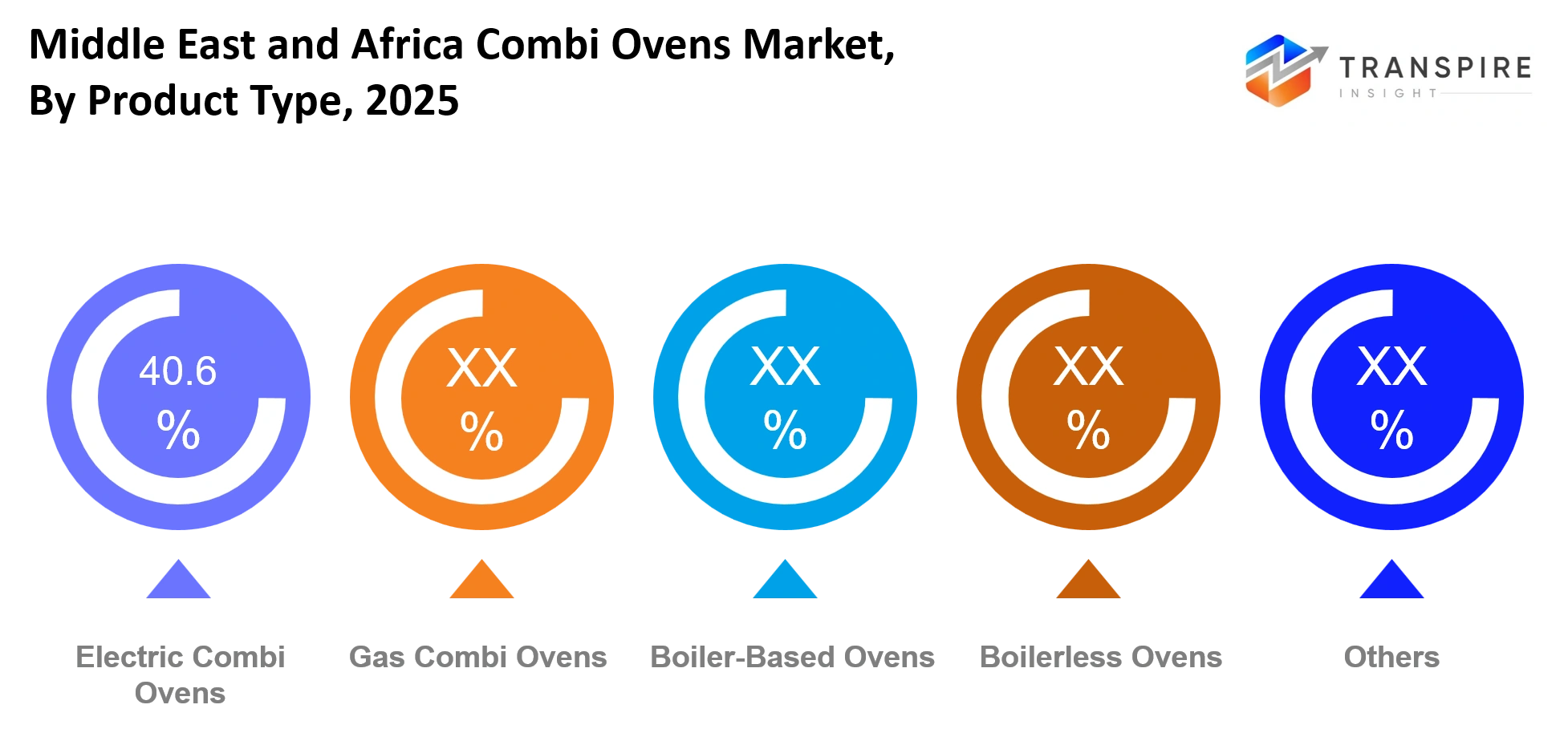
The product type segment sort of makes it clear which technologies are on offer for commercial cooking operations . Electric Combi Ovens keep a strong foothold because they’re easier to set up, they provide precise temperature steering, and they just fit well with today’s kitchen infrastructure, so adoption is widespread. You also see steadier cooking results, along with energy management features that still support ongoing demand in hospitality and foodservice places.
Gas Combi Ovens still matter a lot in sites where gas service is available, since that can mean lower operating costs and they also handle high volume cooking requirements without much fuss. Boiler-Based Ovens are often chosen for their strong steam production, which helps preserve food quality when the cooking cycle gets intense. Boilerless Ovens keep getting more acceptance too, partly because upkeep is simplified and water usage is reduced, which in turn improves everyday operational efficiency. There are also other setups , like specialized configurations, made for niche cooking needs across commercial food prep environments.
To learn more about this report, Download Free Sample Report
By Capacity
The capacity segment pretty much mirrors the range of oven sizes seen across commercial kitchens, with different production needs depending on day-to-day demand. Smaller units work well for compact restaurants , cafés , and those tight-space setups where flexibility matters and the kitchen footprint needs to be used with care. Expansion in this space tends to ride along with more foodservice businesses opening up, plus a steady lift from independent dining places.
Medium capacity ovens generally fit that middle ground for steady output, and they stay a go-to choice for restaurants and institutional kitchens that want operational versatility without overcommitting to size. Larger units capture a big slice of demand in hotels, catering operations and large food preparation centers, where constant throughput and batch consistency are the big deal. Then there are the other options, like customized capacity approaches built around specific operational requirements, or specialized foodservice uses, where a standard size feels a bit too rigid.
By End User
The end user segment, seems to cover a broad mix of commercial foodservice setups using advanced cooking machines. Hotels take a leading portion, mainly because huge meal quantities, banquet programs, and guest dining still depend on dependable, quick cooking systems. As tourism infrastructure keeps being developed, more premium hospitality facilities can justify adopting this kind of equipment, even when budgets are tight.
Restaurants also matter a lot. It’s about steady menu execution, better labor utilization, and speed, service that guests actually notice. Bakeries often lean on combi oven technology, to boost the quality of breads and pastries, while still keeping a strict grip on baking conditions . Catering Services pull real demand too, since they have big batch prep needs and they can’t really afford inconsistent outcomes across different events. Other buyers show up in healthcare facilities, schools and universities, and corporate dining environments, all of which want reliable commercial cooking solutions for day-to-day operations.
By Application
The application segment kinda shifts toward the different cooking processes that multifunctional oven systems can handle. Baking is a big category, because careful humidity and temperature controls, they help make sure the outcomes stay steady across a broad mix of foods. Demand stays pretty strong with hospitality operators, bakeries , and foodservice providers who are aiming for quality with speed and overall efficiency.
Roasting still takes a large share of use as commercial kitchens look for more even heat distribution and also faster prep times. Steaming fits in for healthier food prep and it tends to keep texture, moisture, and that nutritional value more intact across the menu variety. Grilling remains relevant too, mainly because flexible cooking features allow chefs to cook different kinds of items, using just one unit. Other processes also show up, like specialized methods tuned to particular menu needs and day to day operational preferences in many commercial foodservice environments .
What are the Key Use Cases Driving the Middle East and Africa Combi Ovens Market?
The biggest use case stays in large-scale food prep, like in hotels, resorts and commercial restaurants. Operators here really need gear that can juggle multiple cooking styles at the same time, yet still keep things consistent when the meal volume is really high. Combi ovens sort of cut down prep time, and they also boost kitchen output, so yeah they become kind of indispensable in hospitality settings
\Adoption keeps growing too, especially in institutional foodservice spots, such as hospitals, universities military facilities, and corporate cafeterias. These places tend to depend on automated cooking programs to level out the food quality, strengthen food safety compliance, and reduce labor effort across major meal production runs.
Newer use cases are popping up as well. Think cloud kitchens, higher-end bakery operations, and quick-service restaurant chains that want centralized menu control. There are also advanced connected ovens getting traction in production facilities, where they need tight humidity along with temperature control for specialized cooking or baking.
|
Report Metrics |
Details |
|
Market size value in 2025 |
USD 1.30 Billion |
|
Market size value in 2026 |
USD 1.43 Billion |
|
Revenue forecast in 2033 |
USD 2.91 Billion |
|
Growth rate |
CAGR of 10.68% from 2026 to 2033 |
|
Base year |
2025 |
|
Historical data |
2021 - 2024 |
|
Forecast period |
2026 - 2033 |
|
Report coverage |
Revenue forecast, competitive landscape, growth factors, and trends |
|
Regional scope |
Middle East and Africa (Saudi Arabia, United Arab Emirates, South Africa, Rest of Middle East and Africa) |
|
Key company profiled |
Rational AG, Electrolux Professional, Welbilt, Middleby Corporation, Alto-Shaam, Convotherm, UNOX, MKN, Fujimak, Retigo, Henny Penny, Fagor, Ali Group, Hobart, Lainox. |
|
Customization scope |
Free report customization (country, regional & segment scope). Avail customized purchase options to meet your exact research needs. |
|
Report Segmentation |
By Product Type (Electric Combi Ovens, Gas Combi Ovens, Boiler-Based Ovens, Boilerless Ovens, Others); By Capacity (Small, Medium, Large, Others); By End User (Hotels, Restaurants, Bakeries, Catering Services, Others); By Application (Baking, Roasting, Steaming, Grilling, Others). |
Which Regions are Driving the Middle East and Africa Combi Ovens Market Growth?
The Middle East still feels like the dominant regional market, and it’s not really changing fast. Countries like Saudi Arabia and the United Arab Emirates keep putting money into tourism, hospitality infrastructure, and big scale foodservice facilities. There are strong hotel development pipelines, plus international restaurant growth, which helps keep equipment demand moving. Also, the local distributor networks and service ecosystems are well established, so that regional leadership stays reinforced, almost like it’s locked in place.
South Africa is sitting as the second-largest contributor. In contrast with the Gulf area, the momentum comes from a mature commercial foodservice landscape, established retail food chains, and fairly steady institutional catering demand. Economic diversification and continuous investment in hospitality infrastructure also keep driving equipment replacement cycles. The market further gets a benefit from having a relatively developed service and maintenance ecosystem, which is better than in many nearby countries.
For East and West Africa, the fastest growth through 2033 is expected. Investments in urban infrastructure, foodservice modernization, and rising middle class consumption patterns are opening up new chances for commercial kitchen equipment suppliers. At the same time, more international hotel development plus quick-service restaurant expansion has already pushed demand for more advanced cooking systems. For investors and manufacturers, these markets look like they have solid long-term upside, since adoption is still under the levels seen in more mature regions.
Who are the Key Players in the Middle East and Africa Combi Ovens Market and How Do They Compete?
In the Middle East and Africa Combi Ovens Market, competition feels fairly centered, not totally spread out, with international manufacturers holding quite a lot of the premium installations. For most buyers, the real “fight” is on technology skills, cooking results, service backing, and those digital connectivity tools. Lately vendors seem to push harder on overall kitchen productivity, not only on the hardware specifications, like it’s enough to talk about specs anymore.
Rational AG kind of stands out by focusing on intelligent cooking systems and very automated food preparation workflows. They keep growing customer support, and also putting money into digital features that help maintain operational consistency across big foodservice networks. The recent business performance also looks steady, with ongoing demand for its iCombi platform and the related cooking technologies.
UNOX leans into innovation-led differentiation, using AI-assisted cooking platforms, smoother user interfaces, and connected kitchen ecosystems. The arrival of CHEFTOP-X shows what they really want here: intelligent automation, plus data-oriented cooking operations that feel more controlled.
Electrolux Professional competes by offering integrated kitchen management systems, energy efficiency, and remote monitoring. Its connected equipment platform targets multi-site operators who want centralized control and performance improvements, rather than scattered management.
Middleby Corporation and Alto-Shaam use wide commercial kitchen portfolios to deliver more integrated solutions. Convotherm, on the other hand, leans toward precision cooking technologies and improved operational efficiency. In general across the market, manufacturers are extending distributor partnerships and service networks, partly to improve customer retention and also to boost recurring service revenues, because that keeps the cycle going.
Company List
- Rational AG
- Electrolux Professional
- Welbilt
- Middleby Corporation
- Alto-Shaam
- Convotherm
- UNOX
- MKN
- Fujimak
- Retigo
- Henny Penny
- Fagor
- Ali Group
- Hobart
- Lainox
Recent Development News
In February 2025, UNOX launched the CHEFTOP-X intelligent combi oven platform. The product introduced AI-assisted cooking capabilities, food recognition functions, and enhanced automation features, strengthening competition in premium commercial kitchen equipment.
Source: https://www.unox.com
In September 2025, UNOX introduced the fleX equipment leasing program. The initiative allows foodservice operators to access advanced combi oven technologies through subscription-style financing, lowering adoption barriers and expanding market accessibility.
Source: https://www.publicsectorcatering.co.uk
In October 2025, Electrolux Professional expanded software functionality for its connected SkyLine Combi Oven platform, including remote software updates and enhanced performance monitoring capabilities. The development strengthened the company's digital kitchen ecosystem strategy.
Source: https://www.electroluxprofessional.com
What Strategic Insights Define the Future of the Middle East and Africa Combi Ovens Market?
The market is kinda sliding, structurally, toward fully-connected and software-enabled commercial cooking ecosystems. Over the next five to seven years, real competitive advantage is going to depend more and more on digital things like predictive maintenance, recipe automation, remote diagnostics and energy management—not just “plain” cooking performance, which used to be enough. Operators are looking for measurable productivity gains, so it opens the door for vendors that bundle equipment, software, and service together, like one coherent offer.
A more quiet risk is also getting bigger: growing dependence on electronic components and digital infrastructure. Supply chain disruptions impacting sensors, controllers, and connectivity hardware could stall production and also push up equipment costs. On top of that, market concentration among just a few premium technology providers may further squeeze smaller manufacturers, creating more competitive stress than before.
One more emerging opening, that people sometimes miss, is integrated kitchen intelligence platforms. These systems link ovens with inventory tracking, food safety compliance, and workforce management. Vendors should focus on scalable digital service models and, at the same time, strengthen regional service networks. Firms that can show measurable operational savings from data-driven solutions will likely be the ones positioned best to win future market share across the established Gulf regions as well as the faster-growth African economies.
Middle East and Africa Combi Ovens Market Report Segmentation
By Product Type
- Electric Combi Ovens
- Gas Combi Ovens
- Boiler-Based Ovens
- Boilerless Ovens
- Others
By Capacity
- Small
- Medium
- Large
- Others
By End User
- Hotels
- Restaurants
- Bakeries
- Catering Services
- Others
By Application
- Baking
- Roasting
- Steaming
- Grilling
- Others
Frequently Asked Questions
Find quick answers to common questions.
The expected Middle East and Africa Combi Ovens Market size for the market will be USD 1.43 Billion in 2033.
Key segments for the Middle East and Africa Combi Ovens Market are By Product Type (Electric Combi Ovens, Gas Combi Ovens, Boiler-Based Ovens, Boilerless Ovens, Others); By Capacity (Small, Medium, Large, Others); By End User (Hotels, Restaurants, Bakeries, Catering Services, Others); By Application (Baking, Roasting, Steaming, Grilling, Others).
Major Middle East and Africa Combi Ovens Market players are Rational AG, Electrolux Professional, Welbilt, Middleby Corporation, Alto-Shaam, Convotherm, UNOX, MKN, Fujimak, Retigo, Henny Penny, Fagor, Ali Group, Hobart, Lainox.
The Middle East and Africa Combi Ovens Market size is USD 1.30 Billion in 2025.
The Middle East and Africa Combi Ovens Market CAGR is 10.68% from 2026 to 2033.
- Rational AG
- Electrolux Professional
- Welbilt
- Middleby Corporation
- Alto-Shaam
- Convotherm
- UNOX
- MKN
- Fujimak
- Retigo
- Henny Penny
- Fagor
- Ali Group
- Hobart
- Lainox
About the Authors

Chetan Dhatrak
I’m Chetan Dhatrak, a Senior Research Analyst at Transpire Insight, specializing in the Consumer Goods, Foods and Beverages industry. I focus on analyzing market trends, consumer behavior, competitive landscapes, and industry developments to deliver accurate, data-driven insights. My research at Transpire Insight is built on credible sources and in-depth analysis, helping businesses and readers better understand market dynamics, emerging opportunities, and evolving consumer preferences. I’m committed to creating reliable, well-researched content that supports informed decision-making and reflects the latest developments in the consumer goods and food & beverage sectors.

Chakradhar Khansole
Chakradhar serves as the Research Director at Transpire Insight, bringing over 8 years of experience in technology, innovation, and strategic market intelligence. He specializes in transforming complex market data into actionable business insights that enable organizations to make informed, growth-oriented decisions. Recognized for his strategic vision and analytical expertise, Chakradhar leads high-impact research initiatives, delivering comprehensive market assessments, competitive intelligence, and forward-looking industry analysis.
Recently Published Reports
-
Apr 2026
Bottled Water Market
Bottled Water Market Size, Share & Analysis Report By Product Type (Still Bottled Water, Carbonated Bottled Water, Functional Bottled Water, and Others), By Packaging (PET, Cans, and Others), By Sales Channel (Supermarkets/Hypermarkets, Convenience Stores/Drug Stores, Grocery Stores/Club Stores, Foodservice, and Others) and Geography (North America, Europe, Asia-Pacific, Middle East and Africa, South and Central America), 2021 - 2032
-
Apr 2026
Color Cosmetic Packaging Market
Color Cosmetic Packaging Market Size, Share & Analysis Report By Application (Mascara Packaging, Liquid Packaging, and Liquid Face), By Type (Tubes & Bottles, Pens & Markers, Compacts & Containers, and Droppers & Pumps), and Geography (North America, Europe, Asia-Pacific, Middle East and Africa, South and Central America), 2021 - 2031
-
Apr 2026
External Microphone For Camera Market
External Microphone For Camera Market Size, Share & Analysis Report By Type (Shotgun Microphone, Lavalier Microphone, and Others), By Application (Digital Camera, Professional Video Camera, and Others), and Geography (North America, Europe, Asia-Pacific, Middle East and Africa, South and Central America), 2021 - 2031
-
Apr 2026
Foot Orthotic Insoles Market
Foot Orthotic Insoles Market Size, Share & Analysis Report By Type (Pre-fabricated, and Custom-made), By Material (Thermoplastic, Composite Carbon Fiber, and Others), By Distribution Channel (Drug Stores, Hospitals & Clinics, and Others), and Geography (North America, Europe, Asia-Pacific, Middle East and Africa, South and Central America), 2021 - 2031