

Asia Pacific Baking Enzyme Market Size & Forecast:
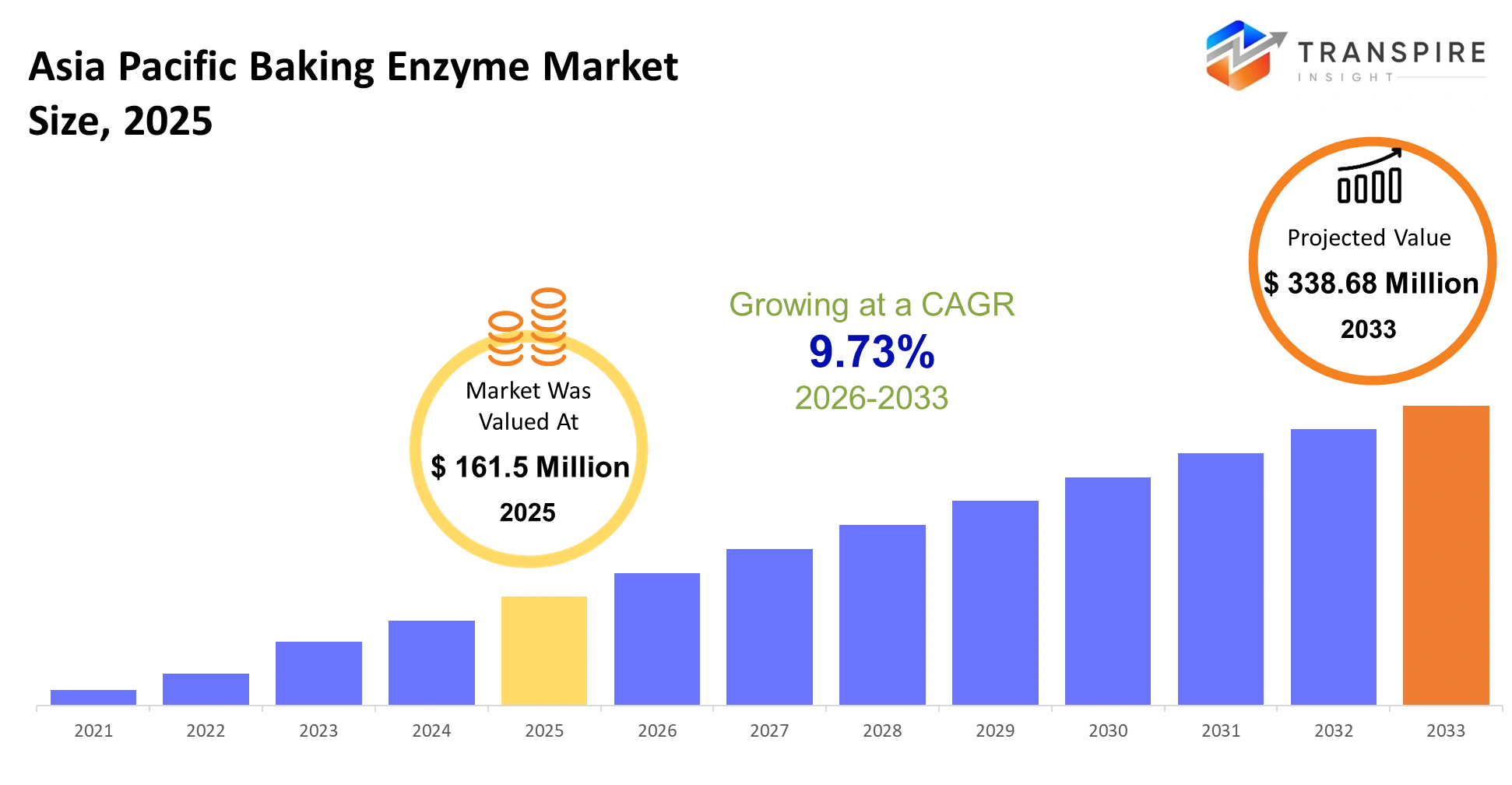
- Asia Pacific Baking Enzyme Market Size 2025: USD 161.5 Million
- Asia Pacific Baking Enzyme Market Size 2033: USD 338.68 Million
- Asia Pacific Baking Enzyme Market CAGR: 9.73%
- Asia Pacific Baking Enzyme Market Segments: By Type (Carbohydrase, Protease, Lipase, Others); By Application (Bread, Cakes, Biscuits, Dough Processing, Others); By End-User (Food Industry, Bakeries, Industrial Users, FMCG Companies, Others); By Form (Powder, Liquid, Others)
To learn more about this report,  Download Free Sample Report
Asia Pacific Baking Enzyme Market Summary
The Asia Pacific Baking Enzyme Market was valued at USD 161.5 Million in 2025. It is forecast to reach USD 338.68 Million by 2033. That is a CAGR of 9.73% over the period.
The Asia Pacific baking enzyme market assists commercial bakeries by providing solutions to common production problems which include inconsistent dough quality and reduced shelf life and the requirement for quicker production methods. Enzymes enable better dough stability and texture and freshness improvements while manufacturers use fewer chemical additives, which has become essential because food producers must meet increased ingredient inspection requirements from both regulators and retail buyers.
The market has shifted towards clean-label enzyme solutions during the past three to five years because manufacturers reformulate bakery products to fulfill new labeling requirements from multiple countries including Japan and Australia and South Korea. The transition started to pick up speed after pandemic-related supply chain disruptions showed the dangers of depending on imported specialty ingredients which led local manufacturers to develop enzyme systems that work with their present formulas. Enzyme adoption at bakery manufacturers has evolved from being a tool for controlling expenses to becoming a main element for developing products which helps create high-profit goods that maintain consistent manufacturing quality.
Key Market Insights
- China controls almost 34% of the Asia Pacific Baking Enzyme Market in 2025 because of its extensive commercial bakery operations.
- India will experience its most rapid market growth until 2032 because organized bakery retailing and processed food manufacturing receive increased funding.
- Indonesian and Vietnamese and Thai urban areas experience major market growth because bakery chains from Southeast Asia expand their operations.
- Protease enzymes exist as the second-largest market segment because they serve as essential components for producing high-volume bread dough with optimal extensibility.
- Lipase enzymes represent the most rapidly expanding segment which scientists predict will continue to grow until 2032 because of environmentally friendly emulsifier replacement practices.
- Bread production leads application demand, contributing nearly 48% market share, which demonstrates strong product usage through retail and foodservice distribution channels.
- Industrial bakeries dominate end-user adoption, which results in about 56% of Asia Pacific Baking Enzyme Market revenue coming from their operations in 2025.
- Mid-sized commercial bakery chains operate as the second-largest customer base because they require standardized processes for their operations.
- Artisanal and specialty bakeries represent the most rapidly expanding market segment as premium product positioning continues to grow in popularity.
What are the Key Drivers, Restraints, and Opportunities in the Asia Pacific Baking Enzyme Market?
The Asia Pacific baking enzyme market experiences its strongest market growth because the region now embraces clean-label bakery production, which became necessary after Japan, Australia, and South Korea established new ingredient disclosure standards and retailer-driven reformulation guidelines. Major grocery stores and restaurant chains now demand that bakery suppliers minimize their usage of artificial emulsifiers and synthetic dough additives, which compels bakery manufacturers to implement enzyme-based solutions. Enzyme producers gain increased revenue prospects because their products now serve multiple applications in various industries beyond process correction needs. The process involves using their products to create high-quality items, which enable product shelf life development and texture enhancement work that boosts product formulation value.
The primary obstacle exists because bakery processing equipment in developing Asia Pacific countries has different levels of technological development. Many mid-sized bakeries in India and Southeast Asia still operate with inconsistent flour quality controls and older processing systems that limit enzyme precision. Companies need to build new facilities which require both funding and staff training and distribution network advancements, which results in extended modernization processes. The result leads to two outcomes, which include postponed implementation of modern enzyme technologies and decreased market earnings because businesses that require low production costs choose to concentrate on maintaining current production levels instead of developing new formulas.
The next phase of growth for the business can be achieved through its frozen and par-baked bakery production operations. The development of cold-chain logistics systems throughout China and India creates an environment that enables manufacturers to produce large quantities of frozen dough. The specialized enzymes developed by enzyme suppliers create new high-value applications for their products because they enhance the ability to maintain product quality during freeze-thaw processes.
What Has the Impact of Artificial Intelligence Been on the Asia Pacific Baking Enzyme Market?
Artificial intelligence together with advanced digital technologies are transforming enzyme-based baking processes throughout Asia Pacific by enabling more accurate formulation creation and production process management. AI-based production management systems allow large industrial bakeries to automate their monitoring of dough moisture balance, fermentation timing, temperature stability and enzyme reaction consistency. The systems use real-time condition adjustments to mixing and proofing processes which results in reduced production variations and more consistent product quality throughout high-volume manufacturing operations.
Machine learning models enable the prediction of enzyme performance across different flour types which benefits markets in India and Southeast Asia because those regions experience high raw material variability. Predictive analytics enables manufacturers to determine optimal enzyme dosage before starting production which results in a 20% reduction of formulation trial cycles while increasing production line efficiency. Advanced digital twins enable processors to test enzyme interactions across various baking conditions which results in better shelf-life performance and reduced ingredient waste.
The technologies create measurable operational benefits because they decrease equipment downtime, improve quality control systems and decrease energy usage during baking processes. The high costs associated with integration together with the absence of extensive regional production databases for accurate predictive system development and diverse flour and climate condition training requirements continue to hinder progress.
Key Market Trends
- Major bakery manufacturers have reduced chemical emulsifier usage by almost 18% since 2022 which has led to faster development of enzyme-based product reformulations throughout Japan, South Korea and Australia.
- Flour-specific enzyme development for Asian wheat differentials received increased funding from Novozymes and AB Enzymes between 2021 and 2025.
- Industrial bakeries have changed their purchasing behavior since 2023 because they now choose multifunctional enzyme systems which provide softness and shelf life and machinability benefits through single product solutions.
- Clean-label compliance evolved from a specialized premium approach into an essential requirement for retail operations after major supermarket chains enforced stricter ingredient disclosure rules for their suppliers.
- Bakeries across China and India have installed automated production lines since 2022 which now depend on precise enzyme delivery systems to achieve specific reductions in product development errors.
- Frozen dough manufacturers have increased their use of enzymes because urban retail markets now require products that maintain freeze-thaw stability due to expanding cold-chain systems.
- After 2024 market competition changed because leading companies established direct technical relationships with commercial bakeries instead of depending on ingredient distribution partners.
- Additive labeling requirements have forced enzyme manufacturers to develop alternatives to synthetic dough conditioners which are used in export production for premium Asia Pacific retail markets.
Asia Pacific Baking Enzyme Market Segmentation
By Type:
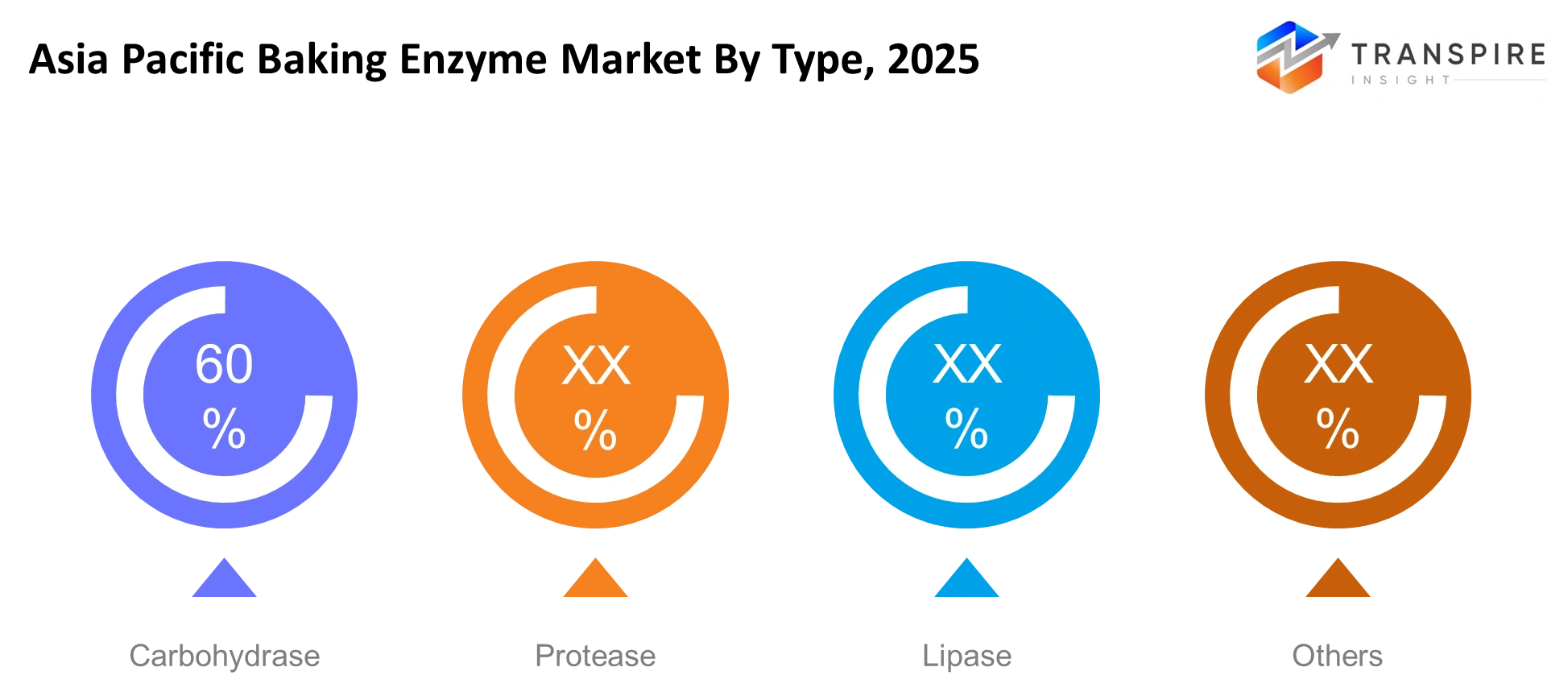
The carbohydrase segment holds a strong position in the Asia Pacific Baking Enzyme Market because of wide use in improving dough texture, increasing softness, and extending freshness in baked products. The ongoing growth in packaged bakery production throughout urban areas maintains a constant need for this particular enzyme. Manufacturers who operate on a large scale use carbohydrates to achieve consistent product quality while minimizing operational difficulties.
Dough processing now benefits from protease because it provides both dough relaxation and improved machinability during processing. Commercial bread production benefits from lipase because it enhances crumb strength and extends product shelf life. The other category, which includes specialty enzyme blends, is seeing gradual growth as bakery producers focus on product customization and process efficiency. The different bakery segments are starting to recognize experimental products which different bakeries create through their product testing.
To learn more about this report, Download Free Sample Report
By Application:
The Asia Pacific Baking Enzyme Market identifies bread as its primary application segment because people consume bread daily while multiple countries produce bread through industrial methods. Supermarkets and retail chains use baking enzymes to maintain packaged bread products, which need to keep their softness and structure while delivering extended freshness to customers.
Consumer preferences for both convenient snacks and premium baked goods have created strong demand for cakes and biscuits. Automated systems which manufacturers now use for dough processing need better dough handling performance to enable their production processes. The other category includes specialty bakery products where enzyme use supports texture refinement and quality consistency, helping producers meet changing consumer expectations.
By End-User:
The food industry operates as the primary market sector since large food processing companies continue to increase their bakery production capabilities. Baking enzymes support better production results by reducing ingredient waste and keeping product quality intact throughout large-scale manufacturing operations. Organized food manufacturing operations drive the main expansion of different regional markets.
Mid-sized and premium bakeries are increasingly choosing enzyme-based solutions which help them create better products without using many artificial ingredients. Enzyme integration in automated production systems provides industrial users with advantages while FMCG companies use baking enzymes to develop new packaged bakery products. Niche producers who operate in specialized fields start to increase their market share through their unique application development.
By Form:
The Asia Pacific Baking Enzyme Market prefers powder form because it offers storage convenience and extended shelf life and works well with dry ingredient mixing methods. Commercial bakery manufacturers prefer powder enzymes because they enable precise measurement of required amounts and they can be easily transported in environments that handle large production volumes.
Liquid enzymes have gained popularity because they provide easy distribution and they function well in systems that operate continuously. Bakeries are currently modernizing their production facilities which has created a demand for liquid formulations that provide operational flexibility. Producers can choose between two production methods, which enable them to meet their specific requirements for processing, production size, and final product specifications.
What are the Key Use Cases Driving the Asia Pacific Baking Enzyme Market?
Baking enzyme markets in Asia Pacific regions experience their main market growth because industrial bakeries use enzymes to produce bread at high volumes while keeping dough stable and enhancing loaf size and extending bread freshness during their production processes. The application creates highest market demand because bread represents the most popular packaged baked goods in the region.
Commercial bakery chains and foodservice suppliers are expanding their use of enzymes across premium cakes and pastries and frozen dough products. Enzymes serve a growing role in maintaining product quality through their ability to enhance texture retention and moisture control while preventing freeze-thaw damage in products that need to be distributed to various locations.
New applications of enzyme technology develop for gluten-free bakery products and high-fiber baked goods which meet the needs of urban customers who prioritize health. The market for enzyme-assisted processing of ready-to-bake artisanal dough develops through modern retail channels because producers require improved control of fermentation and longer storage time for their refrigerated products. The applications develop into niche markets which however demonstrate strong potential for future business success.
|
Report Metrics |
Details |
|
Market size value in 2025 |
USD 161.5 Million |
|
Market size value in 2026 |
USD 176.85 Million |
|
Revenue forecast in 2033 |
USD 338.68 Million |
|
Growth rate |
CAGR of 9.73% from 2026 to 2033 |
|
Base year |
2025 |
|
Historical data |
2021 - 2024 |
|
Forecast period |
2026 - 2033 |
|
Report coverage |
Revenue forecast, competitive landscape, growth factors, and trends |
|
Regional scope |
Asia Pacific (China, India, Japan, South Korea, Australia, Rest of Asia Pacific) |
|
Key company profiled |
Novozymes, DSM, DuPont, AB Enzymes, Amano Enzyme, Chr Hansen, Kerry, BASF, Advanced Enzymes, Enzyme Dev Corp, Biocatalysts, Puratos, Lesaffre, SternEnzym, Aumgene |
|
Customization scope |
Free report customization (country, regional & segment scope). Avail customized purchase options to meet your exact research needs. |
|
Report Segmentation |
By Type (Carbohydrase, Protease, Lipase, Others); By Application (Bread, Cakes, Biscuits, Dough Processing, Others); By End-User (Food Industry, Bakeries, Industrial Users, FMCG Companies, Others); By Form (Powder, Liquid, Others) |
Which Regions are Driving the Asia Pacific Baking Enzyme Market Growth?
The Asia Pacific baking enzyme market reaches its highest point through East Asia because China, Japan and South Korea represent the region's most powerful baking enzyme production and consumption centers. The industry leads the market because of its advanced food processing regulations and its extensive industrial bakery facilities and its ongoing research initiative for ingredient development which both domestic companies and international corporations conduct. The major urban retail networks across these countries have established strict clean-label standards together with shelf-life performance requirements which drive bakery producers to develop advanced enzyme solutions. The established network of food technology research facilities and ingredient distribution centers and automated bakery production sites enables East Asia to maintain its dominant market position.
Australia and New Zealand lead Oceania by providing market stability through their unique operational model which operates differently from production-based market systems. The premium bakery sector in this region has reached maturity because consumers consistently choose baked goods which contain fewer additives and follow specific production standards. The food labeling regulatory framework provides stable conditions which enable bakery manufacturers to develop products while facing minimal compliance challenges. The stable operating environment makes Oceania a reliable revenue contributor for enzyme suppliers who specialize in premium and functional bakery applications.
The market area of South Asia which includes India shows the highest growth rate among all regions. The organized bakery retail industry has expanded rapidly while mid-sized manufacturing facilities have undergone modernization and there has been a rise in funding for cold-chain distribution since 2023. The demand for enzymes has grown because these enzymes help maintain consistent production processes which depend on different flour types and weather-sensitive production conditions. The market growth provides investors and new market entrants an opportunity to form technical partnerships which will help them gain market share during the region's bakery industrialization period which will last until 2033.
Who are the Key Players in the Asia Pacific Baking Enzyme Market and How Do They Compete?
The Asia Pacific baking enzyme market shows moderate consolidation because multinational biotechnology companies hold most advanced enzyme products with regional ingredient experts who provide customized local support. The competition for bakery manufacturing has shifted to formulation technology as businesses select enzyme systems which can solve multiple processing issues at once. Established companies protect their market positions through development of new solutions for specific applications while new companies serve mid-sized bakeries through their adaptable service offerings and ability to combine products locally. The production needs of bakeries across Asia Pacific markets have made geographic responsiveness and technical advisory services essential for companies to compete successfully.
Novonesis competes through biotechnology-driven innovation which uses advanced fermentation platforms to create multifunctional enzyme blends for clean-label bread production. The company uses its technical collaboration model with industrial bakeries to create fast formulation changes that match regional flour differences which helps it gain market leadership in China and Japan. AB Enzymes has built its competitive advantage by offering bakery enzyme solutions for specific applications and providing extensive technical assistance to companies that use automated production systems. The company has expanded its regional footprint by strengthening distributor partnerships across Southeast Asia.
The integrated ingredient systems of IFF build their solutions through enzyme-based systems that combine with texturizers and shelf-life solutions to help bakery clients achieve better sourcing results and formulation optimization. Premium bakery manufacturers use sustainability-certified enzyme development together with precision fermentation technology from DSM-Firmenich as their primary product base. The regional specialization of Amano Enzyme creates business advantages by offering precise solutions which meet the specific needs of Japanese and South Korean bakery markets.
Company List
- Novozymes
- DSM
- DuPont
- AB Enzymes
- Amano Enzyme
- Chr Hansen
- Kerry
- BASF
- Advanced Enzymes
- Enzyme Dev Corp
- Biocatalysts
- Puratos
- Lesaffre
- SternEnzym
- Aumgene
Recent Development News
In April 2026, Novonesis announced acquisition of a production facility from Meihua in Rayong, Thailand. The roughly USD 50 million investment expands fermentation capacity in Southeast Asia, strengthening regional enzyme supply capabilities for food applications including baking enzymes and improving response times for Asia Pacific bakery manufacturers.
Source https://www.novonesis.com/
In May 2026, Angel Yeast launched new protein, bakery, and yeast-biosolution products at FHA-Food & Beverage 2026 in Singapore. The product rollout strengthens the company’s Asia Pacific bakery ingredient portfolio and supports cleaner-label, performance-enhancing baking formulations across commercial bakery markets in the region.Source https://en.angelyeast.com/
What Strategic Insights Define the Future of the Asia Pacific Baking Enzyme Market?
The Asia Pacific baking enzyme market will develop customized data-driven formulation systems which use enzymes as performance tools from 2023 until 2027. The bakery industry now faces three main changes which drive its transformation toward automated production processes and ingredient traceability requirements and extended shelf life products without artificial ingredients. Enzyme suppliers will gain pricing advantages through their ability to provide technical assistance for specific applications while developing formulation analytics solutions that enable better production processes.
Global fermentation supply chains face a significant danger because raw materials depend on a few specific production centers. The production hubs need to depend on their specialized centers because their heavy operational costs will increase at various times which will impact their supply chain through trade interruptions. Enzyme applications for frozen and ready-to-proof dough systems in India and Southeast Asia represent a significant emerging opportunity as cold-chain bakery distribution matures.
Market participants should establish regional application laboratories and industrial bakery co-development partnerships as their main focus. Suppliers who develop localized formulation capabilities will achieve quicker responses to flour changes and new regulations and upcoming product development timelines.
Asia Pacific Baking Enzyme Market Report Segmentation
By Type
- Carbohydrase
- Protease
- Lipase
By Application
- Bread
- Cakes
- Biscuits
- Dough Processing
By End-User
- Food Industry
- Bakeries
- Industrial Users
- FMCG Companies
By Form
- Powder
- Liquid
Frequently Asked Questions
Find quick answers to common questions.
The Asia Pacific Baking Enzyme Market size is USD 338.68 Million in 2033.
Key segments for the Asia Pacific Baking Enzyme Market are By Type (Carbohydrase, Protease, Lipase, Others); By Application (Bread, Cakes, Biscuits, Dough Processing, Others); By End-User (Food Industry, Bakeries, Industrial Users, FMCG Companies, Others); By Form (Powder, Liquid, Others).
Major Asia Pacific Baking Enzyme Market players are Novozymes, DSM, DuPont, AB Enzymes, Amano Enzyme, Chr Hansen, Kerry, BASF, Advanced Enzymes, Enzyme Dev Corp, Biocatalysts, Puratos, Lesaffre, SternEnzym, Aumgene.
The Asia Pacific Baking Enzyme Market size is USD 161.5 Million in 2025.
The Asia Pacific Baking Enzyme Market CAGR is 9.73% from 2026 to 2033.
- Novozymes
- DSM
- DuPont
- AB Enzymes
- Amano Enzyme
- Chr Hansen
- Kerry
- BASF
- Advanced Enzymes
- Enzyme Dev Corp
- Biocatalysts
- Puratos
- Lesaffre
- SternEnzym
- Aumgene
Recently Published Reports
-
Apr 2026
Baby Infant Formula Market
Baby Infant Formula Market Size, Share & Analysis Report By ype (Infant Milk, Follow On Milk, Specialty Baby Milk, Growing-Up Milk), By Ingredient (Carbohydrate, Fat, Protein, Minerals, Vitamins, and Others), By Product Form (Powder, Liquid, and Ready-to-feed), By Distribution Channels (Supermarket/Hypermarket, Specialty Store, Pharmacies, Online Retail, and Others), and Geography (North America, Europe, Asia-Pacific, Middle East and Africa, South and Central America), 2021 - 2031
-
Apr 2026
Edible Insects for Animal Feed Market
Edible Insects for Animal Feed Market Size, Share & Analysis Report By Type (Insect Powder, Insect Meal, Insect Bar, Insect Paste, Insect Oil, and Others), By Insect Type (Beetles, Cricket, Caterpillar, Hymenoptera, Orthoptera, Tree Bugs, and Others), By Application (Livestock, Pet Food, and Aquaculture), By Livestock Type (Poultry, Swine, and Others), and Geography (North America, Europe, Asia-Pacific, Middle East and Africa, South and Central America), 2021 - 2031
-
Apr 2026
Food Industry Disinfection and Bacterial Control Market
Food Industry Disinfection and Bacterial Control Market Size, Share & Analysis Report By Type (Chemical Disinfectants, Physical Disinfectants, and Biocides and Antimicrobials), By Application (Food Processing Equipment Surface Disinfection, Food Preparation Areas Surface Disinfection, Storage Areas Surface Disinfection, Anti-microbial Coatings Food Preservation, and Preservative Solutions Food Preservation), By End User (Meat and Poultry Processing, Dairy Processing, Seafood Processing, Bakery and Confectionery, Restaurants and Commercial Kitchens, and Food Service Providers), By Sales Channel (Online, Offline), and Geography (North America, Europe, Asia-Pacific, Middle East and Africa, South and Central America), 2021 - 2031
-
Apr 2026
Freeze Dried Food Market
Freeze Dried Food Market Size, Share & Analysis Report By Product Type (Fruits, Vegetables, Freeze-Dried Dairy Products, Freeze-Dried Meat and Seafood, Freeze-Dried Pet Food, and Prepared Meal), By Nature (Organic, and Conventional), By Form (Powdered, Granules, and Diced), By End Use (Breakfast Cereals, Dairy Products, Bakery & Confectionery, Nutritional Bars & Supplements, Powdered Beverages, Snacks, and Retail (Household)), and Geography (North America, Europe, Asia-Pacific, Middle East and Africa, South and Central America), 2021 - 2031