
Middle East and Africa Coated Steel Market Size & Forecast:
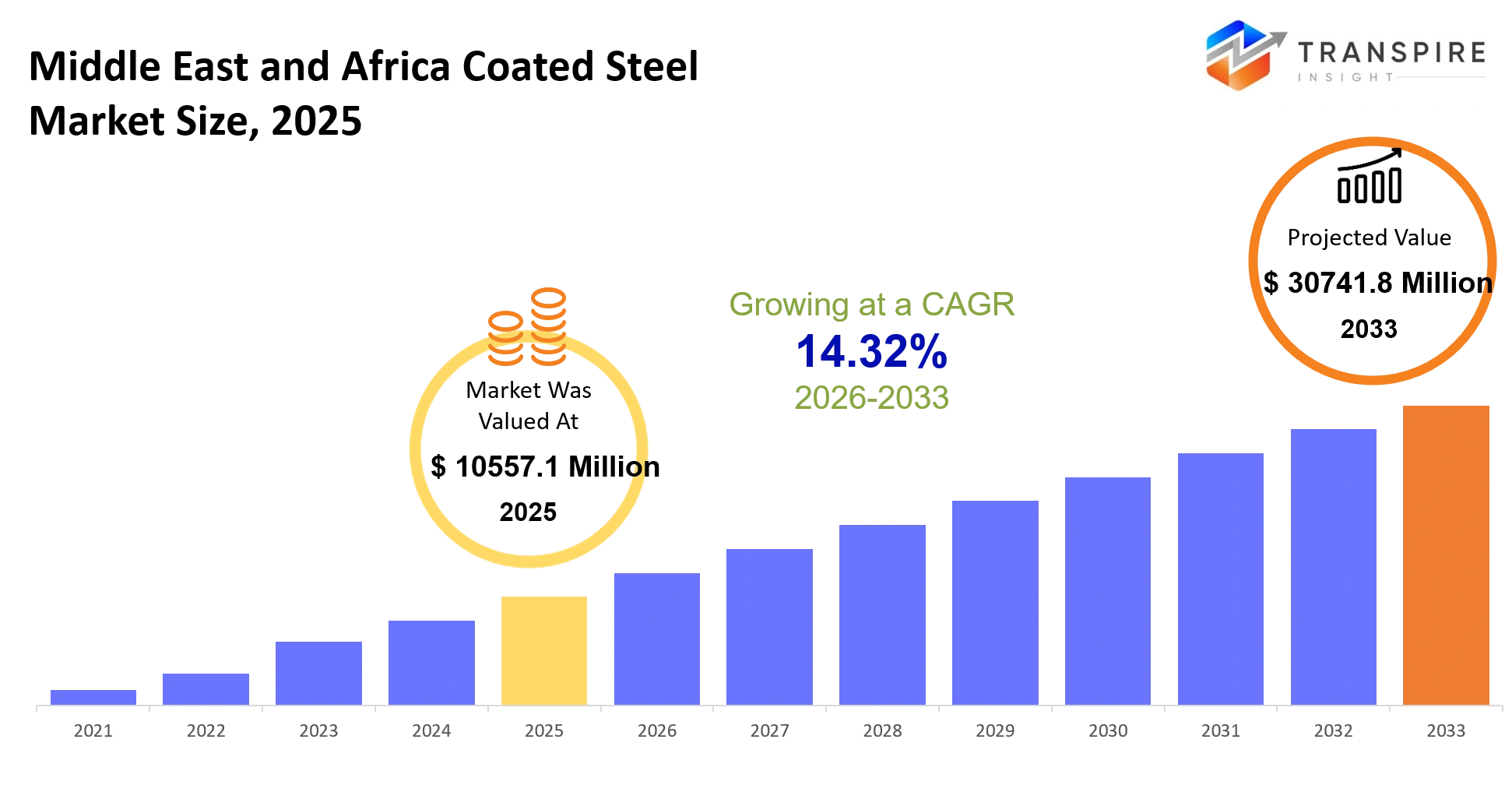
- Middle East and Africa Coated Steel Market Size 2025: USD 10557.1 Million
- Middle East and Africa Coated Steel Market Size 2033: USD 30741.8 Million
- Middle East and Africa Coated Steel Market CAGR: 14.32%
- Middle East and Africa Coated Steel Market Segments: By Coating Type (Galvanized Steel, Galvalume Steel, Color Coated Steel, Tinplate, Others); By Application (Construction, Automotive, Appliances, Packaging, Others); By End User (Construction Companies, Automotive OEMs, Manufacturers, Others); By Product Form (Sheets, Coils, Plates, Others)
To learn more about this report,  Download Free Sample Report
Middle East and Africa Coated Steel Market Summary
The Middle East and Africa Coated Steel Market was valued at USD 10557.1 Million in 2025. It is forecast to reach USD 30741.8 Million by 2033. That is a CAGR of 14.32% over the period.
Coated steel kind of matters a lot, across construction, automotive manufacturing, appliances, and packaging , because it helps shield steel surfaces from corrosion, moisture, heat, and day to day environmental wear. In real life terms it sort of stretches the life of assets, trims upkeep costs and boosts structural staying power when the weather gets pretty harsh in many Middle Eastern and African markets. From roof sheets and industrial plants to vehicle panels and everyday consumer items, coated steel lets industries push for longer service cycles while still keeping the base material doing what it should.
In the last five years, the market is leaning away from the older conventional galvanized options, and moving toward better performance coated materials, like color coated steel and galvalume steel . That shift kind of feels tied to stricter building rules, infrastructure modernization efforts, and the whole need for materials that last through harsh temperatures plus those salty coastal vibes. After the COVID-19 stretch, there were supply chain disturbances and shifts in the global steel trade routes, which then pushed faster regional sourcing decisions, plus more funds going into nearby manufacturing capability, you know. And as governments keep expanding industrial zones, logistics hubs, renewable energy projects and city scale infrastructure, coated steel intake is still climbing. So, overall it’s showing up as bigger production volumes, stronger replacement demand, and more revenue avenues for manufacturers serving construction, automotive, and industrial customers across the region.
Key Market Insights
- The Middle East and Africa Coated Steel Market, kind of benefits from big infrastructure projects, and in 2025 construction uses are close to 40% of overall demand .
- Gulf nations seem to lead the regional picture, they contribute around 45% market share because of those large urban development programs going on, more or less nonstop.
- In the same time color coated steel popped up as the quickest coating segment from 2023 to 2025, helped along by commercial building work and roofing needs.
- Galvanized steel still holds a major position, staying above 35% , largely due to everyday use in structural construction and industrial facilities.
- Also, the market keeps shifting toward more premium corrosion resistant materials, with extended service life and a lower maintenance burden, which is kind of the point for many buyers.
- Automotive manufacturing investments across South Africa, Morocco, and Egypt, have been raising coated steel use for vehicle body parts and components, slowly but surely .
- Appliance producers, meanwhile, raised their coated steel procurement by more than 12% from 2022 through 2025 , aiming for better durability as well as a cleaner appearance.
- Firms like ArcelorMittal, Nippon Steel, POSCO, Tata Steel, and JSW Steel are busy strengthening regional supply routes and distribution channels.
- Right now the strategic push leans toward advanced coating technologies, so weather resistance improves especially in high temperature areas and coastal surroundings.
- Finally, the Middle East and Africa Coated Steel Market is seeing more investment in localized processing plants, mainly so companies can reduce import dependence , and cut down logistics costs too.
What are the Key Drivers, Restraints, and Opportunities in the Middle East and Africa Coated Steel Market?
The strongest growth driver is the acceleration of infrastructure and industrial development programs, across Gulf Cooperation Council countries and also some key African economies. Government backed initiatives tied to economic diversification strategies have pushed up spending on industrial parks, transport corridors, logistics hubs, commercial buildings, and even energy facilities, kind of across the board. Because these projects deal with harsh micro climates, they need durable material that can handle extreme weather plus corrosion exposure. So in turn, coated steel ends up being the preferred material. That means higher procurement volumes and more market revenues, not just in construction but also throughout industrial supply chains.
For the biggest restraint, it’s still exposure to raw material price volatility, and a lingering dependence on imported steel inputs in several regional markets. Costs for zinc, aluminum, and the steel substrate tend to move around with global supply conditions, changing trade policies, and geopolitical developments. This is structural, because regional production capacity is uneven and can’t be scaled fast. When prices feel uncertain procurement gets delayed. That shrinks margin visibility for manufacturers and makes investment planning harder, which ultimately holds back market expansion.
Now a major opportunity is expanding local value added steel processing and advanced coating production. Places like Saudi Arabia, the UAE, Egypt, and South Africa are ramping up investments in manufacturing ecosystems, to reduce import dependency. New coating lines equipped with automation, plus energy efficient technologies can produce premium galvanized and color coated goods for infrastructure, automotive, and appliance sectors.
What Has the Impact of Artificial Intelligence Been on the Middle East and Africa Coated Steel Market?
Artificial intelligence is becoming kinda an important tool across coated steel manufacturing operations, helping with production efficiency, quality control, and asset reliability all at once. Steel producers now tend to roll out AI based vision systems to look at coated surfaces, spot defects, and keep coating thickness steady during the run. At the same time, automated process control platforms chew through production variables in real time and nudge operating parameters around, so coating quality gets better while material waste goes down.
Machine learning models also get used for predictive maintenance, not just basic monitoring.By tracking temp erature levels, vibration signals, equipment wear, and other kinds of production cues, these systems can flag likely issues before a breakdown actually happens. The upside is less unexpected downtime, extended equipment lifespan, and better overall plant utilization. A few manufacturers even say they’ve seen tangible drops in maintenance costs and fewer day to day operational hiccups once predictive analytics solutions go live.
Then again, the newer digital tools are also nudging supply chain visibility and inventory forecasting ahead. AI driven demand planning helps steel makers tune up raw material procurement and production timing, that in turn can cut down working capital requirements.
Still, adoption feels limited overall, mostly because the implementation costs are high and integration can be pretty complex. A lot of facilities keep older, legacy equipment that needs noticeable upgrades first, before advanced AI systems can be deployed properly.
Key Market Trends
- Since 2022, the uptake of color-coated steel went up by over 15% in commercial building jobs plus industrial roofing uses, you can see it everywhere.
- Between 2023 and 2025 , regional makers also boosted their in-country processing bandwidth , kind of to lessen the risk from worldwide shipment shocks.
- In coastal builds, Galvalume materials have been accepted more readily, mainly because the corrosion resistance stays better for longer, and the service life feels more reliable.
- Also, smart manufacturing spend helped raise output efficiency about 10–15% at a handful of advanced coating facilities.
- Infrastructure push programs in Saudi Arabia and UAE sped up buying of premium coated steel for big mega-project schedules.
- Meanwhile, car producers have increasingly leaned toward lighter, coated materials, to keep durability steadier while also smoothing manufacturing efficiency.
- Firms such as ArcelorMittal, Nippon Steel, and POSCO moved further into technology-oriented partnerships that back up premium coating solutions.
- At the same time, sustainability targets are nudging wider use of recyclable coated steel across industrial and commercial projects.
- After 2023, digital quality-control systems showed up more often, and that helped reduce coating problems and lower material wastage.
- Finally, buyers are starting to care more about lifecycle performance than just the first cost, so they’re choosing higher-grade coated steel solutions instead of only cheaper options.
Middle East and Africa Coated Steel Market Segmentation
By Coating
Type Galvanized steel seems to keep a strong spot, since a zinc coating delivers steady protection against corrosion in building sites, industrial structures, and infrastructure work. Galvalume steel, though, it’s more like aluminum plus zinc coatings so it can better handle heat and constant weather hitting it. Color coated steel then brings in the decorative side while still guarding the surface, so it’s often chosen for roofing, wall panels, and different commercial buildings.
Tinplate is still pretty necessary for packaging uses, mainly when product safeguarding and hygiene rules matter a lot. Then there are other coating types that fit specialized industrial needs, especially when the material is stuck in harsh environmental conditions. In the end, picking the right product is about durability first, but also cost factors, the look you’re after, and how long you want it to last in service.
By Application
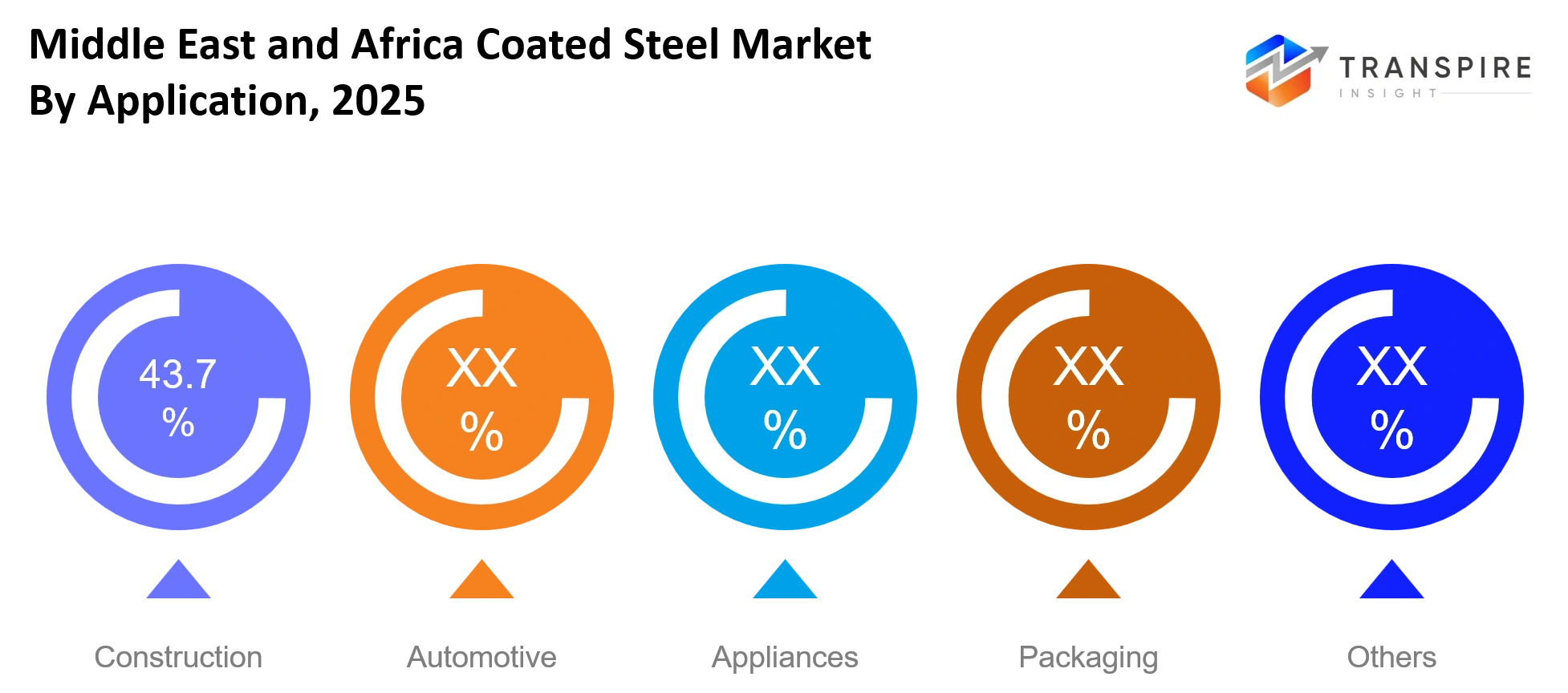
Construction still comes out as the biggest application segment, mostly because coated steel or related materials get used a lot in roofing systems, wall cladding, structural components, warehouses, and even commercial developments. The long service life thing, plus a solid resistance to environmental exposure, really makes it an easy pick for residential jobs and non-residential ones too. And since people keep putting major money into infrastructure, overall demand keeps getting a boost across the whole sector.
In the automotive world, manufacturers use coated steel to enhance corrosion resistance, and that, in turn, helps keep vehicles durable for longer. Appliance producers, on the other hand, lean on coated materials for refrigerators, washing machines, and air- conditioning equipment, where protection matters. For packaging, protective coatings support product lifespan, and then in other industrial activities, coated steel shows up in machinery, storage systems, and specialized manufacturing undertakings, kinda like a everywhere solution.
To learn more about this report, Download Free Sample Report
By End User
Construction firms make up a pretty big slice of consumption, since big building efforts need materials that are durable and, kind of, weather resistant. On top of that, commercial developments and industrial facilities really push procurement volumes, and public infrastructure jobs add even more. Still, the long asset life part stays one of the main reasons buyers are interested.
Automotive OEMs also use coated steel so vehicles can meet higher quality, better performance in real use. A lot of manufacturers, like in appliance, machinery, and industrial equipment areas, depend on coated products to boost both durability and appearance. Beyond that, other end users pop up too: packaging producers, people building logistics infrastructure, and specialized industrial operators who are specifically hunting for corrosion-resistant materials.
By Product Form
Sheets still stay pretty widely used in roofing, cladding, appliance making , and industrial fabrication mainly because they are easier to handle, and to process in general. Having steady dimensions and that reliable surface finish really helps with large scale output needs. So yeah, it’s not surprising that construction and manufacturing sectors bring in a lot of the sheet demand.
Coils are often chosen for high volume processing jobs, they can give manufacturers some clear efficiency perks. Plates, on the other hand, tend to fit the heavy duty industrial work where more thickness matters, plus extra structural strength. Then there are also other product forms that show up when people need something customized, across stuff like infrastructure, transportation, equipment manufacturing, and industrial processing.
What are the Key Use Cases Driving the Middle East and Africa Coated Steel Market?
Construction is still the biggest use case, especially for commercial buildings, industrial facilities, warehouses , airports, transportation infrastructure, and those large residential developments where everything has to last. Protective coatings help extend service life when the climate is really harsh, so coated steel ends up being the preferred choice for roofing, cladding, and also structural uses.
Then there is automotive manufacturing plus appliance production, which sit as the important secondary segment. Vehicle makers rely on coated steel for better corrosion resistance and stronger body durability , while appliance producers lean on coated materials for refrigerators, washing machines, and air conditioning systems, mainly because looks matter and the product has to keep going longer.
More and more, you can also see emerging applications in renewable energy infrastructure, modular construction systems, and advanced logistics facilities. Solar mounting structures, prefabricated buildings, and smart industrial parks increasingly bring in coated steel products, mostly due to their resilience, reduced upkeep, and steady long-term operating efficiency.
|
Report Metrics |
Details |
|
Market size value in 2025 |
USD 10557.1 Million |
|
Market size value in 2026 |
USD 12046.1 Million |
|
Revenue forecast in 2033 |
USD 30741.8 Million |
|
Growth rate |
CAGR of 14.32% from 2026 to 2033 |
|
Base year |
2025 |
|
Historical data |
2021 - 2024 |
|
Forecast period |
2026 - 2033 |
|
Report coverage |
Revenue forecast, competitive landscape, growth factors, and trends |
|
Regional scope |
Middle East and Africa (Saudi Arabia, United Arab Emirates, South Africa, Rest of Middle East and Africa) |
|
Key company profiled |
ArcelorMittal, Nippon Steel, Tata Steel, POSCO, JSW Steel, Baowu Steel, JFE Steel, SSAB, Voestalpine, Nucor, United States Steel, Thyssenkrupp, Hyundai Steel, AK Steel, Severstal |
|
Customization scope |
Free report customization (country, regional & segment scope). Avail customized purchase options to meet your exact research needs. |
|
Report Segmentation |
By Coating Type (Galvanized Steel, Galvalume Steel, Color Coated Steel, Tinplate, Others); By Application (Construction, Automotive, Appliances, Packaging, Others); By End User (Construction Companies, Automotive OEMs, Manufacturers, Others); By Product Form (Sheets, Coils, Plates, Others) |
Which Regions are Driving the Middle East and Africa Coated Steel Market Growth?
The Gulf region kind of leads the market growth because of all that big infrastructure development program work, industrial diversification strategy stuff, plus these huge urban projects. Saudi Arabia and the United Arab Emirates keep on putting money into transportation, logistics, tourism, and industrial facilities, and you can see it clearly. With solid financial backing, together with industrial policies that actually support the sector ,it ends up shaping pretty favorable conditions for coated steel consumption. Then there are integrated supply chains, and domestic manufacturing capacity keeps expanding, so the regional leadership basically gets stronger and stronger.
North Africa stays in the second place, and the growth path looks a bit different. Egypt and Morocco in particular benefit from a push across manufacturing segments, automotive production facilities,and export-driven industrial development. There is also industrial investment that stays relatively stable, plus the geographic nearness to European markets, which helps keep demand steady over time. In other words, it’s more about manufacturing growth, not so much infrastructure spending, as the main growth engine
Sub-Saharan Africa shows the most momentum across the forecast period. Fast urbanization, industrialization drives,and spending on transportation infrastructure are pulling steel consumption upward in multiple sectors. Governments keep treating housing, logistics,and energy development initiatives as priorities. This whole mix opens up appealing windows for suppliers, processors, and investors who want exposure to the newer industrial markets that are emerging now.
Who are the Key Players in the Middle East and Africa Coated Steel Market and How Do They Compete?
Competition is still kinda moderately consolidated, but the big international steel players keep pushing hard—mostly via technology, better coating finish quality, production scale, and the ability to supply by region. Most market watchers are basically circling around advanced corrosion resistant types, more efficient manufacturing routines, and distribution networks that actually work. In the end product performance plus cost competitiveness stay as the big differentiators, even if everything else gets crowded.
ArcelorMittal seems to put weight on advanced coated steel solutions, with wide production capacity and a broad international distribution reach. Nippon Steel goes a bit different, they highlight high performance coated products aimed at automotive and industrial use cases where precision matters, plus durability too, no questions. POSCO meanwhile leans into advanced coating technologies and premium steel grades meant to lift corrosion resistance and extend lifecycle performance.
Tata Steel expands its footprint by leaning into value added steel products and solid regional partnerships. JSW Steel, on the other hand, improves competitiveness through capacity expansions, product innovation, and more integrated manufacturing operations. Overall, these players keep investing in advanced coating technologies, supply chain optimization, and deeper regional market expansion, trying to lock in long term competitive strength.
Company List
- ArcelorMittal
- Nippon Steel
- Tata Steel
- POSCO
- JSW Steel
- Baowu Steel
- JFE Steel
- SSAB
- Voestalpine
- Nucor
- United States Steel
- Thyssenkrupp
- Hyundai Steel
- AK Steel
- Severstal
Recent Development News
In April 2026, POSCO and JSW Steel signed a joint venture agreement to build an integrated steel plant in Odisha, India. The project will have an annual crude steel capacity of 6 million tons and strengthens POSCO's localization strategy in high-growth markets while expanding future coated steel production capabilities. Source:http://newsroom.posco.com
In August 2025, Tata Steel dispatched the first batch of galvanized coils from its new Continuous Galvanising Line at Kalinganagar, Odisha. The facility enables production of advanced coated steel products for automotive and appliance applications, strengthening the company's value-added steel portfolio. Source:http://www.tatasteel.com
In October 2025, BHP and POSCO signed an agreement to develop hydrogen-based low-emissions iron technology. The partnership includes construction of a demonstration plant in South Korea and supports future production of lower-carbon steel products for industrial markets. Source:http://www.reuters.com
What Strategic Insights Define the Future of the Middle East and Africa Coated Steel Market?
The market seems to be sliding toward higher value coated products, backed by infrastructure modernization, industrial diversification programs, and this stronger focus on how lifecycle assets really perform. Premium corrosion resistant materials, plus localized processing capabilities, and digital manufacturing technologies will, you know, start to determine competitive positioning during the next five to seven years. Growth will not just ride on construction activity, but also on more expansion across automotive, appliance, logistics, and industrial manufacturing.
There is also one risk that is a bit less obvious, which is the ongoing exposure to raw material concentration and messy global supply chain disruptions. When there is heavy reliance on imported steel inputs and coating materials, you can still end up with pricing instability even when demand looks pretty strong.
A good opportunity might be the regional investments into value-added manufacturing, especially in the Gulf countries and along emerging African industrial corridors. Advanced coating facilities that can produce specialized products will tend to grab higher margins and, at the same time, reduce import dependence. Market participants should really push local partnerships, downstream processing investments, and technology upgrades in order to strengthen resilience and keep a long term grip on market share.
Middle East and Africa Coated Steel Market Report Segmentation
By Coating Type
- Galvanized Steel
- Galvalume Steel
- Color Coated Steel
- Tinplate
- Others
By Application
- Construction
- Automotive
- Appliances
- Packaging
- Others
By End User
- Construction Companies
- Automotive OEMs
- Manufacturers
- Others
By Product Form
- Sheets
- Coils
- Plates
- Others
Frequently Asked Questions
Find quick answers to common questions.
The expected Middle East and Africa Coated Steel Market size for the market will be USD 30741.8 Million in 2033.
Key segments for the Middle East and Africa Coated Steel Market are By Coating Type (Galvanized Steel, Galvalume Steel, Color Coated Steel, Tinplate, Others); By Application (Construction, Automotive, Appliances, Packaging, Others); By End User (Construction Companies, Automotive OEMs, Manufacturers, Others); By Product Form (Sheets, Coils, Plates, Others)
Major Middle East and Africa Coated Steel Market players are ArcelorMittal, Nippon Steel, Tata Steel, POSCO, JSW Steel, Baowu Steel, JFE Steel, SSAB, Voestalpine, Nucor, United States Steel, Thyssenkrupp, Hyundai Steel, AK Steel, Severstal
The Middle East and Africa Coated Steel Market size is USD 10557.1 Million in 2025.
The Middle East and Africa Coated Steel Market CAGR is 14.32% from 2026 to 2033
- ArcelorMittal
- Nippon Steel
- Tata Steel
- POSCO
- JSW Steel
- Baowu Steel
- JFE Steel
- SSAB
- Voestalpine
- Nucor
- United States Steel
- Thyssenkrupp
- Hyundai Steel
- AK Steel
- Seversta
About the Authors

Pankaj Ghogare Patil
I am Pankaj Ghogare Patil, a Senior Research Analyst at Transpire Insight, specializing in the Pharmaceutical, Chemicals & Materials, Healthcare IT, and Biotechnology industry. My expertise lies in conducting comprehensive market research, analyzing industry trends, evaluating competitive landscapes, and translating complex data into actionable insights. At Transpire Insight, I closely follow emerging technologies, regulatory developments, and market innovations to create accurate, well-researched, and informative content that helps businesses and professionals make informed decisions. I am committed to producing credible, evidence-based articles that reflect industry best practices while making technical topics accessible and valuable for a broad audience.

Chakradhar Khansole
Chakradhar serves as the Research Director at Transpire Insight, bringing over 8 years of experience in technology, innovation, and strategic market intelligence. He specializes in transforming complex market data into actionable business insights that enable organizations to make informed, growth-oriented decisions. Recognized for his strategic vision and analytical expertise, Chakradhar leads high-impact research initiatives, delivering comprehensive market assessments, competitive intelligence, and forward-looking industry analysis.
Recently Published Reports
-
May 2026
Healthcare Polymer Packaging Market
Healthcare Polymer Packaging Market Size, Share & Analysis Report By Packaging Type (Syringes, IV Bottles and Pouches, Clamshells, Blisters, Bottles & Jars, Containers, Tubes, IV Parental Packaging, Others), By Type (Regulated, Non-regulated), By Polymer Type (LDPE (Low-Density Polyethylene), HDPE (High-Density Polyethylene), Homo-polymer (Homo), Random Copolymer (Random), Block Copolymer (Block), PET, Polystyrene, Polyvinyl Chloride, Polyamide/EVOH, Others), and Geography (North America, Europe, Asia-Pacific, Middle East and Africa, South and Central America), 2021 - 2031
-
Apr 2026
Hydrophilic Tape (Waterstop) Market
Hydrophilic Tape (Waterstop) Market Size, Share & Analysis Report By Type (Bentonite-Based Hydrophilic Tape, Rubber-Based Hydrophilic Tape), By Application (Residential Buildings, Commercial Buildings, Infrastructure Projects), and Geography (North America, Europe, Asia-Pacific, Middle East and Africa, South and Central America), 2021 - 2031
-
Apr 2026
Metalens Market
Metalens Market Size, Share & Analysis Report By Type (Visible Light Metalens, and Infrared Metalens), By Application (Consumer Electronics, Automotive Electronics, Industrial, Medical, and Others), and Geography (North America, Europe, Asia-Pacific, Middle East and Africa, South and Central America), 2021 - 2031
-
Apr 2026
PBT Resin Market
PBT Resin Market Size, Share & Analysis Report By Type (Reinforced PBT Resin, Unreinforced PBT Resin), By Processing Method (Injection Molding, Extrusion, Blow Molding, Others), By End-User (Automotive, Electrical & Electronics, Consumer Appliances, Industrial Machinery, Medical Devices, Packaging, Others), and Geography (North America, Europe, Asia-Pacific, Middle East and Africa, South and Central America), 2021 - 2031